


 CBS-2 Domestic Funds Transfer and Payment Services
Introduction

Mapping Interconnections and Interdependencies (MII) is a fundamental activity in implementing Operational Resilience.
It identifies how business processes, supporting resources, technology, information, people, facilities, third parties, and external infrastructure work together to deliver a Critical Business Service (CBS).
For MBSB, mapping is particularly important because Domestic Funds Transfer and Payment Services depend on a complex sequence of activities involving customer instructions, authentication, account validation, payment processing, internal or interbank transfers, settlement coordination, customer confirmation, and reconciliation.
A disruption affecting one process or shared resource may prevent several other processes from operating effectively.
For example, an authentication failure may prevent customers from initiating payments even when the core banking and payment processing platforms remain operational.
Similarly, an external payment network outage may prevent interbank transfers from completing despite successful internal processing.
This chapter develops a structured mapping of all 24 Sub-Critical Business Services (Sub-CBS) supporting CBS-2, documenting their operational connections and dependencies on critical resources.
The mapping is intended to support MBSB in:
- Establishing end-to-end visibility of domestic payment delivery.
- Identifying critical hand-offs between processes and organisational functions.
- Recognising common dependencies, concentration risks, and potential single points of failure.
- Assessing how disruptions propagate across processes and other Critical Business Services.
- Supporting the establishment and validation of service-level Impact Tolerances.
- Developing severe but plausible disruption scenarios.
- Identifying vulnerabilities and prioritising resilience improvements.
- Producing traceable evidence for management oversight and regulatory review.
The analysis is aligned conceptually with the December 2025 BNM Discussion Paper on Operational Resilience and BCM Institute's Mapping Interconnections and Interdependencies methodology.
Regulatory interpretation: BNM's December 2025 document is a Discussion Paper, not automatically a final binding policy document.
The proposed mapping is intended to support the regulatory direction expressed in that paper alongside applicable existing BNM requirements.
Do not present it as evidence of regulatory compliance until MBSB has validated the information and assessed it against the requirements in force.
Mapping Scope and Methodology
Scope of CBS-2
CBS-2 covers the end-to-end delivery of eligible domestic funds transfers and payment services through MBSB's supported banking channels.
The mapping encompasses seven process stages.
|
Stage |
Process Coverage |
Sub-CBS |
|
1. Payment Initiation |
Receipt, registration, and completeness validation of payment instructions |
CBS-2.1–2.3 |
|
2. Authentication and Validation |
Customer authorisation, account eligibility, fraud controls, and beneficiary validation |
CBS-2.4–2.7 |
|
3. Funds and Payment Processing |
Funds verification, payment classification, account posting, and routing |
CBS-2.8–2.11 |
|
4. Payment Execution and Settlement |
Internal transfers, interbank execution, clearing, settlement, and beneficiary credit |
CBS-2.12–2.15 |
|
5. Confirmation and Reconciliation |
Customer confirmation, financial reconciliation, and payment records |
CBS-2.16–2.18 |
|
6. Monitoring and Exception Handling |
Operational monitoring, payment exceptions, and disputes |
CBS-2.19–2.21 |
|
7. Continuity and Recovery |
Disruption assessment, alternative processing, and controlled restoration |
CBS-2.22–2.24 |
The process flow is not entirely linear.
Payment monitoring runs throughout the transaction lifecycle; exceptions may occur at multiple stages, and recovery activities may activate whenever material disruption occurs.
Internal transfers and interbank transfers also follow different execution paths.
MBSB should retain these distinctions when validating the detailed mapping.
Distinguishing Interconnections from Interdependencies
An interconnection is an operational linkage through which a process, service, or component exchanges instructions, information, transactions, approvals, or outputs with another component.
An interdependency exists when a process or service relies on another process, resource, or organisation to operate, perform, continue, or recover.
For example, CBS-2.11 Payment Instruction Routing and Transmission is interconnected with CBS-2.13 Domestic Interbank Payment Execution because it passes payment instructions to the execution process.
CBS-2.13 depends on external payment infrastructure because interbank execution cannot complete through the normal route if the required infrastructure is unavailable.
The first relationship describes the operational hand-off. The second describes a reliance that may create a service vulnerability.
Other Critical Business Services
The mapping uses the previously established MBSB candidate CBS catalogue. The following service names remain consistent across both tables.
|
CBS Code |
Critical Business Service |
|
CBS-1 |
Customer Deposit and Account Access Services |
|
CBS-2 |
Domestic Funds Transfer and Payment Services |
|
CBS-3 |
Digital Banking Services |
|
CBS-4 |
Cash Access and Cash Transaction Services |
|
CBS-5 |
Financing Account Servicing and Repayment Services |
|
CBS-6 |
Corporate Payment and Bulk Transaction Services |
|
CBS-7 |
High-Value and Interbank Payment Services |
|
CBS-8 |
Customer Transaction Authentication and Authorisation Services |
|
CBS-9 |
Customer Support and Assistance During Banking Disruptions |
These are proposed service classifications, not a verified MBSB-approved CBS inventory.
Pay particular attention to CBS-3 and CBS-8, which may represent enabling channels or capabilities rather than separate customer-outcome services.
Assumptions and Mapping Conventions
The tables use functional names for technology, teams, and third parties where MBSB-specific information is not available.
References to payment schemes, including DuitNow and applicable interbank arrangements, are illustrative and subject to confirmation of actual service participation and processing routes.
Upstream refers to the component providing an input or prerequisite.
Downstream refers to the component receiving the resulting transaction, information, decision, or service outcome.
An upstream dependency can also be activated during exception handling or restoration; therefore, the mapping should be read as a network rather than a strictly sequential workflow.
The tables provide a proposed baseline for process-level mapping.
A regulator-ready submission would additionally require verified owners, system and provider identifiers, interface references, recovery requirements, contractual evidence, validation dates, and approval records.

Map Interconnections
This table documents the principal operational connections for each Sub-CBS.
It distinguishes the connected component, the nature of the connection, and the upstream and downstream flows through which the service is delivered.
Table P2: Map Interconnections for CBS-2
|
Name of Sub-CBS |
Connected Component |
Connection Type |
Interconnection Description |
Upstream Interconnections |
Downstream Interconnections |
|
CBS-2.1 Customer Payment Instruction Initiation |
Customer channels, CBS-3 Digital Banking Services, CBS-6 Corporate Payment and Bulk Transaction Services; customer service and branch operations |
Customer-to-bank; channel-to-process |
Customers submit domestic transfer or payment instructions through authorised channels. The channel provides the entry point and transfers the instruction into the payment workflow. |
Customer payment request; digital or branch channel availability; account selection and beneficiary details |
CBS-2.2 registration; CBS-2.4 authentication; CBS-2.19 monitoring of channel or initiation failures |
|
CBS-2.2 Payment Instruction Capture and Registration |
Payment intake workflow; transaction registration service; customer channel; payment operations |
Process-to-process; data exchange |
Converts received instructions into traceable payment records, with transaction references and processing status. |
CBS-2.1; payment instruction payload; channel-generated references |
CBS-2.3 completeness validation; CBS-2.18 transaction records; CBS-2.19 operational monitoring |
|
CBS-2.3 Payment Instruction Completeness Validation |
Payment validation function; beneficiary information; customer channels |
Validation; exception feedback |
Checks whether instructions contain the required fields for the selected payment route and directs incomplete instructions for correction or rejection. |
CBS-2.2; payment scheme data requirements; beneficiary and transaction information |
CBS-2.4 authentication and authorisation; CBS-2.7 destination validation; CBS-2.20 exception management |
|
CBS-2.4 Customer Authentication and Payment Authorisation |
CBS-8 Customer Transaction Authentication and Authorisation Services; identity management; corporate approval workflow |
Cross-CBS; authorisation hand-off |
Confirms customer identity, transaction authority, and applicable approval requirements before execution is permitted. |
CBS-2.3; identity credentials; customer mandate and approval information |
CBS-2.5 account eligibility; CBS-2.6 screening; CBS-2.20 rejected or unauthorised instructions |
|
CBS-2.5 Account Eligibility and Payment Limit Validation |
CBS-1 Customer Deposit and Account Access Services; core banking; account control function |
Cross-CBS; account validation |
Checks account status, transaction eligibility, payment limits, and applicable restrictions before further processing. |
CBS-2.4; account master data; transaction amount and limits |
CBS-2.6 fraud screening; CBS-2.8 funds verification; CBS-2.20 rejected payments |
|
CBS-2.6 Payment Fraud and Compliance Screening |
Fraud operations; financial crime compliance; transaction monitoring and screening services |
Risk-control; decision hand-off |
Assesses payment instructions against relevant fraud and financial crime controls and determines whether to release, hold, reject, or escalate the payment. |
CBS-2.4–2.5; customer risk information; payment details; screening rules |
CBS-2.7 beneficiary validation; CBS-2.9 processing; CBS-2.20 exceptions; CBS-2.21 investigation |
|
CBS-2.7 Beneficiary and Payment Destination Validation |
Beneficiary records; applicable beneficiary verification services; external payment infrastructure |
Internal/external data validation |
Validates destination information and applicable beneficiary identifiers before the instruction proceeds to execution. |
CBS-2.3; CBS-2.6; beneficiary details; supported scheme verification responses |
CBS-2.8 funds verification; CBS-2.9 payment classification; CBS-2.20 invalid destination handling |
|
CBS-2.8 Funds Availability and Account Balance Verification |
CBS-1 Customer Deposit and Account Access Services; core banking; account balance service |
Cross-CBS; financial validation |
Confirms the funds available for the transaction, accounting for relevant holds, restrictions, and approved facilities. |
CBS-2.5; CBS-2.7; account balances and available-funds information |
CBS-2.9 payment processing; CBS-2.10 account debit; CBS-2.20 insufficient-funds exceptions |
|
CBS-2.9 Payment Transaction Classification and Processing |
Payment processing function; payment rules; internal transfer and interbank processing routes |
Processing; routing decision |
Determines the appropriate processing path for accepted payments according to payment type, destination, and scheme requirements. |
CBS-2.6–2.8; authorised instruction; payment scheme rules |
CBS-2.10 account posting; CBS-2.11 routing; CBS-2.12 internal transfer execution; CBS-2.13 interbank execution |
|
CBS-2.10 Customer Account Debit and Transaction Posting |
CBS-1 Customer Deposit and Account Access Services; core banking ledger; finance control |
Ledger posting; financial record exchange |
Posts authorised account debits and generates the financial records required to execute payments and reconcile accounts. Posting sequence must follow the applicable payment scheme and transaction design. |
CBS-2.8–2.9; approved payment; available funds; ledger controls |
CBS-2.11 routing where applicable; CBS-2.12 or CBS-2.13 execution; CBS-2.17 reconciliation; CBS-2.18 records |
|
CBS-2.11 Payment Instruction Routing and Transmission |
Payment gateway; integration interfaces; external payment network; CBS-7 High-Value and Interbank Payment Services, where infrastructure is shared |
Internal/external transaction hand-off |
Formats and transmits eligible payment instructions to the appropriate internal or external execution route, receiving acknowledgements and status responses. |
CBS-2.9–2.10; routing rules; network connectivity; payment message requirements |
CBS-2.12 internal execution; CBS-2.13 interbank execution; CBS-2.19 monitoring; CBS-2.20 transmission exceptions |
|
CBS-2.12 Internal Funds Transfer Execution |
Core banking transfer processing; beneficiary account ledger; CBS-1 Customer Deposit and Account Access Services |
Internal financial transfer |
Completes eligible transfers between accounts held within MBSB, including corresponding account postings and transaction-state confirmation. |
CBS-2.9–2.11 as applicable; originating account debit; beneficiary account information |
CBS-2.15 payment completion; CBS-2.16 confirmation; CBS-2.17 reconciliation |
|
CBS-2.13 Domestic Interbank Payment Execution |
External domestic payment infrastructure; receiving financial institutions; payment gateway |
External transaction execution |
Submits and processes eligible interbank transfers through the applicable payment arrangement and receives processing acknowledgements or rejection information. |
CBS-2.11; approved payment messages; payment network availability |
CBS-2.14 settlement coordination; CBS-2.15 completion; CBS-2.20 rejection or return management |
|
CBS-2.14 Interbank Clearing and Settlement Coordination |
Payment system operator; settlement infrastructure; treasury and payment operations; CBS-7 High-Value and Interbank Payment Services |
External settlement; operational coordination |
Coordinates clearing and settlement obligations relevant to the payment route, including settlement status and applicable liquidity or funding arrangements. |
CBS-2.13; payment network reports; settlement information; treasury funding information, where applicable |
CBS-2.15 completion status; CBS-2.17 settlement reconciliation; CBS-2.19 monitoring; CBS-2.20 settlement exceptions |
|
CBS-2.15 Beneficiary Credit and Payment Completion Management |
Receiving bank; beneficiary account processing; core banking; CBS-1 Customer Deposit and Account Access Services |
Payment completion; interbank status exchange |
Determines the verified completion state of outgoing transfers and manages relevant incoming payment credit processes where MBSB is the receiving institution. |
CBS-2.12 internal execution; CBS-2.13–2.14 interbank outcomes; receiving-bank confirmations where available |
CBS-2.16 customer confirmation; CBS-2.17 reconciliation; CBS-2.20 incomplete or failed payment handling |
|
CBS-2.16 Payment Status Confirmation and Customer Notification |
CBS-3 Digital Banking Services; customer communication channels; CBS-9 Customer Support and Assistance During Banking Disruptions |
Customer information; cross-CBS |
Communicates accurate transaction acknowledgements, pending statuses, completion outcomes, and failure notices using verified processing information. |
CBS-2.12–2.15; transaction status records; CBS-2.20 exception outcomes |
Customer; CBS-2.18 records; CBS-2.21 enquiries; CBS-9 support channels |
|
CBS-2.17 Payment Reconciliation and Financial Control |
Core banking ledger; payment network statements; settlement records; finance and payment control functions |
Financial reconciliation; discrepancy escalation |
Compares payment records, postings, and applicable settlement outcomes to identify unmatched, missing, duplicated, or incorrectly recorded transactions. |
CBS-2.10; CBS-2.12–2.15; settlement reports; transaction records |
CBS-2.18 audit records; CBS-2.20 exception resolution; CBS-2.22 escalation for material discrepancies |
|
CBS-2.18 Payment Records and Transaction Audit Management |
Transaction repository; document and records management; audit, compliance, and customer support |
Information retention; evidence exchange |
Preserves payment instructions, approvals, processing history, status records, and audit evidence for traceability and investigation. |
CBS-2.2; CBS-2.4; CBS-2.10; CBS-2.16–2.17; CBS-2.20–2.21 |
CBS-2.21 investigation; audit and compliance review; CBS-2.24 restoration validation |
|
CBS-2.19 Payment Service Monitoring and Operational Control |
Payment operations monitoring; technology operations; network monitoring; incident management |
Continuous monitoring; event escalation |
Observes payment availability, processing throughput, queue backlogs, failures, latency, and transaction exceptions across the payment lifecycle. |
Status and telemetry from CBS-2.1–2.18; infrastructure and payment network alerts |
CBS-2.20 exception handling; CBS-2.22 disruption assessment; service performance reporting |
|
CBS-2.20 Payment Exception, Rejection, and Return Management |
Payment operations; fraud operations; receiving institutions; customer service |
Exception resolution; corrective processing |
Resolves failed, rejected, returned, or incomplete payments through investigation, approved correction, account adjustment, and communication. |
CBS-2.3–2.17; CBS-2.19 alerts; external rejection and return messages |
CBS-2.16 customer notification; CBS-2.17 reconciliation; CBS-2.21 disputes; CBS-2.22 material escalation |
|
CBS-2.21 Payment Dispute and Transaction Investigation |
CBS-9 Customer Support and Assistance During Banking Disruptions; fraud investigation; payment operations; receiving institutions |
Customer dispute; investigative coordination |
Investigates disputed transfers, duplicate payments, missing credits, and uncertain payment outcomes, coordinating internal and external evidence and resolution. |
CBS-2.16–2.20; customer complaints; payment audit records; counterparty information |
CBS-2.20 corrective processing; CBS-2.16 customer updates; compliance or regulatory escalation, where applicable |
|
CBS-2.22 Payment Disruption Assessment and Service Escalation |
Incident management; Operational Resilience team; BCM; technology and cyber teams; CBS Owners |
Incident escalation; cross-functional decision-making |
Assesses the scale, cause, and service consequences of disruption and determines the appropriate response, including activation of continuity or crisis arrangements. |
CBS-2.19 monitoring; CBS-2.20–2.21 incidents; technology and provider alerts |
CBS-2.23 continuity activation; CBS-2.24 recovery coordination; CBS-9 customer support; management and applicable regulatory notification processes |
|
CBS-2.23 Payment Continuity and Alternative Processing |
BCM; payment operations; technology recovery; alternative channels; CBS-3 Digital Banking Services; CBS-6 Corporate Payment and Bulk Transaction Services, where shared arrangements apply |
Continuity activation; alternative service delivery |
Implements approved arrangements for maintaining essential domestic payment capability, including prioritisation, alternative processing, and controlled service degradation. |
CBS-2.22 escalation; approved continuity plans; resource availability; provider contingency arrangements |
Essential payment processing via CBS-2.9–2.15 as available; CBS-2.16 customer updates; CBS-2.24 restoration |
|
CBS-2.24 Payment Service Recovery and Controlled Restoration |
IT disaster recovery; payment operations; core banking; finance control; external payment infrastructure |
Recovery; reconciliation; return-to-normal hand-off |
Coordinates restoration of normal processing, verifies transaction states, manages backlogs, prevents duplicate execution, and confirms stable service delivery. |
CBS-2.22–2.23; recovered systems; transaction journals; external network status; CBS-2.17 reconciliation |
Restored CBS-2.1–2.21 operations; CBS-2.16 customer confirmation; post-incident review and remediation |
Significant End-to-end Interconnection Pathways
The table demonstrates several critical pathways that MBSB should preserve in its operational mapping.
Customer payment pathway
Customer instruction → authentication and validation → funds verification → payment processing → internal or interbank execution → payment completion → customer confirmation.
Interbank payment pathway
Payment routing → external payment network → receiving financial institution → applicable clearing and settlement processes → confirmed payment outcome.
Financial integrity pathway
Payment instruction → account posting → payment execution → settlement information → reconciliation → transaction records.
Disruption management pathway
Monitoring and exception detection → impact assessment and escalation → continuity arrangements → controlled restoration → reconciliation and service validation.
These pathways are interconnected.
Do not treat them as independent service chains, because a failure in one may prevent completion of another.
 Map Interdependencies
Table 2 identifies the resources and service relationships each Sub-CBS relies on, along with the consequences of disruption.
The mapping distinguishes the resources needed to operate each process from the process itself.
For example, a Payment Processing Platform is a technology dependency; CBS-2.9 Payment Transaction Classification and Processing is the business process that uses that platform.
Reading the table: People and technology entries identify the principal operational capabilities required, not confirmed MBSB staffing assignments or system names. Facilities and providers are indicative unless verified. The Interconnected CBS column records relevant cross-service dependencies or shared capabilities, not necessarily a one-way dependency in every case.
Table P2: Map Interdependencies for CBS-2
|
Name of Sub-CBS |
People |
Systems and Technology |
Data and Information Flows |
Facilities |
Third Parties / External Entities |
Interconnected CBS |
Nature of Dependency |
Disruption Impact |
|
CBS-2.1 Customer Payment Instruction Initiation |
Branch personnel, digital banking operations, payment service support |
Mobile/internet banking; branch transaction interface; payment intake gateway |
Customer identity; originating account; amount; beneficiary; payment instruction |
Branches, digital operations workspace, and hosting facilities |
Telecommunications and internet connectivity providers |
CBS-3 Digital Banking Services; CBS-6 Corporate Payment and Bulk Transaction Services |
Depends on accessible customer channels and functioning instruction interfaces to initiate payments. Shared channel infrastructure may create common failure points. |
Customers cannot initiate new payments; essential transactions are delayed and demand may shift to alternative channels. |
|
CBS-2.2 Payment Instruction Capture and Registration |
Payment operations; application support; transaction control personnel |
Payment intake platform; transaction registration service; transaction database |
Payment payload; transaction reference; submission timestamp; channel identifier |
Processing operations workspace; hosting facilities |
Technology hosting or managed application provider, where applicable |
CBS-3 Digital Banking Services; CBS-6 Corporate Payment and Bulk Transaction Services |
Relies on reliable transfer of customer instructions into a persistent processing record. The registration service may be shared across channels. |
Instructions may be lost, duplicated or left untraceable; downstream processing and reconciliation become unreliable. |
|
CBS-2.3 Payment Instruction Completeness Validation |
Payment processing personnel; channel operations; exception support |
Payment validation engine; payment processing platform; reference-data service |
Mandatory fields; beneficiary identifiers; account details; payment scheme rules |
Operations workspace; application hosting facilities |
Payment scheme operator for applicable specifications; technology support providers |
CBS-3 Digital Banking Services; CBS-6 Corporate Payment and Bulk Transaction Services |
Requires accurate validation rules and complete instruction data before payment release. Incorrect common rules may affect several payment channels. |
Valid payments may be rejected or incomplete instructions accepted, creating failures, rework and customer delays. |
|
CBS-2.4 Customer Authentication and Payment Authorisation |
Identity and access management team, fraud operations, and corporate banking support |
Authentication platform; identity and access management; transaction authorisation service; corporate approval workflow |
Credentials; authentication outcomes; mandates; approval records; transaction details |
Security operations workspace; hosting facilities |
Telecommunications providers; external authentication or messaging providers, where applicable |
CBS-8 Customer Transaction Authentication and Authorisation Services; CBS-3 Digital Banking Services; CBS-6 Corporate Payment and Bulk Transaction Services |
Depends on functioning identity, authorisation and approval capabilities. A shared authentication platform may be a concentration point across several CBSs. |
Customers cannot authorise transactions; approved payments are delayed, or security controls may require transactions to be suspended. |
|
CBS-2.5 Account Eligibility and Payment Limit Validation |
Account operations; payment operations; risk and compliance support |
Core banking; account control module; transaction limit management |
Account status; restrictions; customer entitlements; payment limits; account mandates |
Banking operations workspace; core banking hosting facilities |
Core banking technology support provider, where applicable |
CBS-1 Customer Deposit and Account Access Services; CBS-6 Corporate Payment and Bulk Transaction Services |
Relies on current account eligibility and limit information from core banking. Shared account-control services may affect multiple CBSs. |
Eligible transactions may be blocked, or prohibited transactions may not be reliably prevented; payment processing may need to stop. |
|
CBS-2.6 Payment Fraud and Compliance Screening |
Fraud analysts, financial crime compliance, and payment risk personnel |
Fraud monitoring; transaction screening; case management; risk rules engine |
Transaction details, customer risk profiles, screening indicators, alert decisions, watchlist data |
Fraud and compliance operations workspace; security hosting facilities |
External screening data providers or managed screening services, where applicable; relevant authorities for legally required reporting |
CBS-8 Customer Transaction Authentication and Authorisation Services; CBS-6 Corporate Payment and Bulk Transaction Services |
Requires available and reliable screening controls before releasing payments. Shared screening services may create concentration risk; any contingency must preserve mandatory controls. |
Payments may be held or rejected, or unsafe transactions could proceed if controls fail. Service availability and compliance obligations may conflict. |
|
CBS-2.7 Beneficiary and Payment Destination Validation |
Payment operations, customer support, and exception analysts |
Beneficiary validation service; payment gateway; account or proxy lookup interface |
Beneficiary account details; proxy identifiers; destination validation responses |
Payment operations workspace; hosting facilities |
Relevant payment scheme or verification service provider; receiving financial institutions |
CBS-1 Customer Deposit and Account Access Services; CBS-3 Digital Banking Services |
Relies on correct beneficiary data and, where applicable, external verification responses. A common lookup interface may affect multiple payment channels. |
Payments may be rejected, misdirected or delayed; customers may face uncertainty or financial loss. |
|
CBS-2.8 Funds Availability and Account Balance Verification |
Payment operations; account servicing; core banking support |
Core banking ledger; available-balance service; account hold management |
Available balances; account holds; financing or approved facility limits where relevant; payment amount |
Core banking hosting facilities; operations workspace |
Core banking support or infrastructure providers, where applicable |
CBS-1 Customer Deposit and Account Access Services; CBS-5 Financing Account Servicing and Repayment Services where shared account data applies |
Depends on timely, accurate balance and account-control information. A core banking outage may simultaneously impair payment and account-access services. |
Payments cannot be safely authorised; insufficient-funds checks may fail, and transaction processing may be suspended. |
|
CBS-2.9 Payment Transaction Classification and Processing |
Payment processing team, payment product specialists, application support |
Payment processing platform; transaction rules engine; scheme routing configuration |
Payment type; priority; destination; applicable scheme; validated instruction |
Payment operations workspace; payment application hosting facilities |
Payment scheme operators for rules and specifications; application support providers |
CBS-6 Corporate Payment and Bulk Transaction Services; CBS-7 High-Value and Interbank Payment Services where shared processing applies |
Relies on accurate processing rules and correct selection of internal or external payment routes. Shared processing engines may concentrate failures. |
Payments may be misrouted, queued, rejected or processed incorrectly, potentially affecting several payment services. |
|
CBS-2.10 Customer Account Debit and Transaction Posting |
Core banking operations; payment operations; finance control; database support |
Core banking ledger; posting engine; transaction journal; database services |
Authorised debit; account balance changes; posting reference; transaction status |
Core banking hosting facilities; banking operations workspace |
Core banking infrastructure or technology support providers |
CBS-1 Customer Deposit and Account Access Services; CBS-5 Financing Account Servicing and Repayment Services where shared ledger capability applies |
Depends on consistent and durable financial posting, with appropriate controls to prevent duplicate or incomplete transactions. Core ledger availability is a major shared dependency. |
Payments may stop; balances may become unreliable; duplicate, missing or incomplete postings may require controlled investigation and reconciliation. |
|
CBS-2.11 Payment Instruction Routing and Transmission |
Payment operations; integration support; network operations |
Payment gateway, API or message integration layer, secure network connectivity, message queues |
Payment messages; routing instructions; transmission acknowledgements; error responses |
Payment gateway hosting facilities; network operations centre |
Telecommunications providers; payment network operators; managed connectivity providers |
CBS-6 Corporate Payment and Bulk Transaction Services; CBS-7 High-Value and Interbank Payment Services |
Relies on available, secure connectivity and functioning integration interfaces. Shared network gateways may create common points of failure. |
Instructions cannot reach the required execution platform or external network; queues and payment delays increase. |
|
CBS-2.12 Internal Funds Transfer Execution |
Core banking operations, payment processing, and finance control |
Internal transfer engine; core banking ledger; account posting service |
Originating debit; beneficiary credit; transfer reference; transaction completion state |
Core banking hosting facilities; operations workspace |
Core banking technology or hosting providers, where applicable |
CBS-1 Customer Deposit and Account Access Services; CBS-3 Digital Banking Services |
Requires consistent debit-and-credit execution within the bank. The shared core ledger is a critical dependency for both originating and beneficiary accounts. |
Internal transfers fail or remain incomplete; account balances and customer confidence may be affected. |
|
CBS-2.13 Domestic Interbank Payment Execution |
Payment operations; payment network specialists; integration support |
Interbank payment gateway; payment message processing; secure connectivity; scheme interfaces |
Outgoing payment instructions, acknowledgements, rejection codes, and transaction status |
Payment operations workspace; gateway hosting facilities |
Applicable Malaysian payment infrastructure operators, receiving financial institutions, and telecommunications providers |
CBS-6 Corporate Payment and Bulk Transaction Services; CBS-7 High-Value and Interbank Payment Services where infrastructure is shared |
Depends on external payment infrastructure and receiving participants. A shared payment network failure may affect multiple banks and limit substitution options. |
Interbank transfers may be delayed, rejected or unavailable; customer obligations may remain unsettled. |
|
CBS-2.14 Interbank Clearing and Settlement Coordination |
Payment settlement operations; treasury; finance control; payment network specialists |
Settlement monitoring; payment network interface; treasury or liquidity management; reconciliation platform |
Clearing positions; settlement obligations; funding information; settlement confirmations |
Treasury and payment operations workspace; secure infrastructure facilities |
Applicable clearing or payment system operator; settlement infrastructure; participating financial institutions |
CBS-7 High-Value and Interbank Payment Services; CBS-6 Corporate Payment and Bulk Transaction Services |
Relies on scheme-specific settlement arrangements and, where applicable, available settlement funding. External settlement infrastructure can be a non-substitutable dependency during widespread disruption. |
Settlement delays or uncertainty may affect payment completion, liquidity management and downstream reconciliation. |
|
CBS-2.15 Beneficiary Credit and Payment Completion Management |
Payment operations, receiving payment processing, and account servicing |
Core banking; incoming payment interface; transaction status management; payment gateway |
Beneficiary account details; incoming credit instructions; completion acknowledgements; payment status |
Core banking hosting facilities; payment operations workspace |
Receiving or sending financial institutions, payment network operators |
CBS-1 Customer Deposit and Account Access Services; CBS-3 Digital Banking Services |
Requires verified payment outcomes and accurate beneficiary account crediting. Completion status may depend on external acknowledgements that are not always immediately available. |
Beneficiaries may not receive funds on time; payment status may remain uncertain and customer enquiries may increase. |
|
CBS-2.16 Payment Status Confirmation and Customer Notification |
Customer service; payment operations; digital channel support |
Notification platform; digital banking; transaction status interface; customer communication service |
Acknowledgement, verified payment status, completion or failure reason, and customer contact information |
Customer service workspace; channel hosting facilities |
Telecommunications and messaging providers, where applicable |
CBS-3 Digital Banking Services; CBS-9 Customer Support and Assistance During Banking Disruptions |
Relies on accurate transaction status and functioning communication channels. A common messaging provider may affect notifications across multiple CBSs. |
Customers cannot determine payment outcomes, potentially causing repeated attempts, complaints and additional operational workload. |
|
CBS-2.17 Payment Reconciliation and Financial Control |
Payment reconciliation team; finance control; settlement operations; accounting support |
Reconciliation platform; general ledger interface; core banking records; settlement reporting |
Account postings; transaction journals; network reports; settlement statements; exception records |
Finance and payment operations workspace; hosting facilities |
Payment network operators, settlement participants, and external reporting service providers, where applicable |
CBS-1 Customer Deposit and Account Access Services; CBS-7 High-Value and Interbank Payment Services |
Requires complete, consistent internal and external financial records. Missing or delayed settlement information can prevent confirmation of transaction integrity. |
Unmatched or duplicated payments may remain unresolved; financial reporting, restoration and customer resolution may be impaired. |
|
CBS-2.18 Payment Records and Transaction Audit Management |
Records management; payment operations; compliance; internal audit support |
Transaction archive; audit logging; records management; secure storage |
Instructions; approvals; posting history; processing timestamps; audit trails; investigation records |
Secure information hosting facilities; authorised operations workspace |
Data hosting, backup, or archival service providers, where applicable |
CBS-1 Customer Deposit and Account Access Services; CBS-9 Customer Support and Assistance During Banking Disruptions |
Depends on complete and retrievable evidence across the payment lifecycle. Shared data storage or archival services may create a common dependency. |
Investigations, customer dispute resolution, reconciliation and audit assurance become difficult or impossible. |
|
CBS-2.19 Payment Service Monitoring and Operational Control |
Payment operations monitoring; technology operations; network operations; incident management |
Monitoring dashboards, application telemetry, payment queue monitoring, and alert management |
Throughput; latency; failed transactions; queue depth; platform health; network status |
Operations or monitoring centre; remote operations capability |
Telecommunications providers; payment network status services; managed monitoring providers, where applicable |
CBS-3 Digital Banking Services; CBS-6 Corporate Payment and Bulk Transaction Services; CBS-7 High-Value and Interbank Payment Services |
Depends on timely operational telemetry from internal systems and external networks. Monitoring gaps may conceal a service failure even while technical alerts appear normal. |
Delayed detection and escalation may allow disruption to exceed Impact Tolerance before effective intervention. |
|
CBS-2.20 Payment Exception, Rejection, and Return Management |
Payment exception team, reconciliation, fraud operations, and customer service |
Payment exception workflow; transaction management; core banking; case management |
Rejection reasons; return messages; payment references; corrective instructions; account adjustment records |
Payment operations workspace; customer service facilities |
Receiving financial institutions, payment network operators |
CBS-1 Customer Deposit and Account Access Services; CBS-9 Customer Support and Assistance During Banking Disruptions |
Relies on accurate transaction status, external rejection information and controlled adjustment authority. Shared case management may be a bottleneck during mass failures. |
Unresolved failed payments and incorrect balances may accumulate; customer harm and operational backlog increase. |
|
CBS-2.21 Payment Dispute and Transaction Investigation |
Dispute investigators; payment operations; fraud investigation; customer support; compliance |
Case management; transaction search; payment audit repository; customer communication platform |
Customer complaint; transaction evidence; payment trace; counterparty responses; investigation outcome |
Customer support and investigation workspace |
Receiving financial institutions, payment network operators, and relevant authorities, where applicable |
CBS-9 Customer Support and Assistance During Banking Disruptions; CBS-1 Customer Deposit and Account Access Services |
Depends on accessible transaction evidence, investigation capability and cooperation from external participants. Loss of audit data or specialist capacity delays resolution. |
Customer disputes remain unresolved; financial loss, complaints and regulatory exposure may increase. |
|
CBS-2.22 Payment Disruption Assessment and Service Escalation |
CBS Owner; incident manager; Operational Resilience coordinator; BCM; technology and cyber response teams |
Incident management; service monitoring; crisis communications; impact assessment tools |
Service outage scope; affected transactions; customer numbers; backlog; estimated recovery; tolerance consumption |
Incident command location; alternative or remote coordination facility |
Payment network operators, critical technology and telecommunications providers, BNM or other authorities where notification is required |
CBS-3 Digital Banking Services; CBS-6 Corporate Payment and Bulk Transaction Services; CBS-7 High-Value and Interbank Payment Services; CBS-9 Customer Support and Assistance During Banking Disruptions |
Relies on accurate cross-functional impact information and timely decision-making. Fragmented incident ownership or poor visibility may delay activation. |
Service deterioration may continue without appropriate escalation, customer protection or regulatory notification. |
|
CBS-2.23 Payment Continuity and Alternative Processing |
CBS Owner; payment operations; BCM team; technology recovery; treasury and finance control; authorised decision-makers |
Approved alternative processing arrangements; available backup channels; recovery infrastructure; transaction control and tracking tools |
Prioritised payments; outstanding instructions; validated balances; approved workarounds; transaction status |
Alternate operations site; available branches; remote working arrangements; recovery hosting facilities |
Payment network operators; telecommunications providers; alternate technology or service providers, where contractually available |
CBS-1 Customer Deposit and Account Access Services; CBS-3 Digital Banking Services; CBS-6 Corporate Payment and Bulk Transaction Services; CBS-9 Customer Support and Assistance During Banking Disruptions |
Depends on feasible alternatives that do not reproduce the failed dependency, adequate staffing and preserved financial-crime, authorisation and accounting controls. |
Essential payments may remain unavailable or be processed unsafely; the bank may exceed its service-level Impact Tolerance. |
|
CBS-2.24 Payment Service Recovery and Controlled Restoration |
Technology recovery; core banking operations; payment operations; reconciliation; cybersecurity; CBS Owner |
Disaster recovery infrastructure; payment platform; core banking; backup and restore; transaction reconciliation tools |
Recovery point; transaction journals; pending queues; debit/credit states; settlement records; validated completion status |
Primary and recovery hosting facilities; operations and recovery coordination locations |
Technology and hosting providers; telecommunications providers; payment network operators; participating financial institutions |
CBS-1 Customer Deposit and Account Access Services; CBS-3 Digital Banking Services; CBS-6 Corporate Payment and Bulk Transaction Services; CBS-7 High-Value and Interbank Payment Services; CBS-9 Customer Support and Assistance During Banking Disruptions |
Depends on coordinated restoration of systems, data integrity, external connectivity and financial controls. Recovery order must prevent duplicate, lost or incorrectly completed payments. |
Premature restoration may cause transaction duplication, inaccurate balances, settlement discrepancies and further service interruption. |
Key observations from the dependency mapping
Several resources appear repeatedly across the 24 processes, suggesting areas requiring particular attention during validation.
Core banking and ledger services support account eligibility, balance verification, debit posting, internal transfers, beneficiary credits, reconciliation, and restoration.
A common failure could disrupt multiple stages simultaneously.
Authentication and security controls support customer authorisation and safe payment execution.
Their unavailability may prevent transactions from proceeding even where payment-processing infrastructure remains functional.
Payment gateways and external payment infrastructure connect MBSB's internal processing with other financial institutions. They introduce dependencies that MBSB cannot fully control, and that may be difficult to substitute during industry-wide disruption.
Transaction data and reconciliation records connect payment execution to financial integrity. Their availability and accuracy are essential when determining whether interrupted transactions have already been processed.
Specialist personnel and operational decision-making support exception resolution, incident escalation, alternative processing, and controlled restoration. The absence of trained personnel can therefore undermine otherwise functional technology recovery arrangements.
These are candidate concentration points. Their actual criticality must be confirmed through MBSB's system architecture, transaction flows, operating procedures, supplier arrangements, and recovery evidence.
Critical Interconnections, Concentration Risks, and Potential Single Points of Failure
The two mapping tables should be used together to identify where a common dependency could disrupt several processes or Critical Business Services.
BNM's December 2025 Discussion Paper specifically highlights the importance of mapping internal and external dependencies, identifying concentration and interconnectedness, and understanding how failures can propagate across people, processes, technology, and service providers.
Consolidated concentration and vulnerability assessment
|
Critical Dependency |
Affected Sub-CBS |
Potential Concentration or Vulnerability |
Recommended Resilience Assessment |
|
Core banking and account ledger |
CBS-2.5, 2.8, 2.10, 2.12, 2.15, 2.17, 2.24 |
Multiple payment processes depend on the same account and ledger capability. |
Assess failover independence, ledger integrity, recovery sequencing, and transaction reconciliation. |
|
Customer authentication platform |
CBS-2.4, 2.5, 2.6 |
Shared identity and authorisation services may block several payment channels simultaneously. |
Test authentication outages, approved alternatives, and safe transaction restrictions. |
|
Payment processing and routing platform |
CBS-2.9, 2.11, 2.13, 2.19 |
Common processing or integration failure may affect multiple payment types. |
Assess capacity, queue recovery, routing resilience, and message integrity. |
|
External domestic payment infrastructure |
CBS-2.11, 2.13, 2.14, 2.15 |
Industry infrastructure failure may affect MBSB and other financial institutions concurrently. |
Assess external outage procedures, provider coordination, and feasible alternative arrangements. |
|
Telecommunications and connectivity |
CBS-2.1, 2.4, 2.11, 2.13, 2.16 |
Shared telecommunications services may simultaneously affect initiation, authentication, transmission, and notification. |
Verify network diversity, physical route separation, and failover capability. |
|
Transaction records and reconciliation data |
CBS-2.10, 2.15, 2.17, 2.18, 2.24 |
Missing or inconsistent records can prevent safe restoration. |
Test data integrity, transaction replay controls, reconciliation, and recovery-point validation. |
|
Payment operations specialists |
CBS-2.14, 2.17, 2.20–2.24 |
Specialist staffing or knowledge concentration may delay resolution and recovery. |
Assess cross-training, delegation, alternate staffing, and prolonged-disruption capability. |
|
Common hosting and recovery infrastructure |
Multiple Sub-CBS |
Primary and backup services may share hidden infrastructure or provider dependencies. |
Examine physical and logical separation, cyber recovery, failover testing, and provider concentration. |
Cross-CBS dependency propagation
A failure affecting CBS-2 may propagate into other services, while failures in other services may also prevent CBS-2 from operating.
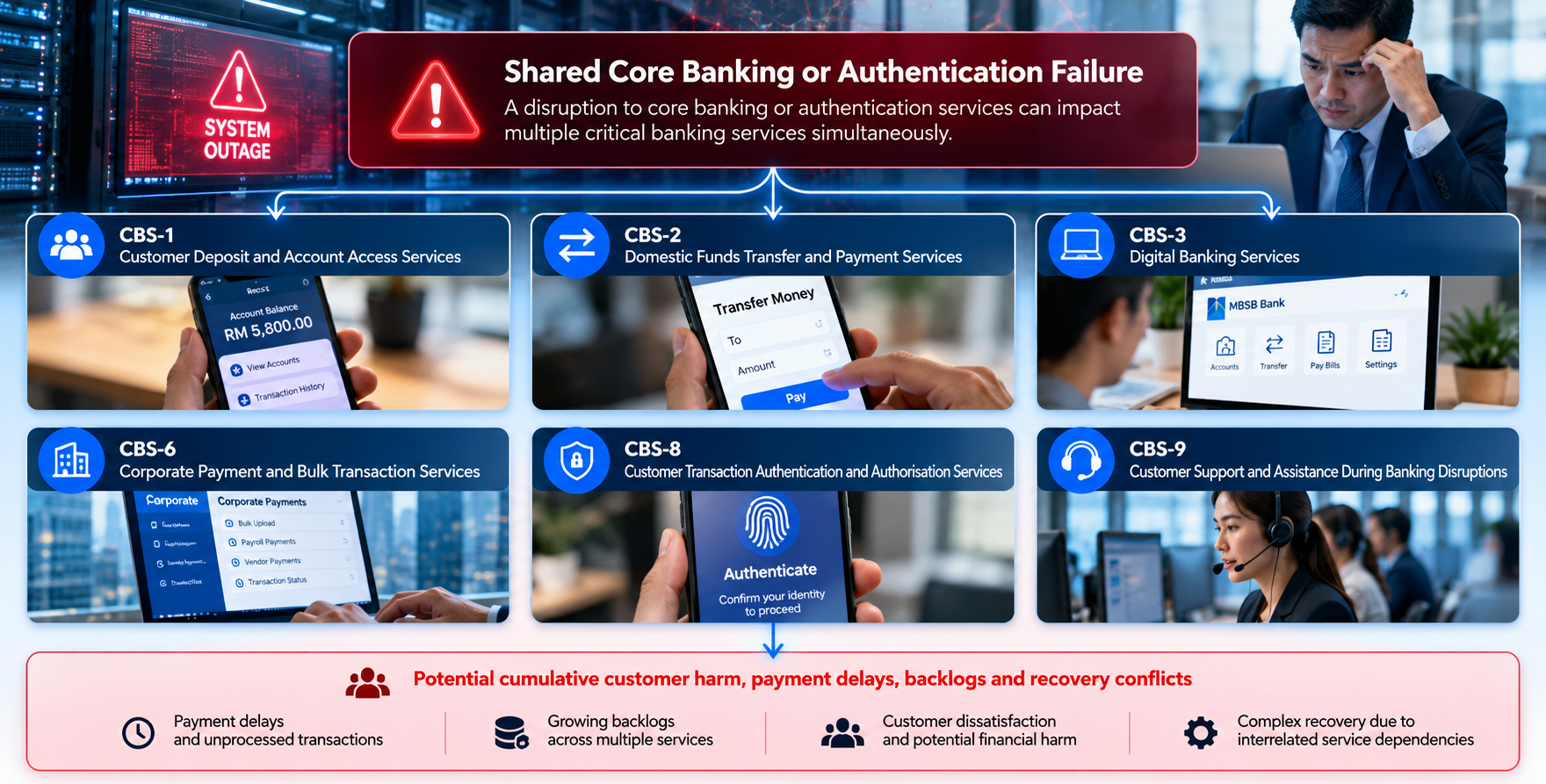
Potential cumulative customer harm, payment delays, backlogs, and recovery conflicts
This demonstrates why Impact Tolerance assessment should consider the combined effects of disruptions rather than evaluating each CBS in isolation.
Using the Mapping to Establish and Validate Impact Tolerances
The completed mapping should inform MBSB's assessment of the maximum disruption CBS-2 can withstand without causing unacceptable harm.
The December 2025 BNM Discussion Paper explains that existing recovery measures, including Maximum Tolerable Downtime and Recovery Time Objective, remain important but may be insufficient to capture the consequences experienced by customers and stakeholders.
For CBS-2, MBSB should consider:
|
Impact Dimension |
Illustrative Measure |
Mapping Application |
|
Service unavailability |
Duration of domestic payment service outage |
Identify processes and dependencies preventing payment completion. |
|
Customer reach |
Number and proportion of affected customers |
Identify affected channels, account types, and customer groups. |
|
Transaction backlog |
Number and value of unprocessed payments |
Map queues and hand-offs between initiation, processing, execution, and settlement. |
|
Payment timeliness |
Number of delayed time-sensitive payments |
Identify critical processing and external infrastructure dependencies. |
|
Financial integrity |
Number and value of unresolved, duplicate, or incorrectly posted transactions |
Trace posting, completion, reconciliation, and restoration dependencies. |
|
Service degradation |
Percentage of normal payment capacity available |
Assess alternative channels, reduced processing capacity, and common resource constraints. |
|
Customer harm |
Essential payments are missed, or customers are unable to access payment services |
Link process disruption to actual customer outcomes. |
The proposed mapping does not establish numerical Impact Tolerances. These must be developed using MBSB's actual customer, transaction, service performance, and risk information, and approved through the appropriate governance process.
Sub-CBS recovery requirements should then be aligned with the approved CBS-level Impact Tolerance. Individual process recovery targets are supporting controls, not substitutes for the overall tolerance.
Application to Severe but Plausible Scenario Testing
MBSB should use the mapping to construct scenarios that challenge several connected components simultaneously.
|
Scenario |
Primary Dependency Failure |
Potentially Affected Sub-CBS |
Key Testing Objective |
|
Core banking outage with delayed recovery |
Shared ledger and account processing |
CBS-2.5, 2.8, 2.10, 2.12, 2.15, 2.17, 2.24 |
Demonstrate whether essential payments can be maintained or safely restored without duplicate or incorrect postings. |
|
Authentication outage during peak payment demand |
Shared authentication and telecommunications |
CBS-2.1, 2.4, 2.5, 2.16 |
Assess customer access, transaction authorisation, alternative arrangements, and cumulative customer harm. |
|
Industry payment infrastructure outage |
External interbank payment network |
CBS-2.11, 2.13–2.17, 2.19–2.20 |
Evaluate payment queue management, external coordination, customer notification, and settlement uncertainty. |
|
Cyberattack compromising payment data integrity |
Payment database, transaction records, and application environment |
CBS-2.9–2.10, 2.15, 2.17–2.18, 2.22–2.24 |
Validate isolation, trusted recovery, transaction-state reconstruction, and reconciliation. |
|
Simultaneous network and recovery-site failure |
Telecommunications, primary infrastructure, and recovery arrangements |
CBS-2.1, 2.4, 2.11, 2.13, 2.22–2.24 |
Test common-cause failures and the independence of alternative processing capabilities. |
|
Prolonged third-party disruption with specialist staff shortage |
External service provider and key personnel |
CBS-2.13–2.14, 2.19–2.24 |
Evaluate provider substitutability, cross-trained staffing, sustained operations, and recovery coordination. |
Scenario test evidence should include the actual customer-facing outcome, transaction processing capacity, backlog, data integrity, recovery time, third-party performance, and whether CBS-2 remained within its approved tolerance.
Validation, Ownership, and Regulatory Evidence
For regulatory and management review, the two mapping tables should be supported by evidence demonstrating that the proposed relationships have been verified.
The following validation activities are recommended:
- CBS Owner review: Confirm that all 24 Sub-CBS processes reflect the actual domestic payment lifecycle.
- Business process validation: Confirm upstream and downstream hand-offs with payment operations, branches, digital banking, and customer support.
- Technology architecture review: Match each functional technology dependency to actual applications, infrastructure, and interfaces.
- Third-party validation: Identify actual providers, contracts, critical fourth parties, service-level commitments, and alternative arrangements.
- Data-flow validation: Confirm the authoritative sources of payment status, account balances, posting records, and settlement information.
- Cross-CBS review: Verify shared resources and dependencies with the owners of CBS-1, CBS-3, CBS-6, CBS-7, CBS-8, and CBS-9.
- Resilience assessment: Evaluate concentration risks, single points of failure, and recovery capability against CBS-2's approved tolerance.
- Formal approval: Record accountable owners, mapping version, validation evidence, material gaps, and approval decisions.
For a controlled regulatory submission, MBSB should supplement the tables with a mapping register containing:
|
Control Field |
Required Information |
|
Mapping reference |
Unique process-to-component relationship identifier |
|
Sub-CBS and CBS owner |
Accountable business owner and relevant resource owner |
|
Actual resource identification |
Verified application, data repository, infrastructure, or provider reference |
|
Dependency criticality |
Materiality of the dependency on service delivery |
|
Failure consequence |
Expected customer, financial, operational, and regulatory impact |
|
Recovery requirement |
Approved recovery capability and its relationship to CBS-2's Impact Tolerance |
|
Alternative arrangement |
Available contingency, its limitations, and tested capability |
|
Evidence |
Architecture diagrams, contracts, recovery tests, transaction records, or other validation material |
|
Validation and approval |
Reviewer, approval authority, date, and next review trigger |
BNM's Discussion Paper explicitly links dependency visibility with identifying vulnerabilities, managing external dependencies, and evaluating resilience under severe but plausible scenarios. Its discussion of existing BCM and RMiT requirements also reinforces the importance of documenting internal and external dependencies.
The completed tables should therefore be treated as a mapping baseline requiring evidence-based validation, rather than as a statement that MBSB has already demonstrated the resilience of all identified dependencies.
Maintaining the Mapping
Interconnections and interdependencies can change when MBSB introduces new payment products, modifies its technology architecture, changes providers, restructures operational processes, or adopts new service channels.
The CBS-2 mapping should be reviewed following material changes, such as:
- introduction or retirement of a payment channel;
- migration or replacement of a core banking or payment platform;
- significant outsourcing or provider changes;
- changes to external payment network arrangements;
- changes in transaction volumes or customer profiles;
- material operational incidents;
- scenario tests revealing previously unidentified dependencies;
- changes in regulatory requirements; and
- significant changes to recovery architecture or alternative processing arrangements.
A periodic review should also be established, with frequency determined by the bank's governance framework and the criticality of the service.

The mapping of interconnections and interdependencies for CBS-2: Domestic Funds Transfer and Payment Services provides MBSB with a structured end-to-end view of the processes and resources supporting domestic payment delivery.
By examining all 24 Sub-CBS processes, the mapping identifies how payment instructions move through initiation, authentication, validation, processing, execution, settlement, confirmation, reconciliation, monitoring, exception management, and recovery.
It also demonstrates that the resilience of CBS-2 depends on more than the availability of the payment processing platform. The service relies on interconnected banking applications, customer channels, authentication controls, accurate account and transaction information, operational personnel, telecommunications, third-party providers, and external payment infrastructure.
The principal value of the mapping is its ability to reveal where a single failure or shared dependency could affect multiple processes and Critical Business Services simultaneously.
These findings support several important Operational Resilience outcomes:
- More informed identification of critical vulnerabilities and concentration risks.
- Stronger alignment between process recovery capabilities and CBS-level Impact Tolerances.
- More realistic, severe, but plausible scenario design and testing.
- Better prioritisation of technology, staffing, supplier, and recovery investments.
- Clearer accountability for dependency management and remediation.
- Improved evidence for Senior Management, Board, and regulatory review.
For MBSB, the mapping should be maintained as a living Operational Resilience document, updated when services, technology, providers, or the operating environment change.
The central implementation principle is that CBS-2 can only be considered resilient when MBSB understands not only the processes delivering domestic payments, but also the dependencies connecting those processes and the consequences when those dependencies fail.
The next stage should use the validated mapping to assess the materiality of dependencies, establish minimum service capabilities, evaluate Impact Tolerance exposure, and develop scenario tests that demonstrate whether MBSB can sustain Domestic Funds Transfer and Payment Services during severe operational disruption.
Methodological references
The mapping approach is informed by BNM's Operational Resilience Discussion Paper (19 December 2025) and BCM Institute's Mapping Interconnections and Interdependencies methodology. The resource classifications, dependency relationships, and implementation recommendations in this chapter are original illustrative applications to MBSB's proposed CBS-2 operating model.


For organisations looking to accelerate their journey, BCM Institute’s training and certification programs, including the OR-5000 Operational Resilience Expert Implementer course, provide in-depth insights and practical toolkits for effectively embedding this model.
More Information About OR-5000 [OR-5] or OR-300 [OR-3]
To learn more about the course and schedule, click the buttons below for the OR-300 Operational Resilience Implementer course and the OR-5000 Operational Resilience Expert Implementer course.







