![[OR] [LBP] Legal Disclaimer Banner](https://no-cache.hubspot.com/cta/default/3893111/2b7fea9a-03e9-47b5-be3a-84dc0128eb83.png)
CBS-1 Deposit & Account Services
Introduction

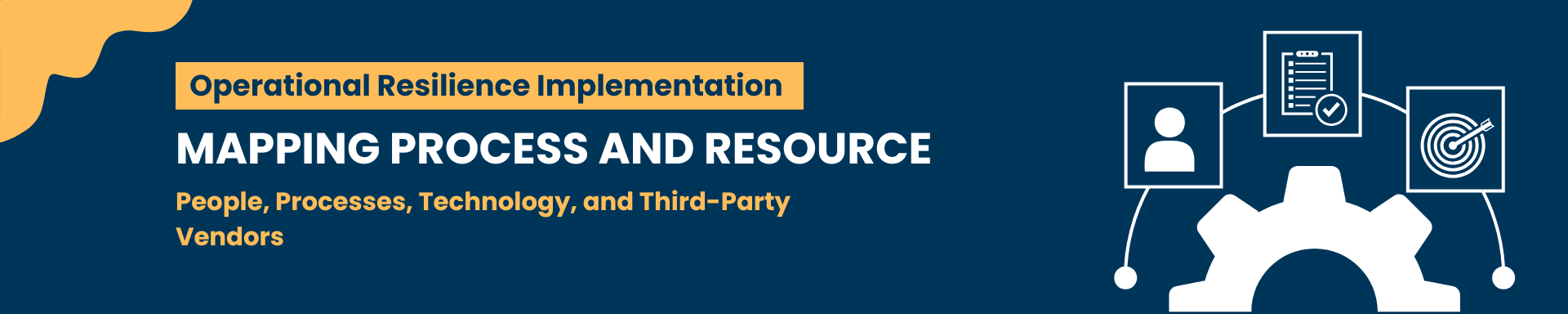
Mapping Processes and Resources is a critical step within the Operational Resilience (OR) implementation lifecycle, particularly under the “Implement Phase – Stage 2: Map Processes and Resources (MPR).”
This stage enables organisations to systematically identify and document the end-to-end processes, supporting resources, and interdependencies required to deliver each Critical Business Service (CBS).
For CBS-1 Deposit and Account Services, this mapping ensures that all operational components—people, processes, technology, and third parties—are clearly understood and aligned with resilience objectives.
In accordance with BSP Circular No. 1203, Philippine banks must demonstrate a comprehensive understanding of their critical operations, including their dependencies and vulnerabilities, to ensure continuity in the face of severe but plausible scenarios.
This chapter provides a structured mapping of the processes and resources that support each Sub-CBS, ensuring traceability, accountability, and preparedness for resilience.
Purpose of the Chapter
The purpose of this chapter is to:
- Provide a structured mapping of processes and resources supporting each Sub-CBS under CBS-1
- Enable identification of critical dependencies and single points of failure
- Support scenario testing and impact tolerance validation
- Ensure compliance with BSP operational resilience requirements, particularly in end-to-end mapping, third-party risk management, and ICT resilience
![Banner [Table] [OR] [E3] Map Dependency](https://no-cache.hubspot.com/cta/default/3893111/8a44ad9d-681b-48ff-90b1-b994a1c12a64.png)
Table P3: Map Processes and Resources for CBS-1
|
Sub-CBF Code |
Sub-CBS |
Processes |
People |
Technology (Applications & Infrastructure) |
Third-Party Vendors |
Upstream / Downstream Dependencies |
|
1.1 |
Customer Onboarding and Account Application |
Customer application intake, data capture, document submission |
Branch officers, Relationship managers |
Front-end onboarding systems, CRM, and document management systems |
KYC utilities, ID verification providers |
Upstream: Customer interaction channels; Downstream: KYC verification (1.2) |
|
1.2 |
Customer Identification and Verification |
KYC/CDD checks, sanctions screening, identity validation |
Compliance officers, KYC analysts |
KYC/AML systems, sanctions screening tools |
Credit bureaus, government ID databases |
Upstream: Onboarding (1.1); Downstream: Account approval (1.3) |
|
1.3 |
Account Approval and Opening |
Account validation, approval workflows, and account creation |
Operations staff, Branch managers |
Core banking system (CBS), workflow engines |
None / regulatory integrations |
Upstream: KYC (1.2); Downstream: Funding (1.4) |
|
1.4 |
Initial Funding and Deposit Booking |
Deposit processing, account funding validation |
Tellers, Operations staff |
Core banking system, payment gateway |
Payment networks, clearing houses |
Upstream: Account opening (1.3); Downstream: Account maintenance (1.5) |
|
1.5 |
Product Terms Setup and Account Parameter Maintenance |
Interest setup, account configuration, product linkage |
Product managers, Operations teams |
Product configuration modules, CBS |
None |
Upstream: Funding (1.4); Downstream: Transaction processing (1.6) |
|
1.6 |
Deposit Transactions Processing |
Deposit posting, clearing, and settlement |
Tellers, Operations, IT support |
Core banking, clearing systems, batch processing engines |
Clearing networks, interbank systems |
Upstream: Account setup; Downstream: Reporting (1.10), reconciliation (1.13) |
|
1.7 |
Withdrawal and Funds Access Processing |
Withdrawal handling, fund transfers |
Tellers, Customer service staff |
ATM systems, CBS, payment switches |
ATM networks (e.g., BancNet), payment providers |
Upstream: Transaction processing (1.6); Downstream: Fraud monitoring (1.15) |
|
1.8 |
Account Servicing and Customer Maintenance |
Profile updates, account modifications |
Customer service, Branch staff |
CRM, CBS |
None |
Upstream: Active accounts; Downstream: Reporting (1.10) |
|
1.9 |
Interest, Fees, and Charges Processing |
Interest calculation, fee deduction |
Finance teams, Operations |
CBS, financial engines |
None |
Upstream: Account balances; Downstream: Reporting (1.10) |
|
1.10 |
Statement, Passbook, and Balance Reporting |
Statement generation, balance inquiry |
Operations staff, Customers |
Reporting systems, digital banking apps |
Print vendors, email/SMS providers |
Upstream: Transactions (1.6); Downstream: Customer servicing (1.8) |
|
1.11 |
Digital Account Access Enablement |
Online banking setup, authentication provisioning |
IT teams, Digital banking support |
Mobile apps, web portals, IAM systems |
Cloud providers, OTP/SMS vendors |
Upstream: Account creation; Downstream: Transactions (1.6) |
|
1.12 |
ATM and Card-Based Access Management |
Card issuance, ATM access control |
Card operations team |
Card management systems, ATM infrastructure |
Card networks (Visa, Mastercard), ATM service providers |
Upstream: Account opening; Downstream: Withdrawal (1.7) |
|
1.13 |
Account Reconciliation and Exception Handling |
Ledger reconciliation, exception resolution |
Finance, Operations teams |
Reconciliation tools, CBS |
External auditors |
Upstream: Transactions (1.6); Downstream: Regulatory reporting (1.17) |
|
1.14 |
Dormancy, Holds, Restrictions, and Account Control Administration |
Account freezing, dormancy tagging |
Compliance teams, Operations |
CBS control modules |
None |
Upstream: Account servicing; Downstream: Compliance reporting (1.17) |
|
1.15 |
Fraud Monitoring and Transaction Surveillance |
Fraud detection, alert management |
Fraud analysts, Risk teams |
Fraud detection systems, AI analytics tools |
Fraud monitoring service providers |
Upstream: Transactions (1.6, 1.7); Downstream: Incident response (1.18) |
|
1.16 |
Complaints, Disputes, and Service Recovery |
Complaint handling, dispute resolution |
Customer service, Ombudsman liaison |
Case management systems, CRM |
Arbitration bodies, regulators |
Upstream: Customer interactions; Downstream: Regulatory reporting (1.17) |
|
1.17 |
Regulatory Reporting and Compliance Support |
Report preparation, compliance validation |
Compliance officers, Risk teams |
Regulatory reporting systems |
Regulators (e.g., BSP) |
Upstream: All processes; Downstream: Governance oversight |
|
1.18 |
Business Continuity and Recovery for Deposit Services |
DR activation, crisis response, recovery execution |
BCM team, IT DR teams, Crisis management team |
DR sites, backup systems, communication tools |
DR site providers, telecom providers |
Upstream: All Sub-CBS; Downstream: Full service restoration |
Regulatory Alignment with BSP Circular No. 1203 (2024)
The above mapping aligns with key requirements of BSP Circular No. 1203, including:
- End-to-End Mapping of Critical Business Services
Banks must identify and map the resources and interconnections supporting each CBS.
Example: Mapping dependencies between onboarding (1.1), KYC (1.2), and account opening (1.3). - Identification of Critical Resources and Dependencies
Institutions must document people, technology, facilities, and third parties.
Example: Reliance on ATM networks, payment gateways, and cloud providers in 1.7 and 1.11. - Third-Party Risk Management Integration
Critical outsourced services must be identified and assessed.
Example: Card networks, KYC vendors, and telecom providers supporting digital and ATM services. - Operational Resilience Testing Readiness
Mapping supports scenario testing and impact tolerance validation.
Example: Fraud detection (1.15) and BC/DR (1.18) linked to cyber and operational disruption scenarios. - Governance and Accountability
Clear ownership of processes and resources must be defined.
Example: Compliance ownership in regulatory reporting (1.17) and fraud monitoring (1.15).
![Banner [Summing] [OR] [E3] Map Interconnections and Interdependencies](https://no-cache.hubspot.com/cta/default/3893111/61e5330e-051c-4874-b6da-a1be8393c283.png)
The mapping of processes and resources for CBS-1 Deposit and Account Services provides a comprehensive view of how the Land Bank of the Philippines delivers one of its most critical services.
By systematically identifying the processes, people, technologies, and third-party dependencies supporting each Sub-CBS, LBP strengthens its ability to anticipate, withstand, and recover from disruptions.
This structured mapping is not merely a documentation exercise—it is a foundational capability for operational resilience.
It enables effective scenario testing, impact tolerance setting, and risk management, all of which are central to compliance with BSP Circular No. 1203.
Ultimately, it ensures that LBP can continue delivering essential banking services to customers, even under severe but plausible conditions, thereby reinforcing trust, stability, and regulatory confidence.
![x [OR] [LandBank] Title Banner](https://no-cache.hubspot.com/cta/default/3893111/5af8c6f4-33f3-4662-b9e6-064232570c94.png)
![[OR] [LBP] [PH] [E3] [CBS] [1] [DP] Retail Deposit & Account Services](https://no-cache.hubspot.com/cta/default/3893111/912392ab-7a11-4801-8ee5-b72502b1872d.png)


 Gain Competency: For organisations looking to accelerate their journey, BCM Institute’s training and certification programs, including the OR-5000 Operational Resilience Expert Implementer course, provide in-depth insights and practical toolkits for effectively embedding this model.
More Information About OR-5000 [OR-5] or OR-300 [OR-3]
To learn more about the course and schedule, click the buttons below for the OR-300 Operational Resilience Implementer course and the OR-5000 Operational Resilience Expert Implementer course.


![[BL-OR] [3-4-5] View Schedule](https://no-cache.hubspot.com/cta/default/3893111/d0d733a1-16c0-4b68-a26d-adbfd4fc6069.png)
![[BL-OR] [3] FAQ OR-300](https://no-cache.hubspot.com/cta/default/3893111/f20c71b4-f5e8-4aa5-8056-c374ca33a091.png)
![Email to Sales Team [BCM Institute]](https://no-cache.hubspot.com/cta/default/3893111/3c53daeb-2836-4843-b0e0-645baee2ab9e.png)