![[OR] [GCash] [Full Banner] Strengthening Operational Resilience at GCash](https://no-cache.hubspot.com/cta/default/3893111/3a39ca09-f7ed-4e75-858f-941c41224c31.png)

![[OR] [GCash] [Disclaimer] Legal Disclaimers and Usage of eBook Banner](https://no-cache.hubspot.com/cta/default/3893111/454a0c6c-3084-45f4-b724-65b4ca4eb6d1.png) Introduction to GCash’s Operational Resilience Planning Methodology
Introduction to GCash’s Operational Resilience Planning Methodology
![[OR] [GCash] [E2] [C1] OR Planning Methodology](https://no-cache.hubspot.com/cta/default/3893111/9b28ba29-58a9-45d1-81fb-45f5db254385.png)
It requires a structured, repeatable methodology that enables an organisation to progressively build, implement, and continuously strengthen its resilience capabilities.
For a digital financial platform such as GCash, whose operations support millions of customers and businesses across the Philippines, operational resilience must be embedded into governance, operational processes, technology, risk management, and organisational culture.
![x eBook Cover [OR] [GCash] [E2] [2D]](https://no-cache.hubspot.com/cta/default/3893111/31f88f39-251a-4717-874a-1adc1c9f5c77.png) This eBook adopts a practical three-phase Operational Resilience Planning Methodology that guides GCash from understanding its current resilience capability, through implementing resilience improvements, to sustaining resilience as an ongoing organisational capability.
This eBook adopts a practical three-phase Operational Resilience Planning Methodology that guides GCash from understanding its current resilience capability, through implementing resilience improvements, to sustaining resilience as an ongoing organisational capability.
The methodology reflects internationally recognised Operational Resilience principles and aligns with the expectations of the Bangko Sentral ng Pilipinas (BSP) under Circular No. 1203 (Series of 2024) – Guidelines on Operational Resilience.
Rather than treating Operational Resilience as a one-time project, the methodology establishes a continuous improvement cycle that enables GCash to anticipate, withstand, respond to, recover from, and adapt to operational disruptions while continuing to perform its Critical Operations.
Purpose of the Chapter
 This chapter introduces the overall Operational Resilience Planning Methodology used throughout this implementation guide.
Before undertaking detailed resilience activities, readers need to understand how the programme is structured, why each phase is important, and how the individual stages build upon one another to create a comprehensive Operational Resilience capability.
By the end of this chapter, readers will be able to:
-
Understand the three phases of the Operational Resilience Planning Methodology.
-
Recognise the purpose of each stage within the methodology.
-
Appreciate how the phases collectively support continual improvement in resilience.
-
Understand how the methodology aligns with BSP Operational Resilience expectations.
-
Visualise how the methodology can be applied within GCash's operational environment.
This understanding provides the roadmap for the remainder of the implementation guide.
Overview of GCash's Operational Resilience Planning Methodology
 The methodology consists of three sequential yet interconnected phases:
-
Phase 1 – Plan
-
Phase 2 – Implement
-
Phase 3 – Sustain
Each phase addresses a different aspect of Operational Resilience maturity. Together, they form a continuous lifecycle that enables GCash to improve resilience capabilities while responding to changing business, technology, regulatory, and threat environments.

Phase 1: Plan – Laying the Foundation for Resilience

 The Plan phase establishes the strategic and governance foundations for Operational Resilience.
During this phase, GCash evaluates its current state, identifies improvement opportunities, defines its resilience strategy, determines acceptable levels of operational risk, and establishes governance arrangements to support programme implementation.
Stage 1 – Assess Capability and Maturity
The first activity is to evaluate GCash's existing Operational Resilience capability across governance, operational risk management, technology resilience, business continuity, cyber resilience, crisis management, third-party risk management, and organisational preparedness.
Example – GCash
GCash performs an enterprise-wide maturity assessment to determine whether existing operational risk, business continuity, cyber resilience, and technology resilience capabilities adequately support the continuity of its digital wallet operations and payment ecosystem.
Stage 2 – Analyse Gap
The current maturity assessment is compared against regulatory expectations, recognised good practices, and organisational objectives to identify capability gaps.
Example – GCash
The assessment identifies limited dependency mapping across third-party payment providers and insufficient scenario testing for cloud infrastructure disruptions.
Stage 3 – Develop Strategy and Roadmap
Based on the gap analysis, GCash develops a multi-year Operational Resilience Strategy and implementation roadmap.
The roadmap should define priorities, responsibilities, resource requirements, implementation timelines, and measurable outcomes.
Example – GCash
Management approves a three-year roadmap focused on identifying Critical Operations, mapping dependencies, developing impact tolerance, enhancing cyber resilience, and conducting enterprise-wide scenario testing.
Stage 4 – Confirm Risk Appetite
Senior management establishes the level of operational disruption the organisation is prepared to tolerate while remaining within acceptable risk limits.
Risk appetite provides strategic direction for resilience investment decisions and operational priorities.
Example – GCash
The Board confirms that payment processing interruptions affecting nationwide customer transactions that exceed defined tolerance levels are unacceptable and require the highest investment priority in resilience.
Stage 5 – Develop and Embed Governance
Appropriate governance structures ensure accountability, oversight, reporting, and continuous management of Operational Resilience.
Governance should define executive ownership, committee responsibilities, reporting mechanisms, and decision-making authority.
Example – GCash
An Operational Resilience Steering Committee is established with representatives from Operations, Technology, Cybersecurity, Operational Risk, Business Continuity, Compliance, Legal, and Internal Audit.
Phase 2: Implement – Bringing the Strategy to Life
![[OR] [PM] [P2] 5 Stage of Implement Phase](https://no-cache.hubspot.com/cta/default/3893111/936cc697-2dbe-4ede-a43d-f063ecdedf4b.png)

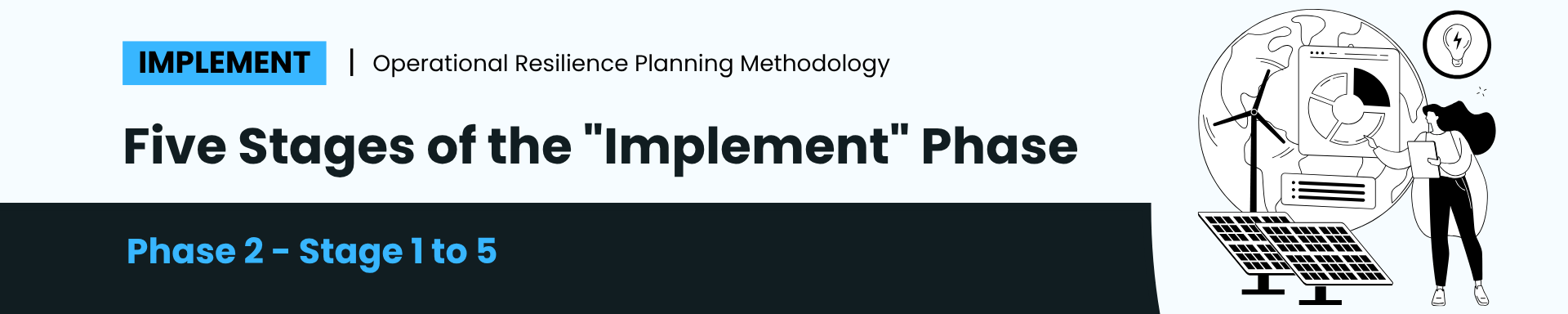
The Implement phase converts strategic planning into operational capability.
It identifies Critical Operations, analyses supporting dependencies, establishes impact tolerances, validates resilience through testing, and improves resilience using lessons learned.
Stage 1 – Identify Critical Operations
The organisation identifies those operational activities whose disruption would result in unacceptable customer, regulatory, financial, or systemic harm.
Example – GCash
Critical Operations include Digital Wallet Operations, Digital Payment and Funds Transfer Operations, Customer Identity and Authentication Operations, Fraud Detection Operations, and Digital Platform Operations.
Stage 2 – Map Processes and Resources
Each Critical Operation is mapped to identify its supporting:
- Business processes
- Technology
- Information
- People
- Facilities
- Third-party providers
- Upstream and downstream dependencies
Example – GCash
Digital Payment Operations are mapped to payment gateways, cloud infrastructure, API services, telecommunications providers, banking partners, fraud detection platforms, and customer authentication systems.
Stage 3 – Set Impact Tolerances
GCash establishes the maximum acceptable level of disruption for each Critical Operation before unacceptable harm occurs.
Impact tolerances provide measurable resilience objectives.
Example – GCash
Management establishes recovery objectives for Digital Wallet Operations based on customer impact, transaction volumes, regulatory obligations, and financial stability considerations.
Stage 4 – Conduct Scenario Testing
The organisation validates resilience through realistic severe but plausible disruption scenarios.
Testing evaluates whether Critical Operations remain within established impact tolerances.
Example – GCash
Scenario exercises simulate ransomware attacks, nationwide telecommunications outages, cloud service failures, payment gateway disruptions, and simultaneous cyber and operational incidents.
Stage 5 – Improve Lessons Learnt
After testing or actual incidents, the team analyses lessons and incorporates them into governance, technology, operational processes, recovery strategies, and resilience planning.
Example – GCash
Following a major technology simulation exercise, GCash enhances cloud failover procedures, strengthens third-party monitoring, and updates crisis communication protocols.

Phase 3: Sustain – Ensuring Long-term Resilience


Operational Resilience is not static. The Sustain phase ensures resilience capabilities remain effective as business operations, technology, customer expectations, threats, and regulatory requirements evolve.
Stage 1 – Introduce Cultural Change
Operational Resilience becomes embedded within organisational values, behaviours, and decision-making.
Example – GCash
Business leaders incorporate resilience objectives into operational planning, project governance, and performance management.
Stage 2 – Develop Communication Strategy
Internal and external communication supports resilience awareness before, during, and after operational disruptions.
Example – GCash
Communication procedures define how the company engages customers, regulators, banking partners, merchants, media, and employees during significant operational incidents.
Stage 3 – Implement Training and Awareness
Personnel receive appropriate education, exercises, and awareness programmes to support resilience responsibilities.
Example – GCash
Operations, Technology, Cybersecurity, Customer Support, and Executive Management participate in annual Operational Resilience workshops and scenario exercises.
Stage 4 – Provide Self-Assessment
Business units periodically evaluate the effectiveness of resilience controls and identify opportunities for continuous improvement.
Example – GCash
Operational departments complete annual self-assessments measuring compliance with Operational Resilience standards and programme objectives.
Stage 5 – Conduct Independent Quality Review
Independent reviews provide assurance that the Operational Resilience Programme remains effective, compliant, and aligned with organisational objectives.
Reviews may be performed by Internal Audit, Risk Assurance, or independent external specialists.
Example – GCash
Internal Audit evaluates governance effectiveness, dependency mapping quality, scenario testing results, and compliance with BSP Operational Resilience expectations.
Bringing the Three Phases Together
The three phases form a continuous Operational Resilience lifecycle.
- Plan establishes strategic direction and governance.
- Implement develops and validates operational resilience capabilities.
- Sustain embeds resilience into organisational culture and continuous improvement.
Rather than progressing through the methodology only once, GCash should continually revisit each phase as business models, technologies, customer expectations, regulations, and threat landscapes evolve. This cyclical approach enables the organisation to maintain resilience maturity over the long term.
![x [Banner] [Summing] [OR] [E2] [C1] Overview of Operational Resilience Planning Methodology](https://no-cache.hubspot.com/cta/default/3893111/0c551e82-cf06-432c-8498-1d3c9bb2dece.png)
A structured Operational Resilience Planning Methodology provides GCash with a practical roadmap for developing and maintaining enterprise-wide resilience capabilities.
By progressing through the Plan, Implement, and Sustain phases, the organisation can systematically assess its current capability, establish governance, identify and strengthen Critical Operations, validate resilience through testing, and embed resilience into everyday business practices.
Each stage builds upon the previous one, creating an integrated programme that supports operational continuity, protects customers, and enhances confidence in GCash's ability to operate during severe but plausible disruptions.
The chapters that follow examine each stage of the methodology in greater detail.
Beginning with the Plan phase, readers will learn how to assess current Operational Resilience capability and maturity, identify opportunities for improvement, and establish the strategic foundations necessary for a successful Operational Resilience Programme at GCash.

Blogs marked [x] are under construction
![[OR] [GCash] [E2] [P1] [S1-S5] [C2] Five Stages of the Plan Phase](https://no-cache.hubspot.com/cta/default/3893111/f8047da8-0830-4215-a8aa-753a4cf258b3.png)
![[OR] [GCash] [E2] [P1] [S1-S5] [C8] Five Stages of the Implement Phase](https://no-cache.hubspot.com/cta/default/3893111/4e62cb7c-f73d-48a7-9652-264863e1294c.png)
![[OR] [GCash] [E2] [P1] [S1-S5] [C14] Five Stages of the Sustain Phase](https://no-cache.hubspot.com/cta/default/3893111/f4a2626b-1f0d-4cc3-9380-d0f94f333197.png)
| eBook 3 | ||
![x eBook Cover [OR] [GCash] [E3] [2D]](https://no-cache.hubspot.com/cta/default/3893111/373886db-5423-4e41-8254-7aad05d852e0.png) |
||
| C5 [x] | C6 [x] | C7 [x] |
![[OR] [GEN] [E2] [P1] [S3] [C5] Developing Strategy and Roadmap](https://no-cache.hubspot.com/cta/default/3893111/afe40ca7-42c1-448f-9ce7-74955f58c946.png) |
![[OR] [GEN] [E2] [P1] [S4] [C6] Confirming Risk Appetite](https://no-cache.hubspot.com/cta/default/3893111/7228dd2d-4764-4aee-8fb5-899bd5b28874.png) |
![[OR] [GEN] [E2] [P1] [S5] [C7] Developing and Embedding Governance](https://no-cache.hubspot.com/cta/default/3893111/e06994e8-b682-4809-b8b8-a7a4f82d0ec7.png) |
| C11 [x] | C12 [x] | C13 [x] |
![[OR] [GEN] [E2] [P2] [S3] [C11] Establishing Impact Tolerance](https://no-cache.hubspot.com/cta/default/3893111/54b6c9d1-e897-4530-8eb4-8419de7503aa.png) |
![[OR] [GEN] [E2] [P2] [S4] [C12] Performing Scenario Testing](https://no-cache.hubspot.com/cta/default/3893111/fe5cc4a9-b109-417e-ba78-651a6dc4f658.png) |
![[OR] [GEN] [E2] [P2] [S5] [C13] Improving Lessons Learned](https://no-cache.hubspot.com/cta/default/3893111/4e3235b4-3630-4359-89bb-8a3b3c098dc8.png) |
| C17 [x] | C18 [x] | C19 [x] |
![[OR] [GEN] [E2] [P3] [S3] C17] Implementing Training and Awareness](https://no-cache.hubspot.com/cta/default/3893111/1e095f66-dca9-4a83-9850-e459cebddbfa.png) |
![[OR] [GEN] [E2] [P3] [S4] [C18] Providing Self-Assessment](https://no-cache.hubspot.com/cta/default/3893111/076a795c-4733-4fb0-b260-fcec767fb221.png) |
![[OR] [GEN] [E2] [P3] [S5] [C19] Conducting Independent Quality Reviews](https://no-cache.hubspot.com/cta/default/3893111/2cff3f12-e08e-43cf-8ca6-aaa6efe33631.png) |
![[OR][BSP Guidelines] Key Implementation and Components](https://no-cache.hubspot.com/cta/default/3893111/cceda0e6-1ccc-48c6-8ecc-682910430f1a.png)
![x eBook Cover [OR] [GCash] [E1] [2D]](https://no-cache.hubspot.com/cta/default/3893111/6be54ccc-e74c-4dc1-9dca-7f943817ad55.png)
![[OR] [GEN] [E2] [C20] Conclusion for eBook 2](https://no-cache.hubspot.com/cta/default/3893111/fb88d7a9-cd61-4414-add4-e284049ff375.png)
![[OR] [GEN] [E2] [C21] [Back Cover] for eBook 2](https://no-cache.hubspot.com/cta/default/3893111/2e6b224b-6df5-4080-a611-383225744f4f.png)
![[OR] [GEN] [E2] [P1] [S1] [C3] Assessing Capability and Maturity](https://no-cache.hubspot.com/cta/default/3893111/3486f1a4-500e-42ee-a7e1-af2a6008f468.png)
![[OR] [GEN] [E2] [P1] [S2] [C4] Analysing Gaps](https://no-cache.hubspot.com/cta/default/3893111/2c0fd2b3-bb2b-47b6-ad44-5e88c8422b37.png)
![[OR] [GEN] [P2] [S1-S5] [C8] Five Stages of the _Implement_ Phase](https://no-cache.hubspot.com/cta/default/3893111/7b251fae-e788-4b59-885f-7079d4845475.png)
![[OR] [GEN] [E2] [P2] [S1] [C9] Identifying Critical Business Services](https://no-cache.hubspot.com/cta/default/3893111/3ac7c230-3ce7-463a-813f-6907a49bdc35.png)
![[OR] [GEN] [E2] [P2] [S2] [C10] Mapping of Processes and Resources](https://no-cache.hubspot.com/cta/default/3893111/e7a81126-d48f-4c84-a7b5-db4324ef1b4f.png)
![[OR] [GEN] [E2] [P3] [C14] The Five Stages of the Sustain Phase](https://no-cache.hubspot.com/cta/default/3893111/931ae9fa-0925-4f30-ba78-fa9be7662fb7.png)
![[OR] [GEN] [E2] [P3] [S1] [C15] Introducing Cultural Change Management](https://no-cache.hubspot.com/cta/default/3893111/3909fd60-d099-4324-a1d2-2040171a7300.png)
![[OR] [GEN] [E2] [P3] [S2] [C16] Developing a Communication Strategy](https://no-cache.hubspot.com/cta/default/3893111/d3bcd703-2173-4eba-90c3-7d45da459f94.png)

For organisations looking to accelerate their journey, BCM Institute’s training and certification programs, including the OR-5000 Operational Resilience Expert Implementer course, provide in-depth insights and practical toolkits for effectively embedding this model.
More Information About OR-5000 [OR-5] or OR-300 [OR-3]
Gain Competency: For organisations looking to accelerate their journey, BCM Institute’s training and certification programs, including the OR-5000 Operational Resilience Expert Implementer course, provide in-depth insights and practical toolkits for effectively embedding this model.
To learn more about the course and schedule, click the buttons below for the OR-300 Operational Resilience Implementer course and the OR-5000 Operational Resilience Expert Implementer course.


![[BL-OR] [3-4-5] View Schedule](https://no-cache.hubspot.com/cta/default/3893111/d0d733a1-16c0-4b68-a26d-adbfd4fc6069.png)
![[BL-OR] [3] FAQ OR-300](https://no-cache.hubspot.com/cta/default/3893111/f20c71b4-f5e8-4aa5-8056-c374ca33a091.png)
![Email to Sales Team [BCM Institute]](https://no-cache.hubspot.com/cta/default/3893111/3c53daeb-2836-4843-b0e0-645baee2ab9e.png)