---
title: [OR] [CIMB] [E3] [CBS] [2] [ST] Perform Scenario Testing
description: [OR] [CIMB] [E3] [CBS] [2] [ST] Perform Scenario Testing
image: https://blog.bcm-institute.org/hubfs/CIMB%20Graphic%20Folder/CIMB%20CBS%202%20Morepost/%5BOR%5D%20%5BCIMB%5D%20%5BE3%5D%20%5BCBS%5D%20%5B2%5D%20%5BST%5D%20Payment%20%26%20Fund%20Transfer%20Services.jpg
---
.
[](http://www.bcm-institute.org/)
- [Home](https://www.bcm-institute.org/)
- [About Us](https://www.bcm-institute.org/about-us-3/)
- [A President’s Perspective](https://www.bcm-institute.org/about-us/a-presidents-perspective/)
- [Our History](https://www.bcm-institute.org/about-us/our-history/)
- [Our Advisory Council](https://www.bcm-institute.org/about-us/our-advisory-council/)
- [Customers’ Testimonials](https://www.bcm-institute.org/about-us/customers-testimonials/)
- [Credential Verification](https://www.bcm-institute.org/about-us/credential-verification/)
- [Courses](https://blog.bcm-institute.org/blog/course-fees-for-blended-learning-courses-master-catalog)
- [ISO 22301 Business Continuity Management System Audit](https://blog.bcm-institute.org/audit/business-continuity-management-audit-courses)
- [ISO 22301 Business Continuity Management](https://blog.bcm-institute.org/bcm/business-continuity-management-courses)
- [Crisis Communication](https://blog.bcm-institute.org/crisis-communication/crisis-communication-courses)
- [Crisis Management](https://blog.bcm-institute.org/en/crisis-management/courses)
- [IT Disaster Recovery](https://blog.bcm-institute.org/it-disaster-recovery/courses)
- [Operational Resilience](https://blog.bcm-institute.org/operational-resilience/courses)
- [Operational Resilience Audit](https://blog.bcm-institute.org/operational-resilience-audit/courses)
- [Certification](https://blog.bcm-institute.org/certification/types-of-certifications-offered)
- [ISO 22301 BCMS Audit Certification](https://blog.bcm-institute.org/certification/business-continuity-management-audit-certification)
- [ISO22301 Business Continuity Management Certification](https://blog.bcm-institute.org/bcm/business-continuity-management-certification)
- [Crisis Communication Certification](https://blog.bcm-institute.org/crisis-communication/crisis-communication-certification)
- [Crisis Management Certification](https://blog.bcm-institute.org/en/crisis-management/crisis-management-certification)
- [IT Disaster Recovery Planning Certification](https://blog.bcm-institute.org/it-disaster-recovery/it-disaster-recovery-certification)
- [Operational Resilience Certification](https://blog.bcm-institute.org/operational-resilience/operational-resilience-certification)
- [Operational Resilience Audit Certification](https://blog.bcm-institute.org/operational-resilience-audit)
- [Seminars](https://blog.bcm-institute.org/meet-the-expert/mte-webinar-mainpage)
- [Store](https://www.bcm-institute.org/store-2/)
- [Contact Us](http://www.bcm-institute.org/about-us/contact-us/)
-
-
###### Operational Resilience in Practice: The CIMB Bank Approach
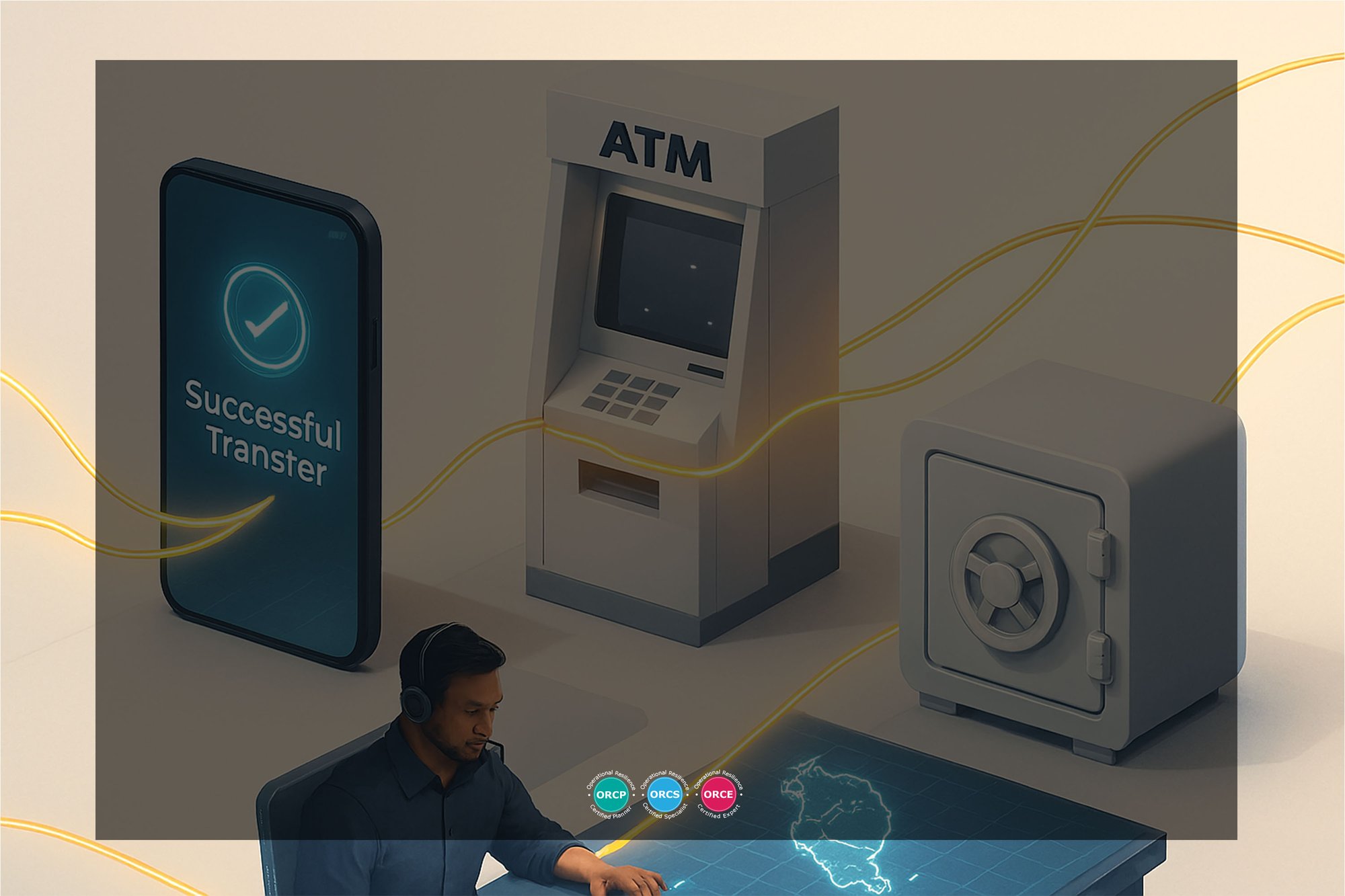
# \[OR\] \[CIMB\] \[E3\] \[CBS\] \[2\] \[ST\] Perform Scenario Testing
[](https://cta-redirect.hubspot.com/cta/redirect/3893111/e6bf3389-adf3-47b2-b35a-90bf5de0996b)
*Scenario testing* is a methodical approach to evaluate whether critical business services can continue operating within **predefined impact tolerances** under extreme yet plausible conditions.
It involves creating realistic, high‑impact scenarios that stress key people, processes, technology, and third-party dependencies. The purpose is not only to assess recovery capabilities but also to identify gaps in **governance, cybersecurity, ICT resilience, and operational continuity**.
For **CIMB Bank**, CBS‑2 Payment & Fund Transfer Services is a core operational capability that supports millions of customer transactions daily. Performing scenario testing ensures that each sub‑process—from customer-initiated transfers to dispute resolution—is stress-tested for **service availability, regulatory compliance, and ICT/cyber resilience**.
Incorporating lessons from the **2025 BNM Discussion Paper on Operational Resilience**, this approach reinforces proactive risk management, strengthens stakeholder confidence, and demonstrates regulatory alignment.
### [](https://cta-redirect.hubspot.com/cta/redirect/3893111/3c32e9b3-ea88-44c3-9182-fa3e6a9aadee)
[Dr Goh Moh Heng](https://blog.bcm-institute.org/ebook-or/author/dr-goh-moh-heng) Mar 13, 2026
###### Operational Resilience Certified Planner-Specialist-Expert
###### [![\[OR\] \[CIMB\] Legal Disclaimer Banner](https://no-cache.hubspot.com/cta/default/3893111/11714c89-3f47-430e-82af-f61521f1677c.png)](https://cta-redirect.hubspot.com/cta/redirect/3893111/11714c89-3f47-430e-82af-f61521f1677c)
### [](https://cta-redirect.hubspot.com/cta/redirect/3893111/3c32e9b3-ea88-44c3-9182-fa3e6a9aadee)
### CBS-2 Payment & Fund Transfer Services
#### Introduction
[](https://cta-redirect.hubspot.com/cta/redirect/3893111/5d2f4433-8420-4537-8156-cf016981e0b1)
*Scenario testing* is a methodical approach to evaluate whether critical business services can continue operating within **predefined impact tolerances** under extreme yet plausible conditions.
It involves creating realistic, high‑impact scenarios that stress key people, processes, technology, and third-party dependencies.
The purpose is not only to assess recovery capabilities but also to identify gaps in **governance, cybersecurity, ICT resilience, and operational continuity**.
[](https://cta-redirect.hubspot.com/cta/redirect/3893111/fe85e2f2-f972-49ad-8321-d370fcfd9caf) For **CIMB Bank**, CBS‑2 Payment & Fund Transfer Services is a core operational capability that supports millions of customer transactions daily.
Performing scenario testing ensures that each sub‑process—from customer-initiated transfers to dispute resolution—is stress-tested for **service availability, regulatory compliance, and ICT/cyber resilience**.
Incorporating lessons from the **2025 BNM Discussion Paper on Operational Resilience**, this approach reinforces proactive risk management, strengthens stakeholder confidence, and demonstrates regulatory alignment.
#### **[![Banner \[Table\] \[OR\] \[E3\] Perform Scenario Testing](https://no-cache.hubspot.com/cta/default/3893111/a45e9708-7139-4f4e-8e0e-41179f5cacc3.png)](https://cta-redirect.hubspot.com/cta/redirect/3893111/a45e9708-7139-4f4e-8e0e-41179f5cacc3)**
###### Table P6: Perform Scenario Testing for CBS-2
| Sub‑CBS Code | Sub‑CBS | Recommended Scenario Test Themes | Impact / Effect | Evidence of Proactive Risk Management Action | Link to Integration of Cyber & ICT Risks |
| --- | --- | --- | --- | --- | --- |
| 2.1 | Customer-Initiated Transfers | High-volume transaction spike with partial ICT system outage | Delayed or failed customer payments; reduced customer trust | Stress testing of transaction platforms; backup transaction queues | Cyber threat simulation (ransomware, DDoS); ICT failover testing |
| 2.2 | Internal Processing & Routing | Routing engine misconfiguration under peak load | Cascading delays in internal transfers; backlogs | Automated rollback & change control processes | Integration of ICT change management and monitoring |
| 2.3 | Clearing & Settlement Interface | Third-party clearing service failure during the peak window | Missed settlement deadlines; liquidity impact | Secondary clearing pathways; SLA testing with partners | ICT integration for secure API connectivity and third-party resilience |
| 2.4 | Foreign & Cross-Border Payments | FX gateway and connectivity outage | Delayed cross-border transfers; currency pricing errors | Dual FX routing; market scenario simulations | ICT risk: connectivity monitoring, intrusion detection for FX gateways |
| 2.5 | Payment & Transfer Compliance Controls | Large-scale AML/CFT false positives triggered by model malfunction | Transaction hold-ups; regulatory reporting delays | Periodic AI/AML model validation; audit trails | Cyber integration for model integrity, secure data pipelines |
| 2.6 | Notification & Status Reporting | Messaging platform disruption | Customers do not receive transaction notifications; trust impact | Independent messaging fallback, queue persistence tests | ICT risk: secure communication channels, resilience of APIs |
| 2.7 | Exception Handling & Remediation | Exception backlog from batch processing failure | SLA breaches; customer dissatisfaction | Automated exception routing; priority escalation dashboards | ICT workflow integration; anomaly detection in exception processing |
| 2.8 | Settlement & Reconciliation Accounting | Data corruption in the settlement database post-patch | Inaccurate accounting, financial reporting errors | End-of-day reconciliation cross-system validation; immutable logs | ICT risk: database integrity, ACID compliance, forensic logging |
| 2.9 | Service & Channel Monitoring | Monitoring tool outage due to a cyber exploit | Loss of visibility over service health; delayed incident response | Distributed monitoring with AI anomaly detection | Cyber integration: predictive monitoring, multi-channel correlation |
| 2.10 | Customer Support & Dispute Resolution | Contact centre outage or VoIP disruption | Customer queries unresolved; disputes escalate | Cloud-based failover; omni-channel support testing | ICT integration: cyber-hardened CRM, DDoS mitigation for contact channels |
#### [![Banner \[Summing\] \[OR\] \[E3\] Perform Scenario Testing](https://no-cache.hubspot.com/cta/default/3893111/11895c06-91e9-4cec-acb6-4356741952e4.png)](https://cta-redirect.hubspot.com/cta/redirect/3893111/11895c06-91e9-4cec-acb6-4356741952e4)
Performing scenario testing for **CBS‑2 Payment & Fund Transfer Services** enables CIMB Bank to systematically evaluate** its operational, technological, and cyber resilience**.
It ensures that severe but plausible disruptions—ranging from ICT outages to process errors—are tested against the bank’s impact tolerances.
Scenario testing delivers **proactive evidence of risk management**, strengthens governance, and identifies areas requiring investment or process improvements.
By incorporating cyber and ICT risks into every test, CIMB Bank not only demonstrates compliance with evolving **BNM operational resilience guidance** but also builds confidence in its ability to sustain core services and protect customer interests under extreme conditions.
| Operational Resilience in Practice: The CIMB Bank Approach | | | | | |
| --- | --- | --- | --- | --- | --- |
| **eBook 3: Starting Your OR Implementation** | | | | | |
| **CBS-2 Payment & Fund Transfer Services** | | | | | |
| **CBS-2 DP** | **CBS-2 MD** | **CBS-2 MPR** | **CBS-2 ITo** | **CBS-2 SuPS** | **CBS-2 ST** |
| [](https://cta-redirect.hubspot.com/cta/redirect/3893111/c1183ef6-0c74-415a-9c50-ee038421db83) | [![\[OR\] \[CIMB\] \[E3\] \[CBS\] \[2\] \[MD\] Map Dependency](https://no-cache.hubspot.com/cta/default/3893111/a3bfca68-b9a5-4e5d-867a-5c6195959943.png)](https://cta-redirect.hubspot.com/cta/redirect/3893111/a3bfca68-b9a5-4e5d-867a-5c6195959943) | [](https://cta-redirect.hubspot.com/cta/redirect/3893111/b5f5f1a8-74a6-41a3-88c6-d38f18c6c1ed) | [![\[OR\] \[CIMB\] \[E3\] \[CBS\] \[2\] \[ITo\] Establish Impact Tolerances](https://no-cache.hubspot.com/cta/default/3893111/fc279add-ed55-46f4-8b83-676b1a9699fe.png)](https://cta-redirect.hubspot.com/cta/redirect/3893111/fc279add-ed55-46f4-8b83-676b1a9699fe) | [![\[OR\] \[CIMB\] \[E3\] \[CBS\] \[2\] \[SuPS\] Identify Severe but Plausible Scenarios](https://no-cache.hubspot.com/cta/default/3893111/adaf7a37-0038-4d26-879d-a6b9c47c79d5.png)](https://cta-redirect.hubspot.com/cta/redirect/3893111/adaf7a37-0038-4d26-879d-a6b9c47c79d5) | [](https://cta-redirect.hubspot.com/cta/redirect/3893111/5d2f4433-8420-4537-8156-cf016981e0b1) |
**[](https://cta-redirect.hubspot.com/cta/redirect/3893111/084e620a-46c5-419a-82ed-6a681d15c0b6)[](https://cta-redirect.hubspot.com/cta/redirect/3893111/13a448f1-f09c-42da-a57e-0988e41658c5)**
For organisations looking to accelerate their journey, BCM Institute’s training and certification programs, including the **OR-5000 Operational Resilience Expert Implementer course**, provide in-depth insights and practical toolkits for effectively embedding this model.
#### More Information About OR-5000 \[OR-5\] or OR-300 \[OR-3\]
Gain Competency: For organisations looking to accelerate their journey, BCM Institute’s training and certification programs, including the OR-5000 Operational Resilience Expert Implementer course, provide in-depth insights and practical toolkits for effectively embedding this model.
To learn more about the course and schedule, click the buttons below for the \[OR-3\] OR-300 Operational Resilience Implementer course and the \[OR-5\] OR-5000 Operational Resilience Expert Implementer course.
| [](https://cta-redirect.hubspot.com/cta/redirect/3893111/3530eccb-515d-401e-afc2-3469e26d7fbf) | [](https://cta-redirect.hubspot.com/cta/redirect/3893111/fdd4fa9c-ed69-40c1-925f-4eb6a1c5c255) | [](https://cta-redirect.hubspot.com/cta/redirect/3893111/77a34b84-0a6d-44f8-b8d6-6ab04cdf5edd) |
| --- | --- | --- |
| [](https://cta-redirect.hubspot.com/cta/redirect/3893111/6e5c0cda-39b9-4bbd-b3d4-4cf46a790b14) | [](https://cta-redirect.hubspot.com/cta/redirect/3893111/a68a08aa-36d3-4216-9551-202c9fde06ea) | [![ \[BL-OR\] \[3-4-5\] View Schedule](https://no-cache.hubspot.com/cta/default/3893111/d0d733a1-16c0-4b68-a26d-adbfd4fc6069.png)](https://cta-redirect.hubspot.com/cta/redirect/3893111/d0d733a1-16c0-4b68-a26d-adbfd4fc6069) |
| [![\[BL-OR\] \[3\] FAQ OR-300](https://no-cache.hubspot.com/cta/default/3893111/f20c71b4-f5e8-4aa5-8056-c374ca33a091.png)](https://cta-redirect.hubspot.com/cta/redirect/3893111/f20c71b4-f5e8-4aa5-8056-c374ca33a091) | If you have any questions, click to contact us.[![Email to Sales Team \[BCM Institute\]](https://no-cache.hubspot.com/cta/default/3893111/3c53daeb-2836-4843-b0e0-645baee2ab9e.png)](https://cta-redirect.hubspot.com/cta/redirect/3893111/3c53daeb-2836-4843-b0e0-645baee2ab9e) | [](https://cta-redirect.hubspot.com/cta/redirect/3893111/7f2718a4-ea80-4f84-a319-dc2d4df37a46) |
| [](https://cta-redirect.hubspot.com/cta/redirect/3893111/74b1e556-8cd2-4a74-8821-db1804534955) | [](https://cta-redirect.hubspot.com/cta/redirect/3893111/f2bd8eb1-32d2-4732-9267-ea53223cf58f) | [](https://cta-redirect.hubspot.com/cta/redirect/3893111/084e620a-46c5-419a-82ed-6a681d15c0b6) |
#### **Your Comments Here:**
---

---

---
---


All rights reserved. Copyright 2026
```json
{
"@context" : "https://schema.org",
"@type" : "BlogPosting",
"author" : {
"@type" : "Person",
"name" : "Dr Goh Moh Heng",
"url" : "https://blog.bcm-institute.org/ebook-or/author/dr-goh-moh-heng"
},
"dateModified" : "2026-04-07T10:19:13.535Z",
"datePublished" : "2026-03-13T07:16:51.000Z",
"headline" : "[OR] [CIMB] [E3] [CBS] [2] [ST] Perform Scenario Testing",
"mainEntityOfPage" : {
"@id" : "https://blog.bcm-institute.org/ebook-or/or-cimb-e3-cbs-2-st-perform-scenario-testing",
"@type" : "WebPage"
},
"publisher" : {
"@type" : "Organization",
"logo" : {
"@type" : "ImageObject",
"url" : "https://blog.bcm-institute.org/hubfs/BCMI%20Logo.png"
},
"name" : "BCMI Pte Ltd"
}
}
```