

![[OR] [CCB] Legal Disclaimer Banner](https://no-cache.hubspot.com/cta/default/3893111/6b0c36e9-6fb9-4705-a42a-089010976426.png)
eBook 2: Chapter 1
Operational Resilience for China Construction Bank (Malaysia): A Structured Three-Phase Methodology
Introduction![eBook Cover [OR] [CCB] [E2] [2D]](https://no-cache.hubspot.com/cta/default/3893111/9b21eac0-621d-41c1-a95b-81665c719a89.png)
![[OR] [CCB] [E2] [P1 to P3] [C1] OR Planning Methodology](https://no-cache.hubspot.com/cta/default/3893111/73350651-10f9-499d-ad68-cedc9bfe31ba.png) In today’s volatile financial landscape, operational disruptions—whether from cyber threats, technology failures, geopolitical tensions, pandemics, or third-party failures—can severely impact financial institutions.
In today’s volatile financial landscape, operational disruptions—whether from cyber threats, technology failures, geopolitical tensions, pandemics, or third-party failures—can severely impact financial institutions.
For China Construction Bank (Malaysia), resilience is not optional; it is essential to maintaining regulatory compliance, customer trust, and systemic stability.
As a licensed financial institution under Bank Negara Malaysia, the bank must demonstrate the ability to continue delivering critical business services during severe disruptions.
This eBook 2 provides a structured and practical roadmap for implementing operational resilience at CCB Malaysia.
It aligns international best practices with Malaysian regulatory requirements, particularly BNM’s operational resilience expectations, RMiT guidelines, outsourcing standards, and corporate governance policies.
Through the structured three-phase methodology—Plan, Implement, and Sustain—the book guides readers from foundational assessment to full cultural embedding of resilience.
This publication is intended for board members, senior management, risk professionals, IT leaders, compliance officers, and operational teams responsible for safeguarding the bank’s continuity and stability.
 To systematically achieve this, CCB Malaysia adopts a structured three-phase Operational Resilience Planning Methodology:
- Phase 1: Plan – Establish foundation, governance, and strategic direction
- Phase 2: Implement – Operationalise resilience across critical services
- Phase 3: Sustain – Embed resilience into culture, assurance, and continuous improvement
This methodology ensures alignment with:
- BNM’s expectations on operational resilience and risk management
- Risk Management in Technology (RMiT) requirements
- Outsourcing policy requirements
- Corporate governance standards
- Group-level risk frameworks
Purpose of the Chapter
This chapter serves as the structural blueprint for understanding how China Construction Bank (Malaysia) will design, execute, and sustain its Operational Resilience (OR) framework.
Before exploring the detailed mechanics of resilience implementation, readers must first appreciate the rationale behind adopting a structured three-phase methodology—Plan, Implement, and Sustain.
In Malaysia’s increasingly stringent regulatory environment, particularly under Bank Negara Malaysia’s expectations on operational resilience, Risk Management in Technology (RMiT), outsourcing controls, and corporate governance standards, financial institutions are required not only to recover from disruptions but to demonstrate the ability to maintain critical business services within defined impact tolerances.
This chapter, therefore, explains why a systematic, phased approach is necessary to meet both regulatory obligations and strategic objectives.
The purpose of this chapter is to equip the reader with a clear understanding of the architecture and intent of CCB Malaysia’s Operational Resilience Planning Methodology.
By the end of this chapter, readers should be able to articulate the objectives of each phase (Plan, Implement, Sustain), understand how the five stages within each phase interconnect, and recognise how the framework aligns with BNM’s compliance expectations and global best practices.
This foundational clarity ensures that subsequent discussions on execution, governance, and assurance are viewed within a coherent strategic structure rather than as isolated compliance activities.

Phase 1: Plan

Establishing the Foundation for Operational Resilience
The Plan phase ensures that CCB Malaysia understands its current capabilities, regulatory obligations, and strategic objectives before executing operational resilience measures.
Stage 1: Assess Capability and Maturity
CCB Malaysia must first evaluate its current operational resilience maturity across:
- Governance and board oversight
- Business continuity and disaster recovery capabilities
- IT resilience and cybersecurity controls
- Third-party risk management
- Incident management frameworks
This aligns with BNM’s expectations that financial institutions maintain sound operational risk management frameworks and technology risk controls under RMiT. The maturity assessment establishes a baseline against which improvements can be measured.
Stage 2: Analyse Gap
Following the maturity assessment, the bank conducts a structured gap analysis against:
- BNM’s operational resilience expectations (e.g., identification of critical business services and impact tolerances)
- RMiT requirements for system availability and recovery time objectives
- Outsourcing risk management standards
- Internal group resilience standards
For example, BNM requires financial institutions to ensure that critical systems are recoverable within defined timeframes and that alternate arrangements are in place for major disruptions. Any deficiencies between current capability and regulatory expectations are documented for remediation.
Stage 3: Develop Strategy and Roadmap
Based on identified gaps, CCB Malaysia formulates a multi-year operational resilience roadmap that includes:
- Prioritisation of critical business services
- Enhancements to system redundancy
- Improvements in third-party monitoring
- Strengthening cross-border coordination with the head office
- Investment in cyber resilience tools
The roadmap must align with the bank’s strategic objectives and regulatory compliance timelines.
Stage 4: Confirm Risk Appetite
BNM expects financial institutions to clearly articulate risk appetite and tolerance thresholds. CCB Malaysia must therefore define:
- Maximum tolerable disruption (MTD)
- Impact tolerance thresholds for customer harm
- Acceptable data loss levels
- Recovery time objectives (RTOs)
These risk appetite statements must be approved by the Board and embedded into operational decision-making.
Stage 5: Develop and Embed Governance
Strong governance is fundamental. CCB Malaysia must:
- Assign clear accountability to senior management
- Define reporting lines to the Board Risk Committee
- Integrate operational resilience into enterprise risk management (ERM)
- Establish cross-functional resilience committees
This supports BNM’s corporate governance policy expectations and ensures accountability at the highest level.
Phase 2: Implement

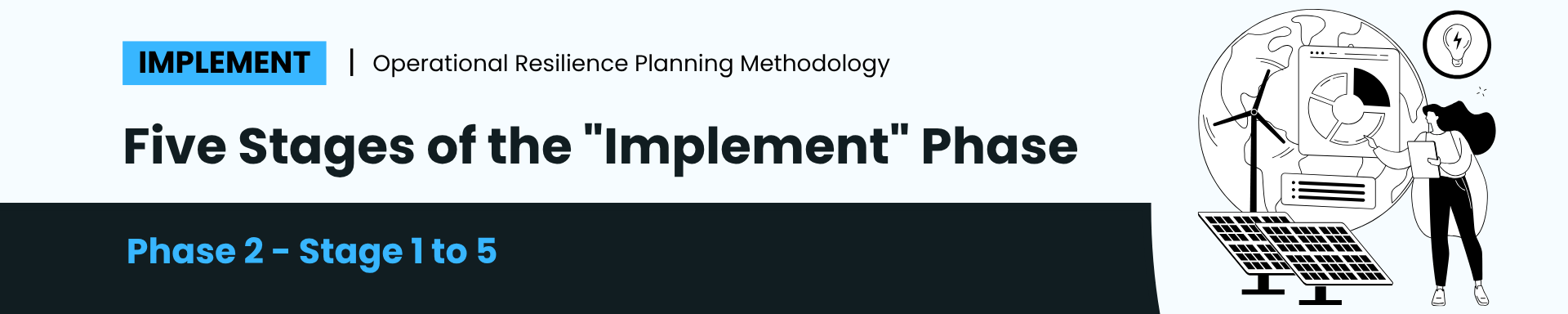
The Implement phase translates strategy into action across business and technology functions.
Stage 1: Identify Critical Business Services
In line with BNM’s operational resilience guidance, CCB Malaysia identifies services whose disruption would:
- Cause significant harm to customers
- Threatens financial stability
- Result in regulatory breaches
- Damage market confidence
Examples may include:
- Corporate payment processing
- Trade finance issuance
- Cross-border remittance services
- Treasury settlement operations
Stage 2: Map Processes and Resources
The bank maps end-to-end processes supporting each critical business service, including:
- IT systems and applications
- Data flows
- Key personnel
- Third-party vendors
- Physical facilities
BNM’s outsourcing requirements demand visibility over third-party dependencies and concentration risks.
Stage 3: Set Impact Tolerance
Impact tolerance defines the maximum acceptable level of disruption. This includes:
- Time-based thresholds (e.g., disruption not exceeding X hours)
- Volume-based tolerances (e.g., maximum backlog)
- Customer harm metrics
These must reflect regulatory expectations and risk appetite statements.
Stage 4: Conduct Scenario Testing
BNM expects severe but plausible scenario testing. CCB Malaysia may test:
- Cyberattacks
- Data centre outages
- Third-party service failure
- Pandemic workforce disruptions
- Cross-border payment system outages
Testing ensures that impact tolerances can realistically be met.
Stage 5: Improve Lesson Learnt
Following testing and real incidents, structured reviews must be conducted. Improvements are documented and integrated into systems, processes, and governance frameworks.
Continuous improvement is central to regulatory compliance.

Phase 3: Sustain

Embedding Resilience into the Organisation
Operational resilience must evolve into a living framework.
Stage 1: Introduce Cultural Change
Resilience must become embedded in decision-making, product development, and risk discussions. Staff must understand that operational resilience is not solely a compliance requirement but a strategic capability.
Stage 2: Develop Communication Strategy
Effective crisis communication plans must address:
- Regulators (BNM notification requirements)
- Corporate clients
- Group headquarters
- Media and stakeholders
Clear communication reduces reputational damage during disruptions.
Stage 3: Implement Training and Awareness
Training programmes ensure that:
- Board members understand resilience oversight
- Senior management understands accountability
- Staff understand incident escalation protocols
Stage 4: Provide Self-Assessment
Periodic self-assessments evaluate ongoing compliance with:
- BNM operational resilience expectations
- RMiT standards
- Internal policies
Stage 5: Conduct Independent Quality Review
Independent assurance—through internal audit or external review—validates that operational resilience frameworks are robust, effective, and compliant.
This aligns with BNM’s expectation for independent oversight of risk management frameworks.
![x [Banner] [Summing] [OR] [E2] [C1] Overview of Operational Resilience Planning Methodology](https://no-cache.hubspot.com/cta/default/3893111/0c551e82-cf06-432c-8498-1d3c9bb2dece.png)
Operational resilience represents a strategic transformation in how financial institutions manage risk.
For China Construction Bank (Malaysia), resilience must reflect its dual identity: a Malaysian-regulated financial institution and a subsidiary of a globally systemic banking group.
By adopting the three-phase methodology outlined in this book—Plan, Implement, and Sustain—the bank can:
- Align with BNM’s operational resilience expectations
- Strengthen governance and accountability
- Protect critical business services
- Enhance cyber and technology resilience
- Reduce third-party and cross-border dependency risks
- Maintain stakeholder confidence during crises
Operational resilience is not a one-time project but an ongoing discipline. Its success depends on leadership commitment, cultural adoption, regulatory alignment, and continuous improvement.
A resilient bank does not avoid disruption entirely, but one that anticipates, withstands, adapts, and recovers from disruption while continuing to serve customers and uphold financial stability.
Through structured implementation and sustained governance, China Construction Bank (Malaysia) can position itself as a resilient, trusted, and future-ready financial institution within Malaysia’s banking landscape.

Blogs marked [x] are under construction.
|
Building a Resilient Banking Institution: Operational Resilience Implementation at China Construction Bank (Malaysia) |
|||
![[OR] [GEN] [P1] [S1-S5] [C2] Five Stages of the _Plan_ Phase](https://no-cache.hubspot.com/cta/default/3893111/78869693-baaa-48cf-836e-13950abc8b16.png)
![[OR] [GEN] [P2] [S1-S5] [C8] Five Stages of the _Implement_ Phase](https://no-cache.hubspot.com/cta/default/3893111/7b251fae-e788-4b59-885f-7079d4845475.png)
![[OR] [GEN] [E2] [P3] [C14] The Five Stages of the Sustain Phase](https://no-cache.hubspot.com/cta/default/3893111/931ae9fa-0925-4f30-ba78-fa9be7662fb7.png)
| C21 [x] | ||
![[OR] [GEN] [E2] [C21] [Back Cover] for eBook 2](https://no-cache.hubspot.com/cta/default/3893111/2e6b224b-6df5-4080-a611-383225744f4f.png) |
||
| C5 [x] | C6 [x] | C7 [x] |
![[OR] [GEN] [E2] [P1] [S3] [C5] Developing Strategy and Roadmap](https://no-cache.hubspot.com/cta/default/3893111/afe40ca7-42c1-448f-9ce7-74955f58c946.png) |
![[OR] [GEN] [E2] [P1] [S4] [C6] Confirming Risk Appetite](https://no-cache.hubspot.com/cta/default/3893111/7228dd2d-4764-4aee-8fb5-899bd5b28874.png) |
![[OR] [GEN] [E2] [P1] [S5] [C7] Developing and Embedding Governance](https://no-cache.hubspot.com/cta/default/3893111/e06994e8-b682-4809-b8b8-a7a4f82d0ec7.png) |
| C11 [x] | C12 [x] | C13 [x] |
![[OR] [GEN] [E2] [P2] [S3] [C11] Establishing Impact Tolerance](https://no-cache.hubspot.com/cta/default/3893111/54b6c9d1-e897-4530-8eb4-8419de7503aa.png) |
![[OR] [GEN] [E2] [P2] [S4] [C12] Performing Scenario Testing](https://no-cache.hubspot.com/cta/default/3893111/fe5cc4a9-b109-417e-ba78-651a6dc4f658.png) |
![[OR] [GEN] [E2] [P2] [S5] [C13] Improving Lessons Learned](https://no-cache.hubspot.com/cta/default/3893111/4e3235b4-3630-4359-89bb-8a3b3c098dc8.png) |
| C17 [x] | C18 [x] | C19 [x] |
![[OR] [GEN] [E2] [P3] [S3] C17] Implementing Training and Awareness](https://no-cache.hubspot.com/cta/default/3893111/1e095f66-dca9-4a83-9850-e459cebddbfa.png) |
![[OR] [GEN] [E2] [P3] [S4] [C18] Providing Self-Assessment](https://no-cache.hubspot.com/cta/default/3893111/076a795c-4733-4fb0-b260-fcec767fb221.png) |
![[OR] [GEN] [E2] [P3] [S5] [C19] Conducting Independent Quality Reviews](https://no-cache.hubspot.com/cta/default/3893111/2cff3f12-e08e-43cf-8ca6-aaa6efe33631.png) |
![eBook Cover [OR] [CCB] [E1] [2D]](https://no-cache.hubspot.com/cta/default/3893111/fd6e83b2-3804-4304-a46c-c92423cc4bf1.png)
![[OR] [GEN] [E2] [C20] Conclusion for eBook 2](https://no-cache.hubspot.com/cta/default/3893111/fb88d7a9-cd61-4414-add4-e284049ff375.png)
![eBook Cover [OR] [CCB] [E3] [2D]](https://no-cache.hubspot.com/cta/default/3893111/3a3fd084-b821-4b45-87af-977064bab906.png)
![[OR] [GEN] [E2] [P1] [S1] [C3] Assessing Capability and Maturity](https://no-cache.hubspot.com/cta/default/3893111/3486f1a4-500e-42ee-a7e1-af2a6008f468.png)
![[OR] [GEN] [E2] [P1] [S2] [C4] Analysing Gaps](https://no-cache.hubspot.com/cta/default/3893111/2c0fd2b3-bb2b-47b6-ad44-5e88c8422b37.png)
![[OR] [GEN] [E2] [P2] [S1] [C9] Identifying Critical Business Services](https://no-cache.hubspot.com/cta/default/3893111/3ac7c230-3ce7-463a-813f-6907a49bdc35.png)
![[OR] [GEN] [E2] [P2] [S2] [C10] Mapping of Processes and Resources](https://no-cache.hubspot.com/cta/default/3893111/e7a81126-d48f-4c84-a7b5-db4324ef1b4f.png)
![[OR] [GEN] [E2] [P3] [S1] [C15] Introducing Cultural Change Management](https://no-cache.hubspot.com/cta/default/3893111/3909fd60-d099-4324-a1d2-2040171a7300.png)
![[OR] [GEN] [E2] [P3] [S2] [C16] Developing a Communication Strategy](https://no-cache.hubspot.com/cta/default/3893111/d3bcd703-2173-4eba-90c3-7d45da459f94.png)


For organisations looking to accelerate their journey, BCM Institute’s training and certification programs, including the OR-5000 Operational Resilience Expert Implementer course, provide in-depth insights and practical toolkits for effectively embedding this model.
More Information About OR-5000 [OR-5] or OR-300 [OR-3]
To learn more about the course and schedule, click the buttons below for the OR-300 Operational Resilience Implementer course and the OR-5000 Operational Resilience Expert Implementer course.


![[BL-OR] [3-4-5] View Schedule](https://no-cache.hubspot.com/cta/default/3893111/d0d733a1-16c0-4b68-a26d-adbfd4fc6069.png)
![[BL-OR] [3] FAQ OR-300](https://no-cache.hubspot.com/cta/default/3893111/f20c71b4-f5e8-4aa5-8056-c374ca33a091.png)
![Email to Sales Team [BCM Institute]](https://no-cache.hubspot.com/cta/default/3893111/3c53daeb-2836-4843-b0e0-645baee2ab9e.png)