![x [OR] [CBC] Title Banner](https://no-cache.hubspot.com/cta/default/3893111/2469e9c7-8c26-46be-a40f-832d893e9227.png)


![x [OR] [CBC] Legal Disclaimer Banner](https://no-cache.hubspot.com/cta/default/3893111/2dcb376b-223f-4162-a06a-b8712ddcf5ff.png)
Operational Resilience Planning Methodology for BDO Unibank
Introduction
![[OR] [BDO] [PH] [E2] [P1 to P3] [C1] OR Planning Methodology](https://no-cache.hubspot.com/cta/default/3893111/3d7e1b93-04ed-447b-9c0f-0d7fed739e92.png)
![eBook Cover [OR] [BDO] [PH] [E2] [2D]](https://no-cache.hubspot.com/cta/default/3893111/6f2d22bd-1a0e-47bd-99ab-6ef0d777f4f6.png)
As one of the oldest and most established financial institutions in the Philippines, China Banking Corporation (China Bank) operates within a highly interconnected, technology-driven, and regulator-intensive environment.
With increasing exposure to cyber threats, third-party dependencies, digital banking disruptions, and systemic risks, the need for a structured and comprehensive Operational Resilience (OR) framework has become imperative.
To address these evolving challenges, China Bank adopts a three-phased Operational Resilience Planning Methodology—Plan, Implement, and Sustain—designed to ensure the bank can prevent, respond to, recover from, and adapt to disruptions while continuing to deliver its critical business services. This methodology aligns with regulatory expectations such as the BSP Circular No. 1203, which emphasises resilience over traditional recovery by focusing on service continuity under severe but plausible scenarios.
Each phase builds upon the previous one, forming a continuous lifecycle of resilience enhancement. The Plan phase establishes the strategic foundation, the Implement phase operationalises resilience capabilities across critical services, and the Sustain phase ensures long-term embedding through governance, culture, and continuous improvement.
Purpose of the Chapter
The purpose of this chapter is to provide a structured overview of China Bank’s Operational Resilience Planning Methodology, enabling readers to clearly understand how the organisation systematically builds, implements, and sustains resilience across its operations.
Specifically, this chapter aims to:
- Explain the three phases of the Operational Resilience lifecycle and how they interrelate
- Clarify the objectives and outcomes of each stage within the phases
- Provide a practical framework that can be replicated or adapted by financial institutions pursuing compliance with regulatory requirements such as BSP Circular No. 1203
- Prepare the reader for deeper exploration of each phase in subsequent chapters
By the end of this chapter, the reader is expected to gain a clear conceptual roadmap of how operational resilience is designed, executed, and continuously enhanced within China Bank.
Overview of the Three Phases of Operational Resilience Planning Methodology
The Operational Resilience Planning Methodology is structured into three key phases:

Phase 1: Plan – Establishing the Foundations
Stages in Phase 1
|
Stage |
Description |
|
Assess Capability and Maturity |
Evaluate China Bank’s existing business continuity, risk management, IT resilience, and crisis management capabilities against recognised frameworks and regulatory expectations. |
|
Analyse Gap |
Identify gaps between current capabilities and target resilience objectives, particularly in relation to critical business services and regulatory compliance. |
|
Develop Strategy and Roadmap |
Define a structured roadmap outlining initiatives, priorities, timelines, and resource requirements to enhance resilience capabilities. |
|
Confirm Risk Appetite |
Establish the bank’s tolerance for disruption, including acceptable levels of operational, financial, and reputational impact. |
|
Develop and Embed Governance |
Create governance structures, roles, and accountability mechanisms to oversee operational resilience implementation and decision-making. |

Outcome of Phase 1
This phase delivers a clear strategic blueprint for operational resilience, ensuring alignment
between business objectives, regulatory expectations, and risk tolerance.

Phase 2: Implement – Translating Strategy into Action

The Implement phase translates strategy into action by focusing on the identification, analysis, and strengthening of critical business services (CBS).
Stages in Phase 2
|
Stage |
Description |
|
Identify Critical Business Services |
Determine the services that, if disrupted, would have significant impact on customers, financial stability, or regulatory obligations. |
|
Map Processes and Resources |
Identify and map the people, processes, technology, facilities, and third parties that support each critical business service. |
|
Set Impact Tolerance |
Define maximum tolerable levels of disruption (e.g., downtime, data loss, customer impact) for each critical service. |
|
Conduct Scenario Testing |
Test resilience capabilities against severe but plausible scenarios such as cyberattacks, system failures, or third-party disruptions. |
|
Improve Lesson Learnt |
Analyse test outcomes and real incidents to identify weaknesses and implement corrective actions. |
Outcome of Phase 2
This phase ensures that China Bank develops operationally resilient capabilities, supported by tested processes, defined tolerances, and a deep understanding of service dependencies.
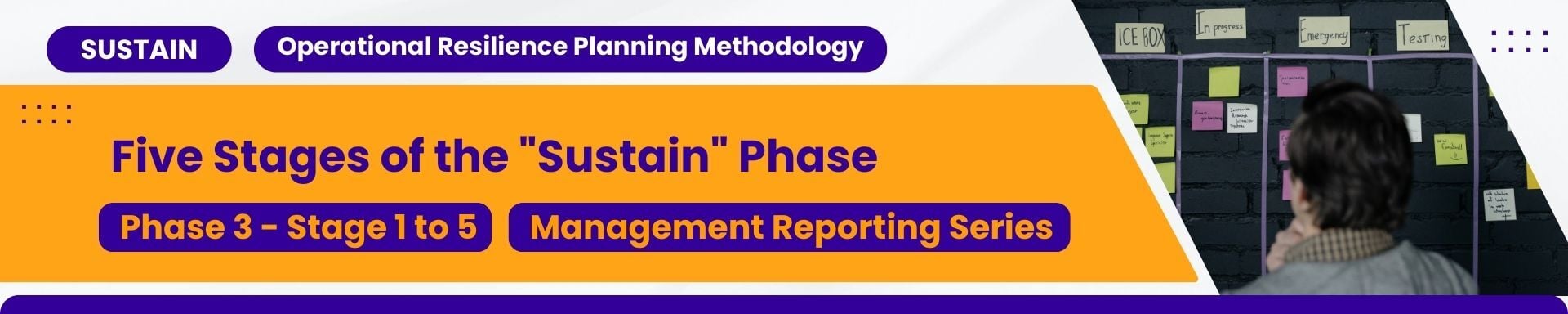
Phase 3: Sustain – Embedding and Continuously Improving Resilience

The Sustain phase ensures that operational resilience becomes an integral part of China Bank’s culture, governance, and continuous improvement processes.
Stages in Phase 3
|
Stage |
Description |
|
Introduce Cultural Change |
Foster a resilience-first mindset across all levels of the organisation, from leadership to operational staff. |
|
Develop Communication Strategy |
Establish clear communication protocols for both normal operations and crisis situations, including internal and external stakeholders. |
|
Implement Training and Awareness |
Conduct regular training, simulations, and awareness programmes to ensure staff readiness. |
|
Provide Self-assessment |
Enable business units to regularly assess their resilience capabilities and compliance with established standards. |
|
Conduct Independent Quality Review |
Perform independent audits or reviews to validate the effectiveness of the operational resilience framework. |
Outcome of Phase 3
This phase ensures long-term sustainability, with resilience continuously monitored, improved, and embedded into the organisation’s DNA.
![x [Banner] [Summing] [OR] [E2] [C1] Overview of Operational Resilience Planning Methodology](https://no-cache.hubspot.com/cta/default/3893111/0c551e82-cf06-432c-8498-1d3c9bb2dece.png)
China Bank’s three-phased Operational Resilience Planning Methodology represents a holistic and iterative approach to managing disruption in an increasingly complex banking environment. By systematically progressing from planning to implementation and ultimately to sustainability, the bank ensures that resilience is not a one-time initiative but an ongoing strategic capability.
This structured methodology not only supports compliance with regulatory frameworks such as BSP Circular No. 1203 but also strengthens China Bank’s ability to protect customers, maintain trust, and ensure financial stability, even in the face of severe disruptions.

Blogs marked [x] are under construction.![x [OR] [BDO] Title Banner](https://no-cache.hubspot.com/cta/default/3893111/7cd9fce2-f5ee-45d0-8b58-a9d11edd3e9c.png)
![[OR] [GEN] [P1] [S1-S5] [C2] Five Stages of the _Plan_ Phase](https://no-cache.hubspot.com/cta/default/3893111/78869693-baaa-48cf-836e-13950abc8b16.png)
![[OR] [GEN] [P2] [S1-S5] [C8] Five Stages of the _Implement_ Phase](https://no-cache.hubspot.com/cta/default/3893111/7b251fae-e788-4b59-885f-7079d4845475.png)
![[OR] [GEN] [E2] [P3] [C14] The Five Stages of the Sustain Phase](https://no-cache.hubspot.com/cta/default/3893111/931ae9fa-0925-4f30-ba78-fa9be7662fb7.png)
| eBook 3 | ||
![eBook Cover [OR] [BDO] [PH] [E3] [2D]](https://no-cache.hubspot.com/cta/default/3893111/7bad677f-5779-418c-aa25-e88ff81cc8ca.png) |
||
| C5 [x] | C6 [x] | C7 [x] |
![[OR] [GEN] [E2] [P1] [S3] [C5] Developing Strategy and Roadmap](https://no-cache.hubspot.com/cta/default/3893111/afe40ca7-42c1-448f-9ce7-74955f58c946.png) |
![[OR] [GEN] [E2] [P1] [S4] [C6] Confirming Risk Appetite](https://no-cache.hubspot.com/cta/default/3893111/7228dd2d-4764-4aee-8fb5-899bd5b28874.png) |
![[OR] [GEN] [E2] [P1] [S5] [C7] Developing and Embedding Governance](https://no-cache.hubspot.com/cta/default/3893111/e06994e8-b682-4809-b8b8-a7a4f82d0ec7.png) |
| C11 [x] | C12 [x] | C13 [x] |
![[OR] [GEN] [E2] [P2] [S3] [C11] Establishing Impact Tolerance](https://no-cache.hubspot.com/cta/default/3893111/54b6c9d1-e897-4530-8eb4-8419de7503aa.png) |
![[OR] [GEN] [E2] [P2] [S4] [C12] Performing Scenario Testing](https://no-cache.hubspot.com/cta/default/3893111/fe5cc4a9-b109-417e-ba78-651a6dc4f658.png) |
![[OR] [GEN] [E2] [P2] [S5] [C13] Improving Lessons Learned](https://no-cache.hubspot.com/cta/default/3893111/4e3235b4-3630-4359-89bb-8a3b3c098dc8.png) |
| C17 [x] | C18 [x] | C19 [x] |
![[OR] [GEN] [E2] [P3] [S3] C17] Implementing Training and Awareness](https://no-cache.hubspot.com/cta/default/3893111/1e095f66-dca9-4a83-9850-e459cebddbfa.png) |
![[OR] [GEN] [E2] [P3] [S4] [C18] Providing Self-Assessment](https://no-cache.hubspot.com/cta/default/3893111/076a795c-4733-4fb0-b260-fcec767fb221.png) |
![[OR] [GEN] [E2] [P3] [S5] [C19] Conducting Independent Quality Reviews](https://no-cache.hubspot.com/cta/default/3893111/2cff3f12-e08e-43cf-8ca6-aaa6efe33631.png) |
![[OR][BSP Guidelines] Key Implementation and Components](https://no-cache.hubspot.com/cta/default/3893111/cceda0e6-1ccc-48c6-8ecc-682910430f1a.png)

![[OR] [GEN] [E2] [C20] Conclusion for eBook 2](https://no-cache.hubspot.com/cta/default/3893111/fb88d7a9-cd61-4414-add4-e284049ff375.png)
![[OR] [GEN] [E2] [C21] [Back Cover] for eBook 2](https://no-cache.hubspot.com/cta/default/3893111/2e6b224b-6df5-4080-a611-383225744f4f.png)
![[OR] [GEN] [E2] [P1] [S1] [C3] Assessing Capability and Maturity](https://no-cache.hubspot.com/cta/default/3893111/3486f1a4-500e-42ee-a7e1-af2a6008f468.png)
![[OR] [GEN] [E2] [P1] [S2] [C4] Analysing Gaps](https://no-cache.hubspot.com/cta/default/3893111/2c0fd2b3-bb2b-47b6-ad44-5e88c8422b37.png)
![[OR] [GEN] [E2] [P2] [S1] [C9] Identifying Critical Business Services](https://no-cache.hubspot.com/cta/default/3893111/3ac7c230-3ce7-463a-813f-6907a49bdc35.png)
![[OR] [GEN] [E2] [P2] [S2] [C10] Mapping of Processes and Resources](https://no-cache.hubspot.com/cta/default/3893111/e7a81126-d48f-4c84-a7b5-db4324ef1b4f.png)
![[OR] [GEN] [E2] [P3] [S1] [C15] Introducing Cultural Change Management](https://no-cache.hubspot.com/cta/default/3893111/3909fd60-d099-4324-a1d2-2040171a7300.png)
![[OR] [GEN] [E2] [P3] [S2] [C16] Developing a Communication Strategy](https://no-cache.hubspot.com/cta/default/3893111/d3bcd703-2173-4eba-90c3-7d45da459f94.png)
 For organisations looking to accelerate their journey, BCM Institute’s training and certification programs, including the OR-5000 Operational Resilience Expert Implementer course, provide in-depth insights and practical toolkits for effectively embedding this model.
More Information About OR-5000 [OR-5] or OR-300 [OR-3]
Gain Competency: For organisations looking to accelerate their journey, BCM Institute’s training and certification programs, including the OR-5000 Operational Resilience Expert Implementer course, provide in-depth insights and practical toolkits for effectively embedding this model.
To learn more about the course and schedule, click the buttons below for the OR-300 Operational Resilience Implementer course and the OR-5000 Operational Resilience Expert Implementer course.


![[BL-OR] [3-4-5] View Schedule](https://no-cache.hubspot.com/cta/default/3893111/d0d733a1-16c0-4b68-a26d-adbfd4fc6069.png)
![[BL-OR] [3] FAQ OR-300](https://no-cache.hubspot.com/cta/default/3893111/f20c71b4-f5e8-4aa5-8056-c374ca33a091.png)
![Email to Sales Team [BCM Institute]](https://no-cache.hubspot.com/cta/default/3893111/3c53daeb-2836-4843-b0e0-645baee2ab9e.png)