


![[OR] [CB] Legal Disclaimer Banner](https://no-cache.hubspot.com/cta/default/3893111/f01cecfa-bf90-40d0-98df-38c4f5cb9706.png)
eBook2: Chapter1
Operational Resilience Implementation at Clarien Bank: A Strategic Framework
Introduction
![[OR] [UOB] [P1 to P3] [C1] OR Planning Methodology](https://no-cache.hubspot.com/cta/default/3893111/48361e77-55bf-4d1f-b7e2-62875e7ad395.png)
![eBook Cover [OR] [CB] [E2] [2D]](https://no-cache.hubspot.com/cta/default/3893111/fb37d393-3894-4480-8af9-2d7e190d73fe.png)
Clarien Bank is a leading private bank headquartered in Bermuda, providing private banking, wealth management, investment advisory, and trust services to high-net-worth individuals, family offices, and institutional clients.
As a financial institution operating within a highly regulated offshore financial environment and serving international clients—including those connected to The Bahamas—Clarien Bank must ensure that its operations remain resilient against disruptions that could threaten financial stability, client confidence, and regulatory compliance.
Operational resilience is no longer limited to traditional business continuity and disaster recovery.
It has evolved into a strategic capability that integrates governance, risk management, technology resilience, third-party oversight, cyber security, and crisis response into a unified framework. For Clarien Bank, operational resilience is essential to:
- Protect client assets and maintain fiduciary integrity
- Safeguard market reputation and stakeholder confidence
- Ensure continuity of critical wealth and banking services
- Comply with cross-border regulatory expectations
- Sustain long-term strategic growth
Financial institutions operating in or servicing clients in The Bahamas are subject to regulatory oversight from the Central Bank of The Bahamas.
The Central Bank has issued operational guidelines that emphasise:
- Strong governance and board oversight of operational risk
- Enterprise-wide risk management frameworks
- Cybersecurity and information security controls
- Business continuity and disaster recovery planning
- Third-party and outsourcing risk management
- Incident reporting and regulatory notification requirements
- Testing and validation of resilience capabilities
Purpose of the Chapter

This chapter is designed to provide readers with a structured understanding of how Clarien Bank approaches operational resilience as a strategic, regulatory, and enterprise-wide priority.
Before exploring the detailed methodology, this section clarifies why operational resilience matters within the context of a private banking institution operating across international jurisdictions, including regulatory expectations applicable to The Bahamas under the oversight of the Central Bank of The Bahamas.
The purpose of this chapter is threefold. First, it establishes the strategic rationale behind Clarien Bank’s three-phase Plan–Implement–Sustain Operational Resilience Planning Methodology.
Second, it explains how regulatory requirements—particularly those relating to governance, outsourcing risk, cybersecurity, business continuity, and incident reporting—shape the Bank’s resilience framework.
Third, it prepares the reader to understand how operational resilience moves beyond traditional business continuity into a measurable, board-driven discipline focused on protecting critical business services, clients, and financial stability.
By the end of this chapter, the reader is expected to:
- Understand the structure and intent of Clarien Bank’s Operational Resilience Planning Methodology
- Recognise the linkage between regulatory compliance and operational resilience design
- Appreciate the importance of governance, impact tolerance, and scenario testing
- Identify how resilience becomes embedded in organisational culture and continuous improvement
This chapter, therefore, serves as a conceptual roadmap, enabling readers to engage with the detailed stages of implementation with clarity, context, and strategic insight.
In line with these expectations, Clarien Bank adopts a structured three-phase Operational Resilience Planning Methodology:
- Phase 1: Plan – Establishing strategy, governance, and capability foundations
- Phase 2: Implement – Operationalising resilience across critical services
- Phase 3: Sustain – Embedding resilience into culture, monitoring, and continuous improvement
This eBook outlines a comprehensive framework tailored to Clarien Bank’s operating model and aligned with regulatory expectations applicable to institutions servicing Bahamian markets.

Phase 1: Plan

The Plan Phase establishes the governance, strategic alignment, and risk appetite required for effective operational resilience implementation.
Stage 1: Assess Capability and Maturity
Clarien Bank conducts a structured maturity assessment across:
- Governance and board oversight
- Operational risk management
- Cyber resilience and IT recovery
- Business continuity management (BCM)
- Third-party risk management
- Incident management and reporting
This assessment measures current practices against leading frameworks and regulatory expectations, including those outlined by the Central Bank of The Bahamas’ operational guidelines.
Stage 2: Analyse Gap
A formal gap analysis identifies deficiencies between:
- Current resilience capabilities
- Regulatory requirements
- Industry best practices
Examples of regulatory-aligned gaps may include:
- Lack of defined impact tolerances for critical services
- Insufficient scenario testing beyond IT disaster recovery
- Incomplete third-party concentration risk analysis
- Limited board reporting on operational resilience metrics
Stage 3: Develop Strategy and Roadmap
Clarien Bank then develops a multi-year resilience roadmap covering:
- Governance enhancements
- Policy updates and framework alignment
- Technology modernization
- Data protection controls
- Crisis management integration
- Regulatory reporting improvements
The roadmap prioritises initiatives based on risk exposure, regulatory urgency, and client impact.
Stage 4: Confirm Risk Appetite
The Board formally articulates operational risk appetite, including:
- Maximum tolerable downtime for critical services
- Acceptable data loss thresholds (RPO/RTO parameters)
- Cyber incident tolerance thresholds
- Outsourcing risk exposure limits
- Client impact thresholds
This aligns with the Central Bank’s expectations for board-level accountability in operational risk oversight.
Stage 5: Develop and Embed Governance
Clarien Bank establishes:
- Operational Resilience Steering Committee
- Defined three lines of defence roles
- Escalation protocols
- Regulatory reporting procedures
- Crisis governance structures
Governance ensures accountability across business, technology, risk, and compliance functions.

Phase 2: Implement

The Implement Phase transforms strategy into operational capability.
Stage 1: Identify Critical Business Services
Clarien Bank identifies services whose disruption would:
- Cause material financial loss
- Harm clients
- Breach regulatory obligations
- Damage financial stability
Examples may include:
- Private banking account access
- Payment and settlement processing
- Investment portfolio management
- Trust administration services
Stage 2: Map Processes and Resources
Each critical business service is mapped to:
- People (key roles and skill dependencies)
- Processes (workflow steps)
- Technology (core banking systems, infrastructure, cloud platforms)
- Facilities (office locations, data centres)
- Third parties (custodians, IT vendors, payment processors)
The Central Bank of The Bahamas requires institutions to maintain adequate oversight of outsourced functions and technology dependencies.
Stage 3: Set Impact Tolerance
Clarien Bank defines measurable tolerances such as:
- Maximum service outage duration
- Maximum tolerable number of affected clients
- Maximum transaction backlogs
- Data integrity thresholds
These are aligned with regulatory expectations for defining acceptable disruption limits.
Stage 4: Conduct Scenario Testing
Clarien Bank conducts severe but plausible scenario testing, including:
- Cyber ransomware attack
- Core banking system failure
- Data centre outage
- Cloud service provider disruption
- Pandemic-related workforce unavailability
- Third-party failure
Testing verifies whether impact tolerances are met.
Stage 5: Improve Lesson Learnt
Post-incident and post-testing reviews identify:
- Control weaknesses
- Communication gaps
- Recovery inefficiencies
- Governance breakdowns
Improvements are tracked through remediation programs.
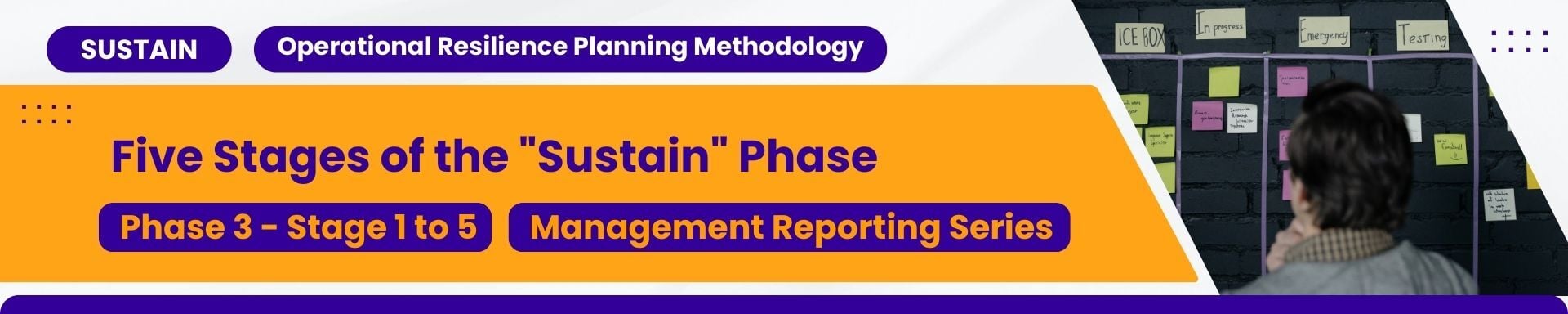
Phase 3: Sustain

The Sustain Phase ensures operational resilience becomes embedded in the organisational culture.
Stage 1: Introduce Cultural Change
Resilience is integrated into:
- Leadership messaging
- Performance objectives
- Risk ownership expectations
- Strategic planning
Operational resilience becomes a shared responsibility.
Stage 2: Develop Communication Strategy
Clear communication channels are defined for:
- Internal crisis coordination
- Client notification
- Regulatory reporting to the Central Bank of The Bahamas
- Media and reputation management
The Central Bank requires timely incident reporting of material operational disruptions.
Stage 3: Implement Training and Awareness
Regular training includes:
- Crisis simulation exercises
- Cyber awareness training
- Business continuity drills
- Board-level tabletop exercises
Stage 4: Provide Self-Assessment
Annual self-assessments evaluate:
- Compliance with operational guidelines
- Effectiveness of controls
- Readiness against evolving threats
- Third-party resilience posture
Stage 5: Conduct Independent Quality Review
Independent validation by:
- Internal Audit
- External auditors
- Regulatory examinations
Ensures objective assessment and continuous improvement.
Additional Operational Resilience Requirements from the Central Bank of The Bahamas
Clarien Bank must also ensure compliance with broader supervisory expectations, including:
- Enterprise Risk Management (ERM) integration
- IT governance and cybersecurity frameworks
- Data protection and confidentiality controls
- Anti-Money Laundering (AML) operational controls
- Outsourcing policy compliance
- Incident escalation timelines
- Recovery and resolution planning
- Capital adequacy linked to operational risk exposure
The Central Bank expects boards to maintain ultimate accountability for operational risk management and to ensure institutions can recover critical services within acceptable timeframes.
![x [Banner] [Summing] [OR] [E2] [C1] Overview of Operational Resilience Planning Methodology](https://no-cache.hubspot.com/cta/default/3893111/0c551e82-cf06-432c-8498-1d3c9bb2dece.png)
Operational resilience is not a compliance exercise—it is a strategic imperative for Clarien Bank. In an increasingly complex and interconnected financial ecosystem, disruptions are inevitable.
The true differentiator lies in preparedness, response capability, and the ability to learn and evolve.
Through its structured Plan–Implement–Sustain methodology, Clarien Bank establishes:
- Clear governance and accountability
- Defined impact tolerances
- Robust scenario testing
- Continuous improvement mechanisms
- Cultural integration of resilience
By aligning its framework with the regulatory expectations of the Central Bank of The Bahamas and international best practices, Clarien Bank positions itself to:
- Protect client trust
- Maintain financial stability
- Strengthen regulatory confidence
- Enhance long-term competitiveness
Operational resilience becomes embedded not only in systems and processes—but in leadership decisions, risk culture, and strategic direction.
Ultimately, resilience at Clarien Bank is the assurance that critical financial services remain secure, reliable, and trusted—even in the face of severe disruption.

Blogs marked [x] are under construction.
![[OR] [UOB] [P1 to P3] [C1] OR Planning Methodology](https://no-cache.hubspot.com/cta/default/3893111/6bfe2adb-5ecf-46f1-8cca-a69fd74f221e.png)
![[OR] [GEN] [P1] [S1-S5] [C2] Five Stages of the _Plan_ Phase](https://no-cache.hubspot.com/cta/default/3893111/78869693-baaa-48cf-836e-13950abc8b16.png)
![[OR] [GEN] [P2] [S1-S5] [C8] Five Stages of the _Implement_ Phase](https://no-cache.hubspot.com/cta/default/3893111/7b251fae-e788-4b59-885f-7079d4845475.png)
![[OR] [GEN] [E2] [P3] [C14] The Five Stages of the Sustain Phase](https://no-cache.hubspot.com/cta/default/3893111/931ae9fa-0925-4f30-ba78-fa9be7662fb7.png)
| C21 [x] | ||
![[OR] [GEN] [E2] [C21] [Back Cover] for eBook 2](https://no-cache.hubspot.com/cta/default/3893111/2e6b224b-6df5-4080-a611-383225744f4f.png) |
||
| C5 [x] | C6 [x] | C7 [x] |
![[OR] [GEN] [E2] [P1] [S3] [C5] Developing Strategy and Roadmap](https://no-cache.hubspot.com/cta/default/3893111/afe40ca7-42c1-448f-9ce7-74955f58c946.png) |
![[OR] [GEN] [E2] [P1] [S4] [C6] Confirming Risk Appetite](https://no-cache.hubspot.com/cta/default/3893111/7228dd2d-4764-4aee-8fb5-899bd5b28874.png) |
![[OR] [GEN] [E2] [P1] [S5] [C7] Developing and Embedding Governance](https://no-cache.hubspot.com/cta/default/3893111/e06994e8-b682-4809-b8b8-a7a4f82d0ec7.png) |
| C11 [x] | C12 [x] | C13 [x] |
![[OR] [GEN] [E2] [P2] [S3] [C11] Establishing Impact Tolerance](https://no-cache.hubspot.com/cta/default/3893111/54b6c9d1-e897-4530-8eb4-8419de7503aa.png) |
![[OR] [GEN] [E2] [P2] [S4] [C12] Performing Scenario Testing](https://no-cache.hubspot.com/cta/default/3893111/fe5cc4a9-b109-417e-ba78-651a6dc4f658.png) |
![[OR] [GEN] [E2] [P2] [S5] [C13] Improving Lessons Learned](https://no-cache.hubspot.com/cta/default/3893111/4e3235b4-3630-4359-89bb-8a3b3c098dc8.png) |
| C17 [x] | C18 [x] | C19 [x] |
![[OR] [GEN] [E2] [P3] [S3] C17] Implementing Training and Awareness](https://no-cache.hubspot.com/cta/default/3893111/1e095f66-dca9-4a83-9850-e459cebddbfa.png) |
![[OR] [GEN] [E2] [P3] [S4] [C18] Providing Self-Assessment](https://no-cache.hubspot.com/cta/default/3893111/076a795c-4733-4fb0-b260-fcec767fb221.png) |
![[OR] [GEN] [E2] [P3] [S5] [C19] Conducting Independent Quality Reviews](https://no-cache.hubspot.com/cta/default/3893111/2cff3f12-e08e-43cf-8ca6-aaa6efe33631.png) |
![eBook Cover [OR] [CB] [E1] [2D]](https://no-cache.hubspot.com/cta/default/3893111/ebc7ed02-a16b-47ff-8dba-c9850456d0e5.png)
![[OR] [GEN] [E2] [C20] Conclusion for eBook 2](https://no-cache.hubspot.com/cta/default/3893111/fb88d7a9-cd61-4414-add4-e284049ff375.png)
![eBook Cover [OR] [CB] [E3] [2D]](https://no-cache.hubspot.com/cta/default/3893111/e428453b-1408-430c-bc90-31450cedea01.png)
![[OR] [GEN] [E2] [P1] [S1] [C3] Assessing Capability and Maturity](https://no-cache.hubspot.com/cta/default/3893111/3486f1a4-500e-42ee-a7e1-af2a6008f468.png)
![[OR] [GEN] [E2] [P1] [S2] [C4] Analysing Gaps](https://no-cache.hubspot.com/cta/default/3893111/2c0fd2b3-bb2b-47b6-ad44-5e88c8422b37.png)
![[OR] [GEN] [E2] [P2] [S1] [C9] Identifying Critical Business Services](https://no-cache.hubspot.com/cta/default/3893111/3ac7c230-3ce7-463a-813f-6907a49bdc35.png)
![[OR] [GEN] [E2] [P2] [S2] [C10] Mapping of Processes and Resources](https://no-cache.hubspot.com/cta/default/3893111/e7a81126-d48f-4c84-a7b5-db4324ef1b4f.png)
![[OR] [GEN] [E2] [P3] [S1] [C15] Introducing Cultural Change Management](https://no-cache.hubspot.com/cta/default/3893111/3909fd60-d099-4324-a1d2-2040171a7300.png)
![[OR] [GEN] [E2] [P3] [S2] [C16] Developing a Communication Strategy](https://no-cache.hubspot.com/cta/default/3893111/d3bcd703-2173-4eba-90c3-7d45da459f94.png)

For organisations looking to accelerate their journey, BCM Institute’s training and certification programs, including the OR-5000 Operational Resilience Expert Implementer course, provide in-depth insights and practical toolkits for effectively embedding this model.
More Information About OR-5000 [OR-5] or OR-300 [OR-3]
Gain Competency: For organisations looking to accelerate their journey, BCM Institute’s training and certification programs, including the OR-5000 Operational Resilience Expert Implementer course, provide in-depth insights and practical toolkits for effectively embedding this model.
To learn more about the course and schedule, click the buttons below for the OR-300 Operational Resilience Implementer course and the OR-5000 Operational Resilience Expert Implementer course.


![[BL-OR] [3-4-5] View Schedule](https://no-cache.hubspot.com/cta/default/3893111/d0d733a1-16c0-4b68-a26d-adbfd4fc6069.png)
![[BL-OR] [3] FAQ OR-300](https://no-cache.hubspot.com/cta/default/3893111/f20c71b4-f5e8-4aa5-8056-c374ca33a091.png)
![Email to Sales Team [BCM Institute]](https://no-cache.hubspot.com/cta/default/3893111/3c53daeb-2836-4843-b0e0-645baee2ab9e.png)







