
![[OR] [BI] Legal Disclaimer Banner](https://no-cache.hubspot.com/cta/default/3893111/b78af26b-21f2-4eb5-be89-d10901d460fb.png)
eBook2: Chapter1
Operational Resilience for Bank Islam: A Structured Three-Phase Methodology
Context and Rationale
![eBook Cover [OR] [BI] [E2] [2D]](https://no-cache.hubspot.com/cta/default/3893111/205b9748-9a08-4765-8faf-410d7f256eb6.png)
 The Malaysian financial sector is undergoing a structural shift driven by accelerated digitalisation, heightened cyber threats, increased third-party dependencies, climate-related physical risks, and rising customer expectations for uninterrupted access to financial services.
For Islamic banks such as Bank Islam, these challenges are amplified by the dual responsibility of ensuring financial stability and Shariah-compliant service continuity.
Bank Negara Malaysia (BNM) has articulated a clear regulatory direction: financial institutions must move beyond traditional recovery-centric business continuity arrangements toward a forward-looking, outcome-based operational resilience approach—one that assumes disruptions are inevitable and focuses on maintaining the continuity of critical business services within tolerable harm thresholds.
In this context, operational resilience is no longer a purely operational or technology concern. It is a board-level strategic imperative that integrates governance, risk appetite, customer impact, third-party management, and continuous learning across the enterprise.
Purpose of the Chapter
 This eBook introduces a three-phase Operational Resilience Planning Methodology tailored for Bank Islam, designed to:
- Align with BNM’s emerging operational resilience expectations while leveraging existing BCM, RMiT, outsourcing, and governance requirements;
- Incorporate global best practices from the Basel Committee on Banking Supervision (BCBS) and other international standard-setters;
- Reflect the operational realities of an Islamic banking institution, including customer-facing retail banking, digital channels, payment services, and Shariah-critical operations; and
- Enable Bank Islam to demonstrate proactive regulatory readiness, strong governance oversight, and measurable resilience outcomes.
The methodology is structured across three interdependent phases: Plan, Implement, and Sustain, each comprising five practical stages.

Phase 1: Plan – Establishing Strategic and Governance Foundations

The Plan Phase focuses on building the strategic, governance, and risk foundations necessary for effective operational resilience. This phase ensures that Bank Islam’s approach is deliberate, risk-informed, and board-driven, rather than reactive.
Stage 1: Assess Capability and Maturity
Bank Islam begins by assessing its current state across BCM, technology resilience, third-party risk, crisis management, and governance maturity. This aligns with BNM’s expectation that institutions understand their existing resilience posture before setting future ambitions
Stage 2: Analyse Gap
Identified gaps are analysed against BNM expectations such as dependency mapping depth, scenario severity, board oversight, and customer harm considerations—areas that may not be fully addressed by traditional MTD/RTO metrics.
Stage 3: Develop Strategy and Roadmap
A multi-year operational resilience roadmap is developed, prioritising investments in critical services, digital banking channels, third-party arrangements, and data visibility—consistent with BNM’s emphasis on long-term capability building over short-term fixes
Stage 4: Confirm Risk Appetite
Bank Islam articulates its operational resilience risk appetite, including tolerable levels of service disruption, customer impact, and reputational harm, thereby complementing existing risk appetite statements and aligning with BNM’s guidance on impact tolerance.
Stage 5: Develop and Embed Governance
Clear accountability structures are established, including board oversight, senior management ownership, and cross-functional coordination, reflecting BNM’s expectation of strong governance and responsibility mapping for operational resilience outcomes.

Phase 2: Implement – Building End-to-End Operational Resilience

The Implement Phase translates strategy into tangible, operational capabilities that protect Bank Islam’s most important services.
Stage 1: Identify Critical Business Services
Bank Islam identifies customer- and market-critical services such as digital banking access, payment services, financing disbursement, and ATM availability—consistent with BNM’s shift from internal functions to external service outcomes.
Stage 2: Map Processes and Resources
End-to-end mapping is conducted across people, processes, technology, data, facilities, and third-party providers, addressing BNM’s concern over opaque interdependencies and concentration risk
2025 BNM Discussion Paper on Op…
Stage 3: Set Impact Tolerance
Impact tolerances are defined by maximum acceptable disruption duration and customer harm, extending beyond traditional RTOs to reflect real-world service expectations.
Stage 4: Conduct Scenario Testing
Severe but plausible scenarios—such as cyberattacks on core banking systems or cloud service outages—are tested to identify vulnerabilities, aligning with BNM’s emphasis on multi-layered and concurrent disruption scenarios
Stage 5: Improve Lessons Learnt
Findings from incidents, near misses, and tests are systematically integrated into remediation plans, reinforcing BNM’s expectation for continuous learning and improvement.
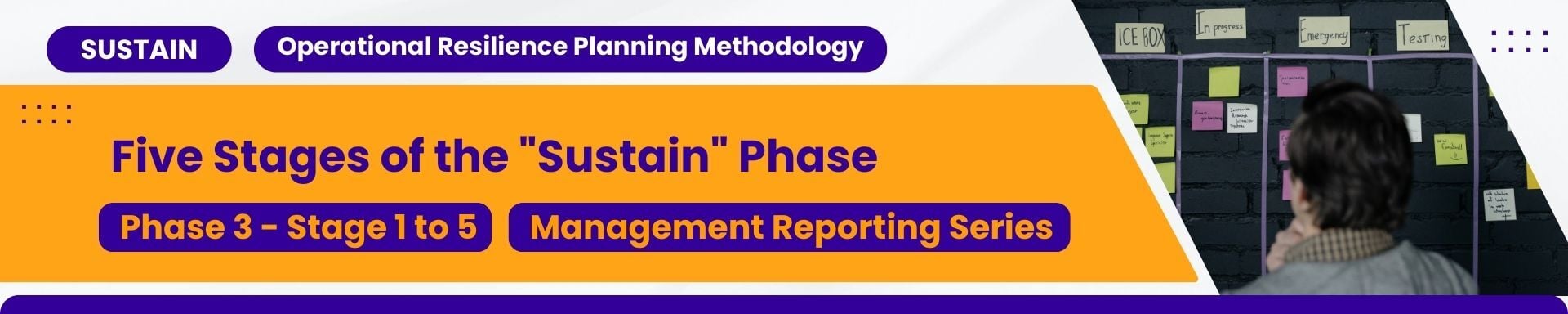
Phase 3: Sustain – Embedding Resilience as an Organisational Capability

The Sustain Phase ensures that operational resilience becomes embedded in Bank Islam’s culture, decision-making, and performance management.
Stage 1: Introduce Cultural Change
Resilience-aware behaviours are promoted across business, technology, and support functions, reinforcing transparency and early escalation.
Stage 2: Develop Communication Strategy
Clear internal and external communication protocols are established to manage stakeholder expectations during disruptions, reflecting BNM’s concern over public confidence and reputational impact.
Stage 3: Implement Training and Awareness
Targeted training is delivered to board members, senior management, and operational teams to enhance resilience literacy and accountability.
Stage 4: Provide Self-Assessment
Regular self-assessments enable Bank Islam to monitor resilience, maturity and regulatory readiness as BNM’s framework evolves.
Stage 5: Conduct Independent Quality Review
Independent assurance provides objective validation of resilience effectiveness and governance robustness.
![x [Banner] [Summing] [OR] [E2] [C1] Overview of Operational Resilience Planning Methodology](https://no-cache.hubspot.com/cta/default/3893111/0c551e82-cf06-432c-8498-1d3c9bb2dece.png)
Strengthening Trust, Stability, and Shariah-Compliant Service Continuity
Operational resilience is rapidly becoming a defining characteristic of a sound, trusted, and future-ready financial institution.
For Bank Islam, the ability to withstand disruption while continuing to deliver Shariah-compliant, customer-critical services is central to maintaining public confidence and fulfilling its role in Malaysia’s financial system.
BNM’s Discussion Paper on Operational Resilience signals a clear regulatory expectation: financial institutions must move decisively from compliance-driven recovery planning towards outcome-focused resilience, underpinned by strong governance, deep visibility of dependencies, realistic scenario testing, and continuous improvement
The three-phase Operational Resilience Planning Methodology presented in this eBook—Plan, Implement, and Sustain—provides Bank Islam with a structured, practical, and regulator-aligned pathway to:
- Strengthen board and senior management oversight;
- Protect customers from intolerable service disruption;
- Address systemic risks arising from digitalisation and third-party dependencies; and
- Demonstrate leadership in operational resilience within Malaysia’s Islamic banking sector.
Ultimately, operational resilience is not a one-off regulatory initiative. It is a strategic journey that enables Bank Islam to remain dependable in times of stress, safeguard stakeholder trust, and contribute meaningfully to the stability and resilience of Malaysia’s financial system—today and in the years ahead.

Blogs marked [x] are under construction.
![x [OR] [BI] [P2] [S1-S5] [C8] Five Stages of the Implement Phase](https://no-cache.hubspot.com/cta/default/3893111/171b8438-d7c4-4eb4-8460-ef22dfa6bf9f.png)
![[OR] [BI] [E2] [P3] [C14] The Five Stages of the Sustain Phase](https://no-cache.hubspot.com/cta/default/3893111/68d31f61-5d41-41bd-85aa-d6e31f9429ab.png)
| eBook 3 | ||
![x eBook Cover [OR] [BI] [E3] [2D]](https://no-cache.hubspot.com/cta/default/3893111/065eaf34-2489-4c1e-8b41-602edee3d735.png) |
||
| C5 [x] | C6 [x] | C7 [x] |
![[OR] [BI] [E2] [P1] [S3] [C5] Developing Strategy and Roadmap](https://no-cache.hubspot.com/cta/default/3893111/a5d12e54-80ba-44d4-9acf-df8f4599dbf3.png) |
![[OR] [BI] [E2] [P1] [S4] [C6] Confirming Risk Appetite](https://no-cache.hubspot.com/cta/default/3893111/1b83a3f7-5c31-4d0e-a104-58587332ddda.png) |
![[OR] [BI] [E2] [P1] [S5] [C7] Developing and Embedding Governance](https://no-cache.hubspot.com/cta/default/3893111/1b56fe34-102b-4fb0-b1cd-cb72f82c1108.png) |
| C11 [x] | C12 [x] | C13 [x] |
![[OR] [BI] [E2] [P2] [S3] [C11] Establishing Impact Tolerance](https://no-cache.hubspot.com/cta/default/3893111/3faa4795-7cfb-48d9-95cd-27f7bc0f8b32.png) |
![[OR] [BI] [E2] [P2] [S4] [C12] Performing Scenario Testing](https://no-cache.hubspot.com/cta/default/3893111/e8dc33a4-d74f-441c-b8fb-a3abc0036dbd.png) |
![[OR] [BI] [E2] [P2] [S5] [C13] Improving Lessons Learned](https://no-cache.hubspot.com/cta/default/3893111/b1888ae6-7504-46e1-8132-558d89d5686d.png) |
| C17 [x] | C18 [x] | C19 [x] |
![[OR] [BI] [E2] [P3] [S3] C17] Implementing Training and Awareness](https://no-cache.hubspot.com/cta/default/3893111/7ac06dc2-ff11-4f66-ab70-9de8f919e1b9.png) |
![[OR] [BI] [E2] [P3] [S4] [C18] Providing Self-Assessment](https://no-cache.hubspot.com/cta/default/3893111/2ef8776e-e00f-4e9b-9710-5daefabbfd16.png) |
![[OR] [BI] [E2] [P3] [S5] [C19] Conducting Independent Quality Reviews](https://no-cache.hubspot.com/cta/default/3893111/ed39a7eb-6998-4146-88f2-f9c7eac4c7be.png) |
![eBook Cover [OR] [BI] [E1] [2D]](https://no-cache.hubspot.com/cta/default/3893111/271f94d9-dc8d-4106-a5ea-7c66aa66c83e.png)

![[OR] [BI] [E2] [P1] [S1] [C3] Assessing Capability and Maturity](https://no-cache.hubspot.com/cta/default/3893111/8ddff714-6b15-4170-9b52-8525a7a2356b.png)
![[OR] [BI] [E2] [P1] [S2] [C4] Analysing Gaps](https://no-cache.hubspot.com/cta/default/3893111/a621c3ff-8ab6-4251-8fd0-cbf93746fee2.png)
![[OR] [BI] [E2] [P2] [S1] [C9] Identifying Critical Business Services](https://no-cache.hubspot.com/cta/default/3893111/439fea91-8f06-4c16-9f95-a2b4c300ac64.png)
![[OR] [BI] [E2] [P2] [S2] [C10] Mapping of Processes and Resources](https://no-cache.hubspot.com/cta/default/3893111/2be09977-4d63-460c-846a-83f17056a112.png)
![[OR] [BI] [E2] [P3] [S1] [C15] Introducing Cultural Change Management](https://no-cache.hubspot.com/cta/default/3893111/78b64e75-4e1f-4aec-baf8-310d944d3f10.png)
![[OR] [BI] [E2] [P3] [S2] [C16] Developing a Communication Strategy](https://no-cache.hubspot.com/cta/default/3893111/6c63da16-6deb-4150-a1a2-e8e69a34e116.png)

 For organisations looking to accelerate their journey, BCM Institute’s training and certification programs, including the OR-5000 Operational Resilience Expert Implementer course, provide in-depth insights and practical toolkits for effectively embedding this model.
More Information About OR-5000 [OR-5] or OR-300 [OR-3]
Gain Competency: For organisations looking to accelerate their journey, BCM Institute’s training and certification programs, including the OR-5000 Operational Resilience Expert Implementer course, provide in-depth insights and practical toolkits for effectively embedding this model.
To learn more about the course and schedule, click the buttons below for the OR-300 Operational Resilience Implementer course and the OR-5000 Operational Resilience Expert Implementer course.


![[BL-OR] [3-4-5] View Schedule](https://no-cache.hubspot.com/cta/default/3893111/d0d733a1-16c0-4b68-a26d-adbfd4fc6069.png)
![[BL-OR] [3] FAQ OR-300](https://no-cache.hubspot.com/cta/default/3893111/f20c71b4-f5e8-4aa5-8056-c374ca33a091.png)
![Email to Sales Team [BCM Institute]](https://no-cache.hubspot.com/cta/default/3893111/3c53daeb-2836-4843-b0e0-645baee2ab9e.png)