
![x [OR] [AmB] Legal Disclaimer Banner](https://no-cache.hubspot.com/cta/default/3893111/c17ea734-ce39-46d1-9b00-ce39367ccfc1.png)
 CBS-1 Retail & Digital Banking
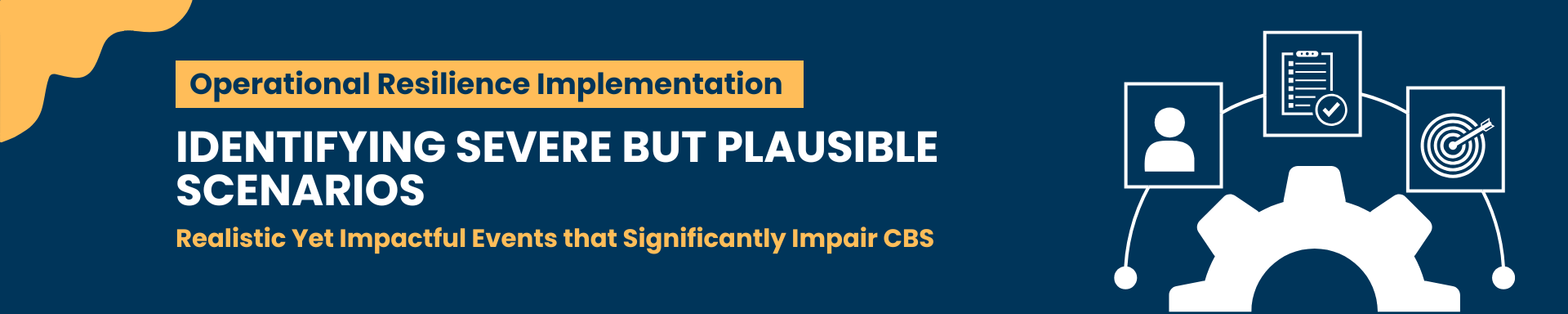
![[OR] [AmB] [E3] [CBS] [1] [SuPS] Identify Severe but Plausible Scenarios](https://no-cache.hubspot.com/cta/default/3893111/74a0ff23-a667-49c3-a8b1-0bb4ee18ec2a.png) Identifying severe but plausible scenarios is a core requirement of operational resilience, enabling AmBank to test whether its Retail & Digital Banking services can remain within defined impact tolerances under extreme yet realistic conditions.
Identifying severe but plausible scenarios is a core requirement of operational resilience, enabling AmBank to test whether its Retail & Digital Banking services can remain within defined impact tolerances under extreme yet realistic conditions.
These scenarios go beyond traditional risk assessments by focusing on service disruption outcomes, rather than isolated causes, and by considering compound events such as cyber incidents, technology failures, third-party outages, and people's unavailability occurring concurrently.
For CBS-1 Retail & Digital Banking, the scenarios below are designed to reflect high-impact disruptions that could materially affect customers, regulatory compliance, financial stability, and trust.
Each scenario explicitly links to the integration of cyber and ICT risks, and demonstrates proactive risk management actions that evidence AmBank’s preparedness, response capability, and continuous improvement in line with modern operational resilience expectations.
![Banner [Table] [OR] [E3] Identify Severe but Plausible Scenarios](https://no-cache.hubspot.com/cta/default/3893111/f4f3c007-e864-48cd-8bc1-0242c8b7fd86.png)
Table P5: Identify Severe but Plausible Scenarios for CBS-1
|
Sub-CBS Code |
Sub-CBS |
Severe but Plausible Scenario |
Impact / Effect |
Proactive Risk Management Action |
Link to Integration of Cyber and ICT Risks |
|
1.1 |
Customer Onboarding & KYC |
Core KYC systems unavailable for 48 hours due to a ransomware attack on the identity verification platform |
Inability to onboard new customers; regulatory breach risk; revenue loss; customer dissatisfaction |
Offline KYC fallback procedures; diversified third-party KYC providers; regular cyber incident simulations |
Cyber attack on third-party SaaS; ICT resilience of identity platforms; data integrity and availability controls |
|
1.2 |
Digital Banking Platform Provisioning |
Major cloud service outage affecting mobile and internet banking platforms during peak hours |
Customers unable to access accounts; reputational damage; increase in call centre volumes |
Multi-region deployment; active-active architecture; periodic cloud exit and failover testing |
Cloud ICT dependency; resilience of hosting infrastructure; integration with cyber resilience testing |
|
1.3 |
Transaction Processing Services |
The core banking transaction engine fails due to a corrupted database following failed patch deployment |
Delayed or failed transactions; potential financial loss; regulatory reporting issues |
Strict change management; pre-production testing; real-time transaction reconciliation |
ICT change risk; cyber-related integrity risk; recovery point objectives (RPOs) |
|
1.4 |
Digital Payments & Settlement |
National payment network disruption, combined with internal gateway failure |
Payment backlogs; missed settlements; merchant and customer impact |
Alternate payment routing, liquidity buffers, and coordination with payment schemes |
External ICT dependency: cyber-physical interconnection with payment ecosystems |
|
1.5 |
Loan & Credit Product Management |
Credit decisioning engine unavailable due to AI model service outage and data feed failure |
Loan approvals delayed; SLA breaches; customer attrition |
Manual credit assessment playbooks; model redundancy; data feed monitoring |
ICT resilience of AI/ML platforms; data pipeline integrity and cyber monitoring |
|
1.6 |
Deposit & Savings Product Management |
Unauthorized configuration change causes incorrect interest calculations for 24 hours |
Financial misstatements; customer complaints; remediation costs |
Segregation of duties; automated controls validation; customer impact remediation plans |
ICT configuration risk; cyber-related access control weaknesses |
|
1.7 |
Customer Support & Service Resolution |
Contact centre systems are unavailable due to a DDoS attack coinciding with a staff shortage |
Customers unable to obtain support; escalation to regulators; reputational harm |
Omnichannel support diversification; cyber DDoS protection; cross-trained staff |
Cyber availability risk; ICT resilience of CRM and telephony systems |
|
1.8 |
Compliance, Risk & Security Monitoring |
Security monitoring tools fail during active cyber intrusion |
Delayed detection; regulatory non-compliance; extended breach impact |
Redundant SOC tooling; independent threat intelligence feeds; 24/7 escalation protocols |
Cyber detection capability; ICT resilience of monitoring and logging infrastructure |
|
1.9 |
Data Analytics & Personalization |
Data lake corrupted due to malware infection affecting analytics workloads |
Loss of customer insights; impaired marketing and risk analytics |
Data segmentation, immutable backups, malware detection on analytics platforms |
Cyber data integrity risk; ICT resilience of big data environments |
|
1.10 |
Back-office Support & Reconciliation |
Reconciliation systems are unavailable due to third-party software failure during the month-end |
Financial reporting delays, audit issues, and operational backlog |
Manual reconciliation contingencies; third-party resilience assurance; recovery testing |
Third-party ICT risk; cyber and operational dependency integration |
![Banner [Summing] [OR] [E3] Identify Severe but Plausible Scenarios](https://no-cache.hubspot.com/cta/default/3893111/446ccb83-e056-40d0-aae5-834d73c13f43.png)
The severe but plausible scenarios identified for CBS-1 Retail & Digital Banking demonstrate how disruptions can arise from interconnected failures across people, process, technology, and third parties, often amplified by cyber and ICT risks.
By grounding scenarios in realistic threat conditions—such as ransomware attacks, cloud outages, data corruption, and third-party failures—AmBank can meaningfully test its ability to continue delivering critical services within acceptable impact thresholds.
Importantly, the inclusion of proactive risk management actions provides tangible evidence of AmBank’s commitment to operational resilience, showing not only how risks are identified but also how they are actively mitigated, monitored, and rehearsed.
This approach strengthens regulatory confidence, protects customers, and ensures that Retail & Digital Banking services remain resilient even under extreme but credible disruption scenarios.
![[OR] [AmB] [E3] [CBS] [1] [DP] Retail & Digital Banking](https://no-cache.hubspot.com/cta/default/3893111/b00c9a8c-e80f-4559-9c4b-8bd4214d03eb.png)
![[OR] [AmB] [E3] [CBS] [1] [MD] Map Dependency](https://no-cache.hubspot.com/cta/default/3893111/1901f5e5-c361-4ddb-a745-d90db93ff68f.png)
![[OR] [AmB] [E3] [CBS] [1] [MPR] Map Processes and Resources](https://no-cache.hubspot.com/cta/default/3893111/11ffd328-c2d3-4d40-ade1-a2cf5b734349.png)
![[OR] [AmB] [E3] [CBS] [1] [ITo] Establish Impact Tolerances](https://no-cache.hubspot.com/cta/default/3893111/fb5ebf39-261f-4021-8b49-9fe150f2ba1a.png)
![[OR] [AmB] [E3] [CBS] [1] [ST] Perform Scenario Testing](https://no-cache.hubspot.com/cta/default/3893111/abc22b9e-b596-4278-a388-19d3f53e53c5.png)

 Gain Competency: For organisations looking to accelerate their journey, BCM Institute’s training and certification programs, including the OR-5000 Operational Resilience Expert Implementer course, provide in-depth insights and practical toolkits for effectively embedding this model.
More Information About OR-5000 [OR-5] or OR-300 [OR-3]
To learn more about the course and schedule, click the buttons below for the OR-300 Operational Resilience Implementer course and the OR-5000 Operational Resilience Expert Implementer course.


![[BL-OR] [3-4-5] View Schedule](https://no-cache.hubspot.com/cta/default/3893111/d0d733a1-16c0-4b68-a26d-adbfd4fc6069.png)
![[BL-OR] [3] FAQ OR-300](https://no-cache.hubspot.com/cta/default/3893111/f20c71b4-f5e8-4aa5-8056-c374ca33a091.png)
![Email to Sales Team [BCM Institute]](https://no-cache.hubspot.com/cta/default/3893111/3c53daeb-2836-4843-b0e0-645baee2ab9e.png)