

IT Disaster Recovery Planning Methodology: A Phased Approach
Try Disasters can strike anytime, threatening your organization's IT infrastructure and disrupting critical business operations. A well-defined IT disaster recovery (DR) plan ensures preparedness. This chapter outlines a seven-phase methodology to implement a comprehensive DR plan systematically.
The initial phases focus on laying the groundwork. You will define your project scope, assemble a cross-functional team, and establish a budget and timeline. Following this, a thorough risk assessment identifies potential threats and their impact on your IT environment. The criticality of your applications is then analyzed, allowing you to define acceptable downtime thresholds and data loss limits.
Once you clearly understand the risks and your application landscape, you can move on to developing DR strategies. This involves exploring options like hot, warm, or cold sites for disaster recovery and data backup and recovery procedures. It is crucial to consider the cost implications and ensure alignment with your broader business continuity plan.
The subsequent phases delve into documenting your DR plan, testing its effectiveness, and establishing a program for continuous improvement. A detailed DR plan outlines specific actions for each disaster scenario, with clearly assigned roles and responsibilities. Regular testing through DR drills helps identify gaps and refine your response procedures.
Finally, maintaining your DR plan through regular reviews and updates, promoting team awareness through training, and staying informed about industry best practices ensure your organization remains prepared to weather any IT storm.
Following this phased approach, you can build a robust and adaptable IT DR plan, safeguarding your critical data and minimizing downtime in the face of unforeseen disruptions.
Seven Phases of the IT Disaster Recovery (DR) Planning Methodology
This outline details the seven phases of the IT disaster recovery (DR) planning methodology, guiding you through the structured implementation of a comprehensive DR plan.
Phase 1: Project Management
Project Kick-Off and Planning (Prepare)
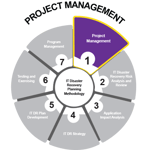 Define Scope and Objectives. Establish the boundaries and goals of your IT DR planning project.
- Assemble the DR Team. Form a cross-functional team comprising IT, impacted departments, and potentially security or risk management specialists.
- Develop Project Timeline and Budget. Create a realistic timeline with milestones for each phase. Establish a budget to cover resources and potential implementation costs.
- Communication Plan. Outline a communication strategy to keep stakeholders informed throughout the project lifecycle.
Phase 2: IT Disaster Recovery Risk Analysis and Review
Threat Landscape Assessment (Identify)
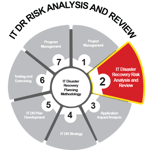 Identify IT Threats. Brainstorm and identify potential IT threats and vulnerabilities, including cyberattacks, natural disasters, hardware failures, and power outages.
- Assess Risk Impact. Evaluate the potential impact of each identified threat on your IT infrastructure, data security, and business continuity. Consider factors like downtime, data loss, and reputational damage.
- Prioritize IT Risks. Prioritize IT risks based on their likelihood and impact to focus efforts on the most critical threats.
Phase 3: Application Impact Analysis
Application Criticality Analysis (Analyze)
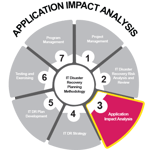 Identify Critical Applications. Define the applications and systems crucial for your business operations. Consider factors like user dependency, the financial impact of downtime, and regulatory compliance requirements.
- Define Recovery Time Objectives (RTOs) and Recovery Point Objectives (RPOs). Establish acceptable downtime thresholds (RTOs) and tolerable data loss limits (RPOs) for each critical application.
Phase 4: IT DR Strategy
Strategy Development (Strategize)
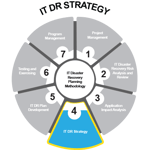 Develop DR Strategies. Based on the risk analysis and application impact assessment, develop high-level IT DR strategies. These might involve hot, warm, or cold site options, data backup and recovery procedures, and business continuity strategies.
- Cost-Benefit Analysis. Analyze the cost implications of different DR strategies and choose the best approach for your risk tolerance and budget.
- Align with Business Continuity Plan. Ensure your IT DR strategy integrates with your broader business continuity plan to achieve a holistic approach to crisis management.
Phase 5: IT DR Plan Development
DR Plan Documentation (Document)
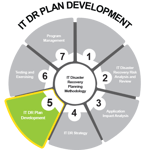 Develop a Detailed DR Plan. Create a comprehensive DR plan outlining specific actions during a disaster.
- Define Roles and Responsibilities. Assign roles and responsibilities to team members for each stage of the disaster response process.
- Document Procedures and Protocols. Document detailed procedures and protocols for data backup, system recovery, communication, and other critical DR activities.
Phase 6: Testing and Exercising
DR Testing and Improvement (Test & Refine)
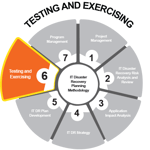 Develop Test Scenarios. Design realistic test scenarios that simulate various disaster situations based on the identified IT risks.
- Conduct DR Drills. Conduct DR drills regularly to test your plan, identify gaps, and refine your response procedures. Evaluate team performance and communication flow during the exercise.
- Update DR Plan based on Test Results. Incorporate learnings from DR drills into your DR plan to improve its effectiveness continually.
Phase 7: Program Management
Program Management and Continuous Improvement (Maintain & Evolve)
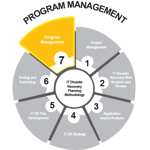 Maintain and Update DR Plan. Schedule regular reviews and updates to your DR plan to reflect changes in your IT environment, evolving threats, and lessons learned from testing and real-world events.
- Promote Awareness and Training. Provide ongoing training and awareness programs to ensure all relevant personnel understand their roles and responsibilities during a disaster.
- Monitor Industry Trends and Best Practices. Stay updated on emerging threats and industry best practices in IT DR to enhance your disaster preparedness posture.
Summing Up ...
By following these seven phases, you can systematically implement a robust IT disaster recovery plan that ensures business continuity and minimizes disruption in the face of unforeseen IT emergencies.

More Information About IT DR Training Course
Contact our colleagues to know more about our IT DR program and when the next course is scheduled. They are the DR-3 or DR-300 IT Disaster Recovery Implementer and the DR-5 or DR-5000 IT Disaster Recovery Expert Implementer.


![Register [BL-DR-3]*](https://no-cache.hubspot.com/cta/default/3893111/15b32c57-3105-4c0c-96fc-92ce68950f81.png)
![FAQ [BL-DR] [5] DRP-5000](https://no-cache.hubspot.com/cta/default/3893111/e1e30273-3d46-4a5b-9f9d-11d9457a377a.png)
![Email to Sales Team [BCM Institute]](https://no-cache.hubspot.com/cta/default/3893111/3c53daeb-2836-4843-b0e0-645baee2ab9e.png)


