---
title: "Module 3 Session 1: Planning Your Operational Resilience Implementation"
description: "Module 3 Session 1: Planning Your Operational Resilience Implementation"
image: https://blog.bcm-institute.org/hubfs/Module%20Morepost/OR/IC_BL-OR-5_Module%203.png
---
[](http://www.bcm-institute.org/)
- [Home](https://www.bcm-institute.org/)
- [About Us](https://www.bcm-institute.org/about-us-3/)
- [A President’s Perspective](https://www.bcm-institute.org/about-us/a-presidents-perspective/)
- [Our History](https://www.bcm-institute.org/about-us/our-history/)
- [Our Advisory Council](https://www.bcm-institute.org/about-us/our-advisory-council/)
- [Customers’ Testimonials](https://www.bcm-institute.org/about-us/customers-testimonials/)
- [Credential Verification](https://www.bcm-institute.org/about-us/credential-verification/)
- [Courses](https://blog.bcm-institute.org/blog/course-fees-for-blended-learning-courses-master-catalog)
- [ISO 22301 Business Continuity Management System Audit](https://blog.bcm-institute.org/audit/business-continuity-management-audit-courses)
- [ISO 22301 Business Continuity Management](https://blog.bcm-institute.org/bcm/business-continuity-management-courses)
- [Crisis Communication](https://blog.bcm-institute.org/crisis-communication/crisis-communication-courses)
- [Crisis Management](https://blog.bcm-institute.org/en/crisis-management/courses)
- [IT Disaster Recovery](https://blog.bcm-institute.org/it-disaster-recovery/courses)
- [Operational Resilience](https://blog.bcm-institute.org/operational-resilience/courses)
- [Operational Resilience Audit](https://blog.bcm-institute.org/operational-resilience-audit/courses)
- [Certification](https://blog.bcm-institute.org/certification/types-of-certifications-offered)
- [ISO 22301 BCMS Audit Certification](https://blog.bcm-institute.org/certification/business-continuity-management-audit-certification)
- [ISO22301 Business Continuity Management Certification](https://blog.bcm-institute.org/bcm/business-continuity-management-certification)
- [Crisis Communication Certification](https://blog.bcm-institute.org/crisis-communication/crisis-communication-certification)
- [Crisis Management Certification](https://blog.bcm-institute.org/en/crisis-management/crisis-management-certification)
- [IT Disaster Recovery Planning Certification](https://blog.bcm-institute.org/it-disaster-recovery/it-disaster-recovery-certification)
- [Operational Resilience Certification](https://blog.bcm-institute.org/operational-resilience/operational-resilience-certification)
- [Operational Resilience Audit Certification](https://blog.bcm-institute.org/operational-resilience-audit)
- [Seminars](https://blog.bcm-institute.org/meet-the-expert/mte-webinar-mainpage)
- [Store](https://www.bcm-institute.org/store-2/)
- [Contact Us](http://www.bcm-institute.org/about-us/contact-us/)
-
-
##### Business Continuity Management
# Module 3 Session 1: Planning Your Operational Resilience Implementation
This session introduces a structured approach to operational resilience implementation, emphasizing project planning, program management, and implementation phases. It discusses the capability and maturity model, risk appetite, and the importance of aligning practices with regulatory standards.
[Moh Heng Goh](https://blog.bcm-institute.org/briefing-or/author/moh-heng-goh) Nov 23, 2023
###### Business Continuity Management Certified Planner-Specialist-Expert
| [![\[BL-OR\] \[3\] \[5\] Module 3](https://no-cache.hubspot.com/cta/default/3893111/4510b0b3-e9dd-4a6e-9133-f6d1423768fe.png)](https://cta-redirect.hubspot.com/cta/redirect/3893111/4510b0b3-e9dd-4a6e-9133-f6d1423768fe) | #### Operational Resilience Expert Implementer #### Module 3 Session 1 | [](https://cta-redirect.hubspot.com/cta/redirect/3893111/ec78d746-1481-4261-936f-3ae9d919d1f4) |
| --- | --- | --- |
Module 3 Session 1 of Operational Resilience Expert Implementer discusses operational resilience's planning and implementation phases, emphasizing a three-phase framework: project planning, program management, and implementation. It highlights the importance of starting with a project plan, followed by program management and implementation.
The emphasis is on the need to understand the difference between operational resilience (OR) and business continuity (BC) and introduces a capability and maturity model for OR.
The model involves assessing the organization's maturity levels and capabilities to achieve the ultimate capability. The session also touches on risk appetite and its alignment with the organization's mission, using the example of protecting a banking license. The text concludes by mentioning gap analysis and the need to align practices with regulatory standards.
In summary, the first session of Module 3 introduces a structured approach to operational resilience implementation, emphasizing project planning, program management, and implementation phases. It discusses the capability and maturity model, risk appetite, and the importance of aligning practices with regulatory standards.
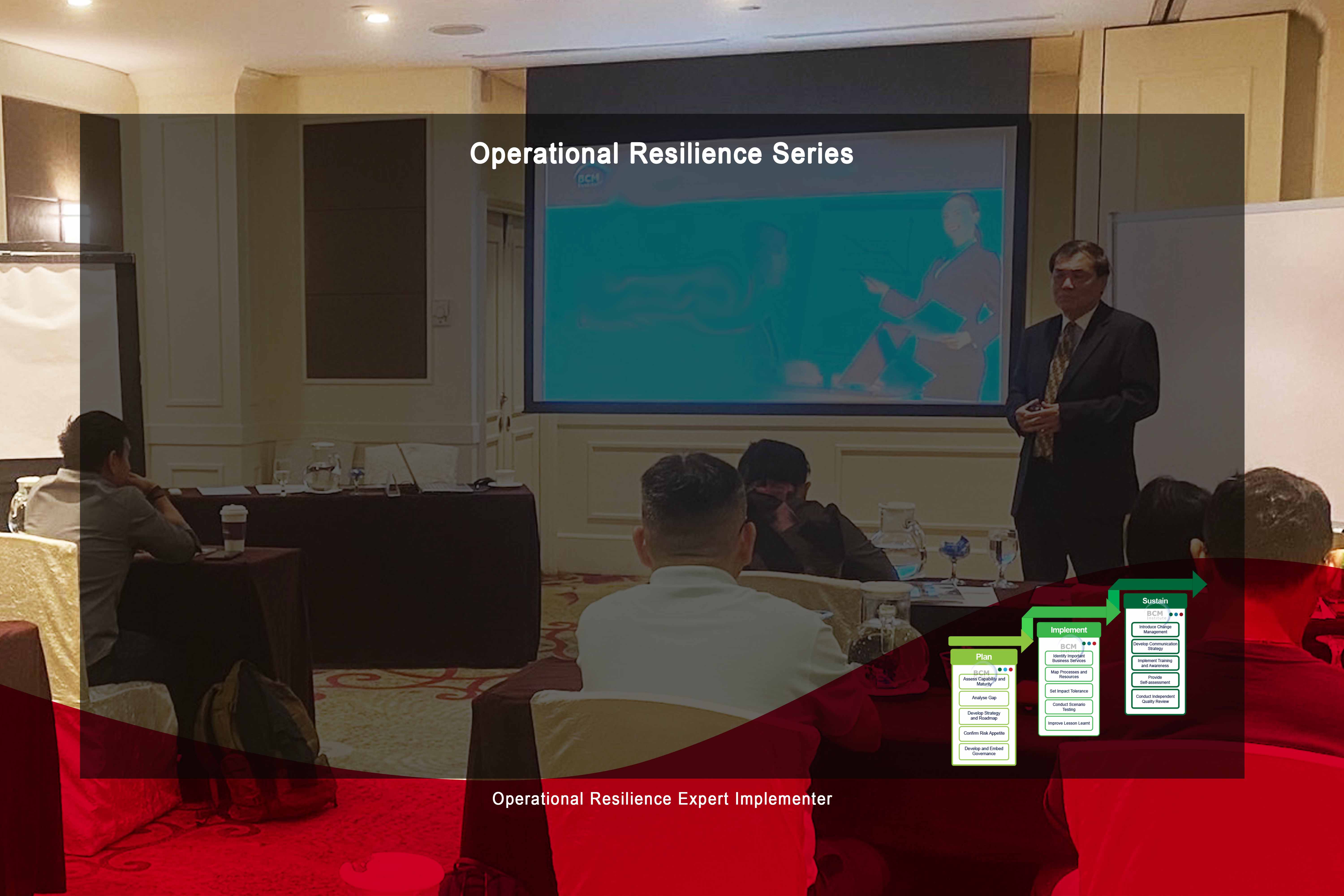
##### Operational Resilience Expert Implementer - Module 3 Session 1
##### Planning Your Operational Resilience Implementation
The introduction to "Planning Your Operational Resilience Implementation" encompasses a comprehensive guide to navigating the Operational Resilience (OR) Training and Certification Roadmap. The initial phase involves strategically planning and developing the initiation of the OR implementation. The emphasis is carefully orchestrating the foundational steps necessary for a successful implementation.
[](https://cta-redirect.hubspot.com/cta/redirect/3893111/b3151014-332e-45ac-b651-9bd7608edbc4)Stage 1 "Assess Capability and Maturity" of the "PLAN" phase of the OR Planning Methodology.
Assessing capability and maturity is a pivotal aspect of the implementation process. The discussion introduces a structured three-phase approach for OR capability and maturity assessment.
This approach systematically evaluates functional capabilities and suitability across various organizational domains, including governance, organizational design, technology, processes, roles, and responsibilities.
The three phases, Assess, Analyse, and Address, form the core framework for this comprehensive evaluation.
| | [](https://cta-redirect.hubspot.com/cta/redirect/3893111/eb987e11-855e-44e7-ab32-07cf21b2fb35) | [](https://cta-redirect.hubspot.com/cta/redirect/3893111/d77fe621-df81-4e2b-86ff-0d7f9d9f7b11) | [](https://cta-redirect.hubspot.com/cta/redirect/3893111/694aed1a-a75a-4356-a56a-1fc5adca879e) | |
| --- | --- | --- | --- | --- |
The first phase, Assess, thoroughly examines existing strengths and weaknesses in each area. The subsequent phase, Analyse, focuses on identifying critical parameters for improvement based on the assessment findings—finally, the Address phase centres around developing and implementing strategies to rectify identified weaknesses, fostering improvement.
Stage 2 "Analyse Gap" of the "PLAN" phase of the OR Planning Methodology
Additionally, the introduction touches upon analyzing gaps, shedding light on the significance of understanding and addressing the disparities between current capabilities and desired objectives. Introducing these key components sets the stage for a structured and strategic approach to planning and executing an Operational Resilience implementation, ensuring organizations are well-equipped to navigate challenges and enhance their overall resilience.
#### **Planning Your Operational Resilience Implementation**
Operational resilience hinges on robust governance and active engagement by the Board of Directors and Senior Management. Securing funding and ensuring the program's success becomes challenging without their buy-in. Accountability is a crucial factor, especially considering regulatory requirements in regions like Singapore, Hong Kong, and Australia, where senior management is explicitly held responsible. This includes adhering to regulations like the Senior Manager or Manager in Charge regime. Integration is crucial, with operational resilience becoming ingrained in the organizational DNA, influencing new products, business processes, and technology changes.
Regarding planning and governance, the focus is on risk appetite statements, ongoing reporting, and active engagement. The organization identifies critical business services, comprising 18 key services, and employs metrics to measure performance, emphasizing impact tolerance and interdependencies. The integration extends to risk and control self-assessment (RCSA) processes, embedding operational resilience components to mitigate risks effectively.
##### **Measuring Impact and Preparedness**
Measuring impact involves assessing harm to the market, firm, and customers, considering factors like transactions, customer impact, and liquidity. This assessment helps determine the impact tolerance level. Testing includes examining dependencies, such as people, facilities, data, tech, and sourcing, ensuring a comprehensive evaluation. The resolution and recovery dimension, specifically addressing liquidity issues, is also critical to impact measurement.
Preparedness involves a concerted effort, bringing together crisis management, incident response, and response teams. An escalation protocol ensures effective and timely crisis response. The approach goes beyond traditional business continuity and crisis management, integrating diverse expertise to enhance the firm's overall operational resilience. End-to-end testing, sometimes involving crisis management functions, is conducted to identify weaknesses and improve response strategies. Industry-wide exercises further contribute to refining responses and preparing for potential scenarios, ensuring that the management is not caught off guard in the event of an actual incident.
#### **Plan and Develop the Initiation of the OR Implementation**
##### Assess Capability and Maturity
[](https://cta-redirect.hubspot.com/cta/redirect/3893111/a5acb961-f2ec-4567-b636-874e365c892e)The initiation phase of Operational Resilience (OR) implementation involves thoroughly examining the organization's capability and maturity levels in operational resilience processes. A three-phase approach is adopted for the assessment, focusing on developing the maturity of processes.
The measurement of the implementation and performance of OR processes provides a snapshot of the organization's operational resilience. This maturity assessment can target specific units, departments, or the entire organization.
##### Analyse Gap
[](https://cta-redirect.hubspot.com/cta/redirect/3893111/48ad32d4-5765-4202-bcfd-4842c25cb2e2)During this phase, specific target objectives for operational resilience are established, and relevant data are collected to analyze the current processes.
Regardless of the organization's position in its operational resilience journey, this stage is crucial for identifying the gaps between the desired state and the current status. The process involves evaluating where the organization wants to be versus its current position, thus defining the gap that needs to be addressed. This analysis sets the foundation for developing the organisation's strategy, roadmap, and risk statement.
##### Plan and Develop Strategy
[](https://cta-redirect.hubspot.com/cta/redirect/3893111/891c6c74-ae2a-4b88-8389-9bd88e49e284)The planning stage focuses on assessing the organization's capability and readiness, understanding the current state through a gap analysis, and developing a strategy and roadmap. Governance plays a critical role in ensuring the success of the operational resilience program.
Establishing proper governance structures ensures that the project remains cohesive and aligned with organizational goals. As organizations embark on this journey, collaboration and learning from regulators and peers become integral, considering the evolving nature of operational resilience. Ultimately, the mission and vision revolve around making the financial institution operationally resilient and ready.
#### **Assess Capability and Maturity in Operational Resilience**
The assessment of capability and maturity is a foundational step in initiating an Operational Resilience (OR) project. Understanding the organisation's capabilities and maturity levels is crucial for developing a comprehensive OR program. This involves evaluating personnel knowledge and technical competencies from ground-level staff to senior management. Additionally, the assessment considers the buy-in from key stakeholders, including financial support and regulatory drivers.
In this phase, the organization evaluates its readiness by examining various dimensions such as strategy, objective setting, governance, and cultural awareness of risk management. The maturity model becomes a guiding framework, allowing organizations to pinpoint their current position on the resilience journey. Engaging with Senior Management and stakeholders through interviews and surveys helps gain insights into individual perspectives, aligning these insights with the end-to-end flow of critical processes.
The assessment extends beyond quantitative measures, recognizing the human element in the evaluation. This involves understanding that biases may exist in individual viewpoints, emphasizing the importance of engaging stakeholders directly. Organizations can foster a culture of resilience by embedding Operational Resilience practices into daily business operations, such as by including mandatory training in e-learning portals. This cultural integration is crucial for ensuring that the OR program adds tangible value to the organization and aligns with the strategic objectives of key stakeholders. Overall, the assessment phase is a vital compass for organizations, guiding them towards a resilient future.
##### **Navigating the Assessment Process: An Insider’s Perspective**
The assessment process involves a multi-faceted approach that includes surveying individuals, conducting interviews, and reviewing existing frameworks and policies. Engaging with various departments ensures a holistic understanding of the organization's resilience landscape. While surveys provide structured questions, interviews offer a more nuanced view, uncovering biases and individual perspectives.
One practical strategy is to align the assessment with existing business processes. For example, integrating resilience considerations into the approval process for new products ensures that resilience becomes an inherent part of decision-making. The emphasis on practical integration extends to mandatory training, using e-learning portals to reinforce key resilience concepts.
The assessment is an ongoing journey; organizations often find themselves at different maturity levels. The realistic acknowledgement of these levels and a commitment to continuous improvement are central to successful resilience initiatives. By weaving Operational Resilience into the fabric of daily operations, organizations can instil a proactive culture that meets regulatory requirements and adds intrinsic value to the business.
#### **Three-Phase Approach of OR Capability and Maturity Assessment**
The Operational Resilience (OR) journey is structured into three key phases: Assess, Analyse, and Address, each contributing to a comprehensive understanding of organizational capabilities and maturity.
###### Phase 1: Assess
Objective: Evaluate the current state of functional capabilities and suitability across various areas within the organization.
Key Areas of Assessment:
- Governance
- Organizational design
- Technology
- Process
- Roles
- Responsibilities
Process:
- Conduct a thorough evaluation of each area to understand the existing strengths and weaknesses.
- Gather data and insights to assess the organization's current functionality.
###### Phase 2: Analyse
Objective: Identify critical parameters for improvement based on the assessment.
Process:
- Utilize scorecards and radar charts to capture and communicate assessment findings.
- Collaborate with the Operational Readiness (OR) team leader to pinpoint the most crucial areas for immediate attention.
###### Phase 3: Address
Objective: Develop and implement strategies to address identified weaknesses and foster improvement.
Process:
- Convene senior management and business heads to address weaknesses collectively.
- Use brainstorming techniques to generate ideas for improvement.
- Compile broad action ideas and use decision tree diagrams for further refinement.
- Organize actionable items into a Gantt chart to create a structured improvement roadmap.
###### Overall Approach:
This three-phase approach aims to comprehensively assess organizational capabilities and maturity. By systematically analysing and addressing weaknesses, the organization can enhance its effectiveness, efficiency, and customer satisfaction. Implementing recommended strategies will better position the organization to achieve its mission and vision.
The initial "Assess" phase evaluates functional capabilities across governance, organizational design, technology, processes, roles, and responsibilities. A thorough examination of strengths and weaknesses is conducted, gathering data to comprehend the organization's current functionality.
Moving to the "Analyse" phase, the objective is to identify critical parameters for improvement based on the assessment. Scorecards and radar charts capture and communicate assessment findings, collaborating with the Operational Readiness (OR) team leader to prioritize crucial areas for immediate attention.
The final "Address" phase involves developing and implementing strategies to rectify identified weaknesses. Senior management and business heads come together to address weaknesses through brainstorming collectively. Action ideas are compiled and refined using decision tree diagrams, and a Gantt chart is employed to create a structured improvement roadmap.
Phase Two emphasises the challenges and urgency of resource acquisition as the OR journey progresses. Engaging senior management, aligning critical business services globally, and addressing regulatory compliance deadlines become focal points. Governance and education are crucial pillars, emphasizing the need for clear committee charters, mandates, and continual stakeholder education.
Analysis and Address (Phase Two) highlights the importance of strategic communication, education, and effective governance structures. Stakeholder involvement is crucial, focusing on embedding operational resilience principles into the organizational DNA. A risk-based approach is discussed, concentrating efforts on high-risk areas and prioritizing action plans.
Addressing Identified Gaps further explores how gaps and areas for improvement serve as foundations for discussions led by business and function heads. Ownership of action plans, ongoing monitoring, and a risk-based approach guide the prioritization of action plans. The conclusion underscores the importance of continuous improvement within people, processes, technology, and governance.
Continuous improvement is framed within four pillars: people, processes, technology, and governance, with senior management holding accountability for the entire operational resilience program. Reporting becomes a comprehensive endeavour, focusing on issues and showcasing successes, highlighting the value brought to the organization.
The presentation concludes by hinting at the following steps, urging the audience to read through a section related to the missing link, and emphasizing the practical application of key principles discussed during the sharing session. Overall, the three-phase approach provides a structured and systematic way to assess, analyze, and address organizational capabilities and maturity in Operational Resilience.
#### **Analyzing the Gap in Operational Resilience**
###### Understanding the Current State
[](https://cta-redirect.hubspot.com/cta/redirect/3893111/a47a6706-91eb-48f5-b1a5-e0999816784c)The discussion on analysing the gap in operational resilience begins by emphasizing the importance of clearly defining the target state. This involves understanding senior management's mission statement and vision, reflecting where the organization aims. The gap analysis, in essence, evaluates the current state against this target, bringing forth the need for collaboration among various subject matter experts. It highlights the significance of involving stakeholders of appropriate seniority across different business lines, ensuring a comprehensive assessment.
###### Key Aspects of Gap Analysis
The gap analysis is viewed through several key lenses, each contributing to a holistic evaluation. Documentation emerges as a critical aspect, with an emphasis on evidence-based results. This satisfies auditors and provides a basis for future assessments and objective identification of gaps. The structure of the gap analysis process is also highlighted, emphasizing the need for careful time management during workshops and interviews. This includes considerations such as sending pre-prepared questions to stakeholders to maximize efficiency.
###### Strategic Vision and Continuous Improvement
The discussion delves into the strategic vision for the future, questioning whether the future state is well-defined. It encourages participants to reverse engineer from a future program management stage, highlighting the importance of building a strong foundation. The mention of capability and maturity models underscores the need for a baseline and framework beyond compliance with current regulatory requirements. The conversation suggests that a well-thought-out model will address current expectations and be a strategic tool for future enhancements and continuous improvement. The speaker urges participants to consider regulatory compliance and the organization's perception of its resilience, paving the way for a proactive and forward-thinking approach.
---
#### Find out more about Blended Learning OR-300 \[BL-OR-3\] and OR-5000 \[BL-OR-5\]
To learn more about the course and schedule, click the buttons below for the OR-3 Blended Learning OR-300 Operational Resilience Implementer course and the OR-5 Blended Learning OR-5000 Operational Resilience Expert Implementer course.
| [](https://cta-redirect.hubspot.com/cta/redirect/3893111/3530eccb-515d-401e-afc2-3469e26d7fbf) | [](https://cta-redirect.hubspot.com/cta/redirect/3893111/fdd4fa9c-ed69-40c1-925f-4eb6a1c5c255) | [](https://cta-redirect.hubspot.com/cta/redirect/3893111/77a34b84-0a6d-44f8-b8d6-6ab04cdf5edd) |
| --- | --- | --- |
| [](https://cta-redirect.hubspot.com/cta/redirect/3893111/6e5c0cda-39b9-4bbd-b3d4-4cf46a790b14) | [](https://cta-redirect.hubspot.com/cta/redirect/3893111/a68a08aa-36d3-4216-9551-202c9fde06ea) | [![ \[BL-OR\] \[3-4-5\] View Schedule](https://no-cache.hubspot.com/cta/default/3893111/d0d733a1-16c0-4b68-a26d-adbfd4fc6069.png)](https://cta-redirect.hubspot.com/cta/redirect/3893111/d0d733a1-16c0-4b68-a26d-adbfd4fc6069) |
| [![\[BL-OR\] \[3\] FAQ OR-300](https://no-cache.hubspot.com/cta/default/3893111/f20c71b4-f5e8-4aa5-8056-c374ca33a091.png)](https://cta-redirect.hubspot.com/cta/redirect/3893111/f20c71b4-f5e8-4aa5-8056-c374ca33a091) | If you have any questions, click to contact us.[![Email to Sales Team \[BCM Institute\]](https://no-cache.hubspot.com/cta/default/3893111/3c53daeb-2836-4843-b0e0-645baee2ab9e.png)](https://cta-redirect.hubspot.com/cta/redirect/3893111/3c53daeb-2836-4843-b0e0-645baee2ab9e) | [](https://cta-redirect.hubspot.com/cta/redirect/3893111/7f2718a4-ea80-4f84-a319-dc2d4df37a46) |
**Comments**
### More Posts
[](https://cta-redirect.hubspot.com/cta/redirect/3893111/839787f4-a4fd-456f-accf-54c947026558)

All rights reserved. Copyright 2026