
![[BCM] [BB] Legal Disclaimer Banner](https://no-cache.hubspot.com/cta/default/3893111/70ed0497-3a94-4c95-a89b-4673ac7382f5.png)
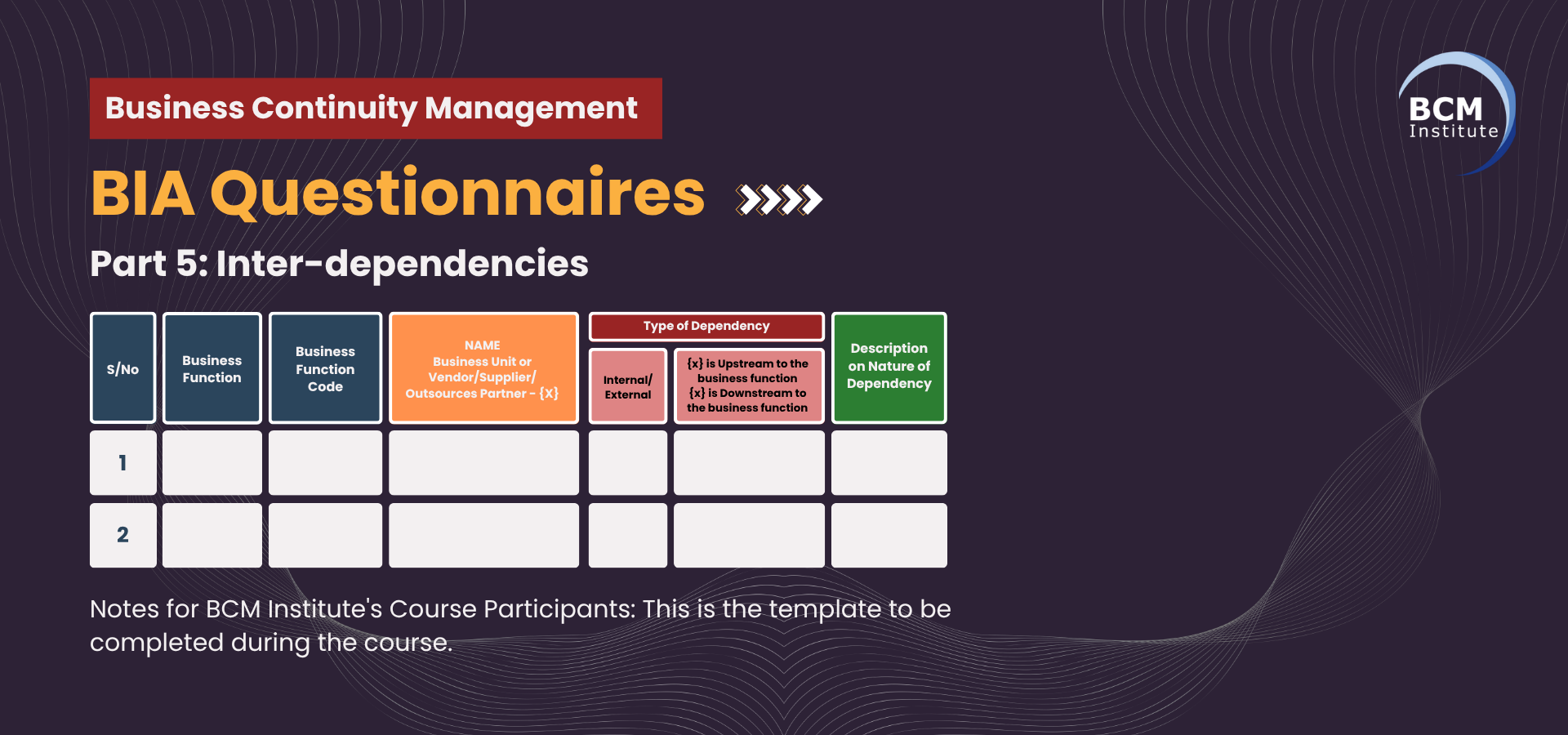 Notes for BCM Institute's Course Participants: This is the template for completing the "Part 5: Inter-dependencies."
 ![Banner [BCM] [E3] [BIA] [P5] Inter-dependencies](https://no-cache.hubspot.com/cta/default/3893111/c7d00b8b-77c0-43ee-a2cf-76ea43b26fe8.png)
CBF-1: Customer Transactions and Payment Processing
Introduction to Part 5 and Part 6
 Assessing the critical elements that underpin the continuity of essential business functions is essential to a comprehensive business impact analysis (BIA).
This chapter deepens the analysis of Boost Bank’s critical business function—customer Transactions and Payment Processing—by examining time-based sensitivity, IT enablement, interdependencies, and the management of vital records.
Part 5 outlines the internal and external interdependencies on which the business function relies. By classifying each dependency as upstream, downstream, or mutual, this table highlights the cascading effects a disruption could have across the organisation and its ecosystem.
Part 6 identifies the vital records essential to the function's continuity and details their media type, storage location, and custodianship. Maintaining access to these records ensures accurate and timely transaction processing during crisis events.
Part 5: Interdependencies
Based on the information from previous discussions and available resources, the following comprehensive table outlines the key business processes and sub-processes for Boost Bank's critical business function: Customer Transactions and Payment Processing.
This table outlines the internal and external dependencies associated with each process.
![Banner [Table] [BCM] [E3] [BIA] [P6] Vital Records [BIAQ]](https://no-cache.hubspot.com/cta/default/3893111/b44d6d49-dfb5-42a1-bc91-c0c701fc0724.png)
Table P5: Inter‑dependencies for CBF-1
| Sub-CBF Code | Sub-Critical Business Function | Name of Business Unit or Vendor/ Supplier/ Outsource Partner | Type of Dependency – Internal | Type of Dependency – External | Type of Dependency – Upstream/ Downstream/ Mutual | Description of the Nature of Dependency |
|---|---|---|---|---|---|---|
| 1.1 | Fund Transfers (Peer-to-Peer and Interbank) | Payments Operations Unit | Yes | No | Upstream | Manages the initiation and processing of fund transfers. |
| 1.1 | Fund Transfers (Peer-to-Peer and Interbank) | DuitNow (PayNet) | No | Yes | Downstream | Provides interbank transfer infrastructure. |
| 1.2 | Bill Payments and Scheduled Payments | Payments Operations Unit | Yes | No | Upstream | Oversees the scheduling and execution of bill payments. |
| 1.2 | Bill Payments and Scheduled Payments | Various Utility Companies | No | Yes | Downstream | Receives and processes scheduled payments. |
| 1.3 | Debit Card Transactions (POS and Online) | Card Services Unit | Yes | No | Upstream | Issues and manages debit card services. |
| 1.3 | Debit Card Transactions (POS and Online) | Visa/Mastercard Networks | No | Yes | Downstream | Facilitates card transaction processing. |
| 1.4 | eWallet-to-Bank Transfers (and vice versa) | Digital Wallet Integration Team | Yes | No | Mutual | Ensures seamless integration between eWallet and bank systems. |
| 1.4 | eWallet-to-Bank Transfers (and vice versa) | Boost eWallet Platform | No | Yes | Mutual | Provides the eWallet platform for transactions. |
| 1.5 | Merchant Payments (QR Code and Online Checkout) | Merchant Services Unit | Yes | No | Upstream | Manages merchant onboarding and payment processing. |
| 1.5 | Merchant Payments (QR Code and Online Checkout) | Boost Biz Merchants | No | Yes | Downstream | Accepts payments via QR codes and online checkouts. |
| 1.6 | Dispute Resolution and Chargebacks | Customer Support Unit | Yes | No | Downstream | Handles customer disputes and chargebacks. |
| 1.6 | Dispute Resolution and Chargebacks | Regulatory Bodies | No | Yes | Upstream | Provides guidelines and regulations for dispute resolution. |
Notes:
-
Internal Dependencies are processes or units within Boost Bank that are essential to executing the business function.
-
External Dependencies involve third-party entities or systems that Boost Bank relies upon to deliver services.
-
Upstream Dependencies are those that provide input into the business function.
-
Downstream Dependencies are those that receive output from the business function.
-
Mutual Dependencies indicate a bidirectional relationship where both entities rely on each other.
This table is constructed based on standard banking operations and the information from previous discussions. For more detailed information on interdependencies, refer to BCM Institute's Part 5: Interdependencies.
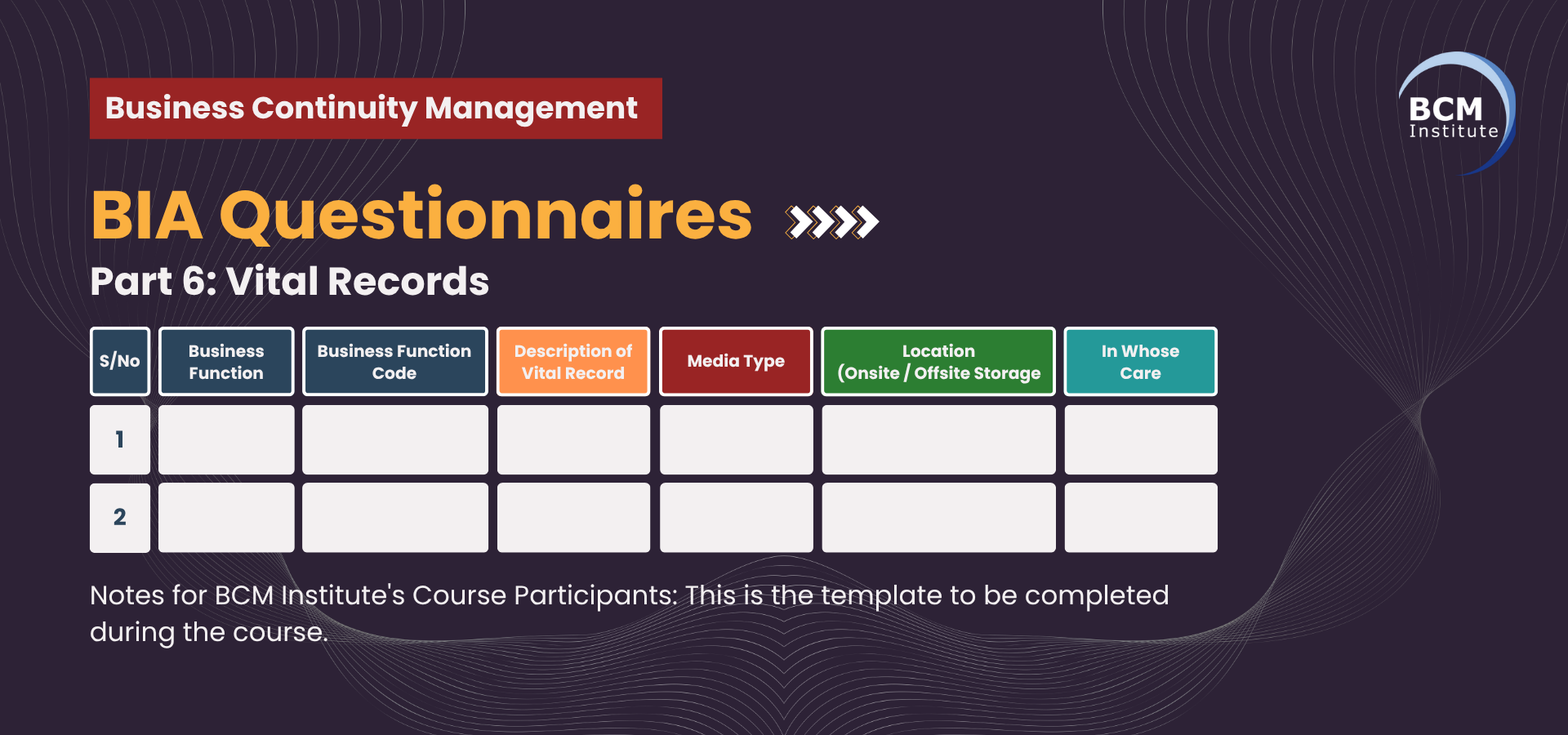
Notes for BCM Institute's Course Participants: This is the template for completing the "Part 6: Vital Records."
![Banner [BCM] [E3] [BIA] [P6] Vital Records](https://no-cache.hubspot.com/cta/default/3893111/6d3e4359-14f4-4816-b274-3f61b92be858.png)
CBF-1: Customer Transactions and Payment Processing
Based on the guidelines from BCMpedia's Part 6: Vital Records, the following comprehensive table details the vital records associated with Boost Bank's critical business function: Customer Transactions and Payment Processing, along with its sub-processes.
This table outlines the description of vital records, media types, storage locations, and custodians responsible for each.
Table P6: Vital Records for CBF-1
| Sub-Critical Business Function | Sub-CBF Code | Description of Vital Records | Media Type | Location | In Whose Care |
|---|---|---|---|---|---|
|
Fund Transfers (Peer-to-Peer and Interbank) |
1.1 | Transaction logs, audit trails, and system configurations | Digital | Cloud storage, off-site backups | IT Security Team |
|
Bill Payments and Scheduled Payments |
1.2 | Payment schedules, customer authorisation records | Digital | Data centres, encrypted archives | Payments Operations Unit |
|
Debit Card Transactions (POS and Online) |
1.3 | Cardholder data, transaction records, compliance reports | Digital | Secure servers, compliance vaults | Card Services Unit |
|
eWallet-to-Bank Transfers (and vice versa) |
1.4 | Integration logs, user consent forms, and transfer records | Digital | Cloud infrastructure, secure databases | Digital Wallet Integration Team |
|
Merchant Payments (QR Code and Online Checkout) |
1.5 | Merchant agreements, transaction histories, and settlement reports | Digital | Merchant services platform, secure archives | Merchant Services Unit |
|
Dispute Resolution and Chargebacks |
1.6 | Dispute case files, communication records, and resolution documents | Digital | Customer support systems, legal archives | Customer Support Unit |
Notes
-
Media Type: All vital records are maintained in digital format to ensure quick access and recovery.
-
Location: Records are stored in secure, redundant locations, including cloud storage and off-site backups, to mitigate the risk of data loss.
-
In Whose Care: Each record is under the custody of the respective unit responsible for the associated business function, ensuring accountability and proper maintenance.
This structured approach to managing vital records ensures that Boost Bank can maintain operational resilience and comply with regulatory requirements during disruptions.
![Banner [BCM] [E3] [BIA] [Summing Up] [P5] Inter-dependencies [BIAQ]](https://no-cache.hubspot.com/cta/default/3893111/117996e6-4a68-4449-880f-d8a48ff3071d.png)
![Banner [BCM] [E3] [BIA] [Summing Up] [P6] Vital Records [BIAQ]](https://no-cache.hubspot.com/cta/default/3893111/06d76589-ebcf-4c9f-8e5b-c27f02938eed.png) This chapter provided a multi-dimensional view of Boost Bank’s critical business function by analysing:
This chapter provided a multi-dimensional view of Boost Bank’s critical business function by analysing:
- The web of internal and external relationships that influence continuity (Table 5), and
-
The vital documentation and records necessary to resume operations (Table 6).
Together, these two components reinforce the operational resilience framework by ensuring that all time-critical, system-dependent, and externally influenced elements are correctly mapped and safeguarded.
This level of detailed analysis enables proactive risk mitigation, optimised recovery planning, and enhanced organisational readiness.





More Information About Business Continuity Management Courses
To learn more about the course and schedule, click the buttons below for the BCM-300 Business Continuity Management Implementer [BCM-3] and the BCM-5000 Business Continuity Management Expert Implementer [BCM-5].


![Register [BL-B-3]*](https://blog.bcm-institute.org/hs-fs/hubfs/hub_generated/resized/19a8306f-6b76-45ff-8585-95111f393aeb.png?width=200&height=56&name=19a8306f-6b76-45ff-8585-95111f393aeb.png)



![FAQ [BL-B-3]](https://blog.bcm-institute.org/hs-fs/hubfs/hub_generated/resized/9b7f5669-8ad6-450b-a98f-5f5d49ebfc8e.png?width=150&height=150&name=9b7f5669-8ad6-450b-a98f-5f5d49ebfc8e.png)
![Email to Sales Team [BCM Institute]](https://blog.bcm-institute.org/hs-fs/hubfs/hub_generated/resized/83ae9ad3-affc-416e-8f51-64218d6d98f2.png?width=100&height=100&name=83ae9ad3-affc-416e-8f51-64218d6d98f2.png)