


Introduction
The risk analysis and review (RAR) work so far listed what could go wrong at Eastern General Hospital (EGH). Chapters 3 and 4 covered the threats and the assumed controls. This chapter asks how bad each threat could be, and how likely it is. The answers turn a list of threats into a ranked set of risks that management can act on.
The assessment supports the risk assessment in clause 8.2.3 of ISO 22301 and uses the  principles of ISO 31000. It represents the current exposure of EGH after the assumed existing controls in Chapter 4 but before any planned control is implemented. The scores are indicative, are not confirmed risk ratings, and must be validated by risk owners and senior management. They support judgement and do not replace it.
Scoring Method
Each threat is scored from 1 to 5 across seven impact areas: finance, operations, legal and regulatory, reputation and image, social responsibility, people, and assets, information technology (IT) systems and information. For a hospital, social responsibility covers patient safety, public health and the effect on the community, including the co-located Eastern Community Hospital.
Table RAR P3-S: Impact and Likelihood Scales for Eastern General Hospital
| Score | Impact Descriptor | Meaning | Likelihood Descriptor |
|---|---|---|---|
| 1 | Very Low (Insignificant) | Routine operations absorb it | 1 – Rare |
| 2 | Low (Minor) | Limited, manageable effect | 2 – Unlikely |
| 3 | Moderate | Material but manageable; needs coordinated management | 3 – Possible |
| 4 | High (Major) | Critical services or obligations significantly affected | 4 – Likely |
| 5 | Very High (Severe) | Hospital's ability to deliver essential care is threatened | 5 – Almost certain |
The risk rating equals the highest impact score multiplied by the likelihood score. The rating is placed in one of four bands.
Table RAR P3-L: Risk Level Bands for Eastern General Hospital
| Rating | Risk Level |
|---|---|
| 1–4 | Very Low / Low |
| 5–9 | Moderate |
| 10–16 | High |
| 17–25 | Very High (Extreme) |
Impact Assessment
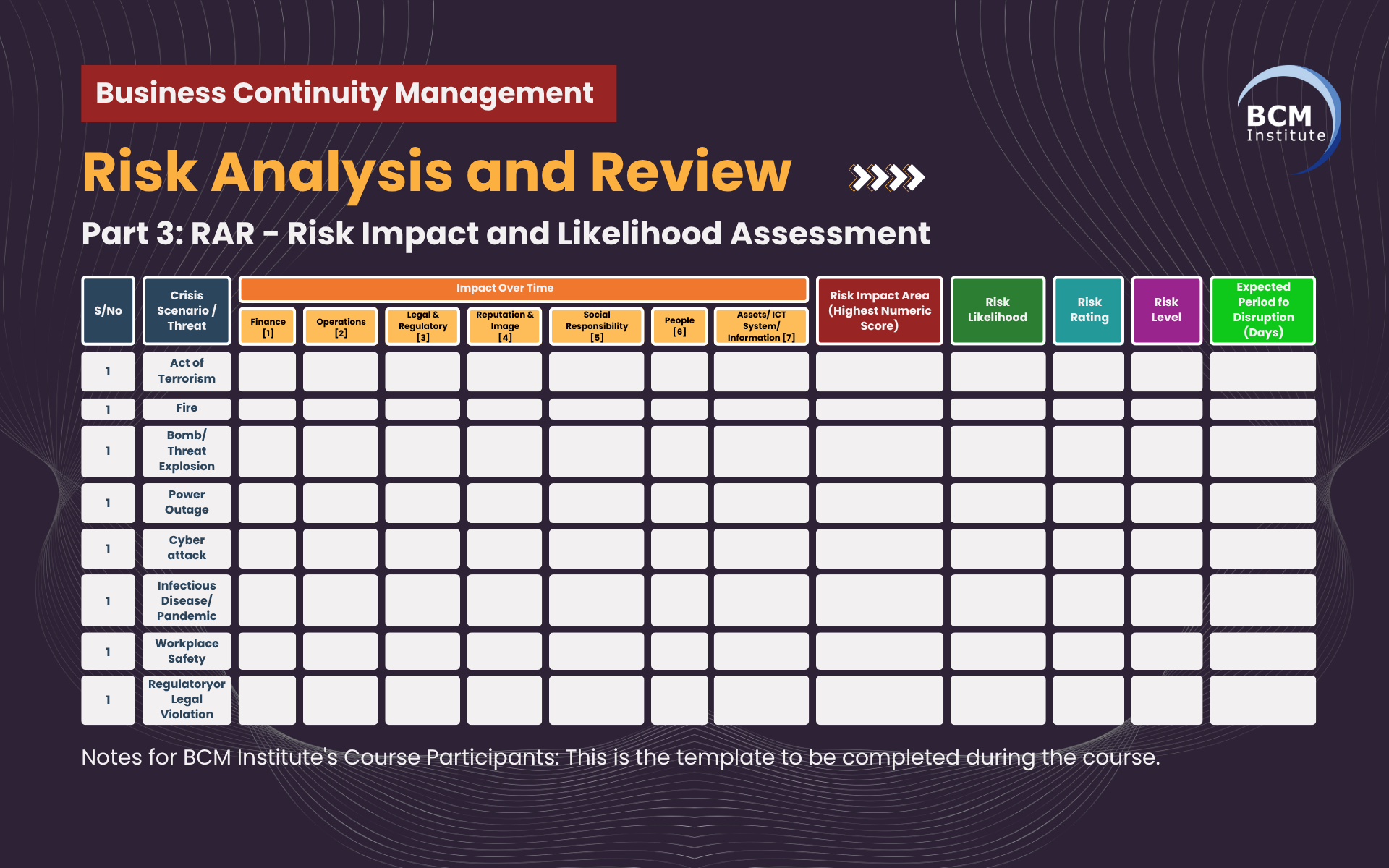
The table gives the seven impact scores for each threat, followed by the highest score and the areas that produce it. Where areas tie, all are listed.
Table RAR P3: Risk Impact Assessment for Eastern General Hospital
| Threat | Finance | Operations | Legal and Regulatory | Reputation and Image | Social Responsibility | People | Assets, IT Systems and Information | Highest Impact Score and Area |
|---|---|---|---|---|---|---|---|---|
| Flash Flood | 3 | 3 | 2 | 3 | 3 | 3 | 3 | 3 – Finance; Operations; Reputation and Image; Social Responsibility; People; Assets, IT Systems and Information |
| Severe Thunderstorm and Lightning | 2 | 3 | 2 | 2 | 2 | 2 | 3 | 3 – Operations; Assets, IT Systems and Information |
| Extreme Heat | 2 | 3 | 2 | 2 | 3 | 3 | 2 | 3 – Operations; Social Responsibility; People |
| Transboundary Haze | 2 | 3 | 2 | 2 | 3 | 3 | 2 | 3 – Operations; Social Responsibility; People |
| Pandemic-Related Movement Restrictions | 4 | 4 | 4 | 4 | 5 | 5 | 3 | 5 – Social Responsibility; People |
| Distant Earthquake Tremors | 2 | 2 | 3 | 2 | 2 | 3 | 3 | 3 – Legal and Regulatory; People; Assets, IT Systems and Information |
| Fire | 5 | 4 | 4 | 4 | 5 | 5 | 5 | 5 – Finance; Social Responsibility; People; Assets, IT Systems and Information |
| Bomb Threat | 3 | 4 | 3 | 4 | 4 | 4 | 2 | 4 – Operations; Reputation and Image; Social Responsibility; People |
| Active Assailant | 3 | 4 | 3 | 5 | 4 | 5 | 2 | 5 – Reputation and Image; People |
| Chemical or Gas Leak | 3 | 4 | 3 | 3 | 4 | 4 | 3 | 4 – Operations; Social Responsibility; People |
| Structural or Building Services Failure | 4 | 4 | 3 | 4 | 4 | 4 | 5 | 5 – Assets, IT Systems and Information |
| Major Road or Public Transport Disruption | 2 | 3 | 2 | 2 | 3 | 3 | 2 | 3 – Operations; Social Responsibility; People |
| Infectious Disease Outbreak | 4 | 4 | 4 | 4 | 5 | 5 | 2 | 5 – Social Responsibility; People |
| Mass Staff Illness | 3 | 4 | 3 | 3 | 4 | 5 | 2 | 5 – People |
| Loss of Key Clinical Personnel | 3 | 4 | 2 | 3 | 4 | 4 | 2 | 4 – Operations; Social Responsibility; People |
| Healthcare Manpower Shortage | 4 | 4 | 3 | 3 | 4 | 4 | 2 | 4 – Finance; Operations; Social Responsibility; People |
| Workplace Violence | 2 | 3 | 3 | 3 | 3 | 4 | 2 | 4 – People |
| Staff Fatigue and Burnout | 3 | 3 | 3 | 3 | 4 | 4 | 2 | 4 – Social Responsibility; People |
| Critical Medical Supplier Failure | 4 | 4 | 3 | 3 | 4 | 4 | 3 | 4 – Finance; Operations; Social Responsibility; People |
| Pharmaceutical Stock-out | 3 | 4 | 3 | 3 | 5 | 4 | 2 | 5 – Social Responsibility |
| Cloud Service Provider Failure | 3 | 4 | 3 | 3 | 3 | 3 | 5 | 5 – Assets, IT Systems and Information |
| Telecommunications Provider Failure | 3 | 4 | 2 | 3 | 3 | 3 | 4 | 4 – Operations; Assets, IT Systems and Information |
| Water Supply Failure | 3 | 5 | 3 | 3 | 4 | 4 | 3 | 5 – Operations |
| Outsourced Service Provider Failure | 3 | 3 | 3 | 3 | 3 | 3 | 2 | 3 – Finance; Operations; Legal and Regulatory; Reputation and Image; Social Responsibility; People |
| Ransomware Attack | 5 | 5 | 5 | 5 | 5 | 4 | 5 | 5 – Finance; Operations; Legal and Regulatory; Reputation and Image; Social Responsibility; Assets, IT Systems and Information |
| Power Failure | 4 | 5 | 3 | 4 | 5 | 5 | 4 | 5 – Operations; Social Responsibility; People |
| Electronic Medical Record System Failure | 3 | 4 | 3 | 3 | 4 | 3 | 5 | 5 – Assets, IT Systems and Information |
| Medical Equipment Failure | 3 | 4 | 3 | 3 | 4 | 4 | 4 | 4 – Operations; Social Responsibility; People; Assets, IT Systems and Information |
| Network and Data Centre Outage | 4 | 5 | 3 | 4 | 4 | 3 | 5 | 5 – Operations; Assets, IT Systems and Information |
| Air-Conditioning and Ventilation Failure | 3 | 4 | 3 | 3 | 4 | 4 | 4 | 4 – Operations; Social Responsibility; People; Assets, IT Systems and Information |
| Data Breach or Insider Misuse | 4 | 3 | 5 | 5 | 3 | 2 | 5 | 5 – Legal and Regulatory; Reputation and Image; Assets, IT Systems and Information |
Likelihood, Rating and Expected Disruption
Likelihood is assessed separately from impact. The expected period of disruption is the credible duration of the operational interruption under the assumed controls. It is not the recovery time objective (RTO), which is a target, nor the maximum tolerable period of disruption (MTPD), which is a limit.
Table RAR P3B: Risk Impact and Likelihood Assessment for Eastern General Hospital
| Threat | Risk Likelihood | Risk Rating | Risk Level | Expected Period of Disruption |
|---|---|---|---|---|
| Flash Flood | 2 – Unlikely | 3 × 2 = 6 | Moderate | 4–8 hours |
| Severe Thunderstorm and Lightning | 3 – Possible | 3 × 3 = 9 | Moderate | 1–4 hours |
| Extreme Heat | 3 – Possible | 3 × 3 = 9 | Moderate | 1–3 days |
| Transboundary Haze | 2 – Unlikely | 3 × 2 = 6 | Moderate | 1–3 days |
| Pandemic-Related Movement Restrictions | 2 – Unlikely | 5 × 2 = 10 | High | More than 1 month |
| Distant Earthquake Tremors | 2 – Unlikely | 3 × 2 = 6 | Moderate | 1–4 hours |
| Fire | 2 – Unlikely | 5 × 2 = 10 | High | 1–3 days |
| Bomb Threat | 2 – Unlikely | 4 × 2 = 8 | Moderate | 4–8 hours |
| Active Assailant | 1 – Rare | 5 × 1 = 5 | Moderate | 8–24 hours |
| Chemical or Gas Leak | 2 – Unlikely | 4 × 2 = 8 | Moderate | 4–8 hours |
| Structural or Building Services Failure | 1 – Rare | 5 × 1 = 5 | Moderate | 3–7 days |
| Major Road or Public Transport Disruption | 3 – Possible | 3 × 3 = 9 | Moderate | 1–4 hours |
| Infectious Disease Outbreak | 3 – Possible | 5 × 3 = 15 | High | 2–4 weeks |
| Mass Staff Illness | 2 – Unlikely | 5 × 2 = 10 | High | 1–2 weeks |
| Loss of Key Clinical Personnel | 3 – Possible | 4 × 3 = 12 | High | 2–4 weeks |
| Healthcare Manpower Shortage | 4 – Likely | 4 × 4 = 16 | High | More than 1 month |
| Workplace Violence | 3 – Possible | 4 × 3 = 12 | High | 1–4 hours |
| Staff Fatigue and Burnout | 4 – Likely | 4 × 4 = 16 | High | More than 1 month |
| Critical Medical Supplier Failure | 3 – Possible | 4 × 3 = 12 | High | 1–2 weeks |
| Pharmaceutical Stock-out | 3 – Possible | 5 × 3 = 15 | High | 1–2 weeks |
| Cloud Service Provider Failure | 2 – Unlikely | 5 × 2 = 10 | High | 4–8 hours |
| Telecommunications Provider Failure | 2 – Unlikely | 4 × 2 = 8 | Moderate | 1–4 hours |
| Water Supply Failure | 1 – Rare | 5 × 1 = 5 | Moderate | 4–8 hours |
| Outsourced Service Provider Failure | 3 – Possible | 3 × 3 = 9 | Moderate | 1–3 days |
| Ransomware Attack | 3 – Possible | 5 × 3 = 15 | High | 1–2 weeks |
| Power Failure | 2 – Unlikely | 5 × 2 = 10 | High | 1–4 hours |
| Electronic Medical Record System Failure | 3 – Possible | 5 × 3 = 15 | High | 4–8 hours |
| Medical Equipment Failure | 3 – Possible | 4 × 3 = 12 | High | 1–3 days |
| Network and Data Centre Outage | 2 – Unlikely | 5 × 2 = 10 | High | 8–24 hours |
| Air-Conditioning and Ventilation Failure | 2 – Unlikely | 4 × 2 = 8 | Moderate | 4–8 hours |
| Data Breach or Insider Misuse | 3 – Possible | 5 × 3 = 15 | High | 1–2 weeks |
High and Extreme Risk Analysis
Seventeen of 31 threats are rated High and none is rated Very High (Extreme); the other 14 are Moderate. This does not mean the hospital is safe from extreme outcomes. It reflects the assumed controls and the low likelihood of the most severe events.
Table RAR P3-H: High Risk Analysis for Eastern General Hospital
| Threat | Highest Impact Area | Main Consequences | Most Significant Existing Control | Principal Control Weakness | Management Attention |
|---|---|---|---|---|---|
| Healthcare Manpower Shortage | Finance; Operations; Social Responsibility; People | Could delay opening of wards and reduce capacity. | Recruitment pipeline | Not yet in place: workforce plan and retention programme tied to phased opening | Urgent mitigation |
| Staff Fatigue and Burnout | Social Responsibility; People | Could raise errors and sickness and drive resignations. | Rostering rules | Not yet in place: fatigue risk management and wellbeing programme | Urgent mitigation |
| Infectious Disease Outbreak | Social Responsibility; People | Could close wards, restrict admissions and strain staff. | Infection control policy and isolation rooms | Not yet in place: outbreak playbook with ward closure rules and rapid cohorting | Urgent mitigation |
| Pharmaceutical Stock-out | Social Responsibility | Could affect treatment of emergency and critical patients. | Medicine stock monitoring | Not yet in place: buffer stock and alternative sourcing for listed critical medicines | Urgent mitigation |
| Ransomware Attack | Finance; Operations; Legal and Regulatory; Reputation and Image; Social Responsibility; Assets, IT Systems and Information | Could halt clinical systems and force manual operations. | Endpoint protection and email filtering | Not yet in place: network segmentation, immutable backups and a tested cyber recovery plan | Urgent mitigation |
| Electronic Medical Record System Failure | Assets, IT Systems and Information | Could delay orders, results and medication. | System redundancy | Not yet in place: downtime playbook with read-only access and data reconciliation | Urgent mitigation |
| Data Breach or Insider Misuse | Legal and Regulatory; Reputation and Image; Assets, IT Systems and Information | Could breach privacy law and damage public trust. | Role-based access and logging | Not yet in place: privileged access management and breach response drill | Urgent mitigation |
| Loss of Key Clinical Personnel | Operations; Social Responsibility; People | Could stop niche services and reduce quality. | Succession planning | Not yet in place: deputy and cross-cover map for all critical specialties | Planned mitigation |
| Workplace Violence | People | Could injure staff and cause absences. | Security presence in emergency areas | Not yet in place: de-escalation training and panic alarm coverage | Planned mitigation |
| Critical Medical Supplier Failure | Finance; Operations; Social Responsibility; People | Could delay surgery and stop procedures. | Approved supplier list | Not yet in place: dual-sourcing for critical items and supplier continuity assessments | Planned mitigation |
| Medical Equipment Failure | Operations; Social Responsibility; People; Assets, IT Systems and Information | Could stop imaging or life support. | Maintenance contracts | Not yet in place: equipment criticality list and loaner agreements | Planned mitigation |
| Pandemic-Related Movement Restrictions | Social Responsibility; People | Could limit staff travel, visitor flow and supply deliveries while demand rises. | Infectious disease preparedness plan | Not yet in place: pandemic playbook with surge beds, cohorting and staff travel passes | Planned mitigation |
| Fire | Finance; Social Responsibility; People; Assets, IT Systems and Information | Could force phased evacuation of non-ambulant patients and damage plant or records. | Fire detection, sprinklers and compartmentation | Not yet in place: phased evacuation drills, patient transfer plan and fire-damage recovery contracts | Planned mitigation |
| Mass Staff Illness | People | Could reduce safe staffing and force service reductions. | Cross-trained staff roster | Not yet in place: minimum safe staffing matrix and agency back-up | Planned mitigation |
| Cloud Service Provider Failure | Assets, IT Systems and Information | Could cut access to cloud-hosted records or telehealth. | Service level agreement with provider | Not yet in place: cloud exit and failover strategy; tested downtime mode | Planned mitigation |
| Power Failure | Operations; Social Responsibility; People | Could stop life-support equipment and cooling. | Standby generators and uninterruptible power | Not yet in place: generator load tests, fuel contracts and manual fallbacks | Planned mitigation |
| Network and Data Centre Outage | Operations; Assets, IT Systems and Information | Could cut all connected systems. | Redundant core network | Not yet in place: data centre failover exercise | Planned mitigation |
Analysis by Impact Area
Assets, IT Systems and Information has the most threats scoring 5 (7), followed by Social Responsibility (6) and People (6). Several threats, such as ransomware, power failure and fire, score high in many areas at once, so they need cross-functional investment rather than a single owner.
Table RAR P3-A: Impact Area Analysis for Eastern General Hospital
| Impact Area | Threats Scoring 5 | Threats Scoring 4 | Threats Scoring 5 (names) |
|---|---|---|---|
| Finance | 2 | 8 | Fire, Ransomware Attack |
| Operations | 4 | 17 | Water Supply Failure, Ransomware Attack, Power Failure, Network and Data Centre Outage |
| Legal and Regulatory | 2 | 3 | Ransomware Attack, Data Breach or Insider Misuse |
| Reputation and Image | 3 | 7 | Active Assailant, Ransomware Attack, Data Breach or Insider Misuse |
| Social Responsibility | 6 | 14 | Pandemic-Related Movement Restrictions, Fire, Infectious Disease Outbreak, Pharmaceutical Stock-out, Ransomware Attack and others |
| People | 6 | 13 | Pandemic-Related Movement Restrictions, Fire, Active Assailant, Infectious Disease Outbreak, Mass Staff Illness and others |
| Assets, IT Systems and Information | 7 | 4 | Fire, Structural or Building Services Failure, Cloud Service Provider Failure, Ransomware Attack, Electronic Medical Record System Failure and others |
- Delayed impacts: regulatory action and loss of public trust after a data breach may emerge weeks after the event.
- Continuing impacts: backlogs of postponed surgery and clinics continue after services resume.
- Amplifiers: dependence on a single network, data centre or supplier can turn a local fault into a hospital-wide event.
Likelihood and Expected Disruption Analysis
- Highest likelihood: Healthcare Manpower Shortage, Staff Fatigue and Burnout.
- Low likelihood but severe: Pandemic-Related Movement Restrictions, Fire, Active Assailant, Structural or Building Services Failure, Mass Staff Illness, Cloud Service Provider Failure, Water Supply Failure, Power Failure, Network and Data Centre Outage.
- Prolonged disruption (two weeks or more): Pandemic-Related Movement Restrictions, Infectious Disease Outbreak, Loss of Key Clinical Personnel, Healthcare Manpower Shortage, Staff Fatigue and Burnout.
- Dependent on external parties: Critical Medical Supplier Failure, Pharmaceutical Stock-out, Cloud Service Provider Failure, Telecommunications Provider Failure, Outsourced Service Provider Failure, Water Supply Failure, Power Failure.
- Needing early warning: weather-related threats, outbreaks and cyber threats benefit from monitoring and alerts.
A threat of moderate likelihood can still need urgent action where the impact is severe or the disruption is long, because the hospital cannot rebuild trust, staff or stock quickly once the event has happened.
Risk Prioritisation
Threats are ranked by risk level and rating, then by the severity of legal, social and people impact, then by the expected duration. A lower-rated threat with safety implications, such as an active assailant, is kept in the list with a crisis management response so that it is not ignored.
Table RAR P3A: Risk Prioritisation for Eastern General Hospital
| Priority Rank | Threat | Highest Impact Area | Likelihood | Risk Rating | Risk Level | Expected Disruption Period | Recommended Management Response |
|---|---|---|---|---|---|---|---|
| 1 | Healthcare Manpower Shortage | Finance (and 3 tied) | 4 – Likely | 16 | High | More than 1 month | Immediate mitigation; detailed business continuity strategy |
| 2 | Staff Fatigue and Burnout | Social Responsibility (and 1 tied) | 4 – Likely | 16 | High | More than 1 month | Immediate mitigation; detailed business continuity strategy |
| 3 | Infectious Disease Outbreak | Social Responsibility (and 1 tied) | 3 – Possible | 15 | High | 2–4 weeks | Immediate mitigation; detailed business continuity strategy |
| 4 | Pharmaceutical Stock-out | Social Responsibility | 3 – Possible | 15 | High | 1–2 weeks | Immediate mitigation; supplier continuity assurance |
| 5 | Ransomware Attack | Finance (and 5 tied) | 3 – Possible | 15 | High | 1–2 weeks | Immediate mitigation; IT disaster recovery enhancement |
| 6 | Data Breach or Insider Misuse | Legal and Regulatory (and 2 tied) | 3 – Possible | 15 | High | 1–2 weeks | Immediate mitigation; IT disaster recovery enhancement |
| 7 | Electronic Medical Record System Failure | Assets, IT Systems and Information | 3 – Possible | 15 | High | 4–8 hours | Immediate mitigation; IT disaster recovery enhancement |
| 8 | Loss of Key Clinical Personnel | Operations (and 2 tied) | 3 – Possible | 12 | High | 2–4 weeks | Detailed business continuity strategy |
| 9 | Critical Medical Supplier Failure | Finance (and 3 tied) | 3 – Possible | 12 | High | 1–2 weeks | Supplier continuity assurance |
| 10 | Medical Equipment Failure | Operations (and 3 tied) | 3 – Possible | 12 | High | 1–3 days | Detailed business continuity strategy |
| 11 | Workplace Violence | People | 3 – Possible | 12 | High | 1–4 hours | Detailed business continuity strategy |
| 12 | Pandemic-Related Movement Restrictions | Social Responsibility (and 1 tied) | 2 – Unlikely | 10 | High | More than 1 month | Detailed business continuity strategy |
| 13 | Mass Staff Illness | People | 2 – Unlikely | 10 | High | 1–2 weeks | Detailed business continuity strategy |
| 14 | Fire | Finance (and 3 tied) | 2 – Unlikely | 10 | High | 1–3 days | Crisis management scenario development |
| 15 | Power Failure | Operations (and 2 tied) | 2 – Unlikely | 10 | High | 1–4 hours | Detailed business continuity strategy |
| 16 | Network and Data Centre Outage | Operations (and 1 tied) | 2 – Unlikely | 10 | High | 8–24 hours | IT disaster recovery enhancement |
| 17 | Cloud Service Provider Failure | Assets, IT Systems and Information | 2 – Unlikely | 10 | High | 4–8 hours | Supplier continuity assurance |
| 18 | Extreme Heat | Operations (and 2 tied) | 3 – Possible | 9 | Moderate | 1–3 days | Routine monitoring |
| 19 | Outsourced Service Provider Failure | Finance (and 5 tied) | 3 – Possible | 9 | Moderate | 1–3 days | Routine monitoring |
| 20 | Major Road or Public Transport Disruption | Operations (and 2 tied) | 3 – Possible | 9 | Moderate | 1–4 hours | Crisis management scenario development |
| 21 | Severe Thunderstorm and Lightning | Operations (and 1 tied) | 3 – Possible | 9 | Moderate | 1–4 hours | Routine monitoring |
| 22 | Bomb Threat | Operations (and 3 tied) | 2 – Unlikely | 8 | Moderate | 4–8 hours | Crisis management scenario development |
| 23 | Chemical or Gas Leak | Operations (and 2 tied) | 2 – Unlikely | 8 | Moderate | 4–8 hours | Crisis management scenario development |
| 24 | Air-Conditioning and Ventilation Failure | Operations (and 3 tied) | 2 – Unlikely | 8 | Moderate | 4–8 hours | Routine monitoring |
| 25 | Telecommunications Provider Failure | Operations (and 1 tied) | 2 – Unlikely | 8 | Moderate | 1–4 hours | Routine monitoring |
| 26 | Transboundary Haze | Operations (and 2 tied) | 2 – Unlikely | 6 | Moderate | 1–3 days | Routine monitoring |
| 27 | Flash Flood | Finance (and 5 tied) | 2 – Unlikely | 6 | Moderate | 4–8 hours | Routine monitoring |
| 28 | Distant Earthquake Tremors | Legal and Regulatory (and 2 tied) | 2 – Unlikely | 6 | Moderate | 1–4 hours | Routine monitoring |
| 29 | Active Assailant | Reputation and Image (and 1 tied) | 1 – Rare | 5 | Moderate | 8–24 hours | Crisis management scenario development |
| 30 | Structural or Building Services Failure | Assets, IT Systems and Information | 1 – Rare | 5 | Moderate | 3–7 days | Crisis management scenario development |
| 31 | Water Supply Failure | Operations | 1 – Rare | 5 | Moderate | 4–8 hours | Routine monitoring |
Management Validation
- Owner review: threat owners and function owners confirm the scores and the controls they rely on.
- Specialist input: IT, security, facilities, human resources and procurement test the assumptions in their areas.
- Challenge: risk management and business continuity management challenge scores that look too low or too high.
- Evidence: scores are checked against incident data, threat intelligence and exercise results.
- Approval: senior management approves the scores through the hospital's risk governance process and records any override.
- Review: scores are refreshed at least yearly and after incidents, exercises or major changes.

Impact and likelihood scoring turns the Threat Register of EGH into prioritised risk information. The highest impact score and likelihood give the rating, but professional judgement still decides how it is used. The 17 High threats, listed in Table RAR P3-H and ranked in Table RAR P3A, should drive mitigation and continuity investment.
A risk assessment must show not only which threats may occur, but also how severe the consequences are, how likely they are and how long they could disrupt the essential services of the hospital. The next chapter sets out the mitigation strategies that follow.
Continue reading: Chapter 6, Mitigation Strategies for Eastern General Hospital, sets residual risk targets and mitigation strategies for each threat.







