


Introduction
Before Eastern General Hospital (EGH) can rank its risks, it must know what could disrupt it.
A threat is a source of potential disruption, such as a flood, a cyber attack on information technology (IT) systems or a shortage of nurses. A vulnerability is a weakness that lets the threat cause harm, and a risk combines the two with the consequence for the hospital.
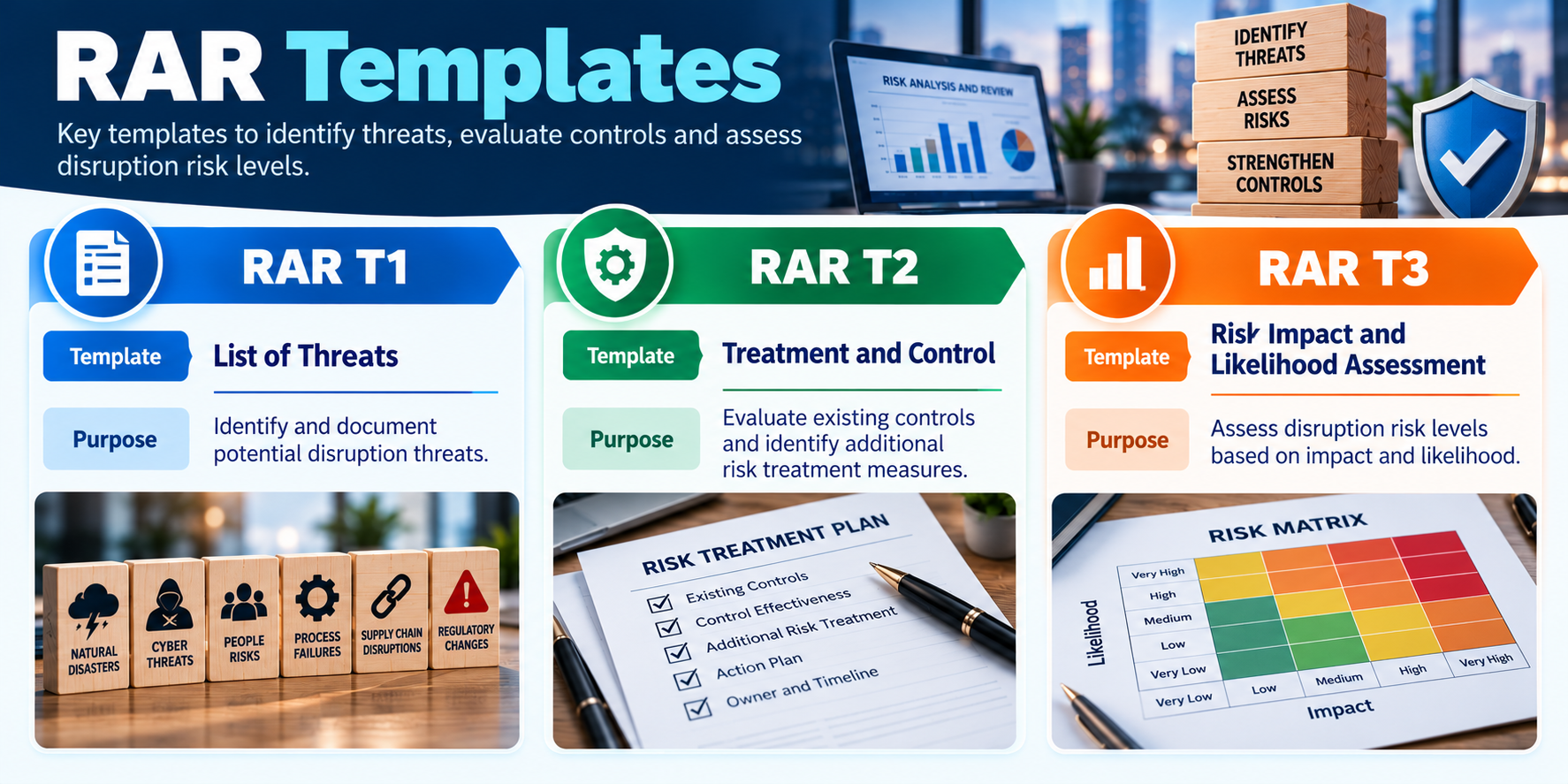
This chapter opens the risk analysis and review (RAR) work by building the threat register for EGH. It follows the business impact analysis in Chapters 1 and 2 and supports the risk assessment in clause 8.2.3 of ISO 22301. It identifies sources of disruption only; likelihood, impact and treatment follow in Chapters 4 to 6.
How the Register Was Built
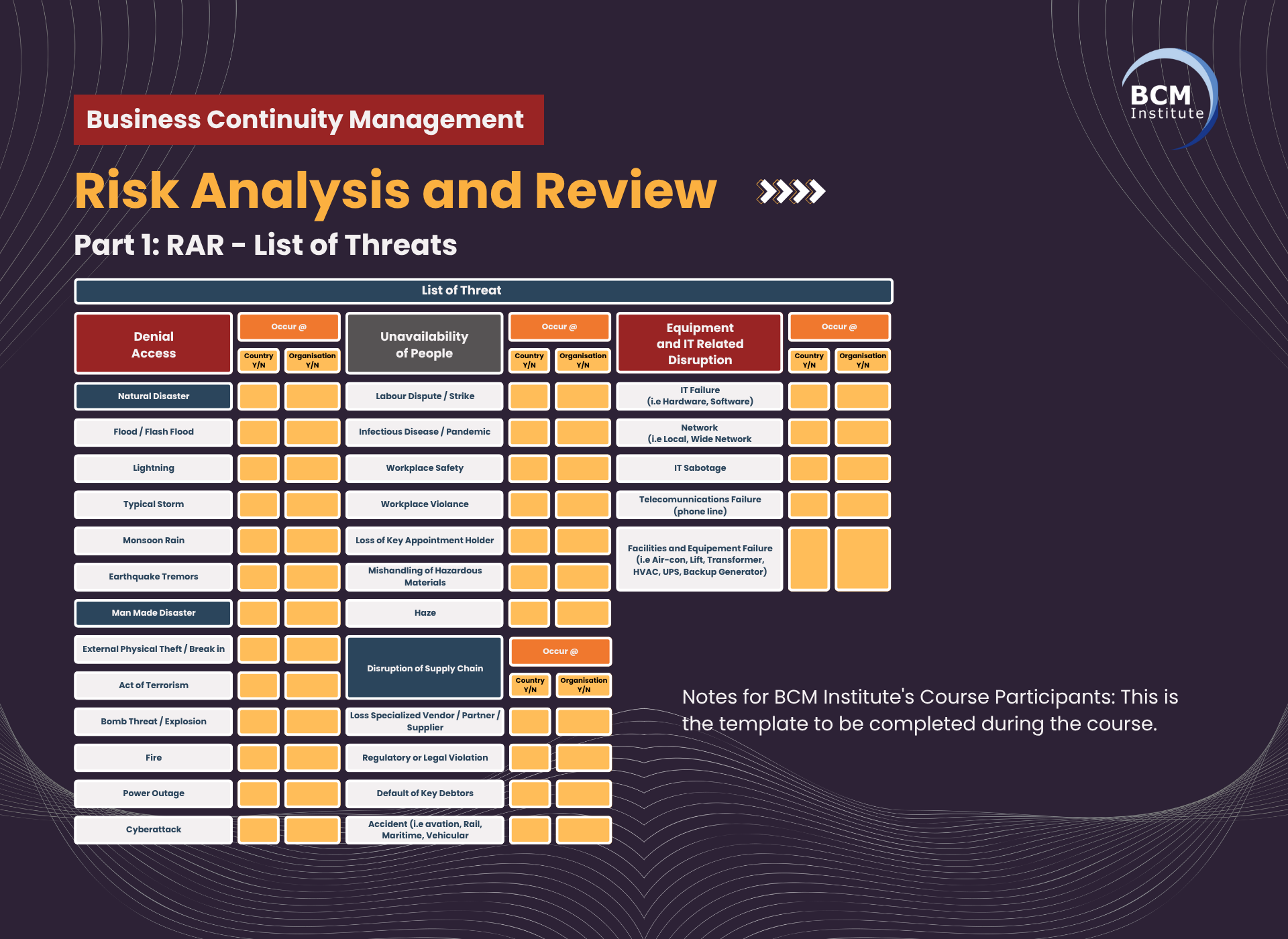
The register contains 31 specific threats in five categories: Denial of Access (Natural) (6); Denial of Access (Man-made) (6); Unavailability of People (6); Disruption to the Supply Chain (6); Equipment and IT-Related Disruption (7). Each threat has a short description, a country-level relevance statement that describes Singapore's operating environment, and an organisation-level relevance statement that describes how the threat could affect EGH.
- Country-level relevance: uses descriptive terms such as commonly encountered, occasional or increasing concern; no numerical likelihood is given.
- Organisation-level relevance: is drawn from the planned hospital, with the planned virtual healthcare services and the co-located Eastern Community Hospital in mind, and is a reasonable assumption rather than a confirmed fact.
- Internal and external: both are included, because a staff shortage can disrupt care as surely as a storm.
The Threat Register
Table RAR P1: List of Threats for Eastern General Hospital
| Category of Threats | Type of Threat | Description of Threat | Country-Level Relevance | Organisation-Level Relevance |
|---|---|---|---|---|
| Denial of Access (Natural) | Flash Flood | Intense rain overwhelms drains and floods roads, basements or loading bays. | Occasional and localised after heavy rainfall. | Could block ambulance and supply routes and flood basement plant rooms. |
| Denial of Access (Natural) | Severe Thunderstorm and Lightning | Frequent storms bring lightning strikes, wind and short power dips. | Commonly encountered. | Could trip equipment, disrupt outdoor movement and cause brief outages. |
| Denial of Access (Natural) | Extreme Heat | Sustained high temperatures strain cooling and affect staff and vulnerable patients. | Increasing concern with warming trends. | Could overload air conditioning and cause heat stress for staff and patients. |
| Denial of Access (Natural) | Transboundary Haze | Smoke from regional fires reduces air quality for days. | Episodic, linked to regional fires. | Could worsen respiratory cases and affect air intake and staff travel. |
| Denial of Access (Natural) | Pandemic-Related Movement Restrictions | Government restrictions limit movement of people and goods during a pandemic. | Experienced in recent years; low likelihood of repeat in any year. | Could limit staff travel, visitor flow and supply deliveries while demand rises. |
| Denial of Access (Natural) | Distant Earthquake Tremors | Tremors from distant earthquakes are felt in tall buildings. | Low historical occurrence of damage; tremors felt occasionally. | Could trigger precautionary evacuation or inspections of high-rise blocks. |
| Denial of Access (Man-made) | Fire | A fire in clinical, plant or support areas forces evacuation of patients. | Credible but infrequent. | Could force phased evacuation of non-ambulant patients and damage plant or records. |
| Denial of Access (Man-made) | Bomb Threat | A threat or suspicious item triggers search or partial evacuation. | Credible but infrequent. | Could disrupt patient flow and require cordons and clinical relocation. |
| Denial of Access (Man-made) | Active Assailant | An armed or violent person attacks staff, patients or visitors on site. | Low historical occurrence; a recognised concern. | Could cause casualties, lockdown and loss of public confidence. |
| Denial of Access (Man-made) | Chemical or Gas Leak | A spill or gas release in a lab, plant room or medical gas store. | Occasional; industrial incidents are rare. | Could force evacuation of a clinical zone and stop services. |
| Denial of Access (Man-made) | Structural or Building Services Failure | A building defect or failed major service makes an area unsafe. | Low historical occurrence. | Could close wards or theatres for days while engineers assess. |
| Denial of Access (Man-made) | Major Road or Public Transport Disruption | An accident or line failure blocks routes to the campus. | Commonly encountered in minor form. | Could delay staff arrival, ambulances and deliveries. |
| Unavailability of People | Infectious Disease Outbreak | A hospital outbreak spreads between patients and staff. | Commonly encountered in healthcare settings. | Could close wards, restrict admissions and strain staff. |
| Unavailability of People | Mass Staff Illness | A large share of staff are absent at the same time. | Occasional, seasonal peaks. | Could reduce safe staffing and force service reductions. |
| Unavailability of People | Loss of Key Clinical Personnel | Sudden loss of rare specialists or clinical leaders. | Commonly encountered in a tight labour market. | Could stop niche services and reduce quality. |
| Unavailability of People | Healthcare Manpower Shortage | Not enough nurses, allied health or support staff, especially during ramp-up. | Increasing concern across the sector. | Could delay opening of wards and reduce capacity. |
| Unavailability of People | Workplace Violence | Aggression towards staff by patients or visitors. | Commonly encountered in healthcare. | Could injure staff and cause absences. |
| Unavailability of People | Staff Fatigue and Burnout | Long hours and stress reduce performance and retention. | Increasing concern. | Could raise errors and sickness and drive resignations. |
| Disruption to the Supply Chain | Critical Medical Supplier Failure | A sole-source supplier of implants, consumables or equipment fails to deliver. | Occasional global disruptions. | Could delay surgery and stop procedures. |
| Disruption to the Supply Chain | Pharmaceutical Stock-out | A critical medicine or blood product becomes unavailable. | Occasional, with global shortages. | Could affect treatment of emergency and critical patients. |
| Disruption to the Supply Chain | Cloud Service Provider Failure | A hosted clinical or business application becomes unavailable. | Increasing concern with cloud use. | Could cut access to cloud-hosted records or telehealth. |
| Disruption to the Supply Chain | Telecommunications Provider Failure | Voice or data carriers fail. | Low historical occurrence. | Could disrupt calls, paging and telehealth. |
| Disruption to the Supply Chain | Water Supply Failure | Mains water is interrupted or contaminated. | Low historical occurrence. | Could affect sterilisation, dialysis, hygiene and cooling. |
| Disruption to the Supply Chain | Outsourced Service Provider Failure | Cleaning, linen, catering or security contractor fails. | Occasional. | Could degrade hygiene, food and linen. |
| Equipment and IT-Related Disruption | Ransomware Attack | Malicious software encrypts hospital systems and data. | Increasing concern; healthcare is a frequent target worldwide. | Could halt clinical systems and force manual operations. |
| Equipment and IT-Related Disruption | Power Failure | Loss of mains power to the campus. | Low historical occurrence. | Could stop life-support equipment and cooling. |
| Equipment and IT-Related Disruption | Electronic Medical Record System Failure | The patient record system is down or corrupted. | Occasional. | Could delay orders, results and medication. |
| Equipment and IT-Related Disruption | Medical Equipment Failure | Critical devices such as ventilators or imaging fail. | Commonly encountered in minor form. | Could stop imaging or life support. |
| Equipment and IT-Related Disruption | Network and Data Centre Outage | The core network or data centre fails. | Occasional. | Could cut all connected systems. |
| Equipment and IT-Related Disruption | Air-Conditioning and Ventilation Failure | Chillers or air handlers fail in critical areas. | Occasional. | Could stop theatres and stress patients. |
| Equipment and IT-Related Disruption | Data Breach or Insider Misuse | Unauthorised access to or leaking of patient information. | Increasing concern. | Could breach privacy law and damage public trust. |
Coverage Check
The register is checked against the areas of exposure that a hospital should consider, so that no area is left without a threat.
Table RAR P1-C: Coverage of Exposure Areas for Eastern General Hospital
| Area of Exposure | Threats That Cover It |
|---|---|
| People | Pandemic-Related Movement Restrictions, Infectious Disease Outbreak, Mass Staff Illness, Loss of Key Clinical Personnel, Healthcare Manpower Shortage, Workplace Violence, Staff Fatigue and Burnout, Transboundary Haze |
| Premises | Flash Flood, Severe Thunderstorm and Lightning, Extreme Heat, Distant Earthquake Tremors, Fire, Chemical or Gas Leak, Structural or Building Services Failure, Air-Conditioning and Ventilation Failure |
| Technology | Cloud Service Provider Failure, Ransomware Attack, Electronic Medical Record System Failure, Medical Equipment Failure, Network and Data Centre Outage |
| Information | Ransomware Attack, Electronic Medical Record System Failure, Data Breach or Insider Misuse |
| Communications | Telecommunications Provider Failure, Network and Data Centre Outage |
| Suppliers | Critical Medical Supplier Failure, Pharmaceutical Stock-out, Outsourced Service Provider Failure |
| Utilities | Water Supply Failure, Power Failure, Air-Conditioning and Ventilation Failure |
| Transportation | Pandemic-Related Movement Restrictions, Major Road or Public Transport Disruption |
| Third Parties | Critical Medical Supplier Failure, Cloud Service Provider Failure, Telecommunications Provider Failure, Outsourced Service Provider Failure |
| Regulators | Pandemic-Related Movement Restrictions, Fire, Infectious Disease Outbreak, Data Breach or Insider Misuse |
| Patients and Visitors | Flash Flood, Active Assailant, Infectious Disease Outbreak, Pharmaceutical Stock-out, Electronic Medical Record System Failure |
| Reputation | Active Assailant, Infectious Disease Outbreak, Ransomware Attack, Data Breach or Insider Misuse |
| Governance | Pandemic-Related Movement Restrictions, Loss of Key Clinical Personnel, Healthcare Manpower Shortage, Data Breach or Insider Misuse |
| Financial Operations | Critical Medical Supplier Failure, Outsourced Service Provider Failure, Ransomware Attack |
| Cybersecurity | Cloud Service Provider Failure, Ransomware Attack, Network and Data Centre Outage, Data Breach or Insider Misuse |
| Physical Security | Bomb Threat, Active Assailant, Workplace Violence |
Keeping the Register Current
The register is a living document. The hospital should review it at least once a year, after every significant incident or exercise, and when its services or site change. Emerging threats such as cyber attack, climate-related events and supply chain disruption need closer watching, because they change faster than the others.

Identifying threats is the first step in protecting the critical services of EGH. The 31 threats in Table RAR P1 give the risk assessment a common starting list. The descriptions are illustrative and need validation by the owners named in later chapters.
The next chapter looks at the treatment options for each threat and the controls that are assumed to exist.
Continue reading: Chapter 4, Treatment and Control for Eastern General Hospital, reviews the treatment options and controls that apply to each threat.







