


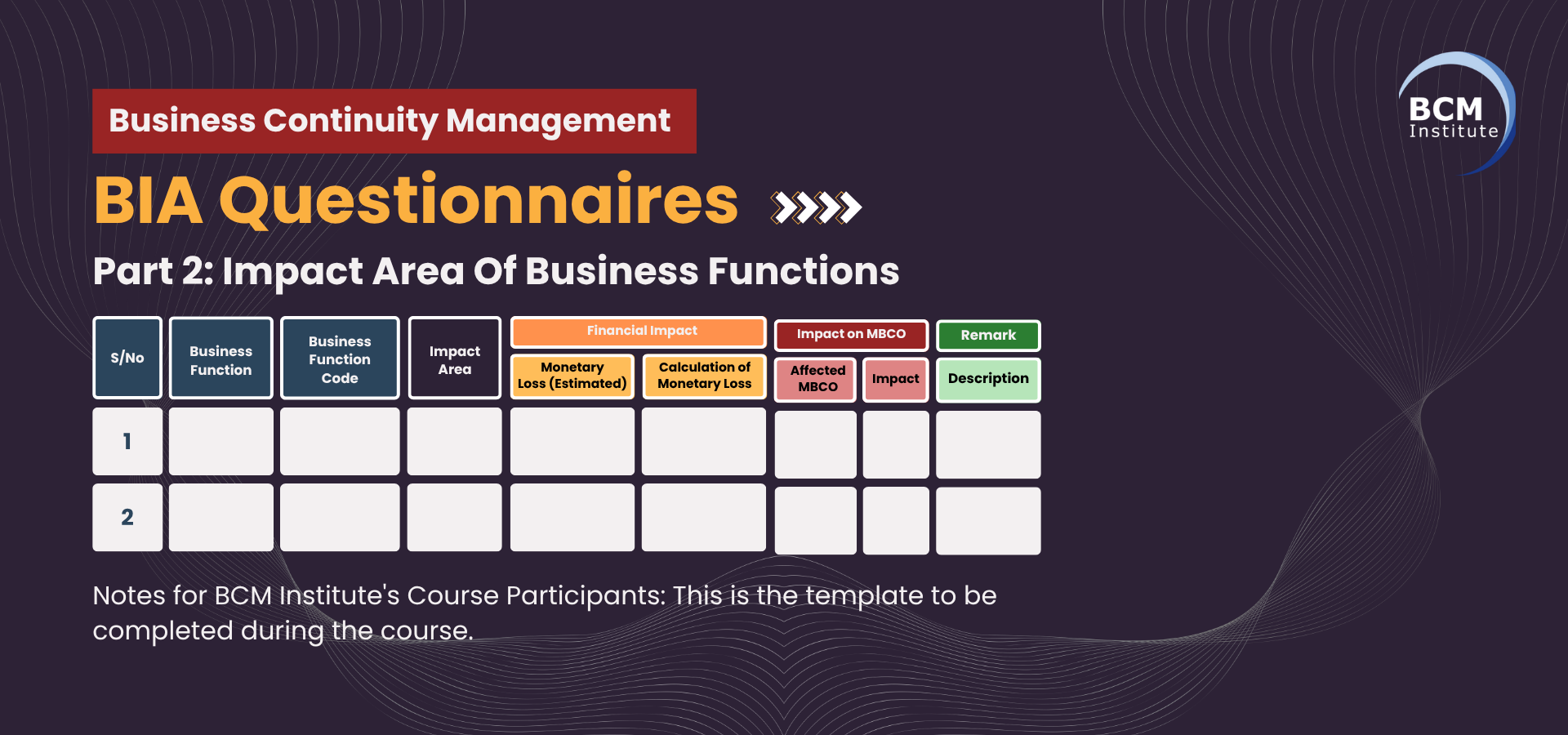
Chapter 3 set a minimum business continuity objective (MBCO) for each of the 12 Sub-Critical Business Functions (Sub-CBFs) of CBF-1 Emergency Department Services at Eastern General Hospital (EGH). This chapter asks what happens if one of those objectives can no longer be met. It estimates the main impact area, an indicative financial loss over a fixed period, and the effect on the business unit MBCO (BU MBCO).
The purpose of evaluating impact in a business impact analysis (BIA) is to turn a general worry into a comparable measure. A manager who says that a failure would be "serious" cannot be compared with another who says the same. A manager who says that a failure would cost about S$200,000 over a week and prevent triage within 10 minutes can be compared and ranked.
Impact areas are analysed separately because the same event harms different things. A failed medication record is mainly a patient safety problem, a failed bed system is mainly a financial and flow problem, and a gap in identity records is mainly a legal problem. Looking at one dominant area per Sub-CBF shows what kind of protection each one needs. The results then support recovery priorities, recovery strategies and Business Continuity Planning, as ISO 22301 clause 8.2.2 expects.
How the Estimates Were Made
Each row uses the same method. It chooses the most significant impact area for the Sub-CBF, estimates a financial loss for a disruption of seven days using a stated formula, and describes the MBCO that would no longer be achievable.
- Impact area: the most significant of patient safety, financial, regulatory, operational, legal, reputation or human resources.
- Financial loss: an indicative planning value in Singapore dollars (S$), built from the stated formula. It is not an accounting figure.
- Affected MBCO: the part of the Chapter 3 objective that could no longer be met.
- Business impact: how the loss affects the safe service level.
All volumes, unit costs and loss values are illustrative assumptions for EGH to validate. The hospital has not published activity or financial data. Where a Sub-CBF puts life at risk, the financial figure understates the true importance, and the patient safety rating should lead the decision.
Impact Area Table
Table 5: Impact Area of Business Functions for CBF-1 Emergency Department Services
| Sub-CBF Code | Sub-Critical Business Function | Impact Area | Financial Impact – Monetary Loss (Estimated) | Financial Impact – Calculation Formula | Impact on BU MBCO – Affected MBCO | Impact on BU MBCO – Business Impact | Remarks / Description |
|---|---|---|---|---|---|---|---|
| CBF-1.1 | Ambulance Arrival and Pre-hospital Handover | Patient safety | S$210,000 | ambulance cases diverted per day (20) × average income per emergency episode (S$1,500) × days (7) = S$210,000 | Handover of every ambulance arrival to a named nurse and doctor, with crews released within 30 minutes (indicative). | Crews queue at the bay, life-threatening cases wait for a handover, and the crew release target cannot be met. | Delay at the door harms patients who arrive by ambulance and may lead the ambulance service to divert future cases. |
| CBF-1.2 | Triage and Registration | Operational | S$16,800 | patients needing manual registration per day (300) × extra staff cost per manual registration (S$8) × days (7) = S$16,800 | Triage of every arrival within 10 minutes (indicative), with hourly rechecks of waiting patients. | Queues build, the highest-priority patients are not identified quickly, and rechecks of waiting patients lapse. | Unsafe waiting and misidentification risks rise quickly, and the department loses the priority order on which all later steps depend. |
| CBF-1.3 | Resuscitation and Life-Saving Intervention | Patient safety | S$420,000 | critical cases per day delayed or diverted (3) × average cost of a serious adverse event, including transfer and review (S$20,000) × days (7) = S$420,000 | At least one staffed and equipped resuscitation space at all times, with a senior doctor and two nurses (indicative) for each critical patient. | The department cannot offer a safe resuscitation space, and critical patients must be diverted or treated without the full team. | Loss of life or permanent harm is the main consequence. Regulatory investigation and loss of public trust would follow. |
| CBF-1.4 | Emergency Assessment and Treatment | Financial | S$210,000 | patients per day treated elsewhere or delayed (120) × average income per attendance (S$250) × days (7) = S$210,000 | Doctor review of high and medium priority patients within a target that may lengthen by 50% (indicative) under disruption. | Waiting times rise well beyond the relaxed target, time-critical conditions are treated late, and patients leave without being seen. | Income falls as patients go elsewhere, while the clinical risk from late treatment is the larger concern. |
| CBF-1.5 | Emergency Diagnostic Requesting and Results Review | Operational | S$84,000 | urgent tests delayed per day (200) × extra cost per delayed test, including repeats and longer stay (S$60) × days (7) = S$84,000 | Urgent requests tracked end to end, with critical results phoned within 15 minutes (indicative) of availability. | Requests and results are delayed or lost, critical values reach doctors late, and clinicians repeat tests to be safe. | Diagnosis slows down for every patient, lengthening stays and adding cost across the department. |
| CBF-1.6 | Emergency Medication Administration | Patient safety | S$45,000 | expected medication-related harm events over the period (3) × average cost per event, including treatment and review (S$15,000) = S$45,000 | Time-critical and high-alert medicines given within the prescribed window with a second-person check, and recorded at the bedside. | Doses are late, missed or duplicated, allergy checks are weaker, and controlled drug records become hard to reconcile. | Harm to patients is direct. Poor medication records also create legal and regulatory exposure. |
| CBF-1.7 | Infection Screening and Isolation | Regulatory | S$150,000 | outbreak response and containment cost per cluster (S$150,000) × clusters in the period (1) = S$150,000 | Screening of every arriving patient and isolation of suspected airborne or high-consequence cases before further care. | Infectious patients mix with others, isolation capacity is not used properly, and public health notifications are late. | A cluster inside the department would close spaces, infect staff and require notification to the regulator. |
| CBF-1.8 | Emergency Observation and Short-Stay Care | Operational | S$126,000 | observation patients per day moved early to inpatient beds (40) × extra bed-day cost (S$450) × days (7) = S$126,000 | Monitoring of every observation patient at the interval set by early warning score, at least every 30 minutes (indicative) for high-risk patients. | Observation spaces close or lose monitoring, deterioration is missed, and patients are admitted or discharged early. | Unrecognised deterioration and avoidable admissions follow, and pressure moves to treatment spaces. |
| CBF-1.9 | Patient Disposition, Transfer and Family Communication | Financial | S$126,000 | blocked bed-days per day (30) × cost per blocked bed-day (S$600) × days (7) = S$126,000 | Recorded disposition with handover to the receiving team, and critical patients transferred with a clinician in attendance. | Patients cannot leave the department, spaces stay occupied, and handover to wards or other hospitals becomes unsafe. | Crowding spreads to the entrance, and families receive no clear information, which damages trust. |
| CBF-1.10 | Surge and Mass Casualty Response | Reputation | S$200,000 | [surge days (2) × extra staff and supply cost per surge day (S$60,000)] + [reputation and communication recovery cost (S$80,000)] = S$200,000 | Declaration of surge or mass casualty status within 15 minutes (indicative) with a named commander and extra treatment space. | Surge is declared late or not at all, extra space is not opened, and mass casualty triage is not applied consistently. | The department is overwhelmed when demand is highest, and public confidence in the hospital's readiness falls. |
| CBF-1.11 | Patient Identification and Clinical Documentation | Legal | S$50,200 | [records needing reconstruction per day (300) × cost per reconstructed record (S$12) × days (7)] + [legal review of record gaps (S$25,000)] = S$50,200 | An identity band and an updated record for every patient, with two identifiers checked before treatment, blood samples or transfusion. | Patients are misidentified, records are incomplete, and results or allergies may be attached to the wrong person. | Wrong-patient errors, complaints and legal claims are likely, and the clinical record needed for review is weakened. |
| CBF-1.12 | Emergency Staff Deployment and Shift Handover | Human resources | S$78,400 | overtime and agency hours per day (160) × cost per hour (S$70) × days (7) = S$78,400 | A named senior doctor and nurse in charge each shift, minimum safe staffing for each area, and a structured handover covering every patient. | Areas are understaffed, handover is incomplete, and staff fatigue grows as cover is stretched. | Safe staffing is the base for every other Sub-CBF, and sustained overload raises the risk of errors and staff loss. |
All values are illustrative planning assumptions for a seven-day disruption of one Sub-CBF at a time. The three largest estimates are Resuscitation and Life-Saving Intervention (S$420,000), Ambulance Arrival and Pre-hospital Handover (S$210,000) and Emergency Assessment and Treatment (S$210,000). The total of all 12 rows is S$1,716,400, but the rows should not be added together in practice, because one event rarely disrupts all 12 at once.

Impact assessment turns the Sub-CBF list into a set of comparable risks. It shows which processes cause the greatest harm when they fail, in what form that harm appears, and which part of the minimum service level is lost. For EGH, patient safety is the dominant area for the processes closest to the bedside, while financial, operational, legal and workforce areas dominate the supporting ones.
Financial estimates help management decide how much to spend on protection. A control that costs S$50,000 a year and prevents a loss of S$1 million is easy to justify, but a control that costs more than the loss it prevents needs another reason, such as patient safety or the law. Because the figures are estimates, the ranking matters more than the exact number.
Impact analysis also shapes the next steps. It influences the recovery time objectives (RTOs), the order of recovery, the choice of strategy and the content of the Business Continuity Plan. A Sub-CBF with a high patient safety impact will receive a short RTO and a strong strategy, while one with a mainly financial impact may accept a longer recovery. Understanding impact areas builds resilience by directing effort to where harm is greatest. EGH should validate every estimate with the process owner, and finance should confirm the unit costs.
Continue reading: Chapter 5, Impact Over Time of Business Functions for CBF-1, shows how the impact grows over time and sets recovery time objectives and maximum tolerable periods of disruption.