


Introduction
Strategies only help if people know how to carry them out under pressure. Plan development is the phase that turns the strategies chosen in Chapter 5 into written business continuity (BC) plans that Singapore Aero Engine Services Private Limited (SAESL) staff can follow when a disruption occurs.

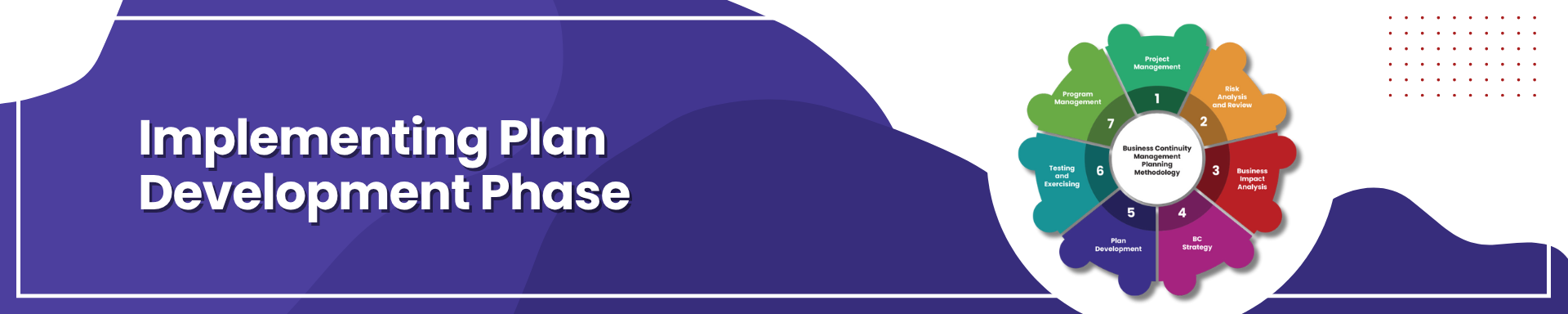
 This chapter covers the fifth phase of the planning methodology and the ISO 22301 requirement to establish business continuity plans and procedures. It first describes what plan development involves, then shows how each stage might work at SAESL. The chapter is part of Implementing Business Continuity Management for Singapore Aero Engine Services Private Limited, and the examples are illustrative.
What Does Plan Development Entail?
The process runs in three stages. Each stage builds on the previous one.
- Decide how the BC plan document is organised: design the plan template and determine the recovery organisation.
- Guide the plan writers: run a BC plan writing workshop, after which each business unit's BCM coordinator completes the template for their unit.
- Finalise plan production: business unit BCM coordinators and business unit heads validate the plans for completeness and coverage.
Stage 1: Organising the Plan Document
Designing the plan template
A common template keeps plans consistent, so a manager from one unit can read and use another unit's plan. The template should be short enough to use in a crisis and complete enough to guide action. A useful template covers the following parts:
- the purpose and scope of the plan;
- the activation criteria and who may activate the plan;
- the recovery team, with roles and alternates;
- the priority activities and their recovery times from the BIA;
- the resources needed: people, premises, technology, suppliers and information;
- step-by-step recovery actions, with checklists;
- contact details for staff, customers, suppliers and authorities;
- how the plan is maintained and when it was last tested.
For example, SAESL might add a short section to every plan on regulatory and customer notification, because many of its functions have reporting duties to aviation authorities or to customers.
Determining the recovery organisation
The recovery organisation is the structure of teams that respond. A typical arrangement has a crisis management team at the top that makes strategic decisions, and business unit recovery teams that restore each function. A small number of support teams, such as information technology, facilities and communications, serve all of them.
SAESL might map this structure onto its existing roles. For example, the executive sponsor of the BCM project could chair the crisis management team, and each business unit head could lead the recovery team for their area. Every role needs a named alternate, since the first choice may be unavailable.
Stage 2: The Plan Writing Workshop
A plan-writing workshop teaches writers what a good plan looks like and gives them time to start. The BCM coordinator explains the template, shows a worked example and links each section to the BIA and strategy results the writers already have. The workshop should end with each writer having a first draft of the sections they own.
After the workshop, each business unit's BCM coordinator completes the template for their unit. They draw on the BIA data for recovery times, and the strategy paper for the agreed solutions. For example, the engine overhaul coordinator would record how work is re-planned if the test facility is unavailable, and the supply chain coordinator would record how alternative sources are approached.
Writers should use plain language and short steps. A plan that is used at three in the morning by a deputy who has never read it must be understood quickly.
Stage 3: Finalising and Validating the Plans
Once the drafts exist, the BCM coordinator reviews them for gaps, such as missing alternates or recovery times that do not match the BIA. The business unit BCM coordinators and the heads of business units then validate the plans for completeness and coverage. Validation asks simple questions. Does the plan cover every priority activity? Can the resources it names be reached in the time allowed? Do the contact details work?
The steering committee approves the final set. The BCM coordinator then issues the plans under document control, with version numbers, owners, and review dates, and ensures copies are available where needed, including when systems are down. Printed or offline copies are worth keeping for the crisis team.
An Illustrative Plan Outline
To show how the template works, consider a plan for the engine test facility. SAESL might structure it as follows. The purpose section states that the plan restores testing of overhauled engines after the facility is lost. The activation section says that the head of engine assembly and testing, or an alternate, may activate it. The recovery team section names the roles needed, such as test engineering, quality, planning and facilities.
The priority activities section records the recovery times from the BIA. The resources section lists what the team needs, including specialist staff, instrumentation and utilities. The actions section gives the first steps: make the area safe, assess the damage, inform the crisis management team and decide which engines are affected. The contacts section lists customers, suppliers and authorities to notify. Written this way, a deputy can use the plan without having seen it before.
Requirements Specific to SAESL
SAESL works under approvals from the Civil Aviation Authority of Singapore (CAAS) and other aviation authorities, and its quality system relies on controlled documents. The BC plans should follow the same discipline: controlled issue, clear approval and records of changes. Plans should also say who contacts the authorities and customers, and in what order, if a disruption affects an engine release or a certified record.
The plans should link to existing emergency and safety procedures so that staff do not face two conflicting sets of instructions. For example, SAESL might state that the evacuation procedure takes precedence, and that the BC plan applies only once people are safe.
Summary Table
Table 6: Business Continuity Plan Development Phase for Business Continuity Management Planning Methodology for Singapore Aero Engine Services Private Limited
| Stage | Main activities | Who | Illustrative SAESL example |
|---|---|---|---|
| 1. Organise the plan | Design template; determine recovery organisation | BCM coordinator, steering committee | Template includes notification to authorities and customers |
| 2. Write the plans | Writing workshop; complete template | Business unit BCM coordinators | Overhaul plan covers test facility loss |
| 3. Finalise | Validate for completeness and coverage; approve and issue | Business unit coordinators, heads of unit, steering committee | Plans issued under document control |
All SAESL-specific entries are illustrative and must be confirmed by SAESL.

Conclusion
Plan development turns strategy into action. A common template, a clear recovery organisation, a guided writing workshop and formal validation give SAESL plans that are consistent, usable and owned by the people who must carry them out. The plans are not complete until they are tested, because a plan that has never been used is only an assumption.
The next chapter looks at how SAESL tests and exercises its plans.
Continue reading: Chapter 7, Testing and Exercising Phase for Business Continuity Management Planning Methodology for Singapore Aero Engine Services Private Limited, shows the types of exercises that SAESL can use to prove its plans.







