


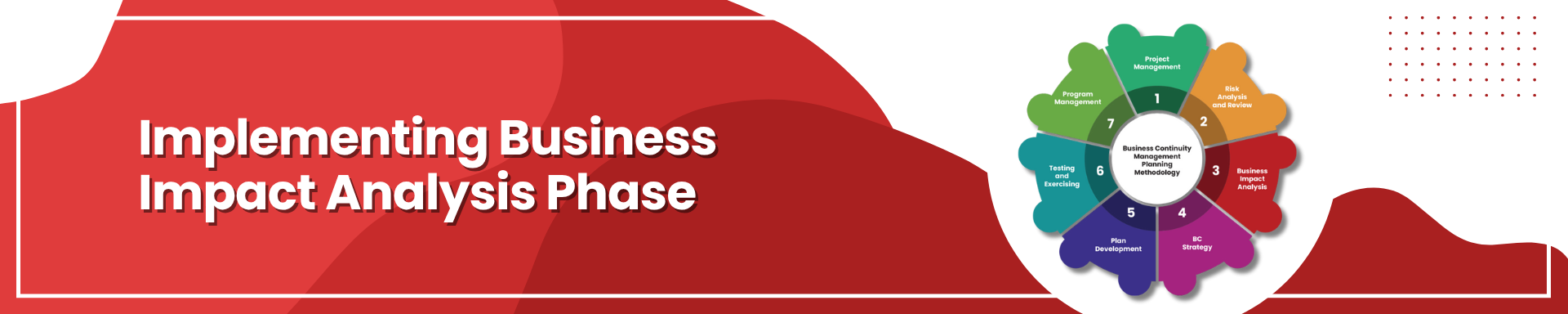
The Business Impact Analysis (BIA) asks a simple but demanding question of every activity at Jamiyah Home for the Aged (JHA): if this stopped, how quickly would residents, staff, the Home's reputation and its standing with the regulator be harmed? The answers set recovery priorities for the rest of the business continuity programme. This chapter explains what the BIA measures, how JHA can carry it out, and presents the Home's twelve critical business functions with illustrative tiers and recovery targets.
Introduction
Chapter 3 built a register of ten illustrative risks, R1 to R10. The risk register looks outward at threats; the BIA looks inward at functions. For BIA purposes, it does not matter whether meals stop because of a kitchen fire, a supplier failure, or a staff shortage. What matters is how long residents can safely go without the function and what is needed to restore it. That separation lets one set of strategies cover many different causes.
The twelve critical business functions (CBFs) used here were identified in the first eBook of this series and are carried forward with codes CBF-01 to CBF-12. All tiers, times and dependencies in this chapter are illustrative and must be confirmed by JHA through its own workshops.
What the BIA Measures
Impact over time
For each function, the BIA estimates how impact grows over time: after one hour, four hours, one day, three days, one week and beyond. Impact is assessed in several categories. For JHA, the most important are resident safety and well-being, regulatory and legal standing, reputation with the community, donors and partners, financial effect, and staff welfare. Each category is scored on a five-point scale similar to the impact scale in Chapter 3, so both phases speak the same language.
Maximum tolerable period of disruption (MTPD)
The MTPD is the point at which the impact of not performing a function becomes unacceptable. For a function such as resident supervision, the MTPD is measured in hours, because frail residents left without adequate supervision can be harmed quickly. For a function such as recreational programmes, it may be weeks.
Recovery time objective (RTO)
The RTO is the target time within which a function must be resumed, at least at a minimum level, after a disruption. It is set shorter than the MTPD to leave a safety margin.
Minimum business continuity objective (MBCO)
The MBCO is the minimum acceptable level of service during a disruption. For JHA, this is where the licence matters. The Code of Practice for Social Residential Homes requires adequate staffing to supervise residents at all times and sets supervision ratios by home type; for welfare homes, the table shows one staff member to 17 residents during waking hours and one to 40 during sleeping hours. If JHA is licensed in that category [verify], these ratios form a natural floor for the MBCO of supervision.
Recovery point objective (RPO)
The RPO applies to information: how much data the Home can afford to lose. For resident medication records, the tolerable loss might be close to zero; for programme attendance records, a day or two might be acceptable.
Dependencies
Every function relies on people, premises, equipment, information, suppliers and other functions. The BIA records these dependencies, because they are what the strategy phase must protect. Shared dependencies, such as the same few senior care staff supporting several functions, deserve special attention.
How the BIA Is Carried Out
A practical BIA for JHA has four steps.
- Prepare. The organisation's business continuity management (BCM) coordinator issues a short questionnaire to each business unit BCM coordinator, covering what each function does, when it is performed, who performs it, what it needs and what happens if it stops.
- Interview and workshop. Coordinators discuss the questionnaire with front-line staff, including night-shift supervisors, then attend a joint workshop to agree impact-over-time scores. For example, JHA might ask care staff to walk through a normal day hour by hour and mark the points at which a missed task would begin to harm residents.
- Analyse. The coordinator consolidates results, sets draft MTPDs, RTOs and MBCOs, and assigns tiers. Tier 1 functions must be resumed within hours; Tier 2 within days; Tier 3 can pause for weeks.
- Validate. Heads of units and the steering committee review and approve the results. Resolve disagreements by reference to residents' safety and the licence.
Worked Example: Impact Over Time for CBF-01
An illustrative walk-through of CBF-01, personal care and 24-hour supervision, shows how the scores build. In the first hour of a sudden loss of half the night shift, the impact on residents is moderate: remaining staff can prioritise those at highest risk of falls and those needing help to the toilet, but routine checks slip. By four hours, missed repositioning, delayed continence care and unanswered calls begin to cause real harm to frail residents, and the Home may no longer meet its supervision ratio, which is itself a regulatory concern. By the next morning, if no relief has arrived, residents' dignity and safety are seriously compromised, and the incident is likely to be reportable to the regulator. On these illustrative scores, the impact becomes unacceptable at around four hours, which sets the MTPD; the one-hour RTO reflects the need to call in relief staff almost immediately.
The same exercise for CBF-12, social and recreational programmes, produces a very different curve. Cancelling outings or volunteer visits for a week has little effect on safety, though residents notice the loss. Only after several weeks does isolation begin to affect mood and well-being, so its MTPD is measured in weeks.
Common Pitfalls in a Care-Home BIA
Three pitfalls are worth avoiding. The first is scoring every function as critical because every function matters to someone; tiers only help if they discriminate. The second is relying only on office staff, whose view of the night shift may be incomplete. The third is setting recovery times that no realistic strategy could meet, such as zero downtime for every Tier 1 function, which simply pushes the problem into the strategy phase.
Requirements Specific to JHA
Regulatory deadlines. The Code of Practice requires serious incidents to be reported to the Ministry of Social and Family Development (MSF), with an incident report submitted within 24 hours. This gives CBF-07 a hard ceiling: its MTPD cannot exceed the reporting window, and its RTO must be much shorter.
Daily care cycles. Medication rounds, meals and hydration follow fixed daily times. A disruption that falls just before a medication round has a sharper impact than one that falls just after. For example, JHA might set the RTO for medication management at four hours so that no more than one scheduled round is affected.
Night-time vulnerability. With fewer staff on duty and residents asleep, the Home's capacity to absorb disruption is lower at night. The BIA should record impact separately for day and night where they differ.
Shared dependencies. Several Tier 1 functions depend on the same care staff, premises, and utilities. A single loss, such as a power failure (R3), therefore affects several functions at once, and recovery strategies must account for that concentration.
Managing agent services. Finance, payroll and some administrative services may be provided through Jamiyah Singapore. The BIA should record these as external dependencies and check that the managing agent's own continuity arrangements meet JHA's recovery targets.
Residents' religious and cultural life. JHA's programmes include religious classes and cultural activities. Although these are not life-critical in the first hours, prolonged loss affects residents' well-being, and the BIA should reflect that over the longer term.
Reading the Results
The illustrative results below place seven functions in Tier 1, four in Tier 2 and one in Tier 3, consistent with the priorities set in the first eBook. The pattern is typical of residential care: almost everything that touches the resident directly is Tier 1. That concentration has a practical consequence. JHA cannot rely on recovering Tier 1 functions one at a time; its strategies must keep several of them running together, often with the same small team, through the first hours of a disruption.
Summary Table
| Code | Critical business function | Tier | RTO | MTPD | Main dependency |
|---|---|---|---|---|---|
| CBF-01 | Personal care and 24-hour supervision | 1 | 1 hour | 4 hours | Care staff on duty at the required ratio |
| CBF-02 | Medication management and access to medical care | 1 | 4 hours | 12 hours | Medication stock, records and visiting doctor or clinic |
| CBF-03 | Meals, nutrition and hydration | 1 | 4 hours | 12 hours | Kitchen, food supplier and drinking water |
| CBF-04 | Safe premises and essential utilities | 1 | 4 hours | 24 hours | Power, water and building maintenance contractor |
| CBF-05 | Infection prevention and control | 1 | 4 hours | 24 hours | Personal protective equipment stock, isolation room and public health guidance |
| CBF-06 | Staffing and rostering | 1 | 8 hours | 24 hours | Staff pool, roster records and relief arrangements |
| CBF-07 | Incident reporting and communication with MSF | 1 | 4 hours | 24 hours | Superintendent or deputy, telephone and email |
| CBF-08 | Admissions, discharges and case management | 2 | 3 days | 7 days | Case worker and referral channels |
| CBF-09 | Resident records and information technology (IT) | 2 | 24 hours | 3 days | Computers, backups and IT support |
| CBF-10 | Religious and spiritual life | 2 | 3 days | 7 days | Religious teachers and volunteers |
| CBF-11 | Finance, procurement and payroll | 2 | 3 days | 7 days | Managing agent finance services and banking |
| CBF-12 | Social, recreational and volunteer programmes | 3 | 14 days | 30 days | Programme staff, volunteers and partner groups |
All tiers, RTOs, MTPDs and dependencies are illustrative and must be confirmed by JHA.

Conclusion
The BIA converts a list of functions into a ranked set of recovery targets. For JHA, it shows that seven of twelve functions must be resumed within hours, that the night shift is the Home's most vulnerable period, and that a few shared dependencies, especially care staff and utilities, underpin almost everything. With these targets agreed, the next phase chooses practical strategies to meet them.
Sources
- Code of Practice for Social Residential Homes (First Edition)
- Jamiyah Home for the Aged, Programmes and Activities
Continue reading: Chapter 5, Business Continuity Strategy Phase for Business Continuity Management Planning Methodology for Jamiyah Home for the Aged, sets out six strategy groups that protect JHA's critical functions and links each to the risks it addresses.