


Introduction
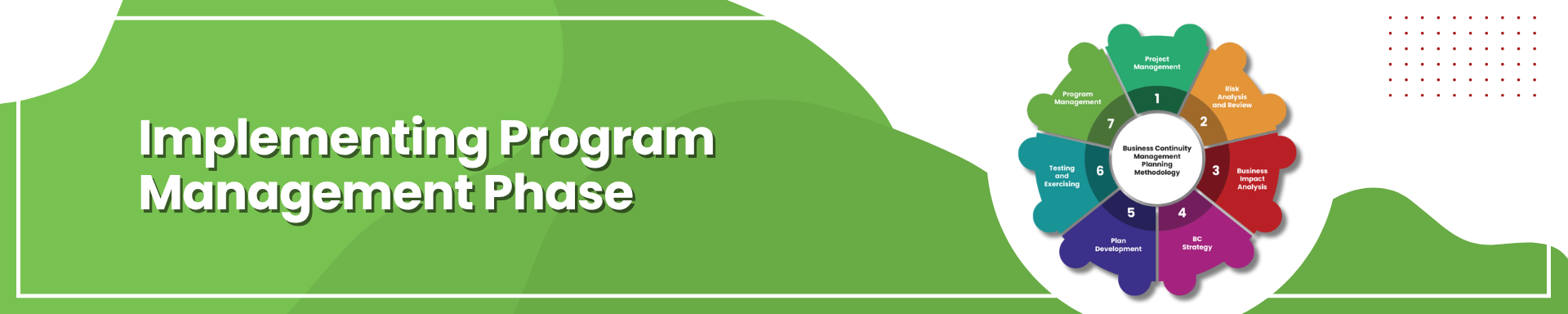
The last phase of the methodology, Program Management (PgM), keeps business continuity alive after the project has finished. Plans go out of date as soon as people change roles, systems are replaced or services are added. Without a standing programme, the work of the earlier phases decays within a year or two. For Eastern General Hospital (EGH), which will grow in stages as its services open, a working programme is the only way to keep continuity arrangements in step with the hospital.
The purpose of this chapter is to describe the elements of the programme and show how they benefit EGH in implementing its business continuity management (BCM) programme: clear ownership, plans that stay current, trained staff, measures that show whether the programme works, independent checks and a calendar that makes the work routine. It ends with requirements specific to EGH. Titles, frequencies and measures are illustrative and must be confirmed by EGH.
How the Phase Benefits EGH
Three benefits stand out. First, the programme protects the investment already made, since a validated plan that is never reviewed loses value each month. Second, it gives managers a view of readiness at any time, so that they can decide what to fund. Third, it builds a habit: routine reviews, tests and training make continuity part of how the hospital works, not an extra task triggered by an incident or an audit.
Governance and Ownership
The programme needs an owner and a forum. The owner, usually the organisation BCM coordinator, manages the work day to day, maintains the master documents and reports on progress. The forum, a BCM steering group chaired by a senior executive, takes over from the project steering committee described in Chapter 2. It should meet at least quarterly, and should include clinical, nursing, facilities, information technology and commissioning representatives while the hospital is still opening. Each business unit has a BCM coordinator who keeps the unit's plans current, and each plan has a named owner.
A short BCM policy, approved by the sponsor, states the scope, objectives, roles and review cycle. If SingHealth has group policies or reporting lines for continuity, the EGH policy should refer to them and should state how EGH reports to the group. Whether such arrangements exist has not been confirmed in this eBook.
Keeping the Programme Current
Scheduled Review
Every element of the programme has a review cycle. The risk register (Chapter 3) is reviewed at least annually, the BIA (Chapter 4) at least annually or when a service changes, strategies (Chapter 5) after each major risk or BIA change, and plans (Chapter 6) at least annually, with contact lists checked more often, for example every quarter. Each review is recorded with the date, reviewer and changes made.
Change Triggers
Some events should prompt an immediate review, without waiting for the calendar. Examples include:
- the opening of a new service, ward or building, or a change in opening dates;
- a change in the service model, such as a new specialty or a change to home-based care;
- replacement of a major clinical or facilities system;
- a change of supplier for critical items, or a change in a group-level contract;
- a significant change in staffing or organisation, such as a new head of a unit;
- a new or changed regulation, licence condition or MOH circular; and
- a major incident, near miss or exercise failure.
Lessons from Events
Every incident, near miss and exercise should end with a short review: what happened, what worked, what did not and what will change. Actions are logged with owners and dates and tracked until closed. Lessons from other SingHealth institutions, where shared, are a valuable source, and the programme should have a route for receiving and acting on them.
Awareness and Training
People can follow a plan only if they know it exists and what it asks of them. The programme should provide:
- General awareness for all staff at induction and annually, covering what BCM is, how to recognise a disruption and whom to call.
- Role-based training for members of the recovery organisation, with practice in using action cards.
- Coordinator development for BCM coordinators, who need deeper skills in analysis, plan writing and exercise design. The BCM Institute offers courses for this purpose, described in Chapter 10.
- Briefings after change whenever a plan is revised, so that staff learn what is different.
Training records should be kept, since they show whether people with defined roles have actually been prepared.
Performance Measures
Measures show whether the programme is working. A small set, reported to the steering group each quarter, is better than a long list. Illustrative measures include:
- the share of the sixteen critical business functions with a validated, in-date plan;
- the share of Tier 1 functions (ten in the illustrative ranking) exercised in the past twelve months;
- the response rate and time in call notification tests;
- the number of corrective actions open, and the number overdue;
- the share of recovery organisation members trained in the past twelve months; and
- the number of risks in the High and Extreme bands (R1 to R10) with an agreed treatment.
Each measure needs a target, an owner and a source of data. Measures should lead to action, for example a rising number of overdue actions prompts an escalation to the sponsor.
Audit and Management Review
Audit gives independent assurance that the programme is operating as intended. It may be carried out by an internal audit team, by the group or by an external body. It should check whether plans exist and are current, whether exercises were held and actions closed, and whether the programme meets ISO 22301 and any requirements of the Ministry of Health. Findings are logged and tracked like any other action.
Management review, held at least annually, brings the sponsor and senior leaders together to consider the audit results, performance measures, lessons from incidents and exercises, changes in risk and resources needed. Its output is a set of decisions, recorded and followed up, on priorities and funding for the next year.
Programme Calendar
A calendar makes the work predictable. The table below shows an illustrative annual cycle for EGH. During the opening stages, extra entries should be added for each new service.
| Period | Activity | Owner |
|---|---|---|
| Quarter 1 | Annual review of risk register R1 to R10 and BIA for CBF-1 to CBF-16; contact list check | Organisation BCM coordinator |
| Quarter 1 | Management review and approval of annual exercise schedule | Sponsor |
| Quarter 2 | Walkthrough exercises for Tier 1 functions; call notification test (day) | Business unit coordinators |
| Quarter 2 | Awareness refresh and role-based training | Organisation BCM coordinator |
| Quarter 3 | Integrated or simulation exercise; component tests of power and systems; contact list check | Exercise director |
| Quarter 3 | Internal audit of the programme | Internal audit |
| Quarter 4 | Call notification test (night); review of open actions; update of plans after changes | Business unit coordinators |
| Quarter 4 | Report to steering group on performance measures; plan for next year | Organisation BCM coordinator |
| Any time | Review triggered by a change or incident | Plan owner |
Requirements Specific to EGH
- Calendar tied to opening. EGH's website states that the hospital will begin serving patients virtually in 2026, with the physical campus due in 2029 to 2030. The calendar should be linked to the opening timetable, with a readiness review before each stage. For example, a readiness review for the emergency department (CBF-1) would confirm that its plan is validated and that at least a walkthrough has been held.
- Regulatory watch. MOH issues licence conditions and circulars for acute hospital licensees from time to time. A named person should check for new or changed documents at least quarterly and report to the steering group, since a new condition is a change trigger.
- Campus coordination. Because EGH and Eastern Community Hospital form a shared campus, the programme should hold a joint review of the transfer protocol (CBF-13) at least annually.
- Digital emphasis. EGH's website describes the hospital as digitally enabled from the start. Changes to digital platforms (CBF-12 and CBF-7) should trigger a continuity review as a matter of routine, and recovery tests of these platforms should be on the calendar every year.
For example, if EGH replaced its medication ordering system, the change process should notify the BCM coordinator, who would update the BIA dependencies for pharmacy (CBF-6), review the downtime procedures and schedule a restoration test.
Summary Table
| Element | Purpose | Illustrative frequency |
|---|---|---|
| Governance forum | Direction and decisions | Quarterly |
| Risk and BIA review | Keep risks and targets current | Annually and on change |
| Plan review and contact checks | Keep plans usable | Annually; contacts quarterly |
| Exercises | Prove plans work | Tier 1 functions at least once a year |
| Awareness and training | Prepare people | Induction and annually |
| Performance measures | Show readiness | Quarterly report |
| Audit | Independent assurance | Annually |
| Management review | Priorities and funding | Annually |

Program Management turns a one-off project into a standing part of how EGH operates. Clear ownership, scheduled reviews, change triggers, training, measures, audit and management review, all placed on a calendar tied to the opening stages, keep plans accurate and people prepared. The seven phases now form a complete cycle, from project set-up to continuous review. The next chapter summarises them and lists what EGH must confirm before relying on the examples in this eBook.
Sources
- Eastern General Hospital, Hospital Overview and homepage.
- HCSA, Acute Hospital Licence Conditions, for the practice of MOH issuing licence conditions.
Continue reading: Chapter 9, Summary for Business Continuity Management Planning Methodology for Eastern General Hospital, which brings the seven phases together and lists what EGH must confirm.