


Introduction
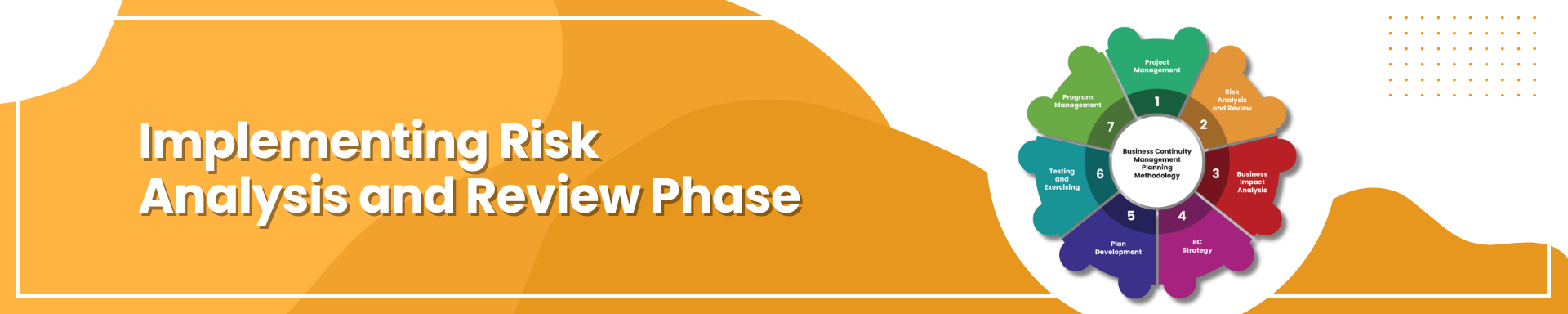
Risk Analysis and Review (RAR) is the second phase of the methodology. Its question is simple: what could stop Eastern General Hospital (EGH) from delivering care, and what can be done about it? The answer feeds the Business Impact Analysis in Chapter 4 and the strategies in Chapter 5.
The phase follows four steps: identifying risks, assessing risks, mitigating risks and continuous review. This chapter explains each, defines a scoring scale and presents a register of ten illustrative risks, coded R1 to R10, that fit an acute hospital. It ends with a section on how the work connects to the risk and patient safety systems that a hospital must already run. Every score and rating is illustrative and must be confirmed by EGH.
Step 1: Identifying Risks
Identification means recognising the threats that could disrupt operations. The aim is breadth, not precision, so the team should draw on several sources. Useful sources include the design and commissioning documents for the campus, incident histories from other SingHealth institutions, workshops with clinical and support staff, and the supplier and utility arrangements that EGH will rely on.
Because EGH is still being built and its virtual service is due to begin before the physical campus, as stated on its website, the team should look at two groups of threat. Commissioning risks arise while systems are installed and tested, for example incomplete utility changeover tests or untested network paths. Operating risks arise once patients are in the building. Both groups belong in the register, tagged by the opening stage to which they apply. This is the pre-opening lens from Chapter 1 applied to risk.
A practical prompt list helps workshop participants. It can ask about loss of people, premises, technology, equipment, suppliers and information, and about events that affect many of these at once, such as an outbreak or a flood.
Step 2: Assessing Risks
Assessment evaluates how likely each risk is and how severe the impact would be. A single scale, used the same way across all units, lets the steering committee compare risks fairly.
Illustrative Scoring Scale
EGH might score likelihood and impact from 1 to 5 and multiply them to give a score from 1 to 25.
- Likelihood: 1 rare (not expected in the life of the building), 2 unlikely, 3 possible (could occur once in several years), 4 likely (expected within a year or two), 5 almost certain (expected within a year).
- Impact: 1 minor (no effect on care), 2 limited (some delay), 3 moderate (a service restricted for hours), 4 major (a critical function interrupted beyond its recovery target, with risk of patient harm), 5 severe (multiple critical functions lost, serious patient harm likely).
- Rating bands: Low 1 to 4, Medium 5 to 9, High 10 to 16, Extreme 17 to 25.
Impact should be judged with patient safety as the first test, not cost. A short outage in the emergency department can be rated more severely than a longer delay in a non-clinical office.
Step 3: Mitigating Risks
Mitigation implements controls that bring each risk to an acceptable level. The team chooses one of four responses: avoid the risk, reduce it, transfer it (for example through contracts or insurance) or accept it with the sponsor's agreement. Controls fall into three kinds:
- Preventive controls reduce likelihood, such as fire detection and suppression, or network segmentation.
- Detective controls shorten the time to notice, such as monitoring of generator fuel or intrusion alerts.
- Corrective controls limit the damage and speed recovery, such as backup systems and downtime procedures.
Mitigation is not the same as continuity strategy. Risk controls aim to stop events or soften them. Strategies in Chapter 5 assume the event has happened and decide how functions recover within their recovery times. The two overlap, and the same measure sometimes serves both, but the questions are different.
Step 4: Continuous Review
The risk profile changes as the building is completed, services open, staff join and technology is installed. Review should therefore be tied to events as well as to the calendar. Risks should be reviewed at each opening stage, after every significant incident or near miss, when a major supplier or system changes, and at least once a year. Each review confirms scores, checks that controls still work, retires risks that no longer apply and adds new ones. Chapter 8 describes how these reviews are scheduled.
Illustrative Risk Register
The register below contains ten risks coded R1 to R10. These codes are used in Chapters 5 to 9. The scores are examples only.
- R1 Extended power failure. Loss of grid supply together with failure of backup generation or changeover, affecting life-critical areas.
- R2 Cyberattack on clinical systems. Ransomware or intrusion that disables electronic records, ordering systems or imaging archives.
- R3 Infectious disease outbreak. A cluster of infections or a wider epidemic that strains isolation capacity and staffing.
- R4 Fire or smoke in a clinical building. A fire that forces partial or full evacuation of wards or theatres.
- R5 Flooding or loss of water supply. Water ingress into plant rooms or basements, or interruption of supply needed for sterilisation, dialysis and cooling.
- R6 Medical gas or critical equipment failure. Loss of oxygen or medical air supply, or failure of imaging, ventilation or sterilisation equipment.
- R7 Supplier or logistics failure. Interruption of delivery of medicines, consumables, food or linen.
- R8 Staff shortage. Large-scale absence from illness, transport disruption or industrial action.
- R9 Mass casualty or demand surge. A sudden influx of patients that exceeds normal capacity.
- R10 Network or telecommunications outage affecting virtual and home care. Loss of connectivity needed for virtual consultations, remote monitoring and home-based care.
Connecting to Existing Risk and Safety Systems
A hospital never starts from nothing. It must already run clinical governance, patient safety and enterprise risk processes, and the continuity risk register should fit with them rather than compete. This eBook has not confirmed what EGH or SingHealth currently use, so the points below describe how a connection might work.
- One register, several views. EGH might keep continuity risks within its enterprise risk register, tagged for BCM, so that the executive sees a single picture.
- Shared scale. If a group scale already exists, the BCM team should use it and adjust only the impact descriptions to refer to service interruption.
- Incident and event learning. MOH licence conditions for acute hospital services include conditions on serious reportable events, which indicates that hospitals must already report and review certain events. Lessons from such reviews, and from mortality and morbidity reviews, can feed the continuity risk register. The conditions themselves should be read in full before any link is designed.
- Infection prevention. The risk of outbreak (R3) overlaps heavily with the work of infection prevention and control teams, who should co-own it.
- Facilities and safety. Fire, utility and building risks (R1, R4, R5, R6) overlap with facilities management and workplace safety processes, and with the commissioning programme.
For example, if a fire safety inspection finds a weakness in a plant room, the finding should update R4 or R5 and trigger a review of any continuity strategy that depends on that room.
Summary Table
| Code | Risk | Likelihood | Impact | Score | Band | Example control |
|---|---|---|---|---|---|---|
| R1 | Extended power failure | 3 | 5 | 15 | High | Redundant feeds, tested changeover |
| R2 | Cyberattack on clinical systems | 4 | 5 | 20 | Extreme | Segmentation, offline backups |
| R3 | Infectious disease outbreak | 4 | 4 | 16 | High | Isolation capacity, surveillance |
| R4 | Fire or smoke in a clinical building | 2 | 5 | 10 | High | Detection, compartments, drills |
| R5 | Flooding or loss of water supply | 3 | 4 | 12 | High | Plant room protection, water storage |
| R6 | Medical gas or critical equipment failure | 3 | 4 | 12 | High | Reserve supply, maintenance contracts |
| R7 | Supplier or logistics failure | 3 | 3 | 9 | Medium | Dual sourcing, buffer stock |
| R8 | Staff shortage | 4 | 3 | 12 | High | Cross-training, redeployment roster |
| R9 | Mass casualty or demand surge | 3 | 4 | 12 | High | Surge plans, cooperation with other hospitals |
| R10 | Network outage affecting virtual and home care | 3 | 3 | 9 | Medium | Diverse network paths, phone fallback |

The four steps give EGH a disciplined way to move from a long list of worries to a ranked register that the steering committee can act on. Seven of the ten illustrative risks fall in the High band, one in the Extreme band and two in the Medium band, which points to power, information systems and infection as early priorities. Linking the register to existing risk and safety systems avoids duplication and keeps clinical teams engaged. The next phase measures what each disruption would do to the hospital's critical functions over time.
Sources
- HCSA, Acute Hospital Licence Conditions, listing the conditions on serious reportable events.
- MOH Circular 87/2023, listing conditions on serious reportable events and mortality and morbidity review.
- Eastern General Hospital, Hospital Overview.
Continue reading: Chapter 4, Business Impact Analysis Phase for Business Continuity Management Planning Methodology for Eastern General Hospital, which sets out how to rank the sixteen critical business functions and set recovery times.