





eBook 2: Chapter 1
Business Continuity Management Planning Methodology for Eastern General Hospital
Introduction
Eastern General Hospital (EGH) is an upcoming acute hospital in Bedok North, planned at about 1,000 beds and described on its official website as part of the SingHealth group.
A hospital of this kind cannot pause. Patients arrive at the emergency department at any hour, operating theatres run to schedule, and wards depend on power, medical gases, medicines and staff all at once. Business continuity management (BCM) is the discipline that keeps these services running, or brings them back in time, when something goes wrong.
This chapter opens eBook 2, Implementing Business Continuity Management for Eastern General Hospital, part of the series Keeping Care Running: Managing and Implementing Business Continuity Management at Eastern General Hospital.
It introduces the seven-phase planning methodology that every later chapter follows.
The methodology meets the planning requirements of ISO 22301, the international standard for business continuity management systems, and it is written for the BCM coordinators who will carry out the work.
One point about EGH shapes the whole eBook. According to its website, EGH is due to begin serving patients virtually in 2026, with the physical campus due for completion in 2029 to 2030.
The hospital is therefore being built while its continuity arrangements are being designed.
All internal details used in these chapters, such as owners, systems, recovery times and ratings, are illustrative.
They show how EGH might set up its programme and must be confirmed by EGH before use.
Why a Phased Methodology

A continuity programme most often fails when it is treated as a document to be written rather than a series of decisions made in a sensible order.
Plans written before the risks are understood protect against the wrong things. Recovery strategies chosen before the impact of disruption is measured tend to be either too expensive or too weak.
A fixed sequence of phases, each handing a defined output to the next, keeps the work ordered and makes progress easy to check.
For a hospital, the order matters even more. The functions are tightly linked: an operating theatre cannot recover without sterile supply, medical gases and power, and none of these can be restored in isolation.
A method that moves from risk to impact to strategy to plan to exercise makes these links visible before an incident exposes them.

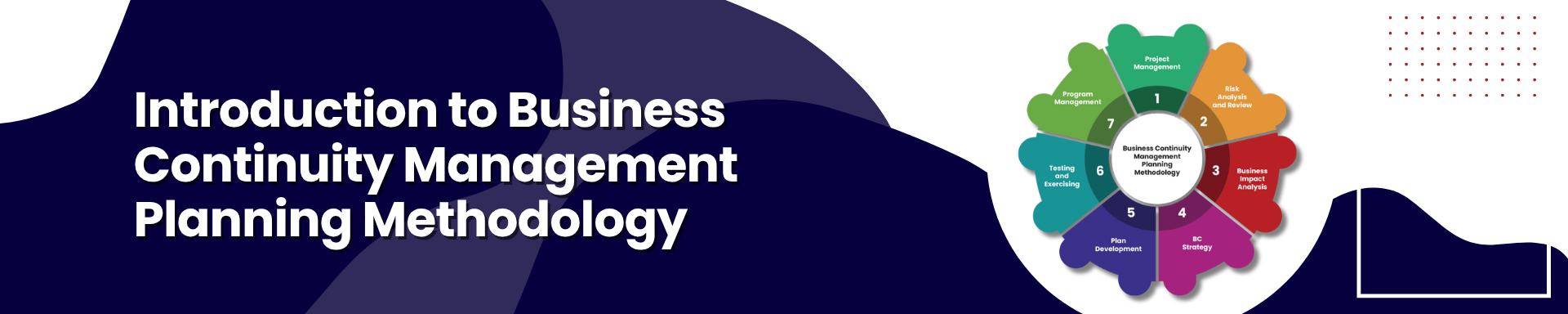
The Seven BCM Planning Phases

Phase 1: Project Management (PM)
The first phase sets up the work. It confirms the scope and objectives, names a sponsor, forms a steering committee and project team, and agrees on a work plan, budget and communication routes.
The output is an approved project charter and a team that knows its responsibilities.
Without this phase, later work lacks authority and tends to stall when it meets competing priorities. Chapter 2 covers it in detail.

Phase 2: Risk Analysis and Review (RAR)
The second phase identifies the threats that could disrupt EGH, assesses their likelihood and impact, decides how to reduce them to an acceptable level, and sets up regular review.
It produces a risk register, which in this eBook uses the codes R1 to R10, and a list of controls.
Chapter 3 explains the four steps and the scoring scale.
 Phase 3: Business Impact Analysis (BIA)
The third phase measures what happens to each critical business function (CBF) as time passes after a disruption. It sets the maximum tolerable period of disruption (MTPD), the recovery time objective (RTO), the minimum business continuity objective (MBCO) and the recovery point objective (RPO), and it records dependencies.
For EGH, the output is a ranked list of sixteen CBFs, coded CBF-1 to CBF-16, with tiers and recovery times. Chapter 4 describes it.
 Phase 4: Business Continuity Strategy (BCS)
The fourth phase chooses how each function will keep going or recover within its RTO.
Strategies cover prevention, mitigation and recovery, and they are grouped by the type of resource a function depends on: people, premises and utilities, technology and data, medical equipment and clinical supplies, suppliers and partners, and information and communications.
Chapter 5 sets out the six groups and ties each to the risk codes.
 Phase 5: Plan Development (PD)
The fifth phase turns the strategies into written plans that people can follow under pressure.
It defines the plan template, the recovery organisation and the writing workshop, and ends with validation by each business unit. Chapter 6 covers this phase and gives an illustrative plan outline.

Phase 6: Testing and Exercising (TE)
The sixth phase proves that plans work and that people can use them. Exercises begin with component tests, call notification tests and walkthroughs, then progress to integrated, simulation and live tests.
Chapter 7 describes each type and what MOH and Singapore law say about exercising.

Phase 7: Program Management (PgM)
The seventh phase keeps the programme alive after the project ends. It covers governance, scheduled review, change triggers, awareness and training, performance measures, audit and management review. Chapter 8 explains how this phase prevents plans from going out of date.
How the Phases Connect
Each phase depends on the output of the previous one, and later phases feed back into earlier ones.
The risk register from RAR informs the BIA by showing which threats are most likely to interrupt which functions.
The BIA ranks functions and sets recovery times, which become the targets strategies must meet. Strategies determine what the plans contain.
Exercises test the plans and often reveal gaps in strategy or in the original impact assumptions. Program Management then schedules the next review cycle, so the sequence repeats rather than ending.
A worked example shows the chain. A risk assessment (RAR) might rate an extended power failure, coded R1, as high. The BIA might show that critical care (CBF-4) has an illustrative RTO of one hour.
The strategy phase would then need a power arrangement able to meet that target, for example, generator capacity with tested automatic changeover.
The plan would record who confirms the changeover and what clinical teams do in the interim.
An exercise would test the call-out and the manual procedures, and the programme phase would schedule the next test.
A Requirement Particular to EGH: Designing Continuity Before Opening
Most organisations introduce BCM into services that already run. EGH has a different starting point.
Its virtual service is planned to begin ahead of the physical campus, and the building itself is still under development, with a Healthcare Living Laboratory used to mock up hospital spaces before they are built. This creates both a requirement and an opportunity.
The requirement is to build continuity thinking into design, commissioning, and staged opening, rather than adding it once wards are occupied. The opportunity is that decisions about power, water, medical gases, network paths and layout are far cheaper to improve on paper than in a finished building.
This requirement is called the pre-opening lens in the rest of the eBook, and it runs through every phase:
-
Project Management: the steering committee includes design, commissioning and digital leads, and the project plan is tied to the opening milestones.
- Risk Analysis and Review: the risk register separates construction and commissioning risks from operating risks, and refreshes at each stage of opening.
- Business Impact Analysis: impacts and recovery times are estimated for the planned service model, and revised as real volumes appear.
- Business Continuity Strategy: resilience needs, such as duplicate utility feeds or alternative network routes, are raised with designers before they are fixed.
- Plan Development: plans are first written for the virtual service, then extended as each physical service opens.
- Testing and Exercising: commissioning tests include continuity scenarios, and each opening stage is preceded by a walkthrough.
- Program Management: the programme calendar is aligned to the opening timetable, and every material change triggers a review.
EGH is also planned to operate as a campus with Eastern Community Hospital (ECH), which is run by SingHealth Community Hospitals.
Patient transfer between the two sites is therefore a natural dependency, and it appears again in Chapter 4 under patient flow and transfer to community care (CBF-13).
Regulatory Context
Acute hospital services in Singapore are regulated by the Ministry of Health (MOH) under the Healthcare Services Act 2020 (HCSA), together with the Healthcare Services (General) Regulations 2021 and the Healthcare Services (Acute Hospital Service) Regulations 2023.
MOH has stated that licensees must comply with the Act, its regulations, licence conditions and codes of practice, and that breaches can lead to action such as licence suspension, revocation, shortened licence terms, rectification directions or financial penalties.
Chapter 7 reports what was and was not found on emergency plan exercising in those documents.
EGH does not state its licensing status on its website, so this eBook refers to what applies to an acute hospital service licensee in general and does not assert that EGH already holds a licence.
Summary Table
| Phase | Chapter | Main question | Main output | Handed to |
|---|---|---|---|---|
| Project Management (PM) | 2 | Who does what, by when? | Project charter, team, work plan | RAR |
| Risk Analysis and Review (RAR) | 3 | What could disrupt EGH? | Risk register R1 to R10, controls | BIA |
| Business Impact Analysis (BIA) | 4 | What must recover first, and how fast? | CBF-1 to CBF-16 with tiers, RTO, MTPD | BCS |
| Business Continuity Strategy (BCS) | 5 | How will each function keep going? | Strategies in six resource groups | PD |
| Plan Development (PD) | 6 | What will people do on the day? | Validated business continuity plans | TE |
| Testing and Exercising (TE) | 7 | Do the plans work? | Exercise reports and corrective actions | PgM |
| Program Management (PgM) | 8 | How is it kept current? | Review calendar, measures, audit results | RAR (next cycle) |
 The seven phases give EGH a repeatable route from understanding threats to proving that plans work, and then back to review.
The pre-opening lens means this route is followed while the hospital is still being designed and commissioned, when continuity measures are least costly to include.
The codes introduced here, R1 to R10 for risks and CBF-1 to CBF-16 for functions, carry through to the summary in Chapter 9. All figures are illustrative until confirmed by EGH.
Sources
- Eastern General Hospital, official website and its Hospital Overview page.
- HCSA, Summary of requirements for licensees.
- MOH Circular 87/2023, notice of issuance of licence conditions under the HCSA.
Continue reading: Chapter 2, Project Management Phase for Business Continuity Management Planning Methodology for Eastern General Hospital, which explains how to set the scope, appoint the sponsor and steering committee, and plan the work.