

![[BCM] [E3] [BIA] [P1] [P2] [P3] [P4] {P5] [P6] Template](https://no-cache.hubspot.com/cta/default/3893111/d0508ed9-8fef-4cbe-a91b-337f2f8a2463.png)


Key Products and Services for Jamiyah Home for the Aged
Introduction
This chapter identifies the products and services that Jamiyah Home for the Aged (JHA) must continue delivering during an incident, emergency, or disaster, and the minimum level at which each must continue. It is the first working output of the business impact analysis (BIA), and every later step in this book builds on it.
Why Start with Products and Services
Business continuity management (BCM) protects what an organisation delivers to the people who depend on it. ISO 22301:2019 asks an organisation to identify its products and services when it sets the scope of its business continuity management system, and then to analyse, through the BIA, the activities that support them.
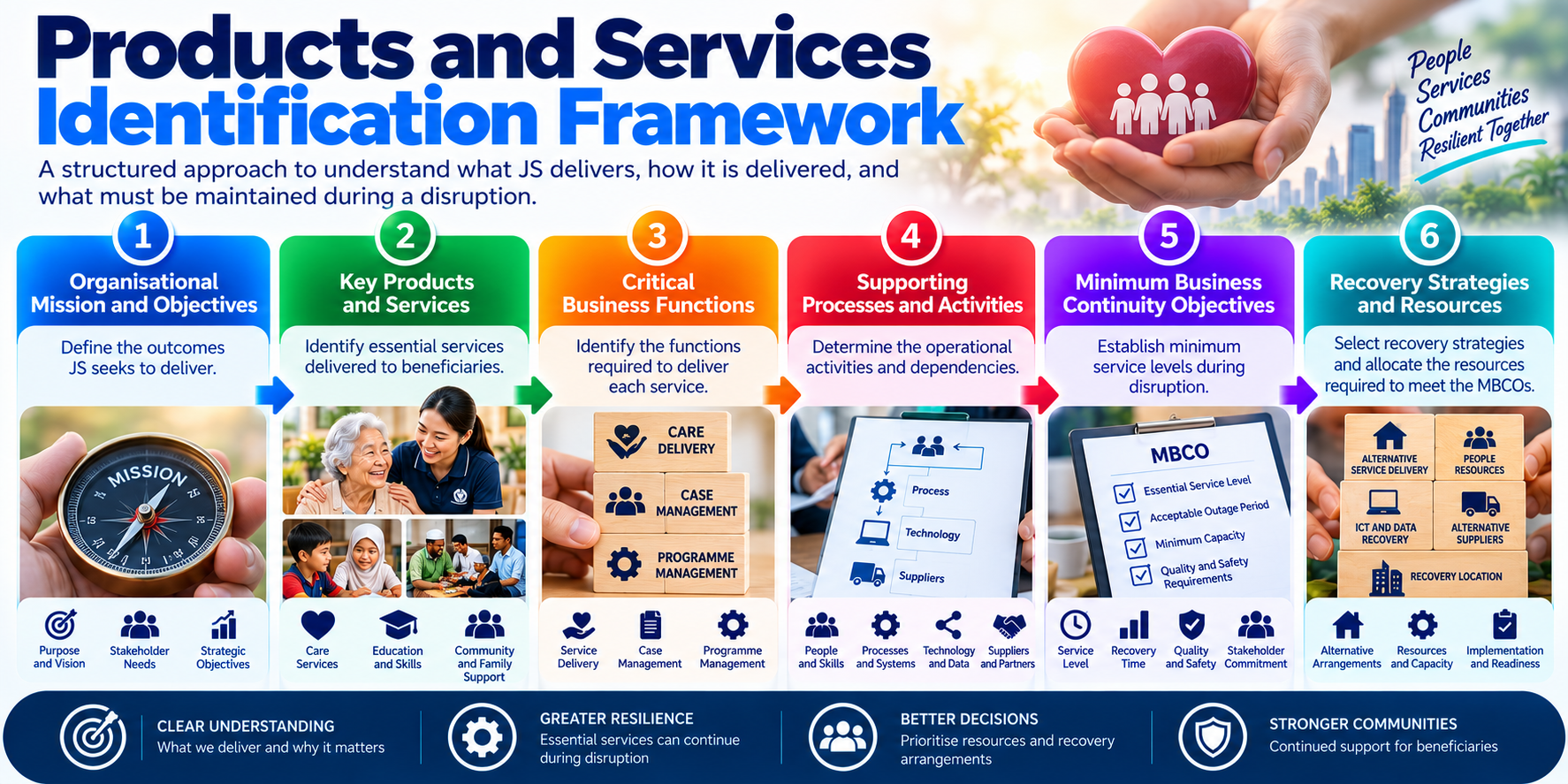
Recovery priorities, strategies, and plans all derive from that list. If the list is wrong or incomplete, the plans will protect the wrong things.
For a commercial firm, "products and services" usually means what customers buy. For JHA, it means what residents, their families, referral agencies and regulators rely on the Home to provide, every hour of every day. Most of these services cannot simply be paused and resumed later, because the people receiving them are frail, dependent and often without family support.
JHA in Context
The Ministry of Community Development established Jamiyah Home for the Aged (Darul Takrim) in 1996 as an eldercare and destitute welfare facility, appointing Jamiyah Singapore (the Muslim Missionary Society Singapore) as managing agent. It began operating at Still Road on 15 December 1996 and moved to its purpose-built premises at 1 Tampines Avenue 3 in December 1997.
The Home's mission is to provide a home for the homeless aged. Its residents are elderly, many frail, and admitted because they are destitute.
The Home pursues two care outcomes: community reintegration for residents with the potential to be discharged, and maintained functioning and well-being for those needing long-term care. It operates 24 hours a day, with office hours of 9 am to 6 pm.
That profile shapes this chapter. A disruption at JHA is not first a loss of revenue or reputation.
It threatens the safety, health, and dignity of people who have nowhere else to go.
The Regulatory Setting
JHA's services are delivered under a set of obligations that continue during any disruption:
- Ministry of Social and Family Development (MSF) is the primary regulator. JHA operates as an MSF-gazetted welfare home under the Destitute Persons Act 1989.
- Social Residential Homes Act 2025, in force from 1 July 2026, brings a new licensing regime for residential homes. Continuity of care and the ability to report incidents to MSF should be read against its requirements.
- Ministry of Health (MOH) sets public health and infection control expectations, which become central during outbreaks.
- The Commissioner of Charities oversees JHA as part of a registered charity, and the Code of Governance for Charities and IPCs (2023) expects the Board to oversee risk, including service failure.
What This Chapter Delivers
This chapter applies ISO 22301:2019 (with Amendment 1:2024) and the guidance in ISO 22313:2020 to produce three things:
- A plain-language explanation of products and services and of the minimum business continuity objective (MBCO).
- Table BIA P&S, which maps JHA's twelve critical business functions (CBFs) to the services they deliver, the people who rely on each, the MBCO and an indicative priority.
- Guidance for the Board and the Superintendent on reading, validating and using the table in the rest of the BIA.
The table is a starting draft. It reflects JHA's published mission and programmes and the CBF list agreed for this series.
Test it with the Superintendent, nursing and care leads, and Jamiyah Singapore's head office before adopting it.
Key concepts
Three ideas carry this chapter: products and services, the minimum business continuity objective, and the link between critical business functions and what residents actually receive.
Products and Services

At JHA, almost everything is a service, delivered in person. The few "products" are records and reports, such as incident notifications to MSF, case reports for discharge planning, and the financial returns a charity must file.
A useful test is to ask: who would notice, and be harmed, if this stopped? If the answer is a resident, a family, MSF or a partner agency, it is a service in scope. Internal activities that no outside party sees directly, such as rostering or procurement, are not services in their own right. They are enablers, and they appear in the table because the resident-facing services cannot run without them.
Minimum Business Continuity Objective (MBCO)
 The MBCO is the minimum level of products and services the organisation accepts to achieve its business objectives during a disruption.
It answers a practical question: if we cannot do everything, what is the least we must still do?
An MBCO is not the normal service standard. During a disruption, JHA might suspend outings, reduce menus or pause volunteer visits. It must not let residents go unsupervised, miss essential medication or go without safe food and water.
The MBCO draws that line in advance, so staff on the night of an incident don't have to decide it under pressure.
A good MBCO for JHA is:
- Specific, stated as an observable level of service (for example, "two meals and one snack daily, with therapeutic diets maintained").
- Resident-centred, framed around safety, health and dignity rather than internal convenience.
- Compliant, never set below what the Destitute Persons Act 1989, the Social Residential Homes Act 2025, MSF licence conditions or MOH infection control directions require.
- Realistic and achievable with the reduced staff, supplies, and premises JHA is likely to have during a disruption.
From Critical Business Functions to Services
The twelve CBFs used in this series describe what JHA does.
The services in the table describe what people receive as a result. Most CBFs deliver one main service; a few, such as medication management, deliver two distinct services with different recovery needs.
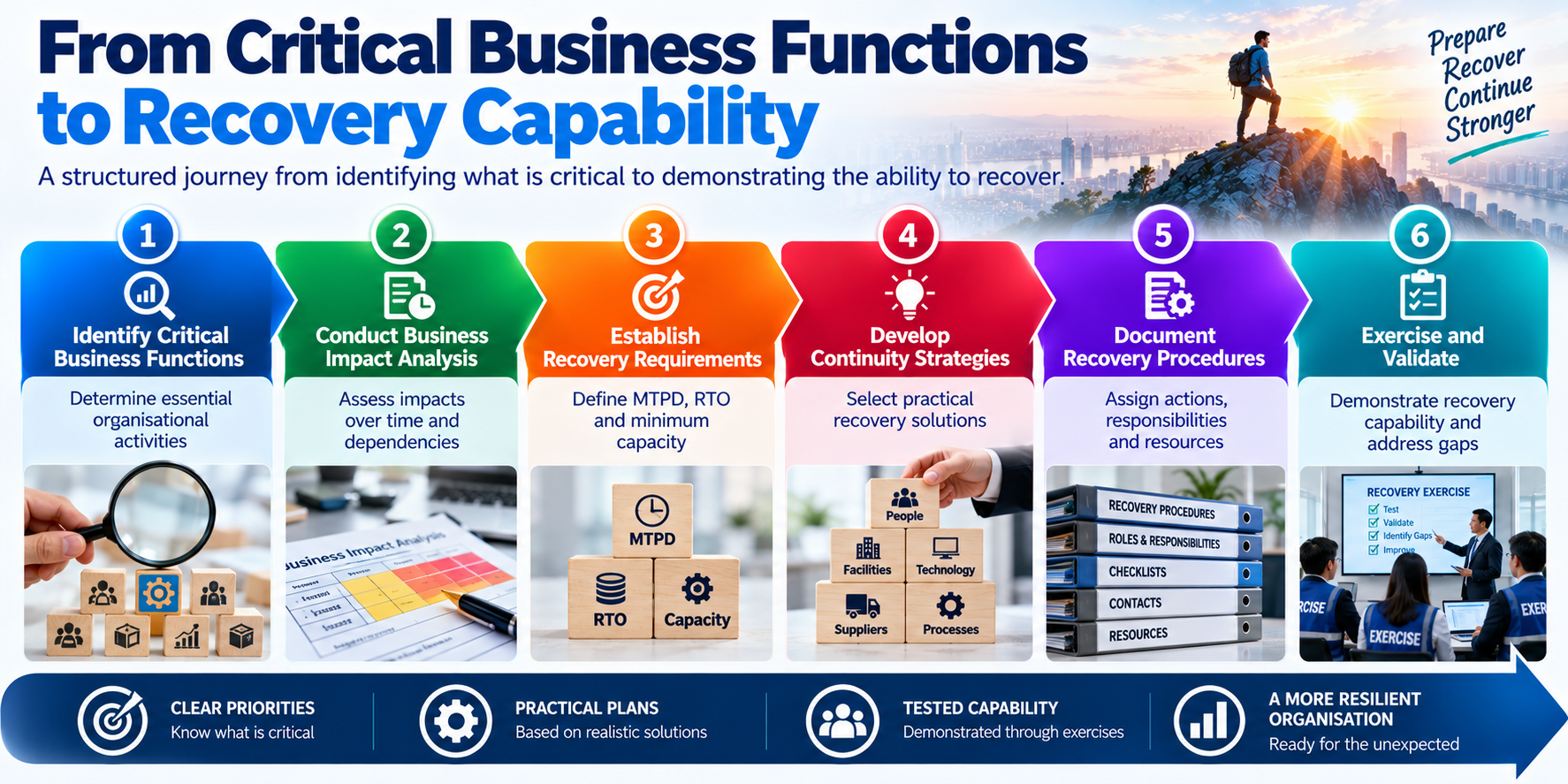
Mapping one to the other keeps the BIA anchored to residents' outcomes.
How the Priority Tiers Work
Each service is given an indicative priority tier. The tiers are a first estimate of how quickly harm would follow if the service stopped. They will be refined into recovery time objectives (RTOs) and maximum tolerable periods of disruption (MTPDs) in the impact assessment later in the BIA.
| Tier | Meaning | Indicative restore window |
|---|---|---|
| Tier 1 | Protects life and must continue without a break: harm to residents or a breach of law follows almost immediately | Continuous, or restored within 4 hours |
| Tier 2 | Must be restored within hours to days: harm or serious regulatory exposure builds over that period | Typically 4 hours to 3 days |
| Tier 3 | Can be paused for a defined period while core care is protected | Typically up to 2 weeks, resumed as capacity returns |
Key Products and Services
JHA's twelve critical business functions deliver sixteen key products and services. Nine are wholly or partly Tier 1: they must continue through any disruption, because residents' lives, health or legal protection depend on them from the first hour.

Table P0: Products and Services for Jamiyah Home for the Aged
| Ref | CBF | Key product or service | Who relies on it | Minimum business continuity objective (MBCO) | Priority |
|---|---|---|---|---|---|
| PS-01 | CBF-1 Personal care and 24-hour supervision | Round-the-clock personal care and supervision of every resident | Residents; families; MSF | Continuous 24-hour supervision with no unattended period. Help with toileting, hygiene, mobility and feeding for every dependent resident. Scheduled checks on residents at high risk of falls, wandering or self-neglect. Full bathing may be reduced to essential hygiene. | Tier 1 |
| PS-02 | CBF-2 Medication management and access to medical care | Safe administration of prescribed medication | Residents; visiting doctors; pharmacy | Every time-critical medication (for example, for diabetes, epilepsy, heart conditions and mental health) given on schedule from a verified list. Medication record kept on paper if IT is down. Buffer stock held for at least 7 days. | Tier 1 |
| PS-03 | CBF-2 Medication management and access to medical care | Access to medical care and emergency referral | Residents; hospitals; GPs and polyclinics | Ability to call 995 and transfer a resident to hospital at any hour. Non-urgent medical review, in person or by teleconsultation, within 48 hours. Critical specialist appointments kept or formally rescheduled. | Tier 1 |
| PS-04 | CBF-3 Meals, nutrition and hydration | Safe food and drinking water | Residents | Safe drinking water available at all times. Three halal meals a day, which may be simplified or ready-to-eat. Therapeutic and texture-modified diets maintained for residents at risk of choking or malnutrition. At least 3 days of emergency food and water on site. | Tier 1 |
| PS-05 | CBF-4 Safe premises and essential utilities | Safe accommodation, utilities and evacuation capability | Residents; staff; SCDF; MSF | Residents housed in a safe space, at 1 Tampines Avenue 3 or an agreed alternate site. Power for lighting, medicine refrigeration and any resident medical equipment. Working water, sanitation and fire safety systems. Ability to evacuate or shelter in place at any hour. | Tier 1 |
| PS-06 | CBF-5 Infection prevention and control | Protection of residents and staff from infection and outbreaks | Residents; staff; visitors; MOH; MSF | Standard precautions applied at all times. Suspected cases isolated or cohorted within hours. PPE and disinfectant stock for a defined outbreak period. Notify outbreaks and apply visitor controls as MOH and MSF direct. | Tier 1 |
| PS-07 | CBF-6 Staffing and rostering | Safe staffing of every care shift (enabler) | Residents; care staff; MSF | No shift falls below the Home's agreed minimum safe staffing level. At least one trained senior staff member in charge on every shift. Call-down list and relief arrangements (for example from other Jamiyah homes, if agreed) ready for use. | Tier 1 |
| PS-08 | CBF-7 Incident reporting and communication with MSF | Regulatory incident reporting and duty contact | MSF; MOH; SCDF; Police; Jamiyah Singapore | Report serious incidents to MSF within the required timeframe. The Superintendent or a named duty officer reachable 24 hours a day. Maintain an incident log from the first hour. | Tier 1 |
| PS-09 | CBF-7 Incident reporting and communication with MSF | Communication with families, referral agencies and partners | Next of kin; referral agencies; partner agencies; Board | Next of kin told of any incident directly affecting their relative within 24 hours. Holding statement issued for wider enquiries. Partner agencies told of changes to admissions, visits or programmes. | Tier 2 |
| PS-10 | CBF-8 Admissions, discharges and case management | Case management, safe transfers and discharges | Residents; MSF; hospitals; community partners | No resident discharged or moved without a case review and a confirmed receiving arrangement. Case information available for any emergency transfer. New admissions paused unless MSF requests an urgent placement that can be safely absorbed. | Tier 2 |
| PS-11 | CBF-9 Resident records and IT | Availability and protection of resident records | Care staff; doctors; hospitals; MSF | Emergency resident summary (photo, next of kin, diagnoses, allergies, medication) available within 1 hour, including offline or paper copies. Full records restored within 72 hours. Personal data protected under the PDPA throughout. | Tier 1 (summary); Tier 2 (full records) |
| PS-12 | CBF-10 Religious and spiritual life | Support for religious practice, rites and pastoral care | Residents; families; religious bodies | Residents can pray with a suitable space and ablution facilities. Halal food maintained. Ramadan fasting supported with suitable meal timings. Death and burial rites arranged in line with the resident's faith without delay. Support residents of all faiths in their own practice. | Tier 2 (death rites are time-critical) |
| PS-13 | CBF-11 Finance, procurement and payroll | Payroll, supplier payments and emergency purchasing (enabler) | Staff; suppliers; residents | Staff paid on the normal pay date. Delegated emergency purchasing authority for food, medicine and PPE. Critical suppliers paid on time. Residents' personal monies safeguarded and accessible. | Tier 2 |
| PS-14 | CBF-11 Finance, procurement and payroll | Funding claims, financial records and statutory returns | MSF; Commissioner of Charities; Jamiyah Singapore; auditors | Funding claims and statutory returns filed by their deadlines, or extensions agreed in writing. Financial records kept intact and recoverable. | Tier 3 |
| PS-15 | CBF-12 Social, recreational and volunteer programmes | Therapeutic, psychosocial and recreational programmes | Residents | Reduced in-house group activities and individual check-ins. Counselling or psychological first aid for residents distressed by the incident. Maintenance physiotherapy resumed within 2 weeks for residents at risk of decline. | Tier 3 |
| PS-16 | CBF-12 Social, recreational and volunteer programmes | Volunteer visits, outings and community employment schemes | Residents; volunteers; schools; employers | May be suspended for a defined period. Promptly inform volunteers and visiting groups and stand them down. Support residents on the Home Employment or Day Release schemes to continue where safe, or help them through the pause. | Tier 3 |
Sources for JHA's mission, care outcomes and programmes: About Us and Programmes. The figures in the MBCO column (for example, 7 days of medication, 3 days of food and water) are proposed planning levels for JHA to confirm, not current measured stock.
Reading the Table
The table is a floor, not a target. Each MBCO describes the least JHA will accept during a disruption; normal service standards return as soon as capacity allows.
The Tier 1 core
Services PS-01 to PS-08, plus the emergency resident summary in PS-11, form JHA's Tier 1 core. Together they keep residents supervised, medicated, fed, sheltered, protected from infection and connected to emergency help, and keep MSF informed. If JHA can sustain only these, it is still meeting its basic duty of care.
The Board should expect business continuity plans, staff training and exercises to concentrate on this core first.
A plan that protects recreation but leaves medication or night supervision exposed has its priorities backwards.
Enablers Carry Hidden Weight
Two entries are marked as enablers: safe staffing (PS-07) and payroll, payments and purchasing (PS-13). Residents do not see them directly, but every resident-facing service depends on them.
Staffing is the table's single largest dependency.
Personal care, medication rounds, meals, infection control, and evacuation all require enough trained staff on the floor. A staff outbreak, a transport disruption, or the sudden loss of foreign workers can therefore threaten every Tier 1 service at once.
The Superintendent must define the minimum safe staffing level in PS-07 in numbers, by shift, and approve it.
Where Jamiyah Singapore's head office, rather than the Home itself, provides payroll, IT, or procurement, those dependencies sit outside JHA's direct control.
Confirm these with head office and document them in the BIA.
How the Services Depend on Each Other
The services are not independent. A failure in one quickly spreads to others:
- Medication (PS-02) depends on resident records (PS-11) for current medication lists and on utilities (PS-05) for refrigerated medicines.
- Meals (PS-04) depend on utilities and the kitchen (PS-05), on suppliers and purchasing (PS-13), and on infection control (PS-06) for safe food handling.
- Religious life (PS-12) is tied to meals through halal food and Ramadan meal timings, and to medical care and families through end-of-life and burial arrangements.
- Infection control (PS-06) directly limits programmes and visits (PS-15 and PS-16), which are usually the first services restricted during an outbreak.
- Communication (PS-08 and PS-09) depends on records (PS-11) for accurate next-of-kin details.
Scenarios to Test the Table Against
The table should hold up across the disruptions JHA is most likely to face. ISO 22301 Amendment 1:2024 also asks organisations to consider whether climate change is relevant, which, for a home of frail residents in Singapore, points to heat and haze.
| Scenario | Services most at risk | What the MBCO protects |
|---|---|---|
| Infectious disease outbreak | PS-01, PS-06, PS-07, PS-15, PS-16 | Supervision and isolation continue on reduced staff; programmes and visits pause |
| Extended power or water failure | PS-02, PS-04, PS-05 | Refrigerated medicines, safe water and lighting maintained; residents moved if needed |
| Fire or loss of the building | PS-01, PS-05, PS-10, PS-11 | Safe evacuation, an alternate site and resident records travelling with residents |
| Severe staff shortage | PS-01, PS-02, PS-07 | Minimum safe staffing on every shift, with lower-tier services released first |
| IT failure or cyber attack | PS-02, PS-11, PS-13 | Paper medication records, offline resident summaries and manual payroll |
| Heatwave or severe haze | PS-01, PS-04, PS-06 | Hydration, cooling and monitoring of vulnerable residents |
What the table is not
The table does not yet set recovery time objectives, list the resources each service needs, or assess impacts over time. Those come in the following BIA steps. The tiers here are indicative and may move once the impact assessment is done.

JHA now has a first, resident-centred statement of what it must keep doing when things go wrong, and the least it will accept while it does so. Sixteen products and services, drawn from twelve critical business functions, define the Home's continuity commitments, and nine of them sit in the Tier 1 core that must not stop.
What the Board should take from this chapter
- The Home's continuity obligations are about people, not premises or systems. Every Tier 1 service protects a resident's safety, health or legal rights. Board oversight of BCM is therefore part of its oversight of care quality and of risk under the Code of Governance for Charities and IPCs (2023).
- The MBCO is a governance decision. Agreeing the minimum acceptable level of care is a judgement about risk appetite and duty of care. The Board should approve it, not leave it to operational staff to decide during an incident.
- Staffing is the critical dependency. The Board should ask how JHA would maintain safe staffing if a third of care staff were unavailable for two weeks, and what support Jamiyah Singapore could provide.
- Regulatory duties do not pause. Reporting to MSF and compliance with the Destitute Persons Act 1989, the Social Residential Homes Act 2025 and MOH directions continue through any disruption, which is why incident reporting sits in Tier 1.
What the Superintendent and senior staff should take from it
The table gives staff a shared language for hard choices. When resources are short, the tiers say which services are released first and which are protected at all costs. The MBCO column gives each team a clear, observable standard to hold.
The figures in the MBCO column are proposals. Each one, from buffer stock levels to the time allowed for next-of-kin notification, must be checked against JHA's licence conditions, MSF requirements, current practice and the realistic capacity of the Home.
Next steps
- Hold a validation workshop with the Superintendent, nursing and care leads, kitchen, administration and a Jamiyah Singapore head office representative to review every row of Table BIA P&S
- Define the minimum safe staffing level for each shift in numbers (PS-07)
- Confirm the MSF incident reporting timeframes and any Social Residential Homes Act 2025 licence conditions that set a floor for the MBCOs
- Confirm which enabling services (payroll, IT, procurement) are provided by head office, and record them as dependencies
- Present the validated table to the Board for approval of the MBCOs
- Carry the approved list into the next BIA steps: impact assessment over time, recovery time objectives, and the resources and dependencies each service needs
With the products and services agreed, JHA has the foundation for the rest of its business impact analysis. Every recovery strategy, plan and exercise that follows should be traceable back to a row in this table.
Sources
- Jamiyah Home for the Aged: About Us
- Jamiyah Home for the Aged: Programmes
- Jamiyah Home for the Aged: Home page (operating hours and contact details)
- BCMpedia: Part 1, MBCO & Product and Services
- ISO 22301:2019 + Amendment 1:2024 and ISO 22313:2020 (definitions of products and services and of the MBCO)







