



![Banner [BCM] [E3] [BIA] [P1] Identification of Business Functions](https://no-cache.hubspot.com/cta/default/3893111/206ddd7e-615a-42c8-aa2a-3416a1ad06b3.png)
CBF-3 Child Health and Nutrition Services
![[BCM] [KL] [E3] [BIA] [T1] [CBF] [3] Child Health and Nutrition Services](https://no-cache.hubspot.com/cta/default/3893111/eba9555f-e731-4b85-8cac-76047d453136.png) In this chapter, we explore the identification of business functions for CBF-3 Child Health and Nutrition Services at Kinderland, a critical component of its operations.
In this chapter, we explore the identification of business functions for CBF-3 Child Health and Nutrition Services at Kinderland, a critical component of its operations.
The child health and nutrition services ensure the well-being of the children in their care, covering a wide range of services including health monitoring, meal preparation, emergency response, and regulatory compliance.
As part of Kinderland’s Business Continuity Management (BCM) plan, these functions are essential in maintaining the organisation’s overall resilience.
The Minimum Business Continuity Objectives (MBCO) are vital for each sub-function to ensure continuity in the event of a disruption.
The sub-functions within CBF-3 are designed to address various aspects of child health, from daily health monitoring and care to emergency medical responses and nutritional planning.
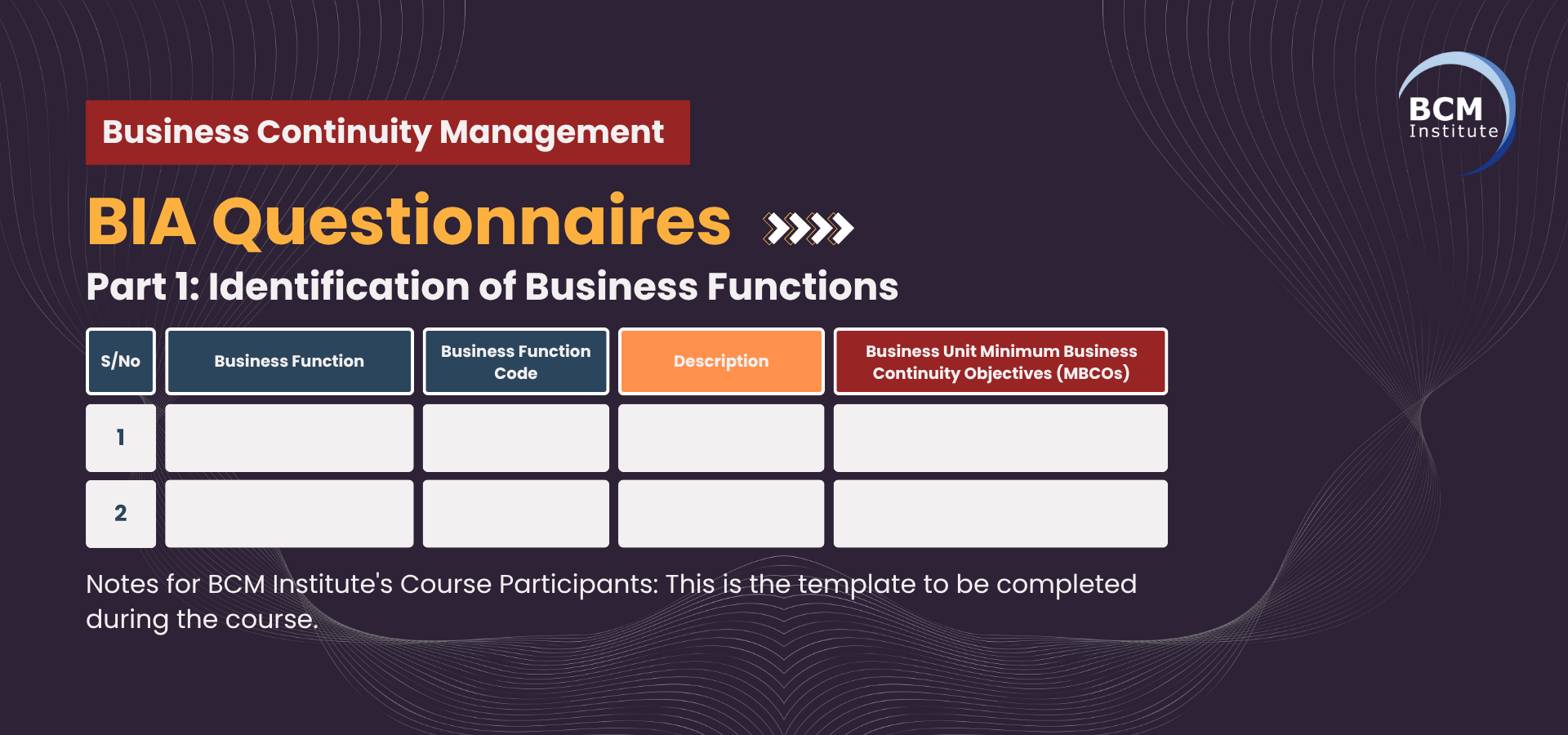
This table provides an overview of each sub-function, its purpose, and the MBCOs required to maintain service delivery, even in the face of potential disruptions.
![Banner [Table] [BCM] [E3] [BIA] [P1] Identification of Critical Business Functions](https://no-cache.hubspot.com/cta/default/3893111/4fe499c9-0c19-46b4-8b6f-75450dba07d8.png)
Table P1: Critical Business Functions for CBF-3
|
Sub-CBF Code |
Sub-CBF |
Description of CBF |
Business Unit Minimum Business Continuity Objective (MBCO) |
|
3.1 |
Health Monitoring & Care |
This sub-function involves tracking and assessing the health status of children, including regular health check-ups, vaccination schedules, and monitoring of health records. |
The MBCO for this unit is ensuring that children's health records are accurately maintained, that vaccinations and check-ups are performed on time, and that any health issues are addressed promptly. |
|
3.2 |
Nutritional Planning & Meal Preparation |
This function is responsible for designing balanced meal plans and preparing nutritious meals for children to ensure their dietary needs are met. |
The MBCO for this unit is to ensure that children receive nutritious meals daily, and that any special dietary requirements (e.g., for allergies) are met without disruption. |
|
3.3 |
Medical Emergency Response |
This function focuses on providing immediate medical attention in case of emergencies, including injuries or sudden illnesses. |
The MBCO for this unit is to provide immediate first aid or emergency medical response, including access to emergency contact information and a trained medical team when required. |
|
3.4 |
Medication Management & Administration |
This includes overseeing and administering medication to children, especially those with chronic conditions, ensuring proper dosage and timing. |
The MBCO for this unit is to ensure that children receive their medications on time, in the correct dosage, and that all records are accurately maintained for compliance and safety. |
|
3.5 |
Health Education & Awareness for Parents |
This function involves educating parents about health, nutrition, and wellness practices that are essential for their children’s development. |
The MBCO for this unit is to maintain regular communication with parents, ensuring that they are informed about health protocols and any issues concerning their child’s health or nutrition. |
|
3.6 |
Hygiene and Sanitation Practices |
This function ensures that proper hygiene standards are met, including regular hand washing, cleanliness of facilities, and sanitation of food preparation areas. |
The MBCO for this unit is to ensure that all facilities are kept sanitary, particularly in high-risk areas such as kitchens and bathrooms, and that hygiene practices are maintained to prevent illness. |
|
3.7 |
Regulatory Compliance & Reporting |
This sub-function ensures compliance with regulations related to child health and nutrition, including the documentation and reporting of incidents to health authorities. |
The MBCO for this unit is to ensure that all health and nutrition-related practices comply with regulatory standards, and that all required documentation and reporting are completed accurately |
![Banner [BCM] [E3] [BIA] [Summing Up] [P1] Identification of Critical Business Functions](https://no-cache.hubspot.com/cta/default/3893111/22330ab3-0a0f-4efd-9da7-43032e1e6573.png)
The identification and analysis of CBF-3 Child Health and Nutrition Services highlight the critical nature of ensuring continuity in these essential services at Kinderland.
By understanding and establishing Minimum Business Continuity Objectives (MBCO) for each sub-function, the organization ensures that child health services are maintained under any circumstances.
Each sub-function has specific MBCOs that prioritize the continuity of health monitoring, medication administration, emergency medical responses, and compliance with health regulations.
These functions are vital in safeguarding the well-being of the children and ensuring that Kinderland operates as a resilient and reliable service provider for parents and the community.
By maintaining continuity in these health and nutrition services, Kinderland ensures that it meets its obligations to both children and their families, reinforcing the importance of BCM within early childhood care settings.
![Banner [BCM] [E3] [BIA] [P2] Impact Area of Business Functions](https://no-cache.hubspot.com/cta/default/3893111/182e67c2-aa89-4b0b-b3e9-144293680ea4.png)
CBF-3 Child Health and Nutrition Services
In the context of Kinderland's critical business functions related to child health and nutrition, it is essential to assess the potential impact of disruptions across various sub-functions.
These functions are pivotal to the overall well-being and development of the children under Kinderland's care. This section focuses on analysing the impact areas associated with each sub-function within CBF-3 Child Health and Nutrition Services.
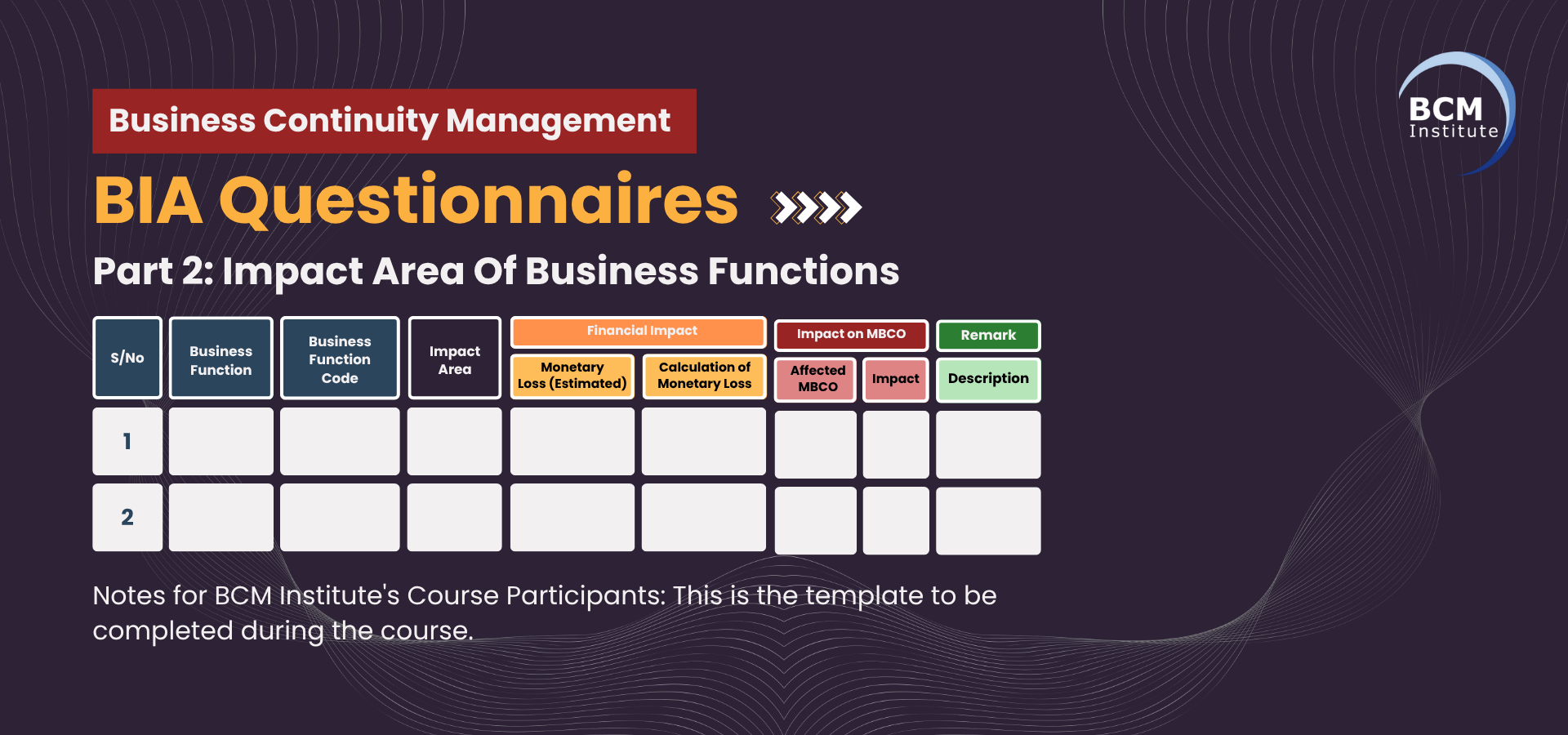
The table below highlights the various business processes and their respective potential impacts in the event of a disruption.
Understanding these impact areas is crucial for formulating effective business continuity strategies to mitigate risks and ensure that Kinderland can continue to provide safe, high-quality services in the face of any adversity.
![Banner [Table] [BCM] [E3] [BIA] [P2] Impact Areas of Business Functions [BIAQ]](https://no-cache.hubspot.com/cta/default/3893111/91582408-03ad-40e1-90e8-43ce62079aa6.png)
Table P2: Impact Area Assessment for CBF-3
|
Sub-CBF Code |
Sub-CBF |
Impact Area |
Financial Impact - Monetary Loss (Estimated) |
Financial Impact - Calculation of Monetary Loss (State Formula for Calculations) |
Impact on MBCO - Affect MBCO |
Impact on MBCO - Impact |
Remarks - Description |
|
3.1 |
Health Monitoring & Care |
Health and Safety |
Loss due to delayed health assessments or care |
Calculation based on the average daily healthcare cost multiplied by the number of affected children and days delayed |
High |
Delay in health monitoring may lead to increased health risks, affecting children's safety and well-being |
Delayed monitoring may lead to non-compliance with health regulations |
|
3.2 |
Nutritional Planning & Meal Preparation |
Nutritional Services |
Loss due to poor meal planning affects children's health and development |
Loss of revenue due to dietary errors leading to unbalanced meals or food wastage |
Medium |
Impact on nutritional services can result in increased absenteeism or poor child health outcomes |
Risk of non-compliance with government nutrition standards |
|
3.3 |
Medical Emergency Response |
Emergency Preparedness |
Loss due to ineffective response in medical emergencies |
Loss of reputation, legal liabilities, and increased treatment costs |
High |
Inadequate response could lead to severe consequences in health emergencies |
Failure to meet emergency response timeframes can affect MBCO |
|
3.4 |
Medication Management & Administration |
Medication Safety |
Financial loss from legal issues and medical errors |
Average cost of medication errors, lawsuits, and staff retraining programs |
High |
Non-compliance or delays in medication management will compromise child's health |
Non-adherence to medical guidelines could lead to penalties |
|
3.5 |
Health Education & Awareness for Parents |
Education & Communication |
Loss due to ineffective health communication strategies |
Loss from underperformance in parental engagement or awareness campaigns |
Medium |
If parents are not properly informed, children's health may be jeopardized |
Weak communication could lead to mistrust and low satisfaction |
|
3.6 |
Hygiene and Sanitation Practices |
Health and Safety |
Loss from disease outbreaks or cross-contamination |
Costs involved in cleaning, sanitizing, and preventing infections |
High |
Poor hygiene practices can lead to health crises affecting many children |
A failure in hygiene practices can damage the organization's reputation |
|
3.7 |
Regulatory Compliance & Reporting |
Legal & Compliance |
Loss due to penalties for non-compliance with health regulations |
Fines and additional legal costs for non-compliance |
High |
Non-compliance with regulations may lead to significant legal and financial consequences |
Regulatory audits could lead to fines, or even closure of facilities |
![Banner [BCM] [E3] [BIA] [Summing Up] [P2] Impact Areas of Business Functions [BIAQ]](https://no-cache.hubspot.com/cta/default/3893111/76188041-e1c9-43d9-8efa-e550f46ad04d.png)
The analysis of impact areas for CBF-3 Child Health and Nutrition Services underscores the importance of robust continuity strategies in managing critical health and nutrition functions.
Disruptions to any of these sub-functions could result in significant financial loss, affect Kinderland’s Minimum Business Continuity Objectives (MBCO), and negatively impact the health and safety of children.
Kinderland must integrate these impact considerations into its business continuity planning to minimize risk and ensure compliance with health and safety standards.
By understanding and addressing these potential impacts, Kinderland can enhance its resilience and continue to provide safe, nutritious, and well-monitored care for children.


![[BCM] [KL] [E3] [BIA] [DP] [CBF] [3] Child Health and Nutrition Services](https://no-cache.hubspot.com/cta/default/3893111/8d24b281-c8dc-49cc-8bb8-f778e93f612d.png)
![[BCM] [KL] [E3] [BIA] [T2] [CBF] [3] Child Health and Nutrition Services](https://no-cache.hubspot.com/cta/default/3893111/ffc45638-6313-4755-9aee-fe17b1ca8757.png)
![[BCM] [KL] [E3] [BIA] [T3] [CBF] [3] Child Health and Nutrition Services](https://no-cache.hubspot.com/cta/default/3893111/ac192524-f045-436f-88a5-18e50962d43f.png)
![[BCM] [KL] [E3] [BCS] [T2] [CBF] [3] BCS Recovery Strategy](https://no-cache.hubspot.com/cta/default/3893111/59d97d78-865f-4da4-9ff2-295415e9d258.png)
![[BCM] [KL] [E3] [BCS] [T3] [CBF] [3] Minimum Resources Required during a Disaster](https://no-cache.hubspot.com/cta/default/3893111/b70da537-140c-42f7-b97b-05d719b61258.png)
![[BCM] [KL] [E3] [PD] [CBF] [3] Child Health and Nutrition Services](https://no-cache.hubspot.com/cta/default/3893111/cee44210-b932-44ff-9716-ffa2b37b92e8.png)
More Information About Business Continuity Management Courses
To learn more about the course and schedule, click the buttons below for the BCM-300 Business Continuity Management Implementer [BCM-3] and the BCM-5000 Business Continuity Management Expert Implementer [BCM-5].


![Register [BL-B-3]*](https://no-cache.hubspot.com/cta/default/3893111/ac6cf073-4cdd-4541-91ed-889f731d5076.png)



![FAQ [BL-B-3]](https://no-cache.hubspot.com/cta/default/3893111/b3824ba1-7aa1-4eb6-bef8-94f57121c5ae.png)
![Email to Sales Team [BCM Institute]](https://no-cache.hubspot.com/cta/default/3893111/3c53daeb-2836-4843-b0e0-645baee2ab9e.png)


