---
title: [CM] [WH] [E1] [C5] Identifying the Types of Crisis Scenarios
description: [CM] [WH] [E1] [C5] Identifying the Types of Crisis Scenarios
image: https://blog.bcm-institute.org/hubfs/Woodlands%20Health%20Campus%20Morepost/E1/%5BCM%5D%20%5BWH%5D%20%5BE1%5D%20%5BC5%5D%20Identifying%20the%20Types%20of%20Crisis%20Scenarios.png
---
[](http://www.bcm-institute.org/)
- [Home](https://www.bcm-institute.org/)
- [About Us](https://www.bcm-institute.org/about-us-3/)
- [A President’s Perspective](https://www.bcm-institute.org/about-us/a-presidents-perspective/)
- [Our History](https://www.bcm-institute.org/about-us/our-history/)
- [Our Advisory Council](https://www.bcm-institute.org/about-us/our-advisory-council/)
- [Customers’ Testimonials](https://www.bcm-institute.org/about-us/customers-testimonials/)
- [Credential Verification](https://www.bcm-institute.org/about-us/credential-verification/)
- [Courses](https://blog.bcm-institute.org/blog/course-fees-for-blended-learning-courses-master-catalog)
- [ISO 22301 Business Continuity Management System Audit](https://blog.bcm-institute.org/audit/business-continuity-management-audit-courses)
- [ISO 22301 Business Continuity Management](https://blog.bcm-institute.org/bcm/business-continuity-management-courses)
- [Crisis Communication](https://blog.bcm-institute.org/crisis-communication/crisis-communication-courses)
- [Crisis Management](https://blog.bcm-institute.org/en/crisis-management/courses)
- [IT Disaster Recovery](https://blog.bcm-institute.org/it-disaster-recovery/courses)
- [Operational Resilience](https://blog.bcm-institute.org/operational-resilience/courses)
- [Operational Resilience Audit](https://blog.bcm-institute.org/operational-resilience-audit/courses)
- [Certification](https://blog.bcm-institute.org/certification/types-of-certifications-offered)
- [ISO 22301 BCMS Audit Certification](https://blog.bcm-institute.org/certification/business-continuity-management-audit-certification)
- [ISO22301 Business Continuity Management Certification](https://blog.bcm-institute.org/bcm/business-continuity-management-certification)
- [Crisis Communication Certification](https://blog.bcm-institute.org/crisis-communication/crisis-communication-certification)
- [Crisis Management Certification](https://blog.bcm-institute.org/en/crisis-management/crisis-management-certification)
- [IT Disaster Recovery Planning Certification](https://blog.bcm-institute.org/it-disaster-recovery/it-disaster-recovery-certification)
- [Operational Resilience Certification](https://blog.bcm-institute.org/operational-resilience/operational-resilience-certification)
- [Operational Resilience Audit Certification](https://blog.bcm-institute.org/operational-resilience-audit)
- [Seminars](https://blog.bcm-institute.org/meet-the-expert/mte-webinar-mainpage)
- [Store](https://www.bcm-institute.org/store-2/)
- [Contact Us](http://www.bcm-institute.org/about-us/contact-us/)
-
-
##### Crisis Management Planning Series

# \[CM\] \[WH\] \[E1\] \[C5\] Identifying the Types of Crisis Scenarios
A crisis scenario, as defined by BCMpedia, refers to a [](https://cta-redirect.hubspot.com/cta/redirect/3893111/61b93210-c0e8-43ff-810c-ff347e849d86)hypothetical situation or sequence of events that poses a significant threat to an organisation’s operations, reputation, stakeholders, or survival, and which requires urgent, coordinated, and strategic response measures.
For a major healthcare institution such as Woodlands Hospital (WH)—a critical provider of acute, sub-acute, rehabilitative, transitional, and long-term care in Singapore’s Northern region—crisis scenarios must be considered not just from the standpoint of operational disruption, but also from the perspective of patient safety, community trust, and the institution’s long-term reputation.
The following crisis scenario categories, adapted from the recognised taxonomy in BCMpedia, highlight the key risks that WH should be prepared to address under its crisis management framework[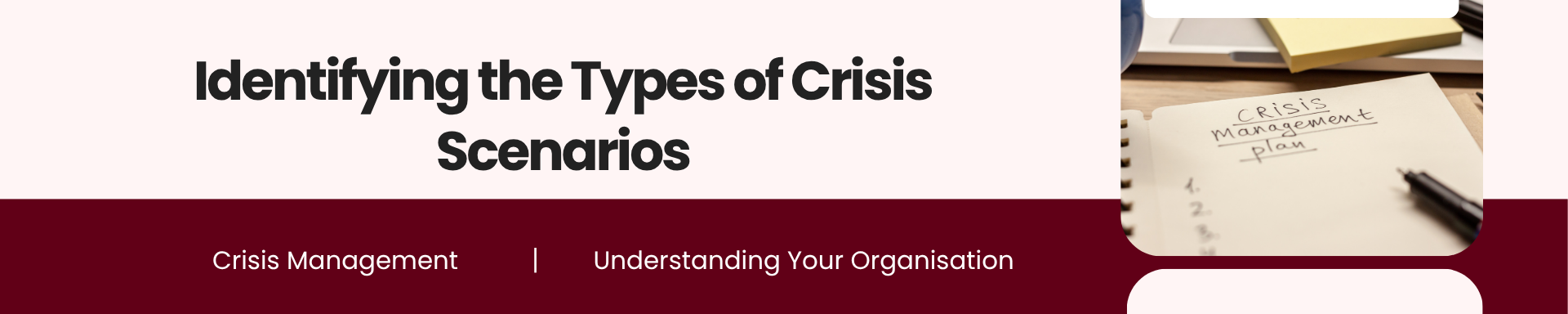](https://cta-redirect.hubspot.com/cta/redirect/3893111/2caf9039-e27e-4c1b-a49d-61a883128f35)
[Moh Heng Goh](https://blog.bcm-institute.org/woodlands-hospital/author/moh-heng-goh) Aug 12, 2025
###### Crisis Management Certified Planner-Specialist-Expert
###### [](https://cta-redirect.hubspot.com/cta/redirect/3893111/2cdcf7e8-e677-4a79-bd94-347f7077ac08)
### **Chapter 5**
### [](https://cta-redirect.hubspot.com/cta/redirect/3893111/2caf9039-e27e-4c1b-a49d-61a883128f35)
### Woodlands Health
[![\[CM\] \[WH\] \[E1\] \[C5\] Identifying the Types of Crisis Scenarios](https://no-cache.hubspot.com/cta/default/3893111/0acf0b49-0232-4bb1-bede-acf0d2ee99f9.png)](https://cta-redirect.hubspot.com/cta/redirect/3893111/0acf0b49-0232-4bb1-bede-acf0d2ee99f9)A crisis scenario, as defined by BCMpedia, refers to a hypothetical situation or sequence of events that poses a significant threat to an organisation’s operations, reputation, stakeholders, or survival, and which requires urgent, coordinated, and strategic response measures.
For a major healthcare institution such as Woodlands Hospital (WH)—a critical provider of acute, sub-acute, rehabilitative, transitional, and long-term care in Singapore’s Northern region—crisis scenarios must be considered not just from the standpoint of operational disruption, but also from the perspective of patient safety, community trust, and the institution’s long-term reputation.
The following crisis scenario categories, adapted from the recognised taxonomy in BCMpedia, highlight the key risks that WH should be prepared to address under its crisis management framework:
#### 1. Natural
Events such as pandemics, extreme weather conditions (e.g., prolonged heat waves, heavy rainfall, or flash floods), or infectious disease outbreaks (e.g., COVID-19, dengue, or influenza surges) may cause service disruptions, strain medical resources, and endanger patient and staff safety.
As WH’s facilities are part of a larger integrated campus, the impact of natural hazards may cascade across multiple care units, affecting acute care wards, community hospitals, and specialist clinics.
#### 2. Technological
Failures in healthcare technology can severely impact care delivery.
Examples include prolonged Electronic Medical Records (EMR) system outages, diagnostic equipment malfunctions, laboratory automation breakdowns, or cybersecurity breaches compromising patient data.
WH’s reliance on advanced medical devices and integrated IT systems makes this scenario particularly critical, requiring robust redundancy and cyber-resilience measures.
#### 3. Organisational Misdeeds
These scenarios involve actions (or inactions) within the organisation that undermine its mission, ethics, or compliance obligations:
- **Skewed Management Values**– Decision-making driven by priorities that conflict with patient safety or ethical care, such as resource allocation favouring non-critical services at the expense of urgent care needs.
- **Deception**– Concealment or manipulation of clinical outcomes, adverse event data, or financial performance reports.
- **Management Misconduct** – Breaches of laws, regulations, or professional ethics by senior leaders, such as improper procurement practices or abuse of authority.
#### 4. Confrontation
Disputes with stakeholders—including unions, community groups, advocacy organisations, or government bodies—can escalate into public challenges to WH’s policies, practices, or governance.
This may occur during disputes over service changes, community engagement issues, or staff working conditions, potentially triggering media scrutiny and reputational risk.
#### 5. Malevolence
Acts intended to harm WH or its stakeholders include arson, deliberate contamination of medical supplies, tampering with hospital systems, or targeted cyberattacks.
In healthcare settings, even small-scale acts of sabotage can have amplified consequences due to the vulnerability of patients and the reliance on uninterrupted care delivery.
#### 6. Workplace Violence
Incidents involving physical harm, threats, or intimidation affecting staff, patients, or visitors.
Healthcare facilities are particularly susceptible due to high-stress environments, emotionally charged situations, and public accessibility.
This may include aggression from patients or relatives, inter-staff conflicts, or targeted assaults on healthcare workers.
#### 7. Rumours
The rapid spread of misinformation—whether about outbreaks, treatment quality, or WH’s operational capacity—can undermine public trust and cause unnecessary panic.
In today’s social media-driven environment, unfounded claims can spread faster than official communications, making proactive reputation and information management critical.
#### 8. Lack of Funds
Financial constraints may arise from reduced government funding, unforeseen operational expenses (e.g., responding to a public health crisis), or mismanagement of resources.
Funding shortfalls can affect staffing, equipment maintenance, and service availability, which can indirectly impact patient care and institutional resilience.
##### Table: Crisis Scenarios for Woodlands Hospital
| No. | Crisis Scenario | Description | Potential Impact on Woodlands Hospital |
| --- | --- | --- | --- |
| 1 | Natural | Events such as pandemics, extreme weather, or infectious disease outbreaks can have significant impacts. | Strain on medical resources, disruption of care services, risk to patient and staff safety, overflow of emergency and inpatient facilities. |
| 2 | Technological | Failures in IT systems, medical equipment, or cybersecurity breaches. | Delay in diagnosis/treatment, loss of critical patient data, inability to operate essential systems, and reputational damage. |
| 3a | Organisational Misdeeds – Skewed Management Values | Decision-making priorities that conflict with patient safety or ethics. | Compromised care quality, erosion of staff morale, and public criticism. |
| 3b | Organisational Misdeeds – Deception | Concealment or manipulation of outcomes or reporting. | Loss of regulatory trust, reputational damage, and legal action. |
| 3c | Organisational Misdeeds – Management Misconduct | Breaches of laws, regulations, or ethics by leadership. | Regulatory penalties, leadership instability, reputational harm. |
| 4 | Confrontation | Disputes with unions, community groups, or government bodies. | Service disruptions, strained stakeholder relationships, negative media coverage. |
| 5 | Malevolence | Acts intended to harm WH, such as sabotage, arson, or cyberattacks. | Disruption of operations, safety risks to patients and staff, and financial loss. |
| 6 | Workplace Violence | Physical harm, threats, or intimidation in the workplace. | Injury to staff or patients, fear among the workforce, and operational instability. |
| 7 | Rumours | Spread of misinformation about the WH or its services. | Public panic, erosion of trust, and increased demand on communication resources. |
| 8 | Lack of Funds | Financial shortfalls from reduced funding, unforeseen costs, or mismanagement. | Reduced service availability, deferred maintenance, and staffing challenges. |
### [![\[Summary\] \[CM\] \[E1\] \[C5\] Identifying the Types of Crisis Scenarios](https://no-cache.hubspot.com/cta/default/3893111/9c00e052-97bc-48c6-85c1-9a6c9c2a1598.png)](https://cta-redirect.hubspot.com/cta/redirect/3893111/9c00e052-97bc-48c6-85c1-9a6c9c2a1598)
By identifying and categorising potential crisis scenarios, Woodlands Hospital can proactively strengthen its Crisis Management Plan in alignment with ISO 22361:2022 principles.
Recognising these threats is the first step toward implementing structured mitigation, preparedness, and response strategies.
Given WH’s role as a healthcare lifeline for the Northern Singapore community, its readiness to manage crises must be rooted in an integrated, organisation-wide approach that safeguards patients, staff, and public trust.
| ###### Operational Readiness: Crisis Management Implementation for Woodlands Hospital | | | | | | |
| --- | --- | --- | --- | --- | --- | --- |
| **eBook 1: Understanding Your Organisation** | | | | | | |
| **C1** | **C2** | **C3** | **C4** | **C5** | **C6** | |
| [![\[CM\] \[WH\] \[E1\] \[C1\] Overview of Case Study for Woodlands Health](https://no-cache.hubspot.com/cta/default/3893111/1bae8a79-7330-48b3-820f-91395da92449.png)](https://cta-redirect.hubspot.com/cta/redirect/3893111/1bae8a79-7330-48b3-820f-91395da92449) | [![\[CM\] \[WH\] \[E1\] \[C2\] Understanding Your Organisation](https://no-cache.hubspot.com/cta/default/3893111/60880ea7-e6ac-4d2e-bec8-314bb01bb14e.png)](https://cta-redirect.hubspot.com/cta/redirect/3893111/60880ea7-e6ac-4d2e-bec8-314bb01bb14e) | [![\[CM\] \[WH\] \[E1\] \[C3\] Establishing CM Goals](https://no-cache.hubspot.com/cta/default/3893111/2894f0bd-7edc-400d-8dd4-fe7f5eecdf9d.png)](https://cta-redirect.hubspot.com/cta/redirect/3893111/2894f0bd-7edc-400d-8dd4-fe7f5eecdf9d) | [![\[CM\] \[WH\] \[E1\] \[C4\] CM Vs BCM](https://no-cache.hubspot.com/cta/default/3893111/1ea8744e-b02a-4ddc-a9cd-0a1dfc2fc4fc.png)](https://cta-redirect.hubspot.com/cta/redirect/3893111/1ea8744e-b02a-4ddc-a9cd-0a1dfc2fc4fc) | [![\[CM\] \[WH\] \[E1\] \[C5\] Identifying the Types of Crisis Scenarios](https://no-cache.hubspot.com/cta/default/3893111/0acf0b49-0232-4bb1-bede-acf0d2ee99f9.png)](https://cta-redirect.hubspot.com/cta/redirect/3893111/0acf0b49-0232-4bb1-bede-acf0d2ee99f9) | [![\[CM\] \[WH\] \[E1\] \[C6\] Assessing Risks and Threats](https://no-cache.hubspot.com/cta/default/3893111/e12715ff-e916-4f53-a810-0d0d5a06ca81.png)](https://cta-redirect.hubspot.com/cta/redirect/3893111/e12715ff-e916-4f53-a810-0d0d5a06ca81) | [](https://cta-redirect.hubspot.com/cta/redirect/3893111/83735804-5393-4332-a2df-acfba9ef8328) |
| **C7** | **C8** | **C9** | **C10** | **C11** | **C12** | **C13** |
| [![\[CM\] \[WH\] \[E1\] \[C7\] Composing the CM Team](https://no-cache.hubspot.com/cta/default/3893111/6e6edfef-e286-43e3-b3d9-0ee02df99bbe.png)](https://cta-redirect.hubspot.com/cta/redirect/3893111/6e6edfef-e286-43e3-b3d9-0ee02df99bbe) | [![\[CM\] \[WH\] \[E1\] \[C8\] Implementing the CM Planning Methodology](https://no-cache.hubspot.com/cta/default/3893111/403cd4ed-886c-4574-9019-67db26192132.png)](https://cta-redirect.hubspot.com/cta/redirect/3893111/403cd4ed-886c-4574-9019-67db26192132) | [![\[CM\] \[WH\] \[E1\] \[C9\] Pre-Crisis - Risk Identification and Crisis Preparedness](https://no-cache.hubspot.com/cta/default/3893111/54679a11-2303-427a-b2e6-f9c7e957764d.png)](https://cta-redirect.hubspot.com/cta/redirect/3893111/54679a11-2303-427a-b2e6-f9c7e957764d) | [![\[CM\] \[WH\] \[E1\] \[C10\] During Crisis - Crisis Response and Decision-Making](https://no-cache.hubspot.com/cta/default/3893111/f4f4e663-709f-40b9-9b28-09420a89a668.png)](https://cta-redirect.hubspot.com/cta/redirect/3893111/f4f4e663-709f-40b9-9b28-09420a89a668) | [![\[CM\] \[WH\] \[E1\] \[C11\] Post Crisis - Crisis Recovery ](https://no-cache.hubspot.com/cta/default/3893111/fa02bee7-870f-4cf2-a2d3-f1a1980e0c95.png)](https://cta-redirect.hubspot.com/cta/redirect/3893111/fa02bee7-870f-4cf2-a2d3-f1a1980e0c95) | [![\[CM\] \[WH\] \[E1\] \[C12\] Summary and Strategic Outlook](https://no-cache.hubspot.com/cta/default/3893111/5a147fec-152d-4aa4-b525-f5144de07804.png)](https://cta-redirect.hubspot.com/cta/redirect/3893111/5a147fec-152d-4aa4-b525-f5144de07804) | [![\[CM\] \[WH\] \[E1\] \[C13\] \[Back Cover\] CM eBook 1](https://no-cache.hubspot.com/cta/default/3893111/6f3af554-70aa-44c2-a11f-096e184384a2.png)](https://cta-redirect.hubspot.com/cta/redirect/3893111/6f3af554-70aa-44c2-a11f-096e184384a2) |
| | | | | | | |
#### More Information About Crisis Management Courses
To learn more about the course and schedule, click the buttons below for the CM-300 Crisis Management Implementer \[CM-3\] and the CM-5000 Crisis Management Expert Implementer \[CM-5\].
| [](https://cta-redirect.hubspot.com/cta/redirect/3893111/5ffecd2d-8000-4805-b5e3-e9ead2e259cc) | [](https://cta-redirect.hubspot.com/cta/redirect/3893111/c3546220-6c76-4a10-8c76-4040b94e09e5) | [](https://cta-redirect.hubspot.com/cta/redirect/3893111/03294547-1df3-435c-9243-971c3d9bb6ce) | | |
| --- | --- | --- | --- | --- |
| [](https://cta-redirect.hubspot.com/cta/redirect/3893111/b29594fe-d44a-4ff8-8160-03f7ce454385) | [](https://cta-redirect.hubspot.com/cta/redirect/3893111/dd120e7f-9fe2-49ed-ad24-489b81c06739) | [![\[BL-CM\] \[5\] Register](https://no-cache.hubspot.com/cta/default/3893111/82024308-16f4-4491-98be-818a882c6286.png)](https://cta-redirect.hubspot.com/cta/redirect/3893111/82024308-16f4-4491-98be-818a882c6286) | | |
| [](https://cta-redirect.hubspot.com/cta/redirect/3893111/c8aaf76b-4c0b-402a-ad12-c8aff24eb911) | [](https://cta-redirect.hubspot.com/cta/redirect/3893111/695c974d-ad26-4e7b-b4d2-25ca9e080e0a) | Please feel free to send us a note if you have any questions. [![Email to Sales Team \[BCM Institute\]](https://no-cache.hubspot.com/cta/default/3893111/3c53daeb-2836-4843-b0e0-645baee2ab9e.png)](https://cta-redirect.hubspot.com/cta/redirect/3893111/3c53daeb-2836-4843-b0e0-645baee2ab9e) | [](https://cta-redirect.hubspot.com/cta/redirect/3893111/397d3df1-5691-4ee9-ba12-2cbe42fc8844) | [](https://cta-redirect.hubspot.com/cta/redirect/3893111/30bcbbbf-c8ea-48d8-8643-da2638f3f0f8) |
| [](https://cta-redirect.hubspot.com/cta/redirect/3893111/83d00c12-c51c-4476-9902-69f9b7667a91) | [](https://cta-redirect.hubspot.com/cta/redirect/3893111/672d2949-6233-4b26-ad42-ae0dd0a1a3ac) | [](https://cta-redirect.hubspot.com/cta/redirect/3893111/3ca6f50d-a3c5-41b8-8da2-26feb8a7613e) | | |
### Your Comments Here:
### More Posts
[](https://cta-redirect.hubspot.com/cta/redirect/3893111/04334171-099a-49e5-becc-c8c082c7947f)

All rights reserved. Copyright 2026
```json
{
"@context" : "https://schema.org",
"@type" : "BlogPosting",
"author" : {
"@type" : "Person",
"name" : "Moh Heng Goh",
"url" : "https://blog.bcm-institute.org/woodlands-hospital/author/moh-heng-goh"
},
"dateModified" : "2026-04-08T09:10:05.182Z",
"datePublished" : "2025-08-12T15:33:00.000Z",
"headline" : "[CM] [WH] [E1] [C5] Identifying the Types of Crisis Scenarios",
"image" : [ "https://blog.bcm-institute.org/hubfs/Woodlands%20Health%20Campus%20Morepost/E1/%5BCM%5D%20%5BWH%5D%20%5BE1%5D%20%5BC5%5D%20Identifying%20the%20Types%20of%20Crisis%20Scenarios.png" ],
"mainEntityOfPage" : {
"@id" : "https://blog.bcm-institute.org/woodlands-hospital/cm-wh-c5-identifying-the-types-of-crisis-scenarios",
"@type" : "WebPage"
},
"publisher" : {
"@type" : "Organization",
"logo" : {
"@type" : "ImageObject",
"url" : "https://blog.bcm-institute.org/hubfs/BCMI%20Logo.png"
},
"name" : "BCMI Pte Ltd"
}
}
```