---
title: "[OR] [BJB] [E2] Chapter 1: Introduction to Bank Julius Baer's Operational Resilience Planning Methodology"
description: A map of Bank Julius Baer's three-phase, fifteen-stage operational resilience methodology, with illustrative examples for each stage in a Singapore bank.
image: https://blog.bcm-institute.org/hubfs/BJB%20Graphic%20Folder/BJB%20Morepost/%5BOR%5D%20%5BBJB%5D%20%5BE2%5D%20%5BC1%5D%20OR%20Planning%20Methodology.jpg
---
[](http://www.bcm-institute.org/)
- [Home](https://www.bcm-institute.org/)
- [About Us](https://www.bcm-institute.org/about-us-3/)
- [A President’s Perspective](https://www.bcm-institute.org/about-us/a-presidents-perspective/)
- [Our History](https://www.bcm-institute.org/about-us/our-history/)
- [Our Advisory Council](https://www.bcm-institute.org/about-us/our-advisory-council/)
- [Customers’ Testimonials](https://www.bcm-institute.org/about-us/customers-testimonials/)
- [Credential Verification](https://www.bcm-institute.org/about-us/credential-verification/)
- [Courses](https://blog.bcm-institute.org/blog/course-fees-for-blended-learning-courses-master-catalog)
- [ISO 22301 Business Continuity Management System Audit](https://blog.bcm-institute.org/audit/business-continuity-management-audit-courses)
- [ISO 22301 Business Continuity Management](https://blog.bcm-institute.org/bcm/business-continuity-management-courses)
- [Crisis Communication](https://blog.bcm-institute.org/crisis-communication/crisis-communication-courses)
- [Crisis Management](https://blog.bcm-institute.org/en/crisis-management/courses)
- [IT Disaster Recovery](https://blog.bcm-institute.org/it-disaster-recovery/courses)
- [Operational Resilience](https://blog.bcm-institute.org/operational-resilience/courses)
- [Operational Resilience Audit](https://blog.bcm-institute.org/operational-resilience-audit/courses)
- [Certification](https://blog.bcm-institute.org/certification/types-of-certifications-offered)
- [ISO 22301 BCMS Audit Certification](https://blog.bcm-institute.org/certification/business-continuity-management-audit-certification)
- [ISO22301 Business Continuity Management Certification](https://blog.bcm-institute.org/bcm/business-continuity-management-certification)
- [Crisis Communication Certification](https://blog.bcm-institute.org/crisis-communication/crisis-communication-certification)
- [Crisis Management Certification](https://blog.bcm-institute.org/en/crisis-management/crisis-management-certification)
- [IT Disaster Recovery Planning Certification](https://blog.bcm-institute.org/it-disaster-recovery/it-disaster-recovery-certification)
- [Operational Resilience Certification](https://blog.bcm-institute.org/operational-resilience/operational-resilience-certification)
- [Operational Resilience Audit Certification](https://blog.bcm-institute.org/operational-resilience-audit)
- [Seminars](https://blog.bcm-institute.org/meet-the-expert/mte-webinar-mainpage)
- [Store](https://www.bcm-institute.org/store-2/)
- [Contact Us](http://www.bcm-institute.org/about-us/contact-us/)
-
-
###### Building Operational Resilience at Bank Julius Baer: A Strategic Implementation Guide

# \[OR\] \[BJB\] \[E2\] \[C1\] Introduction to Bank Julius Baer's Operational Resilience Planning Methodology
[](https://cta-redirect.hubspot.com/cta/redirect/3893111/e929c6dc-a612-428f-b369-59f1b149ace1)
[](https://cta-redirect.hubspot.com/cta/redirect/3893111/da6bcd1f-9f22-4830-80f2-0ef071830a08)Operational resilience asks a simple question of every financial institution: when something goes wrong, can the services that clients depend on keep running within a level of disruption that the institution has decided it can accept?
For a private bank such as Bank Julius Baer, the question is concrete. Clients expect payments to be released, trades to settle, and assets to remain safe and visible, even when a system fails, a supplier is unavailable or a building cannot be used.
Bank Julius Baer's Singapore presence operates under the supervision of the Monetary Authority of Singapore (MAS), which expects licensed institutions to protect the continuity of their critical business services.
[](https://cta-redirect.hubspot.com/cta/redirect/3893111/83897131-f8ad-43cc-a700-821b8c4ccbfd)[](https://cta-redirect.hubspot.com/cta/redirect/3893111/09ce1ea0-4d44-4deb-867f-2e2b1b867768)
[Moh Heng Goh](https://blog.bcm-institute.org/or-v2/author/moh-heng-goh) Nov 16, 2026
## [](https://cta-redirect.hubspot.com/cta/redirect/3893111/76215f61-1d28-496b-9b19-d5146352e15d)
### eBook 2: Chapter 1
#### [](https://cta-redirect.hubspot.com/cta/redirect/3893111/83897131-f8ad-43cc-a700-821b8c4ccbfd)**Building Operational Resilience at Bank Julius Baer: A Strategic Implementation Guide**
## Introduction
[](https://cta-redirect.hubspot.com/cta/redirect/3893111/3d6383a7-3d72-453d-a290-961ba27ab5c3)[](https://cta-redirect.hubspot.com/cta/redirect/3893111/da6bcd1f-9f22-4830-80f2-0ef071830a08)Operational resilience asks a simple question of every financial institution: when something goes wrong, can the services that clients depend on keep running within a level of disruption that the institution has decided it can accept?
For a private bank such as Bank Julius Baer, the question is concrete. Clients expect payments to be released, trades to settle, and assets to remain safe and visible, even when a system fails, a supplier is unavailable or a building cannot be used.
Bank Julius Baer's Singapore presence operates under the supervision of the Monetary Authority of Singapore (MAS), which expects licensed institutions to protect the continuity of their critical business services.
This chapter introduces the Operational Resilience Planning Methodology that the eBook *Implementing Operational Resilience for BJB* uses for Bank Julius Baer (BJB). The methodology has three phases, Plan, Implement and Sustain, and each phase has five stages. Fifteen stages in total take an institution from an honest look at where it stands today to a programme that is tested, reported and independently reviewed every year. Public information about the bank is used as background only. The internal arrangements described here, such as committees, systems and recovery times, are illustrative and should be replaced with BJB's own facts.
## Purpose of the Chapter
This chapter gives you a map before you start walking. By the end, you should be able to name the three phases and fifteen stages, explain what each stage is meant to produce, and see how the output of one stage becomes the input of the next. You should also be able to picture what each stage looks like in a Singapore private bank, so that the later chapters, which take one stage at a time, read as a continuation rather than a new subject.
If you are a senior manager, read it to understand what you are being asked to sponsor and approve. If you are an operational resilience lead, read it to check that your own programme plan has no missing stage. If you are in the second line or in audit, read it to see where your reviews attach to the methodology.
## Why a Methodology Matters at BJB
Resilience work fails most often because it is done in fragments. A business continuity team updates plans, a technology team tests disaster recovery, a vendor management team reviews outsourcing, and nobody can show how these pieces protect a service as the client experiences it. A methodology fixes the order of work and the evidence each step must leave behind. It also gives the board and MAS a consistent way to see progress. The MAS Guidelines on Business Continuity Management centre on critical business services and on the ability to recover them within agreed service recovery times **\[verify the current edition and its application to BJB's Singapore branch\]**, which is the same logic the methodology follows.
#### [](https://cta-redirect.hubspot.com/cta/redirect/3893111/1fe47037-0739-4367-a3bd-31265a1358af)
## Phase 1: Plan
[](https://cta-redirect.hubspot.com/cta/redirect/3893111/99882495-4654-4d10-8cd4-41a72d1ce090)The Plan phase establishes the foundation. Nothing is implemented until the institution knows its starting point, its target and who decides.
### Stage 1: Assess Capability and Maturity
The bank measures its current resilience posture. *Illustrative example:* BJB's Singapore business heads score governance, processes, technology, people and third-party management on a common scale and plot the results on a radar chart. Client payments might score well on technology but poorly on documented procedures.
### Stage 2: Analyse Gap
The assessment is compared with regulatory expectations and the bank's own aims. *Illustrative example:* the team lists where current practice falls short of MAS expectations and Group policy, records the root cause of each gap, and assigns an owner.
### Stage 3: Develop Strategy and Roadmap
Gaps become funded initiatives in a sequence. *Illustrative example:* a three-year roadmap puts service mapping and impact tolerances in year one, integrated testing in year two and independent review in year three.
### Stage 4: Confirm Risk Appetite
The board states how much disruption the bank will accept. *Illustrative example:* the risk appetite statement adds a disruption measure for client-facing services and links it to key risk indicators.
### Stage 5: Develop and Embed Governance
Roles, committees and reporting lines are defined. *Illustrative example:* a named executive owns each critical service, a resilience forum meets quarterly, and the board receives a standing resilience report.
#### [](https://cta-redirect.hubspot.com/cta/redirect/3893111/ef090ab9-1328-4dad-9a77-6b9f542b9ad4)
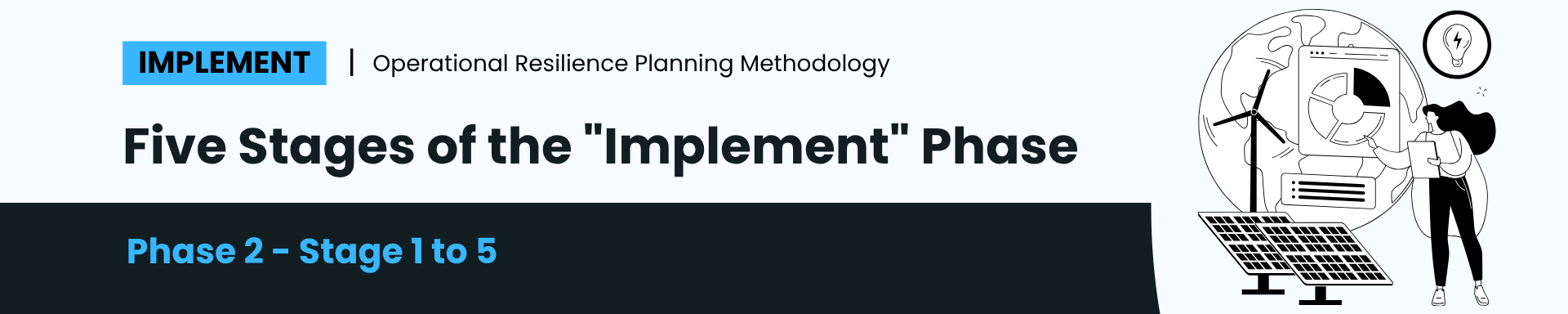
## Phase 2: Implement
[](https://cta-redirect.hubspot.com/cta/redirect/3893111/c208f922-5ed7-4afd-9d9f-6ec60522a396)The Implement phase turns the strategy into services that are identified, mapped, measured and tested. Policy and governance should be settled before it starts.
### Stage 1: Identify Critical Business Services
The bank decides which services matter most to clients and to the stability of the system. *Illustrative example:* client payments, securities settlement and custody are likely candidates for a wealth manager.
### Stage 2: Map Interconnections and Interdependencies
For each service the bank maps the people, processes, information, technology, third parties and facilities it relies on. *Illustrative example:* the payments service depends on the core banking platform, a messaging network, a Singapore operations team and an outsourced data centre.
### Stage 3: Set Impact Tolerance
The bank sets the maximum disruption it will accept for each service. *Illustrative example:* client payment instructions received before the daily cut-off must be released the same day, which sets a tolerance in hours rather than days.
### Stage 4: Conduct Scenario Testing
The bank tests whether it can stay within tolerance under severe but plausible events. *Illustrative example:* a tabletop exercise assumes a ransomware attack on a key vendor during month-end.
### Stage 5: Improve Lessons Learned
Findings are turned into funded fixes and communicated. *Illustrative example:* a test reveals a single point of failure in a reconciliation spreadsheet, and a replacement control is added to the roadmap.
## [](https://cta-redirect.hubspot.com/cta/redirect/3893111/cd40e631-43df-4dc6-85e8-3544d151d6d8)Phase 3: Sustain
[](https://cta-redirect.hubspot.com/cta/redirect/3893111/a95777af-0036-479c-8f57-0f52ddb08108)The Sustain phase keeps the programme alive after the project team has moved on.
### Stage 1: Introduce Cultural Change
Resilience becomes part of how decisions are made. *Illustrative example:* new product approvals include a short question on the impact on critical services.
### Stage 2: Develop Communication Strategy
The bank plans what it will say, to whom and when, both for the programme and during a disruption. *Illustrative example:* a client communication template is pre-approved for a payments delay.
### Stage 3: Implement Training and Awareness
Staff learn their part. *Illustrative example:* relationship managers complete a short module on what to tell clients during an outage.
### Stage 4: Provide Self-assessment
Each service owner documents the resilience journey and how the bank meets regulatory expectations, at least once a year.
### Stage 5: Conduct Independent Quality Review
An independent reviewer, such as internal audit or an external specialist, tests the programme and reports to senior management. *Illustrative example:* the review challenges whether the tolerances are supported by evidence.
## Summary Table
| **Phase** | **Stage** | **Main output** |
| --- | --- | --- |
| **Plan** | **1. Assess Capability and Maturity** | **Baseline scorecards and radar charts** |
| **Plan** | **2. Analyse Gap** | **Gap register with owners** |
| **Plan** | **3. Develop Strategy and Roadmap** | **Approved multi-year roadmap** |
| **Plan** | **4. Confirm Risk Appetite** | **Board-approved disruption appetite** |
| **Plan** | **5. Develop and Embed Governance** | **Roles, forums, policies, reporting** |
| **Implement** | **1. Identify Critical Business Services** | **Service inventory** |
| **Implement** | **2. Map Interconnections and Interdependencies** | **Resource maps per service** |
| **Implement** | **3. Set Impact Tolerance** | **Tolerance per service** |
| **Implement** | **4. Conduct Scenario Testing** | **Test results against tolerance** |
| **Implement** | **5. Improve Lessons Learned** | **Remediation plan** |
| **Sustain** | **1. Introduce Cultural Change** | **Behaviours and incentives aligned** |
| **Sustain** | **2. Develop Communication Strategy** | **Stakeholder messaging plan** |
| **Sustain** | **3. Implement Training and Awareness** | **Training plan and records** |
| **Sustain** | **4. Provide Self-assessment** | **Annual self-assessment report** |
| **Sustain** | **5. Conduct Independent Quality Review** | **Independent review report** |
### [](https://cta-redirect.hubspot.com/cta/redirect/3893111/0c551e82-cf06-432c-8498-1d3c9bb2dece)
## Conclusion
The methodology is deliberately plain. Plan tells BJB where it stands and who decides. Implement ties resilience to the services clients use. Sustain makes sure the work survives staff changes, budget cycles and the passage of time. The chapters that follow take each stage in turn and show how a Singapore private bank can carry it out with the evidence a regulator would expect to see.
## Sources
- [Embarking the Operational Resilience Journey](https://blog.bcm-institute.org/operational-resilience/embarking-the-operational-resilience-journey), BCM Institute
- [Implementing Operational Resilience](https://blog.bcm-institute.org/operational-resilience/implementing-operational-resilience), BCM Institute
- [Sustaining Your Operational Resilience Program](https://blog.bcm-institute.org/operational-resilience/sustaining-your-operational-resilience-program), BCM Institute
- [Julius Baer, Singapore](https://www.juliusbaer.com/en/about-us/our-locations/singapore/) (organisation context)
- Monetary Authority of Singapore, Guidelines on Business Continuity Management **\[verify edition\]**
**Continue reading:** Chapter 2, *Bank Julius Baer's Plan Phase of the Operational Resilience Planning Methodology*, takes a closer look at the five stages that lay the foundation.
[](https://cta-redirect.hubspot.com/cta/redirect/3893111/00cdca0d-a0af-4bc5-972d-ee3caa7a94e4)
| **eBook 2: Implementing Operational Resilience for Bank Julius Baer** | | | |
| --- | --- | --- | --- |
| **C1** | **C2** | **C8** | **C14** |
| [](https://cta-redirect.hubspot.com/cta/redirect/3893111/3d6383a7-3d72-453d-a290-961ba27ab5c3) | [](https://cta-redirect.hubspot.com/cta/redirect/3893111/c8556221-4983-4862-ae1d-469687b348eb) | [](https://cta-redirect.hubspot.com/cta/redirect/3893111/5950274f-db27-46d5-93a8-728b5b0c071c) | [](https://cta-redirect.hubspot.com/cta/redirect/3893111/53ad46fa-2ebc-48b0-9ec6-5d5dd7b6d203) |
[](https://cta-redirect.hubspot.com/cta/redirect/3893111/00cdca0d-a0af-4bc5-972d-ee3caa7a94e4)
| | **eBook 2: Implementing Operational Resilience for Bank Julius Baer** | | | | | |
| --- | --- | --- | --- | --- | --- | --- |
| | **C1** | **eBook 1** | **eBook 2** | **eBook 3** | **C20** | **C21** |
| | [](https://cta-redirect.hubspot.com/cta/redirect/3893111/6eca25b5-b44b-4f0d-af3a-ec398537fb3e) | [](https://cta-redirect.hubspot.com/cta/redirect/3893111/598fb227-ddc9-4fcb-b66a-1e3b1dc01417) | [](https://cta-redirect.hubspot.com/cta/redirect/3893111/da6bcd1f-9f22-4830-80f2-0ef071830a08) | [](https://cta-redirect.hubspot.com/cta/redirect/3893111/cc69e022-5b1d-42d9-8763-47e9aae60ec8) | [](https://cta-redirect.hubspot.com/cta/redirect/3893111/24f25ebf-4e74-4518-8e00-46a12f284a7f) | [](https://cta-redirect.hubspot.com/cta/redirect/3893111/41dab2fe-7c3e-4b07-89ed-45c156261d28) |
| | **"Plan" Phase of the Operational Resilience Planning Methodology** | | | | | |
| | **C2** | **C3** | **C4** | **C5** | **C6** | **C7** |
| [](https://cta-redirect.hubspot.com/cta/redirect/3893111/f2a29754-d200-4bab-9802-6081ca800251) | [](https://cta-redirect.hubspot.com/cta/redirect/3893111/c8556221-4983-4862-ae1d-469687b348eb) | [](https://cta-redirect.hubspot.com/cta/redirect/3893111/4cd0dd3f-1081-4670-a853-e05a53d95e2e) | [](https://cta-redirect.hubspot.com/cta/redirect/3893111/e8395c19-5a7a-4e70-9096-e2ee8e4db0b5) | [](https://cta-redirect.hubspot.com/cta/redirect/3893111/3596e489-0be7-480e-a94e-1155f9afb724) | [](https://cta-redirect.hubspot.com/cta/redirect/3893111/e1802b7e-acfe-4309-bd52-64d640098f9e) | [](https://cta-redirect.hubspot.com/cta/redirect/3893111/68152885-b3fe-46bf-9c72-5a0298ad257a) |
| | **"Implement" Phase of the Operational Resilience Planning Methodology** | | | | | |
| | **C8** | **C9** | **C10** | **C11** | **C12** | **C13** |
| | [](https://cta-redirect.hubspot.com/cta/redirect/3893111/5950274f-db27-46d5-93a8-728b5b0c071c) | [](https://cta-redirect.hubspot.com/cta/redirect/3893111/b99da948-a447-4a5b-a7a0-cc79c15a5c34) | [](https://cta-redirect.hubspot.com/cta/redirect/3893111/37ba6226-41b9-4103-8c91-d0cf1c59378f) | [](https://cta-redirect.hubspot.com/cta/redirect/3893111/764c0954-f189-402d-9267-4569b1f8d47a) | [](https://cta-redirect.hubspot.com/cta/redirect/3893111/cc7273b6-ff28-44e2-bf3e-541e397942b3) | [](https://cta-redirect.hubspot.com/cta/redirect/3893111/2f88c30e-9bb9-4f09-a9fe-3a228915ad60) |
| | **"Sustain" Phase of the Operational Resilience Planning Methodology** | | | | | |
| | **C14** | **C15** | **C16** | **C17** | **C18** | **C19** |
| | [](https://cta-redirect.hubspot.com/cta/redirect/3893111/53ad46fa-2ebc-48b0-9ec6-5d5dd7b6d203) | [](https://cta-redirect.hubspot.com/cta/redirect/3893111/e295f1b8-7a10-4220-a6bd-26a3833cc74c) | [](https://cta-redirect.hubspot.com/cta/redirect/3893111/8d6e7c50-304e-42c8-b122-63a9148bcdba) | [![\[OR\] \[BJB\] \[E2\] \[P3\] \[S3\] C17\] Implementing Training and Awareness](https://no-cache.hubspot.com/cta/default/3893111/7b937ee3-fb5b-4506-b23a-5e744cf8dcf8.png)](https://cta-redirect.hubspot.com/cta/redirect/3893111/7b937ee3-fb5b-4506-b23a-5e744cf8dcf8) | [](https://cta-redirect.hubspot.com/cta/redirect/3893111/392b1906-ffc3-4d4f-840a-71f3d70f9a78) | [](https://cta-redirect.hubspot.com/cta/redirect/3893111/5011ef56-b909-4aa8-896a-ec9692d979f6) |
## **Comments**

---

---

---

---


All rights reserved. Copyright 2026
```json
{
"@context" : "https://schema.org",
"@type" : "BlogPosting",
"author" : {
"@type" : "Person",
"name" : "Moh Heng Goh",
"url" : "https://blog.bcm-institute.org/or-v2/author/moh-heng-goh"
},
"dateModified" : "2026-11-16T08:26:20.436Z",
"datePublished" : "2026-11-16T05:20:51.000Z",
"headline" : "[OR] [BJB] [E2] Chapter 1: Introduction to Bank Julius Baer's Operational Resilience Planning Methodology",
"image" : [ "https://blog.bcm-institute.org/hubfs/BJB%20Graphic%20Folder/BJB%20Morepost/%5BOR%5D%20%5BBJB%5D%20%5BE2%5D%20%5BC1%5D%20OR%20Planning%20Methodology.jpg" ],
"mainEntityOfPage" : {
"@id" : "https://blog.bcm-institute.org/or-v2/or-bjb-e2-chapter-1-introduction-to-bank-julius-baers-operational-resilience-planning-methodology",
"@type" : "WebPage"
},
"publisher" : {
"@type" : "Organization",
"logo" : {
"@type" : "ImageObject",
"url" : "https://blog.bcm-institute.org/hubfs/BCMI%20Logo.png"
},
"name" : "BCMI Pte Ltd"
}
}
```