---
title: "[Implement] [OR] [P2] [S2] Mapping Interconnections and Interdependencies: Building Visibility"
description: [Implement] [OR] [P2] [S2] Purpose of Mapping Interconnections and Interdependencies
image: https://blog.bcm-institute.org/hubfs/Operational%20Resilience%20OR/OR%20GUIDE%20TO%20MOREPOST/IC_OR_BoK%207_GUIDE_Map%20Interconnections%20and%20Interdependencies.png
---
[](http://www.bcm-institute.org/)
- [Home](https://www.bcm-institute.org/)
- [About Us](https://www.bcm-institute.org/about-us-3/)
- [A President’s Perspective](https://www.bcm-institute.org/about-us/a-presidents-perspective/)
- [Our History](https://www.bcm-institute.org/about-us/our-history/)
- [Our Advisory Council](https://www.bcm-institute.org/about-us/our-advisory-council/)
- [Customers’ Testimonials](https://www.bcm-institute.org/about-us/customers-testimonials/)
- [Credential Verification](https://www.bcm-institute.org/about-us/credential-verification/)
- [Courses](https://blog.bcm-institute.org/blog/course-fees-for-blended-learning-courses-master-catalog)
- [ISO 22301 Business Continuity Management System Audit](https://blog.bcm-institute.org/audit/business-continuity-management-audit-courses)
- [ISO 22301 Business Continuity Management](https://blog.bcm-institute.org/bcm/business-continuity-management-courses)
- [Crisis Communication](https://blog.bcm-institute.org/crisis-communication/crisis-communication-courses)
- [Crisis Management](https://blog.bcm-institute.org/en/crisis-management/courses)
- [IT Disaster Recovery](https://blog.bcm-institute.org/it-disaster-recovery/courses)
- [Operational Resilience](https://blog.bcm-institute.org/operational-resilience/courses)
- [Operational Resilience Audit](https://blog.bcm-institute.org/operational-resilience-audit/courses)
- [Certification](https://blog.bcm-institute.org/certification/types-of-certifications-offered)
- [ISO 22301 BCMS Audit Certification](https://blog.bcm-institute.org/certification/business-continuity-management-audit-certification)
- [ISO22301 Business Continuity Management Certification](https://blog.bcm-institute.org/bcm/business-continuity-management-certification)
- [Crisis Communication Certification](https://blog.bcm-institute.org/crisis-communication/crisis-communication-certification)
- [Crisis Management Certification](https://blog.bcm-institute.org/en/crisis-management/crisis-management-certification)
- [IT Disaster Recovery Planning Certification](https://blog.bcm-institute.org/it-disaster-recovery/it-disaster-recovery-certification)
- [Operational Resilience Certification](https://blog.bcm-institute.org/operational-resilience/operational-resilience-certification)
- [Operational Resilience Audit Certification](https://blog.bcm-institute.org/operational-resilience-audit)
- [Seminars](https://blog.bcm-institute.org/meet-the-expert/mte-webinar-mainpage)
- [Store](https://www.bcm-institute.org/store-2/)
- [Contact Us](http://www.bcm-institute.org/about-us/contact-us/)
-
-
###### Operational Resilience Planning Methodology: "Your Guide To" Series

# \[Implement\] \[OR\] \[P2\] \[S2\] Mapping Interconnections and Interdependencies: Building Visibility
[](https://cta-redirect.hubspot.com/cta/redirect/3893111/6072e46a-8b7a-441a-9257-0c17043af1f5)[![\[OR\] \[BoK 7\] \[Guide\] Map Interconnections and Interdependencies](https://no-cache.hubspot.com/cta/default/3893111/315e738a-307c-4ad6-94cf-e555eb8623aa.png)](https://cta-redirect.hubspot.com/cta/redirect/3893111/315e738a-307c-4ad6-94cf-e555eb8623aa)
Operational resilience extends beyond identifying Critical Business Services (CBS); it requires organisations to understand how those services are delivered through a complex network of people, processes, technology, information, facilities, and third-party providers.
Mapping interconnections and interdependencies provides this essential visibility by revealing the relationships and dependencies that support critical operations.
Without a comprehensive understanding of these connections, organisations cannot accurately identify single points of failure, assess the impact of disruptions, or develop effective resilience strategies.
This is the introductory blog \[OR\] \[P2\] \[S2\] to Stage 2 of the "IMPLEMENT" phase \[2\] of the OR Planning Methodology.
It is a pre-reading for participants attending the Operational Resilience Implementer/ Expert Implementer course.[![\[OR\] \[Full Banner\] \[M2\] Pre reading for Participants](https://no-cache.hubspot.com/cta/default/3893111/f040efa7-8a61-43d5-9cc9-539d3b9306a2.png)](https://cta-redirect.hubspot.com/cta/redirect/3893111/f040efa7-8a61-43d5-9cc9-539d3b9306a2)
[Moh Heng Goh](https://blog.bcm-institute.org/operational-resilience/author/moh-heng-goh) Jul 5, 2026
###### Operational Resilience Certified Planner-Specialist-Expert
#### [](https://cta-redirect.hubspot.com/cta/redirect/3893111/6072e46a-8b7a-441a-9257-0c17043af1f5)
#### [![\[OR\] \[Banner\] \[Guide\] \[P2\] \[S2\] Map Interconnections and Interdependencies](https://no-cache.hubspot.com/cta/default/3893111/b024277a-24bf-47c5-878f-c7218bed4a15.png)](https://cta-redirect.hubspot.com/cta/redirect/3893111/b024277a-24bf-47c5-878f-c7218bed4a15) Introduction
[![\[OR\] \[BoK 7\] \[Guide\] Map Interconnections and Interdependencies](https://no-cache.hubspot.com/cta/default/3893111/315e738a-307c-4ad6-94cf-e555eb8623aa.png)](https://cta-redirect.hubspot.com/cta/redirect/3893111/315e738a-307c-4ad6-94cf-e555eb8623aa)Operational resilience extends beyond identifying Critical Business Services (CBS); it requires organisations to understand how those services are delivered through a complex network of people, processes, technology, information, facilities, and third-party providers.
Mapping interconnections and interdependencies provides this essential visibility by revealing the relationships and dependencies that support critical operations.
Without a comprehensive understanding of these connections, organisations cannot accurately identify single points of failure, assess the impact of disruptions, or develop effective resilience strategies.
This blog explains why mapping interconnections and interdependencies is a fundamental component of operational resilience, and how it enables organisations to proactively manage vulnerabilities before they lead to service disruption. [![\[OR\] \[E3\] \[Interdependency and Interconnectivity\] Mapping Interconnections](https://no-cache.hubspot.com/cta/default/3893111/8d43236b-bd8d-4fe6-8e75-3fe4df59be8e.png)](https://cta-redirect.hubspot.com/cta/redirect/3893111/8d43236b-bd8d-4fe6-8e75-3fe4df59be8e)
### Mapping Interconnections
#### Interaction with CBS or Other Components
The purpose of Mapping “Interconnections” is to explain how each dependency interacts with CBS and other components within the organisation's operational ecosystem.
It articulates the operational relationship and integration points, such as:
- How a system supports a process or links to another system (e.g., middleware connecting mobile apps to the core engine).
- How people or teams coordinate across departments or with third parties.
- How external platforms are integrated to facilitate transaction flow, compliance, or settlement.
This information is crucial because understanding the interdependencies and data or operational flow helps to:
- Map single points of failure or cascading impacts in case of disruptions.
- Design more effective contingency plans and recovery strategies.
- Ensure alignment between internal capabilities and external obligations.
- Strengthen real-time monitoring and reduce blind spots in operational risk.
##### \[Sample 1\] Table on Mapping of Interconnections
| Sub-CBS | Sub-CBS Code | Component Inter-dependency Type | Component Interdependency Detail (What/ Who is Involved) | Interconnections (How it connects/ interacts) |
| --- | --- | --- | --- | --- |
| Customer Account Management | 1.1 | People | Customer Service Officers, Branch Managers | Interact with customers to open, close, or manage accounts and feed data to the CRM and Core Banking systems. |
| Process | KYC, AML Checks, Account Maintenance Workflow | Integrated into core banking processes and compliance systems | | |
| Technology | Core Banking System (e.g., Silverlake), CRM, Customer Database | The core engine manages the account lifecycle, synchronising across teller, mobile, and branch services. | | |
| Third-Party | Credit Bureau, Document Verification Vendors | Third-party KYC/AML checks integrated via secure APIs | | |
##### \[Sample 2\] Table on Mapping of Interconnections
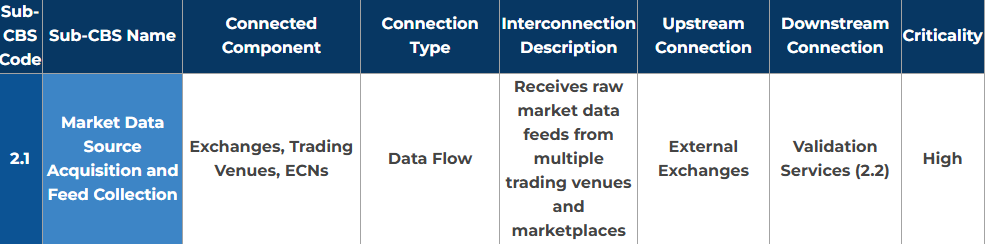
##### Explanatory Notes for Map Interconnections Fields
| **Field** | **Explanation** |
| --- | --- |
| **Connected Component** | The system, application, process, team, facility, third-party service provider, external organisation, infrastructure component, or data source that is connected to and interacts with the Sub-CBS. The Connected Component represents the entity through which information, activities, communications, or transactions flow. Examples include trading venues, market data platforms, network providers, customer systems, operational teams, or regulatory authorities. |
| **Connection Type** | Describes the nature of the interaction or linkage between the Sub-CBS and the Connected Component. This field helps categorise how the connection operates. Common connection types include: **Data Flow** (exchange of information), **Network Connectivity** (communications infrastructure), **Application Integration** (system-to-system interaction), **Operational Interaction** (human or team collaboration), **Security Integration** (authentication or cybersecurity controls), **Governance Connectivity** (management oversight), and **Infrastructure Connectivity** (technology or facility support). |
| **Interconnection Description** | A detailed explanation of how the Sub-CBS and Connected Component interact and support one another in delivering the Critical Business Service. The description should clearly identify the operational relationship, the purpose of the connection, the information or activities exchanged, and the role the connection plays within the end-to-end service delivery process. This field provides the business context necessary to understand operational resilience risks and potential impacts of disruption. |
| **Upstream Connection** | Identifies the preceding system, process, team, facility, or external entity that provides inputs, data, services, resources, or triggers required by the Sub-CBS. Upstream connections are the sources that the Sub-CBS depends on to perform its function. Understanding upstream connections helps organisations identify where disruptions may originate and how failures can propagate through the service delivery chain. Examples include exchanges that supply market data, reference data providers, authentication services, and earlier stages of processing within the workflow. |
##### [![\[OR\] \[E3\] \[Interdependency and Interconnectivity\] Mapping Interdependencies](https://no-cache.hubspot.com/cta/default/3893111/19ad6a1f-c6b1-4dea-84ba-f2bd1293283c.png)](https://cta-redirect.hubspot.com/cta/redirect/3893111/19ad6a1f-c6b1-4dea-84ba-f2bd1293283c)
### Mapping Interdependency
#### What/Who is Involved
The purpose of Mapping “Dependency” is to identify and describe the internal or external components that are critical to each process within CBS. This includes:
People: Functional roles or teams responsible for oversight, execution, or decision-making.
Processes: Key activities or workflows that form part of the payment and settlement lifecycle.
Technology: Core systems, interfaces, or digital tools used to execute, monitor, or support transactions.
Third Parties: External service providers, regulatory bodies, and partner institutions that play an operational or regulatory role.
By detailing “what” is being relied upon or “who” is involved, this column helps stakeholders understand the precise nature of each Interdependency, which is critical for assessing potential vulnerabilities, allocating resources, and prioritising in resilience planning.
##### \[Sample 1\] Table on Mapping of Interdependencies
| | | **Components** | Dependency Relationships | | | |
| --- | --- | --- | --- | --- | --- | --- |
| Sub-CBS Code | Sub-CBS | Processes | People | Technology (Applications & Infrastructure) | Third-Party Vendors | Upstream/ Downstream Dependencies |
| 1.1 | Cash Deposit at Branches | Cash handling, account crediting, cashier operations | Branch tellers, branch managers, customer service representatives | Cash deposit machines, banking software, and branch network infrastructure | None | Integration with central banking systems for account updating |
##### \[Sample 2\] Table on Mapping of Interdependencies
##### 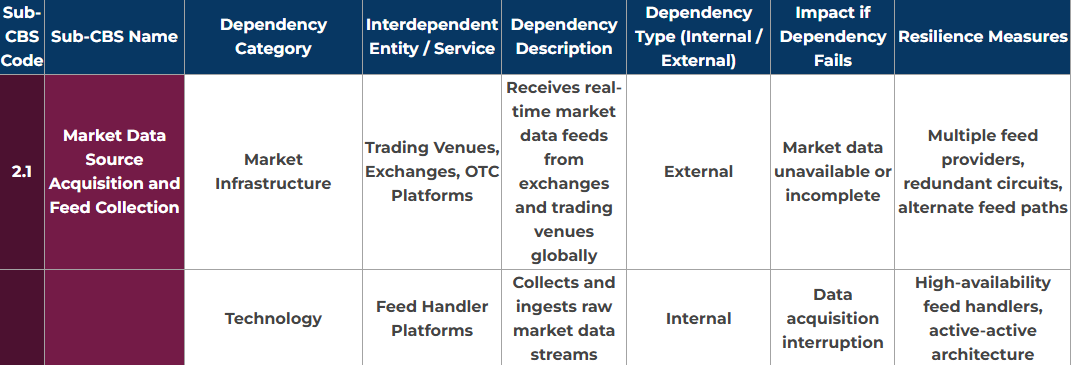
#### Explanatory Notes for Map Interdependencies Fields
##### Sub-CBS Code
A unique identifier assigned to each Sub-Critical Business Service (Sub-CBS) within a Critical Business Service (CBS).
The code provides a structured reference for tracking, analysis, reporting, and resilience assessments.
Example: 2.1 may represent Market Data Source Acquisition and Feed Collection within CBS-2 Market Data Distribution Services.
##### Sub-CBS Name
The official name of the Sub-Critical Business Service being analysed.
This field identifies the specific operational process, capability, or service component that contributes to the delivery of the overall Critical Business Service.
The Sub-CBS Name provides context for understanding the dependencies associated with that process.
##### Dependency Category
Classifies the type of dependency required to support the Sub-CBS.
This field helps group dependencies into meaningful categories for analysis and resilience planning. Common categories include:
- **People** – staff, operational teams, subject matter experts.
- **Process** – business processes, procedures, workflows.
- **Technology** – applications, platforms, databases, infrastructure.
- **Facilities** – offices, data centres, operational sites.
- **Third Party** – vendors, service providers, cloud providers, telecom carriers.
- **Market Infrastructure** – exchanges, clearing houses, payment systems, trading venues.
- **Information/Data** – reference data, market data, security master data, regulatory data.
##### Interdependent Entity / Service
The specific organisation, system, platform, team, service, facility, or external entity that the Sub-CBS depends upon.
This field identifies the actual dependency source.
Examples include a market data feed provider, an identity and access management system, a cloud storage service, a telecommunications network, or an operational support team.
##### Dependency Description
A detailed explanation of the dependency relationship and how the Interdependent Entity or Service supports the Sub-CBS.
The description should explain what is provided (for example, data, connectivity, processing capability, operational support, or infrastructure) and why it is necessary to deliver the Critical Business Service.
##### Dependency Type (Internal / External)
Indicates whether the dependency is provided from within the organisation or by an external party.
- **Internal** – provided by business units, technology teams, infrastructure teams, operations teams, or internal shared services.
- **External** – provided by third parties, exchanges, market infrastructure providers, telecom carriers, cloud providers, regulators, or other external organisations.
This distinction supports third-party risk management and regulatory reporting requirements.
##### Impact if Dependency Fails
Describes the operational consequence if the dependency becomes unavailable, degraded, corrupted, delayed, or otherwise fails.
The impact statement should focus on the effect on the Sub-CBS and the overall Critical Business Service, such as:
- Service outage
- Delayed market data delivery
- Data integrity issues
- Regulatory non-compliance
- Customer access disruption
- Increased latency
- Extended recovery time
- Loss of monitoring visibility
This field helps assess dependency criticality and supports impact tolerance and scenario testing activities.
These definitions align with operational resilience practices for Mapping Interdependencies, where the objective is to identify and document the reliance relationships that support the delivery of a Critical Business Service and to understand the potential impact if those relationships are disrupted.
#### **Interconnections Vs Interdependencies**
While often used together, these terms are not interchangeable. Understanding their distinction is essential for accurate mapping and analysis.
| **Aspect** | **Interconnections** | **Interdependencies** |
| --- | --- | --- |
| **Definition** | Linkages or connections between components | Dependency relationships between components |
| **Focus** | Structure and connectivity | Reliance and impact |
| **Nature** | Describes *how things are connected* | Describes *how things depend on each other* |
| **Risk Perspective** | Identifies pathways of interaction | Identifies points of failure and vulnerability |
| **Directionality** | May or may not imply dependency | Always implies dependency (one affects another) |
| **Example** | System A sends data to System B | System B cannot operate without System A |
| **Usage in Mapping** | Forms the *network map* | Enables *risk and impact analysis* |
[![\[Banner\] \[Summing\] \[OR\] \[E2\] \[C10\] Map Interconnections and Interdependencies](https://no-cache.hubspot.com/cta/default/3893111/1495d277-5040-4704-b09a-469aa2306a3e.png)](https://cta-redirect.hubspot.com/cta/redirect/3893111/1495d277-5040-4704-b09a-469aa2306a3e)Mapping interconnections and interdependencies is far more than a documentation exercise—it is the foundation for understanding how an organisation truly operates under both normal and disrupted conditions.
By identifying the critical relationships between internal functions, technology, data, facilities, suppliers, and external stakeholders, organisations gain the insights needed to prioritise resilience investments, strengthen risk management, conduct meaningful scenario testing, and improve response and recovery capabilities.
As organisations continue their operational resilience journey, a well-maintained dependency map becomes a living resource that supports informed decision-making, continuous improvement, and compliance with evolving regulatory expectations, ultimately enhancing the organisation's ability to deliver critical business services during disruption.
[](https://cta-redirect.hubspot.com/cta/redirect/3893111/03e3e5c5-5fae-4b56-9821-8fbd1a1b4725)
| | **Definition** | **Explanation** | **Definition** | |
| --- | --- | --- | --- | --- |
| | **Mapping** | **is the process of identifying, documenting, and understanding the activities involved in critical business services. ** - **Do not map all processes at once or in detail.** - **Start by identifying and agreeing on the critical processes, assigning ownership, and mapping them using a predefined template.** | **[](https://cta-redirect.hubspot.com/cta/redirect/3893111/b5438182-f1e5-4248-bea5-2d5044665d8d)** | |
| | **Interconnections** | **is the linking of an organisation's network to products, services, equipment, or facilities that do not belong to the originating organisation's network. The term may refer to a connection between the organisation's facilities and its customers' equipment, or between two or more parties.** | [](https://cta-redirect.hubspot.com/cta/redirect/3893111/9fb4af54-0b68-4d76-ac4b-fc34a34d4673) | |
| | **Inter-dependencies** | **are the internal and external dependencies on people, processes, technology, and other resources (including those involving third parties) for each critical business service.** | [](https://cta-redirect.hubspot.com/cta/redirect/3893111/a9db1c33-736a-4cbd-ae84-4ef37c217f89) | |
| | **Mapping Inter-connections and Inter-dependencies** | **These are steps for the operational resilience mapping process, which involves identifying dependencies and connections between people, processes, information, technology, facilities, and third-party service providers required to deliver each critical business service.** | **[](https://cta-redirect.hubspot.com/cta/redirect/3893111/01dcedd7-61e7-4eb4-aa2d-d85f32a66a69)** | |
| | | | | |
##### "Implement" Phase of the OR Planning Methodology
| **Identify Critical Business Services** | **Map Inter-connections and Inter-dependencies** | **Set Impact Tolerance** | **Conduct Scenario Testing** | **Improve Lesson Learned** | |
| --- | --- | --- | --- | --- | --- |
| [](https://cta-redirect.hubspot.com/cta/redirect/3893111/327d1e38-3d2b-46f8-ba67-6c87867c7caa) | [](https://cta-redirect.hubspot.com/cta/redirect/3893111/5e3dd1b4-6317-40ca-be8a-dd8067b4e7cf) | [](https://cta-redirect.hubspot.com/cta/redirect/3893111/c64544e9-072f-4ac1-b56a-9403447f4246) | [](https://cta-redirect.hubspot.com/cta/redirect/3893111/011a840d-ac82-475a-9872-076e579267f3) | [](https://cta-redirect.hubspot.com/cta/redirect/3893111/d4dffacd-42a6-4c71-aa73-4af966674a32) | |
#### More Information About Blended Learning OR-5000 \[OR-5\] or OR-300 \[OR-3\]
To learn more about the course and schedule, click the buttons below for the OR-3 Blended Learning OR-300 Operational Resilience Implementer course and the OR-5 Blended Learning OR-5000 Operational Resilience Expert Implementer course.
| [](https://cta-redirect.hubspot.com/cta/redirect/3893111/3530eccb-515d-401e-afc2-3469e26d7fbf) | [](https://cta-redirect.hubspot.com/cta/redirect/3893111/fdd4fa9c-ed69-40c1-925f-4eb6a1c5c255) | [](https://cta-redirect.hubspot.com/cta/redirect/3893111/77a34b84-0a6d-44f8-b8d6-6ab04cdf5edd) |
| --- | --- | --- |
| [](https://cta-redirect.hubspot.com/cta/redirect/3893111/6e5c0cda-39b9-4bbd-b3d4-4cf46a790b14) | [](https://cta-redirect.hubspot.com/cta/redirect/3893111/a68a08aa-36d3-4216-9551-202c9fde06ea) | [![ \[BL-OR\] \[3-4-5\] View Schedule](https://no-cache.hubspot.com/cta/default/3893111/d0d733a1-16c0-4b68-a26d-adbfd4fc6069.png)](https://cta-redirect.hubspot.com/cta/redirect/3893111/d0d733a1-16c0-4b68-a26d-adbfd4fc6069) |
| [![\[BL-OR\] \[3\] FAQ OR-300](https://no-cache.hubspot.com/cta/default/3893111/f20c71b4-f5e8-4aa5-8056-c374ca33a091.png)](https://cta-redirect.hubspot.com/cta/redirect/3893111/f20c71b4-f5e8-4aa5-8056-c374ca33a091) | If you have any questions, click to contact us.[![Email to Sales Team \[BCM Institute\]](https://no-cache.hubspot.com/cta/default/3893111/3c53daeb-2836-4843-b0e0-645baee2ab9e.png)](https://cta-redirect.hubspot.com/cta/redirect/3893111/3c53daeb-2836-4843-b0e0-645baee2ab9e) | [](https://cta-redirect.hubspot.com/cta/redirect/3893111/7f2718a4-ea80-4f84-a319-dc2d4df37a46) |
| [](https://cta-redirect.hubspot.com/cta/redirect/3893111/74b1e556-8cd2-4a74-8821-db1804534955) | [](https://cta-redirect.hubspot.com/cta/redirect/3893111/f2bd8eb1-32d2-4732-9267-ea53223cf58f) | [](https://cta-redirect.hubspot.com/cta/redirect/3893111/084e620a-46c5-419a-82ed-6a681d15c0b6) |
#### **Comments**
### More Posts
[](https://cta-redirect.hubspot.com/cta/redirect/3893111/d41714c9-8019-4282-95bf-08d62ddc4710)

All rights reserved. Copyright 2026