---
title: [BCM] [JHA] [E3] [BIA] [P3] [CBF] [1] Personal Care and 24-Hour Supervision
description: "Impact-over-time BIA for personal care and 24-hour supervision at Jamiyah Home for the Aged: scores, RTOs, MTPDs and vulnerable periods for 14 sub-functions."
image: https://blog.bcm-institute.org/hubfs/Jamiyah%20Singapore%20Graphic%20Folder/JS%20BCM%20CBF%201%20Morepost/%5BBCM%5D%20%5BJS%5D%20%5BE3%5D%20%5BBIA%5D%20%5BT3%5D%20%5BCBF%5D%20%5B1%5D%20Residential%20Care%20and%20Resident%20Safety.jpg
---
.
[](http://www.bcm-institute.org/)
- [Home](https://www.bcm-institute.org/)
- [About Us](https://www.bcm-institute.org/about-us-3/)
- [A President’s Perspective](https://www.bcm-institute.org/about-us/a-presidents-perspective/)
- [Our History](https://www.bcm-institute.org/about-us/our-history/)
- [Our Advisory Council](https://www.bcm-institute.org/about-us/our-advisory-council/)
- [Customers’ Testimonials](https://www.bcm-institute.org/about-us/customers-testimonials/)
- [Credential Verification](https://www.bcm-institute.org/about-us/credential-verification/)
- [Courses](https://blog.bcm-institute.org/blog/course-fees-for-blended-learning-courses-master-catalog)
- [ISO 22301 Business Continuity Management System Audit](https://blog.bcm-institute.org/audit/business-continuity-management-audit-courses)
- [ISO 22301 Business Continuity Management](https://blog.bcm-institute.org/bcm/business-continuity-management-courses)
- [Crisis Communication](https://blog.bcm-institute.org/crisis-communication/crisis-communication-courses)
- [Crisis Management](https://blog.bcm-institute.org/en/crisis-management/courses)
- [IT Disaster Recovery](https://blog.bcm-institute.org/it-disaster-recovery/courses)
- [Operational Resilience](https://blog.bcm-institute.org/operational-resilience/courses)
- [Operational Resilience Audit](https://blog.bcm-institute.org/operational-resilience-audit/courses)
- [Certification](https://blog.bcm-institute.org/certification/types-of-certifications-offered)
- [ISO 22301 BCMS Audit Certification](https://blog.bcm-institute.org/certification/business-continuity-management-audit-certification)
- [ISO22301 Business Continuity Management Certification](https://blog.bcm-institute.org/bcm/business-continuity-management-certification)
- [Crisis Communication Certification](https://blog.bcm-institute.org/crisis-communication/crisis-communication-certification)
- [Crisis Management Certification](https://blog.bcm-institute.org/en/crisis-management/crisis-management-certification)
- [IT Disaster Recovery Planning Certification](https://blog.bcm-institute.org/it-disaster-recovery/it-disaster-recovery-certification)
- [Operational Resilience Certification](https://blog.bcm-institute.org/operational-resilience/operational-resilience-certification)
- [Operational Resilience Audit Certification](https://blog.bcm-institute.org/operational-resilience-audit)
- [Seminars](https://blog.bcm-institute.org/meet-the-expert/mte-webinar-mainpage)
- [Store](https://www.bcm-institute.org/store-2/)
- [Contact Us](http://www.bcm-institute.org/about-us/contact-us/)
-
-
##### Sustaining Community Services: Implementing BCM at Jamiyah Home for the Aged

# \[BCM\] \[JHA\] \[E3\] \[BIA\] \[P3\] \[CBF\] \[1\] Personal Care and 24-Hour Supervision
[](https://cta-redirect.hubspot.com/cta/redirect/3893111/1ce18ee1-97ef-4ed4-b16b-5d6ab24cec19)Seven of the 14 Sub-Critical Business Functions (Sub-CBFs) that make up personal care and 24-hour supervision at Jamiyah Home for the Aged (JHA) must be restored, at least to a safe minimum level, within 4 hours of disruption.
Eight cannot be left disrupted for more than two days before residents face serious, possibly irreversible, harm.
This chapter shows how we reached those conclusions. It assesses how the impact of losing each Sub-CBF under CBF-1 Personal care and 24-hour supervision grows across twelve time intervals, from 4 hours to 60 days.
From that profile, it derives a Recovery Time Objective (RTO), a Maximum Tolerable Period of Disruption (MTPD) and a Vulnerable Period for each Sub-CBF.
These three values bridge the Business Impact Analysis (BIA) to the recovery strategies, resource requirements, and Business Continuity Plans developed in later chapters.
[](https://cta-redirect.hubspot.com/cta/redirect/3893111/bc131ed6-ca92-4253-8940-2f98dad34599)
[Dr Goh Moh Heng](https://blog.bcm-institute.org/ebook/author/dr-goh-moh-heng) Oct 21, 2026
###### Business Continuity Management Certified Planner-Specialist-Expert
### **[](https://cta-redirect.hubspot.com/cta/redirect/3893111/5cd5edea-eed4-45ec-99b3-824e5267fb21)**
[![\[BCM\] \[E3\] \[BIA\] \[P1\] \[P2\] \[P3\] \[P4\] {P5\] \[P6\] Template ](https://no-cache.hubspot.com/cta/default/3893111/d0508ed9-8fef-4cbe-a91b-337f2f8a2463.png)](https://cta-redirect.hubspot.com/cta/redirect/3893111/d0508ed9-8fef-4cbe-a91b-337f2f8a2463)
[](https://cta-redirect.hubspot.com/cta/redirect/3893111/326c85d5-f1af-4a99-9f0e-0072cfcad36a)
[](https://cta-redirect.hubspot.com/cta/redirect/3893111/bc131ed6-ca92-4253-8940-2f98dad34599)
### **Impact Over Time of Business Functions for CBF-1 Personal Care and 24-Hour Supervision**
#### Objective
Seven of the 14 Sub-Critical Business Functions (Sub-CBFs) that make up personal care and 24-hour supervision at Jamiyah Home for the Aged (JHA) must be restored, at least to a safe minimum level, within 4 hours of disruption.
Eight cannot be left disrupted for more than two days before residents face serious, possibly irreversible, harm.
This chapter shows how we reached those conclusions. It assesses how the impact of losing each Sub-CBF under CBF-1 Personal care and 24-hour supervision grows across twelve time intervals, from 4 hours to 60 days.
From that profile, it derives a Recovery Time Objective (RTO), a Maximum Tolerable Period of Disruption (MTPD) and a Vulnerable Period for each Sub-CBF.
These three values bridge the Business Impact Analysis (BIA) to the recovery strategies, resource requirements, and Business Continuity Plans developed in later chapters.
The chapter is written for the JHA Board, the Superintendent and senior staff, none of whom need prior BCM knowledge.
It is also intended to withstand scrutiny from BCM practitioners and reviewers from the Ministry of Social and Family Development (MSF) and the Ministry of Health (MOH).
#### Introduction
##### Why Analyse Impact Over Time
Earlier parts of the BIA identified what JHA does and which functions matter most. This part answers a different question: how quickly does losing each function become unacceptable?
Two functions can be equally important yet differ greatly in urgency. A missed six-monthly care plan review and a missed insulin dose both matter, but one can wait days and the other cannot wait hours.
ISO 22301:2019 (clause 8.2.2) requires the organisation to assess impacts over time, identify when those impacts become unacceptable, and set prioritised time frames for resuming activities at a specified minimum capacity.
ISO 22313:2020 gives guidance on how to do this. Impact-over-time analysis is the practical method that satisfies these requirements.
It turns a list of important functions into a sequenced recovery order the Superintendent can follow at 3 a.m. during a power failure.
##### Why Impacts Escalate as Disruption Continues
In a residential home for frail, destitute older persons, the impact of disruption rarely stays flat. It grows for four reasons.
1. **Physiological accumulation.** Residents' bodies keep a running account. A skipped repositioning turn is recoverable; six skipped turns can produce a pressure injury that takes months to heal. Dehydration, missed medication, and unmanaged blood glucose follow the same pattern.
2. **Erosion of workarounds.** Most functions have a manual fallback, such as paper charts, double shifts or staff posted at exits. These fallbacks work for hours or days, but they consume staff energy and attention. By day three, fatigue starts to create the errors the workaround was meant to prevent.
3. **Regulatory and legal exposure.** Under the Social Residential Homes Act 2025, in operation since 1 July 2026, JHA is a licensed home with duties set out in its General Regulations and the MSF Code of Practice. A brief lapse may be explainable; a prolonged one becomes a compliance failure that MSF must act on, and may draw MOH involvement where public health is affected.
4. **Loss of trust.** Residents' families, referring agencies, donors and the Jamiyah Singapore leadership extend goodwill during a short, well-managed incident. That goodwill falls away as disruption extends, especially if a resident is harmed.
##### How the Analysis Sets Recovery Priorities
Scoring each Sub-CBF at the same twelve intervals makes their urgency directly comparable.
The Sub-CBFs that reach High or Very High impact first are recovered first, receive the first call on scarce staff and equipment, and are the first to have tested workarounds.
Those whose impact rises slowly can be safely deferred, freeing resources during the critical early hours.
##### How RTO, MTPD and Vulnerable Periods are Derived
The three outputs are read from each Sub-CBF's impact curve.
- **MTPD** is the point at which disruption threatens the viability of personal care at JHA. It is set no later than the first interval at which impact reaches Very High (5).
- **RTO** is the target for restoring the Sub-CBF to a safe minimum level, before impact becomes unacceptable. It is set no later than the last interval at which impact is still Moderate (3) or lower, and always earlier than the MTPD.
- **The Vulnerable Period** is the time of day, week, or year when the same disruption would cause greater harm, so the curve would rise faster than shown. It tells planners when to hold extra capacity or stand up contingencies earlier.
#### Assessment Approach
We scored each Sub-CBF assuming it becomes fully unavailable at the start of the disruption and remains unavailable for the interval shown.
Scores reflect the cumulative effect at that point, not the effect of that interval alone, so they do not fall over time.
##### Impact Scale
| **Score** | **Impact Level** | **What it means for personal care at JHA** |
| --- | --- | --- |
| **1** | **Very Low** | **No noticeable effect on residents; absorbed within normal routines.** |
| **2** | **Low** | **Minor inconvenience or discomfort; no harm; no external reporting.** |
| **3** | **Moderate** | **Reduced quality of care; risk of minor harm; internal escalation to the Superintendent.** |
| **4** | **High** | **Likely harm to one or more residents; reportable incident; MSF or MOH attention probable.** |
| **5** | **Very High** | **Serious or irreversible harm, or a death; licence conditions breached; Board and Jamiyah Singapore leadership engaged; media interest likely.** |
Where several impact areas apply, the score reflects the most severe. The Highest-Impact Area column names that driver, so readers can see why a score is high.
##### Reading RTO in a care setting
For JHA, restoring a function does not mean returning to full normal service. It means reaching the minimum level of care that keeps residents safe and the home compliant, often through a pre-planned workaround. ISO 22301 calls this the minimum acceptable capacity.
For example, the RTO for medication administration is met when staff complete the next scheduled round accurately using paper Medication Administration Records, even if the usual electronic system is still down.
The interval scale starts at 4 hours. Where a Sub-CBF is already at High impact at 4 hours, its RTO is set below that point, based on the clinical rhythm of the function (the next medication round, the next repositioning turn, the next safety round).
##### Planning Assumptions
Organisation-specific data was not available for every function. The assessment therefore rests on the following assumptions, which the Superintendent should confirm or correct before approving the BIA.
- JHA operates 24 hours a day, 365 days a year, on two 12-hour shifts that change at about 0700 and 1900, with lower night staffing.
- The resident population includes bed-bound and high-dependency residents, residents with dementia, and residents on time-critical medicines such as insulin, anti-epileptics and anticoagulants.
- A significant share of care staff are foreign workers, so home leave, work permit renewal and festive leave affect availability.
- Medical cover comes from a visiting doctor or partner clinic during office hours, with after-hours escalation through tele-consultation, emergency ambulance (995) or the nearest public hospital.
- Medicines, continence products and personal protective equipment (PPE) are supplied by external vendors on regular replenishment cycles.
- As a home run by a Muslim organisation serving residents of all backgrounds, JHA's operating calendar is shaped by Ramadan, Hari Raya Puasa and Hari Raya Haji, as well as Chinese New Year, Deepavali and Christmas.
#### Impact Over Time Assessment
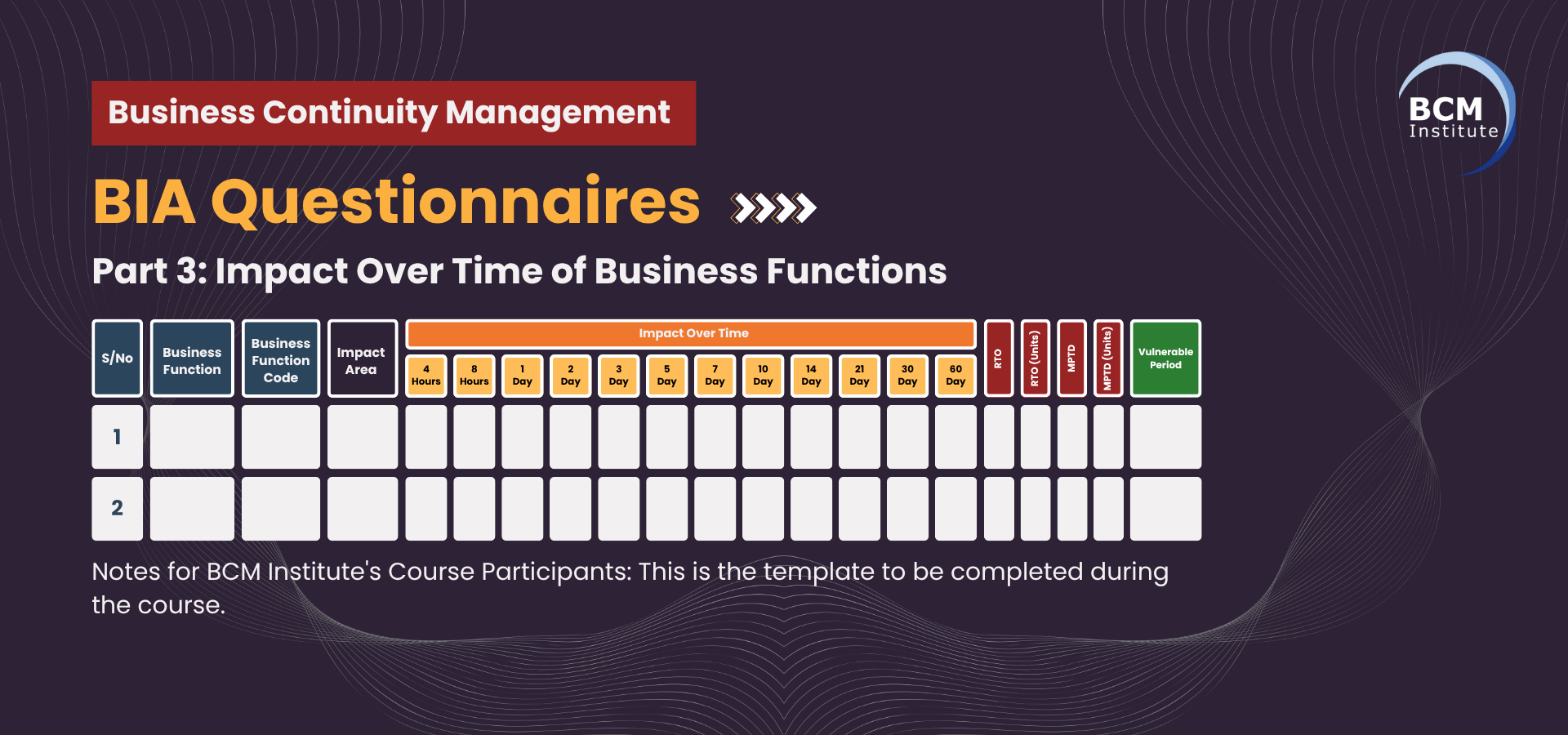
The table scores each Sub-CBF from 1 (Very Low) to 5 (Very High) at twelve disruption intervals and sets its RTO, MTPD and Vulnerable Period. Sub-CBFs are listed in their catalogue order; the recovery order that follows from the scores is set out in the next section.
**Table BIA Part 3: Impact Over Time of Business Functions for CBF-1 Personal Care and 24-Hour Supervision**
| **Sub-CBF Code** | **Sub-Critical Business Function** | **Highest-Impact Area** | **4 Hours** | **8 Hours** | **1 Day** | **2 Days** | **3 Days** | **5 Days** | **7 Days** | **10 Days** | **14 Days** | **21 Days** | **30 Days** | **60 Days** | **Recovery Time Objective (RTO)** | **Maximum Tolerable Period of Disruption (MTPD)** | **Vulnerable Period** |
| --- | --- | --- | --- | --- | --- | --- | --- | --- | --- | --- | --- | --- | --- | --- | --- | --- | --- |
| **CBF-1.1** | **Admission and Care Needs Assessment** | **Regulatory (admission and assessment duties under the SRH Act 2025 and Code of Practice)** | **1** | **1** | **2** | **2** | **2** | **3** | **3** | **4** | **4** | **5** | **5** | **5** | **5 days** | **21 days** | **Urgent placement referrals from MSF and public-hospital medical social workers, especially during year-end and post-festive hospital bed pressure; any group transfer of residents from another home.** |
| **CBF-1.2** | **Individual Care Planning and Review** | **Regulatory (current, reviewed care plans required by the Code of Practice)** | **1** | **1** | **1** | **1** | **2** | **2** | **3** | **3** | **4** | **4** | **5** | **5** | **7 days** | **30 days** | **The 72 hours after a resident returns from hospital with changed needs; scheduled care plan review cycles; MSF inspections in the first licensing cycle under the SRH Act 2025.** |
| **CBF-1.3** | **Care Workforce Rostering and Shift Deployment** | **Human Resources (unfilled shifts, fatigue and unsafe staffing ratios)** | **2** | **3** | **3** | **4** | **5** | **5** | **5** | **5** | **5** | **5** | **5** | **5** | **1 day** | **3 days** | **Festive and long-weekend clusters (Hari Raya Puasa, Hari Raya Haji, Chinese New Year, Deepavali, Christmas); peak home-leave months for foreign care staff; the last week of each month when the next roster is finalised.** |
| **CBF-1.4** | **Activities of Daily Living Assistance** | **Customer / Stakeholder (resident hygiene, comfort and dignity)** | **2** | **3** | **4** | **5** | **5** | **5** | **5** | **5** | **5** | **5** | **5** | **5** | **8 hours** | **2 days** | **The morning personal care window, about 0600 to 1000, when bathing, dressing and toileting peak; festive periods with reduced staffing.** |
| **CBF-1.5** | **Continence Care and Skin Integrity Management** | **Customer / Stakeholder (pressure injury and skin breakdown)** | **3** | **4** | **5** | **5** | **5** | **5** | **5** | **5** | **5** | **5** | **5** | **5** | **4 hours** | **1 day** | **The night shift (1900 to 0700), when bed-bound residents depend on two-hourly repositioning by fewer staff; any delay in continence product deliveries.** |
| **CBF-1.6** | **Mobility, Transfer and Fall Prevention** | **Customer / Stakeholder (fall-related injury, including hip fracture)** | **3** | **4** | **4** | **5** | **5** | **5** | **5** | **5** | **5** | **5** | **5** | **5** | **4 hours** | **2 days** | **Early morning (about 0400 to 0700), when residents rise to use the toilet, night sedation is still active and staffing is thinnest; the morning bathing period when floors are wet.** |
| **CBF-1.7** | **Feeding and Hydration Assistance** | **Customer / Stakeholder (aspiration, dehydration and hypoglycaemia)** | **3** | **4** | **5** | **5** | **5** | **5** | **5** | **5** | **5** | **5** | **5** | **5** | **4 hours** | **1 day** | **Breakfast, lunch and dinner service; the hottest months, around April and May, when dehydration risk rises; Ramadan, when meal timings shift for fasting residents and staff.** |
| **CBF-1.8** | **Medication Administration Support** | **Customer / Stakeholder (harm from missed or wrong doses of time-critical medicines)** | **4** | **5** | **5** | **5** | **5** | **5** | **5** | **5** | **5** | **5** | **5** | **5** | **2 hours** | **8 hours** | **The morning medication round (about 0600 to 0900), when most doses fall; the 48 hours after hospital discharge, when medication lists change; the monthly pharmacy replenishment cycle.** |
| **CBF-1.9** | **Point-of-Care Infection Prevention and Control** | **Regulatory (MOH notification and outbreak control requirements)** | **2** | **2** | **3** | **4** | **4** | **5** | **5** | **5** | **5** | **5** | **5** | **5** | **1 day** | **5 days** | **Singapore's year-end and mid-year influenza seasons; COVID-19 or other respiratory waves; the return of staff and volunteers from Haj or Umrah; any active outbreak in the home.** |
| **CBF-1.10** | **Day and Night Supervision and Safety Rounds** | **Customer / Stakeholder (resident life safety)** | **5** | **5** | **5** | **5** | **5** | **5** | **5** | **5** | **5** | **5** | **5** | **5** | **1 hour** | **4 hours** | **The night shift (1900 to 0700); the 0700 and 1900 shift changeovers; any night-time fire alarm, power failure or evacuation.** |
| **CBF-1.11** | **Dementia and Behavioural Care, including Wandering Prevention** | **Customer / Stakeholder (missing, injured or distressed resident)** | **4** | **5** | **5** | **5** | **5** | **5** | **5** | **5** | **5** | **5** | **5** | **5** | **2 hours** | **8 hours** | **Late afternoon and evening (about 1600 to 2000), when sundowning behaviours peak; weekend and Hari Raya visiting periods, when exits open often; fire drills and evacuations.** |
| **CBF-1.12** | **Health Monitoring and Clinical Escalation** | **Legal (duty-of-care, negligence and coroner's inquiry exposure from delayed escalation)** | **3** | **4** | **5** | **5** | **5** | **5** | **5** | **5** | **5** | **5** | **5** | **5** | **4 hours** | **1 day** | **Nights, weekends and public holidays, when the visiting doctor is unavailable; the first 72 hours after hospital discharge; outbreak periods.** |
| **CBF-1.13** | **Incident Reporting and Safeguarding** | **Regulatory (mandatory MSF notification and safeguarding of vulnerable residents)** | **2** | **3** | **4** | **4** | **5** | **5** | **5** | **5** | **5** | **5** | **5** | **5** | **8 hours** | **3 days** | **The hours after a serious incident (fall with injury, unexpected death, missing resident, abuse allegation) while MSF notification time limits run; outbreaks; MSF inspections.** |
| **CBF-1.14** | **Shift Handover and Care Documentation** | **Information (loss of care continuity and of the legal care record)** | **2** | **3** | **3** | **4** | **4** | **5** | **5** | **5** | **5** | **5** | **5** | **5** | **8 hours** | **5 days** | **Each shift handover at 0700 and 1900; planned downtime or migration of the electronic care record system; month-end documentation audits and MSF inspections.** |
Scores assume no workaround is in place. Where a tested workaround exists, the curve flattens, and the RTO is met through the workaround, not through full restoration.
#### Interpreting the Results
The scores group the 14 Sub-CBFs into four recovery tiers. Within each tier, the Sub-CBF with the shorter MTPD is recovered first.
| **Recovery Tier** | **RTO Band** | **Sub-CBFs (in recovery order)** | **Planning implication** |
| --- | --- | --- | --- |
| **Tier 1: Immediate** | **2 hours or less** | **CBF-1.10 Supervision and Safety Rounds; CBF-1.8 Medication Administration; CBF-1.11 Dementia and Wandering Prevention** | **Workarounds must be pre-built and usable by any shift without management present.** |
| **Tier 2: Same shift** | **4 to 8 hours** | **CBF-1.5 Continence and Skin Integrity; CBF-1.7 Feeding and Hydration; CBF-1.12 Health Monitoring and Escalation; CBF-1.6 Mobility and Falls; CBF-1.4 ADL Assistance; CBF-1.13 Incident Reporting; CBF-1.14 Handover and Documentation** | **Restored by the on-duty shift using paper records, redeployed staff, and on-site stock.** |
| **Tier 3: Next day** | **1 day** | **CBF-1.3 Rostering and Deployment; CBF-1.9 Infection Prevention and Control** | **The Superintendent and senior staff restore this within the first operational day.** |
| **Tier 4: Deferrable** | **5 to 7 days** | **CBF-1.1 Admission and Needs Assessment; CBF-1.2 Care Planning and Review** | **Paused deliberately to release staff for Tiers 1 to 3, with referrers and MSF informed.** |
##### Key observations
**Supervision is the anchor function.** CBF-1.10 is Very High from the first interval because every other care function depends on staff being present and watchful. A 4-hour loss of supervision, for example during a night-time evacuation with residents unaccounted for, is the most severe scenario in CBF-1. Its 1-hour RTO means supervision must never be fully lost; the continuity plan must specify how it is maintained in a degraded state.
**The clinical cluster moves fastest.** Medication, wandering prevention, continence care, feeding and health monitoring all reach Very High within 1 day. These functions share the same staff, so a single cause, such as a staff shortage or the loss of the electronic care record, will hit them together. Recovery strategies should treat them as one bundle rather than five separate problems.
**Rostering is a hidden dependency.** CBF-1.3 has a 1-day RTO because the current roster keeps working briefly after the rostering function fails. It does not mean staff shortages can wait a day. If the disruption is an actual loss of staff, Tiers 1 and 2 are impacted immediately; the next part of the BIA addresses that scenario through resource requirements.
**Night is the common vulnerable period.** Seven Sub-CBFs are most exposed at night or at shift change, when staffing is lowest, and the visiting doctor is off-site. The night shift is therefore the design case for continuity arrangements: if a workaround succeeds with night staffing, it will succeed by day.
**The calendar matters.** Ramadan, Hari Raya Puasa and Hari Raya Haji, Chinese New Year, Deepavali and Christmas concentrate leave, visitors and altered routines. Influenza seasons and the return of Haj and Umrah pilgrims raise infection risk. The hottest months raise dehydration risk; ISO 22301 Amendment 1:2024 asks organisations to consider climate change, and heat is the most direct climate exposure for frail residents.
**Administrative functions can be paused, but not indefinitely.** Organisations can suspend admission and care planning for several days. Beyond about two weeks, unplaced referrals and outdated care plans become a compliance and safeguarding problem in their own right.
#### Validating the Values
These scores are a structured starting point, not a final answer. Before approval, test them in a facilitated workshop with the Superintendent, the nurse in charge, care supervisors from both shifts, and the officer responsible for incident reporting. Workshop participants should test each score against real incidents JHA has experienced, then the Board should approve the final RTOs and MTPDs as part of JHA's risk appetite.
#### Conclusion
##### How impact-over-time analysis supports the BIA
The impact-over-time assessment is the point at which the BIA moves from description to decision. Earlier parts established what JHA does and why CBF-1 is critical.
This part turns that understanding into time-bound commitments, as ISO 22301 requires and as MSF and MOH reviewers will look for.
It also gives the Board a documented rationale for each recovery target, so the Board can challenge, defend, and revise targets on evidence rather than intuition.
The assessment makes JHA's dependencies visible. When several Sub-CBFs reach Very High impact at the same interval and rely on the same staff, records or supplies, that shared dependency becomes a priority for the resource analysis that follows.
##### How the results establish recovery priorities
The four recovery tiers give the Superintendent a ready-made order of work for the first hours of any disruption. Supervision, medication and wandering prevention come first; the clinical cluster follows within the same shift; rostering and infection control are restored on day one; admissions and care planning are deliberately paused.
Print this sequence in the incident response checklist so the duty officer on a night shift doesn't have to work it out under pressure.
The tiers also show what can be safely let go. Pausing admissions and routine care plan reviews for a few days releases skilled staff for the functions that cannot wait. Making that choice explicit in advance, and agreeing it with MSF and referring agencies, avoids the risk of staff trying to keep everything going and failing at what matters most.
##### How RTO and MTPD guide recovery strategy
The RTO defines how fast a recovery strategy must work; the MTPD defines how long it must hold. Together they rule out options that are too slow and identify where investment is justified.
- **RTOs of 2 hours or less** (Tier 1) cannot rely on external help arriving. They require on-site, pre-positioned solutions: printed Medication Administration Records refreshed daily, manual door-watch rotas, emergency lighting and torches, and staff trained to run them without a manager present.
- **RTOs of 4 to 8 hours** (Tier 2) can draw on staff recall, cross-trained Jamiyah Singapore staff, and on-site buffer stocks of continence products, PPE, nutritional supplements and drinking water. Keep paper-based charting and handover templates ready in every ward.
- **RTOs of 1 day or more** (Tiers 3 and 4) allow for supplier arrangements, mutual aid with other homes, agency staff and alternate rostering tools.
The gap between RTO and MTPD is the recovery margin. Where the margin is narrow, as with supervision (1 hour to 4 hours) and medication (2 hours to 8 hours), there is no time for a second attempt. The first workaround must work, which is why these strategies should be exercised most often.
##### How Vulnerable Periods shape contingency planning and resources
Vulnerable Periods tell JHA when to raise its guard. They should drive three practical measures.
1. **Seasonal readiness.** Before Ramadan and the festive clusters, confirm leave plans, standby staff and supplier delivery schedules. Before influenza seasons, check PPE stocks and staff vaccination status. Before the hottest months, review hydration routines and cooling arrangements.
2. **Daily rhythm.** Concentrate resilience measures on the night shift and the 0700 and 1900 changeovers, when seven Sub-CBFs are most exposed. Set minimum night staffing levels with these RTOs in mind.
3. **Event-triggered heightened alert.** A hospital discharge, a serious incident, an outbreak or a planned system migration should automatically trigger closer monitoring of the Sub-CBFs whose Vulnerable Periods they define.
Scheduling also matters. Fire drills, IT upgrades, refurbishment works and BCM exercises should avoid the Vulnerable Periods identified here, unless the purpose is to test performance under those conditions.
### [](https://cta-redirect.hubspot.com/cta/redirect/3893111/987f8ca5-0ba4-4281-be57-5221186733d0)
This analysis gives JHA a shared, evidence-based understanding of how long its residents can safely be without each element of care.
That understanding supports the Board's oversight of risk under the Code of Governance for Charities and IPCs (2023), shows MSF that continuity of care has been planned rather than assumed, and gives staff clarity on what to protect first.
The values in this chapter are not fixed. Review them at least annually, after any significant incident or exercise, and whenever the resident profile, staffing model, systems, or regulatory requirements change.
Kept current, the impact-over-time assessment becomes the reference point for every recovery strategy, plan and exercise that follows, and the foundation of a Business Continuity Plan that protects JHA's residents when it matters most.
[](https://cta-redirect.hubspot.com/cta/redirect/3893111/3aefb2d2-3110-47c1-ad4f-d3e6e5381066)
[](https://cta-redirect.hubspot.com/cta/redirect/3893111/45126cea-7fe9-4ffe-b72e-5e4451c0e271)
| **eBook 3: Starting Your BCM Implementation** | | | | | | |
| --- | --- | --- | --- | --- | --- | --- |
| **MBCO** | **P&S** | **RAR T1** | **RAR T2** | **RAR T3** | **BCS T1** | **CBF** |
| [](https://cta-redirect.hubspot.com/cta/redirect/3893111/3e0b35d2-08b6-4caf-b7db-144625ec8145) | [](https://cta-redirect.hubspot.com/cta/redirect/3893111/ab611654-bce2-450c-affc-3970de6c8909) | [](https://cta-redirect.hubspot.com/cta/redirect/3893111/806c27e6-1db5-42a2-ac84-e0df3624bc49) | [](https://cta-redirect.hubspot.com/cta/redirect/3893111/bf6da142-014d-4c47-83cf-f31e0c55b75e) | [](https://cta-redirect.hubspot.com/cta/redirect/3893111/4c14572c-2ed4-46aa-82c8-5ead8fd31ced) | [](https://cta-redirect.hubspot.com/cta/redirect/3893111/25548d11-adb7-4e6e-9a5a-054db2ea377d) | [](https://cta-redirect.hubspot.com/cta/redirect/3893111/94f8b16c-55da-4543-a948-448f2241296e) |
| **CBF-1 Strategic Procurement and Sourcing** | | | | | | |
| **DP** | **BIAQ P1** | **BIAQ P2** | **BIAQ P3** | **BIAQ P4** | **BIAQ P5** | **BIAQ P6** |
| **[](https://cta-redirect.hubspot.com/cta/redirect/3893111/b1b7c047-3a39-41d7-b2af-2b00d6f13590)** | **[](https://cta-redirect.hubspot.com/cta/redirect/3893111/ffed8b6e-4d2f-4066-a3ab-24aa0a28728b)** | **[](https://cta-redirect.hubspot.com/cta/redirect/3893111/70981a61-b605-4686-a3e5-de0275050496)** | **[](https://cta-redirect.hubspot.com/cta/redirect/3893111/bf3e01a8-f0da-43cc-abc1-d24397682927)** | **[](https://cta-redirect.hubspot.com/cta/redirect/3893111/98714bc9-8556-479e-894b-b67ccfc0f5b9)** | **[](https://cta-redirect.hubspot.com/cta/redirect/3893111/e1572772-84ee-4091-b436-62fb43179d00)** | **[](https://cta-redirect.hubspot.com/cta/redirect/3893111/4bcf60b1-2551-40ea-a780-6283033126cb)** |
| | | **BCS T2** | **BCS T3** | **PD** | | |
| | | **[](https://cta-redirect.hubspot.com/cta/redirect/3893111/1b2b0da8-76c7-4f9a-b2a6-4d4ae8648810)** | **[](https://cta-redirect.hubspot.com/cta/redirect/3893111/154f46c8-d8e4-4ace-89f4-5a6ff2c5abc9)** | **[](https://cta-redirect.hubspot.com/cta/redirect/3893111/b4e8c236-74a3-4226-9cae-52d2b6bf8868)** | | |
| | | | | | | |
#### More Information About Business Continuity Management Courses
To learn more about the course and schedule, click the buttons below for the BCM-300 Business Continuity Management Implementer \[BCM-3\] and the BCM-5000 Business Continuity Management Expert Implementer \[BCM-5\].
| [](https://cta-redirect.hubspot.com/cta/redirect/3893111/f3922b80-e96a-46d6-8993-dc150a5de2d5) | [](https://cta-redirect.hubspot.com/cta/redirect/3893111/9ff8a3dc-e39a-465b-929f-72e232cdd5fb) | [](https://cta-redirect.hubspot.com/cta/redirect/3893111/ac6cf073-4cdd-4541-91ed-889f731d5076) |
| --- | --- | --- |
| [](https://cta-redirect.hubspot.com/cta/redirect/3893111/21525c10-4003-4934-95fc-fe218174bc5b) | [](https://cta-redirect.hubspot.com/cta/redirect/3893111/46460171-c91a-4936-9bb2-8dc5928a0e02) | [](https://cta-redirect.hubspot.com/cta/redirect/3893111/1cb17ac7-50b2-4f88-bc4b-c7444e4b57b5) |
| [](https://cta-redirect.hubspot.com/cta/redirect/3893111/b3824ba1-7aa1-4eb6-bef8-94f57121c5ae) | Please feel free to send us a note if you have any questions. [](https://cta-redirect.hubspot.com/cta/redirect/3893111/3c53daeb-2836-4843-b0e0-645baee2ab9e) | [](https://cta-redirect.hubspot.com/cta/redirect/3893111/9c199ae8-c470-4bb7-9612-73c7a084e94c) |
| [](https://cta-redirect.hubspot.com/cta/redirect/3893111/8999211a-2c51-4be7-bf49-c393f6c67974) | [](https://cta-redirect.hubspot.com/cta/redirect/3893111/5c1aa95d-f6dd-4067-a95c-5cc0c32d7ed8) | [](https://cta-redirect.hubspot.com/cta/redirect/3893111/086ab3b9-4d66-4a95-b2f7-1148e9803a9c) |
#### **Comments**
### More Posts
[](https://cta-redirect.hubspot.com/cta/redirect/3893111/839787f4-a4fd-456f-accf-54c947026558)

All rights reserved. Copyright 2026
```json
{
"@context" : "https://schema.org",
"@type" : "BlogPosting",
"author" : {
"@type" : "Person",
"name" : "Dr Goh Moh Heng",
"url" : "https://blog.bcm-institute.org/ebook/author/dr-goh-moh-heng"
},
"dateModified" : "2026-10-21T02:29:07.863Z",
"datePublished" : "2026-10-21T02:29:07.000Z",
"headline" : "[BCM] [JHA] [E3] [BIA] [P3] [CBF] [1] Personal Care and 24-Hour Supervision",
"mainEntityOfPage" : {
"@id" : "https://blog.bcm-institute.org/ebook/bia-part-3-impact-over-time-of-business-functions-for-cbf-1-personal-care-and-24-hour-supervision",
"@type" : "WebPage"
},
"publisher" : {
"@type" : "Organization",
"logo" : {
"@type" : "ImageObject",
"url" : "https://blog.bcm-institute.org/hubfs/BCMI%20Logo.png"
},
"name" : "BCMI Pte Ltd"
}
}
```