---
title: [BCM] [SPD] [E3] [C1] Starting Your BCM Implementation
description: [BCM] [SPD] [E3] [C1] Starting Your BCM Implementation
image: https://blog.bcm-institute.org/hubfs/SPD%20Graphic%20Folder/SPD%20E3%20Morepost/%5BBCM%5D%20%5BSPD%5D%20%5BE3%5D%20%5BC1%5D%20Starting%20Your%20BCM%20Implementation.jpg
---
. .
[](http://www.bcm-institute.org/)
- [Home](https://www.bcm-institute.org/)
- [About Us](https://www.bcm-institute.org/about-us-3/)
- [A President’s Perspective](https://www.bcm-institute.org/about-us/a-presidents-perspective/)
- [Our History](https://www.bcm-institute.org/about-us/our-history/)
- [Our Advisory Council](https://www.bcm-institute.org/about-us/our-advisory-council/)
- [Customers’ Testimonials](https://www.bcm-institute.org/about-us/customers-testimonials/)
- [Credential Verification](https://www.bcm-institute.org/about-us/credential-verification/)
- [Courses](https://blog.bcm-institute.org/blog/course-fees-for-blended-learning-courses-master-catalog)
- [ISO 22301 Business Continuity Management System Audit](https://blog.bcm-institute.org/audit/business-continuity-management-audit-courses)
- [ISO 22301 Business Continuity Management](https://blog.bcm-institute.org/bcm/business-continuity-management-courses)
- [Crisis Communication](https://blog.bcm-institute.org/crisis-communication/crisis-communication-courses)
- [Crisis Management](https://blog.bcm-institute.org/en/crisis-management/courses)
- [IT Disaster Recovery](https://blog.bcm-institute.org/it-disaster-recovery/courses)
- [Operational Resilience](https://blog.bcm-institute.org/operational-resilience/courses)
- [Operational Resilience Audit](https://blog.bcm-institute.org/operational-resilience-audit/courses)
- [Certification](https://blog.bcm-institute.org/certification/types-of-certifications-offered)
- [ISO 22301 BCMS Audit Certification](https://blog.bcm-institute.org/certification/business-continuity-management-audit-certification)
- [ISO22301 Business Continuity Management Certification](https://blog.bcm-institute.org/bcm/business-continuity-management-certification)
- [Crisis Communication Certification](https://blog.bcm-institute.org/crisis-communication/crisis-communication-certification)
- [Crisis Management Certification](https://blog.bcm-institute.org/en/crisis-management/crisis-management-certification)
- [IT Disaster Recovery Planning Certification](https://blog.bcm-institute.org/it-disaster-recovery/it-disaster-recovery-certification)
- [Operational Resilience Certification](https://blog.bcm-institute.org/operational-resilience/operational-resilience-certification)
- [Operational Resilience Audit Certification](https://blog.bcm-institute.org/operational-resilience-audit)
- [Seminars](https://blog.bcm-institute.org/meet-the-expert/mte-webinar-mainpage)
- [Store](https://www.bcm-institute.org/store-2/)
- [Contact Us](http://www.bcm-institute.org/about-us/contact-us/)
-
-
##### Resilient Support: Implementing Business Continuity Management at SPD

# \[BCM\] \[SPD\] \[E3\] \[C1\] Starting Your BCM Implementation
[](https://cta-redirect.hubspot.com/cta/redirect/3893111/959a4367-6193-4326-848e-799bd16b0bb3)
Business Continuity Management (BCM) becomes effective when an[![\[BCM\] \[SPD\] \[E3\] \[C1\] Starting Your BCM Implementation](https://no-cache.hubspot.com/cta/default/3893111/a6be0709-c51f-4617-a66c-85800248cf32.png)](https://cta-redirect.hubspot.com/cta/redirect/3893111/a6be0709-c51f-4617-a66c-85800248cf32) organisation moves beyond understanding concepts and begins applying them systematically to its actual operations, services, risks, resources and recovery requirements.
For **SPD**, this means translating the BCM framework developed in the first two eBooks into practical implementation activities for the services that SPD has identified as its **Critical Business Functions (CBFs)**.
[![x eBook Cover \[BCM\] \[SPD\] \[E3\] \[2D\]](https://no-cache.hubspot.com/cta/default/3893111/23a468b5-00a3-4792-9579-3eb0f058fbc2.png)](https://cta-redirect.hubspot.com/cta/redirect/3893111/23a468b5-00a3-4792-9579-3eb0f058fbc2)This third eBook, **Starting Your BCM Implementation for SPD**, is therefore the practical implementation component of the eBook series:
**Resilient Support: Implementing Business Continuity Management at SPD**
It builds upon the organisational understanding and BCM methodology established in:
- **eBook 1 — Understanding Your Organisation for SPD**
- **eBook 2 — Implementing Business Continuity Management for SPD**
These two eBooks serve as pre-reading and implementation guidance.
eBook 3 moves from:
**Understanding BCM**
to:
**Applying BCM to SPD's Critical Business Functions**
The principal focus is on four operational phases of the BCM Planning Methodology: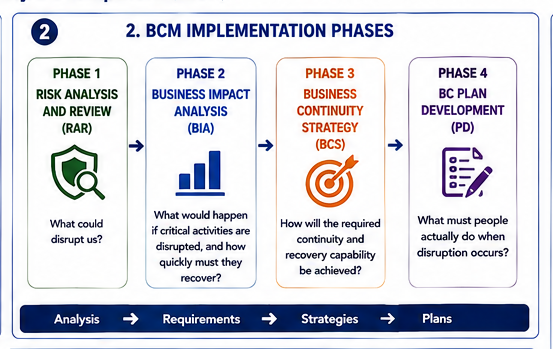
Each phase produces specific BCM documentation and evidence.
This eBook provides the structure through which SPD can prepare, review or update these deliverables as part of a BCM implementation or BCM programme enhancement project.
[](https://cta-redirect.hubspot.com/cta/redirect/3893111/dc612b43-f678-4d9a-888e-8dced9d1b72b)
[Moh Heng Goh](https://blog.bcm-institute.org/ebook/author/moh-heng-goh) Sep 17, 2026
###### Business Continuity Management Certified Planner-Specialist-Expert
**\[x\]**[](https://cta-redirect.hubspot.com/cta/redirect/3893111/dbe9de42-ec8a-403d-92cf-134a99184bb6)
### eBook 3: Chapter 1
[](https://cta-redirect.hubspot.com/cta/redirect/3893111/dc612b43-f678-4d9a-888e-8dced9d1b72b)
#### **Introduction**
Business Continuity Management (BCM) becomes effective when an organisation moves[![\[BCM\] \[SPD\] \[E3\] \[C1\] Starting Your BCM Implementation](https://no-cache.hubspot.com/cta/default/3893111/a6be0709-c51f-4617-a66c-85800248cf32.png)](https://cta-redirect.hubspot.com/cta/redirect/3893111/a6be0709-c51f-4617-a66c-85800248cf32) beyond understanding concepts and applies them systematically to its operations, services, risks, resources, and recovery requirements.
For **SPD**, this means translating the BCM framework developed in the first two eBooks into practical implementation activities for the services that SPD has identified as its **Critical Business Functions (CBFs)**.
This third eBook, **Starting Your BCM Implementation for SPD**, is therefore the practical implementation component of the eBook series:
**Resilient Support: Implementing Business Continuity Management at SPD**
It builds upon the organisational understanding and BCM methodology established in:
- **eBook 1 — Understanding Your Organisation for SPD**
- **eBook 2 — Implementing Business Continuity Management for SPD**
These two eBooks serve as pre-reading and implementation guidance.
eBook 3 moves
from:
**Understanding BCM**
to:
**Applying BCM to SPD's Critical Business Functions**
The principal focus is on four operational phases of the BCM Planning Methodology:

Each phase produces specific BCM documentation and evidence.
This eBook provides the structure through which SPD can prepare, review or update these deliverables as part of a BCM implementation or BCM programme enhancement project.
#### Purpose of This eBook
Starting Your BCM Implementation for SPD provides a practical bridge between BCM knowledge and BCM implementation.
- eBook 1 establishes an understanding of the organisation.
- eBook 2 explains the overall BCM Planning Methodology.
- eBook 3 applies that methodology to the organisation's actual Critical Business Functions.
The relationship can be represented as:
[![\[BCM\] \[E1\] \[C1\] eBook 1 to eBook 3 One Implementation Journey](https://no-cache.hubspot.com/cta/default/3893111/c8ff4234-63bc-493b-9945-c28a3c55b3f0.png)](https://cta-redirect.hubspot.com/cta/redirect/3893111/c8ff4234-63bc-493b-9945-c28a3c55b3f0)
The objective is to enable the organisation to produce the information, analysis, decisions, strategies and procedures required to establish an operational BCM capability.
#### **Why This eBook Is Provided**
This eBook is part of the value-added, **complementary services** provided to organisations that intend to implement a new BCM project or upgrade an existing BCM programme using the **BCM Institute's training-led implementation approach** while attending its certification or competency-based training courses.
The approach combines:
**Training**
↓
**Understanding the BCM Methodology**
↓
**Applying the Methodology to the Organisation**
↓
**Completing BCM Templates**
↓
**Reviewing Organisational Submissions**
↓
**Developing Organisation-Specific BCM Documentation**
↓
**Establishing or Improving BCM Capability**
Instead of learning BCM only through classroom examples, participants apply the concepts to their own organisation.
For SPD, this means that the training and implementation process can use actual organisational functions, services, dependencies and continuity requirements as the basis for BCM development.
The resulting eBook becomes both an **implementation guide** and a **structured compilation of organisational BCM submissions**.
#### **From Training to Implementation**
A training-led implementation approach recognises that organisations often understand the importance of BCM but struggle to translate BCM concepts into operational documentation.
For example, understanding the definition of Business Impact Analysis does not automatically tell an SPD service owner:
- what information needs to be collected;
- which service processes should be analysed;
- how impact should be evaluated;
- how dependencies should be documented;
- how recovery requirements should be determined; or
- how the BIA subsequently influences continuity strategies.
The training-led implementation process therefore follows a practical cycle:
**Learn the BCM Concept**
↓
**Understand the Template**
↓
**Apply It to SPD**
↓
**Complete the Required Information**
↓
**Review the Submission**
↓
**Identify Gaps**
↓
**Improve the Submission**
↓
**Incorporate It into SPD's BCM Documentation**
This approach helps transform BCM learning into organisational capability.
#### **Scope of eBook 3**
Although the complete BCM Planning Methodology in eBook 2 includes seven phases, this eBook focuses on four phases that require detailed operational analysis and documentation.
- **Risk Analysis and Review (RAR)**
- **Business Impact Analysis (BIA)**
- **Business Continuity Strategy (BCS)**
- **Plan Development (PD)**
These phases can be viewed as a connected implementation sequence:
**RAR**
What could disrupt SPD?
↓
**BIA**
What would be the impact if SPD's critical services were disrupted?
↓
**BCS**
How will SPD reduce disruption and recover its critical services?
↓
**PD**
What must SPD personnel actually do during disruption and recovery?
Each phase's output becomes input for the next.
#### [](https://cta-redirect.hubspot.com/cta/redirect/3893111/c2dfdab1-7ab0-4a8b-bd31-7876fd39633e)
#### Phase 1 — Risk Analysis and Review (RAR)
Risk Analysis and Review identifies threats that could disrupt SPD's operations and evaluates the risks associated with those threats.
The RAR phase addresses the question:
**What threats could disrupt SPD's ability to deliver its services, and what should be done about them?**
RAR should consider threats affecting:
- people;
- premises;
- technology;
- information;
- equipment;
- utilities;
- transportation;
- suppliers;
- service partners; and
- the wider operating environment.
For SPD, particular attention should be given to threats capable of interrupting services to persons with disabilities or preventing clients from accessing the support upon which they depend.
#### **RAR Templates**
Three templates are completed during the Risk Analysis and Review phase.
| Template | Title | Purpose |
| --- | --- | --- |
| RAR T1 | List of Threats | Identify relevant threats that could disrupt SPD |
| RAR T2 | Treatment and Control | Document existing and proposed risk treatments and controls |
| RAR T3 | Risk Impact and Likelihood Assessment | Evaluate impact, likelihood and resulting risk |
The implementation sequence is:
**Identify Threats — RAR T1**
↓
**Identify Treatments and Controls — RAR T2**
↓
**Assess Impact and Likelihood — RAR T3**
↓
**Determine Risk Priorities**
#### **RAR T1 — List of Threats**
SPD identifies threats that could disrupt business or services.
Examples include:
- fire;
- flooding;
- denial of access;
- power failure;
- telecommunications outage;
- infectious disease;
- employee shortage;
- cyberattack;
- ransomware;
- critical application failure;
- equipment failure;
- supplier disruption;
- transport disruption; and
- prolonged facility outage.
Focus on threats that could result in **loss of critical capability**.
#### **RAR T2 — Treatment and Control**
For each relevant threat, SPD identifies existing and planned controls.
Risk-treatment options may include:
- **Avoidance**
- **Reduction**
- **Transference**
- **Acceptance**
For example:
**Threat:** Critical ICT outage
**Existing controls:** System backup, technical support and cybersecurity controls.
**Planned controls:** Improved redundancy, alternative connectivity and enhanced recovery testing.
RAR T2 provides visibility into whether existing controls are sufficient or additional risk treatment is required.
#### **RAR T3 — Risk Impact and Likelihood Assessment**
RAR T3 assesses the impact and likelihood of identified threats.
The process can be represented as:
**Threat**
↓
**Impact Assessment**
\+
**Likelihood Assessment**
↓
**Risk Rating**
↓
**Risk Treatment Priority**
The purpose is not to predict precisely which disruptive incident will occur.
Instead, it helps SPD understand its exposure and prioritise risk-reduction activities.
#### [](https://cta-redirect.hubspot.com/cta/redirect/3893111/a1b4b4e2-f0aa-44df-a197-431397a7927c)
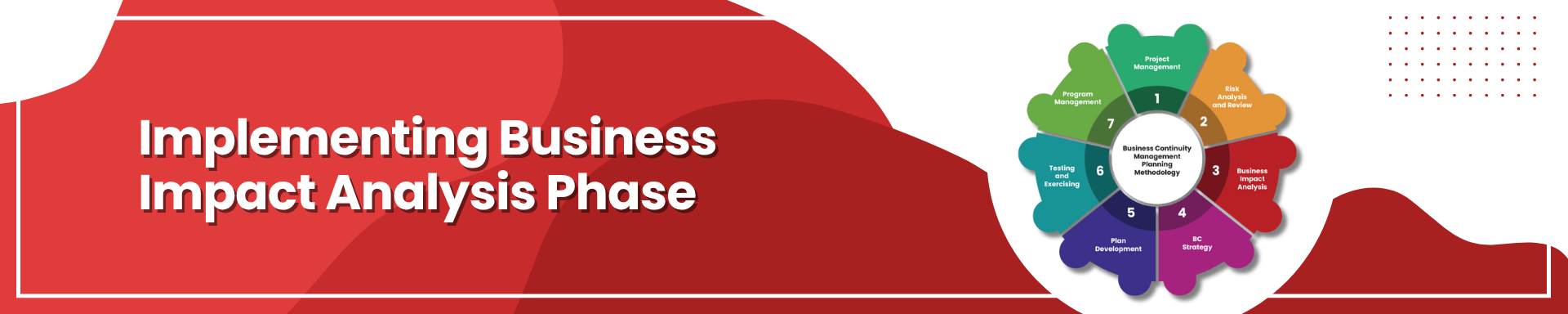
#### Phase 2 — Business Impact Analysis (BIA)
##### **Purpose of BIA**
The Business Impact Analysis identifies SPD's continuity priorities and determines the consequences of disruption over time.
The BIA addresses:
**What must SPD recover, by when, and what resources are required to maintain an acceptable level of service?**
The BIA is conducted against SPD's identified Critical Business Functions.
This makes the CBF catalogue one of the most important inputs into eBook 3.
#### **SPD Critical Business Function Catalogue**
The following Critical Business Functions provide the starting point for SPD's BIA.
| CBF Code | Critical Business Function |
| --- | --- |
| CBF-1 | Early Intervention Services for Children |
| CBF-2 | Day Activity and Disability Support Services |
| CBF-3 | Rehabilitation and Therapy Services |
| CBF-4 | Senior Care and Day Rehabilitation Services |
| CBF-5 | Specialised Case Management and Client Support |
| CBF-6 | Employment and Vocational Support Services |
| CBF-7 | Assistive Technology Assessment and Support |
| CBF-8 | Enabling Services and Community Support |
| CBF-9 | Critical Client Information and Case Records Availability |
| CBF-10 | Critical Digital and ICT Services Supporting Service Delivery |
| CBF-11 | Critical Client Transport and Service Access Support |
This list marks the beginning of the **Business Impact Analysis phase** and should be incorporated into the BIA report.
Each CBF will subsequently be analysed in greater detail.
#### **From CBF to Detailed BIA**
A CBF is initially an enterprise-level service or capability.
For detailed continuity planning, it must be decomposed into its underlying processes or Sub-CBFs.
For example:
**CBF-3 — Rehabilitation and Therapy Services**
↓
**Referral and Intake**
↓
**Client Assessment**
↓
**Therapy Planning**
↓
**Physiotherapy**
↓
**Occupational Therapy**
↓
**Speech Therapy**
↓
**Progress Review**
↓
**Client / Caregiver Guidance**
↓
**Discharge or Transition**
The BIA determines the consequences if these activities become unavailable and identifies the resources required to resume them.
#### **BIA Templates**
The BIA consists of a corporate-level component followed by six detailed parts.
| Part | BIA Requirement | Template |
| --- | --- | --- |
| Part 0 | Corporate MBCO | MBCO |
| Part 0 | Products and Services | P&S |
| Part 1 | Identification of Business Functions | BIAQ T1 |
| Part 2 | Impact Areas of Business Functions | BIAQ T1 |
| Part 3 | Impact Over Time of Business Functions | BIAQ T2 |
| Part 4 | Supporting IT Systems and Applications | BIAQ T2 |
| Part 5 | Inter-dependencies | BIAQ T3 |
| Part 6 | Vital Records | BIAQ T3 |
The BIA therefore progresses from organisational recovery requirements to detailed function-level dependencies.
#### **BIA Part 0 — Corporate MBCO and Products & Services**
Part 0 establishes the corporate context within which individual CBF recovery requirements are determined.
It considers:
##### **Corporate MBCO**
The organisation establishes the overall **Minimum Business Continuity Objective (MBCO)** or equivalent corporate minimum continuity expectation.
##### **Products and Services**
SPD identifies the products and services whose continuity is important to clients and stakeholders.
For SPD, the emphasis is primarily on essential service continuity.
The relationship is:
**SPD Mission and Services**
↓
**Products and Services**
↓
**Corporate Continuity Requirement**
↓
**Critical Business Functions**
↓
**Function-Level Recovery Requirements**
#### **BIA Part 1 — Identification of Business Functions \[BIAQ T1\]**
Part 1 identifies the business functions and processes associated with each CBF.
Information may include:
- CBF code;
- CBF name;
- responsible unit;
- CBF owner;
- function description;
- key processes;
- normal operating requirements; and
- primary clients or stakeholders.
For example:
**CBF:** CBF-1 Early Intervention Services for Children
The analysis should identify the individual processes required to deliver the service rather than treating early intervention as one undifferentiated activity.
#### **BIA Part 2 — Impact Areas of Business Functions \[BIAQ T1\]**
Part 2 determines the types of consequences that could result from disruption.
Potential impact areas for SPD include:
- client safety and wellbeing;
- interruption of care or support;
- service-delivery impact;
- caregiver impact;
- financial impact;
- legal or contractual impact;
- regulatory or funding impact;
- reputational impact;
- operational impact; and
- stakeholder impact.
For SPD, pay particular attention to the **client and caregiver consequences of service interruption**.
#### **BIA Part 3 — Impact Over Time \[BIAQ T2\]**
The significance of disruption frequently increases over time.
Part 3 examines this progression.
For example:
**Initial Disruption**
↓
Appointments Rescheduled
↓
Service Backlog Develops
↓
Clients Miss Continuing Intervention
↓
Caregiver Pressure Increases
↓
Alternative Support Becomes Necessary
↓
Consequences Become Unacceptable
The purpose is to identify the point at which the organisation can no longer tolerate the disruption.
This supports determination of recovery priorities.
#### **BIA Part 4 — Supporting IT Systems and Applications \[BIAQ T2\]**
Part 4 identifies the technology supporting each Critical Business Function.
Rather than beginning with technology, the analysis should begin with the service.
**Critical Business Function**
↓
**Critical Process**
↓
**Information Requirement**
↓
**Application**
↓
**Technology Infrastructure**
↓
**Recovery Requirement**
For SPD, relevant technology could support:
- client records;
- case management;
- therapy information;
- scheduling;
- communications;
- staff access;
- service coordination; and
- management reporting.
This enables business recovery requirements to inform IT Disaster Recovery priorities.
#### **BIA Part 5 — Inter-dependencies \[BIAQ T3\]**
No Critical Business Function operates independently.
Part 5 identifies the dependencies necessary for service delivery.
These may include:
##### **Internal Dependencies**
- ICT;
- Human Resources;
- Facilities;
- Finance;
- Procurement;
- Communications; and
- other SPD service units.
##### **External Dependencies**
- government agencies;
- healthcare organisations;
- community partners;
- transport providers;
- technology providers;
- equipment suppliers;
- contractors; and
- other Social Service Agencies.
A useful representation is:
**CBF**
↓
**People**
↓
**Premises**
↓
**Technology**
↓
**Information**
↓
**Equipment**
↓
**Transport**
↓
**Suppliers and Partners**
Failure of one critical dependency may prevent recovery even when all other resources are available.
#### **BIA Part 6 — Vital Records \[BIAQ T3\]**
Vital records are information required to continue or recover a Critical Business Function.
Examples for SPD may include:
- client records;
- caregiver contact information;
- assessment records;
- therapy plans;
- case notes;
- intervention plans;
- accessibility requirements;
- emergency information;
- referral records;
- supplier information; and
- continuity procedures.
The key question is:
**What information must SPD personnel have access to during disruption in order to continue the service safely and effectively?**
This information must be appropriately protected, available and recoverable.
#### [](https://cta-redirect.hubspot.com/cta/redirect/3893111/fac23b58-f744-480a-b86b-13a824a53308)
#### Phase 3 — Business Continuity Strategy (BCS)
#### **Purpose of BCS**
Once the BIA establishes recovery requirements, SPD must determine how those requirements will be achieved.
BCS answers:
**What practical arrangements will enable SPD to continue and recover its Critical Business Functions?**
Three BCS templates are completed.
| Template | Requirement |
| --- | --- |
| BCS T1 | Mitigation Strategies |
| BCS T2 | Recovery Strategies and Justifications |
| BCS T3 | Minimum Resources Required During a Disaster for Continuity |
The sequence is:
**Reduce Exposure**
↓
**Select Recovery Strategy**
↓
**Determine Minimum Resources**
↓
**Prepare for Implementation**
#### **BCS T1 — Mitigation Strategies**
Mitigation strategies reduce the likelihood or consequences of disruption before an incident occurs.
Examples for SPD could include:
- preventive facility maintenance;
- backup power;
- staff cross-training;
- cybersecurity controls;
- backup communications;
- spare critical equipment;
- supplier diversification;
- alternative accessible transport;
- secure information backup; and
- cross-centre resource arrangements.
Mitigation reduces vulnerability but does not eliminate the need for recovery capability.
#### **BCS T2 — Recovery Strategies and Justifications**
Recovery strategies determine how a CBF will be restored following disruption.
Potential strategies include:
**People**
Cross-deployment, cross-training, alternate teams and temporary staffing.
**Premises**
Alternative SPD centres, temporary locations and remote working where appropriate.
**Technology**
System recovery, backup infrastructure and alternative connectivity.
**Service Delivery**
Alternative service locations, reduced service models and remote delivery where suitable.
**Suppliers**
Alternative suppliers and contingency arrangements.
**Transport**
Alternative accessible transport arrangements.
Each selected strategy should be justified against the BIA requirement.
The relationship should therefore be:
**BIA Requirement**
↓
**Potential Strategies**
↓
**Evaluate Feasibility**
↓
**Select Strategy**
↓
**Document Justification**
#### **BCS T3 — Minimum Resources Required During a Disaster for Continuity**
A continuity strategy cannot be implemented unless the required resources are known.
BCS T3 determines the minimum resources needed during disruption.
These may include:
- minimum number of employees;
- specialist professionals;
- workstations;
- accessible premises;
- ICT equipment;
- applications;
- communications;
- client information;
- therapy or rehabilitation equipment;
- vehicles;
- supplies; and
- third-party services.
For example:
**Normal Service Capacity: 100%**
↓
**Disruption**
↓
**Initial Recovery Capacity: 30%**
↓
**Priority Clients Served**
↓
**Capacity Increased to 50%**
↓
**Capacity Increased to 75%**
↓
**Normal Service Restored**
BCS T3 enables SPD to define what is actually required at each stage of recovery.
#### [](https://cta-redirect.hubspot.com/cta/redirect/3893111/8be70e4c-1b23-4b38-bf36-5bd899b28e17)
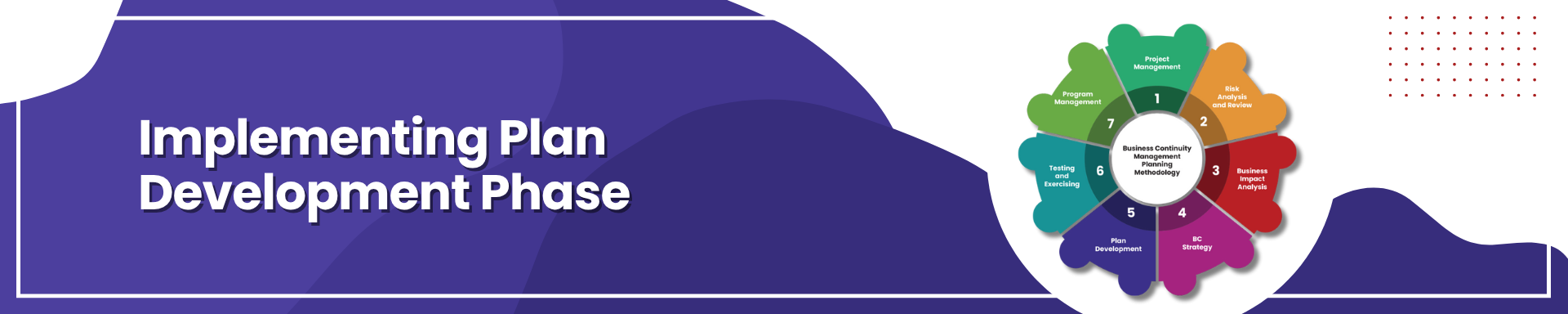
#### Phase 4 — Business Continuity Plan Development (PD)
##### **Purpose of PD**
Plan Development translates BIA requirements and approved continuity strategies into detailed operational procedures.
PD answers:
**What should SPD personnel actually do when a Critical Business Function is disrupted?**
Each CBF should have recovery procedures aligned with its actual processes.
#### **CBF-Specific Recovery Procedures**
A generic corporate continuity plan alone may not provide sufficient operational detail.
The PD phase should therefore drill down into each CBF.
For example:
##### **CBF-1 Early Intervention Services for Children**
may require procedures addressing:
- client prioritisation;
- caregiver notification;
- therapist and interventionist availability;
- alternative facilities;
- remote service suitability;
- access to intervention records; and
- restoration of normal programmes.
Similarly:
##### **CBF-11 Critical Client Transport and Service Access Support**
may require procedures addressing:
- transport provider failure;
- alternative vehicles;
- accessible transport requirements;
- route prioritisation;
- client and caregiver communication;
- alternative service locations; and
- escalation where clients cannot access essential services.
The procedures should reflect each CBF's characteristics rather than relying entirely on generic organisational instructions.
#### **From Analysis to Recovery Procedure**
The four phases should remain clearly traceable.
For example:
**RAR**
Centre unavailability identified as a disruption risk.
↓
**BIA**
CBF-3 Rehabilitation and Therapy Services requires recovery within its approved timeframe.
↓
**BCS**
Alternative SPD centre and therapist redeployment selected as recovery strategies.
↓
**PD**
A detailed procedure specifies how the alternative centre is activated, therapists are redeployed, and affected clients are contacted.
This traceability is essential.
A recovery procedure should exist because it supports an identified business requirement—not merely because a template requires one.
#### **Structure of This eBook as a Compilation of Organisational Submissions**
This eBook is designed to become a **compilation of SPD's submissions** during the BCM planning exercise.
As each phase is completed, the corresponding information can be incorporated into the eBook.
The developing implementation record becomes:
##### **Section A — Risk Analysis and Review**
**RAR T1** — List of Threats
**RAR T2** — Treatment and Control
**RAR T3** — Risk Impact and Likelihood Assessment
↓
##### **Section B — Business Impact Analysis**
**Part 0** — Corporate MBCO and Products & Services
**Part 1** — Identification of Business Functions
**Part 2** — Impact Areas
**Part 3** — Impact Over Time
**Part 4** — Supporting IT Systems and Applications
**Part 5** — Inter-dependencies
**Part 6** — Vital Records
↓
##### **Section C — Business Continuity Strategy**
**BCS T1** — Mitigation Strategies
**BCS T2** — Recovery Strategies and Justifications
**BCS T3** — Minimum Resources Required During a Disaster for Continuity
↓
##### **Section D — Plan Development**
**Detailed CBF Recovery Procedures**
This converts the eBook from a general reference document into an **organisation-specific implementation record**.
#### **How SPD Should Use This eBook**
The recommended implementation cycle is:
**Step 1 — Read the Relevant Guidance**
Review the relevant content from eBooks 1 and 2.
↓
**Step 2 — Understand the Requirement**
Determine what the RAR, BIA, BCS or PD template requires.
↓
**Step 3 — Apply the Requirement to SPD**
Use actual SPD functions, processes, resources and dependencies.
↓
**Step 4 — Complete the Template**
Document the required information.
↓
**Step 5 — Review**
Check completeness, consistency and practicality.
↓
**Step 6 — Validate with CBF Owners**
Ensure operational personnel confirm the information.
↓
**Step 7 — Identify Gaps**
Determine where information, resources or continuity arrangements are insufficient.
↓
**Step 8 — Improve**
Update the analysis, strategy or procedure.
↓
**Step 9 — Incorporate into the eBook**
Maintain the validated output as part of SPD's BCM implementation documentation.
#### **Maintaining Consistency Across the Four Phases**
A significant benefit of this structured approach is that the same CBF codes and names can be maintained throughout the BCM project.
For example:
**CBF-2 — Day Activity and Disability Support Services**
should remain CBF-2 throughout:
**BIA**
Impact and recovery requirements
↓
**BCS**
Mitigation and recovery strategies
↓
**PD**
Recovery procedures
This provides clear traceability.
Similarly:
**CBF-9 — Critical Client Information and Case Records Availability**
should be consistently referenced across its BIA, technology dependencies, recovery strategies and recovery procedures.
This avoids a common weakness in BCM programmes—different documents referring to the same service using inconsistent terminology.
#### **Expected Outputs of eBook 3**
At the completion of the implementation exercise, SPD should have developed or updated a structured set of outputs including:
| BCM Phase | Expected Output |
| --- | --- |
| RAR | Organisational threat catalogue |
| RAR | Threat treatments and controls |
| RAR | Risk impact and likelihood assessments |
| BIA | Corporate MBCO and products/services |
| BIA | Detailed CBF identification |
| BIA | Impact assessments |
| BIA | Impact-over-time assessments |
| BIA | Supporting IT requirements |
| BIA | Interdependency mapping |
| BIA | Vital-record requirements |
| BCS | Mitigation strategies |
| BCS | Recovery strategies and justifications |
| BCS | Minimum continuity resources |
| PD | CBF-specific Business Continuity Recovery Procedures |
Together, these outputs establish the core operational documentation needed to support SPD's continuity capability.
#### **The Implementation Journey**
The complete journey across the three eBooks can therefore be summarised as:
##### **eBook 1 — UNDERSTAND**
**Understand SPD**
↓
Operating Environment
↓
BCM Goals and Objectives
↓
Threats
↓
Critical Business Functions
##### **eBook 2 — LEARN THE METHODOLOGY**
**Understand BCM Implementation**
↓
PM
↓
RAR
↓
BIA
↓
BCS
↓
PD
↓
TE
↓
PgM
##### **eBook 3 — IMPLEMENT**
**Apply BCM to SPD**
↓
Complete RAR
↓
Complete BIA
↓
Develop BCS
↓
Develop PD
↓
Compile Organisational Submissions
↓
Validate
↓
Improve
This creates the progression:
**UNDERSTAND**
↓
**LEARN**
↓
**APPLY**
↓
**DOCUMENT**
↓
**VALIDATE**
↓
**IMPROVE**
#### [](https://cta-redirect.hubspot.com/cta/redirect/3893111/dc612b43-f678-4d9a-888e-8dced9d1b72b)
**Starting Your BCM Implementation for SPD** marks the transition from BCM knowledge to practical organisational implementation.
The first eBook, **Understanding Your Organisation for SPD**, establishes the organisational context, services, operating environment, threats and Critical Business Functions that form the foundation for continuity planning.
The second eBook, **Implementing Business Continuity Management for SPD**, establishes the BCM Planning Methodology and explains how the different phases work together.
This third eBook converts those foundations into practical implementation.
Its four core phases are:
**Risk Analysis and Review (RAR)**
↓
**Business Impact Analysis (BIA)**
↓
**Business Continuity Strategy (BCS)**
↓
**Plan Development (PD)**
RAR enables SPD to understand what could disrupt its operations.
BIA determines what must be recovered, the consequences of disruption, the dependencies involved and the resources required.
BCS determines how SPD will mitigate disruption and recover its Critical Business Functions.
PD converts those strategies into detailed procedures that personnel can use when disruption actually occurs.
Most importantly, these activities are applied to SPD's eleven identified Critical Business Functions, beginning with **CBF-1**
**Early Intervention Services for Children** and extending through **CBF-11 Critical Client Transport and Service Access Support**.
The eBook therefore becomes more than instructional material. As the BCM project progresses, it develops into a structured compilation of SPD's RAR, BIA, BCS and PD submissions and provides traceability from:
**Threat**
↓
**Business Impact**
↓
**Recovery Requirement**
↓
**Continuity Strategy**
↓
**Minimum Resources**
↓
**Recovery Procedure**
This eBook is provided as part of the **value-added and complementary services supporting organisations implementing or upgrading BCM through BCM Institute's training-led implementation approach**, alongside its certification and competency-based training courses.
The intended outcome is practical: participants do not simply learn how BCM should work.
They use the methodology, templates and guidance to develop and improve the organisation's actual BCM programme.
For SPD, this means progressively building a continuity capability that is grounded in its real services, Critical Business Functions, client requirements, operational dependencies and recovery needs—and ultimately strengthening its ability to continue supporting persons with disabilities, caregivers and other stakeholders when normal operations are disrupted.
[](https://cta-redirect.hubspot.com/cta/redirect/3893111/3aefb2d2-3110-47c1-ad4f-d3e6e5381066)
[![\[BCM\] \[GEN 3\] \[3/4 Banner\] Implementing Business Continuity Management](https://no-cache.hubspot.com/cta/default/3893111/19e85049-546e-4764-881b-f651277b16aa.png)](https://cta-redirect.hubspot.com/cta/redirect/3893111/19e85049-546e-4764-881b-f651277b16aa)
| **eBook 3: Starting Your BCM Implementation** | | | | | | |
| --- | --- | --- | --- | --- | --- | --- |
| **MBCO \[x\]** | **P&S \[x\]** | **RAR T1 \[x\]** | **RAR T2 \[x\]** | **RAR T3 \[x\]** | **BCS T1 \[x\]** | **eBook 1** |
| [![\[BCM\] \[SPD\] \[E3\] \[BIA\] MBCO Corporate MBCO](https://no-cache.hubspot.com/cta/default/3893111/a3565d30-146f-4249-9181-d53152ba13b0.png)](https://cta-redirect.hubspot.com/cta/redirect/3893111/a3565d30-146f-4249-9181-d53152ba13b0) | [![\[BCM\] \[SPD\] \[E3\] \[BIA\] \[PS\] Key Product and Services](https://no-cache.hubspot.com/cta/default/3893111/e11c4575-1cc9-4e20-976e-2252497bb37e.png)](https://cta-redirect.hubspot.com/cta/redirect/3893111/e11c4575-1cc9-4e20-976e-2252497bb37e) | [![\[BCM\] \[SPD\] \[E3\] \[RAR\] \[T1\] List of Threats](https://no-cache.hubspot.com/cta/default/3893111/3d8c9eee-a27c-476f-9296-af2406497e9a.png)](https://cta-redirect.hubspot.com/cta/redirect/3893111/3d8c9eee-a27c-476f-9296-af2406497e9a) | [![\[BCM\] \[SPD\] \[E3\] \[RAR\] \[T2\] Treatment and Control](https://no-cache.hubspot.com/cta/default/3893111/0c3828fa-9888-4a7d-b6ad-7bd14be3bcc8.png)](https://cta-redirect.hubspot.com/cta/redirect/3893111/0c3828fa-9888-4a7d-b6ad-7bd14be3bcc8) | [![\[BCM\] \[SPD\] \[E3\] \[RAR\] \[T3\] Risk Impact and Likelihood Assessment](https://no-cache.hubspot.com/cta/default/3893111/9a345a33-765b-441c-ba75-fd8c0e5d0dec.png)](https://cta-redirect.hubspot.com/cta/redirect/3893111/9a345a33-765b-441c-ba75-fd8c0e5d0dec) | [![\[BCM\] \[SPD\] \[E3\] \[BCS\] \[T1\] Mitigation Strategies and Justification](https://no-cache.hubspot.com/cta/default/3893111/0bb7ec21-ed4a-4a61-9e59-42450dd58c0d.png)](https://cta-redirect.hubspot.com/cta/redirect/3893111/0bb7ec21-ed4a-4a61-9e59-42450dd58c0d) | [![x eBook Cover \[BCM\] \[SPD\] \[E1\] \[2D\]](https://no-cache.hubspot.com/cta/default/3893111/5d343ec1-6437-4e47-94e9-59e9476ed5f6.png)](https://cta-redirect.hubspot.com/cta/redirect/3893111/5d343ec1-6437-4e47-94e9-59e9476ed5f6) |
| **CBF-1: Protection and Safeguarding of Children and Vulnerable Adults** | | | | | | |
| **DP \[x\]** | **BIAQ P1 \[x\]** | **BIAQ P2 \[x\]** | **BIAQ P3 \[x\]** | **BIAQ P4 \[x\]** | **BIAQ P5 \[x\]** | **eBook 2** |
| | | | | | | [![x eBook Cover \[BCM\] \[SPD\] \[E2\] \[2D\]](https://no-cache.hubspot.com/cta/default/3893111/5b231d6a-c770-4c0f-8029-99ea35d26e8b.png)](https://cta-redirect.hubspot.com/cta/redirect/3893111/5b231d6a-c770-4c0f-8029-99ea35d26e8b) |
| **BIAQ P6 \[x\]** | **BCS T2 \[x\]** | **BCS T3 \[x\]** | **PD \[x\]** | | | **eBook 3** |
| | | | | | | [![x eBook Cover \[BCM\] \[SPD\] \[E3\] \[2D\]](https://no-cache.hubspot.com/cta/default/3893111/23a468b5-00a3-4792-9579-3eb0f058fbc2.png)](https://cta-redirect.hubspot.com/cta/redirect/3893111/23a468b5-00a3-4792-9579-3eb0f058fbc2) |
#### More Information About Business Continuity Management Courses
[](https://cta-redirect.hubspot.com/cta/redirect/3893111/c010f0fd-7ba6-4f60-b63b-38efafac8ca5)[](https://cta-redirect.hubspot.com/cta/redirect/3893111/354ef907-cf2c-4148-aa47-577a930e76c5)To learn more about the course and schedule, click the buttons below for the BCM-300 Business Continuity Management Implementer \[B-3\] course and the BCM-5000 Business Continuity Management Expert Implementer \[B-5\].
| [![Register \[BL-B-3\]\*](https://no-cache.hubspot.com/cta/default/3893111/ac6cf073-4cdd-4541-91ed-889f731d5076.png)](https://cta-redirect.hubspot.com/cta/redirect/3893111/ac6cf073-4cdd-4541-91ed-889f731d5076) | [](https://cta-redirect.hubspot.com/cta/redirect/3893111/9ff8a3dc-e39a-465b-929f-72e232cdd5fb) | [](https://cta-redirect.hubspot.com/cta/redirect/3893111/f3922b80-e96a-46d6-8993-dc150a5de2d5) |
| --- | --- | --- |
| [](https://cta-redirect.hubspot.com/cta/redirect/3893111/1cb17ac7-50b2-4f88-bc4b-c7444e4b57b5) | [](https://cta-redirect.hubspot.com/cta/redirect/3893111/3ecb1171-819d-45a2-8686-6db917a20156) | [](https://cta-redirect.hubspot.com/cta/redirect/3893111/21525c10-4003-4934-95fc-fe218174bc5b) |
| [![FAQ \[BL-B-3\]](https://no-cache.hubspot.com/cta/default/3893111/b3824ba1-7aa1-4eb6-bef8-94f57121c5ae.png)](https://cta-redirect.hubspot.com/cta/redirect/3893111/b3824ba1-7aa1-4eb6-bef8-94f57121c5ae) | If you have any questions, click to contact us. [![Email to Sales Team \[BCM Institute\]](https://no-cache.hubspot.com/cta/default/3893111/3c53daeb-2836-4843-b0e0-645baee2ab9e.png)](https://cta-redirect.hubspot.com/cta/redirect/3893111/3c53daeb-2836-4843-b0e0-645baee2ab9e) | [](https://cta-redirect.hubspot.com/cta/redirect/3893111/9c199ae8-c470-4bb7-9612-73c7a084e94c) |
| [](https://cta-redirect.hubspot.com/cta/redirect/3893111/8999211a-2c51-4be7-bf49-c393f6c67974) | [](https://cta-redirect.hubspot.com/cta/redirect/3893111/5c1aa95d-f6dd-4067-a95c-5cc0c32d7ed8) | [](https://cta-redirect.hubspot.com/cta/redirect/3893111/086ab3b9-4d66-4a95-b2f7-1148e9803a9c) |
#### **Comments:**
### More Posts
[](https://cta-redirect.hubspot.com/cta/redirect/3893111/839787f4-a4fd-456f-accf-54c947026558)

All rights reserved. Copyright 2026
```json
{
"@context" : "https://schema.org",
"@type" : "BlogPosting",
"author" : {
"@type" : "Person",
"name" : "Moh Heng Goh",
"url" : "https://blog.bcm-institute.org/ebook/author/moh-heng-goh"
},
"dateModified" : "2026-09-22T07:27:01.501Z",
"datePublished" : "2026-09-17T08:40:39.000Z",
"headline" : "[BCM] [SPD] [E3] [C1] Starting Your BCM Implementation",
"mainEntityOfPage" : {
"@id" : "https://blog.bcm-institute.org/ebook/bcm-spd-e3-c1-starting-your-bcm-implementation",
"@type" : "WebPage"
},
"publisher" : {
"@type" : "Organization",
"logo" : {
"@type" : "ImageObject",
"url" : "https://blog.bcm-institute.org/hubfs/BCMI%20Logo.png"
},
"name" : "BCMI Pte Ltd"
}
}
```