---
title: [BCM] [SPD] [E1] [C1] Overview of BCM Case Study
description: [BCM] [SPD] [E1] [C1] Overview of BCM Case Study
image: https://blog.bcm-institute.org/hubfs/SPD%20Graphic%20Folder/SPD%20E1%20Morepost/%5BBCM%5D%20%5BSPD%5D%20%5BE1%5D%20%5BC1%5D%20Overview%20of%20BCM%20Case%20Study.jpg
---
.
[](http://www.bcm-institute.org/)
- [Home](https://www.bcm-institute.org/)
- [About Us](https://www.bcm-institute.org/about-us-3/)
- [A President’s Perspective](https://www.bcm-institute.org/about-us/a-presidents-perspective/)
- [Our History](https://www.bcm-institute.org/about-us/our-history/)
- [Our Advisory Council](https://www.bcm-institute.org/about-us/our-advisory-council/)
- [Customers’ Testimonials](https://www.bcm-institute.org/about-us/customers-testimonials/)
- [Credential Verification](https://www.bcm-institute.org/about-us/credential-verification/)
- [Courses](https://blog.bcm-institute.org/blog/course-fees-for-blended-learning-courses-master-catalog)
- [ISO 22301 Business Continuity Management System Audit](https://blog.bcm-institute.org/audit/business-continuity-management-audit-courses)
- [ISO 22301 Business Continuity Management](https://blog.bcm-institute.org/bcm/business-continuity-management-courses)
- [Crisis Communication](https://blog.bcm-institute.org/crisis-communication/crisis-communication-courses)
- [Crisis Management](https://blog.bcm-institute.org/en/crisis-management/courses)
- [IT Disaster Recovery](https://blog.bcm-institute.org/it-disaster-recovery/courses)
- [Operational Resilience](https://blog.bcm-institute.org/operational-resilience/courses)
- [Operational Resilience Audit](https://blog.bcm-institute.org/operational-resilience-audit/courses)
- [Certification](https://blog.bcm-institute.org/certification/types-of-certifications-offered)
- [ISO 22301 BCMS Audit Certification](https://blog.bcm-institute.org/certification/business-continuity-management-audit-certification)
- [ISO22301 Business Continuity Management Certification](https://blog.bcm-institute.org/bcm/business-continuity-management-certification)
- [Crisis Communication Certification](https://blog.bcm-institute.org/crisis-communication/crisis-communication-certification)
- [Crisis Management Certification](https://blog.bcm-institute.org/en/crisis-management/crisis-management-certification)
- [IT Disaster Recovery Planning Certification](https://blog.bcm-institute.org/it-disaster-recovery/it-disaster-recovery-certification)
- [Operational Resilience Certification](https://blog.bcm-institute.org/operational-resilience/operational-resilience-certification)
- [Operational Resilience Audit Certification](https://blog.bcm-institute.org/operational-resilience-audit)
- [Seminars](https://blog.bcm-institute.org/meet-the-expert/mte-webinar-mainpage)
- [Store](https://www.bcm-institute.org/store-2/)
- [Contact Us](http://www.bcm-institute.org/about-us/contact-us/)
-
-
##### Resilient Support: Implementing Business Continuity Management at SPD
# \[BCM\] \[SPD\] \[E1\] \[C1\] Overview of BCM Case Study
[](https://cta-redirect.hubspot.com/cta/redirect/3893111/959a4367-6193-4326-848e-799bd16b0bb3)Business Continuity Management (BCM) is a structured management approach that enables an organisation to anticipate disruptive incidents, prepare appropriate responses, maintain priority activities at an acceptable level during disruption, and recover its operations in a controlled manner.
[![x eBook Cover \[BCM\] \[SPD\] \[E1\] \[2D\]](https://no-cache.hubspot.com/cta/default/3893111/5d343ec1-6437-4e47-94e9-59e9476ed5f6.png)](https://cta-redirect.hubspot.com/cta/redirect/3893111/5d343ec1-6437-4e47-94e9-59e9476ed5f6)For **SPD**, BCM is particularly important because disruption can affect more than internal business operations.
It can affect persons with disabilities, children and youth requiring early intervention, adults requiring rehabilitation or employment support, seniors receiving rehabilitation and day-care services, caregivers, families, employees and community partners.
SPD has served persons with disabilities in Singapore since 1964.
Its vision is to build an inclusive community where everyone is "a part of it, not apart from it", while its mission focuses on partnering with persons with disabilities to develop their potential for greater self-reliance and independence.
### [](https://cta-redirect.hubspot.com/cta/redirect/3893111/26552c6a-ef41-48d4-b53d-d0b00b62e57f)
[Moh Heng Goh](https://blog.bcm-institute.org/ebook/author/moh-heng-goh) Sep 17, 2026
###### Business Continuity Management Certified Planner-Specialist-Expert
### **\[x\]**[](https://cta-redirect.hubspot.com/cta/redirect/3893111/dbe9de42-ec8a-403d-92cf-134a99184bb6)
### eBook 1: Chapter 1
### [](https://cta-redirect.hubspot.com/cta/redirect/3893111/26552c6a-ef41-48d4-b53d-d0b00b62e57f)
### Building Business Continuity Resilience for SPD
### Introduction
Business Continuity Management (BCM) is a structured management [![\[BCM\] \[SPD\] \[E1\] \[C1\] Overview of BCM Case Study](https://no-cache.hubspot.com/cta/default/3893111/bd889448-2c9a-419a-ae34-7b72c5e2b55d.png)](https://cta-redirect.hubspot.com/cta/redirect/3893111/bd889448-2c9a-419a-ae34-7b72c5e2b55d)approach that enables an organisation to anticipate disruptive incidents, prepare appropriate responses, maintain priority activities at an acceptable level during disruption, and recover its operations in a controlled manner.
For **SPD**, BCM is particularly important because disruption can affect more than internal business operations.
[![x eBook Cover \[BCM\] \[SPD\] \[E1\] \[2D\]](https://no-cache.hubspot.com/cta/default/3893111/5d343ec1-6437-4e47-94e9-59e9476ed5f6.png)](https://cta-redirect.hubspot.com/cta/redirect/3893111/5d343ec1-6437-4e47-94e9-59e9476ed5f6)It can affect persons with disabilities, children and youth requiring early intervention, adults requiring rehabilitation or employment support, seniors receiving rehabilitation and day-care services, caregivers, families, employees and community partners.
SPD has served persons with disabilities in Singapore since 1964.
Its vision is to build an inclusive community where everyone is "a part of it, not apart from it", while its mission focuses on partnering with persons with disabilities to develop their potential for greater self-reliance and independence.
SPD has developed into a multi-service social service organisation supporting people across different stages of life.
Its services include rehabilitation, early intervention, day care, vocational training, sheltered employment, educational support, technology support and specialised transport. SPD reported that its programmes and services supported 15,200 persons with disabilities or persons who may develop disabling conditions in FY2025/2026.
Business continuity is therefore closely connected to SPD's purpose.
A disruption affecting an SPD centre, workforce, ICT system, transportation arrangement, critical supplier or professional service could eventually affect the delivery of support to clients and caregivers.
BCM provides a framework for identifying these dependencies before disruption occurs and establishing arrangements to continue and recover priority services.
This chapter introduces BCM in the context of SPD and provides an overview of the ten areas that will be developed throughout **Understanding Your Organisation for SPD**:
**Introducing BCM**
↓
**Understanding SPD's Operations**
↓
**Identifying BCM Goals**
↓
**Establishing BC Objectives**
↓
**Determining BC Assumptions**
↓
**Developing the BCM Team**
↓
**Analysing the Operating Environment**
↓
**Implementing the BCM Planning Methodology**
↓
**Assessing Risks and Threats**
↓
**Identifying Critical Business Functions**
Together, these activities establish the organisational foundation for developing SPD's Business Continuity Management System (BCMS).
#### **The Three-eBook BCM Implementation Journey**
The eBook series Resilient **Support: Implementing Business Continuity Management at SPD** consists of three complementary eBooks.
##### **eBook 1 — Understanding Your Organisation for SPD[![x eBook Cover \[BCM\] \[SPD\] \[E1\] \[2D\]](https://no-cache.hubspot.com/cta/default/3893111/5d343ec1-6437-4e47-94e9-59e9476ed5f6.png)](https://cta-redirect.hubspot.com/cta/redirect/3893111/5d343ec1-6437-4e47-94e9-59e9476ed5f6)**
The first eBook establishes the organisational context for BCM. It examines SPD's operations, goals, objectives, assumptions, BCM organisation, operating environment, planning methodology, threats and Critical Business Functions.
The fundamental question is:
**What does SPD need to understand before it can design an effective BCM programme?**
##### **eBook 2 — Implementing Business Continuity Management for SPD**
The second eBook translates this organisational understanding into BCM implementation activities.
It should address areas such as:[![x eBook Cover \[BCM\] \[SPD\] \[E2\] \[2D\]](https://no-cache.hubspot.com/cta/default/3893111/5b231d6a-c770-4c0f-8029-99ea35d26e8b.png)](https://cta-redirect.hubspot.com/cta/redirect/3893111/5b231d6a-c770-4c0f-8029-99ea35d26e8b)
- Business Impact Analysis;
- Risk Assessment;
- Business Continuity Strategies;
- resource requirements;
- recovery arrangements;
- business continuity plans;
- crisis and incident response arrangements; and
- recovery procedures.
The fundamental question becomes:
**How will SPD continue and recover its priority services when disruption occurs?**
##### **eBook 3 — Starting Your BCM Implementation for SPD**
The third eBook converts the methodology into practical implementation activities for SPD's Critical Business Functions and service owners.[![x eBook Cover \[BCM\] \[SPD\] \[E3\] \[2D\]](https://no-cache.hubspot.com/cta/default/3893111/23a468b5-00a3-4792-9579-3eb0f058fbc2.png)](https://cta-redirect.hubspot.com/cta/redirect/3893111/23a468b5-00a3-4792-9579-3eb0f058fbc2)
It provides the operational starting point for implementing BCM across the organisation.
Together, the three eBooks create the following implementation journey:
**[![\[BCM\] \[E1\] \[C1\] eBook 1 to eBook 3 One Implementation Journey](https://no-cache.hubspot.com/cta/default/3893111/c8ff4234-63bc-493b-9945-c28a3c55b3f0.png)](https://cta-redirect.hubspot.com/cta/redirect/3893111/c8ff4234-63bc-493b-9945-c28a3c55b3f0)**
#### **Introducing BCM for SPD**
BCM should not be seen as simply preparing a Business Continuity Plan.
A plan is one output of BCM.
The broader management process involves understanding what could disrupt SPD, determining which activities to prioritise, establishing recovery requirements, developing continuity solutions, preparing response and recovery procedures, exercising those arrangements, and continually improving them.
For SPD, the BCM lifecycle can be expressed as:
**Understand SPD**
↓
**Identify What Is Critical**
↓
**Understand Disruption Risks**
↓
**Determine Recovery Requirements**
↓
**Develop Continuity Strategies**
↓
**Develop Plans and Procedures**
↓
**Exercise the Arrangements**
↓
**Review and Improve**
This approach is consistent with the management-system philosophy underpinning ISO 22301.
The objective is not to prevent every disruptive event. That would be unrealistic.
Instead, SPD should develop the organisational capability to respond when preventive measures are insufficient, and disruption actually occurs.
#### **Why BCM Matters to SPD**
SPD's service environment creates several characteristics that make continuity important.
First, many services involve people who may require continuing professional, therapeutic, developmental, care or accessibility support.
Second, some services depend heavily on specialist employees such as therapists, social workers, early-intervention professionals and other trained personnel.
Third, service delivery may depend upon accessible facilities, specialised equipment, transportation, client information and technology.
Fourth, SPD operates across multiple service locations and works with external stakeholders and partners.
Finally, disruption may affect clients and caregivers beyond SPD.
For example:
**SPD Service Disruption**
↓
**Client Cannot Receive Normal Service**
↓
**Caregiver Must Make Alternative Arrangements**
↓
**Therapy / Intervention / Support May Be Delayed**
↓
**Client or Family Impact Increases Over Time**
BCM should therefore consider both **organisational impact** and **client impact**.
#### **[](https://cta-redirect.hubspot.com/cta/redirect/3893111/acdcec83-5ab9-4360-b668-cf37354bde84)**
#### **Understanding SPD's Operations**
An effective BCM programme must start with an understanding of how SPD operates.
SPD's headquarters at SPD Ability Centre provides programmes including adult and geriatric rehabilitation, a sheltered workshop, a Day Activity Centre, paediatric rehabilitation, early intervention, and case management.
Other SPD locations provide different combinations of services, creating a multi-site service-delivery environment.
Its rehabilitation centres, for example, provide centre- and home-based physiotherapy, occupational therapy and speech therapy.
SPD states that these services support people with conditions including stroke, acquired brain injury, orthopaedic, medical and surgical conditions, as well as congenital disabilities.
This means that BCM cannot be designed around a generic concept of "SPD operations".
The organisation must understand the relationship between:
**Clients**
↓
**Services**
↓
**Business Functions**
↓
**Processes**
↓
**People**
↓
**Premises**
↓
**Technology and Information**
↓
**Equipment and Transport**
↓
**Suppliers and Partners**
For example, a rehabilitation session may depend on a qualified therapist, an accessible treatment location, appropriate equipment, client information, scheduling systems and transportation.
Failure of any critical dependency could interrupt the service.
Understanding these relationships provides the foundation for the Business Impact Analysis and Business Continuity Strategy.
#### **[](https://cta-redirect.hubspot.com/cta/redirect/3893111/bf448584-ed62-43bf-830d-e8e73f606fa4)Identifying BCM Goals for SPD**
BCM goals describe what SPD intends its BCM programme to achieve at the organisational level.
The goals should support SPD's organisational purpose rather than operate as separate technical objectives.
Appropriate BCM goals for SPD could include:
**Protect the Wellbeing of Clients and Employees**
Continuity arrangements should place safety and wellbeing at the centre of incident response.
**Maintain Priority Services**
SPD should establish arrangements to maintain or restore priority services within acceptable timeframes following disruption.
**Support Clients and Caregivers**
Continuity arrangements should recognise that service disruption can affect both clients and their caregivers.
**Protect Critical Information**
Client, case, therapy, operational and organisational information required for priority services should remain appropriately protected and recoverable.
**Strengthen Organisational Resilience**
SPD should develop the capability to adapt to disruption rather than relying solely on predetermined recovery procedures.
**Meet Stakeholder Expectations**
BCM should support relevant funding, contractual, governance and service-delivery obligations.
**Continually Improve**
Use incidents, exercises, changes, and lessons learned to improve SPD's continuity capability.
These goals provide strategic direction for the BCMS.
[](https://cta-redirect.hubspot.com/cta/redirect/3893111/7f0f119d-fad1-42d6-9d33-a8190502e6c0)
#### **Establishing BC Objectives for SPD**
BC objectives translate broad BCM goals into measurable outcomes.
A useful distinction is:
##### **BCM Goal**
*Maintain priority client services during disruption.*
↓
##### **BC Objective**
*Establish validated recovery requirements and continuity arrangements for all identified Critical Business Functions.*
Other possible objectives include:
- complete BIA assessments for all validated CBFs;
- establish recovery requirements for priority services;
- document continuity procedures for critical operations;
- maintain current emergency contact arrangements;
- conduct scheduled BCM exercises;
- train relevant employees in their BCM responsibilities;
- review critical third-party dependencies;
- validate alternative working arrangements;
- maintain appropriate ICT recovery capabilities; and
- track corrective actions following incidents and exercises.
Objectives should be measurable wherever practical so management can determine whether the BCMS is achieving its intended outcomes.
#### **[](https://cta-redirect.hubspot.com/cta/redirect/3893111/c338a09a-7f6f-47e5-a008-c9d4d3aa9653)Determining BC Assumptions for SPD**
Business continuity planning requires assumptions because the precise characteristics of a future disruption are unknown.
SPD should therefore establish planning assumptions that are sufficiently challenging to support meaningful continuity planning.
Examples may include:
- a major SPD facility becomes inaccessible;
- significant numbers of employees are unavailable;
- critical ICT systems become unavailable;
- Telecommunications are disrupted;
- transport services are interrupted;
- critical suppliers cannot provide normal services;
- Some employees must work from alternative locations;
- Normal service capacity is substantially reduced;
- Disruption lasts longer than expected;
- Several services are affected simultaneously, or
- Clients and caregivers require rapid communication.
A useful principle is:
##### **Plan for loss of capability rather than attempting to predict the exact incident.**
For example, instead of preparing only for "fire at an SPD centre", SPD can plan for:
**Loss of Premises**
The same continuity arrangement may then support disruption caused by fire, flooding, structural damage, utilities failure, security restrictions or another event that makes the facility inaccessible.
[](https://cta-redirect.hubspot.com/cta/redirect/3893111/7d3edc55-29ae-4482-b5f0-90d2063aa09e)
#### **Developing the BCM Team Composition for SPD**
BCM requires clear governance and accountability.
It should not be treated solely as the responsibility of a BCM coordinator or an administrative department.
An appropriate governance structure could include:
**Board / Governing Body**
↓
**Senior Management**
↓
**BCM Steering Committee**
↓
**BCM Coordinator / BCM Team**
↓
**Critical Business Function Owners**
↓
**Process and Service Owners**
↓
**Supporting Functions and Employees**
Senior management provides direction, resources and oversight.
The BCM Coordinator facilitates the programme and maintains the BCMS framework.
CBF Owners understand the services and recovery requirements within their responsibility.
Supporting functions such as Human Resources, ICT, Facilities, Finance, Communications, Procurement and service operations provide specialist continuity capabilities.
The central principle is:
**The organisation owns BCM; the BCM function coordinates it.**
#### **[](https://cta-redirect.hubspot.com/cta/redirect/3893111/26315a0c-e417-4811-9a9a-4083209ce9b9)**
SPD does not operate independently of its external environment.
Its BCM programme should consider stakeholders including:
- persons with disabilities;
- children and youth receiving services;
- seniors;
- parents and caregivers;
- employees;
- volunteers;
- MSF and other government stakeholders;
- NCSS and sector partners;
- healthcare organisations;
- community organisations;
- employers;
- donors and funders;
- technology providers;
- transport providers;
- suppliers and contractors; and
- other Social Service Agencies.
MSF continues to work with Social Service Agencies as important providers of disability services. For example, MSF states that it appoints and funds SSAs to operate services such as Day Activity Centres, drawing on their disability expertise, operational capabilities and community networks.
Singapore is also expanding disability-support capacity, including Day Activity Centres and Sheltered Workshops, under the broader direction of the Enabling Masterplan 2030.
SPD's continuity planning should therefore consider both internal dependencies and its place within this wider service ecosystem.
#### **[](https://cta-redirect.hubspot.com/cta/redirect/3893111/087d509d-3aea-4a9d-b16b-25b27f8e4623)Implementing the BCM Planning Methodology**
For this implementation guide, the BCM planning methodology consists of **seven phases**:
- **[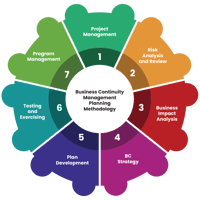](https://cta-redirect.hubspot.com/cta/redirect/3893111/2200ad8c-7d99-4dd5-b92b-249b8d708b20)**Project Management (PM)
- Risk Analysis and Review (RAR)
- Business Impact Analysis (BIA)
- Business Continuity Strategy (BCS)
- Plan Development (PD)
- Testing and Exercising (TE)
- Programme Management (PgM)
##### **Phase 1 — Project Management**
Establish the BCM project, scope, governance, stakeholders, implementation schedule and resources.
##### **Phase 2 — Risk Analysis and Review**
Identify threats that could disrupt ALPS's operations and evaluate existing controls, vulnerabilities, and residual continuity risks.
##### **Phase 3 — Business Impact Analysis**
Identify CBFs and analyse how the consequences of disruption increase over time. Establish recovery priorities and continuity requirements.
##### **Phase 4 — Business Continuity Strategy**
Determine appropriate preventive, mitigation, continuity, and recovery strategies based on the requirements established by the RAR and BIA.
##### **Phase 5 — Plan Development**
Translate strategies into actionable Business Continuity Plans that include escalation, response, continuity, and recovery procedures.
##### **Phase 6 — Testing and Exercising**
Validate BCM arrangements through structured exercises of increasing scope and complexity.
##### **Phase 7 — Programme Management**
Maintain BCM as an ongoing management programme through training, awareness, reviews, exercises, audits, reporting and continual improvement.
Each phase answers a different question.
| **BCM Phase** | **Key Question for SPD** |
| --- | --- |
| Understand Organisation | What does SPD do and what must be protected? |
| Business Impact Analysis | What happens when a critical service is disrupted? |
| Risk Assessment | What threats and vulnerabilities could cause disruption? |
| Business Continuity Strategy | How will priority activities continue or recover? |
| Plan Development | Who does what when disruption occurs? |
| Exercise and Validation | Will the arrangements actually work? |
| Review and Improvement | What should SPD change or strengthen? |
The methodology converts BCM from a collection of individual plans into an integrated management process.
#### **[](https://cta-redirect.hubspot.com/cta/redirect/3893111/a4fa9f02-e184-43b1-8a52-230bf302dd76)Assessing Risks and Threats for SPD**
SPD should identify threats that could disrupt its people, premises, technology, suppliers and service-delivery capabilities.
Potential categories include:
**Denial of Access**
Examples include fire, flooding, building damage, security incidents, or other conditions that prevent employees and clients from accessing an SPD facility.
**Unavailability of People**
Examples include infectious disease outbreaks, simultaneous employee absence, specialist staff shortages or transport disruption affecting workforce availability.
**ICT and Cyber Disruption**
Examples include system outages, ransomware, telecommunications failures, cloud-service disruptions, or loss of access to critical information.
**Equipment Failure**
Specialised rehabilitation, accessibility or assistive equipment may become unavailable.
**Supply-Chain Disruption**
A supplier providing transport, equipment, technology or another essential service may fail.
**Utilities Failure**
Electricity, water, telecommunications or other utilities may be interrupted.
**Transport Disruption**
Clients may be unable to access centre-based services even where the SPD facility itself remains operational.
**Major External Disruption**
Severe weather, haze, infectious disease outbreaks or large-scale transport disruption may affect multiple SPD services simultaneously.
Risk assessment should determine:
**Threat**
↓
**Vulnerability**
↓
**Existing Controls**
↓
**Likelihood**
↓
**Consequence**
↓
**Risk Level**
↓
**Additional Treatment Required**
Risk Assessment and Business Impact Analysis should complement one another.
**Risk Assessment asks:**
##### *What could cause disruption?*
**Business Impact Analysis asks:**
##### *What would happen if the disruption occurred?*
#### **[](https://cta-redirect.hubspot.com/cta/redirect/3893111/fbb42012-8f64-401c-a56c-d84bdcfeee14)Identifying Critical Business Functions**
The final organisational-understanding activity is identifying SPD's Critical Business Functions.
A CBF is a service or function whose disruption could result in unacceptable consequences if it is not resumed within an appropriate timeframe.
Based on SPD's current service environment, the enterprise CBF catalogue developed for this eBook consists of:
| Code | Critical Business Function |
| --- | --- |
| CBF-1 | Early Intervention Services for Children |
| CBF-2 | Day Activity and Disability Support Services |
| CBF-3 | Rehabilitation and Therapy Services |
| CBF-4 | Senior Care and Day Rehabilitation Services |
| CBF-5 | Specialised Case Management and Client Support |
| CBF-6 | Employment and Vocational Support Services |
| CBF-7 | Assistive Technology Assessment and Support |
| CBF-8 | Enabling Services and Community Support |
| CBF-9 | Critical Client Information and Case Records Availability |
| CBF-10 | Critical Digital and ICT Services Supporting Service Delivery |
| CBF-11 | Critical Client Transport and Service Access Support |
SPD should validate these classifications through its formal BIA rather than treating them as predetermined recovery priorities.
This distinction is important.
**Identifying a CBF** establishes that a function warrants continuity analysis.
**The BIA determines how urgently it must be resumed and what resources are needed**.
**Example — Applying BCM to an SPD Service Disruption**
Consider a hypothetical scenario in which an SPD centre providing rehabilitation and therapy services becomes inaccessible for several days.
Without established BCM arrangements, SPD may need to make critical decisions after the disruption occurs.
With BCM arrangements in place, the response becomes structured:
**Centre Becomes Inaccessible**
↓
**Incident Is Assessed and Escalated**
↓
**Affected CBFs Are Identified**
↓
**Clients and Caregivers Are Prioritised**
↓
**Critical Staff and Resources Are Identified**
↓
**Alternative SPD Locations Are Assessed**
↓
**Remote or Alternative Service Options Are Considered**
↓
**Clients and Caregivers Are Informed**
↓
**Priority Services Resume at Minimum Acceptable Levels**
↓
**Capacity Is Progressively Restored**
↓
**Normal Operations Resume**
↓
**Lessons Learned Are Incorporated into the BCMS**
The objective is not necessarily to recreate normal operations immediately.
The initial objective is to restore the **most important services to an acceptable level within the required timeframe**.
#### **Client-Centred Business Continuity**
For SPD, effective BCM should ultimately be client-centred.
Traditional continuity planning can sometimes become overly focused on facilities, systems and administrative processes. These resources are important, but they are means of delivering services.
For SPD, the continuity chain should remain visible:
**Resource**
↓
**Process**
↓
**Critical Business Function**
↓
**Service**
↓
**Client**
↓
**Caregiver / Family / Community**
This perspective changes the questions asked during continuity planning.
Instead of asking only:
*"How quickly must the system be restored?"*
SPD should also ask:
*"Which critical service depends on the system, and what happens to clients if that service cannot be delivered?"*
Instead of asking only:
*"What happens if the building is unavailable?"*
SPD should ask:
*"Which clients depend on services delivered from that building, and how can those services be provided differently?"*
This is the foundation of service-oriented BCM.
#### **Building Resilience into SPD's Future Development**
BCM should also support SPD's future organisational development.
SPD's Vision 2030 roadmap is organised around three key pillars: **Early Intervention, Post-18 Care & Employment, and Community Rehabilitation & Senior Care**, supported by capability building, service innovation, partnerships and organisational excellence.
As SPD expands or changes its services, it should incorporate resilience considerations into new initiatives rather than adding them only after implementation.
For example, when introducing a new centre, programme, technology platform or service model, SPD should consider:
- What happens if this capability becomes unavailable?
- Is there an alternative?
- Are there single points of failure?
- What information must remain accessible?
- Are specialist employees interchangeable?
- What third parties does the service depend upon?
- Can another SPD location provide temporary support?
- What minimum service level must be maintained?
- How will clients and caregivers be contacted during disruption?
This represents a transition from **recovering from disruption** toward **designing services for resilience**.
#### **Overview of eBook 1 — Understanding Your Organisation for SPD**
The rest of this eBook builds on the organisational understanding introduced in this chapter.
The progression is:
**Chapter 1 — Overview of Business Continuity Management for SPD**
Establishes the overall BCM context and implementation journey.
↓
**Chapter 2 — Understanding SPD's Operations**
Examines SPD's organisation, services, stakeholders and operational structure.
↓
**Chapter 3 — Identifying BCM Goals for SPD**
Defines the strategic outcomes expected from BCM.
↓
**Chapter 4 — Establishing BC Objectives for SPD**
Translates BCM goals into actionable, measurable objectives.
↓
**Chapter 5 — Determining BC Assumptions for SPD**
Establishes the planning conditions under which continuity arrangements will be developed.
↓
**Chapter 6 — Developing the BCM Team Composition for SPD**
Defines governance, accountability, responsibilities and BCM participation.
↓
**Chapter 7 — Analysing the Operating Environment for SPD**
Examines internal and external factors influencing continuity.
↓
**Chapter 8 — Implementing the BCM Planning Methodology**
Establishes the structured lifecycle for implementing BCM.
↓
**Chapter 9 — Assessing Risks and Threats for SPD**
Identifies potential causes of service disruption.
↓
**Chapter 10 — Identifying Critical Business Functions for SPD**
Establishes the enterprise CBF catalogue that becomes the basis for detailed BIA and recovery planning.
Together, these chapters answer a fundamental question:
**What must SPD understand about itself before it can effectively prepare for disruption?**
### [![Banner \[Summary\] \[BCM\] \[E1\] \[C2\] Understanding Your Organisation](https://no-cache.hubspot.com/cta/default/3893111/f008eb8e-2d77-4964-abfa-a4ef718b1284.png)](https://cta-redirect.hubspot.com/cta/redirect/3893111/f008eb8e-2d77-4964-abfa-a4ef718b1284)
Business Continuity Management provides SPD with a structured approach for preparing for disruption, maintaining priority services and recovering operations in a controlled manner.
For SPD, the importance of BCM extends beyond organisational recovery. Its services support persons with disabilities across different life stages and circumstances, including children and youth requiring early intervention, adults seeking employment and independence, and seniors requiring rehabilitation and day-care support.
An effective BCMS must therefore link organisational resilience directly to continuity of support for **clients and caregivers**.
The foundation begins with understanding SPD itself: its operations, organisational goals, continuity objectives, planning assumptions, BCM governance, operating environment, planning methodology, risks and Critical Business Functions.
The overall journey established by this eBook can be summarised as:
**Understand the Organisation**
↓
**Understand the People and Services That Depend on It**
↓
**Identify What Is Critical**
↓
**Understand What Could Disrupt It**
↓
**Determine What Must Continue and Recover**
↓
**Develop Appropriate Continuity Arrangements**
↓
**Exercise and Validate the Arrangements**
↓
**Learn and Continually Improve**
This establishes the foundation for **Resilient Support: Implementing Business Continuity Management at SPD**.
For SPD, business continuity should ultimately enable the organisation to continue fulfilling its purpose even when normal operations are disrupted: maintaining essential support, protecting service delivery and enabling persons with disabilities to remain connected to the services and communities upon which they depend.
[](https://cta-redirect.hubspot.com/cta/redirect/3893111/959a4367-6193-4326-848e-799bd16b0bb3)
| **eBook 1: Understanding Your Organisation** | | | | | |
| --- | --- | --- | --- | --- | --- |
| **C1** | **C2 \[x\]** | **C3 \[x\]** | **C4 \[x\]** | **C5 \[x\]** | **C6 \[x\]** |
| [![\[BCM\] \[SPD\] \[E1\] \[C1\] Overview of BCM Case Study](https://no-cache.hubspot.com/cta/default/3893111/bd889448-2c9a-419a-ae34-7b72c5e2b55d.png)](https://cta-redirect.hubspot.com/cta/redirect/3893111/bd889448-2c9a-419a-ae34-7b72c5e2b55d) | [![\[BCM\] \[SPD\] \[E1\] \[C2\] Understanding Your Organisation](https://no-cache.hubspot.com/cta/default/3893111/198862e5-08fa-4bbc-8e87-1de4a2efe9ee.png)](https://cta-redirect.hubspot.com/cta/redirect/3893111/198862e5-08fa-4bbc-8e87-1de4a2efe9ee) | [![\[BCM\] \[SPD\] \[E1\] \[C3\] Establishing Organisational Goals](https://no-cache.hubspot.com/cta/default/3893111/997be1d2-3789-4091-a452-23240f8ca386.png)](https://cta-redirect.hubspot.com/cta/redirect/3893111/997be1d2-3789-4091-a452-23240f8ca386) | [![\[BCM\] \[SPD\] \[E1\] \[C4\] Establishing Business Continuity Objectives](https://no-cache.hubspot.com/cta/default/3893111/806c9414-c396-4036-95c0-f61e7e6ca3ad.png)](https://cta-redirect.hubspot.com/cta/redirect/3893111/806c9414-c396-4036-95c0-f61e7e6ca3ad) | [![\[BCM\] \[SPD\] \[E1\] \[C5\] Determining BC Assumptions](https://no-cache.hubspot.com/cta/default/3893111/2bc112e0-6e6d-43d6-a63f-822b319d18f9.png)](https://cta-redirect.hubspot.com/cta/redirect/3893111/2bc112e0-6e6d-43d6-a63f-822b319d18f9) | [![\[BCM\] \[SPD\] \[E1\] \[C6\] Composing BCM Team](https://no-cache.hubspot.com/cta/default/3893111/e988c6a4-f97c-40ca-9ee5-f5bf6e8e1745.png)](https://cta-redirect.hubspot.com/cta/redirect/3893111/e988c6a4-f97c-40ca-9ee5-f5bf6e8e1745) |
| **C7 \[x\]** | **C8 \[x\]** | **C9 \[x\]** | **C10** | **C11 \[x\]** | **C12 \[x\]** |
| [![\[BCM\] \[SPD\] \[E1\] \[C7\] Analysing Operating Environment](https://no-cache.hubspot.com/cta/default/3893111/2b411a34-5647-443c-8fdf-aa6a13a8d800.png)](https://cta-redirect.hubspot.com/cta/redirect/3893111/2b411a34-5647-443c-8fdf-aa6a13a8d800) | [![\[BCM\] \[SPD\] \[E1\] \[C8\] Implementing the BCM Planning Methodology](https://no-cache.hubspot.com/cta/default/3893111/ac74986c-6d34-4524-ac0a-14ace082acc1.png)](https://cta-redirect.hubspot.com/cta/redirect/3893111/ac74986c-6d34-4524-ac0a-14ace082acc1) | [![\[BCM\] \[SPD\] \[E1\] \[C9\] Assessing Risks and Threats](https://no-cache.hubspot.com/cta/default/3893111/6e8bf302-3e6b-404e-bf70-f4f2a35887a3.png)](https://cta-redirect.hubspot.com/cta/redirect/3893111/6e8bf302-3e6b-404e-bf70-f4f2a35887a3) | [![\[BCM\] \[SPD\] \[E1\] \[C10\] Identifying Critical Business Functions](https://no-cache.hubspot.com/cta/default/3893111/517a70ee-037f-4d7f-bb19-e266515ad218.png)](https://cta-redirect.hubspot.com/cta/redirect/3893111/517a70ee-037f-4d7f-bb19-e266515ad218) | [![\[BCM\] \[SPD\] \[E1\] \[C11\] Summary](https://no-cache.hubspot.com/cta/default/3893111/c99f00e2-d5ed-4d75-b086-797efd27240f.png)](https://cta-redirect.hubspot.com/cta/redirect/3893111/c99f00e2-d5ed-4d75-b086-797efd27240f) | [![\[BCM\] \[SPD\] \[E1\] \[C12\] Back Cover](https://no-cache.hubspot.com/cta/default/3893111/97ae9e51-e13e-498f-88a2-f54ac9c5c9e8.png)](https://cta-redirect.hubspot.com/cta/redirect/3893111/97ae9e51-e13e-498f-88a2-f54ac9c5c9e8) |
| | | | | | |
#### More Information About Business Continuity Management Courses
To learn more about the course and schedule, click the buttons below for BCM-300 Business Continuity Management Implementer \[BCM-3\] and BCM-5000 Business Continuity Management Expert Implementer \[BCM-5\].
| [](https://cta-redirect.hubspot.com/cta/redirect/3893111/f3922b80-e96a-46d6-8993-dc150a5de2d5) | [](https://cta-redirect.hubspot.com/cta/redirect/3893111/9ff8a3dc-e39a-465b-929f-72e232cdd5fb) | [![Register \[BL-B-3\]\*](https://no-cache.hubspot.com/cta/default/3893111/ac6cf073-4cdd-4541-91ed-889f731d5076.png)](https://cta-redirect.hubspot.com/cta/redirect/3893111/ac6cf073-4cdd-4541-91ed-889f731d5076) |
| --- | --- | --- |
| [](https://cta-redirect.hubspot.com/cta/redirect/3893111/21525c10-4003-4934-95fc-fe218174bc5b) | [](https://cta-redirect.hubspot.com/cta/redirect/3893111/46460171-c91a-4936-9bb2-8dc5928a0e02) | [](https://cta-redirect.hubspot.com/cta/redirect/3893111/1cb17ac7-50b2-4f88-bc4b-c7444e4b57b5) |
| [![FAQ \[BL-B-3\]](https://no-cache.hubspot.com/cta/default/3893111/b3824ba1-7aa1-4eb6-bef8-94f57121c5ae.png)](https://cta-redirect.hubspot.com/cta/redirect/3893111/b3824ba1-7aa1-4eb6-bef8-94f57121c5ae) | Please feel free to send us a note if you have any questions. [![Email to Sales Team \[BCM Institute\]](https://no-cache.hubspot.com/cta/default/3893111/3c53daeb-2836-4843-b0e0-645baee2ab9e.png)](https://cta-redirect.hubspot.com/cta/redirect/3893111/3c53daeb-2836-4843-b0e0-645baee2ab9e) | [](https://cta-redirect.hubspot.com/cta/redirect/3893111/9c199ae8-c470-4bb7-9612-73c7a084e94c) |
| [](https://cta-redirect.hubspot.com/cta/redirect/3893111/8999211a-2c51-4be7-bf49-c393f6c67974) | [](https://cta-redirect.hubspot.com/cta/redirect/3893111/5c1aa95d-f6dd-4067-a95c-5cc0c32d7ed8) | [](https://cta-redirect.hubspot.com/cta/redirect/3893111/086ab3b9-4d66-4a95-b2f7-1148e9803a9c) |
### Your Comments Here :
### More Posts
[](https://cta-redirect.hubspot.com/cta/redirect/3893111/839787f4-a4fd-456f-accf-54c947026558)

All rights reserved. Copyright 2026
```json
{
"@context" : "https://schema.org",
"@type" : "BlogPosting",
"author" : {
"@type" : "Person",
"name" : "Moh Heng Goh",
"url" : "https://blog.bcm-institute.org/ebook/author/moh-heng-goh"
},
"dateModified" : "2026-09-22T07:22:09.665Z",
"datePublished" : "2026-09-17T07:37:47.000Z",
"headline" : "[BCM] [SPD] [E1] [C1] Overview of BCM Case Study",
"mainEntityOfPage" : {
"@id" : "https://blog.bcm-institute.org/ebook/bcm-spd-e1-c1-overview-of-bcm-case-study",
"@type" : "WebPage"
},
"publisher" : {
"@type" : "Organization",
"logo" : {
"@type" : "ImageObject",
"url" : "https://blog.bcm-institute.org/hubfs/BCMI%20Logo.png"
},
"name" : "BCMI Pte Ltd"
}
}
```