---
title: [BCM] [MSF] [E2] [C1] Business Continuity Management Planning Methodology
description: [BCM] [MSF] [E2] [C1] Business Continuity Management Planning Methodology
image: https://blog.bcm-institute.org/hubfs/Generic%20Morepost%20for%20Companies/Updated%20Generic%20BCM%20eBook%20Morepost/BCM%20GEN%20E2/%5BBCM%5D%20%5BGEN%5D%20%5BE2%5D%20%5BC1%5D%20Business%20Continuity%20Management%20Planning%20Methodology.png
---
.
[](http://www.bcm-institute.org/)
- [Home](https://www.bcm-institute.org/)
- [About Us](https://www.bcm-institute.org/about-us-3/)
- [A President’s Perspective](https://www.bcm-institute.org/about-us/a-presidents-perspective/)
- [Our History](https://www.bcm-institute.org/about-us/our-history/)
- [Our Advisory Council](https://www.bcm-institute.org/about-us/our-advisory-council/)
- [Customers’ Testimonials](https://www.bcm-institute.org/about-us/customers-testimonials/)
- [Credential Verification](https://www.bcm-institute.org/about-us/credential-verification/)
- [Courses](https://blog.bcm-institute.org/blog/course-fees-for-blended-learning-courses-master-catalog)
- [ISO 22301 Business Continuity Management System Audit](https://blog.bcm-institute.org/audit/business-continuity-management-audit-courses)
- [ISO 22301 Business Continuity Management](https://blog.bcm-institute.org/bcm/business-continuity-management-courses)
- [Crisis Communication](https://blog.bcm-institute.org/crisis-communication/crisis-communication-courses)
- [Crisis Management](https://blog.bcm-institute.org/en/crisis-management/courses)
- [IT Disaster Recovery](https://blog.bcm-institute.org/it-disaster-recovery/courses)
- [Operational Resilience](https://blog.bcm-institute.org/operational-resilience/courses)
- [Operational Resilience Audit](https://blog.bcm-institute.org/operational-resilience-audit/courses)
- [Certification](https://blog.bcm-institute.org/certification/types-of-certifications-offered)
- [ISO 22301 BCMS Audit Certification](https://blog.bcm-institute.org/certification/business-continuity-management-audit-certification)
- [ISO22301 Business Continuity Management Certification](https://blog.bcm-institute.org/bcm/business-continuity-management-certification)
- [Crisis Communication Certification](https://blog.bcm-institute.org/crisis-communication/crisis-communication-certification)
- [Crisis Management Certification](https://blog.bcm-institute.org/en/crisis-management/crisis-management-certification)
- [IT Disaster Recovery Planning Certification](https://blog.bcm-institute.org/it-disaster-recovery/it-disaster-recovery-certification)
- [Operational Resilience Certification](https://blog.bcm-institute.org/operational-resilience/operational-resilience-certification)
- [Operational Resilience Audit Certification](https://blog.bcm-institute.org/operational-resilience-audit)
- [Seminars](https://blog.bcm-institute.org/meet-the-expert/mte-webinar-mainpage)
- [Store](https://www.bcm-institute.org/store-2/)
- [Contact Us](http://www.bcm-institute.org/about-us/contact-us/)
-
-
##### Implementing Business Continuity Management for the Ministry of Social and Family Development (MSF): Practical Guides to Organisational Resilience, Essential Service Continuity and Community Support

# \[BCM\] \[MSF\] \[E2\] \[C1\] Business Continuity Management Planning Methodology
[](https://cta-redirect.hubspot.com/cta/redirect/3893111/7bad9e96-bd43-4e89-ada5-bb0793c72e97)
A successful Business Continuity Management (BCM) programme requires a structured, repeatable methodology that guides the organisation through planning, implementation, validation, maintenance, and continual improvement.[![eBook Cover \[BCM\] \[MSF\] \[E2\] \[2D\]](https://no-cache.hubspot.com/cta/default/3893111/d020550a-f6fc-4870-a77c-97836c002d89.png)](https://cta-redirect.hubspot.com/cta/redirect/3893111/d020550a-f6fc-4870-a77c-97836c002d89)
ISO 22301 advocates a lifecycle approach that ensures BCM activities are systematic, risk-based, and aligned with organisational objectives.
Any disruption affecting these responsibilities could have significant regulatory, legal, operational, and reputational consequences.
[](https://cta-redirect.hubspot.com/cta/redirect/3893111/68f13ffe-b808-44ec-9a28-7304d89f5889)
[Dr Goh Moh Heng](https://blog.bcm-institute.org/ebook/author/dr-goh-moh-heng) Sep 1, 2026
###### Business Continuity Management Certified Planner-Specialist-Expert
[](https://cta-redirect.hubspot.com/cta/redirect/3893111/7291c8d7-49c8-43fe-b3db-1dfc86bad7c2)
### eBook 2: Chapter 1
### [](https://cta-redirect.hubspot.com/cta/redirect/3893111/68f13ffe-b808-44ec-9a28-7304d89f5889)
### Business Continuity Management Planning Methodology for the Ministry of Social and Family Development
#### Introduction
[![eBook Cover \[BCM\] \[MSF\] \[E2\] \[2D\]](https://no-cache.hubspot.com/cta/default/3893111/d020550a-f6fc-4870-a77c-97836c002d89.png)](https://cta-redirect.hubspot.com/cta/redirect/3893111/d020550a-f6fc-4870-a77c-97836c002d89)Business Continuity Management (BCM) provides a structured[![\[BCM\] \[MSF\] \[E2\] \[C1\] Business Continuity Management Planning Methodology](https://no-cache.hubspot.com/cta/default/3893111/2380788c-cd81-469f-b649-fbf2231edc0a.png)](https://cta-redirect.hubspot.com/cta/redirect/3893111/2380788c-cd81-469f-b649-fbf2231edc0a) approach to ensuring that an organisation can continue to deliver its priority products and services when normal operations are disrupted.
ISO 22301 establishes the international requirements for implementing, maintaining, and continually improving a Business Continuity Management System (BCMS), including the capability to continue delivering products and services at an acceptable, predefined capacity during a disruption.
For the Ministry of Social and Family Development (MSF), business continuity is particularly significant because disruption may directly affect individuals, families, and vulnerable groups who depend on social assistance, protection, intervention, care, and family-related services.
MSF's mission is to nurture resilient individuals, strong families, and a caring society, while its responsibilities include financial and social assistance, family support, protection from violence, disability services, and strengthening Singapore's social service sector.
The importance of continuity within this environment has already been demonstrated during major disruptions. During the COVID-19 period, MSF identified services for serious, high-risk, and urgent cases to continue operating and worked with funded Social Service Agencies (SSAs) and charities to maintain critical support for vulnerable groups.
Consequently, BCM for MSF should not be viewed solely as the recovery of internal administrative operations. It should be designed around the continuity of essential social and family services and the protection of vulnerable persons during disruption.
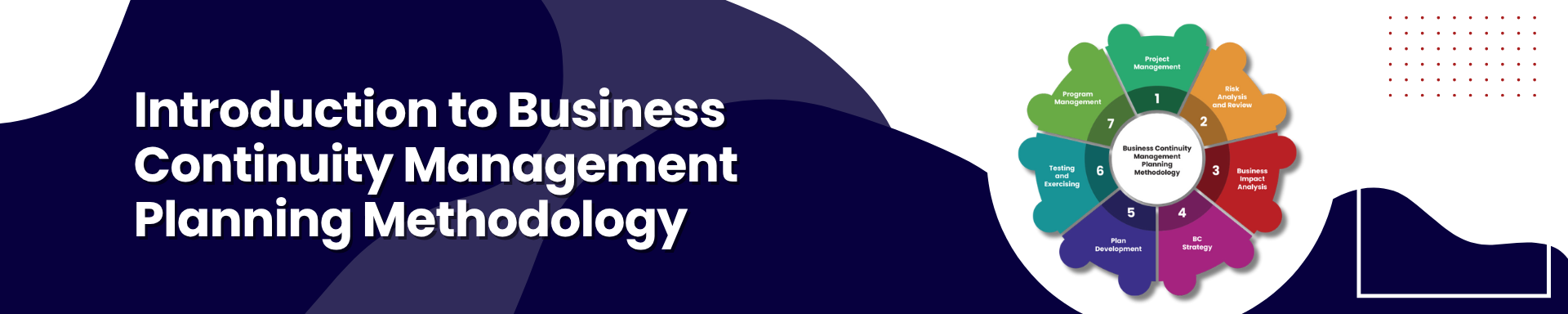
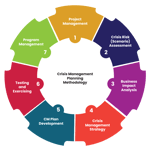
This chapter introduces a seven-phase **BCM Planning Methodology** for MSF:
1. [](https://cta-redirect.hubspot.com/cta/redirect/3893111/1a8e2a34-95f1-46f9-9ee1-abdd9d608470)Project Management (PM)
2. Risk Analysis and Review (RAR)
3. Business Impact Analysis (BIA)
4. Business Continuity Strategy (BCS)
5. Plan Development (PD)
6. Testing and Exercising (TE)
7. Program Management (PgM)
Together, these seven phases provide MSF with a systematic pathway from establishing its BCM programme through understanding risks and service priorities, developing recovery capabilities, documenting response arrangements, validating those arrangements and continually maintaining the effectiveness of the BCMS.
### The Seven-Phase BCM Planning MethodologyBCM Planning Methodology for MSF
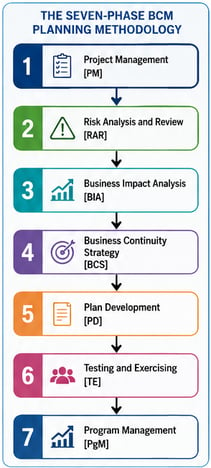The methodology translates the requirements and principles of ISO 22301 into an implementation sequence suitable for MSF's operating environment.
It recognises that MSF operates within an interconnected social-service ecosystem involving government agencies, Social Service Offices, Social Service Agencies, community partners, service providers, technology platforms, facilities and other stakeholders.
MSF's current policy approach also emphasises whole-of-society partnerships alongside family-centric, proactive and strengths-based intervention.
The seven phases should therefore not operate in isolation. Information generated in one phase should inform subsequent phases, while findings from incidents, exercises, audits and reviews should feed back into earlier phases to strengthen the overall BCM capability.
| **Phase** | **Primary Purpose** | **Key Question for MSF** |
| --- | --- | --- |
| **1. Project Management \[PM\]** | **Establish and organise the BCM implementation initiative** | **How will MSF establish, govern and implement BCM?** |
| **2. Risk Analysis and Review \[RAR\]** | **Identify and assess disruption risks** | **What could disrupt MSF's operations and essential services?** |
| **3. Business Impact Analysis \[BIA\]** | **Determine criticality and recovery requirements** | **Which services must be prioritised, and how quickly must they be restored?** |
| **4. Business Continuity Strategy \[BCS\]** | **Determine appropriate continuity and recovery solutions** | **How will MSF continue or recover priority services?** |
| **5. Plan Development \[PD\]** | **Document actionable response and recovery arrangements** | **What must MSF personnel and partners do when disruption occurs?** |
| **6. Testing and Exercising \[TE\]** | **Validate plans, capabilities and assumptions** | **Will MSF's arrangements work under realistic disruptive conditions?** |
| **7. Program Management \[PgM\]** | **Sustain, review and continually improve BCM** | **How will MSF keep its BCM capability current and effective?** |
#### **[](https://cta-redirect.hubspot.com/cta/redirect/3893111/6a36f258-76ba-49d2-9dae-bbb8dc227461)Phase 1: Project Management (PM)**
##### **Purpose**
Project Management lays the foundation for implementing or enhancing MSF's BCMS.
Before detailed risk assessments, BIAs or continuity plans are developed, MSF should define the BCM initiative's objectives, scope, governance, responsibilities, resources, milestones and expected deliverables.
For MSF, BCM implementation should involve more than a central corporate function. Participation should extend to business and service owners responsible for priority services, technology and facilities functions, communications, human resources, security, procurement and relevant external service partners.
##### MSF-Specific Requirement
MSF should establish a BCM governance and implementation structure with clearly defined accountability for ministry-wide BCM and ownership of continuity arrangements at the service or business-function level.
The scope should specifically consider functions that support vulnerable individuals and families, for whom prolonged disruption could result in significant welfare, safety, financial, or societal consequences.
##### Key Activities
MSF should:
• establish the scope and objectives of the BCMS;
• obtain senior management sponsorship;
• appoint BCM programme leadership;
• identify BCM coordinators and business/service owners;
• establish roles and responsibilities;
• identify internal and external stakeholders;
• determine BCM policies and governance requirements;
• establish implementation milestones;
• allocate resources; and
• establish reporting and escalation mechanisms.
##### Key Deliverables
The principal outputs include:
BCM Policy → BCM Governance Structure → BCM Project Plan → Roles and Responsibilities → Implementation Schedule
These outputs establish the management foundation for the remaining six phases.
[](https://cta-redirect.hubspot.com/cta/redirect/3893111/c2dfdab1-7ab0-4a8b-bd31-7876fd39633e)
#### **Phase 2: Risk Analysis and Review (RAR)**
##### **Purpose**
Risk Analysis and Review identifies disruption threats and vulnerabilities that could affect MSF's ability to deliver its services.
The objective is not to predict every possible incident. Instead, MSF should understand credible sources of disruption and determine whether preventive, mitigating or continuity measures are necessary.
##### MSF-Specific Requirement
Risk analysis should consider disruptions affecting both MSF-controlled resources and the wider service-delivery ecosystem.
Examples include:
• prolonged ICT or telecommunications outages;
• cyber incidents;
• loss of access to MSF premises;
• disruption to critical digital services;
• workforce shortages;
• pandemic or infectious-disease events;
• utility failures;
• failure of key vendors or service providers;
• disruption affecting Social Service Agencies or community partners;
• major transport disruption;
• data or information availability failures; and
• concurrent or cascading disruptions affecting several services.
Particular attention should be given to risks that could disrupt services supporting vulnerable individuals or urgent protection cases.
##### Key Activities
MSF should:
1. identify disruption threats;
2. identify vulnerable resources and dependencies;
3. assess likelihood and potential consequences;
4. review existing preventive and mitigating controls;
5. determine residual exposure;
6. identify unacceptable vulnerabilities; and
7. recommend risk treatment or continuity measures.
##### Key Deliverables
Risk Register → Threat Assessment → Vulnerability Assessment → Existing Controls → Residual Risk → Recommended Treatment
RAR provides the risk context for subsequent continuity planning.
[](https://cta-redirect.hubspot.com/cta/redirect/3893111/a1b4b4e2-f0aa-44df-a197-431397a7927c)
#### **Phase 3: Business Impact Analysis (BIA)**
##### **Purpose**
The Business Impact Analysis determines **what matters most during a disruption**.
While RAR examines what could cause disruption, the BIA examines what happens when an activity, service or supporting resource becomes unavailable.
The BIA enables MSF to establish recovery priorities and requirements based upon the consequences of disruption over time.
##### **MSF-Specific Requirement**
MSF's BIA should assess impacts from a **public-service and beneficiary perspective**, rather than relying solely on conventional financial or operational measures.
Impact criteria should therefore consider:
- safety and welfare of vulnerable persons;
- inability to provide urgent social assistance;
- interruption of protection and intervention services;
- impact on individuals and families dependent upon MSF services;
- statutory or governmental obligations;
- reputational and public-confidence consequences;
- operational impact;
- financial impact;
- dependency impacts across the social-service ecosystem; and
- consequences to partner organisations and other government services.
MSF has previously maintained services for serious, high-risk and urgent cases and has continued to provide support through residential homes, selected community-based centres, SSAs and charities during significant disruption.
This demonstrates why service criticality should be considered across the broader delivery ecosystem rather than only within MSF's internal operations.
##### **Key Activities**
The BIA should identify:
##### **Business Function → Service → Activities → Dependencies → Impact of Disruption → Maximum Tolerable Period of Disruption → Recovery Time Objective → Minimum Business Continuity Objective → Resource Requirements**
The analysis should enable MSF to differentiate between services requiring immediate or rapid continuity and those that may tolerate temporary reduction, deferment or suspension.
##### **Key Deliverables**
The BIA should produce:
- prioritised business functions and services;
- impact assessment;
- recovery priorities;
- recovery time objectives;
- minimum service requirements;
- dependency requirements; and
- minimum resources required for continuity and recovery.
[](https://cta-redirect.hubspot.com/cta/redirect/3893111/fac23b58-f744-480a-b86b-13a824a53308)
#### **Phase 4: Business Continuity Strategy (BCS)**
##### **Purpose**
The Business Continuity Strategy determines how MSF will maintain or restore **priority services in accordance with the recovery requirements established by the BIA**.
The strategy phase converts analytical requirements into practical continuity capabilities.
##### **MSF-Specific Requirement**
Continuity strategies should reflect the fact that some MSF services may need to continue even when normal service-delivery channels are unavailable.
Strategies should therefore consider multiple delivery arrangements rather than relying upon a single recovery solution.
For example:
**Normal Service Delivery**
↓ disruption
**Alternative Digital Channel**
or
**Alternative Location**
or
**Remote Workforce**
or
**Partner-Assisted Delivery**
or
**Manual / Temporary Procedure**
or
**Prioritised Essential-Service Model**
The selected strategy should be proportionate to the criticality and recovery requirements of the relevant service.
##### **Strategy Categories**
MSF should consider strategies covering:
- people;
- premises;
- technology;
- information and data;
- telecommunications;
- suppliers;
- Social Service Agencies and community partners;
- alternative service-delivery channels;
- transportation and logistics; and
- specialist skills and resources.
##### **Key Deliverables**
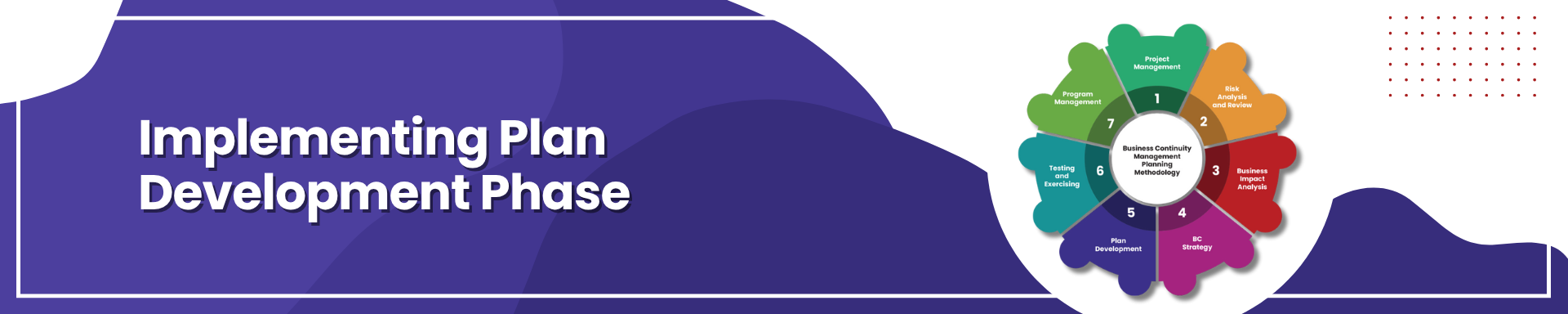
**Recovery Requirement → Strategy Options → Feasibility Assessment → Strategy Selection → Resource Requirement → Implementation**
[](https://cta-redirect.hubspot.com/cta/redirect/3893111/8be70e4c-1b23-4b38-bf36-5bd899b28e17)
#### **Phase 5: Plan Development (PD)**
##### **Purpose**
Plan Development converts the selected continuity strategies into documented procedures that can be activated during an actual disruption.
ISO 22301 emphasises usable continuity arrangements that support an organisation's response to and recovery from disruption.
For MSF, plans should be concise, actionable and sufficiently flexible to accommodate disruptions that do not unfold exactly as anticipated.
##### **MSF-Specific Requirement**
MSF's plans should distinguish between:
**Incident Response**
↓
**Service Continuity**
↓
**Service Recovery**
↓
**Return to Normal Operations**
Where continuity depends upon external organisations, the plan should clearly identify coordination, communication and escalation arrangements.
##### **Plan Content**
Plans should address:
- activation criteria;
- authority to activate;
- command and control;
- notification and escalation;
- roles and responsibilities;
- immediate response actions;
- service prioritisation;
- alternative operating procedures;
- resource requirements;
- stakeholder communication;
- coordination with service partners;
- recovery procedures;
- stand-down criteria; and
- return-to-normal procedures.
##### **Key Deliverables**
MSF may require a hierarchy of plans such as:
**Ministry-Level BCM Arrangements**
↓
**Business/Service Continuity Plans**
↓
**Technology and Resource Recovery Plans**
↓
**Supporting Procedures, Checklists and Contact Lists**
[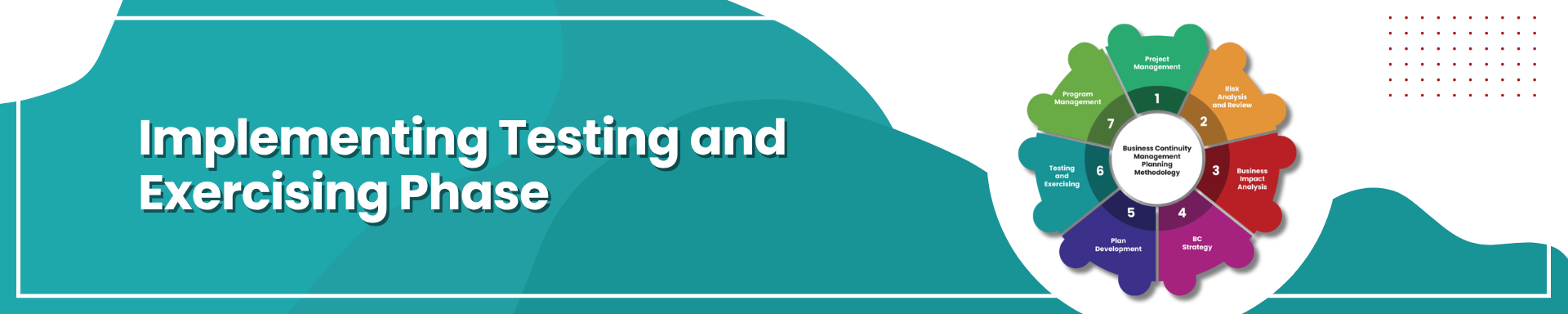](https://cta-redirect.hubspot.com/cta/redirect/3893111/05ab08af-9acb-430c-8a4d-030a6a0e0fe2)
#### **Phase 6: Testing and Exercising (TE)**
##### **Purpose**
A documented plan does not by itself demonstrate continuity capability.
Testing and exercising provide MSF with evidence that its people, procedures, technology, facilities, suppliers and service partners can perform as expected during disruption.
Structured exercises are an important mechanism for validating BCM arrangements and identifying weaknesses before an actual incident occurs.
##### **MSF-Specific Requirement**
MSF's exercise programme should test **end-to-end service continuity**, particularly where service delivery depends upon multiple internal and external parties.
Exercise scenarios could include:
- major cyberattack;
- prolonged outage of a critical government system;
- loss of a major MSF facility;
- telecommunications outage;
- significant workforce unavailability;
- pandemic or public-health disruption;
- failure of a critical service provider;
- simultaneous disruption affecting MSF and key SSAs; or
- sudden increase in demand for urgent social assistance.
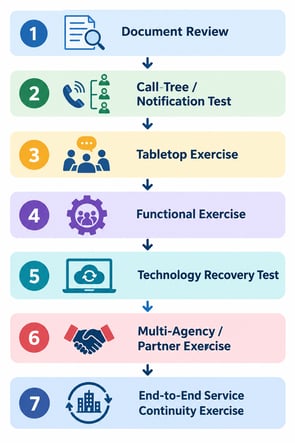
##### **Progressive Exercise Programme**
Testing should progressively increase in complexity:
##### **Key Deliverables**
Each exercise should generate:
##### **Scenario → Objectives → Participants → Exercise Results → Gaps → Lessons Learned → Corrective Actions → Owners → Completion Dates → Retest**
Testing therefore becomes a mechanism for continuous improvement rather than merely a compliance activity.
[](https://cta-redirect.hubspot.com/cta/redirect/3893111/2c2fa354-3d59-4e3e-ab4c-d1e1d1ac521c)
#### **Phase 7: Programme Management (PgM)**
##### **Purpose**
Programme Management ensures that BCM remains a **living organisational capability** after the initial implementation project has been completed.
ISO 22301 requires organisations to monitor, review, maintain and continually improve their BCMS. ([ISO](https://www.iso.org/standard/75106.html?utm_source=chatgpt.com))
MSF's operating environment, service-delivery models, technologies, partners, policies and community needs will continue to evolve. Continuity arrangements must evolve with them.
##### **MSF-Specific Requirement**
MSF should establish an ongoing BCM maintenance cycle linking operational changes to BCM reviews.
Significant changes to services, technology, facilities, organisational structures, suppliers, or external service-delivery partners should prompt consideration of whether existing risk assessments, BIAs, strategies, and continuity plans remain valid.
##### **Program Management Activities**
MSF should establish arrangements for:
- BCM governance and oversight;
- scheduled BIA reviews;
- risk assessment reviews;
- plan maintenance;
- training and awareness;
- exercise scheduling;
- competency development;
- incident and exercise lessons learned;
- internal review and audit;
- management review;
- performance monitoring;
- corrective actions; and
- continual improvement.
##### **Continual Improvement Cycle**
**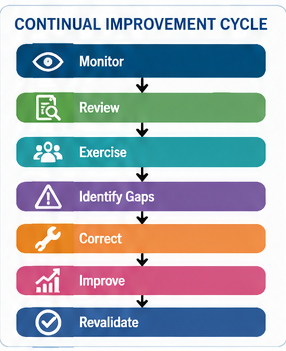**
This cycle ensures that MSF's BCM capability develops alongside changes in its operating environment.
#### **Integration Across the Seven Phases**
Although presented sequentially, the seven phases operate as an integrated BCM lifecycle.
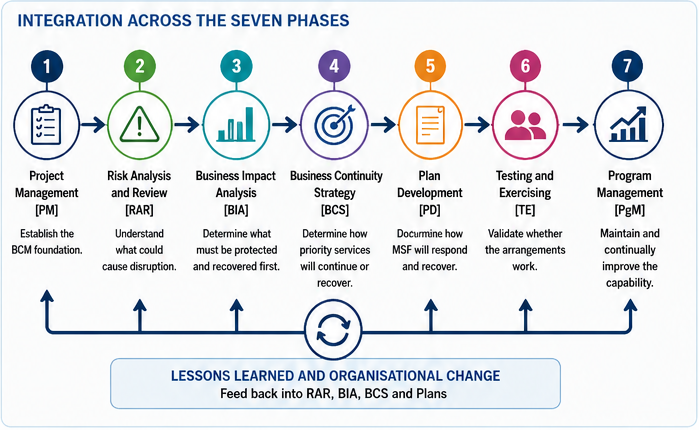
This feedback mechanism is fundamental. BCM should not become a collection of static plans. It should operate as an adaptive management capability.
#### **MSF-Specific BCM Requirement**
The central requirement proposed for MSF is:
##### **MSF shall establish, implement, maintain and continually improve a Business Continuity Management System that prioritises the continued delivery and timely recovery of essential social and family services, particularly services where disruption could adversely affect the safety, welfare or immediate needs of vulnerable individuals and families.**
To fulfil this requirement, MSF should ensure that:
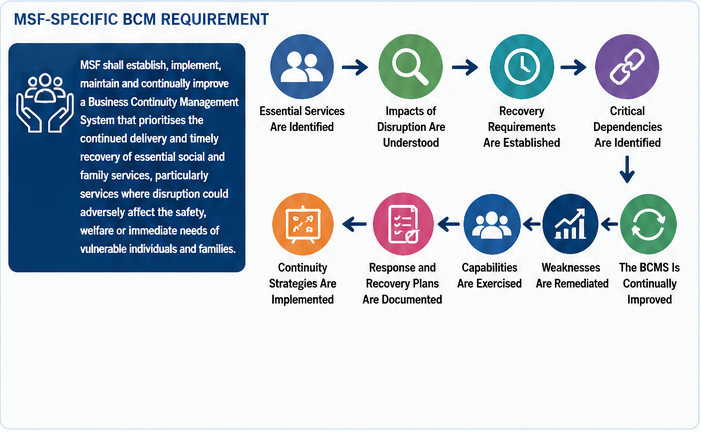
This requirement reflects the distinctive nature of MSF's public-service responsibilities.
The objective is not simply to recover organisational processes; it is to preserve MSF's ability to support individuals and families in Singapore when disruptive circumstances may make those services even more important.
#### **Relationship with ISO 22301**
The seven-phase methodology provides a practical implementation structure through which MSF can operationalise relevant ISO 22301 requirements.
| BCM Planning Phase | ISO 22301 Alignment |
| --- | --- |
| Project Management | Context, leadership, planning and support |
| Risk Analysis and Review | Risk assessment and operational planning |
| Business Impact Analysis | Business impact analysis |
| Business Continuity Strategy | Business continuity strategies and solutions |
| Plan Development | Business continuity plans and procedures |
| Testing and Exercising | Exercise programme and evaluation |
| Program Management | Performance evaluation, management review and improvement |
The methodology should not be interpreted as a replacement for ISO 22301. Rather, it provides MSF with a practical implementation framework through which the requirements of the BCMS can be translated into coordinated activities,
### [![x \[Banner\] \[Summing\] \[OR\] \[E2\] \[C1\] Overview of Operational Resilience Planning Methodology](https://no-cache.hubspot.com/cta/default/3893111/0c551e82-cf06-432c-8498-1d3c9bb2dece.png)](https://cta-redirect.hubspot.com/cta/redirect/3893111/0c551e82-cf06-432c-8498-1d3c9bb2dece)
For the Ministry of Social and Family Development, Business Continuity Management is fundamentally about **maintaining the ability to support people when normal operating conditions have been disrupted**.
This responsibility becomes particularly important where services involve vulnerable individuals and families, urgent social assistance, protection and intervention, disability support, residential care or other forms of essential social support.
MSF's service landscape also depends upon partnerships across government, Social Service Agencies and the wider community, making continuity an ecosystem-wide consideration rather than solely an internal organisational matter.
The seven-phase BCM Planning Methodology provides the structure for building this capability:
- **PM establishes the programme.**
- **RAR identifies the risks.**
- **BIA determines what matters and how quickly it must recover.**
- **BCS establishes how continuity will be achieved.**
- **PD converts strategies into actionable plans.**
- **TE demonstrates whether those arrangements work.**
- **PgM ensures that the capability remains current and continues to improve.**
Together, these phases establish a continuous cycle:
##### **Understand → Prioritise → Prepare → Respond → Recover → Validate → Improve**
When effectively implemented, the methodology enables MSF to move beyond business continuity documents to establish a sustainable **business continuity capability**.
The ultimate measure of that capability is not whether plans exist, but whether MSF can continue to deliver its most important social and family services at an acceptable level during disruptive events.
In this context, effective BCM directly supports MSF's broader mission of nurturing **resilient individuals, strong families and a caring society**.
[](https://cta-redirect.hubspot.com/cta/redirect/3893111/3aefb2d2-3110-47c1-ad4f-d3e6e5381066)
[![\[BCM\] \[GEN 3\] \[3/4 Banner\] Implementing Business Continuity Management](https://no-cache.hubspot.com/cta/default/3893111/19e85049-546e-4764-881b-f651277b16aa.png)](https://cta-redirect.hubspot.com/cta/redirect/3893111/19e85049-546e-4764-881b-f651277b16aa)
| **eBook 2: Implementing Business Continuity Management** | | | | |
| --- | --- | --- | --- | --- |
| **C1** | **C2** | **C3** | **C4** | **C5** |
| [![\[BCM\] \[MSF\] \[E2\] \[C1\] Business Continuity Management Planning Methodology](https://no-cache.hubspot.com/cta/default/3893111/2380788c-cd81-469f-b649-fbf2231edc0a.png)](https://cta-redirect.hubspot.com/cta/redirect/3893111/2380788c-cd81-469f-b649-fbf2231edc0a) | [![\[BCM\] \[MSF\] \[E2\] \[C2\] Project Management](https://no-cache.hubspot.com/cta/default/3893111/1246e9ef-524d-4040-b22e-1067733de520.png)](https://cta-redirect.hubspot.com/cta/redirect/3893111/1246e9ef-524d-4040-b22e-1067733de520) | [![\[BCM\] \[MSF\] \[E2\] \[C3\] Risk Analysis and Review](https://no-cache.hubspot.com/cta/default/3893111/666b424f-044e-47bc-9dcd-dca248550462.png)](https://cta-redirect.hubspot.com/cta/redirect/3893111/666b424f-044e-47bc-9dcd-dca248550462) | [![\[BCM\] \[MSF\] \[E2\] \[C4\] Business Impact Analysis](https://no-cache.hubspot.com/cta/default/3893111/402b5ca1-7e29-4996-8878-c4397e35c7d1.png)](https://cta-redirect.hubspot.com/cta/redirect/3893111/402b5ca1-7e29-4996-8878-c4397e35c7d1) | [![\[BCM\] \[MSF\] \[E2\] \[C5\] Business Continuity Strategy](https://no-cache.hubspot.com/cta/default/3893111/e6928dda-aec6-43fe-868b-e6e0e6e0e121.png)](https://cta-redirect.hubspot.com/cta/redirect/3893111/e6928dda-aec6-43fe-868b-e6e0e6e0e121) |
| **C6** | **C7** | **C8** | **C9** | **C10** |
| [![\[BCM\] \[MSF\] \[E2\] \[C6\] BCM Plan Development](https://no-cache.hubspot.com/cta/default/3893111/356831f4-21ab-4ba4-adfb-fa4f9adc2c36.png)](https://cta-redirect.hubspot.com/cta/redirect/3893111/356831f4-21ab-4ba4-adfb-fa4f9adc2c36) | [![\[BCM\] \[MSF\] \[E2\] \[C7\] Testing and Exercising](https://no-cache.hubspot.com/cta/default/3893111/fa1878c1-4be9-4713-96b0-6875df38c8d0.png)](https://cta-redirect.hubspot.com/cta/redirect/3893111/fa1878c1-4be9-4713-96b0-6875df38c8d0) | [![\[BCM\] \[MSF\] \[E2\] \[C8\] Program Management](https://no-cache.hubspot.com/cta/default/3893111/bd15fa57-e9f3-41bb-89e9-e70da8f04d96.png)](https://cta-redirect.hubspot.com/cta/redirect/3893111/bd15fa57-e9f3-41bb-89e9-e70da8f04d96) | [![\[BCM\] \[MSF\] \[E2\] \[C9\] Summary](https://no-cache.hubspot.com/cta/default/3893111/5a3118fe-c994-4601-b8e3-6f4e6fd3d9c8.png)](https://cta-redirect.hubspot.com/cta/redirect/3893111/5a3118fe-c994-4601-b8e3-6f4e6fd3d9c8) | [![\[BCM\] \[MSF\] \[E2\] \[C10\] Back Cover](https://no-cache.hubspot.com/cta/default/3893111/89304b74-d2c5-47fb-849c-de6f1a88bb85.png)](https://cta-redirect.hubspot.com/cta/redirect/3893111/89304b74-d2c5-47fb-849c-de6f1a88bb85) |
| | | | | |
#### More Information About Business Continuity Management Courses
To learn more about the course and schedule, click the buttons below for BCM-300 Business Continuity Management Implementer \[BCM-3\] and BCM-5000 Business Continuity Management Expert Implementer \[BCM-5\].
| [](https://cta-redirect.hubspot.com/cta/redirect/3893111/f3922b80-e96a-46d6-8993-dc150a5de2d5) | [](https://cta-redirect.hubspot.com/cta/redirect/3893111/9ff8a3dc-e39a-465b-929f-72e232cdd5fb) | [![Register \[BL-B-3\]\*](https://no-cache.hubspot.com/cta/default/3893111/ac6cf073-4cdd-4541-91ed-889f731d5076.png)](https://cta-redirect.hubspot.com/cta/redirect/3893111/ac6cf073-4cdd-4541-91ed-889f731d5076) |
| --- | --- | --- |
| [](https://cta-redirect.hubspot.com/cta/redirect/3893111/21525c10-4003-4934-95fc-fe218174bc5b) | [](https://cta-redirect.hubspot.com/cta/redirect/3893111/46460171-c91a-4936-9bb2-8dc5928a0e02) | [](https://cta-redirect.hubspot.com/cta/redirect/3893111/1cb17ac7-50b2-4f88-bc4b-c7444e4b57b5) |
| [![FAQ \[BL-B-3\]](https://no-cache.hubspot.com/cta/default/3893111/b3824ba1-7aa1-4eb6-bef8-94f57121c5ae.png)](https://cta-redirect.hubspot.com/cta/redirect/3893111/b3824ba1-7aa1-4eb6-bef8-94f57121c5ae) | Please feel free to send us a note if you have any questions. [![Email to Sales Team \[BCM Institute\]](https://no-cache.hubspot.com/cta/default/3893111/3c53daeb-2836-4843-b0e0-645baee2ab9e.png)](https://cta-redirect.hubspot.com/cta/redirect/3893111/3c53daeb-2836-4843-b0e0-645baee2ab9e) | [](https://cta-redirect.hubspot.com/cta/redirect/3893111/9c199ae8-c470-4bb7-9612-73c7a084e94c) |
| [](https://cta-redirect.hubspot.com/cta/redirect/3893111/8999211a-2c51-4be7-bf49-c393f6c67974) | [](https://cta-redirect.hubspot.com/cta/redirect/3893111/5c1aa95d-f6dd-4067-a95c-5cc0c32d7ed8) | [](https://cta-redirect.hubspot.com/cta/redirect/3893111/086ab3b9-4d66-4a95-b2f7-1148e9803a9c) |
#### **Your Comments Here:**
### More Posts
[](https://cta-redirect.hubspot.com/cta/redirect/3893111/839787f4-a4fd-456f-accf-54c947026558)

All rights reserved. Copyright 2026
```json
{
"@context" : "https://schema.org",
"@type" : "BlogPosting",
"author" : {
"@type" : "Person",
"name" : "Dr Goh Moh Heng",
"url" : "https://blog.bcm-institute.org/ebook/author/dr-goh-moh-heng"
},
"dateModified" : "2026-09-04T10:37:58.077Z",
"datePublished" : "2026-09-01T10:14:04.000Z",
"headline" : "[BCM] [MSF] [E2] [C1] Business Continuity Management Planning Methodology",
"mainEntityOfPage" : {
"@id" : "https://blog.bcm-institute.org/ebook/bcm-msf-e2-c1-business-continuity-management-planning-methodology",
"@type" : "WebPage"
},
"publisher" : {
"@type" : "Organization",
"logo" : {
"@type" : "ImageObject",
"url" : "https://blog.bcm-institute.org/hubfs/BCMI%20Logo.png"
},
"name" : "BCMI Pte Ltd"
}
}
```