---
title: [BCM] [MSF] [E1] [C1] Overview of BCM Case Study for MSF
description: [BCM] [MSF] [E1] [C1] Overview of BCM Case Study for MSF
image: https://blog.bcm-institute.org/hubfs/Generic%20Morepost%20for%20Companies/Updated%20Generic%20BCM%20eBook%20Morepost/BCM%20GEN%20E1/%5BBCM%5D%20%5BGEN%5D%20%5BE1%5D%20%5BC1%5D%20Overview%20of%20BCM%20Case%20Study.png
---
. .
[](http://www.bcm-institute.org/)
- [Home](https://www.bcm-institute.org/)
- [About Us](https://www.bcm-institute.org/about-us-3/)
- [A President’s Perspective](https://www.bcm-institute.org/about-us/a-presidents-perspective/)
- [Our History](https://www.bcm-institute.org/about-us/our-history/)
- [Our Advisory Council](https://www.bcm-institute.org/about-us/our-advisory-council/)
- [Customers’ Testimonials](https://www.bcm-institute.org/about-us/customers-testimonials/)
- [Credential Verification](https://www.bcm-institute.org/about-us/credential-verification/)
- [Courses](https://blog.bcm-institute.org/blog/course-fees-for-blended-learning-courses-master-catalog)
- [ISO 22301 Business Continuity Management System Audit](https://blog.bcm-institute.org/audit/business-continuity-management-audit-courses)
- [ISO 22301 Business Continuity Management](https://blog.bcm-institute.org/bcm/business-continuity-management-courses)
- [Crisis Communication](https://blog.bcm-institute.org/crisis-communication/crisis-communication-courses)
- [Crisis Management](https://blog.bcm-institute.org/en/crisis-management/courses)
- [IT Disaster Recovery](https://blog.bcm-institute.org/it-disaster-recovery/courses)
- [Operational Resilience](https://blog.bcm-institute.org/operational-resilience/courses)
- [Operational Resilience Audit](https://blog.bcm-institute.org/operational-resilience-audit/courses)
- [Certification](https://blog.bcm-institute.org/certification/types-of-certifications-offered)
- [ISO 22301 BCMS Audit Certification](https://blog.bcm-institute.org/certification/business-continuity-management-audit-certification)
- [ISO22301 Business Continuity Management Certification](https://blog.bcm-institute.org/bcm/business-continuity-management-certification)
- [Crisis Communication Certification](https://blog.bcm-institute.org/crisis-communication/crisis-communication-certification)
- [Crisis Management Certification](https://blog.bcm-institute.org/en/crisis-management/crisis-management-certification)
- [IT Disaster Recovery Planning Certification](https://blog.bcm-institute.org/it-disaster-recovery/it-disaster-recovery-certification)
- [Operational Resilience Certification](https://blog.bcm-institute.org/operational-resilience/operational-resilience-certification)
- [Operational Resilience Audit Certification](https://blog.bcm-institute.org/operational-resilience-audit)
- [Seminars](https://blog.bcm-institute.org/meet-the-expert/mte-webinar-mainpage)
- [Store](https://www.bcm-institute.org/store-2/)
- [Contact Us](http://www.bcm-institute.org/about-us/contact-us/)
-
-
##### Implementing Business Continuity Management for the Ministry of Social and Family Development (MSF): Practical Guides to Organisational Resilience, Essential Service Continuity and Community Support

# \[BCM\] \[MSF\] \[E1\] \[C1\] Overview of BCM Case Study for MSF
[](https://cta-redirect.hubspot.com/cta/redirect/3893111/7bad9e96-bd43-4e89-ada5-bb0793c72e97)
The [Ministry of Social and Family Development (MSF)](https://www.msf.gov.sg/?utm_source=chatgpt.com) operates in an environment where continuity is closely connected to the well-being, safety and support of individuals and families in Singapore.
[![eBook Cover \[BCM\] \[MSF\] \[E1\] \[2D\]](https://no-cache.hubspot.com/cta/default/3893111/5c3ec6c4-2d26-4547-9637-4f25f5e4568b.png)](https://cta-redirect.hubspot.com/cta/redirect/3893111/5c3ec6c4-2d26-4547-9637-4f25f5e4568b)Its responsibilities encompass financial and social assistance, family support, protection of vulnerable persons, rehabilitation, disability services, residential and shelter support, and the development of Singapore's social service sector.
For MSF, therefore, Business Continuity Management (BCM) is more than ensuring that offices, systems and administrative processes remain operational.
A significant disruption could affect people who depend on timely financial assistance, protection interventions, residential care, counselling, family services and other forms of social support.
Some services have particularly demanding continuity requirements: for example, MSF's National Anti-Violence and Sexual Harassment Helpline operates 24 hours a day, while its social-support enquiry channel operates from 7 a.m. to midnight daily.
### [](https://cta-redirect.hubspot.com/cta/redirect/3893111/26552c6a-ef41-48d4-b53d-d0b00b62e57f)
[Moh Heng Goh](https://blog.bcm-institute.org/ebook/author/moh-heng-goh) Sep 1, 2026
###### Business Continuity Management Certified Planner-Specialist-Expert
###### [](https://cta-redirect.hubspot.com/cta/redirect/3893111/7291c8d7-49c8-43fe-b3db-1dfc86bad7c2)
### eBook 1: Chapter 1
### [](https://cta-redirect.hubspot.com/cta/redirect/3893111/26552c6a-ef41-48d4-b53d-d0b00b62e57f)
### Understanding Your Organisation: MSF
#### Overview of Business Continuity Management for the Ministry of Social and Family Development
#### [](https://cta-redirect.hubspot.com/cta/redirect/3893111/3a157699-9c35-4eb8-85ec-39b4c9f3bb47)
The Ministry of Social and Family Development (MSF) operates in an environment where continuity is closely connected to the well-being, safety and support of individuals and families in Singapore.
Its responsibilities encompass financial and social assistance, family support, protection of vulnerable persons, rehabilitation, disability services, residential and shelter support, and the development of Singapore's social service sector. ([MSF Development](https://www.msf.gov.sg/what-we-do?utm_source=chatgpt.com))
For MSF, therefore, Business Continuity Management (BCM) is more than ensuring that offices, systems and administrative processes remain operational.
A significant disruption could affect people who depend on timely financial assistance, protection interventions, residential care, counselling, family services and other forms of social support.
Some services have particularly demanding continuity requirements: for example, MSF's National Anti-Violence and Sexual Harassment Helpline operates 24 hours a day, while its social-support enquiry channel operates from 7 a.m. to midnight daily. ([MSF Development](https://www.msf.gov.sg/contact-us-feedback?utm_source=chatgpt.com))
This first eBook, **Understanding Your Organisation for the Ministry of Social and Family Development**, establishes the organisational context needed before detailed BCM implementation begins. It forms the foundation for the subsequent books in the series:
- **eBook 1 – Understanding Your Organisation for MSF**
- **eBook 2 – Implementing Business Continuity Management for MSF**
- **eBook 3 – Starting Your BCM Implementation for MSF**
**[![\[BCM\] \[E1\] \[C1\] eBook 1 to eBook 3 One Implementation Journey](https://no-cache.hubspot.com/cta/default/3893111/c8ff4234-63bc-493b-9945-c28a3c55b3f0.png)](https://cta-redirect.hubspot.com/cta/redirect/3893111/c8ff4234-63bc-493b-9945-c28a3c55b3f0)**
Chapter 1 provides the overall BCM perspective. It introduces the purpose of BCM for MSF and progressively considers the Ministry's operations, BCM goals and objectives, planning assumptions, BCM team composition, operating environment, implementation methodology, disruption risks and potentially critical business functions.
The central principle is straightforward:
##### **MSF must understand what it does, whom it serves, what those services depend on, and what could cause unacceptable disruption before it can determine how to protect and recover those services.**
#### **Introducing BCM for the Ministry of Social and Family Development**
Business Continuity Management provides an organisation with a structured capability to prepare for disruptive incidents, respond effectively when disruption occurs, maintain prioritised activities and recover affected operations within acceptable timeframes.
For MSF, this capability should be viewed through the lens of **continuity of essential social and family services**.
MSF provides or oversees services affecting diverse groups, including lower-income households, vulnerable children and adults, persons with disabilities, families requiring counselling and support, individuals requiring rehabilitation and people requiring residential or shelter support.
MSF also works extensively with Social Service Agencies and other government and community partners.
Consequently, BCM for MSF should consider disruption across several dimensions:
- availability of frontline and case-management personnel;
- accessibility of Social Service Offices and other service locations;
- availability of digital systems, case information and communications;
- continuity of financial-assistance processing;
- ability to receive and respond to protection-related reports;
- continuity of residential and care arrangements;
- availability of critical suppliers and service providers;
- coordination with Social Service Agencies and government partners; and
- the ability to communicate with affected individuals, families and stakeholders.
BCM should therefore complement MSF's existing operational, emergency, technology, security, risk and incident-management arrangements rather than operate as a standalone administrative programme.
[](https://cta-redirect.hubspot.com/cta/redirect/3893111/acdcec83-5ab9-4360-b668-cf37354bde84)
#### **Understanding MSF's Operations**
Effective BCM begins with understanding the organisation.
MSF has a diverse operating model. Some activities are performed directly by the Ministry, while others depend upon networks of Social Service Agencies, community organisations, government agencies and specialised service providers.
For example, MSF's Social Service Offices provide financial and social support to individuals and families requiring assistance.
Family Service Centres provide community-based support to vulnerable individuals and families experiencing social and emotional issues. ([MSF Development](https://www.msf.gov.sg/our-services/directories?utm_source=chatgpt.com))
The protection system illustrates the interconnected nature of MSF's operating environment particularly well.
MSF is the lead agency for protecting vulnerable individuals from abuse and neglect and works with organisations including the Police, schools, hospitals, Social Service Agencies, Prisons, Courts and the Attorney-General's Chambers.
From a BCM perspective, MSF should therefore understand operations at several levels:
##### **Service → Process → People → Premises → Technology → Information → Supplier/Partner → Dependency**
For example:
##### **Financial assistance service**
→ application and assessment
→ authorised case officers
→ Social Service Office/digital channels
→ case-management and payment systems
→ applicant and household information
→ banking/payment arrangements
→ other agencies providing complementary assistance.
Understanding these relationships provides the foundation for subsequent Business Impact Analysis (BIA), risk assessment, continuity strategy development and business continuity planning.
[](https://cta-redirect.hubspot.com/cta/redirect/3893111/bf448584-ed62-43bf-830d-e8e73f606fa4)
#### **Identifying BCM Goals for MSF**
BCM goals describe what MSF ultimately intends to achieve through its BCM programme.
Appropriate goals could include:
- **Protect life, safety and well-being** during disruptive incidents.
- **Maintain continuity of prioritised social and family services** where prolonged interruption could adversely affect vulnerable individuals or families.
- **Minimise disruption to beneficiaries and stakeholders.**
- **Maintain appropriate access to financial and social assistance.**
- **Maintain protection and safeguarding capabilities.**
- **Protect critical information and records.**
- **Maintain effective coordination with Social Service Agencies and government partners.**
- **Recover disrupted operations within defined recovery requirements.**
- **Provide senior management with effective command, control and situational awareness.**
- **Continually improve organisational resilience through exercises, incidents, reviews and lessons learned.**
These goals provide the strategic direction for developing more measurable business continuity objectives.
[](https://cta-redirect.hubspot.com/cta/redirect/3893111/7f0f119d-fad1-42d6-9d33-a8190502e6c0)
#### **Establishing BC Objectives for MSF**
While goals establish direction, **business continuity objectives should define intended and, where practical, measurable outcomes**.
Examples for MSF could include:
| BC Objective | Illustrative MSF Application |
| --- | --- |
| Maintain prioritised services | Ensure designated essential services remain available or can be restored within approved recovery requirements |
| Protect vulnerable persons | Maintain mechanisms for receiving, assessing and escalating urgent protection concerns |
| Maintain financial support | Establish alternative arrangements for prioritised financial-assistance activities during major disruption |
| Maintain communications | Ensure affected stakeholders can obtain timely information and instructions |
| Maintain critical information | Ensure authorised personnel can access required case and operational information |
| Maintain partner coordination | Establish alternative communication arrangements with critical Social Service Agencies and government partners |
| Recover technology | Restore critical applications according to business-approved recovery requirements |
| Validate preparedness | Conduct scheduled exercises and tests covering significant disruption scenarios |
| Improve BCM capability | Track exercise and incident findings through to remediation |
MSF should determine the final objectives and associated recovery requirements through its formal BCM governance, BIA, and risk assessment processes rather than assuming them in advance.
[](https://cta-redirect.hubspot.com/cta/redirect/3893111/c338a09a-7f6f-47e5-a008-c9d4d3aa9653)
#### **Determining BC Assumptions for MSF**
Business continuity planning cannot precisely predict how every incident will unfold. Plans therefore need clearly defined **planning assumptions**.
Illustrative assumptions for MSF might include:
- the primary workplace may be inaccessible for an extended period;
- selected Social Service Offices or service locations may be unavailable;
- normal staffing levels may be significantly reduced;
- critical ICT applications may become temporarily unavailable;
- telecommunications may be degraded;
- a cyber incident may restrict access to systems or information;
- a critical external service provider may fail;
- demand for social assistance could increase during a national or community-level disruption;
- multiple Social Service Agencies may be affected simultaneously;
- alternative working arrangements may need to be activated;
- normal supply chains may be disrupted; and
- an incident may continue for days or weeks rather than hours.
Assumptions should not be confused with facts. They provide a reasonable basis for planning and should be reviewed whenever organisational arrangements, technology, services, dependencies or the external risk environment change.
[](https://cta-redirect.hubspot.com/cta/redirect/3893111/7d3edc55-29ae-4482-b5f0-90d2063aa09e)
#### **Developing the BCM Team Composition for MSF**
BCM requires participation from both management and operational functions.
An illustrative MSF BCM structure could comprise:
##### **Senior Management / BCM Steering Committee**
Provides strategic direction, approves BCM policy, determines priorities and ensures adequate resources.
##### **BCM Programme Manager or Coordinator**
Coordinates BCM implementation, methodology, BIA, risk assessment, planning, exercising, reporting and programme maintenance.
##### **Business Continuity Coordinators**
Represent divisions and operational units and facilitate BCM activities within their respective areas.
##### **Service and Process Owners**
Identify critical activities, dependencies, recovery requirements and continuity strategies.
##### **Corporate and Enabling Functions**
Provide specialist support from areas such as human resources, information technology, cybersecurity, facilities, communications, procurement, finance, legal and data management.
##### **External and Inter-agency Representatives, where appropriate**
Support planning in which continuity depends substantially on another government agency, Social Service Agency, facility operator, or service provider.
The exact structure should follow MSF's established governance arrangements. The important principle is that **BCM ownership should reside with the business, supported by BCM specialists and enabling functions**.
[](https://cta-redirect.hubspot.com/cta/redirect/3893111/26315a0c-e417-4811-9a9a-4083209ce9b9)
#### **Analysing MSF's Operating Environment**
ISO 22301 emphasises understanding the organisation and its context. For MSF, this means considering both internal and external factors that can influence its ability to maintain prioritised activities.
##### **Internal Environment**
Relevant considerations may include:
- organisational structure and governance;
- service-delivery models;
- workforce capabilities;
- technology architecture;
- information and data requirements;
- physical facilities;
- financial and procurement arrangements;
- organisational culture;
- existing emergency and incident-management capabilities; and
- dependencies between divisions and services.
##### **External Environment**
MSF also operates within an extensive ecosystem involving individuals, families, Social Service Agencies, community partners, other government agencies and specialised providers.
The Ministry's protection arrangements, for example, explicitly depend upon cooperation across multiple parts of Singapore's public and social service ecosystem. ([MSF Development](https://www.msf.gov.sg/what-we-do/break-the-silence/protective-system/overview?utm_source=chatgpt.com))
MSF's operating environment should therefore be assessed not merely as a collection of internal departments, but as an **interconnected service-delivery ecosystem**.
A disruption affecting a partner may ultimately become a continuity issue for MSF even when MSF's own people, premises and technology remain operational.
[](https://cta-redirect.hubspot.com/cta/redirect/3893111/087d509d-3aea-4a9d-b16b-25b27f8e4623)
#### **Implementing the BCM Planning Methodology**
A structured BCM Planning Methodology enables MSF to move systematically from understanding its organisation to developing, validating and continually improving its continuity capability.
An implementation lifecycle could be represented as:
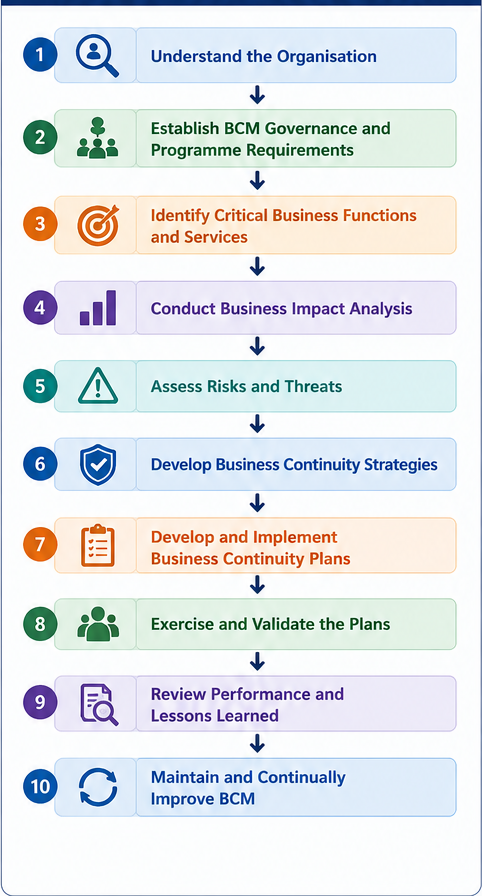
The methodology should be scalable. Not every MSF function requires the same recovery capability.
Resources should be concentrated on activities where disruption could produce the most significant consequences for the Ministry, the Government and, most importantly, the individuals and families relying on essential services.
[](https://cta-redirect.hubspot.com/cta/redirect/3893111/a4fa9f02-e184-43b1-8a52-230bf302dd76)
#### **Assessing Risks and Threats for MSF**
Risk assessment complements the BIA.
The **BIA asks what the consequences would be if an activity were disrupted and how quickly it needs to be recovered**. Risk assessment considers **what could cause that disruption, the vulnerabilities involved and what controls are required**.
Illustrative threats relevant to MSF could include:
| Threat | Potential BCM Consequence |
| --- | --- |
| Cyberattack or ransomware | Loss of access to case-management, communication or administrative systems |
| Major ICT outage | Inability to process transactions or access critical information |
| Building outage | Loss of access to headquarters, offices or frontline service locations |
| Pandemic or infectious disease | Workforce reduction and increased demand for assistance |
| Telecommunications failure | Disruption to hotlines, coordination and stakeholder communication |
| Power failure | Loss of premises and technology availability |
| Third-party failure | Interruption of outsourced or partner-supported services |
| Data breach or corruption | Loss of confidentiality, integrity or availability of sensitive information |
| Transport disruption | Reduced workforce and public access to service locations |
| Large-scale community emergency | Increased demand for social support while normal resources are constrained |
Risk assessment should also consider **compound disruption**. A cyber incident, for example, might simultaneously affect systems, communications, data access and external service providers.
[](https://cta-redirect.hubspot.com/cta/redirect/3893111/fbb42012-8f64-401c-a56c-d84bdcfeee14)
#### **Identifying Critical Business Functions for MSF**
Not every business function is equally time-sensitive. BCM therefore requires MSF to identify those activities whose disruption would create unacceptable impacts.
This assessment should be performed formally through the BIA. Nevertheless, MSF's public service responsibilities indicate several areas warranting detailed assessment.
Examples could include:
| Potential Critical Business Function | Continuity Consideration |
| --- | --- |
| Protection and safeguarding services | Delays could expose vulnerable persons to continuing safety risks |
| Abuse and violence reporting channels | Availability may be necessary for urgent reporting and escalation |
| Financial and social assistance | Disruption could affect households requiring support for basic needs |
| Social Service Office operations | Could affect access to assistance and coordination of support |
| Residential and shelter-related support | Disruption may affect persons requiring accommodation, care or protection |
| Case management | Critical cases may require continued assessment, intervention and monitoring |
| Rehabilitation-related services | Selected activities may require continuity depending on client and statutory requirements |
| Disability support coordination | Disruption could affect vulnerable beneficiaries and caregivers |
| Family support services | Selected cases may require timely counselling, intervention or referral |
| Critical digital and information services | Operational services may depend on continued access to systems and records |
| Partner and inter-agency coordination | Essential where service delivery depends upon multiple organisations |
| Crisis and public communications | Necessary to communicate changes to service availability and alternative arrangements |
These examples should **not be interpreted as MSF's formally designated critical business functions**.
They are candidates for analysis. MSF should establish formal criticality through its BIA, using agreed impact criteria and approved recovery requirements.
MSF's experience with differentiated service continuity reinforces the importance of this analysis.
During earlier nationwide restrictions, MSF identified public services that needed to remain open and other social services for which limited provision had to continue for critical cases.
This demonstrates a fundamental BCM principle: during severe disruption, organisations must know **which services cannot simply stop**.
#### **Bringing the Elements Together**
The ten elements described in this chapter are interconnected:
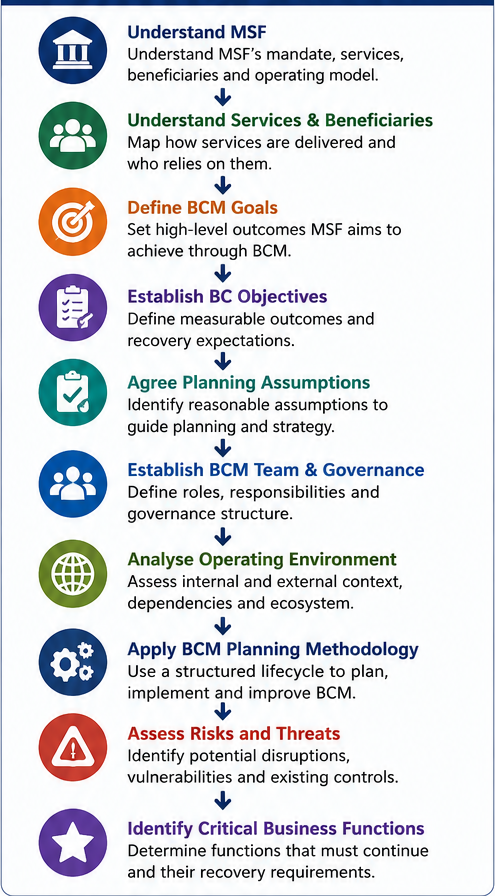
This sequence moves BCM from a plan-writing exercise to an organisational resilience capability.
### [![Banner \[Summary\] \[BCM\] \[E1\] \[C1\] Overview of BCM Implementation](https://no-cache.hubspot.com/cta/default/3893111/d68eecf4-e067-432d-a223-97aa9d785ce8.png)](https://cta-redirect.hubspot.com/cta/redirect/3893111/d68eecf4-e067-432d-a223-97aa9d785ce8)
For the Ministry of Social and Family Development, effective Business Continuity Management begins with understanding the organisation and the people it ultimately supports.
MSF operates across a complex social service environment encompassing financial assistance, family services, protection, rehabilitation, disability services, residential support and partnerships with Social Service Agencies and other government organisations.
Its Social Service Offices provide financial and social support, while its protection system depends on coordination across a broad network of public and community organisations.
This operating environment means that the consequences of disruption cannot be measured only in terms of financial loss or internal operational inconvenience. For some MSF services, an interruption may affect vulnerable individuals and families precisely when they most need assistance.
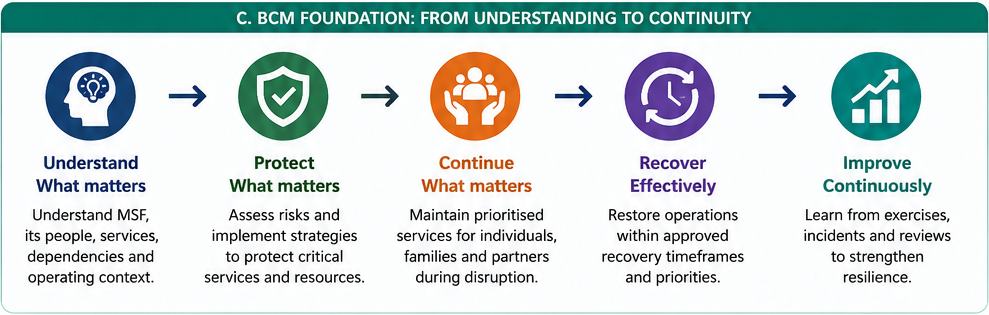
BCM implementation should therefore begin by answering five fundamental questions:
- **What must MSF continue to deliver?**
- **Who could be affected if it is unavailable?**
- **How long can disruption be tolerated?**
- **What resources and dependencies enable the service?**
- **How will MSF continue or recover the service when those resources are disrupted?**
The remainder of **Understanding Your Organisation for the Ministry of Social and Family Development** builds upon this foundation.
It progressively develops a clearer picture of MSF's organisational context, goals, services, stakeholders, dependencies and critical business functions before moving into the detailed BCM implementation activities addressed in the subsequent eBooks.
Ultimately, MSF's purpose for BCM is not simply to ensure the Ministry can **recover from disruption**. It is to ensure that when disruption occurs, MSF can continue to fulfil its essential responsibilities and maintain support for the individuals, families and communities that depend on it.
****
[](https://cta-redirect.hubspot.com/cta/redirect/3893111/3aefb2d2-3110-47c1-ad4f-d3e6e5381066)
[![\[BCM\] \[GEN 3\] \[3/4 Banner\] Implementing Business Continuity Management](https://no-cache.hubspot.com/cta/default/3893111/19e85049-546e-4764-881b-f651277b16aa.png)](https://cta-redirect.hubspot.com/cta/redirect/3893111/19e85049-546e-4764-881b-f651277b16aa)
| **eBook 1: Understanding Your Organisation** | | | | | |
| --- | --- | --- | --- | --- | --- |
| **C1** | **C2** | **C3** | **C4** | **C5** | **C6** |
| [](https://cta-redirect.hubspot.com/cta/redirect/3893111/3a157699-9c35-4eb8-85ec-39b4c9f3bb47) | [![\[BCM\] \[MSF\] \[E1\] \[C2\] Understanding Your Organisation.jpg](https://no-cache.hubspot.com/cta/default/3893111/c0c985ce-2546-402e-85b6-bf956a226577.png)](https://cta-redirect.hubspot.com/cta/redirect/3893111/c0c985ce-2546-402e-85b6-bf956a226577) | [![\[BCM\] \[MSF\] \[E1\] \[C3\] Establishing Organisational Goals](https://no-cache.hubspot.com/cta/default/3893111/ceb9435f-b4fd-4949-b6fd-48c33734b06c.png)](https://cta-redirect.hubspot.com/cta/redirect/3893111/ceb9435f-b4fd-4949-b6fd-48c33734b06c) | [![\[BCM\] \[MSF\] \[E1\] \[C4\] Establishing Business Continuity Objectives](https://no-cache.hubspot.com/cta/default/3893111/1767bd05-6686-4bbb-9d74-59e31cddca29.png)](https://cta-redirect.hubspot.com/cta/redirect/3893111/1767bd05-6686-4bbb-9d74-59e31cddca29) | [![\[BCM\] \[MSF\] \[E1\] \[C5\] Determining BC Assumptions](https://no-cache.hubspot.com/cta/default/3893111/b1a1dade-e918-4e04-9bfd-ea954635d59e.png)](https://cta-redirect.hubspot.com/cta/redirect/3893111/b1a1dade-e918-4e04-9bfd-ea954635d59e) | [![\[BCM\] \[MSF\] \[E1\] \[C6\] Composing BCM Team](https://no-cache.hubspot.com/cta/default/3893111/fe457c8c-a047-42cd-85b7-0bb3cdcffcd4.png)](https://cta-redirect.hubspot.com/cta/redirect/3893111/fe457c8c-a047-42cd-85b7-0bb3cdcffcd4) |
| **C7** | **C8** | **C9** | **C10** | **C11** | **C12** |
| [![\[BCM\] \[MSF\] \[E1\] \[C7\] Analysing Operating Environment](https://no-cache.hubspot.com/cta/default/3893111/e3ba8ba5-4474-4148-88f8-28b38a11c48a.png)](https://cta-redirect.hubspot.com/cta/redirect/3893111/e3ba8ba5-4474-4148-88f8-28b38a11c48a) | [![\[BCM\] \[MSF\] \[E1\] \[C8\] Implementing the BCM Planning Methodology](https://no-cache.hubspot.com/cta/default/3893111/89151394-7af8-46ab-bae0-89c630c8936c.png)](https://cta-redirect.hubspot.com/cta/redirect/3893111/89151394-7af8-46ab-bae0-89c630c8936c) | [![\[BCM\] \[MSF\] \[E1\] \[C9\] Assessing Risks and Threats](https://no-cache.hubspot.com/cta/default/3893111/36bec971-89e7-4abc-86ad-3d51a9082a73.png)](https://cta-redirect.hubspot.com/cta/redirect/3893111/36bec971-89e7-4abc-86ad-3d51a9082a73) | [](https://cta-redirect.hubspot.com/cta/redirect/3893111/63a99242-9674-4082-b851-31e58c8f0692) | [![\[BCM\] \[MSF\] \[E1\] \[C11\] Summary](https://no-cache.hubspot.com/cta/default/3893111/e279189c-cb31-42a4-9eae-2a6969206af3.png)](https://cta-redirect.hubspot.com/cta/redirect/3893111/e279189c-cb31-42a4-9eae-2a6969206af3) | [![\[BCM\] \[MSF\] \[E1\] \[C12\] Back Cover](https://no-cache.hubspot.com/cta/default/3893111/fd4a1eb9-49b2-4624-8273-79e71ed6f401.png)](https://cta-redirect.hubspot.com/cta/redirect/3893111/fd4a1eb9-49b2-4624-8273-79e71ed6f401) |
| | | | | | |
### More Information About Business Continuity Management Courses
[](https://cta-redirect.hubspot.com/cta/redirect/3893111/c010f0fd-7ba6-4f60-b63b-38efafac8ca5)[](https://cta-redirect.hubspot.com/cta/redirect/3893111/354ef907-cf2c-4148-aa47-577a930e76c5)To learn more about the course and schedule, click the buttons below for the BCM-300 Business Continuity Management Implementer \[B-3\] course and the BCM-5000 Business Continuity Management Expert Implementer \[B-5\].
| [![Register \[BL-B-3\]\*](https://no-cache.hubspot.com/cta/default/3893111/ac6cf073-4cdd-4541-91ed-889f731d5076.png)](https://cta-redirect.hubspot.com/cta/redirect/3893111/ac6cf073-4cdd-4541-91ed-889f731d5076) | [](https://cta-redirect.hubspot.com/cta/redirect/3893111/9ff8a3dc-e39a-465b-929f-72e232cdd5fb) | [](https://cta-redirect.hubspot.com/cta/redirect/3893111/f3922b80-e96a-46d6-8993-dc150a5de2d5) |
| --- | --- | --- |
| [](https://cta-redirect.hubspot.com/cta/redirect/3893111/1cb17ac7-50b2-4f88-bc4b-c7444e4b57b5) | [](https://cta-redirect.hubspot.com/cta/redirect/3893111/3ecb1171-819d-45a2-8686-6db917a20156) | [](https://cta-redirect.hubspot.com/cta/redirect/3893111/21525c10-4003-4934-95fc-fe218174bc5b) |
| [![FAQ \[BL-B-3\]](https://no-cache.hubspot.com/cta/default/3893111/b3824ba1-7aa1-4eb6-bef8-94f57121c5ae.png)](https://cta-redirect.hubspot.com/cta/redirect/3893111/b3824ba1-7aa1-4eb6-bef8-94f57121c5ae) | If you have any questions, click to contact us. [![Email to Sales Team \[BCM Institute\]](https://no-cache.hubspot.com/cta/default/3893111/3c53daeb-2836-4843-b0e0-645baee2ab9e.png)](https://cta-redirect.hubspot.com/cta/redirect/3893111/3c53daeb-2836-4843-b0e0-645baee2ab9e) | [](https://cta-redirect.hubspot.com/cta/redirect/3893111/9c199ae8-c470-4bb7-9612-73c7a084e94c) |
| [](https://cta-redirect.hubspot.com/cta/redirect/3893111/8999211a-2c51-4be7-bf49-c393f6c67974) | [](https://cta-redirect.hubspot.com/cta/redirect/3893111/5c1aa95d-f6dd-4067-a95c-5cc0c32d7ed8) | [](https://cta-redirect.hubspot.com/cta/redirect/3893111/086ab3b9-4d66-4a95-b2f7-1148e9803a9c) |
#### **Comments:**
### More Posts
[](https://cta-redirect.hubspot.com/cta/redirect/3893111/839787f4-a4fd-456f-accf-54c947026558)

All rights reserved. Copyright 2026
```json
{
"@context" : "https://schema.org",
"@type" : "BlogPosting",
"author" : {
"@type" : "Person",
"name" : "Moh Heng Goh",
"url" : "https://blog.bcm-institute.org/ebook/author/moh-heng-goh"
},
"dateModified" : "2026-09-22T06:23:02.693Z",
"datePublished" : "2026-09-01T10:12:11.000Z",
"headline" : "[BCM] [MSF] [E1] [C1] Overview of BCM Case Study for MSF",
"mainEntityOfPage" : {
"@id" : "https://blog.bcm-institute.org/ebook/bcm-msf-e1-c1-overview-of-bcm-case-study-for-msf",
"@type" : "WebPage"
},
"publisher" : {
"@type" : "Organization",
"logo" : {
"@type" : "ImageObject",
"url" : "https://blog.bcm-institute.org/hubfs/BCMI%20Logo.png"
},
"name" : "BCMI Pte Ltd"
}
}
```