---
title: [BCM] [KKH] [E3] [BIA] [P4] CBF [1] Emergency Obstetric Services
description: [BCM] [KKH] [E3] [BIA] [P4] CBF [1] Emergency Obstetric Services
image: https://blog.bcm-institute.org/hubfs/KKH%20Graphic%20Folder/KKH%20CBF%201%20Morepost/%5BBCM%5D%20%5BKKH%5D%20%5BE3%5D%20%5BBIA%5D%20%5BT4%5D%20%5BCBF%5D%20%5B1%5D%20Emergency%20Obstetric%20Services.png
---
. .
[](http://www.bcm-institute.org/)
- [Home](https://www.bcm-institute.org/)
- [About Us](https://www.bcm-institute.org/about-us-3/)
- [A President’s Perspective](https://www.bcm-institute.org/about-us/a-presidents-perspective/)
- [Our History](https://www.bcm-institute.org/about-us/our-history/)
- [Our Advisory Council](https://www.bcm-institute.org/about-us/our-advisory-council/)
- [Customers’ Testimonials](https://www.bcm-institute.org/about-us/customers-testimonials/)
- [Credential Verification](https://www.bcm-institute.org/about-us/credential-verification/)
- [Courses](https://blog.bcm-institute.org/blog/course-fees-for-blended-learning-courses-master-catalog)
- [ISO 22301 Business Continuity Management System Audit](https://blog.bcm-institute.org/audit/business-continuity-management-audit-courses)
- [ISO 22301 Business Continuity Management](https://blog.bcm-institute.org/bcm/business-continuity-management-courses)
- [Crisis Communication](https://blog.bcm-institute.org/crisis-communication/crisis-communication-courses)
- [Crisis Management](https://blog.bcm-institute.org/en/crisis-management/courses)
- [IT Disaster Recovery](https://blog.bcm-institute.org/it-disaster-recovery/courses)
- [Operational Resilience](https://blog.bcm-institute.org/operational-resilience/courses)
- [Operational Resilience Audit](https://blog.bcm-institute.org/operational-resilience-audit/courses)
- [Certification](https://blog.bcm-institute.org/certification/types-of-certifications-offered)
- [ISO 22301 BCMS Audit Certification](https://blog.bcm-institute.org/certification/business-continuity-management-audit-certification)
- [ISO22301 Business Continuity Management Certification](https://blog.bcm-institute.org/bcm/business-continuity-management-certification)
- [Crisis Communication Certification](https://blog.bcm-institute.org/crisis-communication/crisis-communication-certification)
- [Crisis Management Certification](https://blog.bcm-institute.org/en/crisis-management/crisis-management-certification)
- [IT Disaster Recovery Planning Certification](https://blog.bcm-institute.org/it-disaster-recovery/it-disaster-recovery-certification)
- [Operational Resilience Certification](https://blog.bcm-institute.org/operational-resilience/operational-resilience-certification)
- [Operational Resilience Audit Certification](https://blog.bcm-institute.org/operational-resilience-audit)
- [Seminars](https://blog.bcm-institute.org/meet-the-expert/mte-webinar-mainpage)
- [Store](https://www.bcm-institute.org/store-2/)
- [Contact Us](http://www.bcm-institute.org/about-us/contact-us/)
-
-
##### Implementing Business Continuity Management for KK Women's and Children's Hospital: An Enterprise Implementation Guide

# \[BCM\] \[KKH\] \[E3\] \[BIA\] \[P4\] CBF \[1\] Emergency Obstetric Services
[![\[BCM\] \[KKH\] \[Full Banner\] Implementing Business Continuity Management for KKH](https://no-cache.hubspot.com/cta/default/3893111/1f88d53c-b518-44bc-a9d0-ba7d040b5378.png)](https://cta-redirect.hubspot.com/cta/redirect/3893111/1f88d53c-b518-44bc-a9d0-ba7d040b5378)
The delivery of **Emergency Obstetric Services** at KK Women's and Children's Hospital (KKH) relies heavily on integrated information systems, clinical applications, medical technologies, and specialised medical equipment.
During a Business Impact Analysis (BIA), identifying these technology dependencies is essential because a disruption to critical IT services can rapidly affect patient assessment, clinical decision-making, emergency surgery, medication administration, neonatal care, and regulatory documentation.
Understanding these dependencies enables the hospital to establish appropriate technology recovery priorities that align with clinical recovery requirements.
Business processes within Emergency Obstetric Services are supported by a wide range of digital platforms, including Electronic Medical Records (EMR), Clinical Information Systems (CIS), Laboratory Information Systems (LIS), Radiology Information Systems (RIS), Picture Archiving and Communication Systems (PACS), Operating Theatre Management Systems, Blood Bank Information Systems, medication management systems, and communication platforms.
### [![Banner \[BCM\] \[E3\] \[BIA\] \[P4\] Supporting IT Systems and Applications](https://no-cache.hubspot.com/cta/default/3893111/e60ed308-5615-4727-b6c2-5fb4eed933d7.png)](https://cta-redirect.hubspot.com/cta/redirect/3893111/e60ed308-5615-4727-b6c2-5fb4eed933d7)
[Dr Goh Moh Heng](https://blog.bcm-institute.org/ebook/author/dr-goh-moh-heng) Aug 10, 2026
###### Business Continuity Management Certified Planner-Specialist-Expert
### [](https://cta-redirect.hubspot.com/cta/redirect/3893111/ebe9ac30-955e-4fbd-bf62-318c559361dd)
[](https://cta-redirect.hubspot.com/cta/redirect/3893111/58912f86-0de7-4b16-bcf9-99bdedd6b04d)
[![Banner \[BCM\] \[E3\] \[BIA\] \[P4\] Supporting IT Systems and Applications](https://no-cache.hubspot.com/cta/default/3893111/e60ed308-5615-4727-b6c2-5fb4eed933d7.png)](https://cta-redirect.hubspot.com/cta/redirect/3893111/e60ed308-5615-4727-b6c2-5fb4eed933d7)
### CBF-1 Emergency Obstetric Processes
[![\[BCM\] \[KKH\] \[E3\] \[BIA\] \[T4\] \[CBF\] \[1\] Emergency Obstetric Services](https://no-cache.hubspot.com/cta/default/3893111/f4e64c69-124b-40a8-b224-dded90e5631b.png)](https://cta-redirect.hubspot.com/cta/redirect/3893111/f4e64c69-124b-40a8-b224-dded90e5631b)
The delivery of **Emergency Obstetric Services** at KK Women's and Children's Hospital (KKH) relies heavily on integrated information systems, clinical applications, medical technologies, and specialised medical equipment.
During a Business Impact Analysis (BIA), identifying these technology dependencies is essential because a disruption to critical IT services can rapidly affect patient assessment, clinical decision-making, emergency surgery, medication administration, neonatal care, and regulatory documentation.
Understanding these dependencies enables the hospital to establish appropriate technology recovery priorities that align with clinical recovery requirements.
Business processes within Emergency Obstetric Services are supported by a wide range of digital platforms, including Electronic Medical Records (EMR), Clinical Information Systems (CIS), Laboratory Information Systems (LIS), Radiology Information Systems (RIS), Picture Archiving and Communication Systems (PACS), Operating Theatre Management Systems, Blood Bank Information Systems, medication management systems, and communication platforms.
These systems exchange real-time clinical information, ensuring that multidisciplinary teams have accurate and timely access to patient data.
Business Continuity Planning (BCP) and IT Disaster Recovery (ITDR) are closely linked. While BCP focuses on maintaining critical healthcare services during disruption, ITDR ensures that the technology supporting those services is restored within acceptable timeframes. Two key measures guide IT recovery planning:
- **Recovery Point Objective (RPO)** defines the maximum acceptable amount of data loss following an IT disruption.
- **System Recovery Time Objective (System RTO)** defines the target time for restoring a supporting system to operational status.
In addition to software applications, specialised medical equipment, communications infrastructure, medical devices, and resilient network connectivity are equally important.
These technology resources should be identified during the BIA to ensure that continuity and disaster recovery plans address both digital systems and the operational equipment required to sustain safe emergency obstetric care.
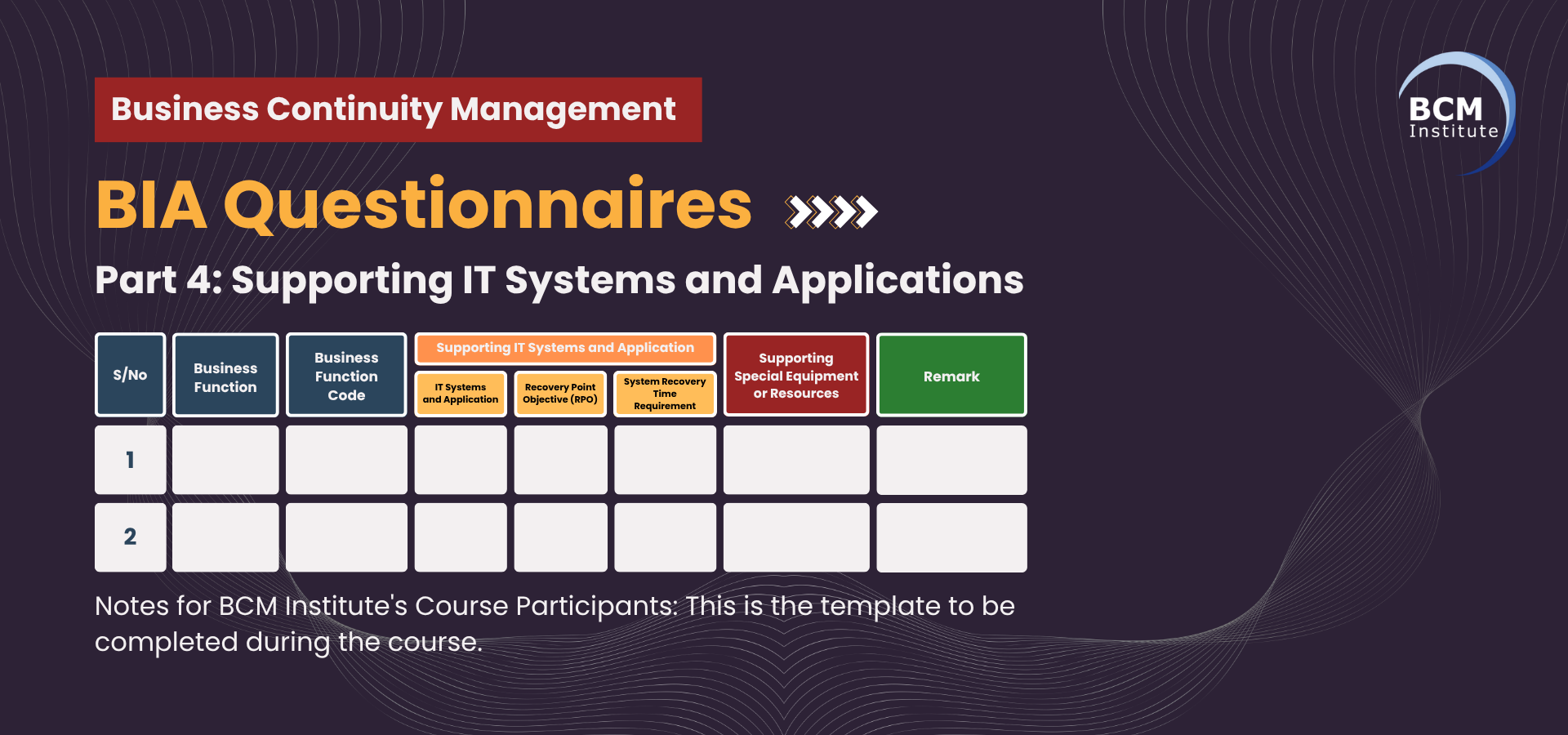
[![Banner \[Table\] \[BCM\] \[E3\] \[BIA\] \[P4\] Supporting IT Systems and Applications \[BIAQ\]](https://no-cache.hubspot.com/cta/default/3893111/b0e47631-f680-46d1-b7a9-040fce25e117.png)](https://cta-redirect.hubspot.com/cta/redirect/3893111/b0e47631-f680-46d1-b7a9-040fce25e117)
Table P4: Supporting IT Systems and Applications for CBF-1
| Sub-CBF Code | Sub-Critical Business Function | Supporting IT Systems and Applications | Recovery Point Objective (RPO) | System Recovery Time Objective (System RTO) | Supporting Special Equipment / Resources | Remarks |
| --- | --- | --- | --- | --- | --- | --- |
| 1.1 | Emergency Patient Arrival and Registration | Electronic Medical Record (EMR), Patient Administration System (PAS), Identity & Registration System | Real-time | 1 Hour | Registration workstations, barcode scanners, patient ID printers, resilient hospital network | Patient registration is the entry point for clinical care. Manual registration procedures should be available during system outages. |
| 1.2 | Obstetric Triage and Clinical Prioritisation | EMR, Clinical Information System (CIS), Triage Management Module | Real-time | 1 Hour | Mobile clinical workstations, fetal monitoring devices, secure Wi-Fi | Immediate access to patient records and triage information is essential for prioritising emergency cases. |
| 1.3 | Emergency Clinical Assessment | EMR, CIS, Clinical Decision Support System (CDSS), e-Prescribing | Real-time | 1 Hour | Diagnostic workstations, secure clinician tablets | Clinical assessment relies on current patient information and decision-support tools. Downtime procedures should support continued care. |
| 1.4 | Diagnostic and Laboratory Support | Laboratory Information System (LIS), Radiology Information System (RIS), PACS | Less than 15 minutes | 2 Hours | Laboratory analysers, ultrasound machines, CTG monitors, diagnostic network | Continuous availability of diagnostic systems is critical for emergency treatment decisions. |
| 1.5 | Emergency Obstetric Decision-Making | EMR, CDSS, PACS, Clinical Dashboard | Real-time | 1 Hour | Specialist workstations, multidisciplinary collaboration tools | Decision-making depends on immediate access to diagnostic results and multidisciplinary information. |
| 1.6 | Emergency Theatre Preparation | Operating Theatre Management System, Surgery Scheduling System, Inventory Management System | 15 Minutes | 2 Hours | Operating theatre equipment, sterile instrument tracking system, UPS-supported infrastructure | Theatre readiness depends on integrated scheduling, equipment tracking, and inventory visibility. |
| 1.7 | Emergency Obstetric Surgery and Delivery | EMR, Anaesthesia Information Management System (AIMS), Theatre Information System | Real-time | 30 Minutes | Anaesthesia machines, surgical equipment, medical gas systems, backup power | This function has the highest IT recovery priority because delays directly affect maternal and fetal survival. |
| 1.8 | Anaesthesia and Perioperative Care | AIMS, EMR, Physiological Monitoring System | Real-time | 30 Minutes | Anaesthesia workstations, patient monitors, infusion pumps, ventilators | Continuous monitoring data must be preserved with minimal data loss to ensure patient safety. |
| 1.9 | Neonatal Emergency Support | Neonatal Clinical Information System, EMR, NICU Monitoring System | Real-time | 30 Minutes | Neonatal incubators, neonatal ventilators, resuscitation equipment, transport incubators | IT systems supporting neonatal resuscitation require very high availability and resilient infrastructure. |
| 1.10 | Maternal Critical Care and Stabilisation | Critical Care Information System (CCIS), EMR, Patient Monitoring System | Real-time | 1 Hour | ICU/HDU monitoring equipment, infusion devices, ventilators | Continuous monitoring and clinical documentation are essential for critically ill mothers. |
| 1.11 | Blood Products and Medication Management | Blood Bank Information System (BBIS), Pharmacy Information System, Medication Administration System | Less than 15 minutes | 1 Hour | Blood refrigerators, barcode medication scanners, temperature monitoring systems | Blood traceability and medication management require accurate, near real-time information. |
| 1.12 | Clinical Communication and Care Coordination | Secure Clinical Messaging Platform, VoIP Telephony, Email, Collaboration Platform | 15 Minutes | 2 Hours | Smartphones, pagers, IP telephony, secure video conferencing, redundant communications | Multiple communication channels should be maintained to support coordinated emergency response. |
| 1.13 | Patient Monitoring and Ongoing Clinical Management | Bedside Patient Monitoring System, EMR, Clinical Observation System | Real-time | 1 Hour | Multiparameter monitors, telemetry systems, nurse call system | Continuous patient monitoring requires resilient networks and uninterrupted power supplies. |
| 1.14 | Patient Transfer and Continuity of Care | Bed Management System, Patient Flow Management System, EMR | 1 Hour | 4 Hours | Patient transport equipment, mobile workstations, secure wireless connectivity | Patient movement across wards requires accurate bed availability and clinical information. |
| 1.15 | Clinical Documentation and Regulatory Reporting | EMR, Document Management System (DMS), Clinical Coding System, Reporting & Analytics Platform | 1 Hour | 8 Hours | Secure document repositories, backup storage, disaster recovery site | Electronic documentation supports medico-legal requirements, regulatory reporting, and continuity of care. |
[![Banner \[BCM\] \[E3\] \[BIA\] \[Summing Up\] \[P4\] Supporting IT Systems and Applications \[BIAQ\]](https://no-cache.hubspot.com/cta/default/3893111/9bde2d75-0c8e-4d9e-a8ca-e8d1655a082c.png)](https://cta-redirect.hubspot.com/cta/redirect/3893111/9bde2d75-0c8e-4d9e-a8ca-e8d1655a082c)
Supporting IT systems and applications form the technological backbone of **Emergency Obstetric Services** at KKH. Clinical workflows—from emergency registration and triage through surgery, neonatal care, critical care, and regulatory documentation—depend on reliable, integrated digital platforms that enable timely access to patient information and coordinated clinical decision-making.
Identifying these technology dependencies during the Business Impact Analysis ensures that Business Continuity and IT Disaster Recovery planning are aligned with operational priorities.
By defining appropriate **Recovery Point Objectives (RPOs)** and **System Recovery Time Objectives (System RTOs)**, KKH can establish recovery targets that minimise data loss while restoring critical systems within clinically acceptable timeframes. These technology recovery objectives should always support the business recovery requirements defined during the BIA.
The inclusion of specialised medical equipment, resilient communications, high-availability infrastructure, backup power, and disaster recovery capabilities further strengthens continuity planning by recognising that clinical services rely on more than software applications alone.
Understanding these interdependencies enables KKH to develop integrated Business Continuity Plans (BCPs) and IT Disaster Recovery (ITDR) strategies that protect patient safety, maintain regulatory compliance, and ensure the continued delivery of life-saving emergency obstetric services during disruptive events.
[![\[BCM\] \[KKH\] \[3/4 Banner\] Implementing Business Continuity Management for KKH](https://no-cache.hubspot.com/cta/default/3893111/141669d3-f654-4e57-9ccd-2d2ab49f536d.png)](https://cta-redirect.hubspot.com/cta/redirect/3893111/141669d3-f654-4e57-9ccd-2d2ab49f536d)
| **eBook 3: Starting Your BCM Implementation** | | | | | | |
| --- | --- | --- | --- | --- | --- | --- |
| **MBCO** | **P&S** | **RAR T1** | **RAR T2** | **RAR T3** | **BCS T1** | **CBF** |
| [![BCM\] \[KKH\] \[E3\] \[BIA\] MBCO Corporate MBCO](https://no-cache.hubspot.com/cta/default/3893111/55ac38bc-d349-4faf-a6dc-cbc3d3f5431b.png)](https://cta-redirect.hubspot.com/cta/redirect/3893111/55ac38bc-d349-4faf-a6dc-cbc3d3f5431b) | [![BCM\] \[KKH\] \[E3\] \[BIA\] \[PS\] Key Product and Services](https://no-cache.hubspot.com/cta/default/3893111/b28ee275-3bf7-4832-a3a0-0bcca82d2522.png)](https://cta-redirect.hubspot.com/cta/redirect/3893111/b28ee275-3bf7-4832-a3a0-0bcca82d2522) | [![BCM\] \[KKH\] \[E3\] \[RAR\] \[T1\] List of Threats](https://no-cache.hubspot.com/cta/default/3893111/684e108e-12b3-4872-99e4-6b61ce39596e.png)](https://cta-redirect.hubspot.com/cta/redirect/3893111/684e108e-12b3-4872-99e4-6b61ce39596e) | [![BCM\] \[KKH\] \[E3\] \[RAR\] \[T2\] Treatment and Control](https://no-cache.hubspot.com/cta/default/3893111/6c690eb5-e7da-4206-ac6b-fb88a8966a69.png)](https://cta-redirect.hubspot.com/cta/redirect/3893111/6c690eb5-e7da-4206-ac6b-fb88a8966a69) | [![BCM\] \[KKH\] \[E3\] \[RAR\] \[T3\] Risk Impact and Likelihood Assessment](https://no-cache.hubspot.com/cta/default/3893111/a9730f15-ebd1-4e30-b308-6d574be794a1.png)](https://cta-redirect.hubspot.com/cta/redirect/3893111/a9730f15-ebd1-4e30-b308-6d574be794a1) | [![BCM\] \[KKH\] \[E3\] \[BCS\] \[T1\] Mitigation Strategies and Justification](https://no-cache.hubspot.com/cta/default/3893111/28b77d9a-b16b-44e7-9abf-965d3db4f803.png)](https://cta-redirect.hubspot.com/cta/redirect/3893111/28b77d9a-b16b-44e7-9abf-965d3db4f803) | [![\[BCM\] \[KKH\] \[E1\] \[C10\] Identifying Critical Business Functions](https://no-cache.hubspot.com/cta/default/3893111/0d1cbf1e-59f6-43c8-a15e-6b34233e632f.png)](https://cta-redirect.hubspot.com/cta/redirect/3893111/0d1cbf1e-59f6-43c8-a15e-6b34233e632f) |
| **CBF-1 Emergency Obstetric Services** | | | | | | |
| **DP** | **BIAQ P1** | **BIAQ P2** | **BIAQ P3** | **BIAQ P4** | **BIAQ P5** | **BIAQ P6** |
| [![\[BCM\] \[KKH\] \[E3\] \[BIA\] \[DP\] \[CBF\] \[1\] Emergency Obstetric Services](https://no-cache.hubspot.com/cta/default/3893111/e497eed8-773b-4e86-bbf8-8e9c3032365b.png)](https://cta-redirect.hubspot.com/cta/redirect/3893111/e497eed8-773b-4e86-bbf8-8e9c3032365b) | **[![\[BCM\] \[KKH\] \[E3\] \[BIA\] \[T1\] \[CBF\] \[1\] Emergency Obstetric Services](https://no-cache.hubspot.com/cta/default/3893111/7bda08a6-461a-4c89-8806-4d6d1216e9f4.png)](https://cta-redirect.hubspot.com/cta/redirect/3893111/7bda08a6-461a-4c89-8806-4d6d1216e9f4)** | **[![\[BCM\] \[KKH\] \[E3\] \[BIA\] \[T2\] \[CBF\] \[1\] Emergency Obstetric Services](https://no-cache.hubspot.com/cta/default/3893111/0724500a-3544-46b8-af30-f31b292e5eb9.png)](https://cta-redirect.hubspot.com/cta/redirect/3893111/0724500a-3544-46b8-af30-f31b292e5eb9)** | **[![\[BCM\] \[KKH\] \[E3\] \[BIA\] \[T3\] \[CBF\] \[1\] Emergency Obstetric Services](https://no-cache.hubspot.com/cta/default/3893111/dc455c8b-0db4-45c4-8f33-e81d69d35344.png)](https://cta-redirect.hubspot.com/cta/redirect/3893111/dc455c8b-0db4-45c4-8f33-e81d69d35344)** | **[![\[BCM\] \[KKH\] \[E3\] \[BIA\] \[T4\] \[CBF\] \[1\] Emergency Obstetric Services](https://no-cache.hubspot.com/cta/default/3893111/f4e64c69-124b-40a8-b224-dded90e5631b.png)](https://cta-redirect.hubspot.com/cta/redirect/3893111/f4e64c69-124b-40a8-b224-dded90e5631b)** | **[![\[BCM\] \[KKH\] \[E3\] \[BIA\] \[T5\] \[CBF\] \[1\] Emergency Obstetric Services](https://no-cache.hubspot.com/cta/default/3893111/f6eaac47-7206-4cba-b6f4-b58245fa9111.png)](https://cta-redirect.hubspot.com/cta/redirect/3893111/f6eaac47-7206-4cba-b6f4-b58245fa9111)** | **[![\[BCM\] \[KKH\] \[E3\] \[BIA\] \[T6\] \[CBF\] \[1\] Emergency Obstetric Services](https://no-cache.hubspot.com/cta/default/3893111/5aa80ea6-6214-44b6-92a2-4156d7d4cfe5.png)](https://cta-redirect.hubspot.com/cta/redirect/3893111/5aa80ea6-6214-44b6-92a2-4156d7d4cfe5)** |
| | | **BCS T2** | **BCS T3** | **PD** | | |
| | | [![\[BCM\] \[KKH\] \[E3\] \[BCS\] \[T2\] \[CBF\] \[1\] Emergency Obstetric Services](https://no-cache.hubspot.com/cta/default/3893111/8d32e264-3e43-4d37-be2a-1382e798c916.png)](https://cta-redirect.hubspot.com/cta/redirect/3893111/8d32e264-3e43-4d37-be2a-1382e798c916) | [![\[BCM\] \[KKH\] \[E3\] \[BCS\] \[T3\] \[CBF\] \[1\] Emergency Obstetric Services](https://no-cache.hubspot.com/cta/default/3893111/b53ff102-21b1-4f31-b47e-5b721028ee65.png)](https://cta-redirect.hubspot.com/cta/redirect/3893111/b53ff102-21b1-4f31-b47e-5b721028ee65) | [![\[BCM\] \[KKH\] \[E3\] \[PD\] \[CBF\] \[1\] Emergency Obstetric Services](https://no-cache.hubspot.com/cta/default/3893111/f9da91f2-6ad8-4c19-b25f-ef7b136c8a04.png)](https://cta-redirect.hubspot.com/cta/redirect/3893111/f9da91f2-6ad8-4c19-b25f-ef7b136c8a04) | | |
| | | | | | | |
#### More Information About Business Continuity Management Courses
To learn more about the course and schedule, click the buttons below for the BCM-300 Business Continuity Management Implementer \[BCM-3\] and the BCM-5000 Business Continuity Management Expert Implementer \[BCM-5\].
| [](https://cta-redirect.hubspot.com/cta/redirect/3893111/f3922b80-e96a-46d6-8993-dc150a5de2d5) | [](https://cta-redirect.hubspot.com/cta/redirect/3893111/9ff8a3dc-e39a-465b-929f-72e232cdd5fb) | [![Register \[BL-B-3\]\*](https://no-cache.hubspot.com/cta/default/3893111/ac6cf073-4cdd-4541-91ed-889f731d5076.png)](https://cta-redirect.hubspot.com/cta/redirect/3893111/ac6cf073-4cdd-4541-91ed-889f731d5076) |
| --- | --- | --- |
| [](https://cta-redirect.hubspot.com/cta/redirect/3893111/21525c10-4003-4934-95fc-fe218174bc5b) | [](https://cta-redirect.hubspot.com/cta/redirect/3893111/46460171-c91a-4936-9bb2-8dc5928a0e02) | [](https://cta-redirect.hubspot.com/cta/redirect/3893111/1cb17ac7-50b2-4f88-bc4b-c7444e4b57b5) |
| [![FAQ \[BL-B-3\]](https://no-cache.hubspot.com/cta/default/3893111/b3824ba1-7aa1-4eb6-bef8-94f57121c5ae.png)](https://cta-redirect.hubspot.com/cta/redirect/3893111/b3824ba1-7aa1-4eb6-bef8-94f57121c5ae) | Please feel free to send us a note if you have any questions. [![Email to Sales Team \[BCM Institute\]](https://no-cache.hubspot.com/cta/default/3893111/3c53daeb-2836-4843-b0e0-645baee2ab9e.png)](https://cta-redirect.hubspot.com/cta/redirect/3893111/3c53daeb-2836-4843-b0e0-645baee2ab9e) | [](https://cta-redirect.hubspot.com/cta/redirect/3893111/9c199ae8-c470-4bb7-9612-73c7a084e94c) |
| [](https://cta-redirect.hubspot.com/cta/redirect/3893111/8999211a-2c51-4be7-bf49-c393f6c67974) | [](https://cta-redirect.hubspot.com/cta/redirect/3893111/5c1aa95d-f6dd-4067-a95c-5cc0c32d7ed8) | [](https://cta-redirect.hubspot.com/cta/redirect/3893111/086ab3b9-4d66-4a95-b2f7-1148e9803a9c) |
#### **Your Comments Here:**
### More Posts
[](https://cta-redirect.hubspot.com/cta/redirect/3893111/839787f4-a4fd-456f-accf-54c947026558)

All rights reserved. Copyright 2026
```json
{
"@context" : "https://schema.org",
"@type" : "BlogPosting",
"author" : {
"@type" : "Person",
"name" : "Dr Goh Moh Heng",
"url" : "https://blog.bcm-institute.org/ebook/author/dr-goh-moh-heng"
},
"dateModified" : "2026-08-10T06:24:58.647Z",
"datePublished" : "2026-08-10T06:24:51.000Z",
"headline" : "[BCM] [KKH] [E3] [BIA] [P4] CBF [1] Emergency Obstetric Services",
"mainEntityOfPage" : {
"@id" : "https://blog.bcm-institute.org/ebook/bcm-kkh-e3-bia-p4-cbf-1-emergency-obstetric-services",
"@type" : "WebPage"
},
"publisher" : {
"@type" : "Organization",
"logo" : {
"@type" : "ImageObject",
"url" : "https://blog.bcm-institute.org/hubfs/BCMI%20Logo.png"
},
"name" : "BCMI Pte Ltd"
}
}
```