---
title: [BCM] [KKH] [E3] [BIA] [P3] CBF [1] Emergency Obstetric Services
description: [BCM] [KKH] [E3] [BIA] [P3] CBF [1] Emergency Obstetric Services
image: https://blog.bcm-institute.org/hubfs/KKH%20Graphic%20Folder/KKH%20CBF%201%20Morepost/%5BBCM%5D%20%5BKKH%5D%20%5BE3%5D%20%5BBIA%5D%20%5BT3%5D%20%5BCBF%5D%20%5B1%5D%20Emergency%20Obstetric%20Services.png
---
. .
[](http://www.bcm-institute.org/)
- [Home](https://www.bcm-institute.org/)
- [About Us](https://www.bcm-institute.org/about-us-3/)
- [A President’s Perspective](https://www.bcm-institute.org/about-us/a-presidents-perspective/)
- [Our History](https://www.bcm-institute.org/about-us/our-history/)
- [Our Advisory Council](https://www.bcm-institute.org/about-us/our-advisory-council/)
- [Customers’ Testimonials](https://www.bcm-institute.org/about-us/customers-testimonials/)
- [Credential Verification](https://www.bcm-institute.org/about-us/credential-verification/)
- [Courses](https://blog.bcm-institute.org/blog/course-fees-for-blended-learning-courses-master-catalog)
- [ISO 22301 Business Continuity Management System Audit](https://blog.bcm-institute.org/audit/business-continuity-management-audit-courses)
- [ISO 22301 Business Continuity Management](https://blog.bcm-institute.org/bcm/business-continuity-management-courses)
- [Crisis Communication](https://blog.bcm-institute.org/crisis-communication/crisis-communication-courses)
- [Crisis Management](https://blog.bcm-institute.org/en/crisis-management/courses)
- [IT Disaster Recovery](https://blog.bcm-institute.org/it-disaster-recovery/courses)
- [Operational Resilience](https://blog.bcm-institute.org/operational-resilience/courses)
- [Operational Resilience Audit](https://blog.bcm-institute.org/operational-resilience-audit/courses)
- [Certification](https://blog.bcm-institute.org/certification/types-of-certifications-offered)
- [ISO 22301 BCMS Audit Certification](https://blog.bcm-institute.org/certification/business-continuity-management-audit-certification)
- [ISO22301 Business Continuity Management Certification](https://blog.bcm-institute.org/bcm/business-continuity-management-certification)
- [Crisis Communication Certification](https://blog.bcm-institute.org/crisis-communication/crisis-communication-certification)
- [Crisis Management Certification](https://blog.bcm-institute.org/en/crisis-management/crisis-management-certification)
- [IT Disaster Recovery Planning Certification](https://blog.bcm-institute.org/it-disaster-recovery/it-disaster-recovery-certification)
- [Operational Resilience Certification](https://blog.bcm-institute.org/operational-resilience/operational-resilience-certification)
- [Operational Resilience Audit Certification](https://blog.bcm-institute.org/operational-resilience-audit)
- [Seminars](https://blog.bcm-institute.org/meet-the-expert/mte-webinar-mainpage)
- [Store](https://www.bcm-institute.org/store-2/)
- [Contact Us](http://www.bcm-institute.org/about-us/contact-us/)
-
-
##### Implementing Business Continuity Management for KK Women's and Children's Hospital: An Enterprise Implementation Guide

# \[BCM\] \[KKH\] \[E3\] \[BIA\] \[P3\] CBF \[1\] Emergency Obstetric Services
[![\[BCM\] \[KKH\] \[Full Banner\] Implementing Business Continuity Management for KKH](https://no-cache.hubspot.com/cta/default/3893111/1f88d53c-b518-44bc-a9d0-ba7d040b5378.png)](https://cta-redirect.hubspot.com/cta/redirect/3893111/1f88d53c-b518-44bc-a9d0-ba7d040b5378)
A critical component of the Business Impact Analysis (BIA) is evaluating how the consequences of a disruption increase over time. For **Emergency Obstetric Services** at KK Women's and Children's Hospital (KKH), the impact of an interruption is immediate because the service supports life-saving care for mothers and newborns.
However, the severity of operational, clinical, regulatory, financial, and reputational consequences continues to escalate as the disruption persists. Understanding this progressive deterioration enables KKH to prioritise recovery activities according to clinical urgency and organisational risk.
Different Sub-Critical Business Functions (Sub-CBFs) exhibit different impact profiles.
Functions directly involved in emergency surgery, clinical decision-making, and neonatal support become critical within minutes or hours, whereas functions such as documentation and regulatory reporting can tolerate slightly longer interruptions provided that alternative manual processes are implemented.
Assessing these differences ensures that continuity measures are proportionate to the operational importance of each function.
The results of this assessment form the basis for establishing **Recovery Time Objectives (RTOs)**, **Maximum Tolerable Periods of Disruption (MTPDs)**, and identifying **Vulnerable Periods**.
Together, these outputs support the prioritisation of recovery resources, development of continuity strategies, and preparation of Business Continuity Plans (BCPs) that preserve patient safety and operational resilience.
[![Banner \[BCM\] \[E3\] \[BIA\] \[P3\] Impact Over Time of Business Functions](https://no-cache.hubspot.com/cta/default/3893111/bc131ed6-ca92-4253-8940-2f98dad34599.png)](https://cta-redirect.hubspot.com/cta/redirect/3893111/bc131ed6-ca92-4253-8940-2f98dad34599)
[Dr Goh Moh Heng](https://blog.bcm-institute.org/ebook/author/dr-goh-moh-heng) Aug 10, 2026
###### Business Continuity Management Certified Planner-Specialist-Expert
### [](https://cta-redirect.hubspot.com/cta/redirect/3893111/ebe9ac30-955e-4fbd-bf62-318c559361dd)
[](https://cta-redirect.hubspot.com/cta/redirect/3893111/326c85d5-f1af-4a99-9f0e-0072cfcad36a)
[![Banner \[BCM\] \[E3\] \[BIA\] \[P3\] Impact Over Time of Business Functions](https://no-cache.hubspot.com/cta/default/3893111/bc131ed6-ca92-4253-8940-2f98dad34599.png)](https://cta-redirect.hubspot.com/cta/redirect/3893111/bc131ed6-ca92-4253-8940-2f98dad34599)
### CBF-1 Emergency Obstetric Processes
[![\[BCM\] \[KKH\] \[E3\] \[BIA\] \[T3\] \[CBF\] \[1\] Emergency Obstetric Services](https://no-cache.hubspot.com/cta/default/3893111/dc455c8b-0db4-45c4-8f33-e81d69d35344.png)](https://cta-redirect.hubspot.com/cta/redirect/3893111/dc455c8b-0db4-45c4-8f33-e81d69d35344)
A critical component of the Business Impact Analysis (BIA) is evaluating how the consequences of a disruption increase over time. For **Emergency Obstetric Services** at KK Women's and Children's Hospital (KKH), the impact of an interruption is immediate because the service supports life-saving care for mothers and newborns.
However, the severity of operational, clinical, regulatory, financial, and reputational consequences continues to escalate as the disruption persists. Understanding this progressive deterioration enables KKH to prioritise recovery activities according to clinical urgency and organisational risk.
Different Sub-Critical Business Functions (Sub-CBFs) exhibit different impact profiles.
Functions directly involved in emergency surgery, clinical decision-making, and neonatal support become critical within minutes or hours, whereas functions such as documentation and regulatory reporting can tolerate slightly longer interruptions provided that alternative manual processes are implemented.
Assessing these differences ensures that continuity measures are proportionate to the operational importance of each function.
The results of this assessment form the basis for establishing **Recovery Time Objectives (RTOs)**, **Maximum Tolerable Periods of Disruption (MTPDs)**, and identifying **Vulnerable Periods**.
Together, these outputs support the prioritisation of recovery resources, development of continuity strategies, and preparation of Business Continuity Plans (BCPs) that preserve patient safety and operational resilience.
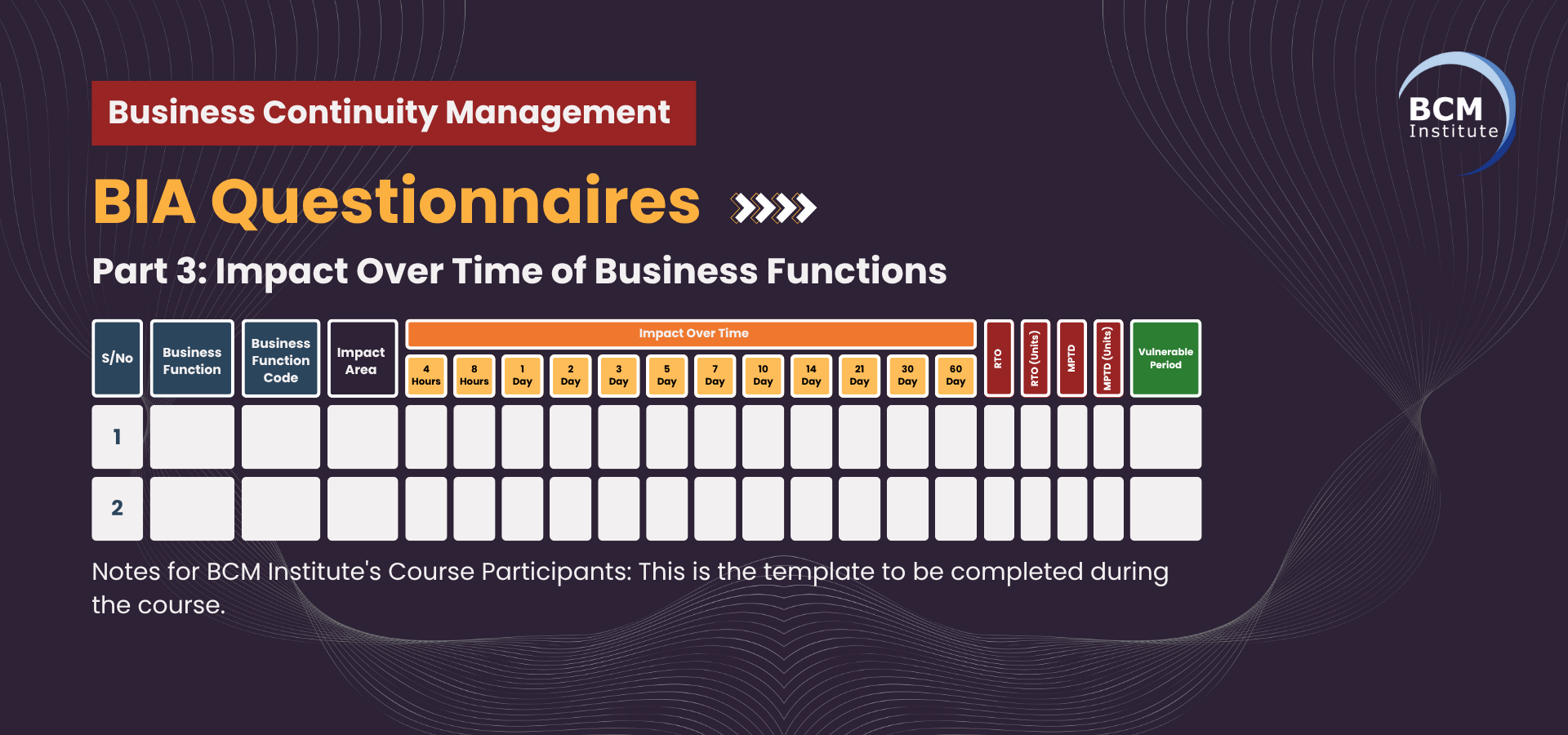
#### [![Banner \[Table\] \[BCM\] \[E3\] \[BIA\] \[\[P3\] Impact Over Time of Business Functions \[BIAQ\]](https://no-cache.hubspot.com/cta/default/3893111/b31bbcc9-edc2-4fc8-9cae-5c5797e36f84.png)](https://cta-redirect.hubspot.com/cta/redirect/3893111/b31bbcc9-edc2-4fc8-9cae-5c5797e36f84)
Table P3: Impact Over Time of Business Functions for CBF-1
| Sub-CBF Code | Sub-Critical Business Function | Highest-Impact Area | 4 Hrs | 8 Hrs | 1 Day | 2 Days | 3 Days | 5 Days | 7 Days | 10 Days | 14 Days | 21 Days | 30 Days | 60 Days | RTO | MTPD | Vulnerable Period |
| --- | --- | --- | --- | --- | --- | --- | --- | --- | --- | --- | --- | --- | --- | --- | --- | --- | --- |
| 1.1 | Emergency Patient Arrival and Registration | Operational | 3 | 4 | 5 | 5 | 5 | 5 | 5 | 5 | 5 | 5 | 5 | 5 | 2 Hours | 8 Hours | Mass casualty incidents, peak Emergency Department demand, public holidays |
| 1.2 | Obstetric Triage and Clinical Prioritisation | Operational | 4 | 5 | 5 | 5 | 5 | 5 | 5 | 5 | 5 | 5 | 5 | 5 | 30 Minutes | 4 Hours | Simultaneous high-risk obstetric admissions and emergency surges |
| 1.3 | Emergency Clinical Assessment | Operational | 4 | 5 | 5 | 5 | 5 | 5 | 5 | 5 | 5 | 5 | 5 | 5 | 1 Hour | 6 Hours | Multiple concurrent obstetric emergencies requiring specialist review |
| 1.4 | Diagnostic and Laboratory Support | Technology | 3 | 4 | 5 | 5 | 5 | 5 | 5 | 5 | 5 | 5 | 5 | 5 | 2 Hours | 8 Hours | Blood shortages, laboratory system failures, emergency surgery periods |
| 1.5 | Emergency Obstetric Decision-Making | Operational | 4 | 5 | 5 | 5 | 5 | 5 | 5 | 5 | 5 | 5 | 5 | 5 | 1 Hour | 6 Hours | Severe maternal haemorrhage, fetal distress, emergency Caesarean decisions |
| 1.6 | Emergency Theatre Preparation | Operational | 4 | 5 | 5 | 5 | 5 | 5 | 5 | 5 | 5 | 5 | 5 | 5 | 1 Hour | 6 Hours | High emergency surgical workload and theatre capacity constraints |
| 1.7 | Emergency Obstetric Surgery and Delivery | Customer / Stakeholder | 5 | 5 | 5 | 5 | 5 | 5 | 5 | 5 | 5 | 5 | 5 | 5 | Immediate (\<30 Minutes) | 2 Hours | Emergency Caesarean section, uterine rupture, severe fetal distress |
| 1.8 | Anaesthesia and Perioperative Care | Human Resources | 4 | 5 | 5 | 5 | 5 | 5 | 5 | 5 | 5 | 5 | 5 | 5 | 30 Minutes | 4 Hours | Concurrent emergency surgical procedures and critical anaesthetic demand |
| 1.9 | Neonatal Emergency Support | Customer / Stakeholder | 5 | 5 | 5 | 5 | 5 | 5 | 5 | 5 | 5 | 5 | 5 | 5 | Immediate (\<30 Minutes) | 2 Hours | Premature deliveries, neonatal resuscitation and NICU admissions |
| 1.10 | Maternal Critical Care and Stabilisation | Operational | 4 | 5 | 5 | 5 | 5 | 5 | 5 | 5 | 5 | 5 | 5 | 5 | 1 Hour | 4 Hours | Severe postpartum haemorrhage, sepsis, critical maternal deterioration |
| 1.11 | Blood Products and Medication Management | Third-Party Dependency | 4 | 5 | 5 | 5 | 5 | 5 | 5 | 5 | 5 | 5 | 5 | 5 | 1 Hour | 4 Hours | Massive transfusion activation and emergency obstetric haemorrhage events |
| 1.12 | Clinical Communication and Care Coordination | Information | 3 | 4 | 5 | 5 | 5 | 5 | 5 | 5 | 5 | 5 | 5 | 5 | 2 Hours | 8 Hours | Hospital-wide emergency response, multiple multidisciplinary activations |
| 1.13 | Patient Monitoring and Ongoing Clinical Management | Technology | 4 | 5 | 5 | 5 | 5 | 5 | 5 | 5 | 5 | 5 | 5 | 5 | 1 Hour | 6 Hours | Intensive monitoring of unstable mothers and critically ill newborns |
| 1.14 | Patient Transfer and Continuity of Care | Operational | 2 | 3 | 4 | 5 | 5 | 5 | 5 | 5 | 5 | 5 | 5 | 5 | 4 Hours | 24 Hours | ICU/NICU bed shortages and hospital-wide patient surge conditions |
| 1.15 | Clinical Documentation and Regulatory Reporting | Regulatory | 2 | 2 | 3 | 3 | 4 | 4 | 5 | 5 | 5 | 5 | 5 | 5 | 24 Hours | 72 Hours | Extended EMR outages, medico-legal investigations and regulatory audits |
[![Banner \[BCM\] \[E3\] \[BIA\] \[Summing Up\] \[P3\] Impact Over Time of Business Functions \[BIAQ\]](https://no-cache.hubspot.com/cta/default/3893111/987f8ca5-0ba4-4281-be57-5221186733d0.png)](https://cta-redirect.hubspot.com/cta/redirect/3893111/987f8ca5-0ba4-4281-be57-5221186733d0)
The impact-over-time assessment demonstrates that the majority of Sub-Critical Business Functions supporting **Emergency Obstetric Services** become highly critical within the first few hours of disruption.
Functions associated with emergency clinical assessment, surgery, anaesthesia, neonatal resuscitation, maternal stabilisation, and blood product management exhibit an immediate escalation to **Very High** impact because any prolonged interruption directly threatens patient safety and clinical outcomes.
Other supporting functions, such as patient transfer and clinical documentation, deteriorate more progressively but still require timely restoration to maintain safe and compliant operations.
The recommended **Recovery Time Objectives (RTOs)** identify the target restoration times needed to avoid unacceptable clinical and operational consequences, while the **Maximum Tolerable Periods of Disruption (MTPDs)** define the point beyond which the continued delivery of Emergency Obstetric Services would be seriously compromised.
These values provide essential design criteria for recovery strategies, technology resilience, staffing models, and contingency arrangements.
Identifying **Vulnerable Periods** further strengthens continuity planning by highlighting operational scenarios in which disruptions would have the greatest impact, such as emergency Caesarean sections, major haemorrhage events, neonatal resuscitations, mass casualty incidents, and periods of exceptionally high emergency demand.
Together, the impact-over-time analysis enables KKH to prioritise recovery efforts, allocate critical resources effectively, and develop Business Continuity Plans that support resilient, uninterrupted emergency obstetric care under severe but plausible disruption scenarios.
[![\[BCM\] \[KKH\] \[3/4 Banner\] Implementing Business Continuity Management for KKH](https://no-cache.hubspot.com/cta/default/3893111/141669d3-f654-4e57-9ccd-2d2ab49f536d.png)](https://cta-redirect.hubspot.com/cta/redirect/3893111/141669d3-f654-4e57-9ccd-2d2ab49f536d)
| **eBook 3: Starting Your BCM Implementation** | | | | | | |
| --- | --- | --- | --- | --- | --- | --- |
| **MBCO** | **P&S** | **RAR T1** | **RAR T2** | **RAR T3** | **BCS T1** | **CBF** |
| [![BCM\] \[KKH\] \[E3\] \[BIA\] MBCO Corporate MBCO](https://no-cache.hubspot.com/cta/default/3893111/55ac38bc-d349-4faf-a6dc-cbc3d3f5431b.png)](https://cta-redirect.hubspot.com/cta/redirect/3893111/55ac38bc-d349-4faf-a6dc-cbc3d3f5431b) | [![BCM\] \[KKH\] \[E3\] \[BIA\] \[PS\] Key Product and Services](https://no-cache.hubspot.com/cta/default/3893111/b28ee275-3bf7-4832-a3a0-0bcca82d2522.png)](https://cta-redirect.hubspot.com/cta/redirect/3893111/b28ee275-3bf7-4832-a3a0-0bcca82d2522) | [![BCM\] \[KKH\] \[E3\] \[RAR\] \[T1\] List of Threats](https://no-cache.hubspot.com/cta/default/3893111/684e108e-12b3-4872-99e4-6b61ce39596e.png)](https://cta-redirect.hubspot.com/cta/redirect/3893111/684e108e-12b3-4872-99e4-6b61ce39596e) | [![BCM\] \[KKH\] \[E3\] \[RAR\] \[T2\] Treatment and Control](https://no-cache.hubspot.com/cta/default/3893111/6c690eb5-e7da-4206-ac6b-fb88a8966a69.png)](https://cta-redirect.hubspot.com/cta/redirect/3893111/6c690eb5-e7da-4206-ac6b-fb88a8966a69) | [![BCM\] \[KKH\] \[E3\] \[RAR\] \[T3\] Risk Impact and Likelihood Assessment](https://no-cache.hubspot.com/cta/default/3893111/a9730f15-ebd1-4e30-b308-6d574be794a1.png)](https://cta-redirect.hubspot.com/cta/redirect/3893111/a9730f15-ebd1-4e30-b308-6d574be794a1) | [![BCM\] \[KKH\] \[E3\] \[BCS\] \[T1\] Mitigation Strategies and Justification](https://no-cache.hubspot.com/cta/default/3893111/28b77d9a-b16b-44e7-9abf-965d3db4f803.png)](https://cta-redirect.hubspot.com/cta/redirect/3893111/28b77d9a-b16b-44e7-9abf-965d3db4f803) | [![\[BCM\] \[KKH\] \[E1\] \[C10\] Identifying Critical Business Functions](https://no-cache.hubspot.com/cta/default/3893111/0d1cbf1e-59f6-43c8-a15e-6b34233e632f.png)](https://cta-redirect.hubspot.com/cta/redirect/3893111/0d1cbf1e-59f6-43c8-a15e-6b34233e632f) |
| **CBF-1 Emergency Obstetric Services** | | | | | | |
| **DP** | **BIAQ P1** | **BIAQ P2** | **BIAQ P3** | **BIAQ P4** | **BIAQ P5** | **BIAQ P6** |
| [![\[BCM\] \[KKH\] \[E3\] \[BIA\] \[DP\] \[CBF\] \[1\] Emergency Obstetric Services](https://no-cache.hubspot.com/cta/default/3893111/e497eed8-773b-4e86-bbf8-8e9c3032365b.png)](https://cta-redirect.hubspot.com/cta/redirect/3893111/e497eed8-773b-4e86-bbf8-8e9c3032365b) | **[![\[BCM\] \[KKH\] \[E3\] \[BIA\] \[T1\] \[CBF\] \[1\] Emergency Obstetric Services](https://no-cache.hubspot.com/cta/default/3893111/7bda08a6-461a-4c89-8806-4d6d1216e9f4.png)](https://cta-redirect.hubspot.com/cta/redirect/3893111/7bda08a6-461a-4c89-8806-4d6d1216e9f4)** | **[![\[BCM\] \[KKH\] \[E3\] \[BIA\] \[T2\] \[CBF\] \[1\] Emergency Obstetric Services](https://no-cache.hubspot.com/cta/default/3893111/0724500a-3544-46b8-af30-f31b292e5eb9.png)](https://cta-redirect.hubspot.com/cta/redirect/3893111/0724500a-3544-46b8-af30-f31b292e5eb9)** | **[![\[BCM\] \[KKH\] \[E3\] \[BIA\] \[T3\] \[CBF\] \[1\] Emergency Obstetric Services](https://no-cache.hubspot.com/cta/default/3893111/dc455c8b-0db4-45c4-8f33-e81d69d35344.png)](https://cta-redirect.hubspot.com/cta/redirect/3893111/dc455c8b-0db4-45c4-8f33-e81d69d35344)** | **[![\[BCM\] \[KKH\] \[E3\] \[BIA\] \[T4\] \[CBF\] \[1\] Emergency Obstetric Services](https://no-cache.hubspot.com/cta/default/3893111/f4e64c69-124b-40a8-b224-dded90e5631b.png)](https://cta-redirect.hubspot.com/cta/redirect/3893111/f4e64c69-124b-40a8-b224-dded90e5631b)** | **[![\[BCM\] \[KKH\] \[E3\] \[BIA\] \[T5\] \[CBF\] \[1\] Emergency Obstetric Services](https://no-cache.hubspot.com/cta/default/3893111/f6eaac47-7206-4cba-b6f4-b58245fa9111.png)](https://cta-redirect.hubspot.com/cta/redirect/3893111/f6eaac47-7206-4cba-b6f4-b58245fa9111)** | **[![\[BCM\] \[KKH\] \[E3\] \[BIA\] \[T6\] \[CBF\] \[1\] Emergency Obstetric Services](https://no-cache.hubspot.com/cta/default/3893111/5aa80ea6-6214-44b6-92a2-4156d7d4cfe5.png)](https://cta-redirect.hubspot.com/cta/redirect/3893111/5aa80ea6-6214-44b6-92a2-4156d7d4cfe5)** |
| | | **BCS T2** | **BCS T3** | **PD** | | |
| | | [![\[BCM\] \[KKH\] \[E3\] \[BCS\] \[T2\] \[CBF\] \[1\] Emergency Obstetric Services](https://no-cache.hubspot.com/cta/default/3893111/8d32e264-3e43-4d37-be2a-1382e798c916.png)](https://cta-redirect.hubspot.com/cta/redirect/3893111/8d32e264-3e43-4d37-be2a-1382e798c916) | [![\[BCM\] \[KKH\] \[E3\] \[BCS\] \[T3\] \[CBF\] \[1\] Emergency Obstetric Services](https://no-cache.hubspot.com/cta/default/3893111/b53ff102-21b1-4f31-b47e-5b721028ee65.png)](https://cta-redirect.hubspot.com/cta/redirect/3893111/b53ff102-21b1-4f31-b47e-5b721028ee65) | [![\[BCM\] \[KKH\] \[E3\] \[PD\] \[CBF\] \[1\] Emergency Obstetric Services](https://no-cache.hubspot.com/cta/default/3893111/f9da91f2-6ad8-4c19-b25f-ef7b136c8a04.png)](https://cta-redirect.hubspot.com/cta/redirect/3893111/f9da91f2-6ad8-4c19-b25f-ef7b136c8a04) | | |
| | | | | | | |
#### More Information About Business Continuity Management Courses
To learn more about the course and schedule, click the buttons below for the BCM-300 Business Continuity Management Implementer \[BCM-3\] and the BCM-5000 Business Continuity Management Expert Implementer \[BCM-5\].
| [](https://cta-redirect.hubspot.com/cta/redirect/3893111/f3922b80-e96a-46d6-8993-dc150a5de2d5) | [](https://cta-redirect.hubspot.com/cta/redirect/3893111/9ff8a3dc-e39a-465b-929f-72e232cdd5fb) | [![Register \[BL-B-3\]\*](https://no-cache.hubspot.com/cta/default/3893111/ac6cf073-4cdd-4541-91ed-889f731d5076.png)](https://cta-redirect.hubspot.com/cta/redirect/3893111/ac6cf073-4cdd-4541-91ed-889f731d5076) |
| --- | --- | --- |
| [](https://cta-redirect.hubspot.com/cta/redirect/3893111/21525c10-4003-4934-95fc-fe218174bc5b) | [](https://cta-redirect.hubspot.com/cta/redirect/3893111/46460171-c91a-4936-9bb2-8dc5928a0e02) | [](https://cta-redirect.hubspot.com/cta/redirect/3893111/1cb17ac7-50b2-4f88-bc4b-c7444e4b57b5) |
| [![FAQ \[BL-B-3\]](https://no-cache.hubspot.com/cta/default/3893111/b3824ba1-7aa1-4eb6-bef8-94f57121c5ae.png)](https://cta-redirect.hubspot.com/cta/redirect/3893111/b3824ba1-7aa1-4eb6-bef8-94f57121c5ae) | Please feel free to send us a note if you have any questions. [![Email to Sales Team \[BCM Institute\]](https://no-cache.hubspot.com/cta/default/3893111/3c53daeb-2836-4843-b0e0-645baee2ab9e.png)](https://cta-redirect.hubspot.com/cta/redirect/3893111/3c53daeb-2836-4843-b0e0-645baee2ab9e) | [](https://cta-redirect.hubspot.com/cta/redirect/3893111/9c199ae8-c470-4bb7-9612-73c7a084e94c) |
| [](https://cta-redirect.hubspot.com/cta/redirect/3893111/8999211a-2c51-4be7-bf49-c393f6c67974) | [](https://cta-redirect.hubspot.com/cta/redirect/3893111/5c1aa95d-f6dd-4067-a95c-5cc0c32d7ed8) | [](https://cta-redirect.hubspot.com/cta/redirect/3893111/086ab3b9-4d66-4a95-b2f7-1148e9803a9c) |
#### **Your Comments Here:**
### More Posts
[](https://cta-redirect.hubspot.com/cta/redirect/3893111/839787f4-a4fd-456f-accf-54c947026558)

All rights reserved. Copyright 2026
```json
{
"@context" : "https://schema.org",
"@type" : "BlogPosting",
"author" : {
"@type" : "Person",
"name" : "Dr Goh Moh Heng",
"url" : "https://blog.bcm-institute.org/ebook/author/dr-goh-moh-heng"
},
"dateModified" : "2026-08-10T06:19:24.453Z",
"datePublished" : "2026-08-10T06:19:16.000Z",
"headline" : "[BCM] [KKH] [E3] [BIA] [P3] CBF [1] Emergency Obstetric Services",
"mainEntityOfPage" : {
"@id" : "https://blog.bcm-institute.org/ebook/bcm-kkh-e3-bia-p3-cbf-1-emergency-obstetric-services",
"@type" : "WebPage"
},
"publisher" : {
"@type" : "Organization",
"logo" : {
"@type" : "ImageObject",
"url" : "https://blog.bcm-institute.org/hubfs/BCMI%20Logo.png"
},
"name" : "BCMI Pte Ltd"
}
}
```