---
title: [BCM] [JS] [E3] [RAR] [P1] List of Threats
description: [BCM] [JS] [E3] [RAR] [P1] List of Threats
image: https://blog.bcm-institute.org/hubfs/Jamiyah%20Singapore%20Graphic%20Folder/JS%20BCM%20E3%20Morepost/BCM%5D%20%5BJS%5D%20%5BE3%5D%20%5BRAR%5D%20%5BT1%5D%20List%20of%20Threats.jpg
---
. .
[](http://www.bcm-institute.org/)
- [Home](https://www.bcm-institute.org/)
- [About Us](https://www.bcm-institute.org/about-us-3/)
- [A President’s Perspective](https://www.bcm-institute.org/about-us/a-presidents-perspective/)
- [Our History](https://www.bcm-institute.org/about-us/our-history/)
- [Our Advisory Council](https://www.bcm-institute.org/about-us/our-advisory-council/)
- [Customers’ Testimonials](https://www.bcm-institute.org/about-us/customers-testimonials/)
- [Credential Verification](https://www.bcm-institute.org/about-us/credential-verification/)
- [Courses](https://blog.bcm-institute.org/blog/course-fees-for-blended-learning-courses-master-catalog)
- [ISO 22301 Business Continuity Management System Audit](https://blog.bcm-institute.org/audit/business-continuity-management-audit-courses)
- [ISO 22301 Business Continuity Management](https://blog.bcm-institute.org/bcm/business-continuity-management-courses)
- [Crisis Communication](https://blog.bcm-institute.org/crisis-communication/crisis-communication-courses)
- [Crisis Management](https://blog.bcm-institute.org/en/crisis-management/courses)
- [IT Disaster Recovery](https://blog.bcm-institute.org/it-disaster-recovery/courses)
- [Operational Resilience](https://blog.bcm-institute.org/operational-resilience/courses)
- [Operational Resilience Audit](https://blog.bcm-institute.org/operational-resilience-audit/courses)
- [Certification](https://blog.bcm-institute.org/certification/types-of-certifications-offered)
- [ISO 22301 BCMS Audit Certification](https://blog.bcm-institute.org/certification/business-continuity-management-audit-certification)
- [ISO22301 Business Continuity Management Certification](https://blog.bcm-institute.org/bcm/business-continuity-management-certification)
- [Crisis Communication Certification](https://blog.bcm-institute.org/crisis-communication/crisis-communication-certification)
- [Crisis Management Certification](https://blog.bcm-institute.org/en/crisis-management/crisis-management-certification)
- [IT Disaster Recovery Planning Certification](https://blog.bcm-institute.org/it-disaster-recovery/it-disaster-recovery-certification)
- [Operational Resilience Certification](https://blog.bcm-institute.org/operational-resilience/operational-resilience-certification)
- [Operational Resilience Audit Certification](https://blog.bcm-institute.org/operational-resilience-audit)
- [Seminars](https://blog.bcm-institute.org/meet-the-expert/mte-webinar-mainpage)
- [Store](https://www.bcm-institute.org/store-2/)
- [Contact Us](http://www.bcm-institute.org/about-us/contact-us/)
-
-
##### Resilient Communities: Implementing Business Continuity Management at Jamiyah Singapore

# \[BCM\] \[JS\] \[E3\] \[RAR\] \[P1\] List of Threats
[](https://cta-redirect.hubspot.com/cta/redirect/3893111/b764264e-ccf8-489f-9125-6bdfc8db17b3)
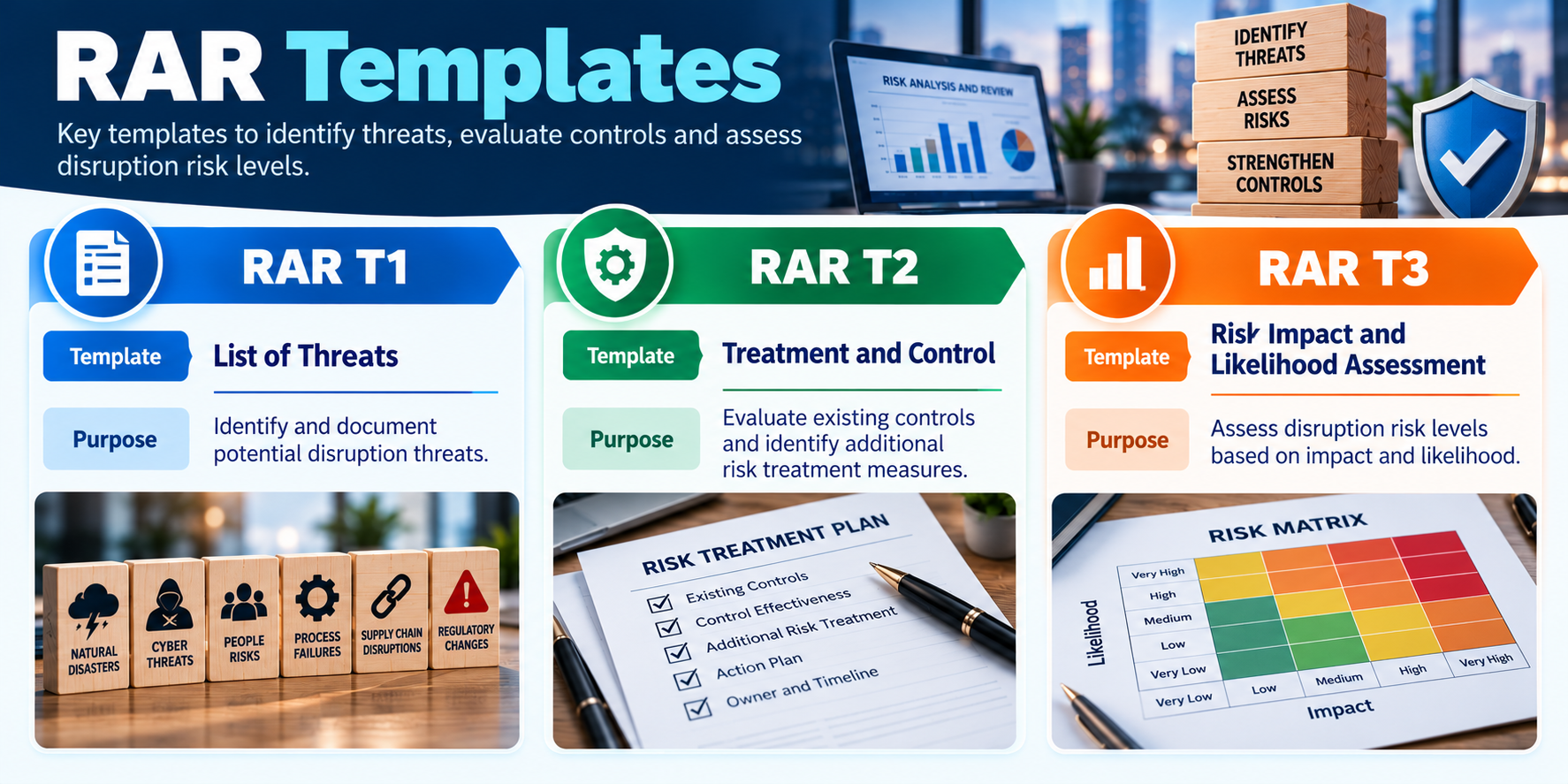
Risk Analysis and Review (RAR) is an essential component of Business Continuity Management (BCM).
It helps an organisation identify potential sources of disruption that could affect its people, premises, technology, information, suppliers, stakeholders, and the delivery of critical services.
The first stage of RAR is identifying threats.
For Jamiyah Singapore (JS), threat identification is particularly important because disruptions may affect services supporting vulnerable individuals, residential care beneficiaries, children, students and families requiring community assistance.
Unlike organisations whose operations primarily involve administrative or commercial activities, JS may deliver services where interruption could have immediate consequences for beneficiary safety, welfare, safeguarding and access to essential support.
This chapter establishes a comprehensive Threat Register identifying credible sources of disruption relevant to JS's operating environment.
[](https://cta-redirect.hubspot.com/cta/redirect/3893111/65957ea5-03c3-451d-aabe-bbf23d32c897)
[Dr Goh Moh Heng](https://blog.bcm-institute.org/ebook/author/dr-goh-moh-heng) Oct 15, 2026
###### Business Continuity Management Certified Planner-Specialist-Expert
### [](https://cta-redirect.hubspot.com/cta/redirect/3893111/7a1ba6dc-8352-46e7-b150-d25945acf3d9)
[](https://cta-redirect.hubspot.com/cta/redirect/3893111/a40e6a2e-edd1-47f8-8caa-b6655d20e294)
#### List of Threats**[](https://cta-redirect.hubspot.com/cta/redirect/3893111/65957ea5-03c3-451d-aabe-bbf23d32c897)**
### RAR Part 1: List of Threats for Jamiyah Singapore
#### Introduction
[](https://cta-redirect.hubspot.com/cta/redirect/3893111/87b522e2-f0d8-4959-9c59-40a3be1b6f71)Risk Analysis and Review (RAR) is an essential component of Business Continuity Management (BCM). It enables an organisation to identify potential sources of disruption that could affect its people, premises, technology, information, suppliers, stakeholders, and delivery of critical services.
The first stage of RAR is identifying threats.
For Jamiyah Singapore (JS), threat identification is particularly important because disruptions may affect services supporting vulnerable individuals, residential care beneficiaries, children, students and families requiring community assistance.
Unlike organisations whose operations primarily involve administrative or commercial activities, JS may deliver services where interruption could have immediate consequences for beneficiary safety, welfare, safeguarding and access to essential support.
This chapter establishes a comprehensive Threat Register identifying credible sources of disruption relevant to JS's operating environment.
The register considers both traditional business continuity threats and emerging operational resilience concerns, including climate-related disruption, cyberattacks, technology dependencies, workforce constraints and supply chain vulnerabilities.
#### **Purpose of Identifying Threats**
Threat identification establishes the potential events or conditions that could interrupt organisational activities.
The objective is to recognise credible disruption scenarios before evaluating their consequences or deciding how to manage them.
For JS, the assessment should consider threats that may affect:
- Residential care and resident safety.
- Nursing and essential healthcare support.
- Early childhood care and education.
- Student care and educational support.
- Emergency welfare and financial assistance.
- Food assistance and essential distribution.
- Beneficiary case management and referral.
- Beneficiary, family and emergency communications.
- Critical ICT systems and information management.
- Essential finance, procurement and resource support.
These ten Critical Business Functions (CBFs) provide the operational context for identifying organisation-level threats.
#### **Why Threat Identification Precedes Risk Assessment**
A threat is a potential source of disruption, such as a fire, infectious disease outbreak, cyberattack or supplier failure.
A vulnerability is a condition that may make an organisation susceptible to that threat, such as reliance on a single facility, a limited pool of qualified personnel or a concentrated technology dependency.
Risk arises when a threat interacts with relevant circumstances and creates uncertainty regarding organisational objectives.
The Threat Register identifies potential sources of disruption. Subsequent assessment activities examine the relevant vulnerabilities, consequences and risk characteristics.
This separation helps prevent the organisation from prematurely excluding threats before it has collected sufficient operational information.
#### **Country-Level and Organisation-Level Threat Identification**
Consider threats from two perspectives.
Country-Level Relevance describes how a threat relates to Singapore's geography, climate, infrastructure, economic conditions, regulatory environment and broader operating context.
Organisation-Level Relevance explains how the same threat could affect JS's facilities, personnel, systems, suppliers, beneficiaries or critical services.
For example, flash flooding is a recognised hazard in Singapore. Its organisation-level consequences could include restricted access to a residential facility, delayed care personnel, interrupted food deliveries or difficulties transporting beneficiaries.
A threat may be credible at the national level without necessarily affecting every JS facility. Therefore, validate site-specific exposure separately.
##### **Relationship with BIA, BCS and Crisis Management**
The Threat Register provides a foundation for subsequent BCM activities.
#### **Threat Identification and BCM Planning**
#### ****
#### **Scope and Assessment Boundaries**
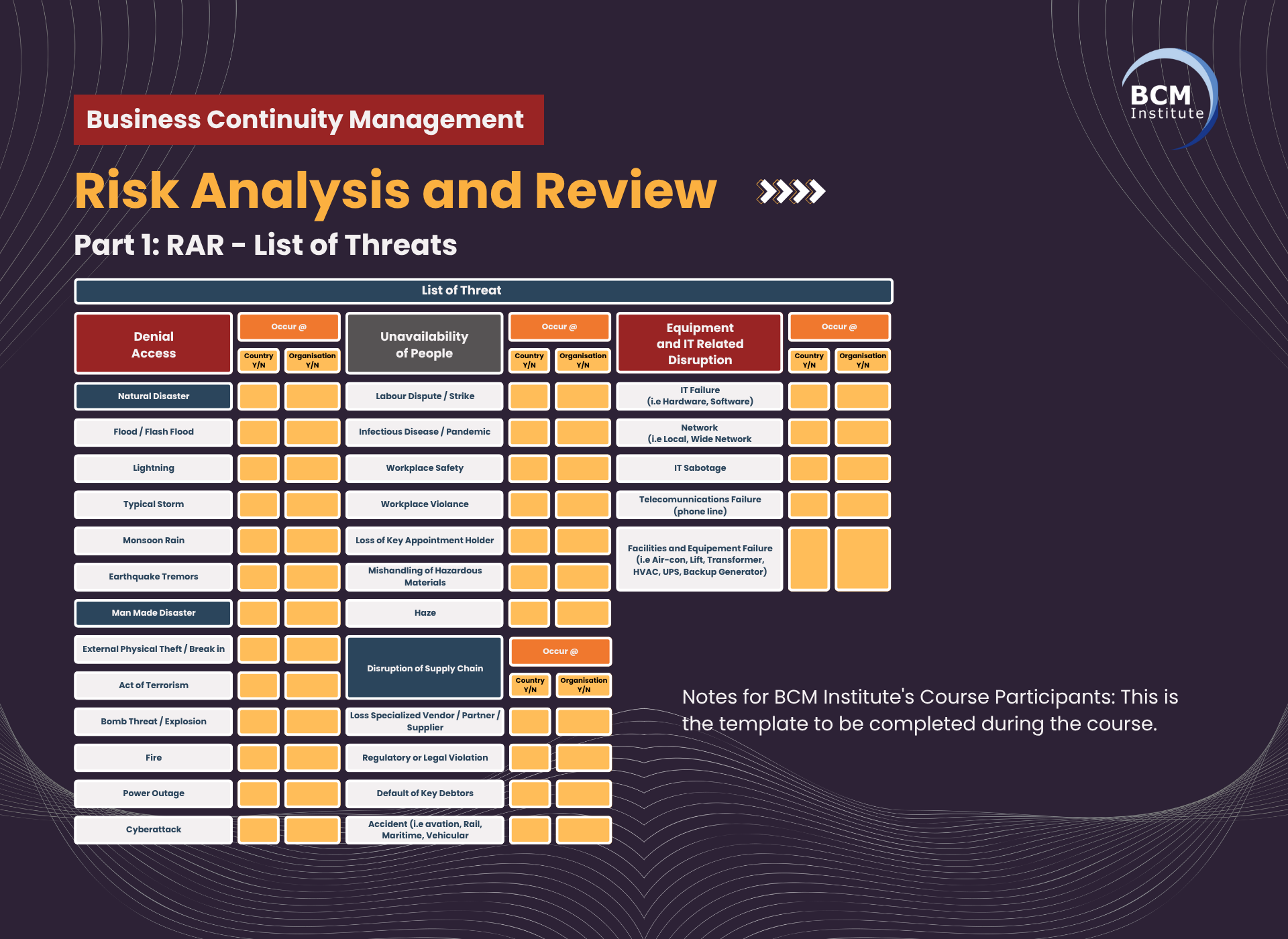
This chapter covers five required threat categories:
1. Denial of Access – Natural Disaster.
2. Denial of Access – Man-made Disaster.
3. Unavailability of People.
4. Disruption to the Supply Chain.
5. Equipment and IT-Related Disruption.
The descriptions are tailored to a Singapore-based charitable and community service organisation, using the ten previously identified JS CBFs as the planning context.
This chapter identifies potential sources of disruption only. It does not assign likelihood, impact scores, risk ratings, or recommend risk treatment measures. These activities belong to subsequent RAR assessments.
The national relevance statements are qualitative contextual descriptions, not formal likelihood assessments.
[](https://cta-redirect.hubspot.com/cta/redirect/3893111/e37f3bd5-8491-4dbf-bc45-2dabc16ba389)
#### **Threat Register**
Table RAR P1: List of Threats for Jamiyah Singapore
The register is organised into five sections using the same prescribed columns. Each threat describes a distinct disruption mechanism and its relevance to Singapore and JS.
The country-level statements describe the operating environment, including historical or geographical context. They should not be interpreted as risk ratings or predictions.
##### **Category 1: Denial of Access – Natural Disaster**
Natural hazards can prevent employees, beneficiaries, residents, suppliers and emergency responders from reaching JS facilities.
They may also render premises temporarily unsafe or unsuitable for continued operations.
Table RAR T1-C1: List of Threats
| Category of Threats | Types of Threats | Description of Threat | Country-Level Relevance | Organisation-Level Relevance |
| --- | --- | --- | --- | --- |
| Denial of Access – Natural Disaster | Flood | Sustained heavy rainfall or drainage overflow inundates roads, entrances, basements or surrounding land, restricting safe access to buildings. | Localised flooding is a recognised hazard in Singapore, particularly in flood-prone or low-lying areas. | Access to residential premises, care centres or food distribution points may be obstructed, delaying staff and essential supplies. |
| Denial of Access – Natural Disaster | Flash Flood | Intense rainfall causes rapid surface-water accumulation and sudden restrictions on road or pedestrian access. | Short-duration intense rainfall and flash-flood incidents are relevant to Singapore's tropical climate. | Care workers, school transport, emergency vehicles and beneficiaries may be unable to reach affected facilities during operating hours. |
| Denial of Access – Natural Disaster | Severe Thunderstorm | Heavy rain, strong winds and lightning create unsafe outdoor conditions, fallen debris and transport disruption. | Thunderstorms are commonly experienced in Singapore throughout the year. | Outdoor beneficiary activities, staff movements, deliveries and access to residential or educational premises may be interrupted. |
| Denial of Access – Natural Disaster | Lightning Strike | Lightning can affect exposed structures, outdoor areas, or electrical installations, potentially causing damage and unsafe access conditions. | Singapore experiences substantial lightning activity associated with tropical thunderstorms. | Outdoor areas may become inaccessible, while affected electrical installations could disrupt care facilities and essential ICT services. |
| Denial of Access – Natural Disaster | Earthquake and Regional Tremors | A regional earthquake can cause tremors or damage structures, prompting evacuation or building access restrictions. | Singapore is outside the main regional earthquake zones but can experience tremors from significant regional earthquakes. | Building inspections or temporary evacuations could disrupt residential accommodation, childcare, and administrative services. |
| Denial of Access – Natural Disaster | Tsunami or Coastal Inundation | A major regional marine event or coastal inundation restricts access to exposed coastal areas and infrastructure. | Singapore's geography generally limits direct tsunami exposure, although regional marine hazards remain relevant to coastal infrastructure planning. | Affected transport routes, coastal facilities or supporting infrastructure could disrupt access and external deliveries. |
| Denial of Access – Natural Disaster | Landslide or Slope Failure | Saturated or unstable ground can cause soil movement, debris accumulation, or the closure of adjacent roads and buildings. | Localised slope instability matters where constructed slopes, retaining structures, or excavations are present. | Affected access roads or premises could become unavailable, particularly where facilities are near slopes or construction works. |
| Denial of Access – Natural Disaster | Vegetation or Wildfire | Fires involving vegetation or landscaped areas produce smoke, heat, and access restrictions. | Large wildfires are not characteristic of urban Singapore, but vegetation fires can occur during dry conditions. | Smoke or nearby fire activity could temporarily close premises or interrupt outdoor beneficiary services. |
| Denial of Access – Natural Disaster | Extreme Heat | Prolonged elevated temperatures create unsafe thermal conditions in buildings or outdoor service areas. | Heat stress is a well-established concern in Singapore's hot, humid climate. | Residential care, childcare and student care facilities may become unsuitable if indoor temperatures cannot be maintained safely. |
| Denial of Access – Natural Disaster | Transboundary Haze | Regional vegetation fires generate smoke pollution that affects air quality and outdoor activity. | Singapore has experienced episodes of transboundary haze associated with regional land and forest fires. | Vulnerable residents, children and staff may be unable to use outdoor areas, while indoor air-quality concerns could affect facility operations. |
| Denial of Access – Natural Disaster | Pandemic-Related Movement Restrictions | Public health restrictions or facility-specific movement controls limit entry, travel or access to service locations. | Singapore has experience with movement and operating restrictions during major public health emergencies. | Residential visits, childcare operations, beneficiary appointments and volunteer deployment could be restricted. |
| Denial of Access – Natural Disaster | Prolonged Severe Weather | Repeated heavy rainfall and storms create extended access difficulties, damage or unsafe external conditions. | Monsoon periods can bring persistent rainfall and adverse weather conditions. | Staff attendance, food assistance distribution and inter-facility transfers may be disrupted over successive operating periods. |
| Denial of Access – Natural Disaster | Sinkhole or Ground Subsidence | Localised ground collapse damages a road, walkway or building approach, requiring access restrictions. | Localised ground instability and subsidence can arise in urban environments, including near underground works. | A facility entrance, nearby road or utility corridor may become inaccessible, interrupting staff and beneficiary movement. |
| Denial of Access – Natural Disaster | Regional Volcanic Ash | A major regional volcanic eruption generates airborne ash or aviation disruption affecting travel and logistics. | Singapore has no active volcanoes, but major eruptions elsewhere in Southeast Asia can affect regional transport networks. | International procurement, specialist personnel travel or time-sensitive imported supplies could be delayed. |
| Denial of Access – Natural Disaster | Coastal Storm Surge and Sea-Level Extremes | Elevated coastal water levels inundate exposed roads or facilities, restricting access and services. | Coastal flooding and sea-level change are relevant to Singapore's long-term climate and infrastructure context. | Coastal transport connections or supporting utilities could be disrupted, affecting JS where operational dependencies use exposed locations. |
##### **Category 2: Denial of Access – Man-made Disaster**
Man-made incidents may originate within a JS facility or from surrounding buildings, transport networks, public spaces and industrial activities.
These incidents can create immediate safety concerns, restrict access, or require suspending normal operations.
Table RAR T1-C2: List of Threats
| Category of Threats | Types of Threats | Description of Threat | Country-Level Relevance | Organisation-Level Relevance |
| --- | --- | --- | --- | --- |
| Denial of Access – Man-made Disaster | Building Fire | A fire within premises causes smoke, heat, evacuation, and potential loss of building access. | Building fires are a recognised urban safety hazard in Singapore. | Residential care, childcare, student care or administrative premises may become unusable, interrupting services and resident accommodation. |
| Denial of Access – Man-made Disaster | Explosion | A gas, equipment or other explosion damages premises and creates unsafe conditions. | Explosions are credible industrial, commercial and building-related hazards. | Structural damage, injuries or emergency cordons could prevent access to JS facilities. |
| Denial of Access – Man-made Disaster | Chemical Spill | An accidental release of hazardous substances can cause contamination or toxic exposure, requiring area isolation. | Singapore's industrial, laboratory, logistics and transport activities involve hazardous materials. | A nearby spill could restrict access, interrupt deliveries or require evacuation of vulnerable beneficiaries. |
| Denial of Access – Man-made Disaster | Gas Leak | The escape of combustible or harmful gas can create fire, explosion, or health hazards. | Gas installations and distribution systems are present across residential, commercial and industrial settings. | A leak within or near a facility could interrupt food preparation, residential accommodation or educational activities. |
| Denial of Access – Man-made Disaster | Structural Failure | Failure of structural components or building elements makes premises unsafe for occupancy. | Building safety is relevant in Singapore's dense built environment, including older premises and renovation sites. | JS may lose access to rooms, care areas or entire facilities while structural conditions are assessed. |
| Denial of Access – Man-made Disaster | Building Collapse | Major structural failure causes widespread damage and prevents occupancy or access. | Severe structural collapse is an exceptional but credible built-environment hazard. | Affected premises could be unavailable for an extended period, disrupting accommodation and essential community services. |
| Denial of Access – Man-made Disaster | Civil Disturbance | Public gatherings or disorder cause road closures, crowding or restrictions around buildings. | Public-order incidents matter for urban security planning, although Singapore generally maintains a stable public environment. | Beneficiaries, staff and suppliers may be unable to reach affected facilities. |
| Denial of Access – Man-made Disaster | Riot | Widespread violent public disorder can lead to security restrictions and disrupt local transport. | Large-scale riots have occurred rarely in Singapore recently but remain a recognised public-order scenario. | Facilities in affected areas could become inaccessible, delaying essential staff and beneficiary services. |
| Denial of Access – Man-made Disaster | Terrorist Attack | A deliberate attack causes casualties, infrastructure damage, security cordons or transport restrictions. | Terrorism remains a recognised national security concern for Singapore. | JS facilities or nearby public locations may be evacuated or isolated, interrupting care and community service delivery. |
| Denial of Access – Man-made Disaster | Bomb Threat or Suspicious Object | A reported explosive threat or suspicious item triggers evacuation, investigation and restricted access. | Security incidents involving suspicious items or threats are credible in public and commercial settings. | Residential, educational or community facilities may require temporary evacuation or suspension of operations. |
| Denial of Access – Man-made Disaster | Sabotage or Deliberate Property Damage | Intentional damage to premises, utilities, equipment or access systems interrupts operations. | Deliberate damage is a credible physical security threat across sectors. | Damaged access systems, essential equipment or facilities could prevent normal service delivery. |
| Denial of Access – Man-made Disaster | Active Assailant | An armed or violent individual creates an immediate threat requiring lockdown, evacuation or police intervention. | Serious targeted violence is a credible security scenario, even where such incidents are uncommon. | Resident, child, student and staff safety could be threatened, with immediate disruption to facility operations. |
| Denial of Access – Man-made Disaster | Public Disorder Near Facilities | Localised aggressive behaviour, crowding or confrontation creates unsafe access conditions. | Public-facing facilities can encounter isolated security and public-order incidents. | Staff, beneficiaries and visitors may be unable to enter or leave a JS service location safely. |
| Denial of Access – Man-made Disaster | Utility Infrastructure Incident | Damage to nearby electrical, water, or gas infrastructure can cause service interruptions or create exclusion zones. | Singapore relies on interconnected urban utility infrastructure. | A facility may become inaccessible or unsuitable because of surrounding infrastructure damage or emergency works. |
| Denial of Access – Man-made Disaster | Road Closure | Planned or emergency road restrictions prevent normal vehicle access. | Road closures occur in Singapore because of construction, major events, accidents and emergency incidents. | Emergency transport, food deliveries, staff movements and beneficiary transfers may be delayed. |
| Denial of Access – Man-made Disaster | Public Transport Disruption | Rail or bus service interruption prevents personnel and beneficiaries from travelling normally. | Singapore has extensive public transport networks that many commuters depend on. | Care workers, childcare personnel, volunteers and beneficiaries may be delayed or unable to attend. |
| Denial of Access – Man-made Disaster | Major Traffic Incident | Multi-vehicle collisions or transport infrastructure incidents cause congestion and road restrictions. | Road traffic incidents are a continuing urban transport concern. | Time-sensitive healthcare transfers, staff arrivals and distribution activities may be affected. |
| Denial of Access – Man-made Disaster | Aircraft Accident | An aviation incident creates emergency restrictions around an airport or affected location. | Singapore is a major aviation hub with extensive air transport activity. | Aviation-related closures could disrupt regional travel, imported supplies or facilities within affected transport corridors. |
| Denial of Access – Man-made Disaster | Nearby Industrial Accident | A fire, explosion, or hazardous release at an industrial or commercial site can affect surrounding access and safety. | Industrial activity and hazardous-material logistics form part of Singapore's operating environment. | Nearby facilities or transport routes could close, affecting JS operations even if its premises are undamaged. |
| Denial of Access – Man-made Disaster | Construction Accident or Excavation Damage | Adjacent construction activity damages access routes, underground utilities or surrounding structures. | Construction and infrastructure redevelopment are ongoing features of Singapore's urban environment. | JS premises could experience restricted access, utility interruption or temporary closure. |
| Denial of Access – Man-made Disaster | Security Lockdown or Police Cordoning | Authorities restrict access to a location during investigation or emergency operations. | Temporary security cordons are an established response to serious incidents. | Staff may be unable to enter facilities, while residents or beneficiaries may require alternative service arrangements. |
##### **Category 3: Unavailability of People**
People-related threats can disrupt services even when facilities, technology and supplies remain available.
For JS, continuity depends not only on workforce numbers but also on the availability of personnel with appropriate care, safeguarding, education, administrative and technical competencies.
Table RAR T1-C3: List of Threats
| Category of Threats | Types of Threats | Description of Threat | Country-Level Relevance | Organisation-Level Relevance |
| --- | --- | --- | --- | --- |
| Unavailability of People | Pandemic | A widespread infectious disease event affects workforce attendance, public health requirements and service demand. | Singapore is highly connected internationally and has experience managing pandemic conditions. | Residential care, childcare, student care and community assistance may face simultaneous staffing shortages and increased beneficiary needs. |
| Unavailability of People | Epidemic | A substantial disease outbreak affects a population or operating region, increasing illness and absenteeism. | Singapore's dense urban setting and international connectivity make infectious disease surveillance relevant. | Care personnel, administrative teams, and volunteers may be unavailable as service demand shifts. |
| Unavailability of People | Infectious Disease Outbreak Within a Facility | Transmission among residents, children, beneficiaries or staff affects attendance and safe service delivery. | Congregate care, educational and community settings have recognised infection-control considerations. | Residential care and education services may face staffing shortages, reduced care capacity, and operational restrictions. |
| Unavailability of People | Mass Illness or Foodborne Illness | Multiple personnel become ill following common exposure to contaminated food, water or another source. | Foodborne and communicable illness incidents remain relevant public health concerns. | A large proportion of a duty team may become unavailable simultaneously, affecting supervision and service delivery. |
| Unavailability of People | Labour Strike | Collective withdrawal of labour interrupts staffing and essential services. | Labour relations operate within Singapore's established industrial relations framework. | Disruption involving JS personnel or contracted service providers could affect care, cleaning, security, transport or catering. |
| Unavailability of People | Industrial Action or Work Stoppage | Organised refusal, slowdown or interruption of work affects operational capacity. | Industrial relations issues can affect employers and external service providers. | Outsourced or internal service interruptions could reduce staffing or delay essential support activities. |
| Unavailability of People | High Staff Turnover | Repeated employee departures reduce available experience and continuity of operations. | Workforce retention pressures affect several service sectors, including care and social services. | JS may experience gaps in experienced residential care, case management, education or technical personnel. |
| Unavailability of People | Loss of Key Personnel | Sudden departure, incapacity or prolonged absence of a critical role holder removes specialised knowledge or authority. | Key-person dependency is a recognised organisational issue across sectors. | Critical approvals, safeguarding escalation, healthcare coordination or BCM activation may be delayed. |
| Unavailability of People | Specialist Skills Shortage | Insufficient qualified or competent personnel are available for required functions. | Singapore faces ongoing competition for specialist care, healthcare, education and ICT skills. | JS may be unable to sustain required staffing competencies for residential care, nursing support or technical recovery. |
| Unavailability of People | Workplace Accident | Workplace injury makes personnel unavailable and may interrupt the affected activity. | Workplace safety incidents remain relevant across service, maintenance, transport and care environments. | Injury to care personnel, drivers or facilities staff may reduce service capacity and require operational reassignment. |
| Unavailability of People | Workplace Violence | Threats, assaults or aggression cause injury, distress or withdrawal from duties. | Public-facing and care-related roles can involve exposure to difficult or aggressive situations. | Personnel may become unavailable while resident supervision, beneficiary engagement or service operations are disrupted. |
| Unavailability of People | Staff Fatigue | Extended shifts, insufficient rest or prolonged emergency duties reduce workforce availability and performance. | Shift-based and essential service operations face fatigue considerations, particularly during prolonged disruption. | Residential care, healthcare coordination and emergency response may experience reduced sustainable staffing capacity. |
| Unavailability of People | Psychological Stress and Burnout | Sustained workload, traumatic incidents or emotional strain contribute to absence or reduced ability to perform duties. | Psychosocial workplace pressures are recognised across Singapore's workforce. | Care workers, social service staff and incident responders may be unable to sustain demanding recovery operations. |
| Unavailability of People | Travel Restrictions | Border controls, transport restrictions or movement limitations prevent personnel from reaching their workplaces. | Singapore's workforce and supply chains depend on cross-border travel. | Staff who commute internationally or travel between service locations may become unavailable. |
| Unavailability of People | Mandatory Quarantine or Isolation | Public health directions or exposure-related isolation requirements temporarily remove personnel from duty. | Quarantine and isolation measures may be applied during relevant public health situations. | Multiple care or education personnel could be unavailable during the same operating period. |
| Unavailability of People | Family or Caregiving Emergencies | Employees cannot attend work because of dependent care, family illness or household emergencies. | Caregiving responsibilities are a recognised factor in workforce availability. | JS may experience simultaneous absences when schools close, family members become ill or community emergencies occur. |
| Unavailability of People | Mass Resignation | Several employees leave within a short period, creating a sudden loss of capacity and institutional knowledge. | Competitive labour markets can lead to concentrated workforce departures. | Service teams may lose supervisory capacity, specialist skills and continuity of beneficiary relationships. |
| Unavailability of People | Volunteer Unavailability | Community volunteers may be unable to attend because of illness, transport disruption, competing obligations, or reduced participation. | Volunteer-dependent community programmes operate within Singapore's wider civic and social service environment. | Food distribution, welfare outreach, and community assistance activities may lose support staff. |
| Unavailability of People | Concurrent Leave or Scheduling Failure | Inadequate workforce coordination results in insufficient staff on duty. | Workforce scheduling challenges are relevant to shift-based and multi-site services. | Residential supervision, childcare coverage or essential beneficiary services may be understaffed. |
| Unavailability of People | Loss of Leadership or Decision-Making Capacity | Several senior decision-makers are unavailable during a major incident. | Organisations can experience simultaneous leadership absence during emergencies or travel disruption. | BCP activation, emergency expenditure, relocation decisions and external communications may be delayed. |
| Unavailability of People | Contractor Workforce Shortage | External providers cannot supply sufficient personnel for contracted activities. | Outsourced cleaning, security, maintenance, transport and other services are part of Singapore's service economy. | JS facilities may lose essential support staff even if its direct employees remain available. |
##### **Category 4: Disruption to the Supply Chain**
JS's critical services may depend on external suppliers for food, water, care supplies, telecommunications, utilities, transportation, software, financial services and specialist support.
Supply chain threats may arise directly from a supplier or indirectly through its subcontractors, technology providers, logistics networks and other dependencies.
Table RAR T1-C4: List of Threats
| Category of Threats | Types of Threats | Description of Threat | Country-Level Relevance | Organisation-Level Relevance |
| --- | --- | --- | --- | --- |
| Disruption to the Supply Chain | Supplier Operational Failure | A supplier cannot deliver contracted goods or services because of operational, financial or infrastructure problems. | Singapore's economy relies on extensive domestic and international supplier networks. | Essential food, hygiene products, care equipment or educational supplies may not arrive when required. |
| Disruption to the Supply Chain | Outsourcing Service Failure | An external service provider cannot perform contracted operational activities. | Singapore's commercial, public, and social service sectors use outsourcing. | Cleaning, security, maintenance, transport or administrative support may become unavailable. |
| Disruption to the Supply Chain | Cloud Service Provider Failure | A cloud provider experiences an outage affecting hosted applications, storage or digital services. | Cloud services are widely used within Singapore's digitally connected operating environment. | Beneficiary records, communication systems, case management or financial applications may become unavailable. |
| Disruption to the Supply Chain | Telecommunications Provider Failure | A telecommunications operator experiences a network or service disruption. | Singapore depends on extensive fixed and mobile communications infrastructure. | JS may lose access to external calls, emergency contact channels or supplier coordination. |
| Disruption to the Supply Chain | Electricity Supply Failure | An external power supply interruption affects buildings or supporting infrastructure. | Singapore has an extensive electricity network, but localised faults and infrastructure incidents remain credible. | Residential care facilities, ICT equipment, lighting, lifts or food storage may be affected. |
| Disruption to the Supply Chain | Water Supply Interruption | External water supply becomes unavailable or unsuitable for normal use. | Singapore depends on integrated water supply, treatment and distribution infrastructure. | Residential accommodation, hygiene, sanitation, food preparation and childcare operations may be disrupted. |
| Disruption to the Supply Chain | Fuel Supply Disruption | Fuel becomes unavailable, or deliveries are delayed, affecting vehicles or backup equipment. | Singapore is an important regional energy and logistics hub with international supply dependencies. | Emergency transport, delivery vehicles or fuel-dependent backup equipment may be affected. |
| Disruption to the Supply Chain | Logistics and Freight Disruption | Freight networks cannot move goods through normal routes or schedules. | Singapore is a major maritime, aviation and logistics centre. | Imported care supplies, food products, equipment or replacement ICT hardware may be delayed. |
| Disruption to the Supply Chain | Transportation Provider Failure | A contracted transport provider cannot supply vehicles or drivers. | Transport services support many education, care, logistics and community activities. | Resident relocation, healthcare transfers, beneficiary transport and food distribution may be interrupted. |
| Disruption to the Supply Chain | Banking Service Disruption | A bank experiences an operational or technology outage affecting account access and transactions. | Singapore is a major financial centre and relies heavily on electronic banking. | JS may experience delays in emergency assistance disbursements, supplier payments or access to operational funds. |
| Disruption to the Supply Chain | Payment System Failure | A payment network, payment gateway or settlement service becomes unavailable. | Digital and electronic payments are widely used in Singapore. | Beneficiary assistance payments, procurement transactions and other authorised disbursements may be delayed. |
| Disruption to the Supply Chain | Regulatory or Administrative Restrictions | Changes in rules, permits or administrative directions interrupt normal supplier operations or service delivery. | Singapore has established regulatory frameworks governing healthcare, childcare, employment, imports and other activities. | JS may experience restrictions affecting specialised supplies, service providers or particular beneficiary services. |
| Disruption to the Supply Chain | Import Restrictions | Trade controls, border restrictions or import approval requirements delay goods entering Singapore. | Singapore imports a substantial proportion of its goods and essential commodities. | Food, specialist medical-related products, care equipment or replacement parts may become difficult to obtain. |
| Disruption to the Supply Chain | Vendor Insolvency | A supplier ceases operations or cannot meet obligations because of financial distress. | Business insolvency is a recognised commercial concern in any competitive economy. | JS may abruptly lose an essential supplier, contracted support service or technology provider. |
| Disruption to the Supply Chain | Third-Party Cyber Incident | A cyberattack disables or compromises a supplier's systems and service delivery. | Supply chain cybersecurity is an increasing concern in Singapore's interconnected digital environment. | JS may lose access to hosted applications, procurement services, communications or supplier-held information. |
| Disruption to the Supply Chain | Contract Termination or Dispute | A commercial disagreement, termination or unresolved contractual issue interrupts service provision. | Contractual disputes and changes in commercial relationships affect service sectors. | Alternative accommodation, transport, catering, or technology support may unexpectedly become unavailable. |
| Disruption to the Supply Chain | Single-Source Supplier Dependency | A critical product or service depends on one provider, and an interruption affects all dependent activities. | Specialist goods and services may be supplied by a limited number of providers in Singapore. | JS may have no immediately available substitute for essential care supplies, specialist equipment or software support. |
| Disruption to the Supply Chain | Supplier's Subcontractor Failure | A critical subcontractor fails, interrupting the primary supplier's ability to deliver. | Multi-tier supply chains are common in logistics, ICT, maintenance and professional services. | A contracted supplier may appear operational but still be unable to deliver food, equipment, or support because of an upstream dependency. |
| Disruption to the Supply Chain | Food Supply Contamination or Recall | Food products are withdrawn or become unusable because of contamination or safety concerns. | Food safety and imported food supply are important considerations in Singapore. | Residential meal services and beneficiary food distribution may experience immediate shortages or cancelled deliveries. |
| Disruption to the Supply Chain | Healthcare Product Shortage | Essential healthcare-related products may become unavailable due to manufacturing, distribution, or procurement disruptions. | Singapore participates in international healthcare and pharmaceutical supply networks. | Essential healthcare support may be affected when beneficiaries require specific supplies or equipment. |
| Disruption to the Supply Chain | Geopolitical Trade Disruption | International conflict, sanctions, or trade restrictions interrupt supply routes and reduce the availability of goods. | Singapore's open economy is exposed to international trade and geopolitical developments. | Imported supplies, ICT equipment, food products and supplier costs may be affected. |
| Disruption to the Supply Chain | Port or Airport Disruption | Major logistics gateways may close, experience congestion, or face operational interruptions. | Singapore relies on major port and aviation infrastructure for international connectivity. | Time-sensitive imports, specialist equipment and external logistics arrangements may be delayed. |
| Disruption to the Supply Chain | Supplier Concentration Across Multiple Services | Several essential services depend on the same supplier or shared infrastructure provider. | Supplier concentration can occur in specialised or highly integrated service markets. | One supplier failure could simultaneously affect residential care, education, welfare distribution and administrative support. |
| Disruption to the Supply Chain | Donor or Funding Channel Interruption | A major funding source, donation collection channel or grant disbursement process becomes unavailable. | Charities in Singapore may rely on donations, grants and other approved funding arrangements. | JS may face disruptions to cash availability for welfare assistance, emergency procurement, or ongoing service commitments. |
##### **Category 5: Equipment and IT-Related Disruption**
Technology threats can affect the confidentiality, integrity and availability of information and systems.
For JS, these disruptions may interfere with beneficiary records, resident care information, communications, financial processing, staff coordination and access to essential operational documentation.
Table RAR T1-C5: List of Threats
| Category of Threats | Types of Threats | Description of Threat | Country-Level Relevance | Organisation-Level Relevance |
| --- | --- | --- | --- | --- |
| Equipment and IT-Related Disruption | Cyberattack | A malicious actor targets networks, applications, accounts or information to disrupt services or gain unauthorised access. | Cybersecurity threats remain a significant concern in Singapore's digitally connected environment. | JS could lose access to beneficiary records, case management applications, financial systems or communications. |
| Equipment and IT-Related Disruption | Ransomware | Malicious software encrypts or disables data and systems, often accompanied by extortion demands. | Ransomware is a recognised threat to organisations in Singapore and internationally. | Resident records, beneficiary case files, financial information and administrative systems could become inaccessible. |
| Equipment and IT-Related Disruption | Malware Infection | Malicious software interferes with devices, networks or stored information. | Malware threats affect organisations across sectors and technology environments. | Staff computers, shared systems and digital service delivery may be disrupted. |
| Equipment and IT-Related Disruption | Distributed Denial of Service (DDoS) | Large volumes of malicious traffic overwhelm internet-facing systems or network services. | Internet-facing organisations in Singapore can be exposed to DDoS activity. | Public websites, online donation platforms, beneficiary portals or external communication channels may become unavailable. |
| Equipment and IT-Related Disruption | Insider Threat | An employee, contractor or authorised user intentionally misuses systems, information or access privileges. | Insider misuse is a recognised information security concern across organisations. | Sensitive beneficiary information may be exposed, altered or deleted, affecting service continuity and stakeholder confidence. |
| Equipment and IT-Related Disruption | Personal Data Breach | Confidential information is disclosed, accessed or transferred without authorisation. | Singapore's digital operating environment and personal data protection framework make data security a significant governance consideration. | Exposing resident, child, family, donor, or beneficiary records could disrupt services, trigger notification obligations, and damage trust. |
| Equipment and IT-Related Disruption | Network Failure | Local area network equipment or connectivity becomes unavailable. | Organisations throughout Singapore depend on reliable internal networks. | JS personnel may lose access to shared files, printers, applications or facility-based communication systems. |
| Equipment and IT-Related Disruption | Server Failure | A physical or virtual server stops functioning because of hardware, configuration or software problems. | Server infrastructure remains essential to many organisational ICT environments. | Applications supporting case management, records, finance or staffing may become unavailable. |
| Equipment and IT-Related Disruption | Database Corruption | Stored data can become damaged, inconsistent, or unreadable. | Database integrity is a recognised concern in digital information management. | Beneficiary records, care histories, payment information or transaction logs may become unreliable or inaccessible. |
| Equipment and IT-Related Disruption | Cloud Service Outage | Hosted software, infrastructure, or storage becomes unavailable due to a provider-side failure. | Cloud adoption is widespread across Singapore's business and service sectors. | JS may be unable to access hosted records, email, collaboration systems or essential applications. |
| Equipment and IT-Related Disruption | Power Failure Affecting ICT | An electrical interruption can cause servers, networking equipment, or end-user devices to shut down. | Localised electrical faults remain a credible technology dependency issue. | Essential ICT systems, network equipment and communications devices may become unavailable. |
| Equipment and IT-Related Disruption | Hardware Failure | Computers, storage devices, network equipment or specialist hardware fail unexpectedly. | Hardware faults are an inherent operational issue in technology-dependent environments. | Care stations, administrative workstations, communication devices or other essential equipment may be unusable. |
| Equipment and IT-Related Disruption | Software Failure | An application crashes, malfunctions or becomes unusable following a defect or update. | Software-dependent services are common throughout Singapore's digital economy. | Admissions, beneficiary case management, financial processing or staff scheduling may be interrupted. |
| Equipment and IT-Related Disruption | Telecommunications System Failure | Telephone systems, voice platforms or communication gateways become unavailable. | Organisations rely on fixed, mobile and internet-based telecommunications services. | JS may be unable to contact families, emergency partners, suppliers or recovery personnel through normal channels. |
| Equipment and IT-Related Disruption | Internet Connectivity Failure | Internet access is lost due to provider, routing, equipment, or connectivity problems. | Internet connectivity is essential to Singapore's digital services environment. | Cloud applications, online communication, remote working and electronic service transactions may be disrupted. |
| Equipment and IT-Related Disruption | Mobile Communications Outage | Mobile voice or data services become unavailable across a location or provider network. | Mobile communications are widely relied upon for work and personal communication in Singapore. | Emergency contact trees, staff mobilisation and mobile recovery coordination may be affected. |
| Equipment and IT-Related Disruption | Backup Failure | Data backups are missing, incomplete, corrupted or inaccessible when restoration is required. | Backup reliability is a core issue for technology-dependent organisations. | JS may be unable to restore essential beneficiary information, care records or financial data after an incident. |
| Equipment and IT-Related Disruption | Data Centre Failure | A hosting facility experiences power, cooling, network or infrastructure disruption. | Singapore is a significant regional data centre and digital infrastructure hub. | Applications hosted in an affected facility may become unavailable, potentially disrupting several JS services simultaneously. |
| Equipment and IT-Related Disruption | Authentication System Failure | Users cannot authenticate because an identity or login service is unavailable. | Centralised authentication and digital identity services are widely used in modern ICT environments. | Authorised personnel may be unable to access essential systems even when the applications themselves remain operational. |
| Equipment and IT-Related Disruption | Identity and Access Management Failure | Access permissions, account provisioning or identity controls malfunction. | Identity management is central to secure digital operations in Singapore. | Staff may lose access to necessary beneficiary information or receive incorrect permissions, affecting service delivery. |
| Equipment and IT-Related Disruption | Artificial Intelligence System Failure | An AI-enabled application produces unavailable, incorrect, or unreliable outputs due to technical or model-related problems. | AI adoption is expanding across Singapore's economy and service environments. | If JS uses AI-supported administration, communication or analysis, inaccurate outputs or outages could disrupt workflows or decisions. |
| Equipment and IT-Related Disruption | AI-Enabled Phishing or Impersonation | Attackers use AI-generated messages, voices or identities to deceive personnel into disclosing information or authorising transactions. | AI-assisted social engineering is an emerging cybersecurity concern in Singapore and internationally. | JS staff could receive fraudulent requests involving beneficiary data, emergency payments, suppliers, or instructions from senior management. |
| Equipment and IT-Related Disruption | Software Supply Chain Compromise | A third-party software component, update or integration introduces malicious code or disruptive defects. | Organisations using commercial software and external integrations face software supply chain exposure. | A compromised update could affect several JS applications or devices simultaneously. |
| Equipment and IT-Related Disruption | Misconfiguration or Failed System Change | Incorrect settings, system upgrades or configuration changes cause outages or unintended access restrictions. | Complex ICT environments routinely undergo software and infrastructure changes. | Essential records, financial systems, communications or remote access may become unavailable following a change. |
| Equipment and IT-Related Disruption | Loss or Theft of ICT Devices | Laptops, mobile devices or storage equipment containing operational information are lost or stolen. | Mobile computing and portable devices are widely used in Singapore workplaces. | JS may lose access to equipment or face exposure of sensitive beneficiary, employee or donor information. |
| Equipment and IT-Related Disruption | Cyber-Physical Equipment Failure | Digitally controlled equipment or building systems malfunction because of technology or control-system problems. | Smart building systems and network-connected facilities are increasingly used in Singapore. | Access control, environmental monitoring, security or other building services may become unavailable. |
| Equipment and IT-Related Disruption | Cooling or Environmental Control Failure | Air-conditioning or cooling equipment fails, affecting ICT infrastructure or occupied facilities. | Cooling is important in Singapore's tropical climate and for technology infrastructure. | Servers may shut down, while residential or childcare premises may become unsuitable for continued occupancy. |
| Equipment and IT-Related Disruption | Data Synchronisation Failure | Information is not correctly synchronised between applications, backups or devices. | Integrated cloud and enterprise systems commonly exchange data across platforms. | Care records, beneficiary case information or financial records may become inconsistent across systems. |
| Equipment and IT-Related Disruption | Electronic Records or Document Management Failure | A document repository or records platform becomes unavailable or fails to retrieve required information. | Digital document management is common across Singapore organisations. | JS may be unable to retrieve essential resident records, case documentation, contracts or BCM procedures. |
| Equipment and IT-Related Disruption | Payment Application or Finance System Failure | Accounting, payment or financial processing software becomes unavailable. | Financial operations are increasingly dependent on integrated digital platforms. | Emergency assistance payments, supplier settlements, payroll or procurement approvals may be delayed. |
| Equipment and IT-Related Disruption | Communication Platform Failure | Email, messaging, collaboration or video communication systems experience outages. | Singapore organisations extensively use digital communication platforms. | JS may lose routine channels for staff coordination, beneficiary contact and recovery management. |
| Equipment and IT-Related Disruption | Digital Service Provider Concentration | Several critical applications depend on the same cloud, identity, networking or platform provider. | Concentrated digital infrastructure dependencies are an operational resilience concern. | A single technology provider outage could simultaneously affect records, communications, finance and beneficiary services. |
#### **Threat Register Coverage and Application**
The Threat Register identifies a broad range of disruptions affecting JS's operating environment.
Several threats can affect more than one category. For example, a severe storm may prevent access to a facility, interrupt electricity supply, delay employees and disrupt telecommunications.
Recognise these relationships when using the register in subsequent assessments.
##### **Coverage of Critical Business Functions**
The following table indicates how the identified threat categories relate to JS's ten proposed Critical Business Functions.
**Table RAR P1-A: Threat Coverage by Critical Business Function**
| CBF Code | Critical Business Function | Principal Threat Exposure Areas |
| --- | --- | --- |
| CBF-1 | Residential Care and Resident Safety | Premises access, workforce availability, utilities, fire, essential supplies, resident information |
| CBF-2 | Nursing and Essential Healthcare Support | Qualified personnel, infectious disease, healthcare supplies, essential information, specialist equipment |
| CBF-3 | Early Childhood Care and Education | Premises safety, infectious disease, staff availability, utilities, communications |
| CBF-4 | Student Care and Educational Support | Facility access, transport, staffing, ICT, safeguarding-related disruption |
| CBF-5 | Emergency Welfare and Financial Assistance | Financial systems, payment services, beneficiary records, staffing, funding channels |
| CBF-6 | Food Assistance and Essential Distribution | Food suppliers, logistics, transport, storage facilities, volunteer availability |
| CBF-7 | Critical Beneficiary Case Management and Referral | Case management systems, personal data, specialist personnel, communications |
| CBF-8 | Beneficiary, Family and Emergency Communications | Telecommunications, internet connectivity, communication platforms, staff availability |
| CBF-9 | Critical ICT Systems and Information Management | Cybersecurity, cloud services, hardware, software, data integrity, authentication |
| CBF-10 | Essential Finance, Procurement and Resource Support | Banking systems, payment processing, supplier failures, procurement platforms, staffing |
This mapping is intended to support subsequent assessment scoping. It does not establish that every threat affects every JS service or location.
#### **Maintaining the Threat Register**
Maintain the Threat Register as controlled BCM documentation.
The BCM Coordinator should consolidate threat identification inputs from relevant service owners, Facilities Management, Human Resources, ICT, Procurement, Finance, Security and other appropriate functions.
The register should be reviewed when the operating environment changes significantly, including changes to facilities, technology, suppliers, service delivery models, public health conditions, or the wider threat landscape.
**Table RAR P1-B: Threat Register Responsibilities**
| Activity | Responsible Contributor | Required Review |
| --- | --- | --- |
| Identify premises and environmental threats | Facilities Management / Safety Representatives | BCM Coordinator |
| Identify people-related threats | Human Resources / Service Managers | BCM Coordinator |
| Identify supplier and logistics threats | Procurement / Vendor Management | BCM Coordinator |
| Identify ICT and cybersecurity threats | ICT / Information Security | BCM Coordinator |
| Identify beneficiary service threats | Relevant CBF Owners | Department Heads |
| Identify financial operations threats | Finance | BCM Coordinator |
| Consolidate the Threat Register | BCM Coordinator | BCM Steering Committee |
| Validate organisational relevance | Relevant CBF Owners | BCM Steering Committee |
| Approve the Threat Register | Designated Senior Management | Authorised Management Approver |
| Maintain and update the register | BCM Coordinator and Threat Owners | BCM Sponsor |
##### **Recommended Register Maintenance Information**
Although the core RAR Part 1 table contains five prescribed columns, the controlled register may include additional administrative information such as a unique threat identifier, date identified, source of information, responsible reviewer, affected facilities and review date.
These administrative fields support traceability and maintenance without introducing risk assessment scores.
##### **Distinguishing Threat Identification from Risk Evaluation**
At this stage, JS should focus on establishing whether a threat represents a credible source of disruption that warrants further examination.
Detailed evaluation of vulnerabilities, existing controls, likelihood, consequences and risk treatment belongs to subsequent RAR activities.
Do not exclude a threat solely because it has not previously affected a JS facility.
Equally, a nationally recognised threat should not automatically be treated as a material exposure for every JS service without examining the relevant operational context.
#### **Expected Deliverables**
**Table RAR P1-C: Threat Identification Deliverables**
| No. | Deliverable | Purpose |
| --- | --- | --- |
| 1 | Consolidated Threat Register | Record potential disruption sources across the five categories |
| 2 | Country-Level Threat Context | Document the relevance of threats to Singapore |
| 3 | Organisation-Level Threat Context | Identify potential consequences for JS operations |
| 4 | Threat-to-CBF Mapping | Establish which critical functions warrant further examination |
| 5 | Threat Ownership and Review Register | Assign responsibility for maintaining threat information |
| 6 | Approved RAR Part 1 Assessment | Establish the validated input for subsequent risk assessment |
| 7 | Threat Register Review Schedule | Keep threat information current as the operating environment changes |
[](https://cta-redirect.hubspot.com/cta/redirect/3893111/d4dc8faf-623d-4f0d-acf8-26776beec0f4)
A comprehensive Threat Register is fundamental to effective Business Continuity Management because it establishes a structured understanding of the events and conditions that could disrupt an organisation's critical services.
For Jamiyah Singapore, the assessment must extend beyond conventional incidents such as fire, flooding and power failure.
It must also consider workforce shortages, infectious disease outbreaks, supplier dependencies, cyberattacks, cloud service outages, information compromise, financial service disruption and emerging technology-related threats.
The five threat categories developed in this chapter provide a structured starting point for examining disruptions affecting people, premises, technology, information, communications, suppliers, utilities, transportation and other essential dependencies.
The distinction between country-level and organisation-level relevance is particularly important.
Singapore's geographic, economic, technological and regulatory environment shapes the threats that organisations may encounter.
However, each threat's relevance to JS depends on its facilities, service delivery arrangements, beneficiaries, workforce, suppliers, and supporting infrastructure.
The Threat Register therefore provides an essential input to subsequent Risk Assessment activities, where JS can examine vulnerabilities and determine the consequences of relevant disruption scenarios.
It also supports Business Impact Analysis by helping identify scenarios that may interrupt critical services, and it informs Business Continuity Strategy development by establishing the types of disruptions that recovery capabilities must be able to address.
For Crisis Management, the register provides a useful basis for developing realistic scenarios involving multiple simultaneous failures, operational uncertainty and significant stakeholder consequences.
Threat identification must remain ongoing.
Changes in climate conditions, cyber threats, technology adoption, workforce availability, supply chains, and the external operating environment may introduce new threats or change existing ones.
Regular review helps ensure that the organisation's BCM planning assumptions remain relevant.
Identifying threats is the first step in protecting Jamiyah Singapore's critical services, beneficiaries, personnel and operational capabilities. The subsequent Risk Assessment will evaluate the likelihood, impact and appropriate treatment of the identified threats.
Implementation note from author: This Threat Register is a proposed planning baseline developed from the supplied organisational context and ten Critical Business Functions. National relevance statements are qualitative contextual observations, not statistical likelihood assessments.
Validate actual exposure against JS's premises, programmes, service dependencies, and current operating arrangements. ISO 22301, ISO 22313, ISO 31000 and ISO 31010 provide relevant BCM and risk management requirements or guidance; they should not be described as Singapore regulatory authorities.
[](https://cta-redirect.hubspot.com/cta/redirect/3893111/320f01c4-c800-4496-aa02-c30e72e7481d)
| **eBook 3: Starting Your BCM Implementation** | | | | | | |
| --- | --- | --- | --- | --- | --- | --- |
| **MBCO** | **P&S** | **RAR T1** | **RAR T2** | **RAR T3** | **BCS T1** | **CBF** |
| [](https://cta-redirect.hubspot.com/cta/redirect/3893111/723f3c3d-5ee0-4bf8-8e22-3244b607978a) | [](https://cta-redirect.hubspot.com/cta/redirect/3893111/db4572cb-afab-45f2-902b-8a8b33b88b58) | [](https://cta-redirect.hubspot.com/cta/redirect/3893111/87b522e2-f0d8-4959-9c59-40a3be1b6f71) | [](https://cta-redirect.hubspot.com/cta/redirect/3893111/bbf2124f-6183-4c2f-85f0-727313f44adf) | [](https://cta-redirect.hubspot.com/cta/redirect/3893111/f4035e58-2c2f-4b9b-aa1d-4e24ef7507fe) | [](https://cta-redirect.hubspot.com/cta/redirect/3893111/4691ede5-015e-4d02-890f-1dc8a37980a6) | [](https://cta-redirect.hubspot.com/cta/redirect/3893111/0e87ad0d-3fdf-495a-a60f-384b0e67a940) |
#### More Information About Business Continuity Management Courses
To learn more about the course and schedule, click the buttons below for the BCM-300 Business Continuity Management Implementer \[BCM-3\] and the BCM-5000 Business Continuity Management Expert Implementer \[BCM-5\].
| [](https://cta-redirect.hubspot.com/cta/redirect/3893111/f3922b80-e96a-46d6-8993-dc150a5de2d5) | [](https://cta-redirect.hubspot.com/cta/redirect/3893111/9ff8a3dc-e39a-465b-929f-72e232cdd5fb) | [](https://cta-redirect.hubspot.com/cta/redirect/3893111/ac6cf073-4cdd-4541-91ed-889f731d5076) |
| --- | --- | --- |
| [](https://cta-redirect.hubspot.com/cta/redirect/3893111/21525c10-4003-4934-95fc-fe218174bc5b) | [](https://cta-redirect.hubspot.com/cta/redirect/3893111/46460171-c91a-4936-9bb2-8dc5928a0e02) | [](https://cta-redirect.hubspot.com/cta/redirect/3893111/1cb17ac7-50b2-4f88-bc4b-c7444e4b57b5) |
| [](https://cta-redirect.hubspot.com/cta/redirect/3893111/b3824ba1-7aa1-4eb6-bef8-94f57121c5ae) | Please feel free to send us a note if you have any questions. [](https://cta-redirect.hubspot.com/cta/redirect/3893111/3c53daeb-2836-4843-b0e0-645baee2ab9e) | [](https://cta-redirect.hubspot.com/cta/redirect/3893111/9c199ae8-c470-4bb7-9612-73c7a084e94c) |
| [](https://cta-redirect.hubspot.com/cta/redirect/3893111/8999211a-2c51-4be7-bf49-c393f6c67974) | [](https://cta-redirect.hubspot.com/cta/redirect/3893111/5c1aa95d-f6dd-4067-a95c-5cc0c32d7ed8) | [](https://cta-redirect.hubspot.com/cta/redirect/3893111/086ab3b9-4d66-4a95-b2f7-1148e9803a9c) |
#### **Your Comments Here:**
### More Posts
[](https://cta-redirect.hubspot.com/cta/redirect/3893111/839787f4-a4fd-456f-accf-54c947026558)

All rights reserved. Copyright 2026
```json
{
"@context" : "https://schema.org",
"@type" : "BlogPosting",
"author" : {
"@type" : "Person",
"name" : "Dr Goh Moh Heng",
"url" : "https://blog.bcm-institute.org/ebook/author/dr-goh-moh-heng"
},
"dateModified" : "2026-10-15T11:22:50.137Z",
"datePublished" : "2026-10-15T07:51:07.000Z",
"headline" : "[BCM] [JS] [E3] [RAR] [P1] List of Threats",
"mainEntityOfPage" : {
"@id" : "https://blog.bcm-institute.org/ebook/bcm-js-e3-rar-p1-list-of-threats",
"@type" : "WebPage"
},
"publisher" : {
"@type" : "Organization",
"logo" : {
"@type" : "ImageObject",
"url" : "https://blog.bcm-institute.org/hubfs/BCMI%20Logo.png"
},
"name" : "BCMI Pte Ltd"
}
}
```