---
title: [BCM] [JS] [E3] [C1] Starting Your BCM Implementation
description: [BCM] [JS] [E3] [C1] Starting Your BCM Implementation
image: https://blog.bcm-institute.org/hubfs/Jamiyah%20Singapore%20Graphic%20Folder/JS%20BCM%20E3%20Morepost/%5BBCM%5D%20%5BJS%5D%20%5BE3%5D%20%5BC1%5D%20Starting%20Your%20BCM%20Implementation.jpg
---
. .
[](http://www.bcm-institute.org/)
- [Home](https://www.bcm-institute.org/)
- [About Us](https://www.bcm-institute.org/about-us-3/)
- [A President’s Perspective](https://www.bcm-institute.org/about-us/a-presidents-perspective/)
- [Our History](https://www.bcm-institute.org/about-us/our-history/)
- [Our Advisory Council](https://www.bcm-institute.org/about-us/our-advisory-council/)
- [Customers’ Testimonials](https://www.bcm-institute.org/about-us/customers-testimonials/)
- [Credential Verification](https://www.bcm-institute.org/about-us/credential-verification/)
- [Courses](https://blog.bcm-institute.org/blog/course-fees-for-blended-learning-courses-master-catalog)
- [ISO 22301 Business Continuity Management System Audit](https://blog.bcm-institute.org/audit/business-continuity-management-audit-courses)
- [ISO 22301 Business Continuity Management](https://blog.bcm-institute.org/bcm/business-continuity-management-courses)
- [Crisis Communication](https://blog.bcm-institute.org/crisis-communication/crisis-communication-courses)
- [Crisis Management](https://blog.bcm-institute.org/en/crisis-management/courses)
- [IT Disaster Recovery](https://blog.bcm-institute.org/it-disaster-recovery/courses)
- [Operational Resilience](https://blog.bcm-institute.org/operational-resilience/courses)
- [Operational Resilience Audit](https://blog.bcm-institute.org/operational-resilience-audit/courses)
- [Certification](https://blog.bcm-institute.org/certification/types-of-certifications-offered)
- [ISO 22301 BCMS Audit Certification](https://blog.bcm-institute.org/certification/business-continuity-management-audit-certification)
- [ISO22301 Business Continuity Management Certification](https://blog.bcm-institute.org/bcm/business-continuity-management-certification)
- [Crisis Communication Certification](https://blog.bcm-institute.org/crisis-communication/crisis-communication-certification)
- [Crisis Management Certification](https://blog.bcm-institute.org/en/crisis-management/crisis-management-certification)
- [IT Disaster Recovery Planning Certification](https://blog.bcm-institute.org/it-disaster-recovery/it-disaster-recovery-certification)
- [Operational Resilience Certification](https://blog.bcm-institute.org/operational-resilience/operational-resilience-certification)
- [Operational Resilience Audit Certification](https://blog.bcm-institute.org/operational-resilience-audit)
- [Seminars](https://blog.bcm-institute.org/meet-the-expert/mte-webinar-mainpage)
- [Store](https://www.bcm-institute.org/store-2/)
- [Contact Us](http://www.bcm-institute.org/about-us/contact-us/)
-
-
##### Resilient Communities: Implementing Business Continuity Management at Jamiyah Singapore

# \[BCM\] \[JS\] \[E3\] \[C1\] Starting Your BCM Implementation
[](https://cta-redirect.hubspot.com/cta/redirect/3893111/b764264e-ccf8-489f-9125-6bdfc8db17b3)
Business Continuity Management (BCM) is an essential organisational capability that enables Jamiyah Singapore (JS) to prepare for, respond to, and recover from disruptive incidents while continuing to deliver critical charitable, residential care, educational, welfare, and community support services.
For an organisation such as Jamiyah Singapore, business continuity extends beyond protecting infrastructure, technology, and administrative operations.
It involves safeguarding vulnerable beneficiaries, maintaining essential care, ensuring timely assistance, and preserving the organisation's ability to fulfil its charitable mission during adverse circumstances.
Disruptions such as cyberattacks, prolonged utility failures, infectious disease outbreaks, facility incidents, workforce shortages, and supply chain interruptions may affect Jamiyah Singapore's ability to deliver services.
The consequences can be particularly significant where beneficiaries depend on continuous residential care, nursing support, childcare, emergency welfare assistance, or essential food distribution.
Recognising these challenges, Jamiyah Singapore needs a structured, practical BCM implementation approach that integrates organisational governance, risk assessment, business impact analysis, continuity strategies, and documented recovery procedures.
This eBook, Starting Your BCM Implementation for Jamiyah Singapore, is the third publication in the Resilient Communities series: Implementing Business Continuity Management at Jamiyah Singapore.
[](https://cta-redirect.hubspot.com/cta/redirect/3893111/dc612b43-f678-4d9a-888e-8dced9d1b72b)
[Moh Heng Goh](https://blog.bcm-institute.org/ebook/author/moh-heng-goh) Oct 14, 2026
###### Business Continuity Management Certified Planner-Specialist-Expert
[](https://cta-redirect.hubspot.com/cta/redirect/3893111/7a1ba6dc-8352-46e7-b150-d25945acf3d9)
### eBook 3: Chapter 1
[](https://cta-redirect.hubspot.com/cta/redirect/3893111/56039fad-f219-441e-8987-905505fe7b5a)
[](https://cta-redirect.hubspot.com/cta/redirect/3893111/dc612b43-f678-4d9a-888e-8dced9d1b72b)
#### Introduction
[](https://cta-redirect.hubspot.com/cta/redirect/3893111/7239b0b1-cfa5-460a-8ac9-3ff0963e49d1)Business Continuity Management (BCM) is an essential organisational capability that enables Jamiyah Singapore (JS) to prepare for, respond to, and recover from disruptive incidents while continuing to deliver critical charitable, residential care, educational, welfare, and community support services.
For an organisation such as Jamiyah Singapore, business continuity extends beyond protecting infrastructure, technology, and administrative operations.
It involves safeguarding vulnerable beneficiaries, maintaining essential care, ensuring timely assistance, and preserving the organisation's ability to fulfil its charitable mission during adverse circumstances.
Disruptions such as cyberattacks, prolonged utility failures, infectious disease outbreaks, facility incidents, workforce shortages, and supply chain interruptions may affect Jamiyah Singapore's ability to deliver services.
The consequences can be particularly significant where beneficiaries depend on continuous residential care, nursing support, childcare, emergency welfare assistance, or essential food distribution.
Recognising these challenges, Jamiyah Singapore needs a structured, practical BCM implementation approach that integrates organisational governance, risk assessment, business impact analysis, continuity strategies, and documented recovery procedures.
This eBook, Starting Your BCM Implementation for Jamiyah Singapore, is the third publication in the Resilient Communities series: Implementing Business Continuity Management at Jamiyah Singapore.
It translates the concepts, organisational context, and planning methodology presented in the preceding two eBooks into practical implementation activities.
Unlike the first two eBooks, which lay the foundation and explain the methodology, this third eBook focuses on preparing, completing, reviewing, and consolidating BCM planning templates and supporting documentation.
It provides a structured approach for Jamiyah Singapore's BCM Coordinator, Critical Business Function (CBF) Owners, supporting departments, and management representatives to document the assessments, decisions, resources, strategies, and procedures required for an effective BCM programme.
The completed documentation will form the basis of Jamiyah Singapore's BCM planning records and support the development, maintenance, exercising, and continual improvement of its Business Continuity Management System (BCMS).
This approach aligns with ISO 22301:2019, including Amendment 1:2024, and the guidance in ISO 22313:2020.
It also considers Singapore's charity governance requirements and applicable sector-specific obligations.
This eBook does not, by itself, establish ISO 22301 conformity or regulatory compliance. Those outcomes depend on the organisation's implementation and the effectiveness of its arrangements.
#### **Purpose of This eBook**
This eBook provides Jamiyah Singapore with a practical implementation guide for developing or updating its BCM programme.
It supports the transition from understanding BCM concepts to completing the assessments and documentation necessary for business continuity planning.
Specifically, this eBook aims to:
1. Provide a structured approach for completing BCM planning templates across the four principal phases.
2. Guide CBF Owners in identifying threats, assessing impacts, determining recovery requirements, and developing continuity arrangements.
3. Ensure consistent documentation across departments and service units.
4. Support the BCM Coordinator in consolidating assessments, reviewing submissions, and monitoring implementation progress.
5. Enable management to make informed decisions concerning continuity priorities, recovery strategies, resource allocation, and risk treatment.
6. Develop practical business continuity recovery procedures aligned with the organisation's critical activities.
7. Support alignment with ISO 22301 and applicable Singapore governance and regulatory requirements.
8. Establish documented evidence that can be maintained, exercised, reviewed, and improved.
##### **A Practical Implementation Companion**
This eBook is not intended to repeat the theoretical explanations presented in the earlier publications.
Instead, it provides implementation-level guidance showing how Jamiyah Singapore can apply the BCM methodology to its actual operations.
For example, rather than merely explaining the concept of Business Impact Analysis, the eBook guides CBF Owners through completing the BIA templates, including identifying sub-critical business functions, assessing disruption impacts, determining recovery requirements, and documenting dependencies.
Similarly, the Business Continuity Strategy phase requires service owners to identify and justify practical recovery arrangements and determine the minimum resources required to sustain critical services during a disruption.
The Plan Development phase translates these approved arrangements into operational recovery procedures.
##### **Supporting New and Existing BCM Programmes**
This eBook can be used by Jamiyah Singapore to:
- Establish a new BCM programme using a structured implementation methodology.
- Review and improve an existing BCM programme.
- Update risk assessments and BIA documentation.
- Reassess recovery priorities following changes in services or operating arrangements.
- Strengthen continuity strategies and resource planning.
- Improve the consistency and usability of business continuity plans.
- Prepare documentation for internal reviews, management reporting, and BCM audits.
#### **Understanding the Three-eBook Series**
The series Resilient Communities: Implementing Business Continuity Management at Jamiyah Singapore consists of three complementary eBooks.
Each publication serves a distinct purpose within the BCM implementation journey.
**Table 1.1: Overview of the Three-eBook Series**
| eBook | Title | Primary Purpose | Expected Outcome |
| --- | --- | --- | --- |
| eBook 1 | Understanding Your Organisation for Jamiyah Singapore | Establish organisational context, governance, BCM goals, operating environment, and critical functions | Understanding of organisational BCM requirements and priorities |
| eBook 2 | Implementing Business Continuity Management for Jamiyah Singapore | Explain the BCM planning methodology, assessment techniques, strategies, procedures, and programme management | Understanding of how BCM activities should be implemented |
| eBook 3 | Starting Your BCM Implementation for Jamiyah Singapore | Guide the completion of BCM templates, assessments, strategy documentation, and recovery procedures | Practical BCM documentation and implementation deliverables |
##### **eBook 1 — Understanding Your Organisation for Jamiyah Singapore**
The first eBook establishes the organisational foundation for BCM.
It introduces Jamiyah Singapore's operating environment, governance considerations, stakeholder requirements, BCM goals, continuity objectives, planning assumptions, and the identification of Critical Business Functions.
It also examines the importance of aligning BCM priorities with the organisation's charitable mission and the needs of vulnerable beneficiaries.
A significant outcome of eBook 1 is the proposed catalogue of ten Critical Business Functions, which provides the starting point for the detailed BIA activities presented in this eBook.
##### **eBook 2 — Implementing Business Continuity Management for Jamiyah Singapore**
The second eBook explains how to establish and maintain BCM capabilities.
It provides guidance on Risk Analysis and Review, Business Impact Analysis, Business Continuity Strategy, Plan Development, Testing and Exercising, and Programme Management.
It explains each phase's purpose, the assessment techniques involved, the roles of participating personnel, and the expected planning outputs.
This publication serves as the methodology reference for the practical work undertaken in eBook 3.
##### **eBook 3 — Starting Your BCM Implementation for Jamiyah Singapore**
The third eBook focuses on implementation.
It provides the specific templates, assessment requirements, documentation structure, examples, and instructions necessary to complete the BCM planning exercise.
Its primary focus is the four planning phases:
1. Risk Analysis and Review (RAR).
2. Business Impact Analysis (BIA).
3. Business Continuity Strategy (BCS).
4. Plan Development (PD).
The completed templates and procedures will be consolidated into a structured BCM documentation set for Jamiyah Singapore.
##### **Three eBooks — One BCM Implementation Journey**
[](https://cta-redirect.hubspot.com/cta/redirect/3893111/1cacf7e8-1f49-405d-ae10-52c8cbdb3bf0)
#### **BCM Institute's Training-Led Implementation Approach**
##### **Purpose of the Training-Led Approach**
This eBook is part of the value-added, complementary services BCM Institute provides to organisations seeking to implement a new BCM programme or upgrade an existing one.
The approach combines structured BCM training with practical implementation activities.
BCM Institute's certification or competency-based training courses encourage participants to apply the concepts and methodology introduced during training to their own organisational environment.
For Jamiyah Singapore, this means that training participants can progressively develop the BCM documentation required for their respective critical business functions.
Rather than learning BCM solely through theoretical exercises, participants work with organisational scenarios, operational information, recovery requirements, and BCM planning templates.
##### **Linking Training with Implementation**
The training-led implementation approach directly links learning to organisational application.
**Table 1.2: Training-Led Implementation Model[](https://cta-redirect.hubspot.com/cta/redirect/3893111/dac32570-ff83-44fb-964f-e57033a93732)**
| Implementation Element | BCM Institute's Role During Training | Jamiyah Singapore's Role |
| --- | --- | --- |
| BCM methodology | Provide structured methodology and implementation guidance | Adopt and adapt the methodology to organisational requirements |
| Training | Explain BCM principles, templates and planning techniques | Nominate appropriate personnel and participate in training |
| Practical exercises | Demonstrate how templates are completed | Apply exercises to actual services and business functions |
| Template preparation | Provide template structure and completion guidance | Prepare organisational assessments and supporting information |
| Documentation review | Provide methodological guidance where included in the engagement | Validate accuracy, completeness and operational suitability |
| Management decisions | Explain considerations for prioritisation and strategy selection | Approve risk treatments, recovery requirements and strategies |
| BCM implementation | Support capability development through the training-led approach | Implement, maintain and exercise the approved BCM arrangements |
##### **Benefits for Jamiyah Singapore**
The training-led approach provides several benefits.
**Knowledge transfer:** Staff develop an understanding of BCM while applying the methodology to their own operations.
Organisational ownership: CBF Owners participate directly in identifying risks, assessing impacts, and developing recovery arrangements.
**Documentation consistency:** Standardised templates support a common approach across different service units.
**Practical relevance:** Assessments and procedures reflect actual operational requirements rather than generic examples.
Capability development: The organisation builds internal BCM knowledge to support future reviews, exercises, and programme maintenance.
**Cost-effective implementation:** The organisation can coordinate training and documentation development to reduce unnecessary duplication, subject to the scope of the agreed engagement.
##### **Responsibility for Completed Documentation**
Although BCM Institute provides methodology, training, and implementation guidance, Jamiyah Singapore remains responsible for the accuracy, suitability, approval, and implementation of its BCM documentation.
The BCM Coordinator should ensure that submitted information is complete and consistent, while CBF Owners remain accountable for validating the operational requirements of their respective functions.
Senior management should approve significant recovery priorities, continuity strategies, and resource commitments.
#### **Overview of the Four BCM Planning Phases**
This eBook focuses on four interconnected phases of the BCM planning methodology.
Each phase produces the information and decisions the next phase requires.
##### **Four Phases of BCM Planning[](https://cta-redirect.hubspot.com/cta/redirect/3893111/56039fad-f219-441e-8987-905505fe7b5a)**
#### [](https://cta-redirect.hubspot.com/cta/redirect/3893111/c2dfdab1-7ab0-4a8b-bd31-7876fd39633e)
#### **[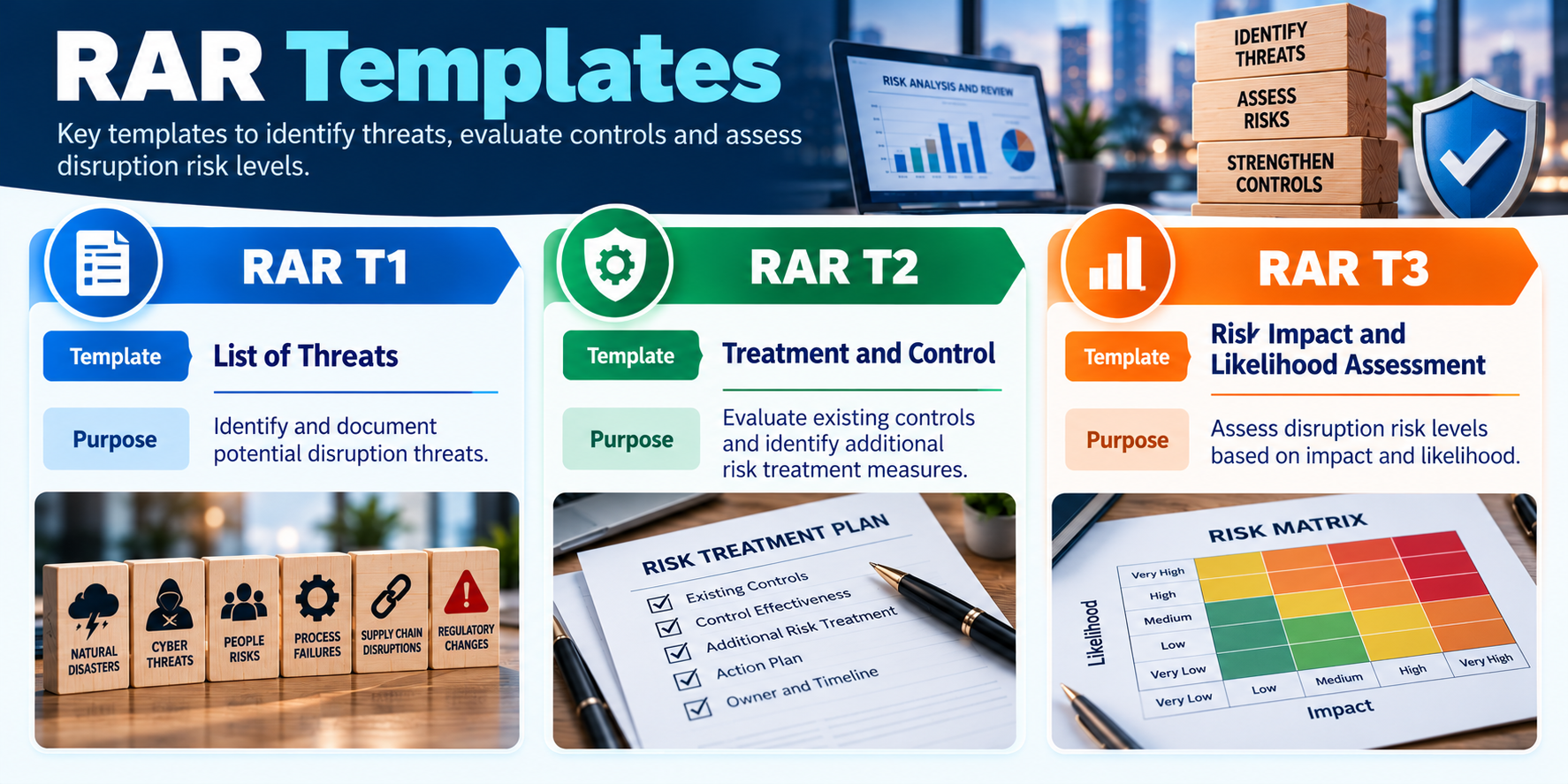](https://cta-redirect.hubspot.com/cta/redirect/3893111/a7ace75d-4eac-4e29-9c8c-e7515c73c4bc)Risk Analysis and Review (RAR)**
##### **Purpose of the RAR Phase**
Risk Analysis and Review is the first planning phase covered in this eBook.
It identifies potential threats to Jamiyah Singapore's operations, assesses the effectiveness of existing controls, evaluates risk exposure, and determines appropriate risk treatment actions.
The assessment should consider threats that could interrupt the delivery of essential charitable, residential care, educational, welfare and community support services.
For Jamiyah Singapore, relevant threats may include:
- Fire and building emergencies.
- Prolonged power, water or telecommunications failures.
- Cyberattacks and information system outages.
- Infectious disease outbreaks.
- Severe weather and flooding.
- Workforce shortages.
- Critical supplier failures.
- Transportation disruptions.
- Loss of access to essential facilities.
- Compromise or unavailability of beneficiary information.
#### **RAR Templates**
Complete three templates during this phase.
In the Risk Analysis and Review (RAR) phase, the content includes the completion of these three templates:
- **List of Threats \[RAR T1\]**
- **Treatment and Control \[RAR T2\]**
- **Risk Impact and Likelihood Assessment \[RAR T3\]**
##### **RAR T1 — List of Threats**
The List of Threats template establishes a structured inventory of disruptive events that may affect Jamiyah Singapore.
For example, the residential care function may identify prolonged utility failure, fire, infectious disease outbreak and staffing shortages as relevant threats.
The food assistance function may identify supplier failure, transport disruption, food storage failure and volunteer shortages.
The completed template should describe the threat, affected functions, potential disruption scenario, and relevant supporting information.
##### **RAR T2 — Treatment and Control**
The Treatment and Control template documents measures intended to prevent disruptions or reduce their consequences.
For example, controls for a prolonged power outage may include backup power, emergency lighting, preventive maintenance, essential equipment prioritisation and alternative service arrangements.
The template should identify existing controls, proposed additional measures, accountable owners and implementation status.
##### **RAR T3 — Risk Impact and Likelihood Assessment**
The Risk Impact and Likelihood Assessment template evaluates the probability and potential consequences of identified threats.
For Jamiyah Singapore, the impact criteria should place particular emphasis on beneficiary safety, continuity of essential care, regulatory obligations and the interruption of critical services.
Risk ratings should follow an approved assessment methodology and be used to prioritise risk treatment.
##### **Expected Outcome of the RAR Phase**
At the completion of RAR, Jamiyah Singapore should have a documented understanding of the threats that may disrupt its operations, the adequacy of existing controls, and the additional treatment actions required.
These findings provide important inputs for subsequent continuity planning.
#### [](https://cta-redirect.hubspot.com/cta/redirect/3893111/a1b4b4e2-f0aa-44df-a197-431397a7927c)
#### **Business Impact Analysis (BIA)**
During the Business Impact Analysis (BIA) phase, we complete six-part templates for each critical business function.
- **Part 0**: Corporate MBCO & Products and Services **\[MBCO\] \[P&S\]**
- **Part 1**: Identification of Business Functions **\[BIAQ P1\]**
- **Part 2**: Impact Areas of Business Functions **\[BIAQ P2\]**
- **Part 3**: Impact Over Time of Business Functions **\[BIAQ P3\]**
- **Part 4**: Supporting IT Systems and Applications **\[BIAQ P4\]**
- **Part 5**: Inter-dependencies **\[BIAQ P5\]**
- **Part 6**: Vital Records **\[BIAQ P6\]**
Each section covers all the organisation's critical business functions, providing granular insight into operational dependencies and recovery priorities.
##### **Purpose of the BIA Phase**
The Business Impact Analysis determines the consequences of disruptions to Jamiyah Singapore's activities over time.
It identifies the functions that must be prioritised, establishes recovery requirements, and documents the resources and dependencies needed to sustain essential services.
The BIA should consider the consequences of service interruption for beneficiaries, employees, families, regulators, donors and other relevant stakeholders.
For Jamiyah Singapore, the assessment should give particular attention to activities involving resident safety, nursing care, childcare, urgent welfare assistance and food distribution.
##### **Corporate MBCO and Products and Services**
Before undertaking the detailed BIA for individual CBFs, Jamiyah Singapore should establish the organisation-wide continuity context.
This includes the corporate Minimum Business Continuity Objective (MBCO) and identifying the organisation's products and services.
##### **Corporate MBCO**
The MBCO defines the minimum acceptable level of products or services that the organisation aims to provide during a disruption.
For Jamiyah Singapore, an illustrative corporate MBCO may be:
Maintain beneficiaries' safety and welfare and continue delivering prioritised residential care, essential healthcare support, childcare supervision, urgent welfare assistance, and other critical community services at an approved minimum acceptable level during disruptive incidents.
Jamiyah Singapore's management should determine and approve the actual MBCO following an appropriate impact assessment.
##### Products and Services
The Products and Services assessment identifies the principal services Jamiyah Singapore delivers and how they support business functions.
This provides the basis for mapping the organisation's CBFs to the outcomes delivered to beneficiaries.
##### **BIA Templates**
The BIA phase consists of a corporate-level assessment and six detailed templates for each CBF.
#### **[![\[BCM\] \[E3\] \[BIA\] \[P1\] \[P2\] \[P3\] \[P4\] {P5\] \[P6\] Template ](https://no-cache.hubspot.com/cta/default/3893111/d0508ed9-8fef-4cbe-a91b-337f2f8a2463.png)](https://cta-redirect.hubspot.com/cta/redirect/3893111/d0508ed9-8fef-4cbe-a91b-337f2f8a2463)**
##### **Part 1 — Identification of Business Functions**
Each CBF Owner identifies the sub-functions and processes required to deliver the critical service.
For example, CBF-1 Residential Care and Resident Safety may include resident supervision, meal provision, hygiene support, essential care coordination, emergency response and relocation arrangements.
##### **Part 2 — Impact Areas of Business Functions**
This template identifies the types of consequences that may arise when a business function is disrupted.
For Jamiyah Singapore, relevant impact areas include:
- Life, health and safety.
- Beneficiary welfare.
- Legal and regulatory compliance.
- Service delivery.
- Financial consequences.
- Reputation and stakeholder confidence.
- Information security and confidentiality.
##### **Part 3 — Impact Over Time of Business Functions**
This template assesses how disruption consequences increase over time.
The assessment supports determining the Maximum Tolerable Period of Disruption (MTPD), Recovery Time Objective (RTO), and minimum acceptable service capacity.
For example, essential resident supervision may require continuous provision, whereas selected administrative processes may tolerate a longer interruption.
The BIA must support recovery requirements, and management must approve them.
##### **Part 4 — Supporting IT Systems and Applications**
This template identifies the applications, systems, databases, communications platforms and technology services required by each CBF.
For Jamiyah Singapore, these may include beneficiary management systems, resident care records, finance applications, communication platforms and document repositories.
The assessment should determine the business recovery requirements that ICT recovery arrangements must support.
##### **Part 5 — Inter-dependencies**
This template documents the relationships between CBFs and the resources or services upon which they depend.
For example, food assistance may depend on procurement, suppliers, storage facilities, volunteers, transportation and beneficiary records.
Identifying these dependencies enables Jamiyah Singapore to recognise shared resources and potential single points of failure.
##### **Part 6 — Vital Records**
This template identifies records essential to continuing and recovering critical activities.
Examples may include resident care information, beneficiary records, emergency contact lists, financial authorisation records, supplier agreements and operational procedures.
The assessment should determine how these records will remain available, accurate and appropriately protected during disruption.
#### **Proposed Critical Business Functions for Jamiyah Singapore**
##### **Establishing the CBF Catalogue**
Identifying Critical Business Functions marks the start of the detailed BIA exercise.
The following catalogue is based on the proposed CBFs established in eBook 1, Chapter 10.
It provides a consistent reference for completing the BIA templates and developing subsequent continuity strategies and recovery procedures.
**Table 1.6: Critical Business Function Catalogue**
****
##### **Applying the BIA Templates to Each CBF**
Each CBF should undergo a separate BIA using the six detailed templates.
For example, CBF-1 Residential Care and Resident Safety will require a completed assessment covering:
1. Identification of residential care sub-functions.
2. Assessment of relevant impact areas.
3. Assessment of impacts over time.
4. Identification of supporting ICT systems.
5. Documentation of internal and external dependencies.
6. Identification of vital records.
Apply the same structured approach to the remaining nine CBFs.
##### **Illustrative BIA Documentation Matrix**
| CBF | BIAQ T1 | BIAQ T2 | BIAQ T3 | BIAQ T4 | BIAQ T5 | BIAQ T6 |
| --- | --- | --- | --- | --- | --- | --- |
| CBF-1 | Required | Required | Required | Required | Required | Required |
| CBF-2 | Required | Required | Required | Required | Required | Required |
| CBF-3 | Required | Required | Required | Required | Required | Required |
| CBF-4 | Required | Required | Required | Required | Required | Required |
| CBF-5 | Required | Required | Required | Required | Required | Required |
| CBF-6 | Required | Required | Required | Required | Required | Required |
| CBF-7 | Required | Required | Required | Required | Required | Required |
| CBF-8 | Required | Required | Required | Required | Required | Required |
| CBF-9 | Required | Required | Required | Required | Required | Required |
| CBF-10 | Required | Required | Required | Required | Required | Required |
Complete the corporate MBCO and Products and Services assessment at the organisational level, with appropriate contributions from management and relevant service owners.
The ten CBFs are proposed planning categories and should be validated against Jamiyah Singapore's actual service arrangements before formal adoption.
#### [](https://cta-redirect.hubspot.com/cta/redirect/3893111/fac23b58-f744-480a-b86b-13a824a53308)
#### **Business Continuity Strategy (BCS)**
In the Business Continuity Strategy (BCS) phase, each critical business unit will have the following requirements presented:
- **Mitigation Strategies \[BCS T1\]**
- **Recovery Strategies and Justifications \[BCS T2\]**
- **Minimum Resources Required during a Disaster \[BCS T3\]**
##### **Purpose of the BCS Phase**
The Business Continuity Strategy phase translates RAR and BIA findings into practical arrangements to reduce disruption risks and sustain or recover critical activities.
The strategies should align with Jamiyah Singapore's operational requirements, available resources, and approved recovery objectives.
For example, a residential care function may require emergency staffing, backup utilities and alternative accommodation arrangements.
A welfare assistance function may require alternative payment processes, manual approval procedures and secure access to beneficiary records.
##### **BCS Templates**
This phase completes three templates.
**Table 1.7: Business Continuity Strategy Templates**
#### **[](https://cta-redirect.hubspot.com/cta/redirect/3893111/0d2c5cc8-ed30-4545-b19a-49a3cb32e0e8)**
##### **BCS T1 — Mitigation Strategies**
Mitigation strategies aim to reduce the probability or consequences of disruptive incidents.
For Jamiyah Singapore, examples may include preventive maintenance, fire safety controls, cybersecurity protection, supplier diversification, workforce cross-training and emergency stock arrangements.
The template should identify the relevant threat, proposed mitigation measure, responsible owner, required resources and implementation status.
##### **BCS T2 — Recovery Strategies and Justifications**
Recovery strategies describe how a critical activity will continue or resume following disruption.
Assess each proposed strategy for operational suitability, effectiveness, implementation requirements, cost, and ability to meet approved recovery objectives.
For example, evaluate a proposed alternative residential care location for safety, capacity, accessibility, staffing, resident needs, and applicable licensing requirements.
The selected strategy should be supported by a documented justification and management approval.
##### **BCS T3 — Minimum Resources Required During a Disaster**
This template identifies the minimum resources necessary to maintain or recover each CBF.
Resources may include:
- Essential personnel and specialist competencies.
- Suitable premises and facilities.
- ICT systems and communication equipment.
- Critical information and records.
- Equipment, materials and supplies.
- Transportation and logistics.
- External service providers.
- Financial and administrative support.
For example, the minimum resource assessment for food assistance may identify essential personnel, storage facilities, food stocks, packaging materials, transport arrangements and beneficiary distribution information.
##### **Expected Outcome of the BCS Phase**
By the end of BCS, Jamiyah Singapore should have a documented set of approved mitigation and recovery strategies, along with the minimum resources required to support continuity.
These strategies provide the basis for developing detailed recovery procedures.
#### [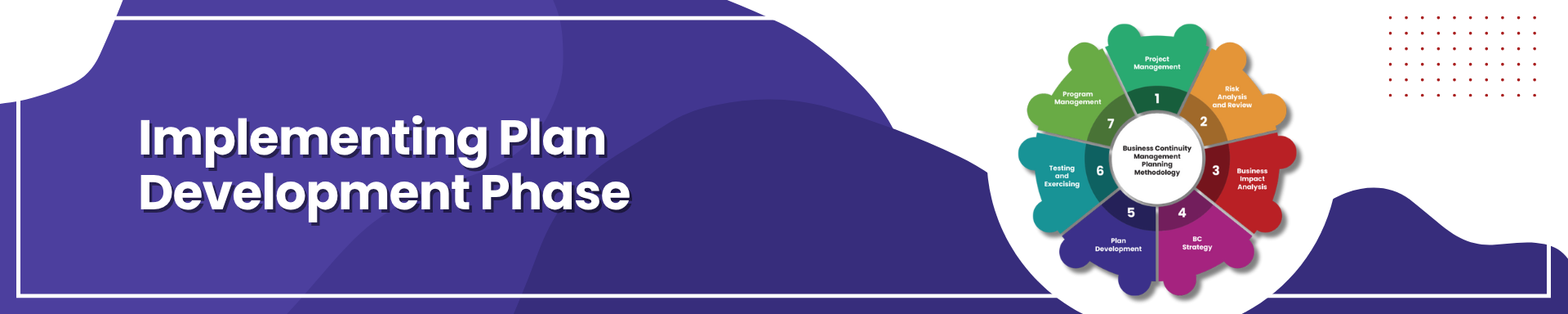](https://cta-redirect.hubspot.com/cta/redirect/3893111/8be70e4c-1b23-4b38-bf36-5bd899b28e17)
#### **Plan Development (PD)**
Once strategies are finalised, the BCM team develops and documents the **Business Continuity Plans** **\[PD\]** for each business function. This includes:
- **Procedures and workflows** tailored to each Sub-CBF
- **Communication protocols**
- **Roles and responsibilities during disruption events**
##### **Purpose of Plan Development**
The Plan Development phase translates approved recovery strategies into practical, actionable procedures for implementation during disruptive incidents.
Business continuity plans should provide clear instructions on activation, responsibilities, recovery activities, resource mobilisation, communications, and resuming normal operations.
For Jamiyah Singapore, plans should be detailed enough to support service owners and recovery teams under time-sensitive, potentially stressful conditions.
##### **Developing Recovery Procedures for Each CBF**
Each CBF should have documented recovery procedures appropriate to its operational requirements.
**Table 1.8: Proposed Business Continuity Recovery Procedures**
| CBF | Recovery Procedure Focus |
| --- | --- |
| CBF-1 Residential Care and Resident Safety | Resident protection, essential care continuity, emergency staffing and relocation |
| CBF-2 Nursing and Essential Healthcare Support | Continuity of essential nursing activities, medication support and clinical records |
| CBF-3 Early Childhood Care and Education | Child safeguarding, supervision, parent communications and approved alternative arrangements |
| CBF-4 Student Care and Educational Support | Student supervision, safe handover, staffing and service resumption |
| CBF-5 Emergency Welfare and Financial Assistance | Alternative assistance processing, emergency approvals and beneficiary communications |
| CBF-6 Food Assistance and Essential Distribution | Alternative food supply, storage, distribution and logistics |
| CBF-7 Critical Beneficiary Case Management and Referral | Urgent case handling, secure records access and referral coordination |
| CBF-8 Beneficiary, Family and Emergency Communications | Emergency notifications, communication escalation and alternative channels |
| CBF-9 Critical ICT Systems and Information Management | ICT incident coordination, system restoration, data recovery and service validation |
| CBF-10 Essential Finance, Procurement and Resource Support | Emergency procurement, payments, supplier coordination and financial controls |
##### **Recommended Recovery Procedure Structure**
Each Business Continuity Recovery Procedure should contain:
#### **[![\[BCM\] \[E3\] PD\] Template ](https://no-cache.hubspot.com/cta/default/3893111/afcff3be-253a-482f-9874-8402369ab4aa.png)](https://cta-redirect.hubspot.com/cta/redirect/3893111/afcff3be-253a-482f-9874-8402369ab4aa)**
##### **Illustrative Recovery Scenario**
Consider a major power outage affecting a Jamiyah Singapore residential care facility.
The recovery procedure may require the responsible personnel to:
1. Assess immediate resident safety and identify affected care activities.
2. Activate emergency lighting and available backup power.
3. Notify designated incident management personnel.
4. Determine whether essential care can continue safely.
5. Mobilise additional staffing and emergency supplies if required.
6. Arrange alternative accommodation or relocation where necessary.
7. Communicate with families and relevant authorities according to approved procedures.
8. Monitor resident welfare and the effectiveness of continuity arrangements.
9. Restore normal operations when facilities and services are safe.
10. Document the incident, recovery actions and improvement requirements.
The actual procedure must reflect the facility's approved arrangements, applicable licensing requirements and available resources.
#### **BCM Documentation Submission and Review**
##### **Purpose of Documentation Consolidation**
This eBook serves as a structured compilation of the documentation Jamiyah Singapore prepared and submitted during its BCM planning exercise.
The submissions should demonstrate how the organisation has identified threats, assessed business impacts, selected continuity strategies and developed recovery procedures.
A standardised documentation process enables the BCM Coordinator to review progress, identify gaps, and consolidate information into a coherent BCM programme.
##### **BCM Documentation Submission Register**
**Table 1.9: BCM Documentation Submission Register[](https://cta-redirect.hubspot.com/cta/redirect/3893111/51972e08-7ed7-4a94-8dda-0438c8ac6d06)**
##### **Documentation Quality Requirements**
Each submission should be:
[](https://cta-redirect.hubspot.com/cta/redirect/3893111/50128e5d-3584-4066-8b3d-27b79859678f)
##### **Document Control**
Jamiyah Singapore should establish appropriate document control arrangements for the completed BCM documentation.
These should include document ownership, version numbers, preparation and review dates, approval records, access restrictions and scheduled reviews.
Protect sensitive information, including beneficiary records, emergency contacts, and recovery arrangements, in accordance with applicable information security and personal data protection requirements.
#### **Roles and Responsibilities During Implementation**
Successful implementation requires coordinated participation from management, the BCM Coordinator, CBF Owners and supporting departments.
**Table 1.10: BCM Implementation Responsibilities**
| Role | Key Responsibilities |
| --- | --- |
| Board / Designated Governance Committee | Provide oversight of significant BCM risks and organisational resilience |
| BCM Sponsor | Approve BCM direction, priorities and resources |
| BCM Steering Committee | Monitor implementation and resolve cross-functional issues |
| BCM Coordinator | Coordinate templates, workshops, submissions, reviews and documentation consolidation |
| CBF Owners | Complete assessments, validate recovery requirements and develop recovery procedures |
| Risk Representatives | Support threat identification, risk assessment and treatment planning |
| ICT Representatives | Validate application dependencies and technology recovery capabilities |
| HR and Volunteer Management | Support workforce continuity and personnel availability |
| Facilities and Logistics | Support premises, utilities, transport and resource planning |
| Finance and Procurement | Support emergency expenditure, supplier arrangements and essential payments |
| Communications Representatives | Support internal and external emergency communication arrangements |
##### **Role of the BCM Coordinator**
The BCM Coordinator should establish the implementation schedule, facilitate planning workshops, monitor template completion, review documentation quality and report progress to management.
The Coordinator should also ensure information remains consistent across phases.
For example, the recovery requirements identified during the BIA should be reflected in the selected BCS strategies and subsequent recovery procedures.
##### **Role of CBF Owners**
CBF Owners should provide accurate information about their services, operational activities, resources, dependencies and recovery requirements.
They should also validate the feasibility of proposed strategies and ensure that recovery procedures reflect actual operating arrangements.
Service or function owners should retain ownership of continuity arrangements.
#### **Alignment with ISO 22301 and Singapore Governance Requirements**
##### **ISO 22301 Alignment**
The four planning phases support several ISO 22301 requirements.
**Table 1.11: Mapping BCM Planning Phases to ISO 22301[](https://cta-redirect.hubspot.com/cta/redirect/3893111/dbaa3c94-cbc2-431a-a90b-14aa940e9e0d)**
The four planning phases do not cover all ISO 22301 requirements.
The overall BCMS must also address leadership, governance, competence, awareness, communication, documented information, performance evaluation, and continual improvement.
##### **Singapore Charity Governance**
Jamiyah Singapore should align BCM governance with applicable obligations under the Charities Act 1994 and relevant charity governance requirements.
The Code of Governance for Charities and IPCs (2023) provides an important reference for organisational oversight, accountability and responsible management.
BCM supports these principles by helping management identify critical services, assess material disruptions, and establish appropriate continuity arrangements.
##### **Sector-Specific Requirements**
Where applicable, Jamiyah Singapore should consider requirements administered by:
- MSF: Relevant social service and residential care requirements.
- MOH: Applicable healthcare and nursing service licensing requirements.
- ECDA: Applicable early childhood development centre requirements.
These obligations should be identified and verified for the relevant operating entities and services.
##### **Personal Data and Information Protection**
BCM documentation may contain sensitive operational and personal information.
Jamiyah Singapore should ensure that information handling, backup, recovery, retention, and access arrangements comply with applicable personal data protection requirements.
Take particular care when documenting beneficiary records, medical information, family contact details, and emergency communications.
#### **Preparing for the BCM Planning Exercise**
##### **Recommended Preparation Activities**
Before commencing the detailed assessments, Jamiyah Singapore should complete several preparatory activities.
| Activity | Expected Output |
| --- | --- |
| Confirm BCM scope | Approved list of services, facilities and organisational units |
| Appoint BCM personnel | Defined roles, responsibilities and reporting arrangements |
| Validate the CBF catalogue | Approved list of critical functions and owners |
| Confirm the assessment methodology | Agreed risk, impact and recovery assessment criteria |
| Distribute BCM templates | Standardised documentation set |
| Conduct implementation briefings | Common understanding of methodology and expectations |
| Establish the implementation schedule | Agreed milestones and submission deadlines |
| Confirm review and approval arrangements | Documented review responsibilities and decision authority |
##### **Recommended Implementation Sequence**
Jamiyah Singapore should implement the four phases in a controlled sequence while allowing findings to be revisited where necessary.
##### **BCM Implementation and Documentation Workflow[](https://cta-redirect.hubspot.com/cta/redirect/3893111/7512cf7f-a1a0-435c-9d46-52f7ac7d64c6)**
##### **Monitoring Implementation Progress**
The BCM Coordinator should maintain an implementation tracker covering template completion, reviews, approvals, outstanding information, resource requirements and unresolved issues.
Progress reports should be submitted to the BCM Steering Committee or designated management authority.
The tracker should distinguish between documentation completion and actual recovery capability.
A completed template does not necessarily mean the organisation has implemented the associated strategy or can achieve its recovery objectives.
##### **Expected Outcomes of eBook 3**
Upon completing the activities described in this eBook, Jamiyah Singapore should have developed a structured BCM documentation set.
**Table 1.12: Expected BCM Implementation Outcomes**
| Planning Area | Expected Outcome |
| --- | --- |
| Risk Analysis and Review | Documented threat assessments, risk ratings and treatment requirements |
| Corporate BIA | Approved MBCO and identification of organisational products and services |
| CBF-Level BIA | Completed assessments for the ten validated critical business functions |
| Recovery Requirements | Documented MTPDs, RTOs, minimum service levels and dependencies |
| Business Continuity Strategy | Approved mitigation and recovery strategies |
| Resource Planning | Defined minimum resources required during disruption |
| Plan Development | Documented business continuity recovery procedures |
| Governance | Defined ownership, review and approval arrangements |
| Documentation Management | Consolidated and controlled BCM planning records |
| Future BCM Activities | Basis for exercises, reviews, audits and continual improvement |
The completed documentation should enable Jamiyah Singapore to understand its continuity requirements and establish practical arrangements for responding to disruptive incidents.
The next step is to validate those arrangements through appropriate exercises and operational reviews.
#### [](https://cta-redirect.hubspot.com/cta/redirect/3893111/0e59113c-d17a-48a8-8c28-bb1bcf487857)
This introductory chapter sets out the purpose, structure, and implementation approach for Jamiyah Singapore's BCM implementation.
It explains how the third book builds on the organisational foundation in eBook 1 and the methodology in eBook 2.
The chapter introduces the four principal BCM planning phases—Risk Analysis and Review, Business Impact Analysis, Business Continuity Strategy and Plan Development—and identifies the templates and deliverables associated with each phase.
It also presents the proposed catalogue of ten Critical Business Functions that will form the basis of the detailed BIA exercise.
A central feature of this eBook is BCM Institute's training-led implementation approach, which combines structured learning with practical organisational application.
Through this approach, Jamiyah Singapore's personnel can develop their BCM knowledge while preparing the documentation required for the organisation's continuity programme.
The chapter also establishes the importance of clear roles, consistent documentation, management review, regulatory awareness, and integrating BCM activities across different services.
##### **Key Takeaways**
1\. eBook 3 focuses on practical implementation. It translates the concepts and methodology from eBooks 1 and 2 into completed BCM assessments, strategies, and recovery procedures.
2\. Four planning phases provide the implementation structure. RAR, BIA, BCS and PD guide the development of the organisation's core BCM documentation.
3\. Ten Critical Business Functions form the proposed BIA scope. Each validated CBF requires detailed assessment of impacts, recovery requirements, resources and dependencies.
4\. Training and implementation are integrated. BCM Institute's training-led approach supports knowledge transfer, practical application and organisational ownership.
5\. Documentation must reflect actual operations. Complete templates using validated organisational information rather than generic assumptions.
6\. Management approval and recovery validation are essential. BCM effectiveness depends on practical implementation, exercising and continual improvement, not documentation alone.
##### **Conclusion: Moving from BCM Methodology to Practical Implementation**
Business Continuity Management gives Jamiyah Singapore a structured way to protect essential services, safeguard vulnerable beneficiaries, and maintain organisational resilience during disruptive incidents.
The first two eBooks in the Resilient Communities series lay out the knowledge and methodology needed to implement BCM.
This third eBook marks the next stage of that journey by focusing on completing assessments, planning templates, continuity strategies, and recovery procedures.
[](https://cta-redirect.hubspot.com/cta/redirect/3893111/320f01c4-c800-4496-aa02-c30e72e7481d)
| **eBook 3: Starting Your BCM Implementation** | | | | | | |
| --- | --- | --- | --- | --- | --- | --- |
| **MBCO** | **P&S** | **RAR T1** | **RAR T2** | **RAR T3** | **BCS T1** | **CBF** |
| [](https://cta-redirect.hubspot.com/cta/redirect/3893111/723f3c3d-5ee0-4bf8-8e22-3244b607978a) | [](https://cta-redirect.hubspot.com/cta/redirect/3893111/db4572cb-afab-45f2-902b-8a8b33b88b58) | [](https://cta-redirect.hubspot.com/cta/redirect/3893111/87b522e2-f0d8-4959-9c59-40a3be1b6f71) | [](https://cta-redirect.hubspot.com/cta/redirect/3893111/bbf2124f-6183-4c2f-85f0-727313f44adf) | [](https://cta-redirect.hubspot.com/cta/redirect/3893111/f4035e58-2c2f-4b9b-aa1d-4e24ef7507fe) | [](https://cta-redirect.hubspot.com/cta/redirect/3893111/4691ede5-015e-4d02-890f-1dc8a37980a6) | [](https://cta-redirect.hubspot.com/cta/redirect/3893111/0e87ad0d-3fdf-495a-a60f-384b0e67a940) |
| **CBF-1 Residential Care and Resident Safety** | | | | | | |
| **DP** | **BIAQ P1** | **BIAQ P2** | **BIAQ P3** | **BIAQ P4** | **BIAQ P5** | **BIAQ P6** |
| [](https://cta-redirect.hubspot.com/cta/redirect/3893111/8fc0299d-8dd3-4524-a501-d69412824245) | [](https://cta-redirect.hubspot.com/cta/redirect/3893111/b6095493-82e5-4021-a587-04abac283a83) | [](https://cta-redirect.hubspot.com/cta/redirect/3893111/6a7f83ac-d900-4ed2-b2e3-0790f8616f4e) | [](https://cta-redirect.hubspot.com/cta/redirect/3893111/fcda677d-0de5-4fd8-90c1-c4ded98df1aa) | [](https://cta-redirect.hubspot.com/cta/redirect/3893111/099c843a-dde6-4f81-9e61-063c199f8c07) | [](https://cta-redirect.hubspot.com/cta/redirect/3893111/55edfd9f-de2d-4faa-8b25-4bd72f6ffa41) | [](https://cta-redirect.hubspot.com/cta/redirect/3893111/4c7bd1f2-689d-4057-aed0-03ec5dd02d81) |
| | | **BCS T2** | **BCS T3** | **PD** | | |
| | | [](https://cta-redirect.hubspot.com/cta/redirect/3893111/2e82d94a-aef2-44c5-837b-2e2dffc1d356) | [](https://cta-redirect.hubspot.com/cta/redirect/3893111/d1c9695c-142d-4544-91bb-b76470cf1a6f) | [](https://cta-redirect.hubspot.com/cta/redirect/3893111/a4a01ce0-cc91-4aa5-b0b4-e091b884db90) | | |
| | | | | | | |
#### More Information About Business Continuity Management Courses
[](https://cta-redirect.hubspot.com/cta/redirect/3893111/c010f0fd-7ba6-4f60-b63b-38efafac8ca5)[](https://cta-redirect.hubspot.com/cta/redirect/3893111/354ef907-cf2c-4148-aa47-577a930e76c5)To learn more about the course and schedule, click the buttons below for the BCM-300 Business Continuity Management Implementer \[B-3\] course and the BCM-5000 Business Continuity Management Expert Implementer \[B-5\].
| [](https://cta-redirect.hubspot.com/cta/redirect/3893111/ac6cf073-4cdd-4541-91ed-889f731d5076) | [](https://cta-redirect.hubspot.com/cta/redirect/3893111/9ff8a3dc-e39a-465b-929f-72e232cdd5fb) | [](https://cta-redirect.hubspot.com/cta/redirect/3893111/f3922b80-e96a-46d6-8993-dc150a5de2d5) |
| --- | --- | --- |
| [](https://cta-redirect.hubspot.com/cta/redirect/3893111/1cb17ac7-50b2-4f88-bc4b-c7444e4b57b5) | [](https://cta-redirect.hubspot.com/cta/redirect/3893111/3ecb1171-819d-45a2-8686-6db917a20156) | [](https://cta-redirect.hubspot.com/cta/redirect/3893111/21525c10-4003-4934-95fc-fe218174bc5b) |
| [](https://cta-redirect.hubspot.com/cta/redirect/3893111/b3824ba1-7aa1-4eb6-bef8-94f57121c5ae) | If you have any questions, click to contact us. [](https://cta-redirect.hubspot.com/cta/redirect/3893111/3c53daeb-2836-4843-b0e0-645baee2ab9e) | [](https://cta-redirect.hubspot.com/cta/redirect/3893111/9c199ae8-c470-4bb7-9612-73c7a084e94c) |
| [](https://cta-redirect.hubspot.com/cta/redirect/3893111/8999211a-2c51-4be7-bf49-c393f6c67974) | [](https://cta-redirect.hubspot.com/cta/redirect/3893111/5c1aa95d-f6dd-4067-a95c-5cc0c32d7ed8) | [](https://cta-redirect.hubspot.com/cta/redirect/3893111/086ab3b9-4d66-4a95-b2f7-1148e9803a9c) |
#### **Comments:**
### More Posts
[](https://cta-redirect.hubspot.com/cta/redirect/3893111/839787f4-a4fd-456f-accf-54c947026558)

All rights reserved. Copyright 2026
```json
{
"@context" : "https://schema.org",
"@type" : "BlogPosting",
"author" : {
"@type" : "Person",
"name" : "Moh Heng Goh",
"url" : "https://blog.bcm-institute.org/ebook/author/moh-heng-goh"
},
"dateModified" : "2026-10-17T14:40:20.858Z",
"datePublished" : "2026-10-14T09:41:29.000Z",
"headline" : "[BCM] [JS] [E3] [C1] Starting Your BCM Implementation",
"mainEntityOfPage" : {
"@id" : "https://blog.bcm-institute.org/ebook/bcm-js-e3-c1-starting-your-bcm-implementation",
"@type" : "WebPage"
},
"publisher" : {
"@type" : "Organization",
"logo" : {
"@type" : "ImageObject",
"url" : "https://blog.bcm-institute.org/hubfs/BCMI%20Logo.png"
},
"name" : "BCMI Pte Ltd"
}
}
```