---
title: [BCM] [JS] [E3] [BIA] [P4] [CBF] [1] Residential Care and Resident Safety
description: [BCM] [JS] [E3] [BIA] [P4] [CBF] [1] Residential Care and Resident Safety
image: https://blog.bcm-institute.org/hubfs/Jamiyah%20Singapore%20Graphic%20Folder/JS%20BCM%20CBF%201%20Morepost/%5BBCM%5D%20%5BJS%5D%20%5BE3%5D%20%5BBIA%5D%20%5BT4%5D%20%5BCBF%5D%20%5B1%5D%20Residential%20Care%20and%20Resident%20Safety.jpg
---
. .
[](http://www.bcm-institute.org/)
- [Home](https://www.bcm-institute.org/)
- [About Us](https://www.bcm-institute.org/about-us-3/)
- [A President’s Perspective](https://www.bcm-institute.org/about-us/a-presidents-perspective/)
- [Our History](https://www.bcm-institute.org/about-us/our-history/)
- [Our Advisory Council](https://www.bcm-institute.org/about-us/our-advisory-council/)
- [Customers’ Testimonials](https://www.bcm-institute.org/about-us/customers-testimonials/)
- [Credential Verification](https://www.bcm-institute.org/about-us/credential-verification/)
- [Courses](https://blog.bcm-institute.org/blog/course-fees-for-blended-learning-courses-master-catalog)
- [ISO 22301 Business Continuity Management System Audit](https://blog.bcm-institute.org/audit/business-continuity-management-audit-courses)
- [ISO 22301 Business Continuity Management](https://blog.bcm-institute.org/bcm/business-continuity-management-courses)
- [Crisis Communication](https://blog.bcm-institute.org/crisis-communication/crisis-communication-courses)
- [Crisis Management](https://blog.bcm-institute.org/en/crisis-management/courses)
- [IT Disaster Recovery](https://blog.bcm-institute.org/it-disaster-recovery/courses)
- [Operational Resilience](https://blog.bcm-institute.org/operational-resilience/courses)
- [Operational Resilience Audit](https://blog.bcm-institute.org/operational-resilience-audit/courses)
- [Certification](https://blog.bcm-institute.org/certification/types-of-certifications-offered)
- [ISO 22301 BCMS Audit Certification](https://blog.bcm-institute.org/certification/business-continuity-management-audit-certification)
- [ISO22301 Business Continuity Management Certification](https://blog.bcm-institute.org/bcm/business-continuity-management-certification)
- [Crisis Communication Certification](https://blog.bcm-institute.org/crisis-communication/crisis-communication-certification)
- [Crisis Management Certification](https://blog.bcm-institute.org/en/crisis-management/crisis-management-certification)
- [IT Disaster Recovery Planning Certification](https://blog.bcm-institute.org/it-disaster-recovery/it-disaster-recovery-certification)
- [Operational Resilience Certification](https://blog.bcm-institute.org/operational-resilience/operational-resilience-certification)
- [Operational Resilience Audit Certification](https://blog.bcm-institute.org/operational-resilience-audit)
- [Seminars](https://blog.bcm-institute.org/meet-the-expert/mte-webinar-mainpage)
- [Store](https://www.bcm-institute.org/store-2/)
- [Contact Us](http://www.bcm-institute.org/about-us/contact-us/)
-
-
##### Resilient Communities: Implementing Business Continuity Management at Jamiyah Singapore

# \[BCM\] \[JS\] \[E3\] \[BIA\] \[P4\] \[CBF\] \[1\] Residential Care and Resident Safety
[](https://cta-redirect.hubspot.com/cta/redirect/3893111/b764264e-ccf8-489f-9125-6bdfc8db17b3)
Information technology plays an important supporting role in delivering residential care services.
Although CBF-1 Residential Care and Resident Safety's primary responsibility is to protect residents and provide essential daily care, many operational processes depend on information systems, communication platforms, digital records, facility technologies, and specialised equipment.
For Jamiyah Singapore (JS), losing a critical application may affect residential care personnel's ability to retrieve resident information, coordinate staffing, access care plans, communicate with families, manage essential supplies, or arrange emergency relocation.
Technology disruptions may arise from cyberattacks, ransomware, hardware failure, telecommunications outages, cloud service interruptions, power failures, software defects or loss of access to critical facilities.
### [](https://cta-redirect.hubspot.com/cta/redirect/3893111/e60ed308-5615-4727-b6c2-5fb4eed933d7)
[Dr Goh Moh Heng](https://blog.bcm-institute.org/ebook/author/dr-goh-moh-heng) Oct 14, 2026
###### Business Continuity Management Certified Planner-Specialist-Expert
### [](https://cta-redirect.hubspot.com/cta/redirect/3893111/7a1ba6dc-8352-46e7-b150-d25945acf3d9)
[![\[BCM\] \[E3\] \[BIA\] \[P1\] \[P2\] \[P3\] \[P4\] {P5\] \[P6\] Template ](https://no-cache.hubspot.com/cta/default/3893111/d0508ed9-8fef-4cbe-a91b-337f2f8a2463.png)](https://cta-redirect.hubspot.com/cta/redirect/3893111/d0508ed9-8fef-4cbe-a91b-337f2f8a2463)[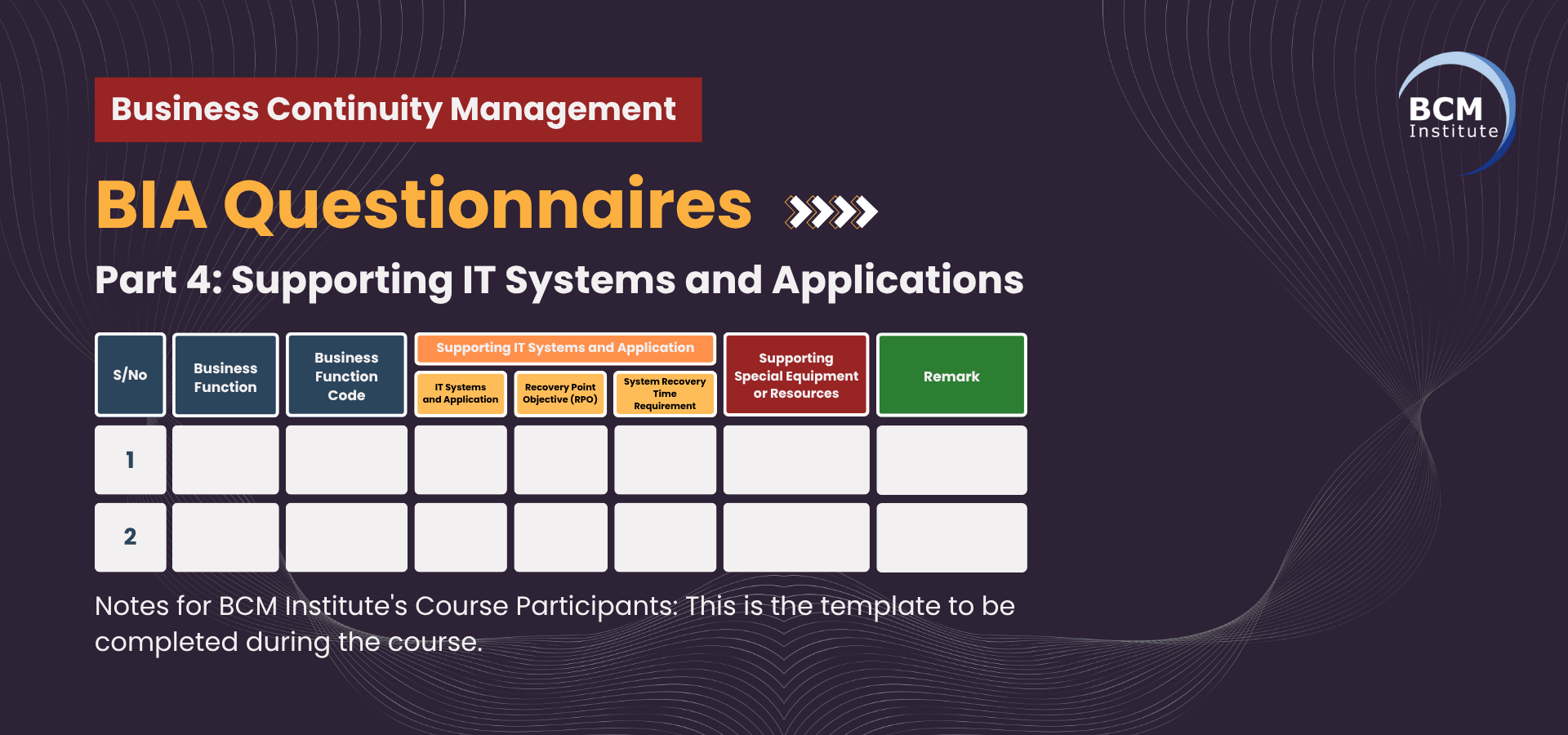](https://cta-redirect.hubspot.com/cta/redirect/3893111/58912f86-0de7-4b16-bcf9-99bdedd6b04d)
[](https://cta-redirect.hubspot.com/cta/redirect/3893111/e60ed308-5615-4727-b6c2-5fb4eed933d7)
### CBF-1 Residential Care and Resident Safety
#### **Introduction**
[](https://cta-redirect.hubspot.com/cta/redirect/3893111/099c843a-dde6-4f81-9e61-063c199f8c07)
Information technology plays an important supporting role in delivering residential care services.
Although CBF-1 Residential Care and Resident Safety's primary responsibility is to protect residents and provide essential daily care, many operational processes depend on information systems, communication platforms, digital records, facility technologies, and specialised equipment.
For Jamiyah Singapore (JS), losing a critical application may prevent residential care personnel from retrieving resident information, coordinating staffing, accessing care plans, communicating with families, managing essential supplies, or arranging emergency relocation.
Technology disruptions may arise from cyberattacks, ransomware, hardware failure, telecommunications outages, cloud service interruptions, power failures, software defects or loss of access to critical facilities.
The consequences may extend beyond administrative inconvenience.
When essential information is unavailable, care personnel may be unable to confirm residents' needs, identify key safeguarding concerns, or coordinate timely emergency assistance.
Consequently, the Business Impact Analysis (BIA) must identify the systems and applications that support each Sub-Critical Business Function (Sub-CBF), assess their importance to minimum service delivery, and establish appropriate recovery requirements.
This chapter examines the technology dependencies associated with the 26 Sub-CBFs supporting Residential Care and Resident Safety.
It also proposes Recovery Point Objectives (RPOs), System Recovery Time Objectives (System RTOs), and the equipment and resources needed for Business Continuity Planning (BCP) and IT Disaster Recovery (ITDR).
#### **Purpose of Identifying Supporting IT Systems**
The purpose of BIA Part 4 is to determine which technology capabilities are necessary to maintain the approved Business Unit Minimum Business Continuity Objectives (BU MBCOs).
The assessment enables Jamiyah Singapore to:
- Identify the applications and digital information required for each residential care process.
- Determine the consequences of technology unavailability.
- Establish acceptable data loss tolerances.
- Define system recovery targets.
- Identify essential devices, communications and supporting infrastructure.
- Establish dependencies between residential care activities and ICT services.
- Support IT Disaster Recovery planning and prioritisation.
- Identify secure manual workarounds where immediate system recovery is not feasible.
#### **Relationship Between Business Continuity and IT Disaster Recovery**
Business Continuity Planning and IT Disaster Recovery are closely related but serve different purposes.
Business Continuity Planning focuses on maintaining essential service delivery during disruption.
IT Disaster Recovery focuses on restoring the technology, applications, infrastructure, information and connectivity required to support those services.
For example, the BU MBCO for Sub-CBF 1.17 Maintain Resident Records and Essential Information requires authorised personnel to access essential resident information.
The ICT team may temporarily achieve this through approved secure downtime records while it restores the primary resident information system.
The Business Continuity Plan defines how essential care continues during the outage. The IT Disaster Recovery Plan defines how the IT team recovers affected systems and information.
The organisation must coordinate both arrangements to avoid gaps in resident care and information integrity.
##### **Recovery Point Objective**
The Recovery Point Objective (RPO) defines the maximum acceptable period of data loss, measured backwards from the point of disruption.
For example, an RPO of one hour means recovery arrangements should be able to restore information to a point no more than one hour before the incident.
An RPO of 15 minutes requires more frequent data protection or replication than an RPO of 24 hours.
For residential care, highly time-sensitive information such as resident accountability, essential care instructions, and incident records may require very low data-loss tolerances.
However, an RPO does not guarantee that all records can be reconstructed automatically. Manual records created during an outage must also be reconciled when normal systems are restored.
##### **System Recovery Time Objective**
The System Recovery Time Objective (System RTO) defines the target time to restore a technology service to the minimum functionality the business needs.
It differs from the Business RTO, which concerns resuming the business activity itself.
For example, the Business RTO for maintaining resident supervision may be immediate, while the System RTO for the digital resident accountability application may be one hour.
This difference is acceptable only if approved alternative arrangements allow safe supervision and accountability to continue without interruption.
Accordingly, the System RTO must support the Business RTO, either through timely technology restoration or through an effective business continuity workaround.
#### **Importance of Specialised Equipment and Supporting Resources**
Technology dependencies extend beyond software applications.
Residential care may also rely on secure mobile devices, communication equipment, network connectivity, backup power, electronic access controls, resident alert systems, digital monitoring devices and other operational equipment.
Some of these resources are safety-related systems rather than conventional IT applications.
Assess their availability, maintenance, fallback arrangements, and recovery requirements separately where necessary.
#### **Technology Dependency Assessment Methodology**
The assessment considers four principal areas.
| Assessment Component | Description |
| --- | --- |
| Supporting IT Systems and Applications | Applications and digital services used to perform the Sub-CBF |
| Recovery Point Objective | Maximum acceptable loss of recorded information |
| System Recovery Time Objective | Target time for restoring the necessary technology capability |
| Supporting Special Equipment and Resources | Devices, connectivity, infrastructure and specialised operational resources |
The proposed systems are functional descriptions, not assertions that Jamiyah Singapore currently operates particular software products.
An ICT inventory should verify actual application names, vendors, hosting arrangements, system owners, and recovery capabilities.
##### **Planning Assumptions**
The following assumptions apply:
1. Residential care processes may use a combination of electronic applications and controlled manual records.
2. Critical resident information is assumed to be held in a secure resident management or case management system.
3. Digital communication and collaboration services are assumed to support internal coordination and stakeholder notifications.
4. Essential technology services are assumed to depend on secure connectivity, identity management, backup arrangements and suitable endpoint devices.
5. The proposed RPOs and System RTOs represent business requirements, not verified technical recovery capabilities.
6. For safety-critical functions, approved alternative arrangements must ensure essential care and emergency response continue even when digital systems are unavailable.
[](https://cta-redirect.hubspot.com/cta/redirect/3893111/b0e47631-f680-46d1-b7a9-040fce25e117)
#### Supporting IT Systems and Applications for CBF-1 Residential Care and Resident Safety
All system names below are illustrative functional categories.
RPOs and System RTOs are proposed targets for the principal supporting digital service identified in each row. Shared applications may require a stricter common recovery target than the individual process target shown.
Table BIA P4: Supporting IT Systems and Applications for CBF-1 Residential Care and Resident Safety
| Sub-CBF Code | Sub-Critical Business Function | Supporting IT Systems and Applications | Recovery Point Objective (RPO) | System Recovery Time Objective (System RTO) | Supporting Special Equipment / Resources | Remarks |
| --- | --- | --- | --- | --- | --- | --- |
| 1.1 | Receive and Assess Resident Referrals | Referral Management System; Case Management System; Secure Email and Document Management | 4 hours | 8 hours | Secure workstations, scanners, and authenticated email access | Urgent referrals must remain receivable through an approved alternative channel during system outages. |
| 1.2 | Coordinate Resident Admission and Registration | Resident Management System; Electronic Registration and Document Management; Identity Verification Records | 1 hour | 4 hours | Secure tablets, scanners, printers, and secure document storage | Capture essential admission information securely and reconcile it after system recovery. |
| 1.3 | Assess Resident Care and Support Requirements | Resident Assessment System; Care Management Application; Electronic Care Records | 1 hour | 2 hours | Secure mobile devices, assessment forms, and authenticated record access | Essential assessment information must remain available to support safe placement and care decisions. |
| 1.4 | Develop and Maintain Individual Resident Care Plans | Electronic Care Planning System; Resident Management System; Document Management | 1 hour | 4 hours | Secure tablets, controlled downtime care plans, backup access devices | Current minimum care instructions should remain accessible through secure offline arrangements. |
| 1.5 | Allocate Residential Accommodation and Facilities | Resident Occupancy Management; Facility and Room Allocation Records; Building Information System | 4 hours | 4 hours | Secure occupancy lists, facility layout records, and communication devices | A current resident-to-room register must remain available during evacuation or alternative placement. |
| 1.6 | Determine and Assign Residential Care Staffing | Workforce Scheduling System; HR Information System; Staff Contact Directory | 1 hour | 2 hours | Secure mobile phones, duty rosters, and emergency contact lists | Approved contingency rosters must be accessible when normal scheduling systems are unavailable. |
| 1.7 | Maintain Resident Supervision and Accountability | Resident Accountability System; Electronic Attendance or Check Register; Resident Alert Platform, if deployed | 15 minutes | 1 hour | Resident alert devices, where applicable, radios, secure tablets, and printed accountability lists | Maintain continuous supervision through manual checks or other approved arrangements during system recovery. |
| 1.8 | Provide Essential Daily Living Assistance | Electronic Care Records; Daily Care Task Management; Resident Support Documentation | 1 hour | 4 hours | Secure care tablets, controlled paper care records, and appropriate care equipment | Essential assistance must continue using current care instructions even when digital task records are unavailable. |
| 1.9 | Provide Essential Meals and Hydration | Meal Planning System; Dietary Information Records; Catering and Supplier Communication Platforms | 4 hours | 4 hours | Dietary lists, kitchen equipment, emergency food records, backup communications | Essential dietary requirements must remain accessible to prevent inappropriate food provision. |
| 1.10 | Maintain Personal Hygiene and Sanitation Support | Care Task Records; Facilities Maintenance System; Hygiene Supply Inventory | 4 hours | 8 hours | Sanitation equipment, water supplies, cleaning equipment, and controlled task checklists | Manual care and sanitation checklists should support continued service during application outages. |
| 1.11 | Coordinate Essential Medication and Healthcare Support | Electronic Medication Administration Records, if deployed; Care Records; Healthcare Communication Systems | 15 minutes | 1 hour | Secure medication records, authorised care devices, backup communications | Time-critical care must continue under approved clinical downtime procedures; data reconciliation requires qualified oversight. |
| 1.12 | Monitor Resident Welfare and Changes in Condition | Electronic Observation Records; Resident Care Monitoring System; Incident Escalation Application | 15 minutes | 1 hour | Resident alert equipment, where applicable, secure tablets, and manual observation charts | Welfare monitoring must continue without unsafe interruption using approved manual procedures. |
| 1.13 | Maintain Resident Safeguarding and Protection | Safeguarding Case Management; Incident Reporting System; Secure Evidence and Document Storage | 15 minutes | 2 hours | Secure communication devices, restricted-access records, and protected evidence storage | Safeguarding reports must be recorded securely, with immediate escalation possible through alternative channels. |
| 1.14 | Maintain Residential Facility Safety and Security | Building Management System; Electronic Access Control; Fire Alarm Monitoring; CCTV, where deployed | 15 minutes for critical event logs | 1 hour for monitoring and management interfaces | Fire detection and alarm equipment, access control devices, emergency lighting, backup power | Life-safety equipment must remain operational or be addressed through immediate protective measures; restoring a management interface is not equivalent to restoring fire protection. |
| 1.15 | Maintain Essential Utilities and Environmental Conditions | Building Management System; Utility Monitoring; Maintenance and Fault Reporting | 1 hour | 2 hours | Backup generators, UPS, emergency lighting, water storage, and environmental monitoring | Backup utilities and protective actions must operate independently of normal application availability where required. |
| 1.16 | Manage Resident Incidents and Immediate Emergencies | Incident Management System; Emergency Notification Platform; Resident Information System | 15 minutes | 1 hour | Emergency phones, radios, first-aid equipment, and evacuation records | Emergency response must be immediate; incident information may be recorded through controlled downtime procedures. |
| 1.17 | Maintain Resident Records and Essential Information | Resident Management System; Electronic Document Management; Secure Database and Backup Services | 15 minutes | 1 hour | Protected backup storage, secure offline records, authenticated recovery workstations | Essential care information requires priority restoration and controlled reconciliation of records created during downtime. |
| 1.18 | Coordinate Resident and Family Communications | Contact Management System; Email and Messaging Platforms; Emergency Notification System | 1 hour | 2 hours | Secure mobile phones, contact lists, and alternative telecommunications | At least one approved communication channel must remain available during primary platform outages. |
| 1.19 | Coordinate External Healthcare and Emergency Services | Care Records; Secure Healthcare Communication; Referral and Transfer Documentation | 15 minutes | 1 hour | Emergency phones, secure transfer records, and communication devices | Emergency service contacts and safe transfer arrangements must not rely solely on the primary application. |
| 1.20 | Maintain Essential Residential Supplies and Equipment | Inventory Management System; Procurement System; Supplier Management Records | 4 hours | 8 hours | Barcode scanners were used, stock records, and secure procurement devices | Keep minimum stock lists and alternative supplier contacts available during system outages. |
| 1.21 | Manage Resident Activities and Essential Welfare Support | Resident Activity Scheduling; Care Management; Welfare Documentation | 24 hours | 24 hours | Communication devices, activity records, and essential welfare materials | Defer non-essential scheduling, but keep critical welfare information available through care records. |
| 1.22 | Activate Residential Care Continuity Arrangements | BCM Plan Repository; Emergency Notification System; Incident and Crisis Management Platform | 1 hour | 2 hours | Offline BCP copies, emergency contact lists, secure phones, backup power | Continuity plans and activation authority must remain accessible without dependence on the primary ICT environment. |
| 1.23 | Coordinate Emergency Resident Relocation and Alternative Accommodation | Resident Accountability System; Accommodation Availability Register; Transport Coordination; Care Records | 15 minutes | 1 hour | Secure resident lists, transport communications, portable care records, and mobile devices | Relocation must begin immediately when required; essential resident information and accountability must remain available offline. |
| 1.24 | Maintain Essential Care at the Recovery Location | Resident Care Management; Electronic Care Records; Workforce Scheduling; Secure Communication | 15 minutes | 2 hours | Portable secure devices, alternative connectivity, backup power, essential care equipment | Minimum safe care must continue from arrival; technology restoration must not delay essential support. |
| 1.25 | Restore Normal Residential Care Operations | Facility Management System; Resident Management; Workforce Scheduling; Recovery Tracking | 4 hours | 8 hours | Facility testing equipment, secure workstations, restoration checklists | Coordinate system restoration with facility readiness, resident transfers, and record reconciliation. |
| 1.26 | Conduct Post-Incident Review and Care Continuity Improvement | Incident Reporting; BCM Management System; Document Management; Corrective Action Tracking | 24 hours | 48 hours | Secure evidence storage, reporting workstations, and backup records | Preserve incident evidence and urgent corrective actions even when the formal review platform is unavailable. |
#### **Analysis of Critical Technology Dependencies**
##### **Resident Management and Care Information Systems**
Resident management and care information systems are among the most important technology dependencies supporting CBF-1.
They may contain essential information on resident identity, care requirements, safeguarding concerns, emergency contacts, accommodation, and daily care arrangements.
Loss of access to this information can affect multiple Sub-CBFs simultaneously.
For example, Sub-CBFs 1.3, 1.4, 1.7, 1.8, 1.11, 1.12, 1.17, 1.23 and 1.24 may depend on common resident information.
The ICT team should therefore evaluate whether these processes rely on a shared system or database and establish a recovery requirement that satisfies the most stringent validated business need.
##### **Emergency Communications and Notification Systems**
Emergency communications support incident escalation, continuity activation, resident relocation and family notifications.
The loss of a primary email or messaging platform should not prevent designated personnel from contacting emergency services, care teams, families or alternative accommodation providers.
Approved secondary communication channels and current contact information should therefore form part of the continuity arrangements.
##### **Workforce and Staff Scheduling Systems**
Workforce scheduling systems support staff allocation, shift planning and contingency staffing.
Although a scheduling application may have a System RTO of two hours, safe staffing must continue throughout the outage.
The organisation should maintain accessible contingency rosters and a way to confirm personnel availability.
##### **Building Management and Safety Systems**
Building management systems may support the monitoring of utilities, environmental conditions and selected facility equipment.
Electronic access controls, fire alarm systems and other safety technologies may operate independently of normal ICT applications.
Determine their recovery requirements based on their actual safety function and operating design.
Where essential safety equipment is unavailable, immediate protective action or relocation may be required.
#### **Consolidated Technology Recovery Priorities**
The individual Sub-CBF assessments can be consolidated into a technology recovery priority register.
**Table 5.1: Proposed Technology Recovery Priorities**
| Recovery Priority | Technology Service | Proposed RPO | Proposed System RTO | Primary Supporting Activities |
| --- | --- | --- | --- | --- |
| Priority 1 | Essential Resident Information and Care Records | 15 minutes | 1 hour | Resident care, supervision, healthcare coordination, and emergency relocation |
| Priority 1 | Resident Accountability and Critical Alert Information | 15 minutes | 1 hour | Supervision, accountability, and emergency response |
| Priority 1 | Critical Healthcare and Medication Information | 15 minutes | 1 hour | Essential healthcare coordination and resident monitoring |
| Priority 1 | Emergency Incident and Communication Capability | 15 minutes–1 hour | 1–2 hours | Emergency response, escalation, continuity activation |
| Priority 1 | Critical Facility Monitoring and Safety Interfaces | 15 minutes–1 hour | 1–2 hours | Facility safety, security and essential utilities |
| Priority 2 | Workforce Scheduling and Staff Information | 1 hour | 2 hours | Staffing, care coordination and recovery deployment |
| Priority 2 | Admission and Resident Assessment Systems | 1–4 hours | 2–8 hours | Referral, admission and assessment |
| Priority 2 | Procurement and Essential Inventory Systems | 4 hours | 8 hours | Supplies and equipment |
| Priority 3 | Resident Activities and Non-Essential Scheduling | 24 hours | 24 hours | Routine resident activities |
| Priority 3 | Post-Incident Review and Improvement Systems | 24 hours | 48 hours | Review, reporting and corrective actions |
Validate the priority classification through a technology dependency assessment.
If several Sub-CBFs use the same application, assign the application a recovery target that supports the most demanding validated business requirement.
#### **Aligning Business RTO and System RTO**
##### **Importance of Recovery Alignment**
The System RTO must support the recovery requirements established in BIA Part 3.
However, Business RTO and System RTO do not always need to be identical.
For example, the Business RTO for maintaining resident supervision is immediate, while the digital accountability system may have a proposed System RTO of one hour.
This arrangement is acceptable only if approved alternative arrangements can maintain safe resident supervision and accountability.
**Table 6.1: Business and System Recovery Alignment**
| Sub-CBF | Illustrative Business RTO | Proposed System RTO | Required Continuity Arrangement |
| --- | --- | --- | --- |
| 1.7 Resident Supervision and Accountability | Immediate | 1 hour | Manual supervision and resident accountability checks |
| 1.11 Medication and Healthcare Coordination | Immediate for time-critical care | 1 hour | Approved clinical downtime and medication verification procedures |
| 1.13 Resident Safeguarding | Immediate | 2 hours | Alternative safeguarding reporting and escalation |
| 1.16 Emergency Response | Immediate | 1 hour | Emergency phones, direct escalation and controlled incident records |
| 1.17 Resident Records | 1 hour | 1 hour | Secure offline essential records while the system is restored |
| 1.22 Continuity Activation | 15 minutes | 2 hours | Offline continuity plans and alternative communications |
| 1.23 Emergency Relocation | Immediate initiation | 1 hour | Portable resident records, manual accountability and transport coordination |
| 1.24 Care at Recovery Location | Immediately upon transfer | 2 hours | Portable care records and alternative care documentation |
The table demonstrates why Business Continuity Planning and IT Disaster Recovery must be integrated.
Technology recovery targets alone cannot guarantee that essential residential care will continue safely.
#### **Data Protection and Recovery Point Objectives**
##### **Importance of RPO Validation**
An RPO defines the maximum acceptable information loss, but achieving the target depends on the actual data protection architecture.
For example, a proposed RPO of 15 minutes may require frequent replication, transaction logging, continuous backup or another suitable protection method.
A daily backup alone would not ordinarily demonstrate the capability to achieve a 15-minute RPO.
The ICT team should therefore evaluate whether the current technology environment can support the proposed requirements.
##### **Data Recovery Considerations**
For residential care, important considerations include:
- Accuracy and integrity of resident information.
- Protection of sensitive personal and care-related records.
- Availability of current emergency contact information.
- Recovery of care plans and incident records.
- Secure access by authorised personnel.
- Reconciliation of records created during an outage.
- Verification that restored information is complete and reliable.
Consider the Personal Data Protection Act 2012 and applicable confidentiality obligations when designing backup, recovery, and downtime arrangements.
##### **Secure Manual Workarounds**
Where digital systems are unavailable, Jamiyah Singapore may need to use controlled manual records.
These should preserve essential information while protecting confidentiality and accuracy.
Once the primary systems are restored, the organisation should reconcile the manual records, resolve discrepancies and verify that the recovered data is complete.
#### **Specialised Equipment and Supporting Resources**
##### **Importance of Equipment Dependencies**
Specialised equipment and supporting resources may be necessary to maintain essential residential care even when the primary applications are functioning.
For example, a resident alert system may depend on local devices, power and communication infrastructure.
Restoring a software application does not necessarily mean the associated equipment is operational.
**Table 8.1: Specialised Equipment and Resource Requirements**
| Equipment or Resource | Supporting Activities | Continuity Consideration |
| --- | --- | --- |
| Secure Mobile Devices | Resident care, supervision, records and communication | Replacement devices, authentication and secure access |
| Resident Alert Equipment, Where Deployed | Supervision, welfare monitoring and emergency response | Device availability, power and alternative alert methods |
| Emergency Communication Devices | Incident response, continuity activation and relocation | Secondary telecommunications and charging capability |
| Backup Power and UPS | Critical ICT, communication and facility systems | Capacity, maintenance and operational testing |
| Secure Network Connectivity | Resident records and cloud applications | Alternative connectivity and network recovery |
| Portable Resident Records | Emergency relocation and recovery-site care | Secure storage, currency and authorised access |
| Scanners and Printers | Admissions, records and transfer documentation | Alternative devices and controlled paper processing |
| Backup Storage and Recovery Infrastructure | Essential information systems | Backup integrity, recoverability and access controls |
| Facility Monitoring and Safety Equipment | Facility safety and utilities | Independent safety operation and protective alternatives |
| Alternative Recovery-Site Connectivity | Care delivery at temporary accommodation | Secure remote access and communication capability |
#### **Integrating Technology Dependencies with IT Disaster Recovery Planning**
Transfer the findings from BIA Part 4 to the ICT and IT Disaster Recovery teams for detailed technical assessment.
##### **Recommended ITDR Activities**
The ICT team should:
1. Verify the actual systems supporting each Sub-CBF.
2. Identify application owners, vendors, hosting locations and technical dependencies.
3. Consolidate shared applications and determine the most stringent applicable RPO and System RTO.
4. Assess existing backup, replication and recovery capabilities.
5. Identify recovery gaps.
6. Develop or update application recovery procedures.
7. Confirm access to recovery infrastructure, credentials and supporting equipment.
8. Test restoration and data integrity.
9. Validate the ability to meet approved RPOs and System RTOs.
10. Report unresolved gaps to the BCM Steering Committee and relevant management.
##### **Technology Dependency Mapping**
Technology recovery planning should recognise that an application may depend on multiple supporting components.

The technical recovery sequence should therefore align with business recovery priorities.
#### **Testing and Exercising Technology Recovery Capabilities**
Validate the proposed RPOs and System RTOs through practical recovery tests.
For example, a test involving the loss of the resident management system should evaluate whether essential resident information can be recovered within the approved System RTO and whether the recovered data meets the approved RPO.
A separate business continuity exercise should confirm that residential care personnel can continue essential activities while the system is unavailable.
**Table 10.1: Recommended Recovery Tests**
| Test Scenario | Primary Objective |
| --- | --- |
| Resident Management System Failure | Validate recovery time and access to essential resident records |
| Data Corruption or Ransomware | Validate protected backups, recovery integrity and data loss tolerance |
| Network or Internet Outage | Validate alternative connectivity and secure downtime arrangements |
| Emergency Communication Platform Failure | Validate secondary communication channels |
| Workforce Scheduling System Failure | Validate contingency staffing and offline rosters |
| Facility Monitoring Interface Failure | Validate safety monitoring and protective alternatives |
| Recovery-Site Technology Activation | Validate access to essential systems and information at alternative premises |
Test results should record actual recovery times, achieved recovery points, unresolved issues and corrective actions.
#### **Review and Approval**
Residential Care Management, the BCM Coordinator, and the ICT function should jointly review the proposed technology dependencies and recovery objectives.
**Table 11.1: Recommended Review Responsibilities**
| Assessment Activity | Responsible Contributor | Required Review |
| --- | --- | --- |
| Identify supporting applications | Residential Care Process Owners | Head of Residential Care |
| Validate business information requirements | Residential Care and Healthcare Representatives | BCM Coordinator |
| Confirm actual system inventory | ICT Application Owners | ICT Manager |
| Validate RPO requirements | Business Owners and ICT | BCM Coordinator |
| Validate System RTO requirements | ICT and ITDR Personnel | Head of ICT |
| Assess backup and recovery capabilities | ITDR Personnel | ICT Manager |
| Validate specialised equipment dependencies | Facilities, ICT and Residential Care Representatives | BCM Coordinator |
| Consolidate technology recovery gaps | BCM Coordinator and ICT | BCM Steering Committee |
| Approve recovery requirements | Designated Senior Management | Authorised Management Approver |
Maintain approved recovery objectives as controlled BCM and ITDR documentation.
Review them after significant changes to business processes, applications, infrastructure, suppliers, or resident care requirements.
[](https://cta-redirect.hubspot.com/cta/redirect/3893111/9bde2d75-0c8e-4d9e-a8ca-e8d1655a082c)
Identifying supporting IT systems and applications is essential to Business Impact Analysis because it establishes the relationship between critical residential care processes and the technology capabilities that support them.
For Jamiyah Singapore, CBF-1 Residential Care and Resident Safety depends on a combination of resident information systems, care management applications, workforce scheduling platforms, communication services, facility technologies and specialised operational equipment.
The assessment of the 26 Sub-Critical Business Functions shows that technology dependencies vary with each activity's operational purpose and criticality.
Processes involving resident supervision, healthcare coordination, safeguarding, emergency response and relocation require particularly reliable access to essential information and communications.
The proposed Recovery Point Objectives establish the acceptable level of data loss for supporting applications, while the System Recovery Time Objectives provide targets for restoring technology services.
Validate these requirements against the actual ICT architecture and incorporate them into IT Disaster Recovery planning.
Importantly, the assessment also recognises that restoring technology does not automatically guarantee continuity of residential care.
Approved manual workarounds, alternative communications, secure resident records, backup power and specialised equipment may be necessary to maintain essential services while primary systems are unavailable.
By integrating technology recovery requirements with the Business Continuity Plan, Jamiyah Singapore can better maintain resident safety, preserve essential information, and coordinate recovery during disruptive incidents.
The ultimate objective is to ensure that technology failures do not prevent Jamiyah Singapore from maintaining the minimum safe level of residential care, safeguarding and essential support required by residents under its responsibility.
The next stage of the Business Impact Analysis will focus on BIA Part 5 — Inter-dependencies, identifying the internal functions, external organisations, suppliers, infrastructure and resources upon which the 26 Sub-Critical Business Functions depend.
[](https://cta-redirect.hubspot.com/cta/redirect/3893111/3aefb2d2-3110-47c1-ad4f-d3e6e5381066)
[](https://cta-redirect.hubspot.com/cta/redirect/3893111/320f01c4-c800-4496-aa02-c30e72e7481d)
| **eBook 3: Starting Your BCM Implementation** | | | | | | |
| --- | --- | --- | --- | --- | --- | --- |
| **MBCO** | **P&S** | **RAR T1** | **RAR T2** | **RAR T3** | **BCS T1** | **CBF** |
| [](https://cta-redirect.hubspot.com/cta/redirect/3893111/723f3c3d-5ee0-4bf8-8e22-3244b607978a) | [](https://cta-redirect.hubspot.com/cta/redirect/3893111/db4572cb-afab-45f2-902b-8a8b33b88b58) | [](https://cta-redirect.hubspot.com/cta/redirect/3893111/87b522e2-f0d8-4959-9c59-40a3be1b6f71) | [](https://cta-redirect.hubspot.com/cta/redirect/3893111/bbf2124f-6183-4c2f-85f0-727313f44adf) | [](https://cta-redirect.hubspot.com/cta/redirect/3893111/f4035e58-2c2f-4b9b-aa1d-4e24ef7507fe) | [](https://cta-redirect.hubspot.com/cta/redirect/3893111/4691ede5-015e-4d02-890f-1dc8a37980a6) | [](https://cta-redirect.hubspot.com/cta/redirect/3893111/0e87ad0d-3fdf-495a-a60f-384b0e67a940) |
| **CBF-1 Residential Care and Resident Safety** | | | | | | |
| **DP** | **BIAQ P1** | **BIAQ P2** | **BIAQ P3** | **BIAQ P4** | **BIAQ P5** | **BIAQ P6** |
| [](https://cta-redirect.hubspot.com/cta/redirect/3893111/8fc0299d-8dd3-4524-a501-d69412824245) | [](https://cta-redirect.hubspot.com/cta/redirect/3893111/b6095493-82e5-4021-a587-04abac283a83) | [](https://cta-redirect.hubspot.com/cta/redirect/3893111/6a7f83ac-d900-4ed2-b2e3-0790f8616f4e) | [](https://cta-redirect.hubspot.com/cta/redirect/3893111/fcda677d-0de5-4fd8-90c1-c4ded98df1aa) | [](https://cta-redirect.hubspot.com/cta/redirect/3893111/099c843a-dde6-4f81-9e61-063c199f8c07) | [](https://cta-redirect.hubspot.com/cta/redirect/3893111/55edfd9f-de2d-4faa-8b25-4bd72f6ffa41) | [](https://cta-redirect.hubspot.com/cta/redirect/3893111/4c7bd1f2-689d-4057-aed0-03ec5dd02d81) |
| | | **BCS T2** | **BCS T3** | **PD** | | |
| | | [](https://cta-redirect.hubspot.com/cta/redirect/3893111/2e82d94a-aef2-44c5-837b-2e2dffc1d356) | [](https://cta-redirect.hubspot.com/cta/redirect/3893111/d1c9695c-142d-4544-91bb-b76470cf1a6f) | [](https://cta-redirect.hubspot.com/cta/redirect/3893111/a4a01ce0-cc91-4aa5-b0b4-e091b884db90) | | |
| | | | | | | |
#### More Information About Business Continuity Management Courses
To learn more about the course and schedule, click the buttons below for the BCM-300 Business Continuity Management Implementer \[BCM-3\] and the BCM-5000 Business Continuity Management Expert Implementer \[BCM-5\].
| [](https://cta-redirect.hubspot.com/cta/redirect/3893111/f3922b80-e96a-46d6-8993-dc150a5de2d5) | [](https://cta-redirect.hubspot.com/cta/redirect/3893111/9ff8a3dc-e39a-465b-929f-72e232cdd5fb) | [](https://cta-redirect.hubspot.com/cta/redirect/3893111/ac6cf073-4cdd-4541-91ed-889f731d5076) |
| --- | --- | --- |
| [](https://cta-redirect.hubspot.com/cta/redirect/3893111/21525c10-4003-4934-95fc-fe218174bc5b) | [](https://cta-redirect.hubspot.com/cta/redirect/3893111/46460171-c91a-4936-9bb2-8dc5928a0e02) | [](https://cta-redirect.hubspot.com/cta/redirect/3893111/1cb17ac7-50b2-4f88-bc4b-c7444e4b57b5) |
| [](https://cta-redirect.hubspot.com/cta/redirect/3893111/b3824ba1-7aa1-4eb6-bef8-94f57121c5ae) | Please feel free to send us a note if you have any questions. [](https://cta-redirect.hubspot.com/cta/redirect/3893111/3c53daeb-2836-4843-b0e0-645baee2ab9e) | [](https://cta-redirect.hubspot.com/cta/redirect/3893111/9c199ae8-c470-4bb7-9612-73c7a084e94c) |
| [](https://cta-redirect.hubspot.com/cta/redirect/3893111/8999211a-2c51-4be7-bf49-c393f6c67974) | [](https://cta-redirect.hubspot.com/cta/redirect/3893111/5c1aa95d-f6dd-4067-a95c-5cc0c32d7ed8) | [](https://cta-redirect.hubspot.com/cta/redirect/3893111/086ab3b9-4d66-4a95-b2f7-1148e9803a9c) |
#### **Your Comments Here:**
### More Posts
[](https://cta-redirect.hubspot.com/cta/redirect/3893111/839787f4-a4fd-456f-accf-54c947026558)

All rights reserved. Copyright 2026
```json
{
"@context" : "https://schema.org",
"@type" : "BlogPosting",
"author" : {
"@type" : "Person",
"name" : "Dr Goh Moh Heng",
"url" : "https://blog.bcm-institute.org/ebook/author/dr-goh-moh-heng"
},
"dateModified" : "2026-10-15T12:35:27.958Z",
"datePublished" : "2026-10-14T08:12:50.000Z",
"headline" : "[BCM] [JS] [E3] [BIA] [P4] [CBF] [1] Residential Care and Resident Safety",
"mainEntityOfPage" : {
"@id" : "https://blog.bcm-institute.org/ebook/bcm-js-e3-bia-p4-cbf-1-residential-care-and-resident-safety",
"@type" : "WebPage"
},
"publisher" : {
"@type" : "Organization",
"logo" : {
"@type" : "ImageObject",
"url" : "https://blog.bcm-institute.org/hubfs/BCMI%20Logo.png"
},
"name" : "BCMI Pte Ltd"
}
}
```