---
title: [BCM] [JS] [E3] [BIA] [P2] [CBF] [1] Residential Care and Resident Safety
description: [BCM] [JS] [E3] [BIA] [P2] [CBF] [1] Residential Care and Resident Safety
image: https://blog.bcm-institute.org/hubfs/Jamiyah%20Singapore%20Graphic%20Folder/JS%20BCM%20CBF%201%20Morepost/%5BBCM%5D%20%5BJS%5D%20%5BE3%5D%20%5BBIA%5D%20%5BT2%5D%20%5BCBF%5D%20%5B1%5D%20Residential%20Care%20and%20Resident%20Safety.jpg
---
. .
[](http://www.bcm-institute.org/)
- [Home](https://www.bcm-institute.org/)
- [About Us](https://www.bcm-institute.org/about-us-3/)
- [A President’s Perspective](https://www.bcm-institute.org/about-us/a-presidents-perspective/)
- [Our History](https://www.bcm-institute.org/about-us/our-history/)
- [Our Advisory Council](https://www.bcm-institute.org/about-us/our-advisory-council/)
- [Customers’ Testimonials](https://www.bcm-institute.org/about-us/customers-testimonials/)
- [Credential Verification](https://www.bcm-institute.org/about-us/credential-verification/)
- [Courses](https://blog.bcm-institute.org/blog/course-fees-for-blended-learning-courses-master-catalog)
- [ISO 22301 Business Continuity Management System Audit](https://blog.bcm-institute.org/audit/business-continuity-management-audit-courses)
- [ISO 22301 Business Continuity Management](https://blog.bcm-institute.org/bcm/business-continuity-management-courses)
- [Crisis Communication](https://blog.bcm-institute.org/crisis-communication/crisis-communication-courses)
- [Crisis Management](https://blog.bcm-institute.org/en/crisis-management/courses)
- [IT Disaster Recovery](https://blog.bcm-institute.org/it-disaster-recovery/courses)
- [Operational Resilience](https://blog.bcm-institute.org/operational-resilience/courses)
- [Operational Resilience Audit](https://blog.bcm-institute.org/operational-resilience-audit/courses)
- [Certification](https://blog.bcm-institute.org/certification/types-of-certifications-offered)
- [ISO 22301 BCMS Audit Certification](https://blog.bcm-institute.org/certification/business-continuity-management-audit-certification)
- [ISO22301 Business Continuity Management Certification](https://blog.bcm-institute.org/bcm/business-continuity-management-certification)
- [Crisis Communication Certification](https://blog.bcm-institute.org/crisis-communication/crisis-communication-certification)
- [Crisis Management Certification](https://blog.bcm-institute.org/en/crisis-management/crisis-management-certification)
- [IT Disaster Recovery Planning Certification](https://blog.bcm-institute.org/it-disaster-recovery/it-disaster-recovery-certification)
- [Operational Resilience Certification](https://blog.bcm-institute.org/operational-resilience/operational-resilience-certification)
- [Operational Resilience Audit Certification](https://blog.bcm-institute.org/operational-resilience-audit)
- [Seminars](https://blog.bcm-institute.org/meet-the-expert/mte-webinar-mainpage)
- [Store](https://www.bcm-institute.org/store-2/)
- [Contact Us](http://www.bcm-institute.org/about-us/contact-us/)
-
-
##### Resilient Communities: Implementing Business Continuity Management at Jamiyah Singapore

# \[BCM\] \[JS\] \[E3\] \[BIA\] \[P2\] \[CBF\] \[1\] Residential Care and Resident Safety
[](https://cta-redirect.hubspot.com/cta/redirect/3893111/b764264e-ccf8-489f-9125-6bdfc8db17b3)
Business Impact Analysis (BIA) is a structured assessment process used to identify and evaluate the consequences of disrupting an organisation's business activities.
For Jamiyah Singapore (JS), the BIA must consider the impact of disruption on its ability to provide essential residential care, maintain resident safety, protect vulnerable beneficiaries, and fulfil applicable governance and service obligations.
The assessment of CBF-1 Residential Care and Resident Safety is particularly important because interruptions to residential care processes may create immediate consequences for resident health, safety, welfare, and safeguarding.
Unlike many commercial business functions, where disruption consequences may be measured primarily through lost revenue or financial penalties, residential care activities must be assessed against broader impact considerations.
These include resident safety, service continuity, legal and regulatory obligations, stakeholder confidence, information availability, staffing capability, external dependencies, and financial consequences.
This chapter evaluates the potential impact of disrupting each of the 26 Sub-Critical Business Functions (Sub-CBFs) identified in BIA Part 1.
### [](https://cta-redirect.hubspot.com/cta/redirect/3893111/182e67c2-aa89-4b0b-b3e9-144293680ea4)
[Dr Goh Moh Heng](https://blog.bcm-institute.org/ebook/author/dr-goh-moh-heng) Oct 14, 2026
###### Business Continuity Management Certified Planner-Specialist-Expert
### [](https://cta-redirect.hubspot.com/cta/redirect/3893111/7a1ba6dc-8352-46e7-b150-d25945acf3d9)
[![\[BCM\] \[E3\] \[BIA\] \[P1\] \[P2\] \[P3\] \[P4\] {P5\] \[P6\] Template ](https://no-cache.hubspot.com/cta/default/3893111/d0508ed9-8fef-4cbe-a91b-337f2f8a2463.png)](https://cta-redirect.hubspot.com/cta/redirect/3893111/d0508ed9-8fef-4cbe-a91b-337f2f8a2463)[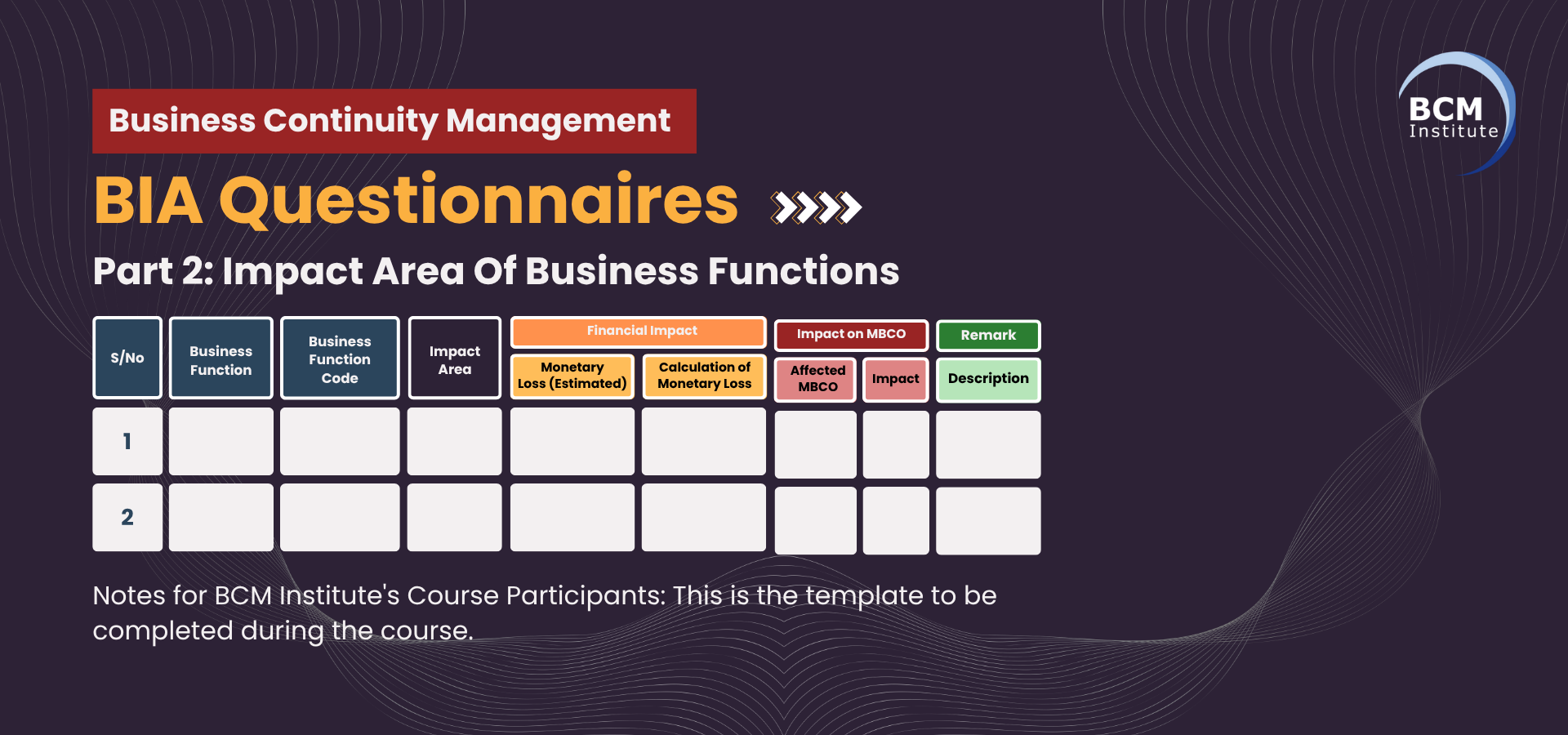](https://cta-redirect.hubspot.com/cta/redirect/3893111/6f3def45-6e82-4ee5-9e44-fc3946ad2398)
### [](https://cta-redirect.hubspot.com/cta/redirect/3893111/182e67c2-aa89-4b0b-b3e9-144293680ea4)
### CBF-1 Residential Care and Resident Safety
#### **Introduction**
[](https://cta-redirect.hubspot.com/cta/redirect/3893111/6a7f83ac-d900-4ed2-b2e3-0790f8616f4e)Business Impact Analysis (BIA) is a structured assessment process that identifies and evaluates the consequences of disruptions to an organisation's business activities.
For Jamiyah Singapore (JS), the BIA must consider how disruption affects its ability to provide essential residential care, maintain resident safety, protect vulnerable beneficiaries, and fulfil applicable governance and service obligations.
Assessing CBF-1 Residential Care and Resident Safety is particularly important because interruptions to residential care processes can have immediate consequences for resident health, safety, welfare, and safeguarding.
Unlike many commercial business functions, where disruption consequences may be measured primarily through lost revenue or financial penalties, residential care activities must be assessed against broader impact considerations.
These include resident safety, service continuity, legal and regulatory obligations, stakeholder confidence, information availability, staffing capability, external dependencies, and financial consequences.
This chapter evaluates the potential impact of disrupting each of the 26 Sub-Critical Business Functions (Sub-CBFs) identified in BIA Part 1.
It also establishes the relationship between disruption consequences and the Business Unit Minimum Business Continuity Objectives (BU MBCOs) previously defined for each Sub-CBF.
#### **Purpose of the Impact Area Assessment**
BIA Part 2 identifies the principal consequences that may arise when an individual residential care process becomes unavailable or cannot operate at its approved minimum service level.
The assessment supports Jamiyah Singapore in:
- Identifying the most significant impact area associated with each Sub-CBF.
- Estimating potential financial consequences arising from disruption.
- Understanding how disruption may prevent the achievement of BU MBCOs.
- Identifying activities where safety, safeguarding or service obligations take precedence over financial considerations.
- Establishing an evidence base for determining recovery priorities.
- Supporting the subsequent assessment of disruption impacts over time.
- Informing the selection of Business Continuity Strategies and recovery procedures.
#### **Importance of Assessing Different Impact Areas Separately**
Different residential care processes may produce different types of consequences when disrupted.
For example, interrupting resident supervision may create immediate safety and safeguarding concerns, while losing resident information may primarily affect information availability, care coordination, and confidentiality.
A shortage of residential care personnel may create operational and human resource impacts, whereas a critical supplier failure may create third-party dependency and service continuity risks.
Assessing these areas separately enables Jamiyah Singapore to identify the nature of disruption consequences rather than relying exclusively on financial estimates.
Although a single primary impact area is selected for each Sub-CBF in the table below, the assessment should recognise that a disruption may affect multiple impact areas simultaneously.
#### **Financial Impact Assessment Basis**
The financial estimates in this chapter are illustrative planning assumptions expressed in Singapore Dollars (SGD).
They represent potential incremental expenditure, emergency operating costs, alternative service arrangements, replacement resources, external support and other reasonably foreseeable financial consequences associated with disruption.
For consistency, the assessment assumes a single disruption event affecting the relevant Sub-CBF over a 24-hour assessment period, unless a different period is explicitly stated.
The estimates are not based on verified Jamiyah Singapore expenditure, resident numbers, supplier contracts or actual financial records.
They are intended to support BIA workshops and should be replaced with validated organisational data.
Do not interpret the figures as predicted losses, regulatory fines, statutory penalties, or approved recovery budgets.
Where resident safety or safeguarding is affected, do not use financial estimates as a substitute for evaluating potential consequences to people.
#### **Business Impact Assessment Criteria**
##### **Impact Areas**
The following impact areas are used in this assessment.
| Impact Area | Assessment Consideration |
| --- | --- |
| Financial | Emergency expenditure, additional staffing, replacement resources and recovery costs |
| Regulatory | Potential inability to meet applicable licensing, reporting or service requirements |
| Operational | Inability to maintain essential residential care activities |
| Customer / Stakeholder | Consequences for residents, families, caregivers and other stakeholders |
| Legal | Potential legal exposure arising from failure to fulfil applicable obligations |
| Reputation | Loss of confidence among beneficiaries, families, donors and community stakeholders |
| Information | Loss of access to essential resident information or records |
| Technology | Unavailability of systems supporting residential care |
| Human Resources | Insufficient staffing, competencies or personnel availability |
| Third-Party Dependency | Failure of suppliers, healthcare providers, transport or external service partners |
For CBF-1, resident safety and safeguarding are assessed explicitly within the operational, regulatory and stakeholder impact categories.
##### **Financial Estimation Methodology**
The following general formula is used:
Where relevant, the estimate may also include substantiated contractual or compliance-related costs.
Assess potential fines, legal claims, and other contingent liabilities separately unless there is a defensible basis for estimating them.
##### **Financial Estimation Assumptions**
The sample calculations use indicative unit costs, such as:
| Cost Component | Illustrative Planning Assumption |
| --- | --- |
| Additional care personnel | SGD 250 per staff-shift |
| Emergency administrative or coordination support | SGD 200 per staff-shift |
| Specialist or external support | SGD 400–800 per engagement |
| Emergency transportation | SGD 250–600 per vehicle movement |
| Temporary accommodation | SGD 150 per resident-night |
| Emergency food provision | SGD 25 per resident-day |
| Replacement supplies and equipment | Based on indicative quantities and replacement cost |
These are modelling assumptions only. They are not market quotations or confirmed JS costs.
For examples involving resident numbers, we use a hypothetical population of 40 residents where necessary. Actual capacity, staffing and resource requirements must be established through the approved BIA.
[](https://cta-redirect.hubspot.com/cta/redirect/3893111/91582408-03ad-40e1-90e8-43ce62079aa6)
#### Impact Area of Business Functions for CBF-1 Residential Care and Resident Safety
All monetary values are indicative SGD estimates for one 24-hour disruption event. Formula variables and unit rates are illustrative.
The selected impact area represents the principal non-financial consequence; financial exposure is assessed separately for every row.
Table BIA Part 2: Impact Area of Business Functions for CBF-1 Residential Care and Resident Safety
| Sub-CBF Code | Sub-Critical Business Function | Impact Area | Financial Impact – Monetary Loss (Estimated) | Financial Impact – Calculation Formula | Impact on BU MBCO – Affected MBCO | Impact on BU MBCO – Business Impact | Remarks / Description |
| --- | --- | --- | --- | --- | --- | --- | --- |
| 1.1 | Receive and Assess Resident Referrals | Operational | SGD 600 | 2 emergency assessment shifts × SGD 200 + SGD 200 external coordination | Ability to receive and assess all urgent referrals involving immediate safeguarding concerns | Urgent referrals may remain unassessed, delaying decisions on safe placement or referral | Routine referrals may be deferred, but urgent safeguarding cases require continued assessment and escalation. |
| 1.2 | Coordinate Resident Admission and Registration | Regulatory | SGD 850 | 2 administrative shifts × SGD 200 + SGD 450 emergency registration and verification support | Ability to complete essential registration and care information capture for urgent admissions | Urgent placements may proceed without complete essential information or may be delayed | Missing admission records or authorisations could create safeguarding, accountability and applicable compliance concerns. |
| 1.3 | Assess Resident Care and Support Requirements | Operational | SGD 1,200 | 2 specialist assessments × SGD 400 + 2 support shifts × SGD 200 | Ability to assess essential care and safety requirements for residents requiring new or changed support | Residents may receive inappropriate supervision, mobility assistance or other necessary care | Failure to identify changing dependency needs may expose residents to avoidable harm. |
| 1.4 | Develop and Maintain Individual Resident Care Plans | Information | SGD 900 | 3 care planning shifts × SGD 200 + SGD 300 documentation reconstruction | Accessible minimum care plans for 100% of residents | Care personnel may lack current instructions on essential care, supervision and escalation | Inaccurate or unavailable care plans increase inconsistency in care delivery, especially during staff redeployment. |
| 1.5 | Allocate Residential Accommodation and Facilities | Operational | SGD 4,000 | 10 emergency room placements × SGD 150 + SGD 2,500 facility preparation and transfer support | Safe and suitable accommodation for all residents under JS care | Residents may be unable to occupy appropriate rooms or facilities | Alternative accommodation may be necessary when existing premises cannot safely support resident needs. |
| 1.6 | Determine and Assign Residential Care Staffing | Human Resources | SGD 3,000 | 8 replacement staff-shifts × SGD 250 + SGD 1,000 emergency staffing coordination | Sufficiently trained and authorised personnel to maintain safe supervision and essential care | Required staffing coverage may become inadequate, affecting supervision and care delivery | Staff shortages may require approved redeployment, replacement personnel or alternative service arrangements. |
| 1.7 | Maintain Resident Supervision and Accountability | Operational | SGD 2,500 | 6 emergency supervision shifts × SGD 250 + SGD 1,000 accountability and response support | Continuous safe supervision and accurate accountability for 100% of residents | Residents may become unaccounted for or remain without necessary supervision | This is a safety-critical function. Financial costs do not represent the full consequences of inadequate supervision. |
| 1.8 | Provide Essential Daily Living Assistance | Customer / Stakeholder | SGD 2,000 | 6 additional care shifts × SGD 250 + SGD 500 essential support supplies | Essential daily living assistance for residents who depend on it | Residents may be unable to complete necessary mobility, dressing or other daily activities | Delays may cause distress, loss of dignity, avoidable deterioration or increased safeguarding risks. |
| 1.9 | Provide Essential Meals and Hydration | Third-Party Dependency | SGD 1,800 | 40 residents × SGD 25 emergency meals + SGD 800 alternative catering and delivery | Safe meals and drinking water for 100% of residents requiring provision | Residents may experience interruption to nutrition, hydration or required dietary arrangements | Alternative food sourcing and safe delivery arrangements may be required immediately. |
| 1.10 | Maintain Personal Hygiene and Sanitation Support | Operational | SGD 2,200 | SGD 1,200 temporary sanitation services + SGD 1,000 emergency hygiene supplies and labour | Essential hygiene, toileting and sanitation arrangements for all residents | Personal care and environmental hygiene may fall below safe and acceptable levels | Prolonged disruption increases infection prevention, dignity and welfare concerns. |
| 1.11 | Coordinate Essential Medication and Healthcare Support | Regulatory | SGD 2,500 | 3 authorised specialist shifts × SGD 500 + SGD 1,000 emergency clinical coordination | All time-critical medication and healthcare needs are addressed through authorised care arrangements | Necessary medication or clinical support may be delayed or unavailable | Clinical risks require immediate escalation. Actual professional and licensing obligations must govern response arrangements. |
| 1.12 | Monitor Resident Welfare and Changes in Condition | Operational | SGD 1,400 | 4 additional monitoring shifts × SGD 250 + SGD 400 escalation support | Minimum welfare checks and timely escalation of urgent changes in residents' condition | Deterioration or distress may go undetected or be escalated too late | Residents with higher dependency or vulnerability may require more frequent monitoring. |
| 1.13 | Maintain Resident Safeguarding and Protection | Legal | SGD 2,800 | SGD 1,200 emergency safeguarding support + SGD 1,000 specialist review + SGD 600 documentation and follow-up | Effective safeguarding and escalation capability for all residents | Suspected abuse, neglect or exploitation may not be identified or addressed promptly | Potential legal, safeguarding and reputational consequences may be substantial and cannot be adequately represented by this cost estimate. |
| 1.14 | Maintain Residential Facility Safety and Security | Regulatory | SGD 5,000 | SGD 2,500 emergency repairs + SGD 1,500 temporary security + SGD 1,000 safety assessment | Safe residential premises, essential protection measures and controlled access | Residents may be exposed to unsafe premises, unauthorised access or physical hazards | Serious safety deficiencies may require partial closure or emergency relocation. |
| 1.15 | Maintain Essential Utilities and Environmental Conditions | Operational | SGD 6,000 | SGD 3,000 temporary power and water + SGD 2,000 emergency equipment + SGD 1,000 technical support | Minimum utility and environmental conditions necessary for safe accommodation | Loss of power, water or sanitation may make normal residential care unsustainable | Extended failure may trigger alternative accommodation or full relocation. |
| 1.16 | Manage Resident Incidents and Immediate Emergencies | Operational | SGD 3,500 | SGD 1,500 emergency response support + SGD 1,000 specialist assistance + SGD 1,000 immediate remediation | Immediate protective response and escalation for serious resident incidents | Emergency assistance may be delayed, increasing the severity of consequences | This function is safety-critical; potential injury or loss of life cannot be meaningfully reduced to a monetary estimate. |
| 1.17 | Maintain Resident Records and Essential Information | Information | SGD 2,400 | 6 manual documentation shifts × SGD 200 + SGD 1,200 secure data recovery support | Authorised access to essential information for all residents under care | Care personnel may lack access to care instructions, contact details or safeguarding information | Secure downtime records and protected backups are essential to safe continuity. |
| 1.18 | Coordinate Resident and Family Communications | Customer / Stakeholder | SGD 1,000 | SGD 400 alternative communications + 3 coordination shifts × SGD 200 | At least one approved emergency communication channel and priority notification capability | Families and authorised representatives may not receive essential safety or service information | Communication failure may increase distress, complaints and loss of confidence. |
| 1.19 | Coordinate External Healthcare and Emergency Services | Third-Party Dependency | SGD 3,000 | 3 emergency transport movements × SGD 600 + SGD 1,200 external coordination support | Ability to obtain emergency healthcare assistance and coordinate necessary transfers | Residents may experience delays in receiving appropriate external healthcare or emergency assistance | Dependence on external providers and transport arrangements must be addressed in continuity planning. |
| 1.20 | Maintain Essential Residential Supplies and Equipment | Third-Party Dependency | SGD 4,000 | SGD 2,500 emergency supplies + SGD 1,000 replacement equipment + SGD 500 expedited delivery | Availability of minimum essential care supplies and equipment | Care activities may be interrupted because required materials or equipment are unavailable | Emergency stock arrangements and alternative suppliers reduce concentration risk. |
| 1.21 | Manage Resident Activities and Essential Welfare Support | Customer / Stakeholder | SGD 700 | 2 welfare support shifts × SGD 200 + SGD 300 alternative activities and support materials | Essential welfare monitoring and appropriate psychosocial support | Residents may experience increased isolation, distress or disruption to necessary routines | Non-essential activities may be deferred, but essential welfare support should remain available. |
| 1.22 | Activate Residential Care Continuity Arrangements | Operational | SGD 4,500 | 6 emergency coordination shifts × SGD 250 + SGD 3,000 mobilisation and logistics | Ability to activate continuity arrangements before minimum safe care is compromised | Delayed activation may prolong disruption and prevent timely resource mobilisation | Clear authority, escalation triggers and activation procedures are essential. |
| 1.23 | Coordinate Emergency Resident Relocation and Alternative Accommodation | Operational | SGD 10,000 | 40 residents × SGD 150 accommodation + 5 transport movements × SGD 600 + SGD 1,000 transfer support | Ability to relocate all affected residents safely to suitable accommodation | Residents may remain in unsafe premises or experience unsafe transfer arrangements | Relocation is resource-intensive and depends on suitable premises, transport, staffing and resident information. |
| 1.24 | Maintain Essential Care at the Recovery Location | Operational | SGD 8,000 | 40 residents × SGD 150 accommodation + 4 additional care shifts × SGD 250 + SGD 1,000 supplies and coordination | Minimum essential care for 100% of relocated residents | Alternative accommodation may be available without sufficient care, staffing or supplies | A recovery location must support safe operations, not merely provide physical space. |
| 1.25 | Restore Normal Residential Care Operations | Financial | SGD 5,000 | SGD 2,500 facility reinstatement + SGD 1,500 resident return logistics + SGD 1,000 verification and support | Safe continuation of essential care throughout transition and authorised restoration of normal operations | Premature restoration may expose residents to unsafe conditions; delayed restoration prolongs temporary operating costs | Facility readiness, resident accountability and service verification are required before return. |
| 1.26 | Conduct Post-Incident Review and Care Continuity Improvement | Reputation | SGD 1,500 | 5 review shifts × SGD 200 + SGD 500 corrective action coordination | Ability to document significant incidents, assign corrective actions and escalate urgent deficiencies | Repeated weaknesses may remain unresolved, increasing exposure to future disruption | Failure to address lessons learned may undermine governance oversight and stakeholder confidence. |
##### **Interpretation of Financial Impact Estimates**
The estimated financial impact varies considerably across the 26 Sub-CBFs.
Activities involving emergency accommodation, utilities, relocation, facilities and alternative care arrangements generally generate higher direct financial expenditure than routine administrative or coordination activities.
However, do not treat the monetary estimate as the sole indicator of criticality.
For example, the estimated incremental cost of disrupting resident supervision may be lower than the cost of emergency relocation. Nevertheless, inadequate supervision may create more immediate and severe safety consequences.
Consequently, recovery priorities must consider both financial and non-financial impacts.
ILLUSTRATIVE FINANCIAL EXPOSURE
SGD 78,850
Arithmetic sum of all 26 scenario-level estimates — not a consolidated incident loss forecast.
The sum is useful as a worksheet reconciliation figure only.
Do not interpret it as the expected cost of a single organisation-wide incident, because the individual scenarios may overlap, share resources, or involve mutually exclusive recovery arrangements.
For example, emergency accommodation costs in Sub-CBF 1.23 and Sub-CBF 1.24 may refer to the same accommodation period. Adding both amounts without adjustment could overstate the actual financial exposure.
A consolidated incident estimate should therefore remove overlapping costs and apply a consistent scenario, duration and affected population.
#### **Impact on Business Unit Minimum Business Continuity Objectives**
##### **Relationship Between Disruption and BU MBCO**
Each BU MBCO defines the minimum operational capability that a Sub-CBF must maintain during disruption.
The impact assessment identifies the consequences of failing to achieve the BU MBCO.
For residential care, failing to meet an MBCO may have direct consequences for resident safety, essential care delivery, safeguarding, information availability, and recovery coordination.
**Table 4.1: Examples of BU MBCO Failure**
| Sub-CBF | BU MBCO Requirement | Consequence of Failure |
| --- | --- | --- |
| 1.7 Resident Supervision | Continuous safe supervision and accountability | Residents may become unsupervised or unaccounted for |
| 1.9 Meals and Hydration | Safe nutrition and drinking water for residents | Essential nutritional and hydration needs may not be met |
| 1.11 Medication and Healthcare Support | Continuity of time-critical care | Residents may experience avoidable clinical deterioration |
| 1.13 Safeguarding | Effective protection and escalation | Safeguarding concerns may remain unidentified or unresolved |
| 1.15 Essential Utilities | Safe environmental conditions | Residential facilities may become unsuitable for continued occupation |
| 1.17 Resident Records | Access to essential resident information | Care delivery and emergency decisions may be based on incomplete information |
| 1.23 Emergency Relocation | Safe relocation to suitable accommodation | Residents may remain in unsafe premises |
| 1.24 Care at Recovery Location | Essential care for all relocated residents | Alternative accommodation may not provide an acceptable level of care |
##### **Assessing Severity Beyond Financial Loss**
Jamiyah Singapore should not assume that activities with the highest estimated monetary losses are necessarily the most critical.
Where disruption threatens resident life, health, safety, or safeguarding, these consequences should receive appropriate priority regardless of financial exposure.
A complete BIA should therefore assess each relevant impact dimension separately before determining overall criticality.
#### **Preliminary Impact Prioritisation**
The following classification provides an initial indication of the consequences of disrupting selected Sub-CBFs.
It is not a substitute for the formal impact-over-time assessment.
**Table 5.1: Preliminary Impact Classification**
| Impact Classification | Relevant Sub-CBFs | Primary Consideration |
| --- | --- | --- |
| Immediate Safety and Safeguarding Impact | 1.6, 1.7, 1.11, 1.12, 1.13, 1.16, 1.19 | Potential immediate consequences for resident safety, necessary care and emergency response |
| Essential Daily Care Impact | 1.8, 1.9, 1.10, 1.15 | Interruption of essential care, nutrition, hygiene and safe environmental conditions |
| Facility and Recovery Capability Impact | 1.5, 1.14, 1.22, 1.23, 1.24, 1.25 | Loss of suitable accommodation, continuity of activation or safe recovery arrangements |
| Essential Information and Resource Impact | 1.4, 1.17, 1.18, 1.20 | Reduced availability of care information, communications and critical supplies |
| Planning, Assessment and Improvement Impact | 1.1, 1.2, 1.3, 1.21, 1.26 | Delays in admissions, care planning, welfare support and improvement activities |
These categories are illustrative and do not represent approved impact ratings.
An activity ordinarily regarded as less time-sensitive may become critical under specific circumstances. For example, urgent admission or reassessment may be necessary to protect an individual facing immediate safeguarding risks.
#### **Using Financial Impact Estimates for Management Decision-Making**
##### **Purpose of Financial Quantification**
Financial impact estimation helps management understand the resources needed to respond to disruption and maintain essential services.
For Jamiyah Singapore, this may include:
- Additional personnel and emergency staffing costs.
- Temporary accommodation and relocation expenditure.
- Emergency procurement of essential supplies.
- Replacement equipment and technical support.
- Alternative communications and transport arrangements.
- Facility repair and restoration expenditure.
- Specialist support and corrective action costs.
These estimates support resource planning, contingency budgeting, and evaluation of recovery strategies.
##### **Comparing Recovery Strategy Costs**
Financial impact estimates can help evaluate the cost-effectiveness of alternative continuity arrangements.
For example, a prolonged utility failure may require either temporary backup utility arrangements or relocation to alternative accommodation.
Select the preferred option based on resident safety, feasibility, regulatory requirements, recovery objectives, and total expected costs.
Do not select a lower-cost option if it cannot maintain the approved minimum safe service level.
##### **Validating Financial Assumptions**
The BCM Coordinator should work with Finance, Facilities, Residential Care Management and Procurement to validate the assumptions used in the assessment.
Actual information should include staffing rates, accommodation costs, supplier quotations, emergency transport arrangements, equipment replacement costs and relevant contractual obligations.
Review the estimates when resident numbers, facilities, operating costs, or continuity arrangements change significantly.
#### **Relationship with Recovery Time Objectives and Impact Over Time**
BIA Part 2 identifies the nature and potential severity of disruption consequences.
The next assessment, BIA Part 3 — Impact Over Time of Business Functions, determines how these consequences develop as the duration of disruption increases.
This distinction matters because the impact of an interruption can change significantly over time.
For example, a brief interruption to routine administrative processing may initially be manageable. In contrast, even a short interruption to essential resident supervision or emergency response may create unacceptable safety consequences.
The impact-over-time assessment should determine:
1. The consequences of disruption at defined time intervals.
2. When consequences become unacceptable.
3. The Maximum Tolerable Period of Disruption (MTPD).
4. The Recovery Time Objective (RTO).
5. The minimum acceptable operating capacity.
6. The recovery priorities and resource requirements.
Establish an RTO with sufficient allowance to avoid reaching the MTPD.
Where an activity must remain continuously available to protect resident safety, the continuity strategy should prevent an unsafe service gap rather than rely solely on restoring the activity after interruption.
#### **Implications for Business Continuity Strategy and Plan Development**
##### **Business Continuity Strategy**
The impact assessment provides evidence for selecting appropriate recovery strategies.
**Table 8.1: Impact-Driven Recovery Strategy Considerations**
| Disruption Impact | Potential Strategy |
| --- | --- |
| Insufficient residential care staffing | Approved replacement staffing, cross-training and contingency rosters |
| Unavailable meals or drinking water | Emergency food stocks, alternative catering and water supply |
| Loss of essential utilities | Backup power, emergency water and alternative premises |
| Unavailable resident information | Protected backups and secure manual downtime records |
| Loss of residential premises | Pre-identified alternative accommodation and relocation arrangements |
| Critical supplier failure | Alternative suppliers and emergency procurement procedures |
| Communication failure | Secondary communication channels and emergency contact trees |
| Healthcare coordination disruption | Approved alternative referral and emergency transfer arrangements |
##### **Business Continuity Plan Development**
The Business Continuity Plan should translate approved strategies into actionable procedures.
For each relevant Sub-CBF, the recovery procedure should identify:
- Activation criteria and escalation requirements.
- Responsible personnel and decision-making authority.
- Immediate safety and protective actions.
- Minimum service level to be maintained.
- Required personnel, facilities, equipment and information.
- Alternative arrangements and recovery steps.
- Communications and stakeholder notification requirements.
- Verification that minimum service levels have been restored or maintained.
##### **Testing and Exercising**
The impact assessment should also inform exercise scenarios.
For example, a tabletop exercise involving the loss of residential premises should evaluate whether the proposed relocation arrangements can protect residents, maintain accountability and support essential care at the recovery location.
Compare exercise results with the approved BU MBCOs and recovery requirements.
#### **Review, Validation and Approval**
Personnel who understand the operational, financial, safety, and governance implications of residential care disruption should validate the impact assessment.
**Table 9.1: Recommended Review Responsibilities**
| Assessment Activity | Responsible Contributor | Required Review |
| --- | --- | --- |
| Identify operational consequences | Residential Care Process Owners | Head of Residential Care |
| Validate resident safety impacts | Residential Care and Safeguarding Personnel | Relevant Service Management |
| Validate healthcare-related impacts | Healthcare Representatives | Authorised Healthcare Lead |
| Validate financial assumptions | Finance and Procurement Representatives | BCM Coordinator |
| Validate facility and utility costs | Facilities Representatives | BCM Coordinator |
| Validate ICT and information impacts | ICT and Records Representatives | BCM Coordinator |
| Consolidate impact assessments | BCM Coordinator | BCM Steering Committee |
| Approve the BIA impact assessment | Designated Senior Management | Authorised Management Approver |
Maintain the approved assessment as controlled BCM documentation and review it after significant changes to residential care operations, resident profiles, staffing, facilities, technology, suppliers, or applicable requirements.
[](https://cta-redirect.hubspot.com/cta/redirect/3893111/76188041-e1c9-43d9-8efa-e550f46ad04d)
The business impact assessment provides Jamiyah Singapore with a structured understanding of the consequences that may arise when individual residential care processes are disrupted.
For CBF-1 Residential Care and Resident Safety, the 26 Sub-Critical Business Functions represent the operational activities necessary to support resident admission, care planning, supervision, essential daily living assistance, safeguarding, facility safety, emergency response, relocation and restoration of normal operations.
By identifying the primary impact area for each Sub-CBF, Jamiyah Singapore can distinguish between financial, operational, regulatory, stakeholder, legal, information, human resource and third-party dependency consequences.
The financial estimates provide an initial basis for understanding potential emergency expenditure and recovery costs.
Although illustrative, they can help management evaluate contingency funding, recovery options, and resource allocation once validated against actual organisational data.
More importantly, the assessment shows how disruption may prevent the BU from achieving the MBCOs developed in BIA Part 1.
This relationship is particularly significant for residential care, where failure to maintain minimum service levels may affect resident safety, essential care, safeguarding and welfare.
The impact assessment will provide a foundation for BIA Part 3 — Impact Over Time of Business Functions, where Jamiyah Singapore will determine how disruption consequences increase over time and establish appropriate MTPDs, RTOs and recovery priorities.
The results will also inform Business Continuity Strategy development by identifying the resources and alternative arrangements necessary to maintain essential services.
During Business Continuity Plan Development, the findings will support practical recovery procedures that address the most significant operational vulnerabilities and consequences.
From an operational resilience perspective, the assessment strengthens Jamiyah Singapore's ability to understand the relationships between critical activities, supporting resources and service outcomes.
The ultimate objective is to ensure Jamiyah Singapore can prioritise recovery capabilities based on the consequences of disruption, while maintaining the safety, safeguarding, welfare, and essential care of residents under its responsibility.
[](https://cta-redirect.hubspot.com/cta/redirect/3893111/3aefb2d2-3110-47c1-ad4f-d3e6e5381066)
[](https://cta-redirect.hubspot.com/cta/redirect/3893111/320f01c4-c800-4496-aa02-c30e72e7481d)
| **eBook 3: Starting Your BCM Implementation** | | | | | | |
| --- | --- | --- | --- | --- | --- | --- |
| **MBCO** | **P&S** | **RAR T1** | **RAR T2** | **RAR T3** | **BCS T1** | **CBF** |
| [](https://cta-redirect.hubspot.com/cta/redirect/3893111/723f3c3d-5ee0-4bf8-8e22-3244b607978a) | [](https://cta-redirect.hubspot.com/cta/redirect/3893111/db4572cb-afab-45f2-902b-8a8b33b88b58) | [](https://cta-redirect.hubspot.com/cta/redirect/3893111/87b522e2-f0d8-4959-9c59-40a3be1b6f71) | [](https://cta-redirect.hubspot.com/cta/redirect/3893111/bbf2124f-6183-4c2f-85f0-727313f44adf) | [](https://cta-redirect.hubspot.com/cta/redirect/3893111/f4035e58-2c2f-4b9b-aa1d-4e24ef7507fe) | [](https://cta-redirect.hubspot.com/cta/redirect/3893111/4691ede5-015e-4d02-890f-1dc8a37980a6) | [](https://cta-redirect.hubspot.com/cta/redirect/3893111/0e87ad0d-3fdf-495a-a60f-384b0e67a940) |
| **CBF-1 Residential Care and Resident Safety** | | | | | | |
| **DP** | **BIAQ P1** | **BIAQ P2** | **BIAQ P3** | **BIAQ P4** | **BIAQ P5** | **BIAQ P6** |
| [](https://cta-redirect.hubspot.com/cta/redirect/3893111/8fc0299d-8dd3-4524-a501-d69412824245) | [](https://cta-redirect.hubspot.com/cta/redirect/3893111/b6095493-82e5-4021-a587-04abac283a83) | [](https://cta-redirect.hubspot.com/cta/redirect/3893111/6a7f83ac-d900-4ed2-b2e3-0790f8616f4e) | [](https://cta-redirect.hubspot.com/cta/redirect/3893111/fcda677d-0de5-4fd8-90c1-c4ded98df1aa) | [](https://cta-redirect.hubspot.com/cta/redirect/3893111/099c843a-dde6-4f81-9e61-063c199f8c07) | [](https://cta-redirect.hubspot.com/cta/redirect/3893111/55edfd9f-de2d-4faa-8b25-4bd72f6ffa41) | [](https://cta-redirect.hubspot.com/cta/redirect/3893111/4c7bd1f2-689d-4057-aed0-03ec5dd02d81) |
| | | **BCS T2** | **BCS T3** | **PD** | | |
| | | [](https://cta-redirect.hubspot.com/cta/redirect/3893111/2e82d94a-aef2-44c5-837b-2e2dffc1d356) | [](https://cta-redirect.hubspot.com/cta/redirect/3893111/d1c9695c-142d-4544-91bb-b76470cf1a6f) | [](https://cta-redirect.hubspot.com/cta/redirect/3893111/a4a01ce0-cc91-4aa5-b0b4-e091b884db90) | | |
| | | | | | | |
#### More Information About Business Continuity Management Courses
To learn more about the course and schedule, click the buttons below for the BCM-300 Business Continuity Management Implementer \[BCM-3\] and the BCM-5000 Business Continuity Management Expert Implementer \[BCM-5\].
| [](https://cta-redirect.hubspot.com/cta/redirect/3893111/f3922b80-e96a-46d6-8993-dc150a5de2d5) | [](https://cta-redirect.hubspot.com/cta/redirect/3893111/9ff8a3dc-e39a-465b-929f-72e232cdd5fb) | [](https://cta-redirect.hubspot.com/cta/redirect/3893111/ac6cf073-4cdd-4541-91ed-889f731d5076) |
| --- | --- | --- |
| [](https://cta-redirect.hubspot.com/cta/redirect/3893111/21525c10-4003-4934-95fc-fe218174bc5b) | [](https://cta-redirect.hubspot.com/cta/redirect/3893111/46460171-c91a-4936-9bb2-8dc5928a0e02) | [](https://cta-redirect.hubspot.com/cta/redirect/3893111/1cb17ac7-50b2-4f88-bc4b-c7444e4b57b5) |
| [](https://cta-redirect.hubspot.com/cta/redirect/3893111/b3824ba1-7aa1-4eb6-bef8-94f57121c5ae) | Please feel free to send us a note if you have any questions. [](https://cta-redirect.hubspot.com/cta/redirect/3893111/3c53daeb-2836-4843-b0e0-645baee2ab9e) | [](https://cta-redirect.hubspot.com/cta/redirect/3893111/9c199ae8-c470-4bb7-9612-73c7a084e94c) |
| [](https://cta-redirect.hubspot.com/cta/redirect/3893111/8999211a-2c51-4be7-bf49-c393f6c67974) | [](https://cta-redirect.hubspot.com/cta/redirect/3893111/5c1aa95d-f6dd-4067-a95c-5cc0c32d7ed8) | [](https://cta-redirect.hubspot.com/cta/redirect/3893111/086ab3b9-4d66-4a95-b2f7-1148e9803a9c) |
#### **Your Comments Here:**
### More Posts
[](https://cta-redirect.hubspot.com/cta/redirect/3893111/839787f4-a4fd-456f-accf-54c947026558)

All rights reserved. Copyright 2026
```json
{
"@context" : "https://schema.org",
"@type" : "BlogPosting",
"author" : {
"@type" : "Person",
"name" : "Dr Goh Moh Heng",
"url" : "https://blog.bcm-institute.org/ebook/author/dr-goh-moh-heng"
},
"dateModified" : "2026-10-15T12:53:31.005Z",
"datePublished" : "2026-10-14T07:46:40.000Z",
"headline" : "[BCM] [JS] [E3] [BIA] [P2] [CBF] [1] Residential Care and Resident Safety",
"mainEntityOfPage" : {
"@id" : "https://blog.bcm-institute.org/ebook/bcm-js-e3-bia-p2-cbf-1-residential-care-and-resident-safety",
"@type" : "WebPage"
},
"publisher" : {
"@type" : "Organization",
"logo" : {
"@type" : "ImageObject",
"url" : "https://blog.bcm-institute.org/hubfs/BCMI%20Logo.png"
},
"name" : "BCMI Pte Ltd"
}
}
```