---
title: [BCM] [JS] [E3] [BCS] [T3] [CBF] [1] Residential Care and Resident Safety
description: [BCM] [JS] [E3] [BCS] [T3] [CBF] [1] Residential Care and Resident Safety
image: https://blog.bcm-institute.org/hubfs/Jamiyah%20Singapore%20Graphic%20Folder/JS%20BCM%20CBF%201%20Morepost/%5BBCM%5D%20%5BJS%5D%20%5BE3%5D%20%5BBCS%5D%20%5BT3%5D%20%5BCBF%5D%20%5B1%5D%20Residential%20Care%20and%20Resident%20Safety.jpg
---
. .
[](http://www.bcm-institute.org/)
- [Home](https://www.bcm-institute.org/)
- [About Us](https://www.bcm-institute.org/about-us-3/)
- [A President’s Perspective](https://www.bcm-institute.org/about-us/a-presidents-perspective/)
- [Our History](https://www.bcm-institute.org/about-us/our-history/)
- [Our Advisory Council](https://www.bcm-institute.org/about-us/our-advisory-council/)
- [Customers’ Testimonials](https://www.bcm-institute.org/about-us/customers-testimonials/)
- [Credential Verification](https://www.bcm-institute.org/about-us/credential-verification/)
- [Courses](https://blog.bcm-institute.org/blog/course-fees-for-blended-learning-courses-master-catalog)
- [ISO 22301 Business Continuity Management System Audit](https://blog.bcm-institute.org/audit/business-continuity-management-audit-courses)
- [ISO 22301 Business Continuity Management](https://blog.bcm-institute.org/bcm/business-continuity-management-courses)
- [Crisis Communication](https://blog.bcm-institute.org/crisis-communication/crisis-communication-courses)
- [Crisis Management](https://blog.bcm-institute.org/en/crisis-management/courses)
- [IT Disaster Recovery](https://blog.bcm-institute.org/it-disaster-recovery/courses)
- [Operational Resilience](https://blog.bcm-institute.org/operational-resilience/courses)
- [Operational Resilience Audit](https://blog.bcm-institute.org/operational-resilience-audit/courses)
- [Certification](https://blog.bcm-institute.org/certification/types-of-certifications-offered)
- [ISO 22301 BCMS Audit Certification](https://blog.bcm-institute.org/certification/business-continuity-management-audit-certification)
- [ISO22301 Business Continuity Management Certification](https://blog.bcm-institute.org/bcm/business-continuity-management-certification)
- [Crisis Communication Certification](https://blog.bcm-institute.org/crisis-communication/crisis-communication-certification)
- [Crisis Management Certification](https://blog.bcm-institute.org/en/crisis-management/crisis-management-certification)
- [IT Disaster Recovery Planning Certification](https://blog.bcm-institute.org/it-disaster-recovery/it-disaster-recovery-certification)
- [Operational Resilience Certification](https://blog.bcm-institute.org/operational-resilience/operational-resilience-certification)
- [Operational Resilience Audit Certification](https://blog.bcm-institute.org/operational-resilience-audit)
- [Seminars](https://blog.bcm-institute.org/meet-the-expert/mte-webinar-mainpage)
- [Store](https://www.bcm-institute.org/store-2/)
- [Contact Us](http://www.bcm-institute.org/about-us/contact-us/)
-
-
##### Resilient Communities: Implementing Business Continuity Management at Jamiyah Singapore
# \[BCM\] \[JS\] \[E3\] \[BCS\] \[T3\] \[CBF\] \[1\] Residential Care and Resident Safety
[](https://cta-redirect.hubspot.com/cta/redirect/3893111/b764264e-ccf8-489f-9125-6bdfc8db17b3)The objective of Business Continuity Management (BCM) is not to restore normal business operations immediately following a disruption, but to maintain the **Minimum Business Continuity Objective (MBCO)** using the minimum resources necessary until full recovery can be achieved.
Identifying minimum recovery resources enables ALPS Healthcare to determine the essential personnel, facilities, technology, communications, and operational support required to sustain Strategic Procurement and Sourcing during disruptive events.
This approach ensures that critical procurement activities supporting Singapore's public healthcare system continue despite reduced operational capacity.
Resource planning is a direct outcome of the Business Impact Analysis (BIA) and the Recovery Strategy development process.
The BIA establishes which Sub-Critical Business Functions (Sub-CBFs) are essential, their Recovery Time Objectives (RTOs), and the minimum service levels that must be maintained.
### [](https://cta-redirect.hubspot.com/cta/redirect/3893111/8969ce47-38c2-4b89-88da-727979f12c39)
[Dr Goh Moh Heng](https://blog.bcm-institute.org/ebook/author/dr-goh-moh-heng) Oct 14, 2026
###### Business Continuity Management Certified Planner-Specialist-Expert
### [](https://cta-redirect.hubspot.com/cta/redirect/3893111/7a1ba6dc-8352-46e7-b150-d25945acf3d9)
### [](https://cta-redirect.hubspot.com/cta/redirect/3893111/0d2c5cc8-ed30-4545-b19a-49a3cb32e0e8)
[](https://cta-redirect.hubspot.com/cta/redirect/3893111/2473a6fd-c3f8-42a1-9622-442761ec98fe)
[](https://cta-redirect.hubspot.com/cta/redirect/3893111/8969ce47-38c2-4b89-88da-727979f12c39)
### CBF-1 Residential Care and Resident Safety
#### **Introduction**
[](https://cta-redirect.hubspot.com/cta/redirect/3893111/d1c9695c-142d-4544-91bb-b76470cf1a6f)
Recovering critical business functions during a disruptive incident depends on having sufficient personnel, suitable facilities, essential technology, communication capabilities, equipment, information, and supporting services.
Within Business Continuity Management (BCM), identifying the Minimum Resources Required during a Disaster is a critical activity in the Business Continuity Strategy (BCS) phase.
It translates the recovery requirements established during Business Impact Analysis (BIA) into practical resource arrangements that can be activated when normal operations are disrupted.
For Jamiyah Singapore (JS), the continuity of CBF-1 Residential Care and Resident Safety is particularly important because disruptions may directly affect residents who depend on the organisation for accommodation, supervision, daily living assistance, safeguarding and essential care.
Unlike administrative activities that may be temporarily deferred, many residential care activities must continue without interruption.
For example, resident supervision, safeguarding, emergency response, and time-critical healthcare coordination cannot simply be suspended while the organisation restores an alternative facility or information system.
The organisation must therefore determine the minimum resources required to sustain safe care under disrupted conditions.
This chapter identifies proposed minimum staffing, workspace, communication, computing and other essential resource requirements for the 26 Sub-Critical Business Functions (Sub-CBFs) supporting Residential Care and Resident Safety.
#### **Purpose of Minimum Recovery Resource Planning**
Minimum recovery resource planning identifies the smallest feasible set of resources needed to meet an approved Minimum Business Continuity Objective (MBCO).
The purpose is not to reproduce normal operating capacity.
Instead, it establishes a controlled minimum operating capability that protects residents and sustains essential services until normal operations can be restored.
The assessment enables Jamiyah Singapore to determine:
- The minimum personnel and competencies required.
- The facilities and recovery locations needed.
- The essential communication and computing devices.
- The equipment and supplies required to maintain safe care.
- The supporting information and technology capabilities.
- The resources that may be shared across several Sub-CBFs.
- Resources that must remain dedicated for safety or operational requirements.
#### **Relationship Between BIA, Recovery Strategies, and Minimum Resources**
The Business Impact Analysis establishes each Sub-CBF's criticality, MBCO, Recovery Time Objective (RTO), Maximum Tolerable Period of Disruption (MTPD), and essential dependencies.
The Recovery Strategy assessment determines how the Sub-CBF will continue or recover.
Minimum resource planning then establishes what is required to implement the selected strategy.

#### **Importance of Resource Optimisation**
During a major disruption, available personnel, facilities and equipment may be limited.
Jamiyah Singapore should therefore prioritise resources according to resident safety, safeguarding, essential care requirements and approved recovery objectives.
For example, a single secure laptop may support admissions, referral assessment and administrative coordination if these activities are performed sequentially.
However, one care worker cannot simultaneously provide continuous supervision in two physically separate areas where both require direct observation.
Resource optimisation must therefore distinguish between resources that can safely be shared and resources that require dedicated coverage.
Minimum resources must never be interpreted as permission to operate below safe staffing, supervision, safeguarding, clinical or facility requirements.
#### **Resource Planning Basis and Assumptions**
Because actual resident numbers, dependency levels, staffing rosters, facilities and recovery arrangements have not been provided, the following assumptions are used to develop an illustrative resource baseline.
**Table 2.1: Resource Planning Assumptions**
| Planning Parameter | Illustrative Assumption |
| --- | --- |
| Residential population | 40 residents requiring continued care |
| Recovery scenario | Primary residential facility partially or fully unavailable |
| Recovery operating model | Essential residential care is maintained at a safe primary area or approved alternative accommodation |
| Recovery period | Initial 72 hours, with provision for extended operations |
| Staffing arrangement | Continuous shift-based coverage for essential care |
| Staff numbers | Minimum concurrent personnel for each function, not total establishment |
| Seats | Administrative or coordination work positions; resident beds and care spaces are recorded separately |
| Telephones | Dedicated communication endpoints are needed for the function, including secure mobile phones |
| PCs/Laptops | Minimum concurrent computing devices, excluding shared devices already assigned elsewhere |
| Shared resources | Permitted where timing, location, security, and workload allow |
| Safety-critical equipment | Must remain available in quantities appropriate to resident needs and facility risk |
| Approval | All proposed quantities require operational validation and management approval |
The assumption of 40 residents is a planning example only. It does not represent a verified JS residential census.
##### **Interpretation of Minimum Staffing**
The staffing figures in the assessment table represent the minimum number of personnel required to perform the identified function concurrently during recovery.
They do not represent the total number of employees required for continuous 24-hour operations.
For example, a function requiring four personnel on duty continuously will require additional staff to cover shifts, rest periods, leave, sickness and other operational contingencies.
Where personnel are shared across Sub-CBFs, do not add the figures without accounting for overlapping duties.
##### **Interpretation of Recovery Locations**
The recovery locations used in this assessment include:
| Recovery Location | Application |
| --- | --- |
| Safe Primary Residential Area | Unaffected part of the original facility where continued occupancy is safe |
| Alternative Residential Care Facility | Approved premises suitable for resident accommodation and essential care |
| Recovery-Site Care Station | Designated care coordination point at alternative accommodation |
| Alternate Administrative Office | Secure location for essential administration and coordination |
| Remote Working | Suitable for selected administrative activities involving authorised secure access |
| Mobile Incident Coordination Point | Temporary location for incident response and relocation coordination |
| Restored Primary Residential Facility | Original premises after safety and operational readiness have been confirmed |
Establish the suitability of any alternative facility before relying on it as a recovery location.
#### [](https://cta-redirect.hubspot.com/cta/redirect/3893111/7456e7dd-9e1f-4c07-a6f9-a39e58f74746)
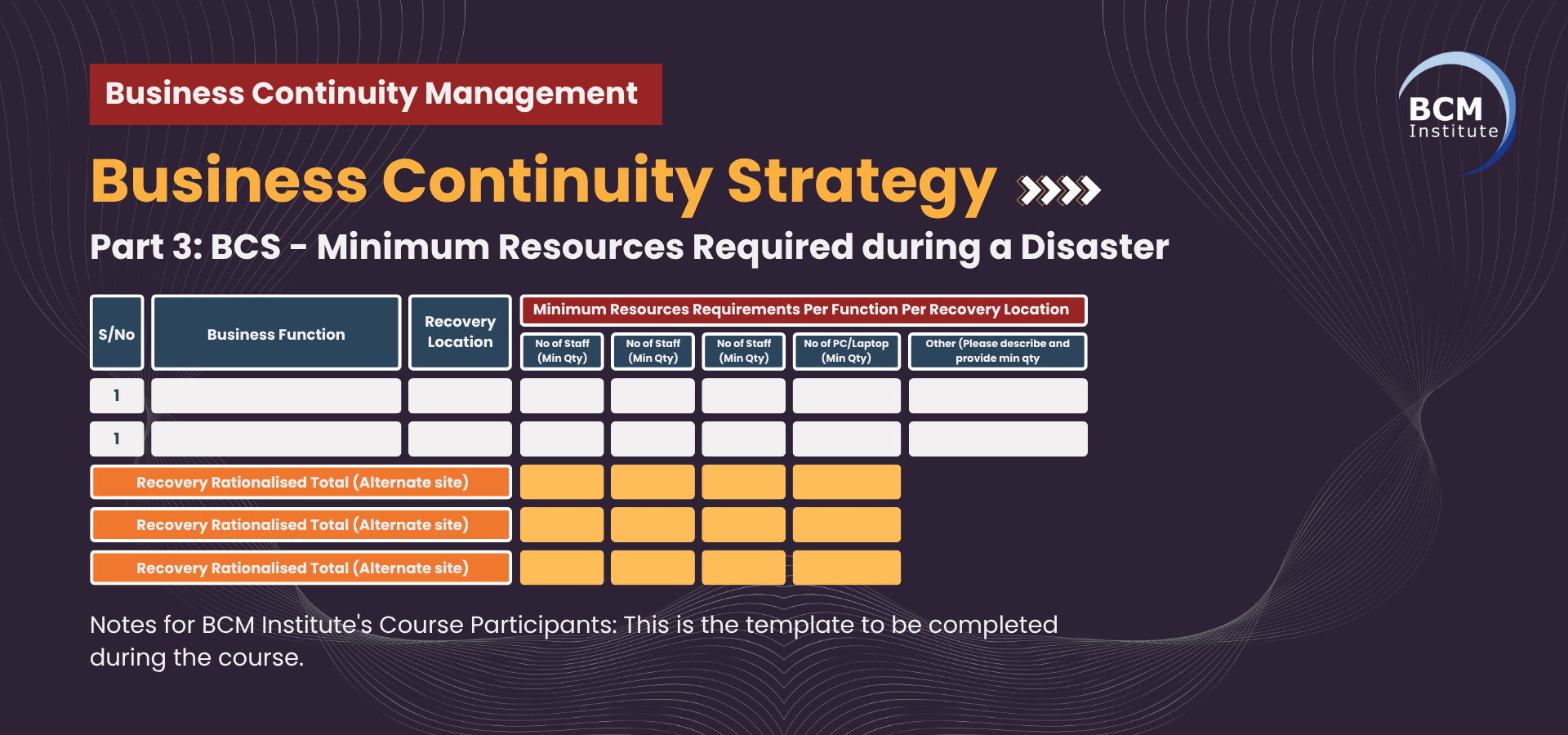
#### Table BCS P3: Minimum Resources Required during a Disaster for CBF-1 Residential Care and Resident Safety
The quantities below are illustrative minimum concurrent allocations.
They support an initial 40-resident recovery scenario and must be adjusted for resident dependency, building layout, staffing competencies, actual recovery-site capacity, and applicable requirements.
Table BCS P3: Minimum Resources Required during a Disaster for CBF-1 Residential Care and Resident Safety
| Sub-CBF Code | Sub-Critical Business Function | Recovery Location | Minimum Resource Requirements per Function per Recovery Location | Number of Staff (Minimum) | Number of Seats (Minimum) | Number of Telephones (Minimum) | Number of PCs/Laptops (Minimum) | Other Resources (Description and Minimum Quantity) |
| --- | --- | --- | --- | --- | --- | --- | --- | --- |
| 1.1 | Receive and Assess Resident Referrals | Alternate Administrative Office / Remote Working | Authorised intake officer with secure access to referral information; urgent referrals prioritised and routine referrals deferred | 1 | 1 | 1 | 1 | 1 secure referral register; 1 approved secure document repository; 1 controlled intake checklist |
| 1.2 | Coordinate Resident Admission and Registration | Recovery-Site Administration Station | Admission officer with resident identity, essential care and emergency contact information; manual registration available | 1 | 1 | 1 | 1 | 1 controlled admission register; 1 portable document scanner; 1 secure document storage facility |
| 1.3 | Assess Resident Care and Support Requirements | Alternative Residential Care Facility | Competent assessment personnel with access to resident care requirements and approved assessment procedures | 2 | 1 | 1 | 1 | 2 assessment kits; 1 controlled assessment form set; 1 secure resident information access arrangement |
| 1.4 | Develop and Maintain Individual Resident Care Plans | Recovery-Site Care Station | Designated care plan owner with access to essential resident information and authority to update minimum care instructions | 1 | 1 | 1 | 1 | 1 controlled care plan register; 1 secure offline care plan set; 1 authorised care documentation system |
| 1.5 | Allocate Residential Accommodation and Facilities | Alternative Residential Care Facility | Accommodation coordinator and facilities representative to confirm safe placement, room suitability and accessibility | 2 | 1 | 1 | 1 | 40 suitable resident accommodation places; 1 current occupancy register; 1 facility layout plan; accessible accommodation as required |
| 1.6 | Determine and Assign Residential Care Staffing | Recovery-Site Care Station / Remote Working | Duty manager and HR support to confirm minimum shift coverage, competencies and contingency deployment | 2 | 1 | 2 | 1 | 1 approved emergency duty roster; 1 staff competency list; 1 emergency staff contact directory |
| 1.7 | Maintain Resident Supervision and Accountability | Alternative Residential Care Facility | Continuous supervision by appropriately trained care personnel with clear resident accountability and escalation arrangements | 4 | 1 | 2 | 1 | 1 current resident register; 2 portable radios; 1 controlled supervision log; resident alert equipment as individually required |
| 1.8 | Provide Essential Daily Living Assistance | Alternative Residential Care Facility | Care personnel capable of assisting residents with essential personal care, mobility and daily living requirements | 4 | 0 | 1 | 0 | 4 essential care equipment sets; PPE sufficient for assigned tasks; resident-specific mobility aids as required |
| 1.9 | Provide Essential Meals and Hydration | Alternative Residential Care Facility / Catering Area | Meal coordinator and support personnel to receive, check and distribute safe meals and drinking water | 2 | 0 | 1 | 0 | 120 resident meal portions per 24 hours; 120 litres of potable drinking water per 24 hours as an illustrative reserve; 1 current dietary list; 1 food-safe distribution area |
| 1.10 | Maintain Personal Hygiene and Sanitation Support | Alternative Residential Care Facility | Care and housekeeping personnel to maintain essential hygiene, sanitation and infection prevention arrangements | 2 | 0 | 1 | 0 | 2 sanitation equipment sets; 1 cleaning supply reserve for 72 hours; PPE sufficient for planned tasks; accessible toilet and bathing facilities |
| 1.11 | Coordinate Essential Medication and Healthcare Support | Alternative Residential Care Facility / Care Station | Appropriately authorised healthcare personnel with essential care records and access to external clinical escalation | 1 | 1 | 1 | 1 | 1 secure medication storage arrangement; 1 current medication record set; 1 first-aid kit; resident-specific medical equipment as required |
| 1.12 | Monitor Resident Welfare and Changes in Condition | Alternative Residential Care Facility | Competent personnel to conduct essential welfare observations, record changes and escalate deterioration | 2 | 0 | 1 | 1 | 2 observation equipment sets; 1 controlled welfare monitoring register; resident-specific monitoring devices as required |
| 1.13 | Maintain Resident Safeguarding and Protection | Alternative Residential Care Facility / Secure Coordination Area | Designated safeguarding officer with authority to assess, escalate and document protection concerns | 1 | 1 | 1 | 1 | 1 secure safeguarding case register; 1 restricted-access record storage arrangement; 1 approved safeguarding escalation procedure |
| 1.14 | Maintain Residential Facility Safety and Security | Alternative Residential Care Facility | Facilities or safety representative supported by functioning fire protection, access control and emergency arrangements | 1 | 0 | 1 | 0 | 1 approved evacuation plan; 1 facility safety checklist; functioning fire protection and emergency lighting throughout occupied areas; 2 portable radios |
| 1.15 | Maintain Essential Utilities and Environmental Conditions | Alternative Residential Care Facility | Facilities technician or authorised support person to monitor power, water, sanitation and environmental conditions | 1 | 0 | 1 | 0 | 1 backup power arrangement sized to critical loads; 1 emergency water reserve; 1 essential utility contact list; 1 environmental monitoring kit |
| 1.16 | Manage Resident Incidents and Immediate Emergencies | Mobile Incident Coordination Point / Alternative Residential Care Facility | Incident coordinator and response personnel with authority to initiate immediate protective actions and emergency escalation | 3 | 1 | 2 | 1 | 2 emergency response kits; 2 portable radios; 1 incident log; 1 resident accountability list; 1 approved emergency response plan |
| 1.17 | Maintain Resident Records and Essential Information | Recovery-Site Care Station / Secure Cloud Environment | Authorised records officer with secure access to essential resident information and controlled downtime records | 1 | 1 | 1 | 1 | 1 protected resident records backup; 1 secure offline essential records set; 1 encrypted access method; 1 controlled reconciliation log |
| 1.18 | Coordinate Resident and Family Communications | Alternate Administrative Office / Recovery-Site Coordination Point | Designated communications officer with current contact information and approved notification messages | 1 | 1 | 2 | 1 | 1 emergency contact directory; 1 approved notification template set; 1 communication log; 1 secondary telecommunications method |
| 1.19 | Coordinate External Healthcare and Emergency Services | Alternative Residential Care Facility | Authorised care coordinator with essential transfer information and direct emergency service communication | 1 | 1 | 1 | 1 | 1 emergency healthcare contact directory; 1 transfer documentation set; 1 portable resident care summary set; suitable transport arranged according to clinical need |
| 1.20 | Maintain Essential Residential Supplies and Equipment | Alternative Residential Care Facility / Temporary Storage Area | Procurement or logistics coordinator to monitor stock levels and arrange emergency replenishment | 1 | 1 | 1 | 1 | 1 essential stock register; 1 secure storage area; 1 approved supplier list; minimum 72-hour essential consumable reserve |
| 1.21 | Manage Resident Activities and Essential Welfare Support | Alternative Residential Care Facility | Welfare support personnel to maintain essential psychosocial support and prioritised resident engagement | 1 | 0 | 1 | 0 | 1 essential welfare activity kit; 1 resident welfare needs list; 1 controlled welfare monitoring log |
| 1.22 | Activate Residential Care Continuity Arrangements | Mobile Incident Coordination Point / Alternate Office | Authorised continuity coordinator and residential management representative to assess impacts, activate arrangements and coordinate resources | 2 | 2 | 2 | 2 | 1 approved Residential Care BCP; 1 incident action log; 1 emergency contact tree; 1 alternative communications arrangement |
| 1.23 | Coordinate Emergency Resident Relocation and Alternative Accommodation | Mobile Incident Coordination Point / Alternative Residential Care Facility | Relocation coordinator, transport liaison and resident accountability personnel to organise safe movement and handover | 3 | 1 | 2 | 1 | 1 approved relocation plan; 1 current resident manifest; 1 alternative accommodation agreement; transport capacity for all affected residents through an approved staged or simultaneous movement plan; mobility aids as required |
| 1.24 | Maintain Essential Care at the Recovery Location | Alternative Residential Care Facility | On-site care supervisor and essential care team to sustain supervision, accommodation, meals, hygiene and resident safeguarding | 5 | 1 | 2 | 1 | 40 suitable resident places; 40 appropriate beds or sleeping arrangements; 1 secure care station; essential supplies for 72 hours; resident-specific care equipment |
| 1.25 | Restore Normal Residential Care Operations | Restored Primary Residential Facility | Residential manager and facilities representative to verify readiness and coordinate safe return to normal operations | 2 | 2 | 2 | 2 | 1 facility readiness checklist; 1 resident return plan; 1 safety inspection record set; 1 recovery closure register |
| 1.26 | Conduct Post-Incident Review and Care Continuity Improvement | Alternate Administrative Office / Remote Working | BCM or risk coordinator to collect evidence, conduct review and track corrective actions | 1 | 1 | 1 | 1 | 1 incident evidence repository; 1 corrective action register; 1 approved review template; 1 secure collaboration facility |
##### **Important qualifications for the resource table**
The quantities for staffing, accommodation, water, food, communications and equipment are illustrative planning assumptions, not validated safe operating minima.
In particular:
- The four staff shown for supervision and four for daily living assistance may be the same personnel only where they can safely perform both combined duties. They are not a validated staffing ratio for 40 residents.
- The five staff shown for recovery-site care are an illustrative core team, not a substitute for a complete staffing and competency assessment.
- One authorised healthcare professional may not be sufficient to meet all clinical or medication requirements. The necessary competencies and coverage depend on residents' actual needs and the service model.
- The 120 litres per day water quantity represents an illustrative drinking-water planning allowance of three litres per resident. It excludes water needed for sanitation, cleaning, food preparation and other operational requirements.
- The 40 beds and accommodation places must be suitable for individual resident needs, including accessibility, mobility, privacy and any applicable facility requirements.
- Determine quantities for safety equipment, fire protection, and emergency power through site-specific engineering and safety assessments.
Do not adopt any proposed staffing number without confirming resident dependency levels, required supervision, physical layout, shift coverage, applicable licence conditions, and professional care requirements.
#### **Resource Requirements by Recovery Priority**
Prioritise resources according to the recovery objectives established during the BIA.
**Table 4.1: Recovery Priority and Minimum Resource Focus**
| Recovery Priority | Relevant Sub-CBFs | Essential Resource Focus |
| --- | --- | --- |
| Priority 1 — Immediate Safety and Care | 1.6–1.8, 1.11–1.16, 1.19, 1.22–1.24 | Safe staffing, supervision, healthcare, emergency response, suitable premises, utilities and resident accountability |
| Priority 2 — Essential Operational Support | 1.3–1.5, 1.9, 1.10, 1.17, 1.18, 1.20 | Care information, accommodation allocation, meals, sanitation, communications and essential supplies |
| Priority 3 — Controlled Administrative Continuity | 1.1, 1.2, 1.4, 1.21 | Urgent referrals, essential admissions, care plan updates and minimum welfare support |
| Priority 4 — Restoration and Improvement | 1.25, 1.26 | Facility restoration, return-to-normal coordination, evidence and corrective action management |
The priority groups should not be interpreted as permission to defer essential tasks. Urgent admissions, safeguarding and resident welfare requirements may require immediate attention regardless of their general grouping.
#### **Consolidated Resource Requirements**
##### **Avoiding Double Counting**
The resource quantities in the detailed table represent individual functional requirements.
They should not be added together directly because some personnel, devices, workstations and facilities may support multiple Sub-CBFs.
For example, the same duty supervisor may coordinate staffing, resident accountability, and incident escalation, provided they can discharge these responsibilities safely.
Similarly, a secure laptop may support admission, care planning and resident records administration at different times.
A consolidated recovery resource register should therefore distinguish:
- Dedicated resources that cannot be shared.
- Shared resources that can support multiple activities.
- Resources are required continuously.
- Resources required only during activation or specific events.
- Resources that must be available at more than one location.
##### **Illustrative Consolidated Recovery Resource Baseline**
The following provides a starting point for resource planning for an assumed 40-resident recovery scenario. It is not a validated staffing or accommodation specification.
| **Resource Category** | **Illustrative Planning Baseline** | **Key Validation Requirement** |
| --- | --- | --- |
| Residential accommodation | 40 suitable places | Actual census, individual care needs, occupancy and applicable facility requirements |
| Beds and sleeping arrangements | 40 suitable arrangements | Resident-specific accessibility, positioning and care equipment |
| Direct-care staffing | To be determined from dependency-based staffing assessment | Continuous supervision, care workload, qualifications and shift coverage |
| On-site supervision | At least one designated responsible supervisor per operating shift, subject to validated staffing structure | Safe supervision and management escalation |
| Authorised healthcare coverage | According to actual care and medication requirements | Clinical competencies, response times and professional oversight |
| Administrative coordination | Approximately 2–3 shared work positions | Concurrent workload, confidentiality and recovery-site configuration |
| Incident coordination | Approximately 2 shared work positions | Command, communications and escalation requirements |
| Secure computing devices | Approximately 4–6 shared devices across recovery operations | Simultaneous access, authentication and offline alternatives |
| Communication devices | Approximately 6–8 devices allocated to essential roles | Coverage, charging, alternative networks and location separation |
| Emergency food | At least 72 hours of essential provision | Resident-specific dietary needs, storage and supplier arrangements |
| Drinking water | Illustrative 120 litres per day for 40 residents | Actual consumption, climate, care requirements and separate operational water needs |
| Essential care and hygiene supplies | Initial 72-hour reserve | Resident dependency, usage rates and replenishment lead times |
| Backup power | Capacity for identified critical loads | Engineering assessment, runtime, maintenance and testing |
| Essential resident records | One protected primary recovery-access arrangement plus controlled alternative access | Record currency, confidentiality, completeness and recovery testing |
| Emergency transport | Sufficient approved transport capacity to complete safe relocation within the required timeframe | Mobility needs, accessibility, journey time and provider availability |
Convert the baseline into an approved resource schedule once actual operational information is available.
#### **Minimum Staffing and Shift Coverage**
##### **Importance of Staffing Validation**
Residential care is personnel-intensive.
Unlike many administrative functions, essential care cannot always be maintained remotely or through automation.
The staffing assessment must consider resident dependency, physical layout, supervision requirements, personal care needs, clinical support and emergency response capability.
A staffing figure that appears adequate during normal daytime conditions may be insufficient during evacuation, night operations or simultaneous resident incidents.
##### **Shift-Based Staffing Calculation**
A practical planning approach is to calculate the required personnel per shift, then determine the total staffing establishment needed to sustain operations.
For illustration, assume that a validated assessment establishes a need for six care personnel continuously on duty.

If a staff member is available for 40 productive hours per week, the theoretical staffing requirement is:

This implies at least 26 full-time-equivalent personnel before allowing for leave, sickness, training, handovers, supervision constraints and other contingencies.
This is a mathematical illustration only. It does not establish the correct staffing requirement for Jamiyah Singapore.
##### **Cross-Trained Personnel**
Cross-training can improve recovery flexibility.
For example, an administrative officer may be trained to support emergency contact management, controlled recordkeeping and basic recovery coordination.
However, cross-training should not substitute unqualified personnel for activities requiring specialised care competencies or professional authorisation.
#### **Recovery Workplace and Accommodation Requirements**
##### **Alternative Residential Accommodation**
The most important recovery location for CBF-1 is a suitable facility that can support essential residential care.
The alternative accommodation must be assessed for:
- Capacity and accessibility.
- Safe sleeping arrangements.
- Toilets, bathing and sanitation.
- Fire safety and emergency evacuation.
- Water and electricity.
- Food provision and storage.
- Resident supervision.
- Privacy and safeguarding.
- Healthcare support.
- Communication connectivity.
- Resident-specific equipment needs.
##### **Administrative and Coordination Workspace**
Administrative activities should use shared workstations wherever practical.
For example, a small, secure coordination area may support referral assessment, admission administration, records management, and family communications.
However, confidential information must not be exposed through inappropriate shared access.
##### **Remote Working**
Remote working may suit selected administrative activities such as referral processing, reporting, procurement coordination, and post-incident reviews.
It is generally not a substitute for physical resident supervision, essential personal care or on-site emergency response.
#### **Minimum Technology and Communication Resources**
##### **Essential ICT Capabilities**
The technology resources identified in BIA Part 4 should be aligned with the minimum recovery resources.
Key capabilities include secure access to resident information, care plans, emergency contacts, staffing records, and continuity procedures.
The recovery environment should provide the minimum computing and communication capability necessary to sustain these activities.
##### **Communication Resilience**
Emergency communications should not depend on a single device, platform or telecommunications provider.
Alternative methods may include secure mobile phones, portable radios and approved secondary telecommunications arrangements.
Allocate communication devices according to operational responsibility rather than simply by headcount.
##### **Secure Information Access**
Essential resident information must remain accessible to authorised personnel while protecting confidentiality.
Controlled offline records, secure remote access and protected backups may support this requirement.
Where paper records are used during an outage, procedures must provide for secure storage and subsequent reconciliation.
#### **Essential Supplies and Equipment**
##### **Minimum Stock Requirements**
Determine minimum supply quantities based on resident needs, expected consumption, disruption duration, and supplier replenishment capability.
For example, a 72-hour emergency supply reserve may be a suitable initial planning assumption, but the actual quantity should reflect individual care requirements and realistic replenishment lead times.
**Table 9.1: Essential Supply Planning**
| Supply Category | Minimum Planning Approach |
| --- | --- |
| Food | Number of residents multiplied by required meals per day and reserve duration, adjusted for dietary requirements |
| Drinking Water | Resident-specific daily consumption requirement multiplied by population and reserve duration |
| Hygiene Supplies | Expected daily usage multiplied by reserve duration |
| PPE | Task-based consumption estimates multiplied by expected activities and reserve duration |
| Bedding and Linen | Minimum suitable sets based on occupancy and replacement needs |
| Medication and Healthcare Supplies | Individual requirements, lawful storage and authorised replenishment arrangements |
| Mobility and Care Equipment | Actual resident-specific requirements and contingency availability |
| Cleaning Supplies | Minimum quantities needed for safe sanitation and infection prevention |
##### **Specialist Equipment**
Some residents may require mobility aids, assistive devices or other specialised equipment.
Identify such equipment through resident-specific care assessments.
A generic quantity may be inappropriate when equipment must match an individual resident's needs.
#### **Resource Mobilisation and Activation**
##### **Activation Principles**
Resource mobilisation should begin as soon as a disruption threatens the approved MBCO.
For safety-critical activities, do not delay protective action while completing administrative activation procedures.
The responsible manager should be authorised to initiate immediate safety measures, subject to the organisation's approved governance arrangements.
##### **Recommended Mobilisation Sequence**
****
#### **Testing and Validation of Minimum Recovery Resources**
The proposed resource baseline should be validated through practical exercises.
##### **Table 11.1: Recommended Resource Validation Exercises**
| Exercise Scenario | Validation Objective |
| --- | --- |
| Sudden Loss of Residential Premises | Confirm alternative accommodation, transport and essential care resources |
| Severe Workforce Shortage | Confirm safe staffing, competency coverage and contingency deployment |
| ICT and Communications Outage | Validate secure downtime records and alternative communications |
| Extended Utility Failure | Validate backup power, water, sanitation and environmental conditions |
| Food Supplier Disruption | Confirm emergency food stocks and alternative catering |
| Emergency Resident Relocation | Validate resident accountability, mobility support and transport capacity |
| Prolonged Recovery-Site Operation | Assess staffing sustainability, supplies, equipment and resource replenishment |
The exercises should record actual resource availability, mobilisation times, shortages and corrective actions.
Do not consider a resource listed in the BCP available solely because it has been identified on paper.
#### **Review and Approval Responsibilities**
**Table 12.1: Minimum Resource Assessment Responsibilities**
| Assessment Activity | Responsible Contributor | Required Review |
| --- | --- | --- |
| Determine minimum care staffing | Residential Care Management | Relevant Service Head |
| Validate care competencies and coverage | Residential Care and Healthcare Representatives | Authorised Care Lead |
| Validate staffing sustainability | Human Resources | BCM Coordinator |
| Identify recovery premises | Facilities Management | Residential Care Management |
| Validate accommodation safety and suitability | Facilities and Designated Safety Personnel | Authorised Management |
| Identify ICT and communication resources | ICT | BCM Coordinator |
| Determine essential supply quantities | Procurement and Residential Care | BCM Coordinator |
| Validate external provider capacity | Procurement / Vendor Management | Relevant Business Owner |
| Consolidate minimum recovery resources | BCM Coordinator | BCM Steering Committee |
| Approve recovery resource requirements | Designated Senior Management | Authorised Management Approver |
Maintain the approved resource requirements in the Residential Care Business Continuity Plan and review them after significant changes in resident population, care dependency, staffing, facilities, suppliers, or recovery strategies.
#### **Implementation Recommendations**
Jamiyah Singapore should use the BCS P3 assessment to establish a practical register of recovery resources.
Each resource entry should include the resource description, quantity, owner, normal location, recovery location, availability, mobilisation time and alternative arrangement.
The organisation should also distinguish between resources that are permanently available, resources requiring reservation and resources dependent on external providers.
For example, an alternative accommodation arrangement should be supported by documented capacity, suitability, and activation arrangements, not an informal assumption that space will be available during an emergency.
Similarly, emergency staffing arrangements should identify personnel with the necessary competencies and realistic availability.
The BCM Coordinator should reconcile the resource register against BIA Part 3 recovery requirements, BIA Part 5 dependencies and the selected recovery strategies.
Document any resource shortfall that could prevent achievement of the MBCO as a recovery capability gap and escalate it for management consideration.
#### [](https://cta-redirect.hubspot.com/cta/redirect/3893111/6cebfa28-ed8a-49d6-8978-797c3a577f9e)
Identifying minimum recovery resources is essential to Business Continuity Strategy development because it translates Business Impact Analysis findings into practical operational requirements.
For Jamiyah Singapore, CBF-1 Residential Care and Resident Safety requires an integrated combination of personnel, safe accommodation, essential care equipment, communication capabilities, information resources, utilities, supplies and recovery coordination arrangements.
The assessment of the 26 Sub-Critical Business Functions demonstrates that different activities require different resource configurations.
Safety-critical activities such as resident supervision, safeguarding, emergency response and essential healthcare coordination require immediate operational capability and appropriately competent personnel.
Other activities, such as referral administration, record processing and post-incident review, may be supported through shared workstations, remote working or temporary manual procedures.
The Minimum Business Continuity Objective establishes the minimum service capability that must be maintained, while the Recovery Time Objective determines how quickly that capability must be achieved.
The selected recovery strategy determines where and how the activity will operate, and the minimum resource assessment identifies the people, facilities, technology and equipment required to implement that strategy.
Resource optimisation is particularly important during major disruptions because personnel, facilities and equipment may be constrained.
However, optimisation must never compromise resident safety, required care competencies or applicable safeguarding and facility requirements.
By documenting minimum recovery resources, assigning ownership, confirming availability, and validating mobilisation through exercises, Jamiyah Singapore can better sustain essential residential care during disruption.
The resulting resource register also provides a practical basis for procurement planning, staffing contingencies, recovery-site arrangements, ICT recovery coordination and management decisions.
These activities support the intent of ISO 22301 and ISO 22313 and align with Singapore's risk-based BCM and resilience principles.
Public-sector BCM policies should be treated as applicable guidance or benchmarks only where relevant; they should not automatically be presented as binding requirements for JS.
The ultimate objective is to ensure that Jamiyah Singapore has sufficient, accessible, and appropriately managed resources to maintain resident safety, safeguarding, and essential care throughout a disruptive incident until normal operations can be safely restored.
The approved outputs of BCS P3 should feed directly into Plan Development (PD) — Business Continuity Recovery Procedures, where the recovery resource requirements are translated into operational instructions, mobilisation responsibilities, escalation arrangements and recovery checklists.
Implementation note: All 26 Sub-CBF names have been retained exactly as supplied. Staffing quantities, workspace allocations, device counts, resident capacity, supplies and equipment are illustrative estimates for a hypothetical 40-resident scenario.
They are not verified JS operating requirements, statutory staffing ratios or approved recovery capacities.
Before implementation, JS must validate them against actual resident dependency, care competencies, shift requirements, physical facilities, applicable obligations and the approved recovery strategies.
[](https://cta-redirect.hubspot.com/cta/redirect/3893111/3aefb2d2-3110-47c1-ad4f-d3e6e5381066)
[](https://cta-redirect.hubspot.com/cta/redirect/3893111/320f01c4-c800-4496-aa02-c30e72e7481d)
| **eBook 3: Starting Your BCM Implementation** | | | | | | |
| --- | --- | --- | --- | --- | --- | --- |
| **MBCO** | **P&S** | **RAR T1** | **RAR T2** | **RAR T3** | **BCS T1** | **CBF** |
| [](https://cta-redirect.hubspot.com/cta/redirect/3893111/723f3c3d-5ee0-4bf8-8e22-3244b607978a) | [](https://cta-redirect.hubspot.com/cta/redirect/3893111/db4572cb-afab-45f2-902b-8a8b33b88b58) | [](https://cta-redirect.hubspot.com/cta/redirect/3893111/87b522e2-f0d8-4959-9c59-40a3be1b6f71) | [](https://cta-redirect.hubspot.com/cta/redirect/3893111/bbf2124f-6183-4c2f-85f0-727313f44adf) | [](https://cta-redirect.hubspot.com/cta/redirect/3893111/f4035e58-2c2f-4b9b-aa1d-4e24ef7507fe) | [](https://cta-redirect.hubspot.com/cta/redirect/3893111/4691ede5-015e-4d02-890f-1dc8a37980a6) | [](https://cta-redirect.hubspot.com/cta/redirect/3893111/0e87ad0d-3fdf-495a-a60f-384b0e67a940) |
| **CBF-1 Residential Care and Resident Safety** | | | | | | |
| **DP** | **BIAQ P1** | **BIAQ P2** | **BIAQ P3** | **BIAQ P4** | **BIAQ P5** | **BIAQ P6** |
| [](https://cta-redirect.hubspot.com/cta/redirect/3893111/8fc0299d-8dd3-4524-a501-d69412824245) | [](https://cta-redirect.hubspot.com/cta/redirect/3893111/b6095493-82e5-4021-a587-04abac283a83) | [](https://cta-redirect.hubspot.com/cta/redirect/3893111/6a7f83ac-d900-4ed2-b2e3-0790f8616f4e) | [](https://cta-redirect.hubspot.com/cta/redirect/3893111/fcda677d-0de5-4fd8-90c1-c4ded98df1aa) | [](https://cta-redirect.hubspot.com/cta/redirect/3893111/099c843a-dde6-4f81-9e61-063c199f8c07) | [](https://cta-redirect.hubspot.com/cta/redirect/3893111/55edfd9f-de2d-4faa-8b25-4bd72f6ffa41) | [](https://cta-redirect.hubspot.com/cta/redirect/3893111/4c7bd1f2-689d-4057-aed0-03ec5dd02d81) |
| | | **BCS T2** | **BCS T3** | **PD** | | |
| | | [](https://cta-redirect.hubspot.com/cta/redirect/3893111/2e82d94a-aef2-44c5-837b-2e2dffc1d356) | [](https://cta-redirect.hubspot.com/cta/redirect/3893111/d1c9695c-142d-4544-91bb-b76470cf1a6f) | [](https://cta-redirect.hubspot.com/cta/redirect/3893111/a4a01ce0-cc91-4aa5-b0b4-e091b884db90) | | |
| | | | | | | |
#### More Information About Business Continuity Management Courses
To learn more about the course and schedule, click the buttons below for the BCM-300 Business Continuity Management Implementer \[BCM-3\] and the BCM-5000 Business Continuity Management Expert Implementer \[BCM-5\].
| [](https://cta-redirect.hubspot.com/cta/redirect/3893111/f3922b80-e96a-46d6-8993-dc150a5de2d5) | [](https://cta-redirect.hubspot.com/cta/redirect/3893111/9ff8a3dc-e39a-465b-929f-72e232cdd5fb) | [](https://cta-redirect.hubspot.com/cta/redirect/3893111/ac6cf073-4cdd-4541-91ed-889f731d5076) |
| --- | --- | --- |
| [](https://cta-redirect.hubspot.com/cta/redirect/3893111/21525c10-4003-4934-95fc-fe218174bc5b) | [](https://cta-redirect.hubspot.com/cta/redirect/3893111/46460171-c91a-4936-9bb2-8dc5928a0e02) | [](https://cta-redirect.hubspot.com/cta/redirect/3893111/1cb17ac7-50b2-4f88-bc4b-c7444e4b57b5) |
| [](https://cta-redirect.hubspot.com/cta/redirect/3893111/b3824ba1-7aa1-4eb6-bef8-94f57121c5ae) | Please feel free to send us a note if you have any questions. [](https://cta-redirect.hubspot.com/cta/redirect/3893111/3c53daeb-2836-4843-b0e0-645baee2ab9e) | [](https://cta-redirect.hubspot.com/cta/redirect/3893111/9c199ae8-c470-4bb7-9612-73c7a084e94c) |
| [](https://cta-redirect.hubspot.com/cta/redirect/3893111/8999211a-2c51-4be7-bf49-c393f6c67974) | [](https://cta-redirect.hubspot.com/cta/redirect/3893111/5c1aa95d-f6dd-4067-a95c-5cc0c32d7ed8) | [](https://cta-redirect.hubspot.com/cta/redirect/3893111/086ab3b9-4d66-4a95-b2f7-1148e9803a9c) |
#### **Your Comments Here:**
### More Posts
[](https://cta-redirect.hubspot.com/cta/redirect/3893111/839787f4-a4fd-456f-accf-54c947026558)

All rights reserved. Copyright 2026
```json
{
"@context" : "https://schema.org",
"@type" : "BlogPosting",
"author" : {
"@type" : "Person",
"name" : "Dr Goh Moh Heng",
"url" : "https://blog.bcm-institute.org/ebook/author/dr-goh-moh-heng"
},
"dateModified" : "2026-10-15T05:18:53.815Z",
"datePublished" : "2026-10-14T09:52:53.000Z",
"headline" : "[BCM] [JS] [E3] [BCS] [T3] [CBF] [1] Residential Care and Resident Safety",
"mainEntityOfPage" : {
"@id" : "https://blog.bcm-institute.org/ebook/bcm-js-e3-bcs-t3-cbf-1-residential-care-and-resident-safety",
"@type" : "WebPage"
},
"publisher" : {
"@type" : "Organization",
"logo" : {
"@type" : "ImageObject",
"url" : "https://blog.bcm-institute.org/hubfs/BCMI%20Logo.png"
},
"name" : "BCMI Pte Ltd"
}
}
```