---
title: [BCM] [JS] [E3] [BCS] [P1] Mitigation Strategies and Justification
description: [BCM] [JS] [E3] [BCS] [P1] Mitigation Strategies and Justification
image: https://blog.bcm-institute.org/hubfs/Jamiyah%20Singapore%20Graphic%20Folder/JS%20BCM%20E3%20Morepost/BCM%5D%20%5BJS%5D%20%5BE3%5D%20%5BBCS%5D%20%5BT1%5D%20Mitigation%20Strategies%20and%20Justification.jpg
---
. .
[](http://www.bcm-institute.org/)
- [Home](https://www.bcm-institute.org/)
- [About Us](https://www.bcm-institute.org/about-us-3/)
- [A President’s Perspective](https://www.bcm-institute.org/about-us/a-presidents-perspective/)
- [Our History](https://www.bcm-institute.org/about-us/our-history/)
- [Our Advisory Council](https://www.bcm-institute.org/about-us/our-advisory-council/)
- [Customers’ Testimonials](https://www.bcm-institute.org/about-us/customers-testimonials/)
- [Credential Verification](https://www.bcm-institute.org/about-us/credential-verification/)
- [Courses](https://blog.bcm-institute.org/blog/course-fees-for-blended-learning-courses-master-catalog)
- [ISO 22301 Business Continuity Management System Audit](https://blog.bcm-institute.org/audit/business-continuity-management-audit-courses)
- [ISO 22301 Business Continuity Management](https://blog.bcm-institute.org/bcm/business-continuity-management-courses)
- [Crisis Communication](https://blog.bcm-institute.org/crisis-communication/crisis-communication-courses)
- [Crisis Management](https://blog.bcm-institute.org/en/crisis-management/courses)
- [IT Disaster Recovery](https://blog.bcm-institute.org/it-disaster-recovery/courses)
- [Operational Resilience](https://blog.bcm-institute.org/operational-resilience/courses)
- [Operational Resilience Audit](https://blog.bcm-institute.org/operational-resilience-audit/courses)
- [Certification](https://blog.bcm-institute.org/certification/types-of-certifications-offered)
- [ISO 22301 BCMS Audit Certification](https://blog.bcm-institute.org/certification/business-continuity-management-audit-certification)
- [ISO22301 Business Continuity Management Certification](https://blog.bcm-institute.org/bcm/business-continuity-management-certification)
- [Crisis Communication Certification](https://blog.bcm-institute.org/crisis-communication/crisis-communication-certification)
- [Crisis Management Certification](https://blog.bcm-institute.org/en/crisis-management/crisis-management-certification)
- [IT Disaster Recovery Planning Certification](https://blog.bcm-institute.org/it-disaster-recovery/it-disaster-recovery-certification)
- [Operational Resilience Certification](https://blog.bcm-institute.org/operational-resilience/operational-resilience-certification)
- [Operational Resilience Audit Certification](https://blog.bcm-institute.org/operational-resilience-audit)
- [Seminars](https://blog.bcm-institute.org/meet-the-expert/mte-webinar-mainpage)
- [Store](https://www.bcm-institute.org/store-2/)
- [Contact Us](http://www.bcm-institute.org/about-us/contact-us/)
-
-
##### Resilient Communities: Implementing Business Continuity Management at Jamiyah Singapore

# \[BCM\] \[JS\] \[E3\] \[BCS\] \[P1\] Mitigation Strategies and Justification
[](https://cta-redirect.hubspot.com/cta/redirect/3893111/b764264e-ccf8-489f-9125-6bdfc8db17b3)
[](https://cta-redirect.hubspot.com/cta/redirect/3893111/f34dd618-1dd0-4efd-a0ea-7217027ffa68)
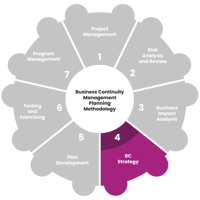
Business Continuity Strategy (BCS) Part 1 focuses on identifying and selecting mitigation strategies to address threats that could disrupt Jamiyah Singapore's (JS) critical services, personnel, facilities, technology, suppliers and essential resources.
This chapter builds upon the three preceding Risk Analysis and Review (RAR) activities:
- RAR Part 1 — List of Threats: Identifies credible sources of disruption.
- RAR Part 2 — Treatment and Control: Examines existing controls, risk treatment approaches and control gaps.
- RAR Part 3 — Risk Impact and Likelihood Assessment: Establishes risk ratings and priorities for further treatment.
Mitigation planning aims to reduce the probability of disruption, limit its consequences, and strengthen the organisation's ability to maintain essential services.
[](https://cta-redirect.hubspot.com/cta/redirect/3893111/fdc7087d-c996-4bf1-9dbb-59f7d2ba89c5)
[Dr Goh Moh Heng](https://blog.bcm-institute.org/ebook/author/dr-goh-moh-heng) Oct 15, 2026
###### Business Continuity Management Certified Planner-Specialist-Expert
### [](https://cta-redirect.hubspot.com/cta/redirect/3893111/7a1ba6dc-8352-46e7-b150-d25945acf3d9)
[](https://cta-redirect.hubspot.com/cta/redirect/3893111/0d2c5cc8-ed30-4545-b19a-49a3cb32e0e8)[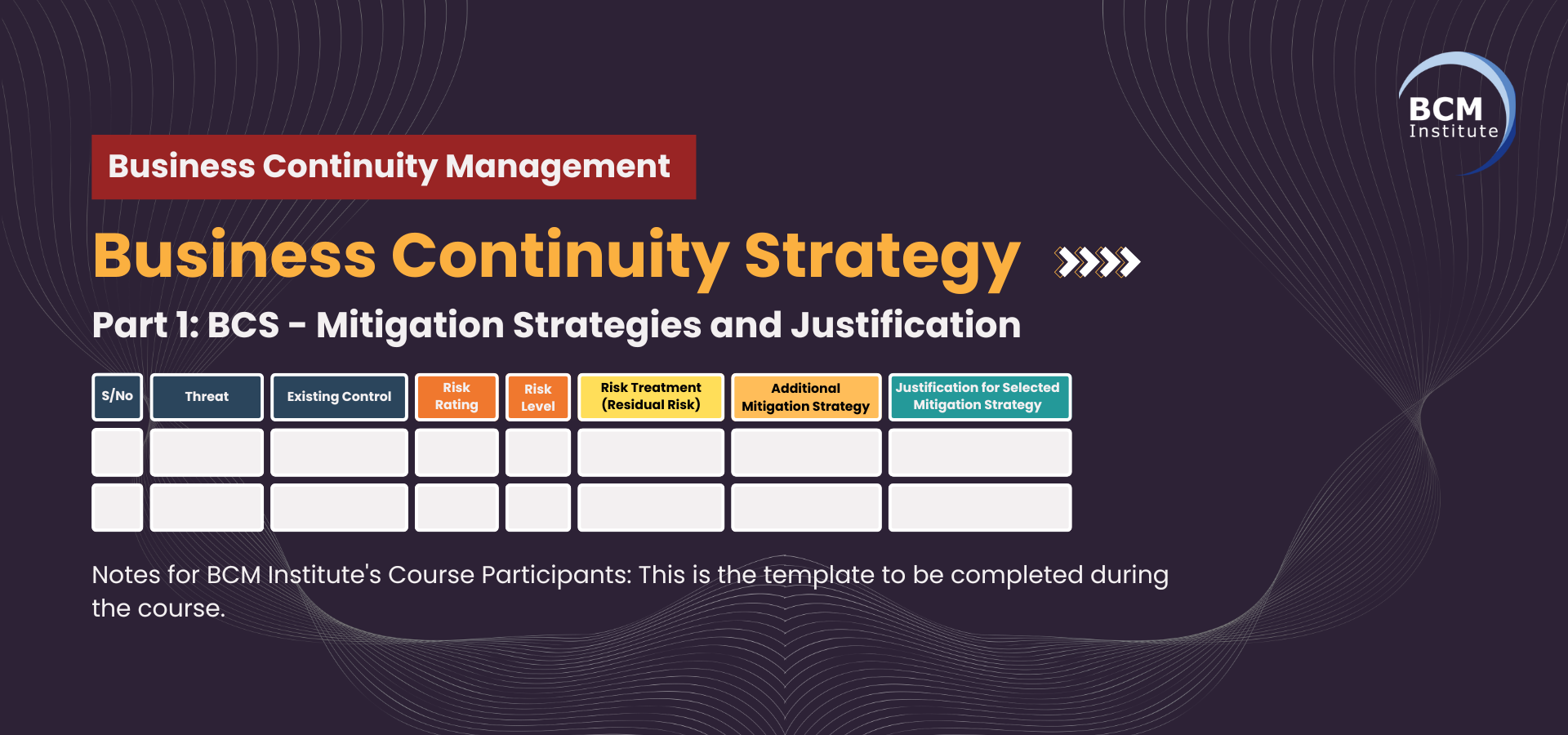](https://cta-redirect.hubspot.com/cta/redirect/3893111/db71ff66-a979-4fcc-8ce7-3866edc2b5ff)
[](https://cta-redirect.hubspot.com/cta/redirect/3893111/fdc7087d-c996-4bf1-9dbb-59f7d2ba89c5)
### T1: BCS — Mitigation Strategies for Jamiyah Singapore
Introduction
[](https://cta-redirect.hubspot.com/cta/redirect/3893111/f34dd618-1dd0-4efd-a0ea-7217027ffa68)[](https://cta-redirect.hubspot.com/cta/redirect/3893111/4691ede5-015e-4d02-890f-1dc8a37980a6)Business Continuity Strategy (BCS) Part 1 focuses on identifying and selecting mitigation strategies to address threats that could disrupt Jamiyah Singapore's (JS) critical services, personnel, facilities, technology, suppliers and essential resources.
This chapter builds upon the three preceding Risk Analysis and Review (RAR) activities:
- **RAR Part 1 —** List of Threats: Identifies credible sources of disruption.
- **RAR Part 2 —** Treatment and Control: Examines existing controls, risk treatment approaches and control gaps.
- **RAR Part 3 —** Risk Impact and Likelihood Assessment: Establishes risk ratings and priorities for further treatment.
Mitigation planning aims to reduce the probability of disruption, limit its consequences, and strengthen the organisation's ability to maintain essential services.
For Jamiyah Singapore, mitigation strategies must reflect the organisation's responsibilities to residents, children, families, vulnerable beneficiaries, staff, volunteers, donors and other stakeholders.
Give particular attention to CBF-1 Residential Care and Resident Safety, CBF-2 Nursing and Essential Healthcare Support, CBF-3 Early Childhood Care and Education, CBF-5 Emergency Welfare and Financial Assistance, and other critical functions where interruption could affect beneficiary safety or essential assistance.
#### **Mitigation Strategies Versus Recovery Strategies**
Mitigation strategies primarily aim to reduce exposure before disruption occurs or limit its immediate consequences.
Recovery strategies focus on restoring or sustaining critical functions after disruption.
For example, installing and maintaining fire detection systems is a mitigation measure.
Arranging alternative residential accommodation after a building becomes unusable is primarily a recovery strategy, although arranging it in advance can also reduce the consequences of a fire.
Both are necessary for effective Business Continuity Management.
#### **Assessment Basis**
The mitigation tables below use the Jamiyah Singapore threat register and illustrative risk ratings developed in the preceding RAR chapters, rather than treating the supplied JCUS link as a Jamiyah-approved register.
The risk ratings are provisional, and existing controls are assumed arrangements requiring verification. No actual JS control implementation, risk acceptance or residual risk rating has been confirmed.
The Risk Treatment (Residual Risk) column therefore describes the proposed treatment decision and the residual exposure that must be reassessed after implementation and testing. It does not present an unverified numerical residual risk score.
#### **Risk Rating and Treatment Criteria**
| Risk Rating | Risk Level | Proposed Treatment Direction |
| --- | --- | --- |
| 1–4 | Low | Maintain proportionate controls and monitor exposure. |
| 5–9 | Moderate | Validate controls and implement targeted improvements where justified. |
| 10–14 | High | Prioritise additional mitigation and management review. |
| 15–19 | Very High | Establish time-bound mitigation actions with senior management oversight. |
| 20–25 | Critical | Evaluate immediate safeguards and urgent mitigation, especially for beneficiary safety and essential service continuity. |
The selected mitigation must be proportionate to the exposure, practical to implement, assigned to a responsible owner, and verifiable through inspections, testing, exercises, or other evidence.
[](https://cta-redirect.hubspot.com/cta/redirect/3893111/126d86fd-4977-4d69-8e44-fe000291f236)
#### **Mitigation Strategy Assessment**
The following register retains the seven requested columns. Existing controls are carried forward in substance from RAR Part 2, while risk ratings and levels are carried forward from RAR Part 3.
This follows the BCMpedia methodology of assessing additional mitigation against the risks identified in RAR.
In the tables, AV means assumed existing control requiring validation.
The risk treatment column identifies the proposed treatment of remaining exposure; actual residual ratings must be recalculated after the measures are implemented and verified.
##### **Category 1: Denial of Access – Natural Disaster**
Table T1-1: BCS — Mitigation Strategies for Jamiyah Singapore
| Threat | Existing Controls | Risk Rating | Risk Level | Risk Treatment (Residual Risk) | Additional Mitigation Strategy | Justification for Selected Mitigation Strategy |
| --- | --- | --- | --- | --- | --- | --- |
| Flood | AV: Drain inspections, water ingress reporting, evacuation procedures. | 12 | High | Risk Reduction; reassess site exposure. | Map flood-prone entrances; install suitable barriers; elevate vulnerable equipment. | Targeted protection reduces water damage and loss of facility access. |
| Flash Flood | AV: Weather advisories and access restrictions. | 16 | Very High | Risk Reduction. | Establish flood alert triggers and pre-approved alternative staff and delivery routes. | Rapid response reduces unsafe travel and delayed essential services. |
| Severe Thunderstorm | AV: Inspect roofs and restrict outdoor activity. | 12 | High | Risk Reduction. | Inspect exposed roofing, windows and external structures; test shelter procedures. | Reduces damage and protects occupants during severe weather. |
| Lightning Strike | AV: Lightning protection inspections and electrical safeguards. | 12 | High | Risk Reduction. | Verify lightning protection certification and install surge protection for critical systems. | Protects occupants and essential electronic equipment. |
| Earthquake and Regional Tremors | AV: Evacuation and building inspection escalation. | 8 | Moderate | Risk Reduction. | Establish post-tremor structural inspection and safe re-entry criteria. | Avoids continued occupancy of potentially unsafe premises. |
| Tsunami or Coastal Inundation | AV: General emergency notification and evacuation arrangements. | 5 | Moderate | Risk Reduction; location-specific acceptance may be considered after assessment. | Screen premises for coastal exposure and prepare evacuation arrangements where applicable. | Proportionate treatment avoids unnecessary expenditure at unexposed locations. |
| Landslide or Slope Failure | AV: Report building defects and cordon off emergency areas. | 8 | Moderate | Risk Reduction. | Inspect exposed slopes and retaining walls; establish closure triggers. | Prevents continued access to unsafe areas. |
| Vegetation or Wildfire | AV: Fire detection and evacuation procedures. | 8 | Moderate | Risk Reduction. | Inspect surrounding vegetation and establish smoke intrusion procedures. | Reduces exposure to fire spread and smoke-related harm. |
| Extreme Heat | AV: Maintain cooling and monitor resident welfare. | 20 | Critical | Risk Reduction; urgent safety priority. | Introduce temperature monitoring, checks for vulnerable residents, and backup cooling arrangements. | Protects residents and other beneficiaries susceptible to heat stress. |
| Transboundary Haze | AV: Air-quality advisories and ventilation arrangements. | 12 | High | Risk Reduction. | Establish air-quality operating thresholds, indoor activity adjustments and filtration checks. | Reduces exposure while maintaining essential indoor services. |
| Pandemic-Related Movement Restrictions | AV: Public health communications and service access procedures. | 10 | High | Risk Reduction. | Define essential staff access, remote administration and restricted-movement operating arrangements. | Sustains services when travel and physical attendance are constrained. |
| Prolonged Severe Weather | AV: Weather monitoring and emergency supplier contacts. | 12 | High | Risk Reduction. | Validate emergency supplies and contingency staffing for an extended disruption. | Reduces dependency on uninterrupted deliveries and travel. |
| Sinkhole or Ground Subsidence | AV: Report building defects and evacuation arrangements. | 8 | Moderate | Risk Reduction. | Establish ground-movement reporting, engineering escalation, and alternative access. | Enables early exclusion of potentially unstable areas. |
| Regional Volcanic Ash | AV: Supplier communications and emergency procurement. | 3 | Low | Risk Reduction; formal acceptance may be considered after validation. | Identify essential imports dependent on air transport and alternative local sources. | Provides proportionate protection against indirect logistics disruption. |
| Coastal Storm Surge and Sea-Level Extremes | AV: Flood and facility emergency procedures. | 10 | High | Risk Reduction. | Assess coastal exposure and avoid placing critical resources in vulnerable locations. | Addresses longer-duration inundation and access disruption. |
##### **Category 2: Denial of Access – Man-made Disaster**
Table T1-2: BCS — Mitigation Strategies for Jamiyah Singapore
| Threat | Existing Controls | Risk Rating | Risk Level | Risk Treatment (Residual Risk) | Additional Mitigation Strategy | Justification for Selected Mitigation Strategy |
| --- | --- | --- | --- | --- | --- | --- |
| Building Fire | AV: Fire alarms, extinguishers, evacuation plans and drills. | 15 | Very High | Risk Reduction; partial financial transference. | Verify fire systems, compartmentation, evacuation assistance and resident accountability; review insurance. | Protects life and reduces damage and displacement. |
| Explosion | AV: Inspect equipment and review evacuation procedures. | 10 | High | Risk Reduction and Risk Avoidance of unsafe activities. | Identify explosion exposures, inspect relevant equipment and prohibit unsafe operations. | Eliminates avoidable hazardous activities and limits consequences. |
| Chemical Spill | AV: Chemical inventories and incident reporting. | 10 | High | Risk Reduction. | Improve chemical segregation, spill response materials and shelter/evacuation criteria. | Limits exposure to harmful substances. |
| Gas Leak | AV: Gas maintenance and emergency contacts. | 15 | Very High | Risk Reduction. | Verify leak detection, emergency isolation and competent contractor response. | Supports immediate action before escalation to fire or explosion. |
| Structural Failure | AV: Building inspections and defect reporting. | 10 | High | Risk Reduction and Risk Avoidance of unsafe occupancy. | Implement defect-severity triggers and independent engineering assessments. | Prevents continued use of unsafe premises. |
| Building Collapse | AV: Facility condition monitoring and evacuation procedures. | 5 | Moderate | Risk Reduction; mandatory life-safety controls remain applicable. | Validate structural inspection requirements and alternative accommodation arrangements. | Catastrophic consequences require safeguards regardless of the moderate numerical rating. |
| Civil Disturbance | AV: Security monitoring and access controls. | 8 | Moderate | Risk Reduction. | Define temporary lockdown, alternative access and stakeholder communication procedures. | Reduces exposure to nearby disorder. |
| Riot | AV: Emergency contacts and facility closure procedures. | 5 | Moderate | Risk Reduction. | Exercise prolonged area denial and safe beneficiary shelter arrangements. | Supports continuity when normal access becomes unsafe. |
| Terrorist Attack | AV: Security awareness and emergency response. | 10 | High | Risk Reduction; partial financial transference where appropriate. | Conduct protective security review and coordinated emergency response exercise. | Addresses potentially severe harm and operational disruption. |
| Bomb Threat or Suspicious Object | AV: Security reporting and evacuation arrangements. | 8 | Moderate | Risk Reduction. | Establish suspicious-object exclusion, police notification and re-entry procedures. | Reduces unsafe handling and inconsistent decisions. |
| Sabotage or Deliberate Property Damage | AV: Visitor controls, patrols and incident logs. | 12 | High | Risk Reduction. | Strengthen access controls, protect critical assets, and preserve incident evidence. | Reduces deliberate interference and supports investigation. |
| Active Assailant | AV: Access controls and emergency reporting. | 10 | High | Risk Reduction. | Develop site-specific protective action procedures and staff awareness exercises. | Prioritises immediate occupant protection and emergency coordination. |
| Public Disorder Near Facilities | AV: Visitor controls and incident reporting. | 12 | High | Risk Reduction. | Establish closure triggers and alternative beneficiary service access. | Prevents unnecessary exposure to external disorder. |
| Utility Infrastructure Incident | AV: Utility fault reporting and emergency contacts. | 12 | High | Risk Reduction. | Map critical utility dependencies and test backup service arrangements. | Reduces common-cause interruption across facilities and systems. |
| Road Closure | AV: Transport coordination and contact lists. | 12 | High | Risk Reduction. | Pre-identify alternative routes for staff, emergency vehicles and essential deliveries. | Supports continued physical access and service delivery. |
| Public Transport Disruption | AV: Staff notification and roster adjustments. | 16 | Very High | Risk Reduction. | Establish local standby staff and alternative staff transport arrangements. | Reduces staffing gaps in time-critical services. |
| Major Traffic Incident | AV: Driver contacts and transport scheduling. | 16 | Very High | Risk Reduction. | Arrange backup vehicles and alternative routes for urgent resident transfers. | Protects timely access to healthcare and essential transport. |
| Aircraft Accident | AV: Supplier communications and travel notification. | 5 | Moderate | Risk Reduction; possible formal acceptance after review. | Identify critical air-freight dependencies and approved substitutes. | Addresses indirect disruption without disproportionate investment. |
| Nearby Industrial Accident | AV: Emergency notifications and evacuation arrangements. | 10 | High | Risk Reduction. | Assess nearby hazardous facilities and establish shelter versus evacuation criteria. | Reduces exposure to toxic releases, fire and access restrictions. |
| Construction Accident or Excavation Damage | AV: Contractor access approvals and incident reporting. | 12 | High | Risk Reduction and contractual Risk Transfer. | Require utility surveys, contractor safety plans and emergency response obligations. | Reduces accidental infrastructure damage and clarifies responsibilities. |
| Security Lockdown or Police Cordoning | AV: Emergency contacts and access procedures. | 12 | High | Risk Reduction. | Test continuity without physical access to premises, equipment or records. | Ensures critical services can operate during prolonged cordoning. |
##### **Category 3: Unavailability of People**
Table T1-3: BCS — Mitigation Strategies for Jamiyah Singapore
| Threat | Existing Controls | Risk Rating | Risk Level | Risk Treatment (Residual Risk) | Additional Mitigation Strategy | Justification for Selected Mitigation Strategy |
| --- | --- | --- | --- | --- | --- | --- |
| Pandemic | AV: Infection-control instructions, staff health reporting and emergency rosters. | 10 | High | Risk Reduction. | Develop pandemic staffing contingencies, cohort arrangements and essential-service prioritisation. | Maintains safe care and welfare services during widespread illness. |
| Epidemic | AV: Health advisories and illness reporting. | 15 | Very High | Risk Reduction. | Establish absenteeism thresholds and cross-site workforce deployment criteria. | Supports earlier intervention before staffing falls below essential requirements. |
| Infectious Disease Outbreak Within a Facility | AV: Hygiene procedures and care escalation. | 20 | Critical | Risk Reduction; urgent safety priority. | Validate isolation arrangements, infection-control supplies and separate staffing teams. | Protects vulnerable residents and limits transmission. |
| Mass Illness or Foodborne Illness | AV: Food handling procedures and staff illness reporting. | 15 | Very High | Risk Reduction; contractual Risk Transference where applicable. | Test food recall, alternative catering and emergency staffing procedures. | Addresses simultaneous illness among beneficiaries and employees. |
| Labour Strike | AV: HR grievance procedures and operational escalation. | 8 | Moderate | Risk Reduction. | Establish lawful essential-duty staffing alternatives and workforce engagement processes. | Reduces service interruption without undermining employment obligations. |
| Industrial Action or Work Stoppage | AV: HR consultation and escalation procedures. | 8 | Moderate | Risk Reduction. | Identify critical outsourced and internal roles requiring contingency coverage. | Maintains essential operations during workforce disputes. |
| High Staff Turnover | AV: Recruitment procedures, handovers and competency tracking. | 16 | Very High | Risk Reduction. | Implement critical-role retention, succession and structured knowledge transfer. | Reduces loss of institutional knowledge and qualified staffing. |
| Loss of Key Personnel | AV: Organisation charts, job descriptions and leave handovers. | 15 | Very High | Reduces and partially avoids the risk of sole-person dependencies. | Appoint qualified alternates and test delegated authority. | Removes avoidable single-person failure points. |
| Specialist Skills Shortage | AV: Maintain training records and conduct qualification checks. | 20 | Critical | Risk Reduction. | Establish competency matrices, cross-training and approved specialist staffing arrangements. | Preserves safe delivery of services requiring specialised qualifications. |
| Workplace Accident | AV: Safety procedures, induction and accident reporting. | 15 | Very High | Risk Reduction; financial Risk Transfer where applicable. | Conduct task-specific safety assessments and improve staffing contingencies for injuries. | Protects personnel and reduces operational loss from workplace injuries. |
| Workplace Violence | AV: Workplace conduct procedures and visitor controls. | 15 | Very High | Risk Reduction. | Introduce de-escalation training, incident alarms and clear security escalation. | Protects staff and beneficiaries while supporting timely response. |
| Staff Fatigue | AV: Shift schedules and supervisor oversight. | 20 | Critical | Reduces unsafe duty arrangements. | Establish maximum-duty triggers, minimum rest periods and relief staffing. | Reduces errors and unsafe care caused by exhaustion. |
| Psychological Stress and Burnout | AV: Staff welfare channels and supervisory check-ins. | 20 | Critical | Risk Reduction. | Implement workload monitoring, structured welfare reviews and professional support referral. | Supports workforce sustainability and safe service delivery. |
| Travel Restrictions | AV: Staff location records and emergency communications. | 12 | High | Risk Reduction. | Identify cross-border staffing dependencies and develop local staffing contingencies. | Reduces reliance on unrestricted staff movement. |
| Mandatory Quarantine or Isolation | AV: Absence reporting and contingency rosters. | 15 | Very High | Risk Reduction. | Establish independent shift teams and test complete-team unavailability. | Limits service interruption when an entire team must isolate. |
| Family or Caregiving Emergencies | AV: Emergency leave and supervisor notification. | 16 | Very High | Risk Reduction. | Create a competent relief pool and flexible emergency staffing arrangements. | Sustains essential services during simultaneous personal emergencies. |
| Mass Resignation | AV: Exit handovers and workforce reporting. | 15 | Very High | Risk Reduction. | Develop retention triggers, replacement pipelines and knowledge continuity plans. | Reduces prolonged loss of service capability. |
| Volunteer Unavailability | AV: Volunteer rosters and programme contacts. | 16 | Very High | Reduces risk and partially avoids sole-volunteer dependency. | Ensure essential services have a minimum delivery model independent of volunteers. | Prevents critical beneficiary assistance from relying exclusively on voluntary attendance. |
| Concurrent Leave or Scheduling Failure | AV: Leave approval and duty roster checks. | 20 | Critical | Risk Reduction. | Introduce automated or independent competency-based roster coverage checks. | Prevents simultaneous absence of essential qualified personnel. |
| Loss of Leadership or Decision-Making Capacity | AV: Delegation schedules and management contact lists. | 15 | Very High | Risk Reduction. | Establish emergency succession, delegated financial authority and decision exercises. | Maintains timely crisis decisions when senior leaders are unavailable. |
| Contractor Workforce Shortage | AV: Supplier schedules and escalation contacts. | 16 | Very High | Risk Reduction and contractual Risk Transfer. | Require minimum staffing commitments and verify alternative contractors. | Reduces dependence on a single contractor workforce. |
Category 3 assessment summary: Workforce mitigation should prioritise safe staffing, competency coverage, infection prevention, succession and the ability to sustain essential services during extended personnel shortages.
Pay particular attention where regulatory or professional qualifications are required.
##### **Category 4: Disruption to the Supply Chain**
Table T1-4: BCS — Mitigation Strategies for Jamiyah Singapore
| Threat | Existing Controls | Risk Rating | Risk Level | Risk Treatment (Residual Risk) | Additional Mitigation Strategy | Justification for Selected Mitigation Strategy |
| --- | --- | --- | --- | --- | --- | --- |
| Supplier Operational Failure | AV: Supplier contacts, purchase records and delivery monitoring. | 15 | Very High | Risk Reduction and partial Risk Transference. | Classify critical suppliers, qualify alternatives and test replacement lead times. | Limits interruption to essential goods and services. |
| Outsourcing Service Failure | AV: Contractor performance reviews and escalation procedures. | 15 | Very High | Risk Reduction and contractual Risk Transfer. | Include continuity obligations, substitute service arrangements and joint exercises. | Outsourcing does not remove JS's responsibility for service continuity. |
| Cloud Service Provider Failure | AV: Vendor support and backup arrangements. | 15 | Very High | Risk Reduction and contractual Risk Transfer. | Verify independent data backups, export capability and provider outage procedures. | Reduces dependence on a single hosting environment. |
| Telecommunications Provider Failure | AV: Provider fault reporting and emergency contacts. | 15 | Very High | Risk Reduction. | Establish independent backup communication services and test failover. | Maintains emergency coordination and stakeholder communications. |
| Electricity Supply Failure | AV: Electrical maintenance and outage procedures. | 15 | Very High | Risk Reduction. | Verify backup power capacity, maintenance and essential-load prioritisation. | Protects residential safety systems and critical ICT. |
| Water Supply Interruption | AV: Utility reporting and emergency supplier contacts. | 15 | Very High | Risk Reduction. | Establish emergency potable water supply and sanitation continuity arrangements. | Maintains hygiene, hydration and essential residential care. |
| Fuel Supply Disruption | AV: Transport provider contacts and procurement procedures. | 8 | Moderate | Risk Reduction. | Identify fuel-dependent essential services and alternative transport capacity. | Provides proportionate continuity for critical movement requirements. |
| Logistics and Freight Disruption | AV: Supplier tracking and procurement escalation. | 12 | High | Risk Reduction. | Establish minimum stock holdings and alternative distribution arrangements. | Reduces dependence on uninterrupted freight movement. |
| Transportation Provider Failure | AV: Transport booking and emergency contacts. | 15 | Very High | Risk Reduction and contractual Risk Transfer. | Qualify accessible backup vehicles and emergency transport providers. | Protects urgent resident and beneficiary transportation. |
| Banking Service Disruption | AV: Bank contacts and payment approval records. | 12 | High | Risk Reduction. | Establish alternative banking channels and emergency payment procedures. | Supports welfare disbursement and essential supplier payments. |
| Payment System Failure | AV: Finance reconciliation and transaction escalation. | 16 | Very High | Risk Reduction. | Test alternative approved payment methods and manual reconciliation. | Prevents payment outages from stopping urgent assistance. |
| Regulatory or Administrative Restrictions | AV: Governance review and authority communications. | 15 | Very High | Risk Reduction. | Maintain regulatory obligation mapping and pre-defined service adaptation procedures. | Enables lawful continuation of essential services. |
| Import Restrictions | AV: Procurement tracking and supplier communications. | 12 | High | Risk Reduction. | Identify import-sensitive essential goods and approved local substitutes. | Reduces exposure to cross-border supply constraints. |
| Vendor Insolvency | AV: Supplier registration and payment monitoring. | 15 | Very High | Risk Reduction and partial Risk Avoidance. | Assess financial health of critical vendors and prepare replacement plans. | Reduces prolonged disruption from supplier failure. |
| Third-Party Cyber Incident | AV: Vendor contracts and ICT incident escalation. | 20 | Critical | Risk Reduction and contractual Risk Transfer. | Require cyber incident notification, independent backups and joint recovery tests. | Addresses interconnected cyber and service-delivery consequences. |
| Contract Termination or Dispute | AV: Contract records and renewal tracking. | 12 | High | Risk Reduction and contractual Risk Transfer. | Include exit assistance, data return and transition provisions. | Prevents contract disputes from abruptly ending essential services. |
| Single-Source Supplier Dependency | AV: Supplier registers and procurement approvals. | 20 | Critical | Risk Reduction and partial Risk Avoidance. | Qualify alternative suppliers and establish emergency stock buffers. | Eliminates avoidable single points of supply failure. |
| Supplier's Subcontractor Failure | AV: Primary supplier contacts and escalation arrangements. | 12 | High | Risk Reduction and contractual Risk Transfer. | Require disclosure of critical subcontractors and their continuity arrangements. | Improves visibility of indirect dependencies. |
| Food Supply Contamination or Recall | AV: Food receiving inspections and supplier records. | 15 | Very High | Reduces risk and partially avoids unsafe products. | Implement traceability, stock isolation, and alternative meal-supply procedures. | Protects beneficiary health and preserves food assistance. |
| Healthcare Product Shortage | AV: Stock records and healthcare supplier contacts. | 15 | Very High | Risk Reduction. | Establish critical stock thresholds and clinically authorised alternatives. | Protects continuity of essential healthcare support. |
| Geopolitical Trade Disruption | AV: Procurement monitoring and supplier communications. | 12 | High | Risk Reduction. | Diversify critical supply sources and maintain proportionate emergency inventories. | Reduces dependence on exposed international supply routes. |
| Port or Airport Disruption | AV: Shipment tracking and supplier escalation. | 12 | High | Risk Reduction. | Establish local sourcing and minimum stocks for time-critical imports. | Maintains essential supplies during freight disruption. |
| Supplier Concentration Across Multiple Services | AV: Contract and supplier registers. | 20 | Critical | Risk Reduction and partial Risk Avoidance. | Map shared suppliers across CBFs and diversify critical dependencies. | Prevents one supplier failure from disrupting several essential services simultaneously. |
| Donor or Funding Channel Interruption | AV: Finance forecasts, donation records and grant tracking. | 15 | Very High | Risk Reduction. | Establish liquidity thresholds, diversify donation channels, and prioritise essential expenditures. | Protects beneficiary assistance during interrupted funding receipts. |
Category 4 assessment summary: Key mitigation considerations include alternative suppliers, continuity obligations, emergency inventories, independent service channels, and avoiding concentrated dependencies that affect multiple CBFs.
##### **Category 5: Equipment and IT-Related Disruption**
Table T1-5: BCS — Mitigation Strategies for Jamiyah Singapore
| Threat | Existing Controls | Risk Rating | Risk Level | Risk Treatment (Residual Risk) | Additional Mitigation Strategy | Justification for Selected Mitigation Strategy |
| --- | --- | --- | --- | --- | --- | --- |
| Cyberattack | AV: Firewalls, endpoint protection and security incident procedures. | 20 | Critical | Risk Reduction; partial financial Risk Transference where appropriate. | Implement stronger access controls, vulnerability remediation, monitoring and cyber incident exercises. | Reduces the likelihood and consequences of attacks on essential systems and information. |
| Ransomware | AV: Antivirus, backup schedules and privileged access controls. | 20 | Critical | Risk Reduction. | Implement protected offline or immutable backups, endpoint detection and isolated recovery testing. | Limits data encryption, lateral movement and prolonged service interruption. |
| Malware Infection | AV: Device security tools and software update procedures. | 20 | Critical | Risk Reduction. | Verify endpoint coverage, restrict unauthorised software and test malware containment. | Reduces infection propagation and loss of critical applications. |
| Distributed Denial of Service (DDoS) | AV: Hosting support and website monitoring. | 16 | Very High | Risk Reduction and contractual Risk Transference. | Establish provider-based DDoS protection and alternative communication channels. | Preserves access to public information and essential digital communications. |
| Insider Threat | AV: User provisioning, access approvals and account termination procedures. | 15 | Very High | Reduces risk and partially avoids excessive access. | Implement privileged access management, segregation of duties and periodic access reviews. | Reduces opportunities for unauthorised activity and misuse of information. |
| Personal Data Breach | AV: Data protection policies, access controls and breach escalation. | 20 | Critical | Reduces risk through data minimisation. | Strengthen encryption, retention controls, access monitoring and breach response exercises. | Protects confidential beneficiary information and supports applicable data protection obligations. |
| Network Failure | AV: Support network equipment and report faults. | 20 | Critical | Risk Reduction. | Remove critical single points of failure and test redundant network connections. | Maintains connectivity supporting essential operations. |
| Server Failure | AV: Server maintenance and backup records. | 20 | Critical | Risk Reduction. | Implement hardware redundancy, monitor capacity, and test server restoration. | Reduces downtime and supports recovery of critical applications. |
| Database Corruption | AV: Schedule backups and monitor application errors. | 15 | Very High | Risk Reduction. | Implement integrity monitoring, point-in-time recovery and data reconciliation testing. | Protects the accuracy and recoverability of resident and beneficiary records. |
| Cloud Service Outage | AV: Cloud support arrangements and user incident reporting. | 20 | Critical | Risk Reduction and contractual Risk Transfer. | Establish independent backups, offline procedures and tested SaaS outage arrangements. | Maintains essential services when the primary cloud platform is unavailable. |
| Power Failure Affecting ICT | AV: Maintain UPS systems and report electrical faults. | 20 | Critical | Risk Reduction. | Validate UPS capacity, backup runtime and controlled shutdown procedures. | Protects critical systems from abrupt power loss and data corruption. |
| Hardware Failure | AV: Asset register and hardware support. | 16 | Very High | Reduces risk and partially transfers contractual risk. | Maintain spare critical devices and tested equipment replacement procedures. | Reduces replacement delays and interruption to frontline operations. |
| Software Failure | AV: Application support tickets and change approval procedures. | 20 | Critical | Risk Reduction. | Implement pre-release testing, rollback capability and documented manual workarounds. | Limits disruption from application defects or failed releases. |
| Telecommunications System Failure | AV: Telephony fault reporting and mobile contact lists. | 20 | Critical | Risk Reduction. | Provide alternative telephone arrangements and test emergency communications failover. | Maintains communication with emergency services, staff and beneficiaries. |
| Internet Connectivity Failure | AV: Internet fault reporting and provider contacts. | 20 | Critical | Risk Reduction. | Establish independent secondary internet connectivity at critical facilities. | Reduces reliance on a single connection for essential digital services. |
| Mobile Communications Outage | AV: Fixed-line contacts and staff communication procedures. | 15 | Very High | Risk Reduction. | Test fixed-line, alternative messaging and emergency communication arrangements. | Maintains staff mobilisation when mobile networks fail. |
| Backup Failure | AV: Backup schedules and failure alerts. | 15 | Very High | Risk Reduction. | Implement backup verification, protected copies and periodic full restoration exercises. | Ensures backup arrangements can actually restore essential information. |
| Data Centre Failure | AV: Data centre support and backup arrangements. | 15 | Very High | Risk Reduction and contractual Risk Transfer. | Validate alternative hosting capability and complete site recovery testing. | Reduces prolonged system outages following hosting infrastructure failure. |
| Authentication System Failure | AV: Identity administration and support escalation. | 20 | Critical | Risk Reduction. | Establish secure emergency access and test authentication service recovery. | Prevents identity outages from blocking essential systems and authorised users. |
| Identity and Access Management Failure | AV: Account provisioning and access approval procedures. | 15 | Very High | Risk Reduction. | Implement identity configuration backups, privileged account recovery and access restoration tests. | Maintains controlled access to essential applications. |
| Artificial Intelligence System Failure | AV: General application support, where AI is deployed. | 12 | High | Reduces risk and partially avoids overreliance on AI. | Inventory AI-dependent processes and establish human review and manual fallback. | Prevents AI malfunction from interrupting critical decisions or services. |
| AI-Enabled Phishing or Impersonation | AV: Payment authorisation and suspicious-message reporting. | 20 | Critical | Risk Reduction. | Require independent callback verification for sensitive instructions and conduct impersonation exercises. | Reduces fraudulent payments, disclosure, and personnel manipulation. |
| Software Supply Chain Compromise | AV: Software procurement and update approval procedures. | 15 | Very High | Reduces risk and partially avoids untrusted components. | Verify software provenance, supplier security and emergency update isolation procedures. | Reduces exposure to malicious or compromised third-party software. |
| Misconfiguration or Failed System Change | AV: Change tickets, approvals and configuration backups. | 20 | Critical | Risk Reduction. | Introduce configuration validation, staged deployment and tested rollback procedures. | Reduces avoidable outages caused by internal system changes. |
| Loss or Theft of ICT Devices | AV: Asset register and lost-device reporting. | 20 | Critical | Reduces and partially avoids unnecessary local data storage. | Enforce encryption, remote lock/wipe and prompt credential revocation. | Limits exposure of confidential information following device loss. |
| Cyber-Physical Equipment Failure | AV: Facilities maintenance and equipment fault reporting. | 15 | Very High | Risk Reduction. | Identify safety-critical connected equipment and test manual or backup operating modes. | Protects resident safety when connected facility systems fail. |
| Cooling or Environmental Control Failure | AV: Air-conditioning maintenance and reporting of facility faults. | 20 | Critical | Risk Reduction. | Implement temperature alerts, backup cooling and relocation triggers for vulnerable occupants. | Reduces health consequences and maintains safe residential conditions. |
| Data Synchronisation Failure | AV: Application error logs and data reconciliation. | 20 | Critical | Risk Reduction. | Implement automated exception monitoring, integrity checks and reconciliation procedures. | Prevents conflicting or incomplete information from affecting service decisions. |
| Electronic Records or Document Management Failure | AV: Document access permissions and backup arrangements. | 20 | Critical | Risk Reduction. | Maintain protected vital-record copies and test secure offline retrieval. | Preserves access to essential resident, beneficiary and operational information. |
| Payment Application or Finance System Failure | AV: Payment approval controls and finance support procedures. | 20 | Critical | Risk Reduction. | Establish approved emergency payments, alternative processing and reconciliation procedures. | Sustains essential procurement, welfare assistance and financial accountability. |
| Communication Platform Failure | AV: Staff contact lists and application support. | 20 | Critical | Risk Reduction. | Maintain independent emergency communications and test coordination without email or collaboration platforms. | Enables incident management when primary digital communications fail. |
| Digital Service Provider Concentration | AV: Vendor and application inventories. | 15 | Very High | Risk Reduction and partial Risk Avoidance. | Map common cloud, identity and network dependencies; diversify critical services where feasible. | Reduces correlated outages affecting several CBFs simultaneously. |
Category 5 assessment summary: The preferred strategies emphasise prevention, early detection, redundancy, protected information, reliable restoration and tested manual alternatives. These are particularly important where technology supports residential care, safeguarding, beneficiary records, emergency communications and financial assistance.
#### **Implementation and Monitoring of Mitigation Strategies**
Consolidate the proposed strategies into a formal mitigation action register.
Priorities should reflect the RAR risk rating, beneficiary safety, regulatory obligations, control deficiencies, and implementation feasibility.
**Table T1-A: Mitigation Implementation and Monitoring**
| Implementation Activity | Responsible Contributor | Expected Deliverable | Review and Approval |
| --- | --- | --- | --- |
| Confirm existing controls | Relevant CBF Owners and Control Owners | Validated Control Register | BCM Coordinator |
| Confirm risk ratings | Risk Management and CBF Owners | Approved RAR Part 3 Assessment | BCM Steering Committee |
| Select mitigation strategies | CBF Owners and Supporting Functions | Mitigation Strategy Register | BCM Coordinator |
| Evaluate cost and feasibility | Finance, Procurement and Relevant Owners | Cost-Benefit and Feasibility Assessment | Senior Management |
| Establish implementation priorities | BCM Coordinator and Risk Management | Prioritised Mitigation Action Plan | BCM Steering Committee |
| Allocate resources and responsibilities | Senior Management and Department Heads | Approved Action Owners and Budgets | Authorised Management |
| Implement mitigation controls | Assigned Control Owners | Completed Mitigation Actions | Department Heads |
| Verify effectiveness | BCM Coordinator, ICT, Facilities, HR and Other Relevant Functions | Test Reports and Control Evidence | Risk Management |
| Reassess residual risk | Risk Management and CBF Owners | Updated Residual Risk Ratings | BCM Steering Committee |
| Approve remaining risk acceptance | Authorised Risk Acceptance Authority | Documented Risk Acceptance | According to JS Governance Requirements |
| Review mitigation performance | BCM Coordinator | Periodic Mitigation Status Report | Senior Management |
##### **Selecting Mitigation Strategies**
Mitigation options should be evaluated using consistent criteria, including:
- Safety and service criticality: Whether the strategy protects beneficiaries and supports time-critical services.
- Effectiveness: The extent to which it reduces the occurrence or consequences of disruption.
- Cost and practicality: Whether the investment and maintenance requirements are proportionate.
- Implementation readiness: Whether suitable personnel, suppliers, technology and facilities are available.
- Regulatory suitability: Whether the strategy supports applicable safety, safeguarding, data protection and service obligations.
- Testability: Whether its performance can be verified through measurable evidence.
##### **Residual Risk Reassessment**
After implementing additional mitigation, JS should reassess the relevant threat using the approved RAR methodology.
Residual Risk Rating = Reassessed Impact × Reassessed Likelihood
Evidence should support a reduction in risk rating by demonstrating that the new controls operate effectively.
Where the remaining risk exceeds approved risk appetite, further treatment or formal management escalation is required.
[](https://cta-redirect.hubspot.com/cta/redirect/3893111/c2542a7f-6d92-4371-93ba-348e87d8c1ce)
BCS Part 1 provides Jamiyah Singapore with a structured approach to selecting mitigation strategies for threats identified through its Risk Analysis and Review process.
The chapter demonstrates that effective mitigation requires more than maintaining existing policies or purchasing additional equipment.
It requires understanding the causes and consequences of disruption, identifying weaknesses in existing controls, and selecting practical measures to address them.
For JS, mitigation priorities should reflect the organisation's responsibility to protect vulnerable beneficiaries, sustain residential care and healthcare support, maintain educational and welfare services, and preserve essential information and financial capabilities.
The proposed strategies address five major sources of disruption: natural disasters, man-made incidents, workforce unavailability, supply chain failures and equipment or technology disruptions.
Implementation should be supported by accountable owners, approved resources, measurable completion criteria and appropriate testing.
The assessment should also recognise that not every threat can be prevented. Where mitigation cannot eliminate exposure, JS must maintain appropriate recovery strategies and Business Continuity Plans.
The ultimate objective is to reduce avoidable disruption, protect beneficiaries and establish a stronger foundation for the continued delivery of Jamiyah Singapore's critical services.
The next stage of Business Continuity Strategy development should therefore focus on selecting recovery strategies that enable JS to sustain or restore its Critical Business Functions within approved recovery requirements.
Implementation note from the author: All existing controls remain assumed and unverified. Risk ratings are carried forward from the illustrative RAR Part 3 assessment; the treatment descriptions are proposals rather than approved residual risk decisions.
Reconcile and formally validate the master threat register and final ratings before adoption.
[](https://cta-redirect.hubspot.com/cta/redirect/3893111/320f01c4-c800-4496-aa02-c30e72e7481d)
| **eBook 3: Starting Your BCM Implementation** | | | | | | |
| --- | --- | --- | --- | --- | --- | --- |
| **MBCO** | **P&S** | **RAR T1** | **RAR T2** | **RAR T3** | **BCS T1** | **CBF** |
| [](https://cta-redirect.hubspot.com/cta/redirect/3893111/723f3c3d-5ee0-4bf8-8e22-3244b607978a) | [](https://cta-redirect.hubspot.com/cta/redirect/3893111/db4572cb-afab-45f2-902b-8a8b33b88b58) | [](https://cta-redirect.hubspot.com/cta/redirect/3893111/87b522e2-f0d8-4959-9c59-40a3be1b6f71) | [](https://cta-redirect.hubspot.com/cta/redirect/3893111/bbf2124f-6183-4c2f-85f0-727313f44adf) | [](https://cta-redirect.hubspot.com/cta/redirect/3893111/f4035e58-2c2f-4b9b-aa1d-4e24ef7507fe) | [](https://cta-redirect.hubspot.com/cta/redirect/3893111/4691ede5-015e-4d02-890f-1dc8a37980a6) | [](https://cta-redirect.hubspot.com/cta/redirect/3893111/0e87ad0d-3fdf-495a-a60f-384b0e67a940) |
#### More Information About Business Continuity Management Courses
To learn more about the course and schedule, click the buttons below for the BCM-300 Business Continuity Management Implementer \[BCM-3\] and the BCM-5000 Business Continuity Management Expert Implementer \[BCM-5\].
| [](https://cta-redirect.hubspot.com/cta/redirect/3893111/f3922b80-e96a-46d6-8993-dc150a5de2d5) | [](https://cta-redirect.hubspot.com/cta/redirect/3893111/9ff8a3dc-e39a-465b-929f-72e232cdd5fb) | [](https://cta-redirect.hubspot.com/cta/redirect/3893111/ac6cf073-4cdd-4541-91ed-889f731d5076) |
| --- | --- | --- |
| [](https://cta-redirect.hubspot.com/cta/redirect/3893111/21525c10-4003-4934-95fc-fe218174bc5b) | [](https://cta-redirect.hubspot.com/cta/redirect/3893111/46460171-c91a-4936-9bb2-8dc5928a0e02) | [](https://cta-redirect.hubspot.com/cta/redirect/3893111/1cb17ac7-50b2-4f88-bc4b-c7444e4b57b5) |
| [](https://cta-redirect.hubspot.com/cta/redirect/3893111/b3824ba1-7aa1-4eb6-bef8-94f57121c5ae) | Please feel free to send us a note if you have any questions. [](https://cta-redirect.hubspot.com/cta/redirect/3893111/3c53daeb-2836-4843-b0e0-645baee2ab9e) | [](https://cta-redirect.hubspot.com/cta/redirect/3893111/9c199ae8-c470-4bb7-9612-73c7a084e94c) |
| [](https://cta-redirect.hubspot.com/cta/redirect/3893111/8999211a-2c51-4be7-bf49-c393f6c67974) | [](https://cta-redirect.hubspot.com/cta/redirect/3893111/5c1aa95d-f6dd-4067-a95c-5cc0c32d7ed8) | [](https://cta-redirect.hubspot.com/cta/redirect/3893111/086ab3b9-4d66-4a95-b2f7-1148e9803a9c) |
#### **Your Comments Here:**
### More Posts
[](https://cta-redirect.hubspot.com/cta/redirect/3893111/839787f4-a4fd-456f-accf-54c947026558)

All rights reserved. Copyright 2026
```json
{
"@context" : "https://schema.org",
"@type" : "BlogPosting",
"author" : {
"@type" : "Person",
"name" : "Dr Goh Moh Heng",
"url" : "https://blog.bcm-institute.org/ebook/author/dr-goh-moh-heng"
},
"dateModified" : "2026-10-15T09:53:09.783Z",
"datePublished" : "2026-10-15T08:33:30.000Z",
"headline" : "[BCM] [JS] [E3] [BCS] [P1] Mitigation Strategies and Justification",
"mainEntityOfPage" : {
"@id" : "https://blog.bcm-institute.org/ebook/bcm-js-e3-bcs-p1-mitigation-strategies-and-justification",
"@type" : "WebPage"
},
"publisher" : {
"@type" : "Organization",
"logo" : {
"@type" : "ImageObject",
"url" : "https://blog.bcm-institute.org/hubfs/BCMI%20Logo.png"
},
"name" : "BCMI Pte Ltd"
}
}
```