---
title: [BCM] [JS] [E1] [C1] Overview of BCM Case Study
description: [BCM] [JS] [E1] [C1] Overview of BCM Case Study
image: https://blog.bcm-institute.org/hubfs/Jamiyah%20Singapore%20Graphic%20Folder/JS%20BCM%20E1%20Morepost/%5BBCM%5D%20%5BJS%5D%20%5BE1%5D%20%5BC1%5D%20Overview%20of%20BCM%20Case%20Study.jpg
---
.
[](http://www.bcm-institute.org/)
- [Home](https://www.bcm-institute.org/)
- [About Us](https://www.bcm-institute.org/about-us-3/)
- [A President’s Perspective](https://www.bcm-institute.org/about-us/a-presidents-perspective/)
- [Our History](https://www.bcm-institute.org/about-us/our-history/)
- [Our Advisory Council](https://www.bcm-institute.org/about-us/our-advisory-council/)
- [Customers’ Testimonials](https://www.bcm-institute.org/about-us/customers-testimonials/)
- [Credential Verification](https://www.bcm-institute.org/about-us/credential-verification/)
- [Courses](https://blog.bcm-institute.org/blog/course-fees-for-blended-learning-courses-master-catalog)
- [ISO 22301 Business Continuity Management System Audit](https://blog.bcm-institute.org/audit/business-continuity-management-audit-courses)
- [ISO 22301 Business Continuity Management](https://blog.bcm-institute.org/bcm/business-continuity-management-courses)
- [Crisis Communication](https://blog.bcm-institute.org/crisis-communication/crisis-communication-courses)
- [Crisis Management](https://blog.bcm-institute.org/en/crisis-management/courses)
- [IT Disaster Recovery](https://blog.bcm-institute.org/it-disaster-recovery/courses)
- [Operational Resilience](https://blog.bcm-institute.org/operational-resilience/courses)
- [Operational Resilience Audit](https://blog.bcm-institute.org/operational-resilience-audit/courses)
- [Certification](https://blog.bcm-institute.org/certification/types-of-certifications-offered)
- [ISO 22301 BCMS Audit Certification](https://blog.bcm-institute.org/certification/business-continuity-management-audit-certification)
- [ISO22301 Business Continuity Management Certification](https://blog.bcm-institute.org/bcm/business-continuity-management-certification)
- [Crisis Communication Certification](https://blog.bcm-institute.org/crisis-communication/crisis-communication-certification)
- [Crisis Management Certification](https://blog.bcm-institute.org/en/crisis-management/crisis-management-certification)
- [IT Disaster Recovery Planning Certification](https://blog.bcm-institute.org/it-disaster-recovery/it-disaster-recovery-certification)
- [Operational Resilience Certification](https://blog.bcm-institute.org/operational-resilience/operational-resilience-certification)
- [Operational Resilience Audit Certification](https://blog.bcm-institute.org/operational-resilience-audit)
- [Seminars](https://blog.bcm-institute.org/meet-the-expert/mte-webinar-mainpage)
- [Store](https://www.bcm-institute.org/store-2/)
- [Contact Us](http://www.bcm-institute.org/about-us/contact-us/)
-
-
##### Resilient Communities: Implementing Business Continuity Management at Jamiyah Singapore
# \[BCM\] \[JS\] \[E1\] \[C1\] Overview of BCM Case Study
[](https://cta-redirect.hubspot.com/cta/redirect/3893111/b764264e-ccf8-489f-9125-6bdfc8db17b3)
Business Continuity Management (BCM) is an essential organisational capability that enables an institution to anticipate, prepare for, respond to, and recover from disruptive incidents while continuing to deliver its priority products and services.
For a community-focused charitable organisation such as Jamiyah Singapore (JS), BCM matters because disruptions can directly affect vulnerable individuals, families, children, elderly residents, and other beneficiaries who depend on timely, reliable social support.
Unlike commercial organisations, where business disruptions are often measured in revenue loss, reduced productivity, or contractual penalties, Jamiyah Singapore must also consider the human and social consequences of service interruptions.
A disruption to residential care, nursing support, childcare, food assistance, or essential welfare services may immediately raise concerns about beneficiary safety, continuity of care, safeguarding, public confidence, and the organisation's ability to fulfil its charitable mission.
This chapter introduces BCM in Jamiyah Singapore's operational context and lays the foundation for a structured BCM programme.
It explains how the organisation can understand its operating environment, define continuity goals and objectives, establish planning assumptions, appoint appropriate BCM personnel, assess threats, and identify the critical business functions that require prioritised recovery arrangements.
The chapter adopts the principles and requirements of ISO 22301:2019, including Amendment 1:2024, supported by ISO 22313:2020. It also considers Singapore's charity governance framework and relevant sector-specific regulatory requirements.
ISO 22301 provides the management system framework; the applicability of individual statutory and licensing obligations must be confirmed for each Jamiyah Singapore service and operating entity.
### [](https://cta-redirect.hubspot.com/cta/redirect/3893111/26552c6a-ef41-48d4-b53d-d0b00b62e57f)
[Moh Heng Goh](https://blog.bcm-institute.org/ebook/author/moh-heng-goh) Oct 12, 2026
###### Business Continuity Management Certified Planner-Specialist-Expert
### **[](https://cta-redirect.hubspot.com/cta/redirect/3893111/7a1ba6dc-8352-46e7-b150-d25945acf3d9)**
### eBook 1: Chapter 1
### [](https://cta-redirect.hubspot.com/cta/redirect/3893111/26552c6a-ef41-48d4-b53d-d0b00b62e57f)
### Overview of Business Continuity Management for Jamiyah Singapore
#### Introduction
Business Continuity Management (BCM) is an essential organisational capability that enables an institution to anticipate, prepare for, respond to, and recover from disruptive incidents while continuing to deliver its priority products and services.[](https://cta-redirect.hubspot.com/cta/redirect/3893111/90950226-c212-4120-a636-5df405a583be)
For a community-focused charitable organisation such as Jamiyah Singapore (JS), BCM matters because disruptions can directly affect vulnerable individuals, families, children, elderly residents, and other beneficiaries who depend on timely, reliable social support.
Unlike commercial organisations, where business disruptions are often measured in revenue loss, reduced productivity, or contractual penalties, Jamiyah Singapore must also consider the human and social consequences of service interruptions.
A disruption to residential care, nursing support, childcare, food assistance, or essential welfare services may raise immediate concerns about beneficiary safety, continuity of care, safeguarding, public confidence, and the organisation's ability to fulfil its charitable mission.
This chapter introduces BCM within Jamiyah Singapore's operational context and lays the foundation for a structured BCM programme.
It explains how the organisation can understand its operating environment, define continuity goals and objectives, establish planning assumptions, appoint appropriate BCM personnel, assess threats, and identify the critical business functions that require prioritised recovery arrangements.
The chapter adopts the principles and requirements of ISO 22301:2019, including Amendment 1:2024, supported by ISO 22313:2020.
It also considers Singapore's charity governance framework and relevant sector-specific regulatory requirements. ISO 22301 provides the management system framework; the applicability of individual statutory and licensing obligations must be confirmed for each Jamiyah Singapore service and operating entity.
The discussion forms the first chapter of a three-eBook implementation series:

| eBook | Title | Purpose |
| --- | --- | --- |
| eBook 1 | Understanding Your Organisation for Jamiyah Singapore | Establish organisational context, BCM governance, priorities, critical functions, and the foundation for continuity planning |
| eBook 2 | Implementing Business Continuity Management for Jamiyah Singapore | Explain the structured BCM planning methodology, assessments, strategies, procedures, exercises, and programme management |
| eBook 3 | Starting Your BCM Implementation for Jamiyah Singapore | Provide practical implementation guidance, templates, examples, assessment documentation, and recovery planning tools |
The three eBooks guide Jamiyah Singapore from understanding the need for BCM to developing, implementing, exercising, maintaining, and continually improving its business continuity capabilities.
#### **Introducing BCM for Jamiyah Singapore**
##### 1.1 Understanding Business Continuity Management
Business Continuity Management is a holistic management process that identifies potential threats to an organisation and the impacts those threats could have on its operations.
It provides a framework to build organisational resilience and develop an effective response that safeguards key stakeholders, essential activities, reputation, and the organisation's mission.
For Jamiyah Singapore, BCM should be viewed as more than a collection of emergency response plans.
It is an organisation-wide management discipline that integrates governance, risk assessment, business impact analysis, continuity strategies, recovery procedures, exercising, and continual improvement.
The BCM programme should enable Jamiyah Singapore to:
1. Protect the safety and well-being of beneficiaries, residents, children, staff, and volunteers.
2. Maintain essential charitable, residential, educational, and community support services.
3. Minimise disruption to critical operations and supporting resources.
4. Establish effective incident escalation, crisis communication, and recovery arrangements.
5. Protect essential information, records, facilities, and technology systems.
6. Meet applicable legal, regulatory, governance, and contractual obligations.
7. Maintain stakeholder confidence and preserve the organisation's charitable mission.
##### **1.2 Why BCM Matters to Jamiyah Singapore**
Jamiyah Singapore operates in an environment where service continuity can have significant social and humanitarian implications.
For example, a disruption affecting a residential care facility could interrupt essential daily care, meal provision, supervision, medication coordination, and communication with family members.
Similarly, an information technology failure could affect beneficiary records, appointment scheduling, financial assistance processing, or communications between service teams.
These incidents demonstrate why Jamiyah Singapore requires a BCM programme that considers both operational dependencies and the consequences of service interruption for beneficiaries.
Illustrative disruption scenario
A prolonged electrical outage affects a Jamiyah Singapore residential care facility. Lighting, cooling, communication systems, and selected care-support equipment become unavailable.
An effective BCM response would assess immediate safety needs, activate emergency power or alternative arrangements, maintain essential care, communicate with relevant stakeholders, and relocate residents if continued operation at the facility becomes unsafe.
The objective is not simply to restore electricity. It is to ensure that essential care continues safely throughout the disruption.
##### **1.3 Alignment with ISO 22301**
ISO 22301 establishes requirements for developing, implementing, maintaining, and continually improving a Business Continuity Management System (BCMS).
For Jamiyah Singapore, the standard provides a structured approach covering:
#### 
ISO 22301 Amendment 1:2024 also requires organisations to determine whether climate change is relevant to their organisational context.
For Jamiyah Singapore, this consideration could include the effects of extreme weather, prolonged heat, flooding, and disruptions to transport, utilities, or community support arrangements.
##### **1.4 BCM and Other Management Disciplines**
BCM should complement, rather than replace, other organisational capabilities.
#### 
For Jamiyah Singapore, these disciplines should operate as an integrated resilience capability, with clear responsibilities and escalation arrangements.
#### **[](https://cta-redirect.hubspot.com/cta/redirect/3893111/acdcec83-5ab9-4360-b668-cf37354bde84)**
#### **2. Understanding Jamiyah Singapore's Operations**
##### **2.1 Organisational Overview**
Jamiyah Singapore is a charitable, community-oriented organisation that supports individuals and families through welfare, educational, residential, and community programmes.
Its operating environment involves delivering services to beneficiaries with different needs, varying levels of vulnerability, and a dependence on uninterrupted assistance.
For BCM planning purposes, Jamiyah Singapore's operations can be organised into several service categories. The examples below are planning categories and should be validated against its current organisational structure and services.
| Service category | Illustrative activities | BCM considerations |
| --- | --- | --- |
| Residential and elderly care | Accommodation, resident supervision, daily care and support | Resident safety, staffing, meals, utilities, care continuity |
| Nursing and healthcare support | Nursing care and health-related support | Clinical safety, medication, equipment, healthcare staffing |
| Early childhood education | Childcare, kindergarten and educational activities | Child safeguarding, supervision, parent communications |
| Student and educational support | Student care, learning support and related activities | Student safety, teaching continuity, premises availability |
| Welfare and financial assistance | Beneficiary assessments, assistance processing and distribution | Timely assistance, accurate records, approval processes |
| Food assistance and distribution | Food collection, storage, preparation or distribution | Food safety, supplies, transport and delivery |
| Community and counselling services | Outreach, counselling, referrals and community engagement | Beneficiary access, confidentiality, continuity of support |
| Corporate and supporting functions | Finance, human resources, ICT, facilities, procurement and administration | Resources required to sustain frontline services |
##### **2.2 Understanding the Service Delivery Model**
Jamiyah Singapore's services depend on coordinated activities involving employees, volunteers, facilities, technology, suppliers, donors, government agencies, and community partners.
For example, continuity of a food assistance programme may depend on:
- Availability of food supplies and appropriate storage facilities.
- Sufficient employees and volunteers.
- Access to beneficiary records and distribution schedules.
- Transportation and delivery arrangements.
- Communication with recipients, donors, and partner organisations.
A disruption to any of these supporting resources may affect the organisation's ability to deliver assistance.
Consequently, BCM planning must examine the complete service delivery chain rather than considering individual departments in isolation.
##### **2.3 Identifying Interested Parties**
ISO 22301 requires organisations to determine relevant interested parties and their applicable requirements.
For Jamiyah Singapore, these may include:
| Interested party | Key expectations |
| --- | --- |
| Beneficiaries and residents | Safe, timely, and dependable services |
| Parents, families and caregivers | Protection, communication and continuity of care |
| Board and senior management | Effective governance, accountability and organisational sustainability |
| Commissioner of Charities | Compliance with applicable charity governance and statutory obligations |
| MSF, MOH and ECDA | Compliance with applicable service-specific licensing and operating requirements |
| Employees and volunteers | Safe working arrangements, clear instructions and adequate resources |
| Donors and sponsors | Responsible stewardship and continuity of supported programmes |
| Suppliers and service partners | Clear coordination, contingency arrangements and communication |
| Community stakeholders | Reliable services and transparent communications |
##### **2.4 Establishing the BCMS Scope**
Jamiyah Singapore should define which activities, locations, services, and supporting resources fall within the scope of its BCMS.
An illustrative scope statement is:
Jamiyah Singapore's Business Continuity Management System covers the governance, coordination, delivery, and recovery of its prioritised charitable, residential, educational, welfare, and community support services, along with the people, facilities, information systems, suppliers, and supporting functions required to sustain these services during disruptive incidents.
The final scope should identify the actual legal entities, premises, services, and any justified exclusions.
#### **[](https://cta-redirect.hubspot.com/cta/redirect/3893111/bf448584-ed62-43bf-830d-e8e73f606fa4)**
#### 3. Identifying BCM Goals for Jamiyah Singapore
##### **3.1 Purpose of BCM Goals**
BCM goals describe the broad outcomes that Jamiyah Singapore intends to achieve through its continuity programme.
These goals should be consistent with the organisation's charitable mission, governance responsibilities, and commitment to beneficiary welfare.
Unlike detailed business continuity objectives, BCM goals provide strategic direction and establish the desired organisational outcomes.
##### **3.2 Proposed BCM Goals**
| BCM goal | Description | Expected outcome |
| --- | --- | --- |
| Protect beneficiaries | Safeguard vulnerable individuals during disruptions | Minimise threats to life, health and well-being |
| Sustain essential services | Continue prioritised residential, welfare, educational and community activities | Reduce unacceptable service interruptions |
| Strengthen organisational preparedness | Establish effective BCM arrangements across services | Improve readiness and response capabilities |
| Support governance and compliance | Align BCM arrangements with applicable obligations | Demonstrate management oversight and accountability |
| Protect essential resources | Safeguard employees, facilities, records, ICT and suppliers | Reduce the consequences of resource unavailability |
| Maintain stakeholder confidence | Communicate effectively with beneficiaries, families, regulators and donors | Preserve trust during disruption |
| Promote continual improvement | Use exercises, incidents, reviews and lessons learned to improve resilience | Maintain an effective and current BCMS |
##### **3.3 Translating Goals into Management Commitments**
The Board and senior management should endorse BCM goals and ensure that appropriate resources are provided.
For example, a goal to protect vulnerable residents may require management to approve emergency staffing arrangements, backup utilities, alternative accommodation options, and arrangements with external service providers.
Similarly, sustaining welfare assistance may require alternative processing procedures, secure access to beneficiary records, and contingency arrangements for urgent payments or distribution activities.
BCM goals should therefore influence operational planning, investment decisions, and management accountability.
[](https://cta-redirect.hubspot.com/cta/redirect/3893111/7f0f119d-fad1-42d6-9d33-a8190502e6c0)
#### **4. Establishing Business Continuity Objectives for Jamiyah Singapore**
##### **4.1 Understanding Business Continuity Objectives**
Business continuity objectives translate strategic BCM goals into specific, measurable outcomes.
ISO 22301 Clause 6.2 requires organisations to establish business continuity objectives at relevant functions and levels, and to determine how those objectives will be achieved and evaluated.
For Jamiyah Singapore, continuity objectives should be realistic, measurable, and linked to the potential consequences of disruption.
##### **4.2 Proposed Business Continuity Objectives**
The following targets are illustrative planning examples, not approved Jamiyah Singapore recovery requirements.
| Business continuity objective | Illustrative performance target | Measurement |
| --- | --- | --- |
| Protect residents and beneficiaries | Initiate emergency protective actions immediately when a serious safety threat is identified | Emergency response records |
| Activate BCM arrangements | Notify the designated incident management team within 30 minutes of a qualifying incident | Notification and activation logs |
| Maintain essential residential care | Sustain essential care without an unsafe interruption | Care continuity and incident records |
| Continue urgent welfare assistance | Resume prioritised assistance processing within 24 hours where feasible | Recovery exercise and processing records |
| Restore essential beneficiary information access | Recover designated critical records within the approved recovery time objective | IT recovery test results |
| Maintain critical stakeholder communications | Issue an initial approved notification within 60 minutes where required and feasible | Communication records |
| Exercise BCM arrangements | Conduct at least one planned exercise annually for each designated critical service | Exercise reports |
| Review BCM documentation | Review critical plans at least annually and after material changes | Plan review and approval records |
Do not adopt recovery targets solely because they appear achievable.
Validate them through Business Impact Analysis (BIA), risk assessment, available resources, service obligations, and management approval.
##### **4.3 Recovery Time Objectives**
A Recovery Time Objective (RTO) identifies the target period within which an activity or supporting resource should be resumed after disruption.
For example, Jamiyah Singapore may establish different recovery requirements for:
- Essential residential care, where continuity may be required immediately.
- Urgent beneficiary assistance, where short interruptions may be manageable through alternative procedures.
- Routine administrative reporting, where a longer interruption may be acceptable.
A BIA should determine the maximum tolerable period of disruption and the minimum acceptable service capacity. The selected RTO should be set within those constraints.
##### **4.4 Monitoring and Reviewing Objectives**
The BCM Coordinator should monitor achievement against approved objectives and report material gaps to management.
Performance indicators may include plan completion, exercise participation, recovery time achievement, corrective action closure, and the availability of trained recovery personnel.
#### **[](https://cta-redirect.hubspot.com/cta/redirect/3893111/c338a09a-7f6f-47e5-a008-c9d4d3aa9653)**
#### **5. Determining Business Continuity Assumptions for Jamiyah Singapore**
##### **5.1 Purpose of Planning Assumptions**
Business continuity assumptions establish the conditions under which continuity strategies and recovery procedures are expected to operate.
They provide a consistent basis for planning when the actual circumstances of a future disruption cannot be predicted precisely.
However, assumptions must be documented, tested, and reviewed periodically because an invalid assumption can undermine a recovery strategy's effectiveness.
##### **5.2 Proposed BCM Planning Assumptions**
| Planning area | Illustrative assumption | Implication if assumption fails |
| --- | --- | --- |
| Employees | A minimum number of trained personnel will remain available | Essential services may require external staffing support |
| Volunteers | Some trained volunteers can assist with designated activities | Distribution or outreach capacity may decline |
| Facilities | At least one suitable alternative location can be accessed | Relocation may be delayed |
| Utilities | Backup power can support designated essential activities | Care and communication services may be affected |
| ICT systems | Critical data can be recovered from protected backups | Beneficiary records and service coordination may be unavailable |
| Suppliers | Alternative suppliers can provide essential goods and services | Food, medical supplies or other resources may be delayed |
| Communications | At least one alternative communication channel remains operational | Staff, families and partners may not receive timely instructions |
| Transportation | Emergency transportation can be arranged when required | Resident relocation and delivery services may be affected |
| Funding | Emergency expenditure can be authorised under established arrangements | Recovery activities may be delayed |
| External agencies | Relevant emergency services and authorities remain contactable | Escalation and external coordination may become more difficult |
##### **5.3 Validating Assumptions**
Jamiyah Singapore should test critical assumptions through exercises and scenario-based assessments.
For example, a continuity strategy that assumes alternative accommodation is available should be supported by evidence of actual capacity, suitability, accessibility, transport arrangements, and the ability to accommodate residents with specific care requirements.
Similarly, validate assumptions about ICT recovery through restoration tests rather than relying solely on backup completion reports.
##### **5.4 Considering Severe Scenarios**
The BCM programme should avoid assuming that only one facility or department will be affected at a time.
Severe scenarios may involve simultaneous disruption to multiple resources, such as:
- Flooding that affects facilities and transportation.
- A cyberattack that disrupts several applications and communication channels.
- An infectious disease outbreak that reduces employee and volunteer availability.
- A prolonged power failure that affects several service locations.
These scenarios should be incorporated into risk assessment and continuity exercises.
[](https://cta-redirect.hubspot.com/cta/redirect/3893111/7d3edc55-29ae-4482-b5f0-90d2063aa09e)
#### **6. Developing the BCM Team Composition for Jamiyah Singapore**
##### **6.1 Establishing BCM Governance**
An effective BCM programme requires clearly defined responsibilities, reporting relationships, and management authority.
For Jamiyah Singapore, BCM governance should reflect the organisation's structure and the different operational requirements of its services.
Management should approve the proposed structure and adapt it to existing reporting arrangements.
##### **6.2 Proposed BCM Team Structure**

##### **6.3 Responsibilities of the BCM Coordinator**
The BCM Coordinator should coordinate the organisation-wide BCM programme.
Key activities include developing BCM implementation schedules, facilitating risk assessments and BIAs, consolidating continuity strategies, coordinating recovery plan development, organising exercises, and reporting programme performance.
The BCM Coordinator should not be expected to assume operational responsibility for every critical service. Accountability for individual continuity arrangements should remain with the relevant business function owners.
##### **6.4 Responsibilities of Critical Business Function Owners**
Critical Business Function Owners should understand the resources and dependencies necessary to sustain their services.
For example, a residential care function owner should identify essential staffing levels, resident care requirements, backup utilities, medical or other essential supplies, alternative accommodation arrangements, and the procedures needed to maintain safe operations.
A welfare assistance function owner may focus on beneficiary information, approval authority, payment arrangements, distribution capacity, and communication with community partners.
##### **6.5 Integration with Incident and Crisis Management**
Jamiyah Singapore should establish clear escalation arrangements between operational incident teams, senior management, and the BCM recovery teams.
A significant incident may require an immediate emergency response, followed by crisis-management decisions and activation of business continuity procedures.
The BCM governance structure should specify who can declare a disruption, authorise activation, approve emergency expenditure, and determine when normal operations may resume.
#### **[](https://cta-redirect.hubspot.com/cta/redirect/3893111/26315a0c-e417-4811-9a9a-4083209ce9b9)**
#### **6. Developing the BCM Team Composition for Jamiyah Singapore**
##### **6.1 Establishing BCM Governance**
An effective BCM programme requires clearly defined responsibilities, reporting relationships, and management authority.
For Jamiyah Singapore, BCM governance should reflect the organisation's structure and the different operational requirements of its services.
Management should approve the proposed structure and adapt it to existing reporting arrangements.
##### **6.2 Proposed BCM Team Structure**

##### **6.3 Responsibilities of the BCM Coordinator**
The BCM Coordinator should coordinate the organisation-wide BCM programme.
Key activities include developing BCM implementation schedules, facilitating risk assessments and BIAs, consolidating continuity strategies, coordinating recovery plan development, organising exercises, and reporting programme performance.
The BCM Coordinator should not be expected to assume operational responsibility for every critical service. Accountability for individual continuity arrangements should remain with the relevant business function owners.
##### **6.4 Responsibilities of Critical Business Function Owners**
Critical Business Function Owners should understand the resources and dependencies necessary to sustain their services.
For example, a residential care function owner should identify essential staffing levels, resident care requirements, backup utilities, medical or other essential supplies, alternative accommodation arrangements, and the procedures needed to maintain safe operations.
A welfare assistance function owner may focus on beneficiary information, approval authority, payment arrangements, distribution capacity, and communication with community partners.
##### **6.5 Integration with Incident and Crisis Management**
Jamiyah Singapore should establish clear escalation arrangements between operational incident teams, senior management, and the BCM recovery teams.
A significant incident may require immediate emergency response, followed by crisis management decisions and activation of business continuity procedures.
The BCM governance structure should specify who can declare a disruption, authorise activation, approve emergency expenditure, and determine when normal operations may resume.
#### **[](https://cta-redirect.hubspot.com/cta/redirect/3893111/087d509d-3aea-4a9d-b16b-25b27f8e4623)8. Implementing the BCM Planning Methodology**
For this implementation guide, the BCM planning methodology consists of **seven phases**:
- **[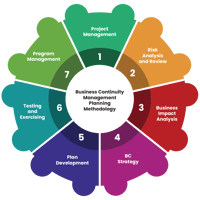](https://cta-redirect.hubspot.com/cta/redirect/3893111/2200ad8c-7d99-4dd5-b92b-249b8d708b20)**Project Management (PM)
- Risk Analysis and Review (RAR)
- Business Impact Analysis (BIA)
- Business Continuity Strategy (BCS)
- Plan Development (PD)
- Testing and Exercising (TE)
- Programme Management (PgM)
##### **8.1 Overview of the Planning Methodology**
Jamiyah Singapore should implement BCM through a structured methodology that translates organisational priorities into documented and tested continuity capabilities.
The methodology can be organised into seven planning phases.

| Phase | BCM planning activity | Expected deliverables |
| --- | --- | --- |
| 1. Programme Management (PM) | Establish governance, scope, policy, roles and implementation arrangements | BCM policy, governance structure, programme plan |
| 2. Risk Analysis and Review (RAR) | Identify and assess threats, vulnerabilities and existing controls | Risk register, threat assessment, treatment actions |
| 3. Business Impact Analysis (BIA) | Identify critical functions, impacts, recovery requirements and dependencies | BIA reports, recovery priorities, RTOs and resource requirements |
| 4. Business Continuity Strategy (BCS) | Select appropriate mitigation and recovery strategies | Approved continuity strategies and resource arrangements |
| 5. Plan Development (PD) | Document response and recovery procedures | Business continuity plans and recovery procedures |
| 6. Testing and Exercising (TE) | Validate strategies, plans, resources and personnel readiness | Exercise plans, results, gaps and corrective actions |
| 7. Programme Management and Maintenance (PgM) | Maintain, review, audit and improve BCM arrangements | Updated plans, review records, management reports |
These seven phases represent the BCM implementation methodology used in this eBook series.
Map them to ISO 22301 requirements rather than interpreting them as the standard's prescribed sequence.
##### **8.2 Applying the Methodology to Jamiyah Singapore**
For example, Jamiyah Singapore may begin by identifying a residential care service as a priority area for continuity planning.
During the RAR phase, the service team assesses threats such as fire, prolonged utility failure, infectious disease outbreaks, and staff shortages.
During the BIA phase, it identifies the activities that must continue, the maximum tolerable disruption, minimum staffing levels, essential equipment, and supporting dependencies.
During the BCS phase, management selects suitable arrangements such as backup utilities, alternative care locations, emergency staffing and supplier contingencies.
The organisation documents, exercises, reviews, and maintains the resulting recovery procedures.
##### **8.3 Implementation Principles**
The BCM methodology should follow several principles.
First, planning should be risk-based and proportionate to the consequences of disruption. Activities affecting beneficiary safety may require stronger continuity arrangements than routine administrative activities.
Second, business function owners should actively participate in assessments and planning. A central coordinator cannot implement BCM effectively alone.
Third, continuity strategies must be practical, supported by available resources, approved arrangements, and evidence of recoverability.
Finally, BCM should be an ongoing management programme rather than a one-time documentation project.
#### **[](https://cta-redirect.hubspot.com/cta/redirect/3893111/a4fa9f02-e184-43b1-8a52-230bf302dd76)**
#### **9. Assessing Risks and Threats for Jamiyah Singapore**
##### **9.1 Purpose of Risk Assessment**
Risk assessment identifies threats that could disrupt Jamiyah Singapore's activities and evaluates the effectiveness of existing preventive and protective controls.
In the BCM context, the emphasis is on threats that could cause unacceptable interruptions to critical services.
The risk assessment should complement the organisation's broader enterprise risk management activities.
##### **9.2 Illustrative BCM Threat Register**
| Threat | Potential disruption | Potentially affected services | Possible preventive controls |
| --- | --- | --- | --- |
| Fire | Loss of premises, equipment and access | Residential care, education, administration | Fire detection, inspections, evacuation procedures |
| Prolonged power outage | Unavailability of lighting, equipment and ICT | Residential care, nursing, education | Backup power, maintenance, alternative premises |
| Cyberattack or ransomware | Unavailable or compromised information systems | Beneficiary administration, finance, communications | Access controls, endpoint protection, protected backups |
| Infectious disease outbreak | Staff shortages, service restrictions and increased care demands | Residential care, nursing, childcare | Infection prevention, workforce contingency arrangements |
| Severe flooding | Inaccessible facilities and transport disruption | Community outreach, food distribution, residential services | Flood monitoring, alternative routes, relocation planning |
| Critical supplier failure | Shortage of food, medical supplies or essential services | Residential care, nursing, welfare distribution | Supplier assessment, alternative suppliers, buffer stocks |
| Workforce shortage | Reduced operational capacity | All labour-intensive services | Cross-training, succession arrangements, relief staffing |
| Telecommunications failure | Loss of contact with staff, beneficiaries and partners | All services | Alternative communication channels and contact lists |
| Data breach | Compromise of sensitive personal information | Beneficiary services, HR, donor management | Data protection controls, incident response procedures |
| Transportation disruption | Delayed deliveries or relocation | Food assistance, community outreach, residential care | Alternative transport providers and delivery arrangements |
##### **9.3 Assessing Likelihood and Impact**
Jamiyah Singapore may adopt a five-point likelihood and impact assessment scale.
A simple risk rating can be calculated as:
Risk Rating= Risk Likelihood x Risk Impact
For example, a prolonged power failure could be assigned a likelihood score of 3 and an impact score of 5, producing an illustrative risk score of 15.
Interpret this score using an approved organisational risk matrix with defined thresholds and escalation requirements.
The impact assessment should consider beneficiary safety, interruption of critical services, legal and regulatory consequences, financial effects, information security, and reputation.
##### **9.4 Risk Treatment and Control**
Risk treatment may involve reducing the likelihood of an incident, reducing its consequences, transferring certain financial exposures, or accepting residual risks within approved limits.
For example, Jamiyah Singapore may reduce the impact of a prolonged power outage by installing or securing access to backup power, maintaining emergency lighting, identifying equipment requiring uninterrupted electricity, and establishing alternative care arrangements.
Risk treatment decisions should identify accountable owners, target dates, required resources and residual risk ratings.
##### **9.5 Linking Risk Assessment to BCM Strategies**
Risk assessment identifies potential causes of disruption, while the BIA identifies the consequences of interruption and the time-critical activities that require recovery.
The two assessments should be integrated.
A high-impact threat affecting a critical residential service may justify additional preventive controls and stronger recovery arrangements.
However, BCM planning should not automatically exclude a low-likelihood threat if its potential consequences are severe.
#### **[](https://cta-redirect.hubspot.com/cta/redirect/3893111/fbb42012-8f64-401c-a56c-d84bdcfeee14)**
#### **10. Identifying Critical Business Functions for Jamiyah Singapore**
##### **10.1 Understanding Critical Business Functions**
Critical Business Functions (CBFs) are activities whose interruption could cause unacceptable consequences for the organisation, its beneficiaries, or other interested parties.
For Jamiyah Singapore, identifying CBFs should consider beneficiary safety and welfare, statutory and licensing obligations, time sensitivity, availability of alternatives, and dependencies on essential resources.
Not every organisational activity will require the same recovery priority.
##### **10.2 Proposed Critical Business Function Catalogue**
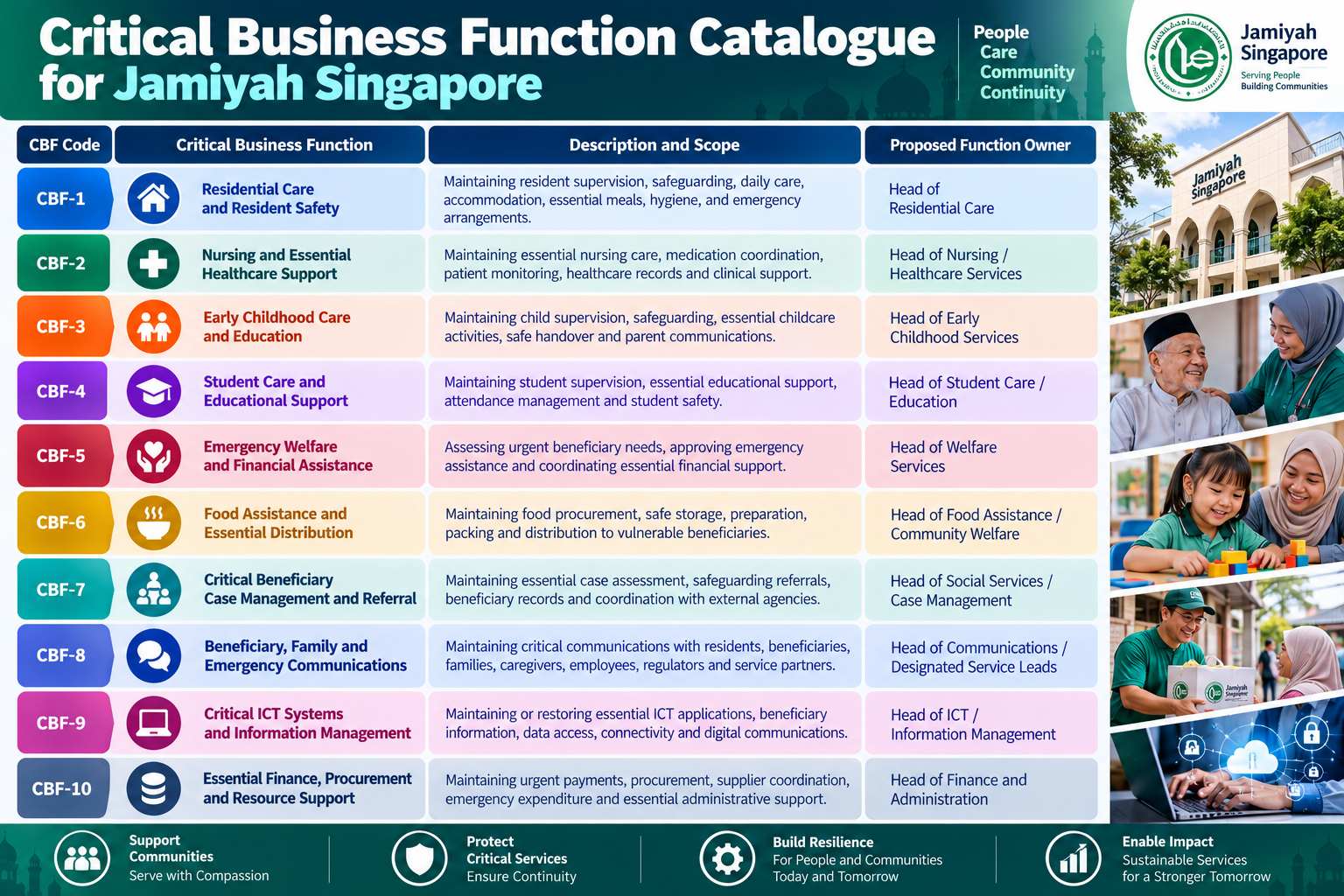
The following catalogue is an illustrative starting point for Jamiyah Singapore's BIA. It is not a confirmed or approved inventory of the organisation's actual critical functions.
| CBF code | Proposed critical business function | Continuity rationale |
| --- | --- | --- |
| CBF-1 | Residential Care and Resident Safety | Protects residents and maintains essential daily care and supervision |
| CBF-2 | Nursing and Essential Healthcare Support | Maintains essential nursing, medication-related and patient care activities |
| CBF-3 | Early Childhood Care and Education | Protects children and maintains essential childcare and supervision |
| CBF-4 | Student Care and Educational Support | Sustains essential student supervision and education-related support |
| CBF-5 | Emergency Welfare and Financial Assistance | Supports beneficiaries requiring urgent financial or social assistance |
| CBF-6 | Food Assistance and Essential Distribution | Maintains food access for vulnerable individuals and families |
| CBF-7 | Critical Beneficiary Case Management and Referral | Maintains essential case records, assessments and referrals |
| CBF-8 | Beneficiary, Family and Emergency Communications | Supports timely communication during serious service disruptions |
| CBF-9 | Critical ICT Systems and Information Management | Supports availability, integrity and recovery of essential systems and records |
| CBF-10 | Essential Finance, Procurement and Resource Support | Enables urgent payments, procurement, staffing and recovery expenditure |
##### ****
##### **10.3 Criteria for Determining Criticality**
Jamiyah Singapore should establish consistent criteria for evaluating business functions.
These criteria may include:
| Criticality factor | Key question |
| --- | --- |
| Life and safety | Could interruption endanger residents, children, patients, staff or beneficiaries? |
| Beneficiary welfare | Would disruption prevent vulnerable individuals from receiving essential support? |
| Regulatory obligations | Could interruption cause a breach of applicable legal or licensing requirements? |
| Time sensitivity | How quickly would the consequences become unacceptable? |
| Service alternatives | Can the activity be performed through another process, location or provider? |
| Dependencies | Which personnel, systems, suppliers and facilities are essential? |
| Financial and reputational impact | Could disruption cause significant financial loss or undermine stakeholder confidence? |
##### **10.4 Illustrative Assessment of CBF-1**
Critical Business Function: CBF-1 Residential Care and Resident Safety
This function covers the activities required to maintain residents' safety, supervision, welfare, and essential daily care.
Illustrative sub-functions include:
1. Maintain resident supervision and safeguarding.
2. Provide essential meals and hydration.
3. Coordinate medication and healthcare-related support.
4. Maintain hygiene, sanitation and environmental safety.
5. Provide emergency response and first aid.
6. Maintain essential utilities and care-support equipment.
7. Communicate with families, caregivers and relevant authorities.
8. Coordinate temporary relocation where necessary.
9. Maintain access to essential resident information.
10. Restore normal residential care operations.
##### **10.5 Identifying Dependencies**
CBF-1's continuity may depend on trained care personnel, appropriate facilities, electricity, water, food supplies, medical support, resident records, transportation, and external emergency services.
Document these dependencies during the BIA and map them to the responsible internal or external providers.
##### **10.6 Establishing Recovery Priorities**
Jamiyah Singapore should use the BIA to determine recovery priorities and minimum service levels.
For example, essential resident supervision may require uninterrupted delivery, while certain non-urgent administrative activities may tolerate a longer interruption.
Management should approve recovery priorities and support them with documented evidence.
##### **10.7 Maintaining the Critical Business Function Catalogue**
Review the CBF catalogue when Jamiyah Singapore introduces new services, changes operating arrangements, opens or closes facilities, changes key suppliers, or undergoes significant organisational restructuring.
The catalogue should also be updated following material incidents, BIA reviews, exercises and changes to applicable regulatory requirements.
#### What Effective BCM Should Look Like at Jamiyah Singapore
A mature Jamiyah Singapore BCMS should ultimately allow management to answer several practical questions confidently:
- Which Jamiyah Singapore activities must continue during a serious disruption?
- How long can each priority activity tolerate interruption?
- What is the minimum acceptable operating level?
- Which people are essential?
- Which systems and information are required?
- Which facilities are required?
- Which suppliers and external parties are critical?
- What alternative arrangements are available?
- Who has authority to activate continuity arrangements?
- How will students and employees be informed?
- How will ICT recovery priorities align with business priorities?
- How will Jamiyah Singapore know that its plans actually work?
- How will weaknesses be corrected?
Exercises and tests are particularly important because they provide evidence about whether continuity arrangements work as intended.
ISO guidance emphasises structured exercises to validate arrangements and build organisational capability. ISO
BCM maturity should therefore be measured not by the number of plans Jamiyah Singapore possesses but by its demonstrated ability to continue and recover priority activities under realistic disruption conditions.
#### **Relationship to the Three-eBook Series**
This three-eBook series takes Jamiyah Singapore through a progressive BCM implementation journey.
**[](https://cta-redirect.hubspot.com/cta/redirect/3893111/c8ff4234-63bc-493b-9945-c28a3c55b3f0)**
This chapter also establishes the foundation for the complete series:
##### **eBook 1 — *Understanding Your Organisation for Jamiyah Singapore***
Establishes organisational context, BCM goals and objectives, assumptions, governance, operating environment, threats and Critical Business Functions.
##### **eBook 2 — *Implementing Business Continuity Management for Jamiyah Singapore***
Translates organisational understanding into detailed risk assessment, BIA, continuity strategies, recovery requirements, procedures, exercising and implementation activities.
##### **eBook 3 — *Starting Your BCM Implementation for Jamiyah Singapore***
Provides a practical implementation pathway to turn the methodology into an operational Jamiyah Singapore BCM programme, including ownership, implementation activities, templates, workshops, and continuous improvement.
Together, the three eBooks move the reader from:
**Understanding → Analysis → Strategy → Planning → Validation → Sustained BCM Capability**
### [](https://cta-redirect.hubspot.com/cta/redirect/3893111/f008eb8e-2d77-4964-abfa-a4ef718b1284)
#### **Building the Foundation for Business Continuity at Jamiyah Singapore**
Business Continuity Management is essential to Jamiyah Singapore's commitment to sustaining its charitable mission, protecting vulnerable beneficiaries, and maintaining reliable community services during disruptive incidents.
Given the organisation's diverse activities, BCM must extend beyond emergency response and disaster recovery to encompass organisational governance, risk management, critical service continuity, stakeholder communication, and continual improvement.
This chapter has established the foundational elements of a structured BCM programme for Jamiyah Singapore.
It introduced BCM principles, examined the organisation's operating environment, proposed strategic BCM goals and measurable business continuity objectives, identified planning assumptions, and outlined a suitable BCM governance and team structure.
It also explains the seven-phase BCM planning methodology and introduces processes for assessing threats and identifying Critical Business Functions.
A key consideration is that business continuity priorities should be determined by the consequences of disruption to beneficiaries and essential services, rather than solely by financial or operational considerations.
Activities involving resident safety, nursing care, childcare, urgent welfare assistance, and essential food distribution may require particularly robust continuity arrangements.
The actual criticality and recovery requirements of these activities must be established through a formal Business Impact Analysis.
The proposed approach aligns with ISO 22301:2019, including Amendment 1:2024, and the implementation guidance of ISO 22313:2020. It also recognises the importance of Singapore's charity governance framework and applicable sector-specific requirements administered by relevant authorities.
These references provide the foundation for developing an appropriate BCMS, but the organisation must demonstrate regulatory compliance and ISO 22301 conformity through implementation and supporting evidence.
#### **Moving Forward with BCM Implementation**
The next chapters of Understanding Your Organisation for Jamiyah Singapore will examine each foundational component in greater detail, enabling the organisation to develop a consistent understanding of its operations, governance responsibilities, business continuity priorities, and critical dependencies.
These foundations will support the practical methodology presented in eBook 2 — Implementing Business Continuity Management for Jamiyah Singapore, followed by the templates, assessments, and implementation guidance in eBook 3 — Starting Your BCM Implementation for Jamiyah Singapore.
[](https://cta-redirect.hubspot.com/cta/redirect/3893111/e9a39a85-2a0e-4b9f-9070-845e26391b34)
Ultimately, the objective is to establish a BCM programme that is not merely documented but practical, sustainable, regularly exercised, and capable of protecting Jamiyah Singapore's essential services when disruption occurs.
By embedding BCM into its governance, operations, and organisational culture, Jamiyah Singapore can strengthen its preparedness, safeguard the communities it serves, and continue fulfilling its mission under challenging circumstances.
[](https://cta-redirect.hubspot.com/cta/redirect/3893111/3aefb2d2-3110-47c1-ad4f-d3e6e5381066)
Blogs marked \[x\] are under construction
[](https://cta-redirect.hubspot.com/cta/redirect/3893111/7ac10d1d-0ce9-43c4-b788-b82967012808)
| **eBook 1: Understanding Your Organisation** | | | | | |
| --- | --- | --- | --- | --- | --- |
| **C1** | **C2** | **C3** | **C4** | **C5** | **C6** |
| [](https://cta-redirect.hubspot.com/cta/redirect/3893111/90950226-c212-4120-a636-5df405a583be) | [](https://cta-redirect.hubspot.com/cta/redirect/3893111/44f3a3f2-fe38-486b-ba11-e9dc6f5135db) | [](https://cta-redirect.hubspot.com/cta/redirect/3893111/633757ca-6975-44c3-b449-24e69f3e0d5b) | [](https://cta-redirect.hubspot.com/cta/redirect/3893111/8fd3550d-2ed2-4e87-9bc2-fd539440c672) | [](https://cta-redirect.hubspot.com/cta/redirect/3893111/ee5f005a-a260-466b-a362-f5d3e152b998) | [](https://cta-redirect.hubspot.com/cta/redirect/3893111/579601b8-d4e0-427c-aa19-965ec8dd1d9a) |
| **C7** | **C8** | **C9** | **C10** | **C11** | **C12** |
| [](https://cta-redirect.hubspot.com/cta/redirect/3893111/74d86b35-a399-48a3-8ecf-3c08b8afa473) | [](https://cta-redirect.hubspot.com/cta/redirect/3893111/6e595cc3-b4cf-403d-b82b-852a55b76a7e) | [](https://cta-redirect.hubspot.com/cta/redirect/3893111/1627555b-6cfd-45ba-aa1a-23c911976ea9) | [](https://cta-redirect.hubspot.com/cta/redirect/3893111/0e87ad0d-3fdf-495a-a60f-384b0e67a940) | [](https://cta-redirect.hubspot.com/cta/redirect/3893111/63397e83-6813-4186-ac55-88ec64749e8d) | [](https://cta-redirect.hubspot.com/cta/redirect/3893111/533a4598-10a4-4347-895c-0b2dff7c7a3e) |
| | | | | | |
More Information About Business Continuity Management Courses
To learn more about the course and schedule, click the buttons below for BCM-300 Business Continuity Management Implementer \[BCM-3\] and BCM-5000 Business Continuity Management Expert Implementer \[BCM-5\].
| [](https://cta-redirect.hubspot.com/cta/redirect/3893111/f3922b80-e96a-46d6-8993-dc150a5de2d5) | [](https://cta-redirect.hubspot.com/cta/redirect/3893111/9ff8a3dc-e39a-465b-929f-72e232cdd5fb) | [](https://cta-redirect.hubspot.com/cta/redirect/3893111/ac6cf073-4cdd-4541-91ed-889f731d5076) |
| --- | --- | --- |
| [](https://cta-redirect.hubspot.com/cta/redirect/3893111/21525c10-4003-4934-95fc-fe218174bc5b) | [](https://cta-redirect.hubspot.com/cta/redirect/3893111/46460171-c91a-4936-9bb2-8dc5928a0e02) | [](https://cta-redirect.hubspot.com/cta/redirect/3893111/1cb17ac7-50b2-4f88-bc4b-c7444e4b57b5) |
| [](https://cta-redirect.hubspot.com/cta/redirect/3893111/b3824ba1-7aa1-4eb6-bef8-94f57121c5ae) | Please feel free to send us a note if you have any questions. [](https://cta-redirect.hubspot.com/cta/redirect/3893111/3c53daeb-2836-4843-b0e0-645baee2ab9e) | [](https://cta-redirect.hubspot.com/cta/redirect/3893111/9c199ae8-c470-4bb7-9612-73c7a084e94c) |
| [](https://cta-redirect.hubspot.com/cta/redirect/3893111/8999211a-2c51-4be7-bf49-c393f6c67974) | [](https://cta-redirect.hubspot.com/cta/redirect/3893111/5c1aa95d-f6dd-4067-a95c-5cc0c32d7ed8) | [](https://cta-redirect.hubspot.com/cta/redirect/3893111/086ab3b9-4d66-4a95-b2f7-1148e9803a9c) |
### Your Comments Here :
### More Posts
[](https://cta-redirect.hubspot.com/cta/redirect/3893111/839787f4-a4fd-456f-accf-54c947026558)

All rights reserved. Copyright 2026
```json
{
"@context" : "https://schema.org",
"@type" : "BlogPosting",
"author" : {
"@type" : "Person",
"name" : "Moh Heng Goh",
"url" : "https://blog.bcm-institute.org/ebook/author/moh-heng-goh"
},
"dateModified" : "2026-10-15T03:23:56.929Z",
"datePublished" : "2026-10-12T06:03:14.000Z",
"headline" : "[BCM] [JS] [E1] [C1] Overview of BCM Case Study",
"mainEntityOfPage" : {
"@id" : "https://blog.bcm-institute.org/ebook/bcm-js-e1-c1-overview-of-bcm-case-study",
"@type" : "WebPage"
},
"publisher" : {
"@type" : "Organization",
"logo" : {
"@type" : "ImageObject",
"url" : "https://blog.bcm-institute.org/hubfs/BCMI%20Logo.png"
},
"name" : "BCMI Pte Ltd"
}
}
```