---
title: [BCM] [JHA] [E3] [RAR] [P3] Risk Impact and Likelihood Assessment
description: "How Jamiyah Home for the Aged rates impact, likelihood and disruption for its 70 threats: 18 High risks, priorities and validation steps."
image: https://blog.bcm-institute.org/hubfs/Jamiyah%20Singapore%20Graphic%20Folder/JS%20BCM%20E3%20Morepost/BCM%5D%20%5BJS%5D%20%5BE3%5D%20%5BRAR%5D%20%5BT3%5D%20Risk%20Impact%20and%20Likelihood%20Assessment.jpg
---
.
[](http://www.bcm-institute.org/)
- [Home](https://www.bcm-institute.org/)
- [About Us](https://www.bcm-institute.org/about-us-3/)
- [A President’s Perspective](https://www.bcm-institute.org/about-us/a-presidents-perspective/)
- [Our History](https://www.bcm-institute.org/about-us/our-history/)
- [Our Advisory Council](https://www.bcm-institute.org/about-us/our-advisory-council/)
- [Customers’ Testimonials](https://www.bcm-institute.org/about-us/customers-testimonials/)
- [Credential Verification](https://www.bcm-institute.org/about-us/credential-verification/)
- [Courses](https://blog.bcm-institute.org/blog/course-fees-for-blended-learning-courses-master-catalog)
- [ISO 22301 Business Continuity Management System Audit](https://blog.bcm-institute.org/audit/business-continuity-management-audit-courses)
- [ISO 22301 Business Continuity Management](https://blog.bcm-institute.org/bcm/business-continuity-management-courses)
- [Crisis Communication](https://blog.bcm-institute.org/crisis-communication/crisis-communication-courses)
- [Crisis Management](https://blog.bcm-institute.org/en/crisis-management/courses)
- [IT Disaster Recovery](https://blog.bcm-institute.org/it-disaster-recovery/courses)
- [Operational Resilience](https://blog.bcm-institute.org/operational-resilience/courses)
- [Operational Resilience Audit](https://blog.bcm-institute.org/operational-resilience-audit/courses)
- [Certification](https://blog.bcm-institute.org/certification/types-of-certifications-offered)
- [ISO 22301 BCMS Audit Certification](https://blog.bcm-institute.org/certification/business-continuity-management-audit-certification)
- [ISO22301 Business Continuity Management Certification](https://blog.bcm-institute.org/bcm/business-continuity-management-certification)
- [Crisis Communication Certification](https://blog.bcm-institute.org/crisis-communication/crisis-communication-certification)
- [Crisis Management Certification](https://blog.bcm-institute.org/en/crisis-management/crisis-management-certification)
- [IT Disaster Recovery Planning Certification](https://blog.bcm-institute.org/it-disaster-recovery/it-disaster-recovery-certification)
- [Operational Resilience Certification](https://blog.bcm-institute.org/operational-resilience/operational-resilience-certification)
- [Operational Resilience Audit Certification](https://blog.bcm-institute.org/operational-resilience-audit)
- [Seminars](https://blog.bcm-institute.org/meet-the-expert/mte-webinar-mainpage)
- [Store](https://www.bcm-institute.org/store-2/)
- [Contact Us](http://www.bcm-institute.org/about-us/contact-us/)
-
-
##### Sustaining Community Services: Implementing BCM at Jamiyah Home for the Aged

# \[BCM\] \[JHA\] \[E3\] \[RAR\] \[P3\] Risk Impact and Likelihood Assessment
[](https://cta-redirect.hubspot.com/cta/redirect/3893111/1ce18ee1-97ef-4ed4-b16b-5d6ab24cec19)
RAR Part 1 identified 70 threats that could prevent Jamiyah Home for the Aged (JHA) from sheltering, feeding, caring for, and protecting its residents.
RAR Part 2 recorded what JHA already does about each one and where those controls fall short.
Part 3 asks the question the Board needs answered before it spends money: **how much does each threat matter?**
Answering that requires two separate judgements. **Impact** is how badly JHA would be hurt if the threat occurred.
**Likelihood** is how plausible it is that the threat will occur.
A threat that would be devastating but is almost unheard of calls for a different response from one that is mildly disruptive but happens every month.
Keeping the two judgements apart stops a frightening threat from being rated as probable simply because it is frightening, and stops a familiar nuisance from being dismissed simply because it is familiar.
[](https://cta-redirect.hubspot.com/cta/redirect/3893111/1626b4db-b5dd-4c9d-8d1d-c84aa9a691f1)
[Dr Goh Moh Heng](https://blog.bcm-institute.org/ebook/author/dr-goh-moh-heng) Oct 22, 2026
###### Business Continuity Management Certified Planner-Specialist-Expert
### [](https://cta-redirect.hubspot.com/cta/redirect/3893111/5cd5edea-eed4-45ec-99b3-824e5267fb21)[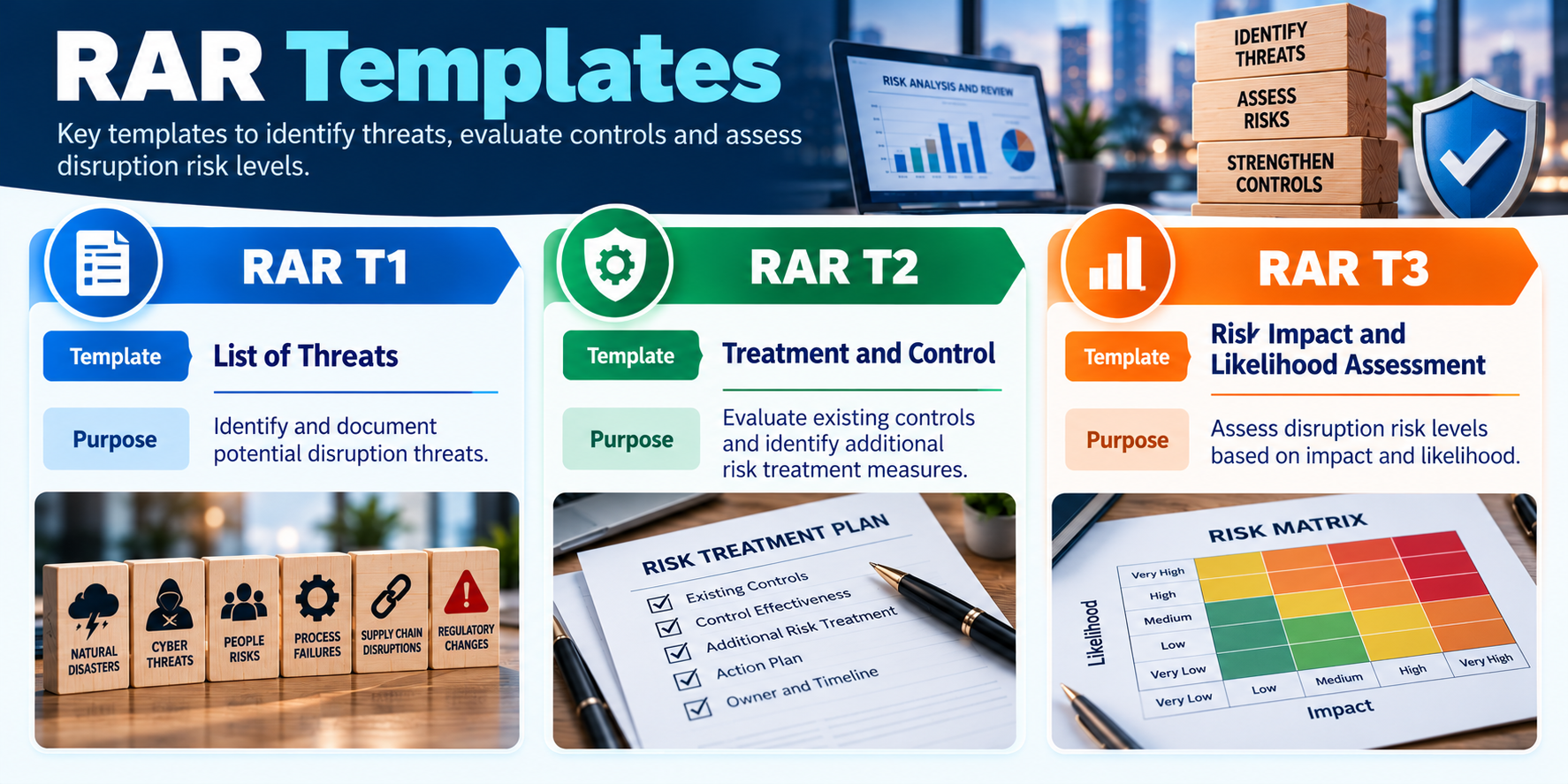](https://cta-redirect.hubspot.com/cta/redirect/3893111/a7ace75d-4eac-4e29-9c8c-e7515c73c4bc)[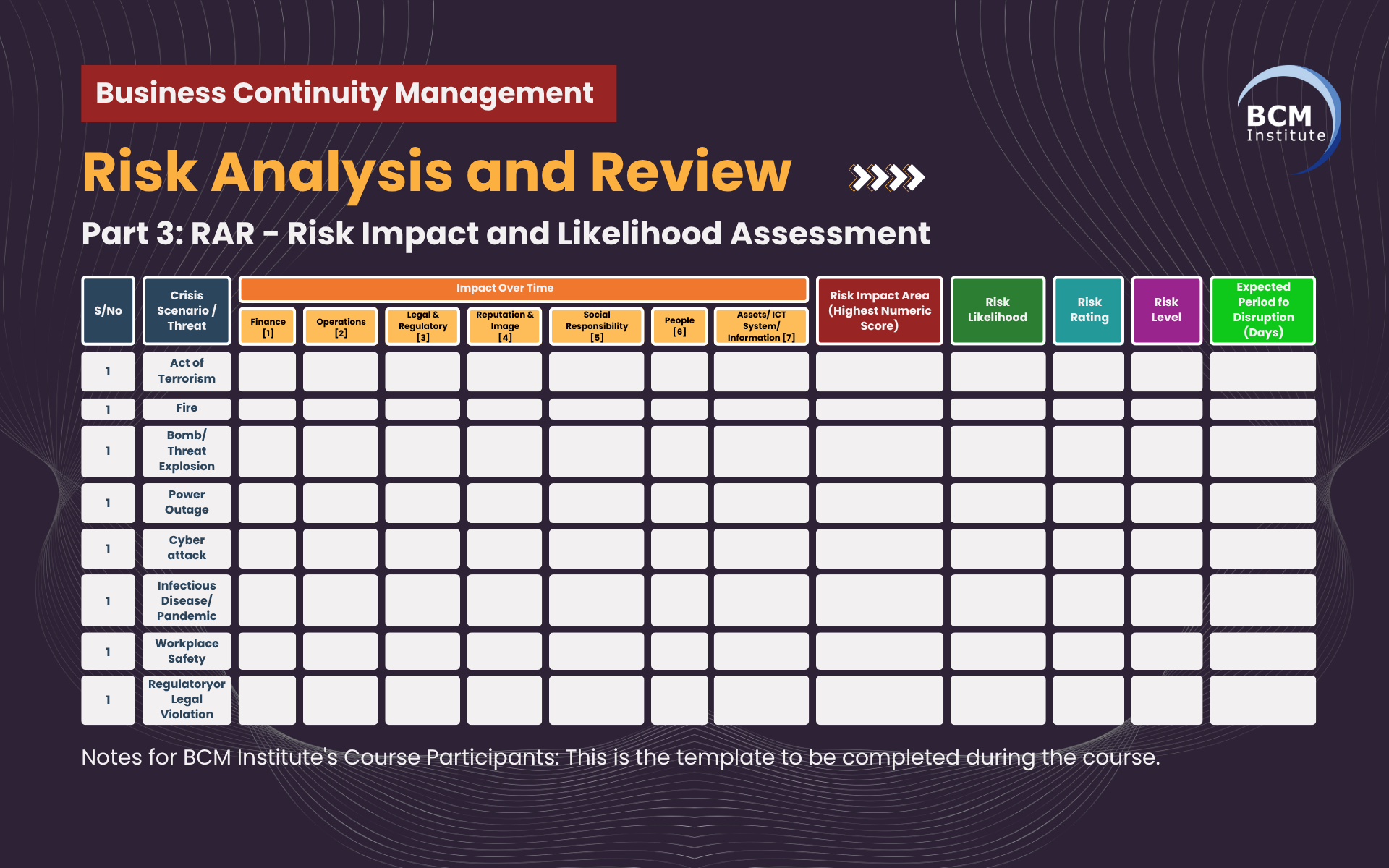](https://cta-redirect.hubspot.com/cta/redirect/3893111/972f1733-4274-42e5-9fc6-fe3acf70f929)[](https://cta-redirect.hubspot.com/cta/redirect/3893111/1626b4db-b5dd-4c9d-8d1d-c84aa9a691f1)RAR Part 3: Risk Impact and Likelihood Assessment for Jamiyah Home for the Aged
#### Introduction
[](https://cta-redirect.hubspot.com/cta/redirect/3893111/1115b558-848b-447d-af32-b2f7dc24a147)RAR Part 1 identified 70 threats that could prevent Jamiyah Home for the Aged (JHA) from sheltering, feeding, caring for, and protecting its residents.
RAR Part 2 recorded what JHA already does about each one and where those controls fall short.
Part 3 asks the question the Board needs answered before it spends money: **how much does each threat matter?**
Answering that requires two separate judgements. **Impact** is how badly JHA would be hurt if the threat occurred.
**Likelihood** is how plausible it is that the threat will occur.
A threat that would be devastating but is almost unheard of calls for a different response from one that is mildly disruptive but happens every month.
Keeping the two judgements apart stops a frightening threat from being rated as probable simply because it is frightening, and stops a familiar nuisance from being dismissed simply because it is familiar.
#### Why Impact is Assessed Across Seven Areas
A single disruption rarely hurts JHA in only one way. A fire costs money, closes wards, triggers SCDF and MSF scrutiny, draws media attention, endangers residents, injures staff and destroys equipment and records.
If the assessment looked only at cost or only at operations, it would understate threats whose worst effects lie elsewhere: a data breach barely touches daily care but carries serious legal and reputational consequences.
Each threat is therefore scored against seven impact areas: Finance; Operations; Legal and Regulatory; Reputation and Image; Social Responsibility; People; and Assets, IT Systems and Information.
The **risk calculation uses the highest of the seven scores**. JHA does not get to average away its worst consequence.
If a threat could cause severe harm to residents but only minor financial loss, the Board must plan for the severe harm. Using the highest credible score keeps the rating anchored to the consequence that would actually define the incident.
#### From Scores to Priorities
Multiplying the highest impact score by the likelihood score gives a **Risk Rating** from 1 to 25, and the rating falls into a **Risk Level**: Low, Moderate, High or Very High.
The level tells management how much attention a threat deserves and who must own it. Ratings also make threats comparable across categories, so the Board can weigh a supply problem against a cyber problem on a common scale.
Each threat also carries an **Expected Period of Disruption**: a realistic estimate of how long it would interrupt operations at JHA, given the controls that exist today.
This is not the Recovery Time Objective (RTO), JHA's target for resuming a function, nor the Maximum Tolerable Period of Disruption (MTPD), the point beyond which harm becomes unacceptable.
Both of those were set in the Corporate and Business Unit MBCO chapter. Comparing the expected disruption with them shows where JHA's current capability falls short of its own targets.
Together, these outputs tell the Business Continuity Strategy where to concentrate effort and money: which threats need immediate mitigation, which need detailed recovery strategies, which need Crisis Management scenarios, and which can be accepted and monitored.
This risk analysis and evaluation step is required by ISO 22301:2019 (clause 8.2.3) and is carried out using the consequence-and-likelihood approach described in ISO 31000 and ISO 31010.
##### Assessment Basis
**The scores in this chapter represent current risk after the existing controls recorded in RAR Part 2, before any additional planned controls are implemented.**
They are neither inherent risk (as if no controls existed) nor target residual risk (after the planned controls in Part 2 are complete).
When Part 2 flags a control as a gap, unverified, or untested, the scores give it limited or no credit: an untested generator does not reduce the impact of a power failure until it has been shown to run under load.
This is the same basis used in the Business Continuity Strategy chapter (Table BCS-1). The 24 threats rated there carry the same Risk Ratings here, so the two chapters can be read together.
##### How to Use the Numbers
The scores are decision-support tools, not measurements.
They compress complex judgements into a common scale so you can compare and rank 70 threats.
Always read them alongside professional judgement, the strength of the evidence behind each control, and the Board's risk appetite.
Where the number and the judgement disagree, the disagreement itself is useful information and should be recorded.
**Every score in this chapter is indicative.** No JHA incident data, insurance terms or control test records were available, and Part 2 found that almost all existing controls are assumed rather than evidenced.
The threat owners, the Superintendent, and senior staff must validate the scores, and the Board or its delegated committee must approve them, before using them to commit resources. Part 6 of this chapter sets out how.
#### Assessment Method
##### Impact Areas as Applied at JHA
The seven impact areas are standard across the series. The table below shows what each means for a residential welfare home.
To avoid double-counting, score harm to residents under Social Responsibility and harm to staff, volunteers, **and partners** under People.
| **Impact area** | **What is considered at JHA** |
| --- | --- |
| **Finance** | **Emergency spending, replacement and repair, agency staff and overtime, temporary relocation, insurance excesses, lost donations, legal costs** |
| **Operations** | **Interruption to the 12 critical business functions, above all 24-hour personal care and supervision, meals, medication and resident safety; backlogs in admissions, case management and reporting** |
| **Legal and Regulatory** | **Licence conditions under the Social Residential Homes Act 2025; notification duties to MSF and MOH; fire safety, workplace safety and health and data protection (PDPA) obligations; charity governance expectations of the Commissioner of Charities** |
| **Reputation and Image** | **Confidence of MSF, Jamiyah Singapore, donors, residents' families, partner agencies, the Muslim community and the public; media coverage** |
| **Social Responsibility** | **Harm to residents, who are elderly, frail, often immobile and without family support; loss of dignity, missed care or unsafe conditions; wider community consequences** |
| **People** | **Death, injury, illness, fatigue and psychological harm to staff and volunteers; loss of key personnel; reduced workforce availability** |
| **Assets, IT Systems and Information** | **Damage to the building, plant and care equipment; loss of ICT, telecommunications and records; loss of confidentiality, integrity or availability of resident, staff and donor data** |
##### Impact Scale
| **Score** | **Descriptor** | **Indicative meaning at JHA** |
| --- | --- | --- |
| **1** | **Insignificant** | **Absorbed by routine operations; no effect on residents' care** |
| **2** | **Minor** | **Short, manageable degradation; minor inconvenience; resolved by the duty manager** |
| **3** | **Moderate** | **Material disruption to one or more important functions; Superintendent involvement; complaints or limited publicity; recoverable loss of systems or information** |
| **4** | **Major** | **Prolonged interruption to critical care; serious regulatory consequences; sustained media attention; serious harm to residents or staff is credible** |
| **5** | **Severe** | **Threatens JHA's ability to continue caring for residents; fatality or widespread harm credible; loss of MSF or public confidence; possible loss of licence** |
##### Likelihood Scale
| **Score** | **Descriptor** | **Indicative meaning** |
| --- | --- | --- |
| **1** | **Rare** | **Exceptional; not expected under normal conditions** |
| **2** | **Unlikely** | **Credible but uncommon; may occur over an extended period** |
| **3** | **Possible** | **Realistic; some history or clear exposure; controls reduce but do not remove it** |
| **4** | **Likely** | **Expected within the normal planning horizon; recurring incidents or warning signs** |
| **5** | **Almost Certain** | **Occurring now or expected within a short period** |
Likelihood was judged from national incident history, JHA's location and resident profile, sector trends, the threat environment and, critically, whether the relevant controls are tested and would work during the disruption. A control's existence alone did not justify a low likelihood score.
##### Risk Rating and Risk Level
**Risk Rating = Highest Impact Score × Likelihood Score.**
No approved JHA risk matrix was supplied, so the default bands below apply. They match the bands used in Table BCS-1, where Moderate is labelled Medium.
| **Risk Rating** | **Risk Level** | **Management expectation** |
| --- | --- | --- |
| **1–4** | **Low (Very Low / Low)** | **Routine monitoring; may be formally accepted** |
| **5–9** | **Moderate** | **Tolerable with active controls; owner monitors; annual review** |
| **10–16** | **High** | **Treatment required; named owner and deadline; quarterly Board visibility** |
| **17–25** | **Very High (Extreme)** | **Not tolerated; immediate action; reported to the Board without delay** |
Note that with two 1–5 scales the only achievable ratings above 16 are 20 and 25.
##### Assumptions
- The planning assumptions in RAR Part 1 apply: a single 24-hour site at 1 Tampines Avenue 3; frail, often immobile residents admitted through MSF; local and foreign shift staff; finance, HR, procurement and some ICT shared with Jamiyah Singapore; external caterers and pharmacy; income from MSF funding and donations.
- Existing controls are those recorded in RAR Part 2. Controls marked there as gaps or as requiring validation receive limited credit.
- No threat names were changed, combined or removed. Numbering follows Table RAR-1.
- Financial scores reflect scale relative to a charity of JHA's size, not absolute amounts. No financial figures were available to validate them.
- Disruption periods describe a credible scenario, not the worst case imaginable.
#### Part 1: Risk Impact and Likelihood Assessment
The assessment is presented as two tables, each split into the five threat categories confirmed in RAR Part 1.
All five required categories are covered:
- Denial of Access – Natural Disaster (12 threats)
- Denial of Access – Man-made Disaster (15)
- Unavailability of People (13)
- Disruption to the Supply Chain (14)
- Equipment and IT-Related Disruption (16)
##### RAR P3: Risk Impact and Likelihood Assessment for Jamiyah Home for the Aged
Impact scores for all seven areas, with the highest score and the area that produces it.
**Table RAR P3 – Category 1: Denial of Access – Natural Disaster**
| **Threat** | **Finance** | **Operat-ions** | **Legal & Regulatory** | **Reputation & Image** | **Social Respon-sibility** | **People** | **Assets / IT Systems / Information** | **Highest Impact Score** |
| --- | --- | --- | --- | --- | --- | --- | --- | --- |
| **1. Flood and flash flood** | **2 – Minor** | **3 – Moderate** | **2 – Minor** | **2 – Minor** | **3 – Moderate** | **2 – Minor** | **3 – Moderate** | **3 – Operations; Social Responsibility; Assets, IT Systems and Information** |
| **2. Severe storm and Sumatra squall** | **2 – Minor** | **3 – Moderate** | **1 – Insignificant** | **1 – Insignificant** | **2 – Minor** | **2 – Minor** | **3 – Moderate** | **3 – Operations; Assets, IT Systems and Information** |
| **3. Lightning** | **2 – Minor** | **2 – Minor** | **2 – Minor** | **1 – Insignificant** | **2 – Minor** | **1 – Insignificant** | **3 – Moderate** | **3 – Assets, IT Systems and Information** |
| **4. Earthquake tremors** | **1 – Insignificant** | **2 – Minor** | **1 – Insignificant** | **1 – Insignificant** | **3 – Moderate** | **2 – Minor** | **2 – Minor** | **3 – Social Responsibility** |
| **5. Tsunami** | **1 – Insignificant** | **1 – Insignificant** | **1 – Insignificant** | **1 – Insignificant** | **1 – Insignificant** | **1 – Insignificant** | **1 – Insignificant** | **1 – All seven impact areas** |
| **6. Landslide and slope failure** | **1 – Insignificant** | **2 – Minor** | **1 – Insignificant** | **1 – Insignificant** | **1 – Insignificant** | **1 – Insignificant** | **1 – Insignificant** | **2 – Operations** |
| **7. Vegetation fire (wildfire)** | **1 – Insignificant** | **2 – Minor** | **1 – Insignificant** | **1 – Insignificant** | **2 – Minor** | **2 – Minor** | **1 – Insignificant** | **2 – Operations; Social Responsibility; People** |
| **8. Extreme heat** | **2 – Minor** | **3 – Moderate** | **2 – Minor** | **2 – Minor** | **3 – Moderate** | **3 – Moderate** | **2 – Minor** | **3 – Operations; Social Responsibility; People** |
| **9. Transboundary haze** | **2 – Minor** | **2 – Minor** | **1 – Insignificant** | **1 – Insignificant** | **3 – Moderate** | **3 – Moderate** | **1 – Insignificant** | **3 – Social Responsibility; People** |
| **10. Pandemic-related movement restrictions** | **2 – Minor** | **3 – Moderate** | **2 – Minor** | **2 – Minor** | **3 – Moderate** | **2 – Minor** | **1 – Insignificant** | **3 – Operations; Social Responsibility** |
| **11. Sinkhole and ground subsidence** | **2 – Minor** | **3 – Moderate** | **1 – Insignificant** | **1 – Insignificant** | **2 – Minor** | **1 – Insignificant** | **3 – Moderate** | **3 – Operations; Assets, IT Systems and Information** |
| **12. Volcanic ash** | **1 – Insignificant** | **2 – Minor** | **1 – Insignificant** | **1 – Insignificant** | **1 – Insignificant** | **2 – Minor** | **1 – Insignificant** | **2 – Operations; People** |
**Table RAR P3 – Category 2: Denial of Access – Man-made Disaster**
| **Threat** | **Finance** | **Operat-ions** | **Legal & Regulatory** | **Reputation & Image** | **Social Respon-sibility** | **People** | **Assets / IT Systems / Information** | **Highest Impact Score** |
| --- | --- | --- | --- | --- | --- | --- | --- | --- |
| **13. Fire** | **4 – Major** | **5 – Severe** | **5 – Severe** | **5 – Severe** | **5 – Severe** | **5 – Severe** | **4 – Major** | **5 – Operations; Legal and Regulatory; Reputation and Image; Social Responsibility; People** |
| **14. Explosion** | **3 – Moderate** | **4 – Major** | **4 – Major** | **4 – Major** | **4 – Major** | **4 – Major** | **4 – Major** | **4 – Operations; Legal and Regulatory; Reputation and Image; Social Responsibility; People; Assets, IT Systems and Information** |
| **15. Chemical spill** | **1 – Insignificant** | **2 – Minor** | **2 – Minor** | **1 – Insignificant** | **2 – Minor** | **3 – Moderate** | **1 – Insignificant** | **3 – People** |
| **16. Gas leak** | **2 – Minor** | **3 – Moderate** | **3 – Moderate** | **2 – Minor** | **3 – Moderate** | **4 – Major** | **2 – Minor** | **4 – People** |
| **17. Structural failure and building collapse** | **4 – Major** | **4 – Major** | **3 – Moderate** | **3 – Moderate** | **4 – Major** | **4 – Major** | **4 – Major** | **4 – Finance; Operations; Social Responsibility; People; Assets, IT Systems and Information** |
| **18. Civil disturbance, riot and public disorder** | **1 – Insignificant** | **2 – Minor** | **1 – Insignificant** | **1 – Insignificant** | **1 – Insignificant** | **2 – Minor** | **1 – Insignificant** | **2 – Operations; People** |
| **19. Terrorism** | **3 – Moderate** | **4 – Major** | **3 – Moderate** | **4 – Major** | **5 – Severe** | **5 – Severe** | **3 – Moderate** | **5 – Social Responsibility; People** |
| **20. Bomb threat and suspicious item** | **1 – Insignificant** | **3 – Moderate** | **1 – Insignificant** | **2 – Minor** | **3 – Moderate** | **2 – Minor** | **1 – Insignificant** | **3 – Operations; Social Responsibility** |
| **21. Sabotage and vandalism** | **2 – Minor** | **3 – Moderate** | **1 – Insignificant** | **2 – Minor** | **2 – Minor** | **1 – Insignificant** | **3 – Moderate** | **3 – Operations; Assets, IT Systems and Information** |
| **22. Active assailant or intruder** | **2 – Minor** | **3 – Moderate** | **4 – Major** | **5 – Severe** | **5 – Severe** | **5 – Severe** | **1 – Insignificant** | **5 – Reputation and Image; Social Responsibility; People** |
| **23. Utility failure affecting access** | **1 – Insignificant** | **4 – Major** | **3 – Moderate** | **2 – Minor** | **4 – Major** | **3 – Moderate** | **2 – Minor** | **4 – Operations; Social Responsibility** |
| **24. Road closure and major traffic incident** | **1 – Insignificant** | **2 – Minor** | **1 – Insignificant** | **1 – Insignificant** | **2 – Minor** | **1 – Insignificant** | **1 – Insignificant** | **2 – Operations; Social Responsibility** |
| **25. Public transport disruption** | **1 – Insignificant** | **2 – Minor** | **1 – Insignificant** | **1 – Insignificant** | **1 – Insignificant** | **2 – Minor** | **1 – Insignificant** | **2 – Operations; People** |
| **26. Aircraft accident** | **3 – Moderate** | **4 – Major** | **2 – Minor** | **2 – Minor** | **4 – Major** | **4 – Major** | **3 – Moderate** | **4 – Operations; Social Responsibility; People** |
| **27. Nearby industrial accident** | **1 – Insignificant** | **3 – Moderate** | **2 – Minor** | **2 – Minor** | **3 – Moderate** | **3 – Moderate** | **1 – Insignificant** | **3 – Operations; Social Responsibility; People** |
**Table RAR P3 – Category 3: Unavailability of People**
| **Threat** | **Finance** | **Operat-ions** | **Legal & Regulatory** | **Reputation & Image** | **Social Respon-sibility** | **People** | **Assets / IT Systems / Information** | **Highest Impact Score** |
| --- | --- | --- | --- | --- | --- | --- | --- | --- |
| **28. Pandemic and epidemic** | **4 – Major** | **5 – Severe** | **4 – Major** | **4 – Major** | **5 – Severe** | **5 – Severe** | **2 – Minor** | **5 – Operations; Social Responsibility; People** |
| **29. Infectious disease outbreak within the Home** | **3 – Moderate** | **4 – Major** | **3 – Moderate** | **3 – Moderate** | **4 – Major** | **4 – Major** | **1 – Insignificant** | **4 – Operations; Social Responsibility; People** |
| **30. Labour strike and industrial action** | **1 – Insignificant** | **2 – Minor** | **1 – Insignificant** | **1 – Insignificant** | **1 – Insignificant** | **1 – Insignificant** | **1 – Insignificant** | **2 – Operations** |
| **31. High staff turnover and mass resignation** | **3 – Moderate** | **4 – Major** | **3 – Moderate** | **3 – Moderate** | **4 – Major** | **4 – Major** | **1 – Insignificant** | **4 – Operations; Social Responsibility; People** |
| **32. Loss of key personnel** | **3 – Moderate** | **4 – Major** | **4 – Major** | **3 – Moderate** | **3 – Moderate** | **3 – Moderate** | **2 – Minor** | **4 – Operations; Legal and Regulatory** |
| **33. Skills shortage** | **3 – Moderate** | **4 – Major** | **3 – Moderate** | **2 – Minor** | **4 – Major** | **4 – Major** | **1 – Insignificant** | **4 – Operations; Social Responsibility; People** |
| **34. Workplace injury** | **2 – Minor** | **2 – Minor** | **2 – Minor** | **1 – Insignificant** | **1 – Insignificant** | **2 – Minor** | **1 – Insignificant** | **2 – Finance; Operations; Legal and Regulatory; People** |
| **35. Workplace violence** | **1 – Insignificant** | **2 – Minor** | **3 – Moderate** | **2 – Minor** | **3 – Moderate** | **3 – Moderate** | **1 – Insignificant** | **3 – Legal and Regulatory; Social Responsibility; People** |
| **36. Staff fatigue and psychological stress** | **2 – Minor** | **3 – Moderate** | **2 – Minor** | **2 – Minor** | **3 – Moderate** | **3 – Moderate** | **1 – Insignificant** | **3 – Operations; Social Responsibility; People** |
| **37. Travel restrictions** | **2 – Minor** | **3 – Moderate** | **1 – Insignificant** | **1 – Insignificant** | **2 – Minor** | **3 – Moderate** | **1 – Insignificant** | **3 – Operations; People** |
| **38. Mandatory quarantine and isolation** | **2 – Minor** | **4 – Major** | **3 – Moderate** | **2 – Minor** | **4 – Major** | **3 – Moderate** | **1 – Insignificant** | **4 – Operations; Social Responsibility** |
| **39. Family emergencies** | **1 – Insignificant** | **2 – Minor** | **1 – Insignificant** | **1 – Insignificant** | **2 – Minor** | **2 – Minor** | **1 – Insignificant** | **2 – Operations; Social Responsibility; People** |
| **40. Loss of volunteers and visiting partners** | **1 – Insignificant** | **2 – Minor** | **1 – Insignificant** | **2 – Minor** | **2 – Minor** | **1 – Insignificant** | **1 – Insignificant** | **2 – Operations; Reputation and Image; Social Responsibility** |
**Table RAR P3 – Category 4: Disruption to the Supply Chain**
| **Threat** | **Finance** | **Operat-ions** | **Legal & Regulatory** | **Reputation & Image** | **Social Respon-sibility** | **People** | **Assets / IT Systems / Information** | **Highest Impact Score** |
| --- | --- | --- | --- | --- | --- | --- | --- | --- |
| **41. Catering and food supplier failure** | **2 – Minor** | **4 – Major** | **3 – Moderate** | **3 – Moderate** | **4 – Major** | **2 – Minor** | **1 – Insignificant** | **4 – Operations; Social Responsibility** |
| **42. Outsourcing and shared services failure** | **3 – Moderate** | **3 – Moderate** | **3 – Moderate** | **2 – Minor** | **2 – Minor** | **4 – Major** | **3 – Moderate** | **4 – People** |
| **43. Medication and medical supply disruption** | **2 – Minor** | **4 – Major** | **3 – Moderate** | **3 – Moderate** | **4 – Major** | **1 – Insignificant** | **1 – Insignificant** | **4 – Operations; Social Responsibility** |
| **44. Utility failure** | **3 – Moderate** | **4 – Major** | **3 – Moderate** | **3 – Moderate** | **4 – Major** | **2 – Minor** | **3 – Moderate** | **4 – Operations; Social Responsibility** |
| **45. Telecommunications provider failure** | **1 – Insignificant** | **3 – Moderate** | **2 – Minor** | **2 – Minor** | **3 – Moderate** | **1 – Insignificant** | **3 – Moderate** | **3 – Operations; Social Responsibility; Assets, IT Systems and Information** |
| **46. Cloud service provider failure** | **3 – Moderate** | **3 – Moderate** | **3 – Moderate** | **2 – Minor** | **2 – Minor** | **1 – Insignificant** | **3 – Moderate** | **3 – Finance; Operations; Legal and Regulatory; Assets, IT Systems and Information** |
| **47. Fuel supply disruption** | **1 – Insignificant** | **3 – Moderate** | **1 – Insignificant** | **1 – Insignificant** | **3 – Moderate** | **1 – Insignificant** | **2 – Minor** | **3 – Operations; Social Responsibility** |
| **48. Logistics and transportation failure** | **1 – Insignificant** | **2 – Minor** | **1 – Insignificant** | **1 – Insignificant** | **2 – Minor** | **1 – Insignificant** | **1 – Insignificant** | **2 – Operations; Social Responsibility** |
| **49. Banking and payment system failure** | **3 – Moderate** | **2 – Minor** | **1 – Insignificant** | **2 – Minor** | **1 – Insignificant** | **2 – Minor** | **1 – Insignificant** | **3 – Finance** |
| **50. Regulatory and funding change** | **4 – Major** | **3 – Moderate** | **4 – Major** | **3 – Moderate** | **3 – Moderate** | **2 – Minor** | **1 – Insignificant** | **4 – Finance; Legal and Regulatory** |
| **51. Import restrictions and food supply shocks** | **2 – Minor** | **2 – Minor** | **1 – Insignificant** | **1 – Insignificant** | **2 – Minor** | **1 – Insignificant** | **1 – Insignificant** | **2 – Finance; Operations; Social Responsibility** |
| **52. Vendor insolvency and contract termination** | **3 – Moderate** | **4 – Major** | **2 – Minor** | **2 – Minor** | **3 – Moderate** | **1 – Insignificant** | **2 – Minor** | **4 – Operations** |
| **53. Third-party cyber incident** | **2 – Minor** | **2 – Minor** | **4 – Major** | **4 – Major** | **2 – Minor** | **1 – Insignificant** | **3 – Moderate** | **4 – Legal and Regulatory; Reputation and Image** |
| **54. Single source dependency** | **2 – Minor** | **3 – Moderate** | **2 – Minor** | **2 – Minor** | **3 – Moderate** | **1 – Insignificant** | **2 – Minor** | **3 – Operations; Social Responsibility** |
**Table RAR P3 – Category 5: Equipment and IT-Related Disruption**
| **Threat** | **Finance** | **Operat-ions** | **Legal & Regulatory** | **Reputation & Image** | **Social Respon-sibility** | **People** | **Assets / IT Systems / Information** | **Highest Impact Score** |
| --- | --- | --- | --- | --- | --- | --- | --- | --- |
| **55. Ransomware** | **3 – Moderate** | **4 – Major** | **4 – Major** | **4 – Major** | **3 – Moderate** | **2 – Minor** | **4 – Major** | **4 – Operations; Legal and Regulatory; Reputation and Image; Assets, IT Systems and Information** |
| **56. Malware, phishing and business email compromise** | **3 – Moderate** | **2 – Minor** | **2 – Minor** | **3 – Moderate** | **1 – Insignificant** | **1 – Insignificant** | **3 – Moderate** | **3 – Finance; Reputation and Image; Assets, IT Systems and Information** |
| **57. Distributed Denial of Service (DDoS)** | **2 – Minor** | **1 – Insignificant** | **1 – Insignificant** | **2 – Minor** | **1 – Insignificant** | **1 – Insignificant** | **2 – Minor** | **2 – Finance; Reputation and Image; Assets, IT Systems and Information** |
| **58. Insider threat** | **3 – Moderate** | **2 – Minor** | **4 – Major** | **4 – Major** | **4 – Major** | **2 – Minor** | **3 – Moderate** | **4 – Legal and Regulatory; Reputation and Image; Social Responsibility** |
| **59. Data breach** | **3 – Moderate** | **2 – Minor** | **4 – Major** | **4 – Major** | **3 – Moderate** | **2 – Minor** | **3 – Moderate** | **4 – Legal and Regulatory; Reputation and Image** |
| **60. Network and internet failure** | **1 – Insignificant** | **3 – Moderate** | **1 – Insignificant** | **1 – Insignificant** | **2 – Minor** | **1 – Insignificant** | **3 – Moderate** | **3 – Operations; Assets, IT Systems and Information** |
| **61. Server and hardware failure** | **1 – Insignificant** | **2 – Minor** | **1 – Insignificant** | **1 – Insignificant** | **1 – Insignificant** | **1 – Insignificant** | **2 – Minor** | **2 – Operations; Assets, IT Systems and Information** |
| **62. Software failure and database corruption** | **2 – Minor** | **3 – Moderate** | **3 – Moderate** | **2 – Minor** | **3 – Moderate** | **1 – Insignificant** | **3 – Moderate** | **3 – Operations; Legal and Regulatory; Social Responsibility; Assets, IT Systems and Information** |
| **63. Cloud service outage** | **1 – Insignificant** | **3 – Moderate** | **2 – Minor** | **1 – Insignificant** | **3 – Moderate** | **1 – Insignificant** | **3 – Moderate** | **3 – Operations; Social Responsibility; Assets, IT Systems and Information** |
| **64. Power failure** | **2 – Minor** | **4 – Major** | **3 – Moderate** | **3 – Moderate** | **4 – Major** | **2 – Minor** | **3 – Moderate** | **4 – Operations; Social Responsibility** |
| **65. Loss of telecommunications and mobile communications** | **1 – Insignificant** | **3 – Moderate** | **2 – Minor** | **2 – Minor** | **4 – Major** | **2 – Minor** | **3 – Moderate** | **4 – Social Responsibility** |
| **66. Backup failure** | **3 – Moderate** | **3 – Moderate** | **4 – Major** | **3 – Moderate** | **3 – Moderate** | **1 – Insignificant** | **4 – Major** | **4 – Legal and Regulatory; Assets, IT Systems and Information** |
| **67. Data centre and server room failure** | **3 – Moderate** | **3 – Moderate** | **3 – Moderate** | **2 – Minor** | **2 – Minor** | **1 – Insignificant** | **4 – Major** | **4 – Assets, IT Systems and Information** |
| **68. Authentication and identity management failure** | **1 – Insignificant** | **3 – Moderate** | **1 – Insignificant** | **1 – Insignificant** | **2 – Minor** | **1 – Insignificant** | **3 – Moderate** | **3 – Operations; Assets, IT Systems and Information** |
| **69. Care and safety equipment failure** | **2 – Minor** | **3 – Moderate** | **3 – Moderate** | **2 – Minor** | **3 – Moderate** | **3 – Moderate** | **3 – Moderate** | **3 – Operations; Legal and Regulatory; Social Responsibility; People; Assets, IT Systems and Information** |
| **70. Artificial intelligence system failure** | **1 – Insignificant** | **2 – Minor** | **1 – Insignificant** | **1 – Insignificant** | **2 – Minor** | **1 – Insignificant** | **1 – Insignificant** | **2 – Operations; Social Responsibility** |
##### RAR P3B: Risk Impact and Likelihood Assessment for Jamiyah Home for the Aged
Likelihood, Risk Rating (highest impact × likelihood), Risk Level and expected period of disruption.
**Table RAR P3B – Category 1: Denial of Access – Natural Disaster**
| Threat | **Likelihood** | **Risk Rating** | **Risk Level** | **Expected Period of Disruption** |
| --- | --- | --- | --- | --- |
| **1. Flood and flash flood** | **3 – Possible: flash floods recur; ground-floor exposure not yet mapped** | **3 × 3 = 9** | **Moderate** | **4–8 hours; 1–3 days if the kitchen or switch room floods** |
| **2. Severe storm and Sumatra squall** | **3 – Possible: squalls are frequent; damage usually localised** | **3 × 3 = 9** | **Moderate** | **1–4 hours; 1–3 days if roof or window damage closes rooms** |
| **3. Lightning** | **3 – Possible: very high national strike rate; surge protection unconfirmed** | **3 × 3 = 9** | **Moderate** | **Less than 1 hour; 1–3 days if alarm or nurse-call panels need parts** |
| **4. Earthquake tremors** | **1 – Rare: distant tremors only; no recorded damage** | **3 × 1 = 3** | **Low** | **1–4 hours for precautionary evacuation and checks** |
| **5. Tsunami** | **1 – Rare: sheltered coastline; inland site** | **1 × 1 = 1** | **Low** | **Less than 1 hour; no direct effect expected** |
| **6. Landslide and slope failure** | **1 – Rare: flat site; exposure limited to nearby works** | **2 × 1 = 2** | **Low** | **4–8 hours if an access road is closed** |
| **7. Vegetation fire (wildfire)** | **2 – Unlikely: dry-season fires in nearby green spaces** | **2 × 2 = 4** | **Low** | **4–8 hours of smoke management** |
| **8. Extreme heat** | **4 – Likely: heat advisories increasing; no hard temperature thresholds** | **3 × 4 = 12** | **High** | **3–7 days per hot spell; longer if cooling fails** |
| **9. Transboundary haze** | **3 – Possible: recurring regional episodes** | **3 × 3 = 9** | **Moderate** | **1–4 weeks; depends on regional fires and monsoon winds** |
| **10. Pandemic-related movement restrictions** | **2 – Unlikely: requires a major public health emergency** | **3 × 2 = 6** | **Moderate** | **More than 1 month; set by public health orders** |
| **11. Sinkhole and ground subsidence** | **1 – Rare: isolated national incidents only** | **3 × 1 = 3** | **Low** | **1–2 weeks if access or utilities are cut; depends on agency repairs** |
| **12. Volcanic ash** | **1 – Rare: indirect effect through flight disruption** | **2 × 1 = 2** | **Low** | **3–7 days of stranded staff** |
**Table RAR P3B – Category 2: Denial of Access – Man-made Disaster**
| Threat | **Likelihood** | **Risk Rating** | **Risk Level** | **Expected Period of Disruption** |
| --- | --- | --- | --- | --- |
| **13. Fire** | **3 – Possible: common in residential premises; night evacuation untested** | **5 × 3 = 15** | **High** | **Hours if contained; 2–4 weeks or more if wards are lost; alternate shelter is the key variable** |
| **14. Explosion** | **2 – Unlikely: oxygen and battery sources present; storage not audited** | **4 × 2 = 8** | **Moderate** | **1–2 weeks pending structural assessment** |
| **15. Chemical spill** | **2 – Unlikely: small quantities; basic storage controls** | **3 × 2 = 6** | **Moderate** | **1–4 hours** |
| **16. Gas leak** | **2 – Unlikely: inspected installation; detector unconfirmed** | **4 × 2 = 8** | **Moderate** | **8–24 hours of kitchen closure; depends on standby caterer** |
| **17. Structural failure and building collapse** | **2 – Unlikely: building in use since 1997; periodic inspection** | **4 × 2 = 8** | **Moderate** | **2–4 weeks to more than 1 month for closed wards** |
| **18. Civil disturbance, riot and public disorder** | **1 – Rare: very low national occurrence** | **2 × 1 = 2** | **Low** | **4–8 hours of travel delay** |
| **19. Terrorism** | **1 – Rare: credible nationally; Home not a likely target** | **5 × 1 = 5** | **Moderate** | **1–3 days; police cordon duration** |
| **20. Bomb threat and suspicious item** | **2 – Unlikely: email hoaxes against institutions rising** | **3 × 2 = 6** | **Moderate** | **1–4 hours** |
| **21. Sabotage and vandalism** | **2 – Unlikely: plant rooms locked; access lists informal** | **3 × 2 = 6** | **Moderate** | **1–3 days for repair or parts** |
| **22. Active assailant or intruder** | **2 – Unlikely: visits by arrangement; no lockdown procedure** | **5 × 2 = 10** | **High** | **1–4 hours on site; 1–3 days of investigation and recovery** |
| **23. Utility failure affecting access** | **2 – Unlikely: prolonged outages rare; no plan for upper-floor residents** | **4 × 2 = 8** | **Moderate** | **1–4 hours; 4–8 hours if lift repair is needed** |
| **24. Road closure and major traffic incident** | **4 – Likely: frequent but brief incidents** | **2 × 4 = 8** | **Moderate** | **1–4 hours** |
| **25. Public transport disruption** | **3 – Possible: periodic line disruptions** | **2 × 3 = 6** | **Moderate** | **4 hours to 3–7 days; depends on operator recovery** |
| **26. Aircraft accident** | **1 – Rare: under flight paths; very low occurrence** | **4 × 1 = 4** | **Low** | **1–3 days of cordon; longer if the site is damaged** |
| **27. Nearby industrial accident** | **2 – Unlikely: industrial estates nearby; no shelter-in-place procedure** | **3 × 2 = 6** | **Moderate** | **4–8 hours of shelter-in-place** |
**Table RAR P3B – Category 3: Unavailability of People**
| Threat | **Likelihood** | **Risk Rating** | **Risk Level** | **Expected Period of Disruption** |
| --- | --- | --- | --- | --- |
| **28. Pandemic and epidemic** | **3 – Possible: credible within the planning horizon; plan currency unverified** | **5 × 3 = 15** | **High** | **More than 1 month, in waves** |
| **29. Infectious disease outbreak within the Home** | **4 – Likely: common in shared living settings** | **4 × 4 = 16** | **High** | **1–4 weeks; depends on pathogen and cohorting** |
| **30. Labour strike and industrial action** | **1 – Rare: strikes almost unknown nationally** | **2 × 1 = 2** | **Low** | **1–3 days at an outsourced vendor** |
| **31. High staff turnover and mass resignation** | **4 – Likely: tight eldercare labour market** | **4 × 4 = 16** | **High** | **More than 1 month; recruitment cycle** |
| **32. Loss of key personnel** | **3 – Possible: small team; no named deputies** | **4 × 3 = 12** | **High** | **1–2 weeks for interim cover; longer without alternates** |
| **33. Skills shortage** | **4 – Likely: demand outpacing supply of qualified staff** | **4 × 4 = 16** | **High** | **More than 1 month; structural** |
| **34. Workplace injury** | **4 – Likely: frequent lifting and transfers** | **2 × 4 = 8** | **Moderate** | **1–3 days of roster adjustment; individual leave 1–2 weeks** |
| **35. Workplace violence** | **3 – Possible: residents with cognitive and behavioural conditions** | **3 × 3 = 9** | **Moderate** | **1–4 hours; staff absence may follow** |
| **36. Staff fatigue and psychological stress** | **3 – Possible: overtime and emotional load** | **3 × 3 = 9** | **Moderate** | **Gradual; can persist beyond 1 month** |
| **37. Travel restrictions** | **2 – Unlikely: requires border closures or major flight disruption** | **3 × 2 = 6** | **Moderate** | **2–4 weeks to more than 1 month** |
| **38. Mandatory quarantine and isolation** | **2 – Unlikely: arises only with significant outbreaks** | **4 × 2 = 8** | **Moderate** | **3–7 days; isolation period** |
| **39. Family emergencies** | **4 – Likely: routine; clusters at festive periods** | **2 × 4 = 8** | **Moderate** | **Less than 1 day to 1–3 days** |
| **40. Loss of volunteers and visiting partners** | **3 – Possible: partner availability varies** | **2 × 3 = 6** | **Moderate** | **2–4 weeks, within the 30-day MTPD for programmes** |
**Table RAR P3B – Category 4: Disruption to the Supply Chain**
| Threat | **Likelihood** | **Risk Rating** | **Risk Level** | **Expected Period of Disruption** |
| --- | --- | --- | --- | --- |
| **41. Catering and food supplier failure** | **3 – Possible: caterer suspensions occur; no standby caterer** | **4 × 3 = 12** | **High** | **8–24 hours with a standby caterer; 1–3 days without one** |
| **42. Outsourcing and shared services failure** | **2 – Unlikely: established managing agent; no written service schedule** | **4 × 2 = 8** | **Moderate** | **1–3 days to 1–2 weeks** |
| **43. Medication and medical supply disruption** | **3 – Possible: shortages and recalls; seven-day reserve not evidenced** | **4 × 3 = 12** | **High** | **1–3 days to 1–2 weeks for national shortages** |
| **44. Utility failure** | **3 – Possible: local faults occur; standby power untested** | **4 × 3 = 12** | **High** | **4–8 hours; 1–3 days for water or building faults** |
| **45. Telecommunications provider failure** | **3 – Possible: recent carrier outages; single carrier** | **3 × 3 = 9** | **Moderate** | **4–8 hours; up to 1–3 days** |
| **46. Cloud service provider failure** | **2 – Unlikely: prolonged failure or withdrawal is uncommon** | **3 × 2 = 6** | **Moderate** | **1–2 weeks to more than 1 month if migration is needed** |
| **47. Fuel supply disruption** | **2 – Unlikely: resilient national supply; on-site stock unknown** | **3 × 2 = 6** | **Moderate** | **8–24 hours, only during a long power outage** |
| **48. Logistics and transportation failure** | **3 – Possible: provider availability varies** | **2 × 3 = 6** | **Moderate** | **1–3 days** |
| **49. Banking and payment system failure** | **2 – Unlikely: outages occasional and short** | **3 × 2 = 6** | **Moderate** | **4 hours to 1–3 days** |
| **50. Regulatory and funding change** | **3 – Possible: SRHA licensing transition under way** | **4 × 3 = 12** | **High** | **Gradual; adjustment over 1–6 months** |
| **51. Import restrictions and food supply shocks** | **3 – Possible: recurrent regional export curbs** | **2 × 3 = 6** | **Moderate** | **2–4 weeks** |
| **52. Vendor insolvency and contract termination** | **2 – Unlikely: periodic small-business failures** | **4 × 2 = 8** | **Moderate** | **1–4 weeks; re-procurement time** |
| **53. Third-party cyber incident** | **2 – Unlikely: supplier attacks rising; contract clauses unverified** | **4 × 2 = 8** | **Moderate** | **1–2 weeks** |
| **54. Single source dependency** | **3 – Possible: several services rest on one provider** | **3 × 3 = 9** | **Moderate** | **1–2 weeks; follows whichever supplier fails** |
**Table RAR P3B – Category 5: Equipment and IT-Related Disruption**
| Threat | **Likelihood** | **Risk Rating** | **Risk Level** | **Expected Period of Disruption** |
| --- | --- | --- | --- | --- |
| **55. Ransomware** | **3 – Possible: active threat environment; restores untested** | **4 × 3 = 12** | **High** | **1–4 weeks; depends on clean, restorable backups** |
| **56. Malware, phishing and business email compromise** | **4 – Likely: constant phishing attempts** | **3 × 4 = 12** | **High** | **1–3 days** |
| **57. Distributed Denial of Service (DDoS)** | **2 – Unlikely: occasional hacktivist campaigns** | **2 × 2 = 4** | **Low** | **4–8 hours** |
| **58. Insider threat** | **2 – Unlikely: two-person handling of residents' money** | **4 × 2 = 8** | **Moderate** | **1–2 weeks of investigation; reputational effects longer** |
| **59. Data breach** | **3 – Possible: sensitive data across paper, apps and vendors** | **4 × 3 = 12** | **High** | **1–3 days operationally; regulatory follow-up over 1 month** |
| **60. Network and internet failure** | **3 – Possible: single internet link** | **3 × 3 = 9** | **Moderate** | **1–4 hours; up to 1–3 days** |
| **61. Server and hardware failure** | **4 – Likely: routine device faults** | **2 × 4 = 8** | **Moderate** | **8–24 hours; depends on spares** |
| **62. Software failure and database corruption** | **3 – Possible: updates and vendor changes** | **3 × 3 = 9** | **Moderate** | **1–3 days** |
| **63. Cloud service outage** | **3 – Possible: provider outages reach Singapore users** | **3 × 3 = 9** | **Moderate** | **1–4 hours; 8–24 hours for a major provider incident** |
| **64. Power failure** | **3 – Possible: local faults occur; generator untested on load** | **4 × 3 = 12** | **High** | **1–4 hours; 8–24 hours for building faults** |
| **65. Loss of telecommunications and mobile communications** | **2 – Unlikely: requires fixed and mobile failure together** | **4 × 2 = 8** | **Moderate** | **1–8 hours** |
| **66. Backup failure** | **3 – Possible: restores never tested** | **4 × 3 = 12** | **High** | **Latent; can extend another outage by 1–4 weeks or make loss permanent** |
| **67. Data centre and server room failure** | **2 – Unlikely: shared server room; cooling unverified** | **4 × 2 = 8** | **Moderate** | **1–3 days to 1–2 weeks** |
| **68. Authentication and identity management failure** | **2 – Unlikely: out-of-hours lockouts** | **3 × 2 = 6** | **Moderate** | **4–8 hours until helpdesk support** |
| **69. Care and safety equipment failure** | **4 – Likely: frequent faults across many devices** | **3 × 4 = 12** | **High** | **4 hours to 1–3 days; depends on spares and repair** |
| **70. Artificial intelligence system failure** | **1 – Rare: use assumed limited** | **2 × 1 = 2** | **Low** | **Less than 1 day** |
*Result:* 18 threats are rated High, 41 Moderate and 11 Low. No threat is rated Very High under current controls. That should not be read as reassurance: several High ratings rest on controls that Part 2 could not confirm, and if those controls turn out not to exist, the affected ratings would rise.
#### Part 2: High and Extreme Risk Analysis
No threat currently reaches Very High (Extreme). The 18 High risks are summarised below, grouped by the resource they put at risk.
Tables RAR P3 and P3B show the highest-impact area and expected disruption period; this section focuses on what drives each rating and what management must do.
| Threat (rating) | Highest impact · expected disruption | Main consequences and likelihood driver | Most significant existing control | Principal control weakness | Management attention | Urgent? |
| --- | --- | --- | --- | --- | --- | --- |
| **29. Infectious disease outbreak within the Home (16)** | **4 – Operations; Social Responsibility; People** **1–4 weeks; depends on pathogen and cohorting** | **Residents and staff fall ill together; admissions pause; notification to MOH and MSF. Driver: outbreaks are common in shared living** | **IPC procedures and symptom surveillance** | **No tested cohorting plan or line-list** | **Outbreak drill and cohorting plan; Nursing Lead** | **Yes** |
| **31. High staff turnover and mass resignation (16)** | **4 – Operations; Social Responsibility; People** **More than 1 month; recruitment cycle** | **Shift gaps and loss of knowledge of individual residents. Driver: tight eldercare labour market** | **Recruitment via Jamiyah Singapore HR** | **No agency agreement; no resident profiles** | **Board to approve minimum safe staffing per shift** | **Yes** |
| **33. Skills shortage (16)** | **4 – Operations; Social Responsibility; People** **More than 1 month; structural** | **Medication and dementia care cannot be safely staffed on some shifts. Driver: demand outpacing qualified supply** | **Competency records** | **No skills matrix by shift** | **Skills matrix; cross-training in permitted tasks** | **Yes** |
| **28. Pandemic and epidemic (15)** | **5 – Operations; Social Responsibility; People** **More than 1 month, in waves** | **Severe outcomes for residents while staff absence lasts months. Driver: credible within the planning horizon** | **COVID-19 experience; MOH guidance** | **Plan currency unverified; no staged absence triggers; PPE reserve unproven** | **Update plan with 20/30/40% absence triggers; tabletop exercise** | **Yes** |
| **32. Loss of key personnel (12)** | **4 – Operations; Legal and Regulatory** **1–2 weeks for interim cover; longer without alternates** | **Emergency decisions, spending and MSF reporting stall. Driver: small team, no deputies** | **Job descriptions; leave handovers** | **No named alternates or written delegation** | **Named alternate per critical role; written delegation** | **Yes** |
| **13. Fire (15)** | **5 – Operations; Legal and Regulatory; Reputation and Image; Social Responsibility; People** **Hours if contained; 2–4 weeks or more if wards are lost; alternate shelter is the key variable** | **Injury or death of residents who cannot self-evacuate; wards lost for weeks; regulatory and media scrutiny. Driver: residential fires common nationally** | **Alarm, sprinklers, compartmentation and drills (assumed)** | **No timed night drill with bedbound residents; no alternate shelter agreement** | **Night-shift drill; evacuation aids; alternate shelter agreement; Board oversight** | **Yes** |
| **22. Active assailant or intruder (10)** | **5 – Reputation and Image; Social Responsibility; People** **1–4 hours on site; 1–3 days of investigation and recovery** | **Harm to residents who cannot move away from danger; severe reputational damage. Driver: open-site exposure** | **Visits arranged through the Superintendent (confirmed)** | **No lockdown procedure or panic alarms** | **Lockdown procedure, panic alarms, de-escalation training** | **Yes** |
| **41. Catering and food supplier failure (12)** | **4 – Operations; Social Responsibility** **8–24 hours with a standby caterer; 1–3 days without one** | **Missed meals and therapeutic diets within hours; the MTPD is 12 hours. Driver: caterer suspensions; single halal caterer** | **Catering contract; dry stock** | **No standby caterer; three-day reserve not evidenced** | **Standby halal caterer; verified reserve** | **Yes** |
| **43. Medication and medical supply disruption (12)** | **4 – Operations; Social Responsibility** **1–3 days to 1–2 weeks for national shortages** | **Missed chronic medication harms residents within days. Driver: shortages and recalls** | **Pharmacy supply; stock checks** | **Seven-day reserve and alternate pharmacy not evidenced** | **Verified reserve; alternate pharmacy; emergency prescribing route** | **Yes** |
| **44. Utility failure (12)** | **4 – Operations; Social Responsibility** **4–8 hours; 1–3 days for water or building faults** | **No cooking, bathing, laundry or cooling; water loss. Driver: local faults occur** | **Roof tank; emergency lighting** | **No critical-load list or water reserve; standby supply untested** | **Critical-load list; water reserve; bowser arrangement** | **Yes** |
| **64. Power failure (12)** | **4 – Operations; Social Responsibility** **1–4 hours; 8–24 hours for building faults** | **Pressure-relief mattresses, oxygen, nurse-call and medicine fridges stop. Driver: local faults; untested standby** | **UPS; generator if installed** | **No on-load generator test; no list of power-dependent residents** | **Quarterly on-load test; power-dependent resident list** | **Yes** |
| **8. Extreme heat (12)** | **3 – Operations; Social Responsibility; People** **3–7 days per hot spell; longer if cooling fails** | **Heat illness among frail residents; wards or kitchen unusable. Driver: rising heat; no thresholds** | **Hydration rounds; NEA advisories** | **No ward temperature thresholds or high-risk list** | **Heat protocol in place before the next hot season** | **Yes** |
| **69. Care and safety equipment failure (12)** | **3 – Operations; Legal and Regulatory; Social Responsibility; People; Assets, IT Systems and Information** **4 hours to 1–3 days; depends on spares and repair** | **Nurse-call, hoists, oxygen, beds or fridges fail during care. Driver: many devices, frequent faults** | **Servicing contracts; spare oxygen** | **No register with a backup for each item** | **Equipment register with backups; rental agreements** | **Yes** |
| **55. Ransomware (12)** | **4 – Operations; Legal and Regulatory; Reputation and Image; Assets, IT Systems and Information** **1–4 weeks; depends on clean, restorable backups** | **Care records, medication charts and rosters unavailable; PDPA exposure. Driver: active threat environment** | **Endpoint protection, MFA and backups (assumed)** | **Restores untested; no offline care pack** | **Offline backups; restore test; ransomware tabletop** | **Yes** |
| **66. Backup failure (12)** | **4 – Legal and Regulatory; Assets, IT Systems and Information** **Latent; can extend another outage by 1–4 weeks or make loss permanent** | **Turns any outage into permanent data loss. Driver: restores never tested** | **Scheduled backups** | **No restore has ever been proven** | **Quarterly restore test against the four-hour RTO** | **Yes** |
| **56. Malware, phishing and business email compromise (12)** | **3 – Finance; Reputation and Image; Assets, IT Systems and Information** **1–3 days** | **Fraudulent payment changes and fake appeals in JHA's name. Driver: constant phishing** | **Email filtering; dual authorisation** | **No call-back verification for bank-detail changes** | **Call-back rule; phishing simulation** | **Yes (low cost)** |
| **59. Data breach (12)** | **4 – Legal and Regulatory; Reputation and Image** **1–3 days operationally; regulatory follow-up over 1 month** | **PDPC and MSF notification; loss of donor and family trust. Driver: sensitive data across paper, apps and vendors** | **Data Protection Officer; access controls** | **No breach playbook; personal messaging apps in use** | **Breach playbook and tabletop** | **Within 6 months** |
| **50. Regulatory and funding change (12)** | **4 – Finance; Legal and Regulatory** **Gradual; adjustment over 1–6 months** | **New SRHA licence conditions or delayed funding constrain staffing and admissions. Driver: licensing transition** | **MSF liaison; budgeting** | **No SRHA gap review; reserves policy unconfirmed** | **SRHA gap review; funding-delay scenario** | **Within 6 months** |
Three patterns stand out. **People are the core exposure.** Five of the 18 High risks remove or degrade the workforce, and three of them (outbreak, turnover, skills shortage) are rated Likely.
Care cannot be paused, so every one of these lands directly on residents. **Resident immobility keeps impact high.**
Fire and intrusion score 5 because residents cannot protect themselves; the only practical levers are lower likelihood and faster, rehearsed response.
**Daily essentials have thin margins.** Meals, medication, water, power and care equipment all score 4 for Operations and Social Responsibility, and in each case the reserve or backup that would cushion the blow exists on paper but has not been verified.
Sixteen of the 18 are marked urgent; the other two should start within six months.
Most required actions are low-cost: named deputies, call-back checks, restore tests, and a verified reserve. The Board should treat the absence of those actions, rather than the threats themselves, as the main finding.
#### Part 3: Analysis by Impact Area
The table counts the threats scoring 4 (Major) or 5 (Severe) in each impact area.
| **Impact area** | **Threats scoring 4 or 5** | **Of which 5 are Severe** |
| --- | --- | --- |
| **Finance** | **4** | **0** |
| **Operations** | **18** | **2** |
| **Legal and Regulatory** | **11** | **1** |
| **Reputation and Image** | **9** | **2** |
| **Social Responsibility** | **18** | **4** |
| **People** | **12** | **4** |
| **Assets, IT Systems and Information** | **6** | **0** |
- **Finance.** Only four threats reach Major: fire, structural failure, pandemic and regulatory and funding change. Disruption at JHA is rarely ruinous in money terms, but the costs are real and land on a charity with limited reserves. Recovery costs for fire and structural failure, and the funding gap from a regulatory change, would continue long after operations resume.
- **Operations.** Eighteen threats score 4 or 5, the joint-highest concentration. They cluster around four resources: staff, the building, utilities and supplies. Fire and pandemic are the only threats rated Severe for Operations, because each could stop several critical functions at once.
- **Legal and Regulatory.** Eleven threats reach Major. Fire is the only Severe score, reflecting the potential for SCDF and MSF investigation after harm to residents. Data-related threats (ransomware, data breach, backup failure, insider threat, third-party cyber incident) form a distinct group, because PDPA duties remain with JHA even when a vendor is at fault. Regulatory consequences often emerge later, once investigations conclude.
- **Reputation and Image.** Nine threats reach Major, with fire and active assailant rated Severe. Reputational damage is the impact most likely to outlast the disruption, affecting donations and MSF confidence for months.
- **Social Responsibility.** Eighteen threats score 4 or 5, and four are Severe: fire, terrorism, active assailant and pandemic. This is where JHA's exposure is most distinctive. Many threats that are an inconvenience to an office (a lift failure, a dead telephone line, a late caterer) become safety issues for residents who cannot walk, call for help or wait for a meal.
- **People.** Twelve threats reach Major and four are Severe. The workforce threats (outbreak, turnover, skills shortage) combine likelihood with impact, which is why they lead the priority list. Psychological harm after a serious incident and fatigue during long disruptions are delayed impacts that can trigger further resignations.
- **Assets, IT Systems and Information.** Six threats reach Major, none Severe. Ransomware and backup failure are linked: if backups fail, a ransomware incident moves from weeks of disruption to permanent loss of care records.
##### Cross-Cutting Themes
Twelve threats score Major or Severe in three or more areas at once. Fire scores 4 or 5 in all seven; explosion and pandemic in six; structural failure in five; terrorism, active assailant and ransomware in four.
These multi-area threats justify investments that protect several dimensions together, such as an alternate shelter agreement or a tested evacuation method for immobile residents.
Several dependencies amplify consequences. A **single halal caterer**, a **single pharmacy**, **Jamiyah Singapore's shared ICT and payroll** and a **single carrier** each turn a supplier problem into a care problem.
A power failure, in turn, triggers utility failure affecting access, care equipment failure, and, after about a day, fuel supply disruption. Resilience spending is best directed at these shared dependencies, because one investment reduces exposure across several impact areas and several threats.
This applies to cross-functional funding rather than budgets held separately by facilities, nursing, and ICT.
#### Part 4: Likelihood and Expected Disruption Analysis
##### Highest Likelihood
Ten threats are rated Likely (4); none is Almost Certain. Three of these are High risks: infectious disease outbreak, high staff turnover and skills shortage.
The others are extreme heat, malware and phishing, care and safety equipment failure, workplace injury, family emergencies, server and hardware failure, and road closures. The last four are frequent but brief and are managed through routine operations.
##### Low Likelihood, Severe Consequences
Fourteen threats are rated Rare or Unlikely yet carry a Major or Severe impact.
They include terrorism and aircraft accident (both Rare), active assailant, explosion, structural failure, gas leak, utility failure affecting access, mandatory quarantine, outsourcing and shared services failure, vendor insolvency, third-party cyber incident, insider threat, loss of telecommunications and data centre failure.
Their infrequency is not a reason to dismiss them.
For several, the consequence falls on residents who cannot move: utility failure affecting access, for example, would leave upper-floor residents without lifts, and Part 2 found no plan for it.
These threats belong in Crisis Management scenarios and exercises, even when rated only Moderate or Low.
##### Short, Intense Disruption
Active assailant, bomb threat, chemical spill, gas leak, nearby industrial accident and loss of telecommunications typically disrupt for hours, but the first minutes decide the outcome. They need rehearsed immediate actions (lockdown, shelter-in-place, evacuation decisions, a runner to call 995) rather than long recovery plans.
##### Prolonged Disruption
Pandemic, staff turnover, and skills shortages can run for more than a month.
Fire and structural failure can close wards for two to four weeks or more. Haze can last up to four weeks. Ransomware can take one to four weeks if backups prove unreliable. Regulatory and funding change unfolds over months. These need staged strategies with triggers, not single responses.
##### Dependence on External Parties
The duration of utility failure, fuel supply disruption, telecommunications provider failure, cloud outages, medication shortages, sinkholes and public transport disruption is largely set by utilities, carriers, providers, suppliers and public agencies.
JHA cannot shorten them; it can only ride them out.
For these threats, the priority is endurance: reserves, alternative suppliers and manual workarounds that last longer than the external party's recovery.
##### Where Disruption May Exceed Current Capability
Comparing expected disruption with the targets set in the MBCO chapter shows clear shortfalls:
- **Catering and food supplier failure:** 8–24 hours with a standby caterer, 1–3 days without one, against an MTPD of 12 hours. No standby caterer is confirmed.
- **Utility failure and power failure:** outages of 4–24 hours against a four-hour RTO, with standby power untested.
- **Ransomware and backup failure:** one to four weeks against a four-hour RTO for care-critical systems, with restores never proven.
- **Fire and structural failure:** weeks of ward closure with no alternate shelter agreement.
- **Cloud service outage:** hours of lost care records with no offline downtime procedure.
##### Early Warning and Scenario Plans
Several threats give warning that JHA does not yet use systematically: NEA heat stress advisories and PSI readings (extreme heat, haze), PUB flood alerts, MSS lightning and squall warnings, MOH outbreak alerts and supplier distress signals. Linking each to a named trigger and action card would convert warning time into preparation time. Scenario-specific plans are most needed for fire with night-time evacuation, an outbreak during staff shortage, prolonged power and water loss, ransomware with paper fallback, and active assailant lockdown.
A Moderate likelihood does not mean a threat can wait. Fire is rated Possible, but its impact is Severe and its disruption could last weeks with no alternate site. When impact is severe or disruption outlasts JHA's tolerance, the consequence dominates, and treatment should not wait for the threat to become more likely.
#### Part 5: Risk Prioritisation
Threats are ranked by Risk Level, then Risk Rating, then severity of safety, legal and social consequences, expected disruption, uncertainty, control weakness and dependency concentration. Five threats were moved for safety reasons: *active assailant or intruder* (rating 10) is ranked above several High risks rated 12 because its impact on residents is Severe; *utility failure affecting access*, *structural failure* and *mandatory quarantine and isolation* (rating 8) are ranked above Moderate risks rated 9 because of their effect on immobile residents or safe staffing; and *terrorism* (rating 5) is ranked above risks rated 6 because its impact is Severe.
**Table RAR P3A: Risk Prioritisation for Jamiyah Home for the Aged**
| **Priority Rank** | **Threat** | **Highest Impact Area** | **Likelihood** | **Risk Rating** | **Risk Level** | **Expected Disruption Period** | **Recommended Management Response** |
| --- | --- | --- | --- | --- | --- | --- | --- |
| **1** | **29. Infectious disease outbreak within the Home (People)** | **4 – Operations; Social Responsibility; People** | **4 – Likely** | **16** | **High** | **1–4 weeks; depends on pathogen and cohorting** | **Immediate mitigation; Crisis Management scenario development** |
| **2** | **31. High staff turnover and mass resignation (People)** | **4 – Operations; Social Responsibility; People** | **4 – Likely** | **16** | **High** | **More than 1 month; recruitment cycle** | **Immediate mitigation; Detailed Business Continuity Strategy** |
| **3** | **33. Skills shortage (People)** | **4 – Operations; Social Responsibility; People** | **4 – Likely** | **16** | **High** | **More than 1 month; structural** | **Immediate mitigation; Detailed Business Continuity Strategy** |
| **4** | **13. Fire (Man-made)** | **5 – Operations; Legal and Regulatory; Reputation and Image; Social Responsibility; People** | **3 – Possible** | **15** | **High** | **Hours if contained; 2–4 weeks or more if wards are lost; alternate shelter is the key variable** | **Immediate mitigation; Crisis Management scenario development** |
| **5** | **28. Pandemic and epidemic (People)** | **5 – Operations; Social Responsibility; People** | **3 – Possible** | **15** | **High** | **More than 1 month, in waves** | **Detailed Business Continuity Strategy; Crisis Management scenario development** |
| **6** | **41. Catering and food supplier failure (Supply Chain)** | **4 – Operations; Social Responsibility** | **3 – Possible** | **12** | **High** | **8–24 hours with a standby caterer; 1–3 days without one** | **Immediate mitigation; Supplier continuity assurance** |
| **7** | **43. Medication and medical supply disruption (Supply Chain)** | **4 – Operations; Social Responsibility** | **3 – Possible** | **12** | **High** | **1–3 days to 1–2 weeks for national shortages** | **Immediate mitigation; Supplier continuity assurance** |
| **8** | **64. Power failure (Equipment and IT)** | **4 – Operations; Social Responsibility** | **3 – Possible** | **12** | **High** | **1–4 hours; 8–24 hours for building faults** | **Immediate mitigation; Detailed Business Continuity Strategy** |
| **9** | **44. Utility failure (Supply Chain)** | **4 – Operations; Social Responsibility** | **3 – Possible** | **12** | **High** | **4–8 hours; 1–3 days for water or building faults** | **Immediate mitigation; Supplier continuity assurance** |
| **10** | **32. Loss of key personnel (People)** | **4 – Operations; Legal and Regulatory** | **3 – Possible** | **12** | **High** | **1–2 weeks for interim cover; longer without alternates** | **Immediate mitigation** |
| **11** | **55. Ransomware (Equipment and IT)** | **4 – Operations; Legal and Regulatory; Reputation and Image; Assets, IT Systems and Information** | **3 – Possible** | **12** | **High** | **1–4 weeks; depends on clean, restorable backups** | **IT Disaster Recovery enhancement; Crisis Management scenario development** |
| **12** | **66. Backup failure (Equipment and IT)** | **4 – Legal and Regulatory; Assets, IT Systems and Information** | **3 – Possible** | **12** | **High** | **Latent; can extend another outage by 1–4 weeks or make loss permanent** | **IT Disaster Recovery enhancement** |
| **13** | **22. Active assailant or intruder (Man-made)** | **5 – Reputation and Image; Social Responsibility; People** | **2 – Unlikely** | **10** | **High** | **1–4 hours on site; 1–3 days of investigation and recovery** | **Immediate mitigation; Crisis Management scenario development** |
| **14** | **8. Extreme heat (Natural)** | **3 – Operations; Social Responsibility; People** | **4 – Likely** | **12** | **High** | **3–7 days per hot spell; longer if cooling fails** | **Immediate mitigation** |
| **15** | **69. Care and safety equipment failure (Equipment and IT)** | **3 – Operations; Legal and Regulatory; Social Responsibility; People; Assets, IT Systems and Information** | **4 – Likely** | **12** | **High** | **4 hours to 1–3 days; depends on spares and repair** | **Immediate mitigation; Supplier continuity assurance** |
| **16** | **59. Data breach (Equipment and IT)** | **4 – Legal and Regulatory; Reputation and Image** | **3 – Possible** | **12** | **High** | **1–3 days operationally; regulatory follow-up over 1 month** | **Detailed Business Continuity Strategy; Crisis Management scenario development** |
| **17** | **50. Regulatory and funding change (Supply Chain)** | **4 – Finance; Legal and Regulatory** | **3 – Possible** | **12** | **High** | **Gradual; adjustment over 1–6 months** | **Further assessment; Detailed Business Continuity Strategy** |
| **18** | **56. Malware, phishing and business email compromise (Equipment and IT)** | **3 – Finance; Reputation and Image; Assets, IT Systems and Information** | **4 – Likely** | **12** | **High** | **1–3 days** | **Immediate mitigation** |
| **19** | **23. Utility failure affecting access (Man-made)** | **4 – Operations; Social Responsibility** | **2 – Unlikely** | **8** | **Moderate** | **1–4 hours; 4–8 hours if lift repair is needed** | **Immediate mitigation** |
| **20** | **17. Structural failure and building collapse (Man-made)** | **4 – Finance; Operations; Social Responsibility; People; Assets, IT Systems and Information** | **2 – Unlikely** | **8** | **Moderate** | **2–4 weeks to more than 1 month for closed wards** | **Further assessment; Detailed Business Continuity Strategy** |
| **21** | **38. Mandatory quarantine and isolation (People)** | **4 – Operations; Social Responsibility** | **2 – Unlikely** | **8** | **Moderate** | **3–7 days; isolation period** | **Detailed Business Continuity Strategy** |
| **22** | **63. Cloud service outage (Equipment and IT)** | **3 – Operations; Social Responsibility; Assets, IT Systems and Information** | **3 – Possible** | **9** | **Moderate** | **1–4 hours; 8–24 hours for a major provider incident** | **IT Disaster Recovery enhancement** |
| **23** | **54. Single source dependency (Supply Chain)** | **3 – Operations; Social Responsibility** | **3 – Possible** | **9** | **Moderate** | **1–2 weeks; follows whichever supplier fails** | **Supplier continuity assurance** |
| **24** | **35. Workplace violence (People)** | **3 – Legal and Regulatory; Social Responsibility; People** | **3 – Possible** | **9** | **Moderate** | **1–4 hours; staff absence may follow** | **Routine monitoring; training** |
| **25** | **36. Staff fatigue and psychological stress (People)** | **3 – Operations; Social Responsibility; People** | **3 – Possible** | **9** | **Moderate** | **Gradual; can persist beyond 1 month** | **Routine monitoring** |
| **26** | **9. Transboundary haze (Natural)** | **3 – Social Responsibility; People** | **3 – Possible** | **9** | **Moderate** | **1–4 weeks; depends on regional fires and monsoon winds** | **Detailed Business Continuity Strategy** |
| **27** | **1. Flood and flash flood (Natural)** | **3 – Operations; Social Responsibility; Assets, IT Systems and Information** | **3 – Possible** | **9** | **Moderate** | **4–8 hours; 1–3 days if the kitchen or switch room floods** | **Further assessment** |
| **28** | **45. Telecommunications provider failure (Supply Chain)** | **3 – Operations; Social Responsibility; Assets, IT Systems and Information** | **3 – Possible** | **9** | **Moderate** | **4–8 hours; up to 1–3 days** | **Supplier continuity assurance** |
| **29** | **62. Software failure and database corruption (Equipment and IT)** | **3 – Operations; Legal and Regulatory; Social Responsibility; Assets, IT Systems and Information** | **3 – Possible** | **9** | **Moderate** | **1–3 days** | **IT Disaster Recovery enhancement** |
| **30** | **60. Network and internet failure (Equipment and IT)** | **3 – Operations; Assets, IT Systems and Information** | **3 – Possible** | **9** | **Moderate** | **1–4 hours; up to 1–3 days** | **IT Disaster Recovery enhancement** |
| **31** | **3. Lightning (Natural)** | **3 – Assets, IT Systems and Information** | **3 – Possible** | **9** | **Moderate** | **Less than 1 hour; 1–3 days if alarm or nurse-call panels need parts** | **Further assessment** |
| **32** | **2. Severe storm and Sumatra squall (Natural)** | **3 – Operations; Assets, IT Systems and Information** | **3 – Possible** | **9** | **Moderate** | **1–4 hours; 1–3 days if roof or window damage closes rooms** | **Routine monitoring** |
| **33** | **14. Explosion (Man-made)** | **4 – Operations; Legal and Regulatory; Reputation and Image; Social Responsibility; People; Assets, IT Systems and Information** | **2 – Unlikely** | **8** | **Moderate** | **1–2 weeks pending structural assessment** | **Further assessment; Crisis Management scenario development** |
| **34** | **16. Gas leak (Man-made)** | **4 – People** | **2 – Unlikely** | **8** | **Moderate** | **8–24 hours of kitchen closure; depends on standby caterer** | **Routine monitoring; standby caterer covers kitchen loss** |
| **35** | **65. Loss of telecommunications and mobile communications (Equipment and IT)** | **4 – Social Responsibility** | **2 – Unlikely** | **8** | **Moderate** | **1–8 hours** | **Crisis Management scenario development** |
| **36** | **42. Outsourcing and shared services failure (Supply Chain)** | **4 – People** | **2 – Unlikely** | **8** | **Moderate** | **1–3 days to 1–2 weeks** | **Supplier continuity assurance** |
| **37** | **52. Vendor insolvency and contract termination (Supply Chain)** | **4 – Operations** | **2 – Unlikely** | **8** | **Moderate** | **1–4 weeks; re-procurement time** | **Supplier continuity assurance** |
| **38** | **58. Insider threat (Equipment and IT)** | **4 – Legal and Regulatory; Reputation and Image; Social Responsibility** | **2 – Unlikely** | **8** | **Moderate** | **1–2 weeks of investigation; reputational effects longer** | **Routine monitoring; audit** |
| **39** | **53. Third-party cyber incident (Supply Chain)** | **4 – Legal and Regulatory; Reputation and Image** | **2 – Unlikely** | **8** | **Moderate** | **1–2 weeks** | **Supplier continuity assurance** |
| **40** | **67. Data centre and server room failure (Equipment and IT)** | **4 – Assets, IT Systems and Information** | **2 – Unlikely** | **8** | **Moderate** | **1–3 days to 1–2 weeks** | **IT Disaster Recovery enhancement** |
| **41** | **34. Workplace injury (People)** | **2 – Finance; Operations; Legal and Regulatory; People** | **4 – Likely** | **8** | **Moderate** | **1–3 days of roster adjustment; individual leave 1–2 weeks** | **Routine monitoring** |
| **42** | **61. Server and hardware failure (Equipment and IT)** | **2 – Operations; Assets, IT Systems and Information** | **4 – Likely** | **8** | **Moderate** | **8–24 hours; depends on spares** | **Routine monitoring** |
| **43** | **39. Family emergencies (People)** | **2 – Operations; Social Responsibility; People** | **4 – Likely** | **8** | **Moderate** | **Less than 1 day to 1–3 days** | **Routine monitoring** |
| **44** | **24. Road closure and major traffic incident (Man-made)** | **2 – Operations; Social Responsibility** | **4 – Likely** | **8** | **Moderate** | **1–4 hours** | **Routine monitoring** |
| **45** | **19. Terrorism (Man-made)** | **5 – Social Responsibility; People** | **1 – Rare** | **5** | **Moderate** | **1–3 days; police cordon duration** | **Crisis Management scenario development** |
| **46** | **27. Nearby industrial accident (Man-made)** | **3 – Operations; Social Responsibility; People** | **2 – Unlikely** | **6** | **Moderate** | **4–8 hours of shelter-in-place** | **Crisis Management scenario development** |
| **47** | **10. Pandemic-related movement restrictions (Natural)** | **3 – Operations; Social Responsibility** | **2 – Unlikely** | **6** | **Moderate** | **More than 1 month; set by public health orders** | **Routine monitoring** |
| **48** | **47. Fuel supply disruption (Supply Chain)** | **3 – Operations; Social Responsibility** | **2 – Unlikely** | **6** | **Moderate** | **8–24 hours, only during a long power outage** | **Supplier continuity assurance** |
| **49** | **46. Cloud service provider failure (Supply Chain)** | **3 – Finance; Operations; Legal and Regulatory; Assets, IT Systems and Information** | **2 – Unlikely** | **6** | **Moderate** | **1–2 weeks to more than 1 month if migration is needed** | **Further assessment** |
| **50** | **37. Travel restrictions (People)** | **3 – Operations; People** | **2 – Unlikely** | **6** | **Moderate** | **2–4 weeks to more than 1 month** | **Routine monitoring** |
| **51** | **20. Bomb threat and suspicious item (Man-made)** | **3 – Operations; Social Responsibility** | **2 – Unlikely** | **6** | **Moderate** | **1–4 hours** | **Crisis Management scenario development** |
| **52** | **15. Chemical spill (Man-made)** | **3 – People** | **2 – Unlikely** | **6** | **Moderate** | **1–4 hours** | **Routine monitoring** |
| **53** | **21. Sabotage and vandalism (Man-made)** | **3 – Operations; Assets, IT Systems and Information** | **2 – Unlikely** | **6** | **Moderate** | **1–3 days for repair or parts** | **Routine monitoring** |
| **54** | **49. Banking and payment system failure (Supply Chain)** | **3 – Finance** | **2 – Unlikely** | **6** | **Moderate** | **4 hours to 1–3 days** | **Routine monitoring** |
| **55** | **68. Authentication and identity management failure (Equipment and IT)** | **3 – Operations; Assets, IT Systems and Information** | **2 – Unlikely** | **6** | **Moderate** | **4–8 hours until helpdesk support** | **IT Disaster Recovery enhancement** |
| **56** | **25. Public transport disruption (Man-made)** | **2 – Operations; People** | **3 – Possible** | **6** | **Moderate** | **4 hours to 3–7 days; depends on operator recovery** | **Routine monitoring** |
| **57** | **48. Logistics and transportation failure (Supply Chain)** | **2 – Operations; Social Responsibility** | **3 – Possible** | **6** | **Moderate** | **1–3 days** | **Routine monitoring** |
| **58** | **51. Import restrictions and food supply shocks (Supply Chain)** | **2 – Finance; Operations; Social Responsibility** | **3 – Possible** | **6** | **Moderate** | **2–4 weeks** | **Routine monitoring** |
| **59** | **40. Loss of volunteers and visiting partners (People)** | **2 – Operations; Reputation and Image; Social Responsibility** | **3 – Possible** | **6** | **Moderate** | **2–4 weeks, within the 30-day MTPD for programmes** | **Routine monitoring** |
| **60** | **26. Aircraft accident (Man-made)** | **4 – Operations; Social Responsibility; People** | **1 – Rare** | **4** | **Low** | **1–3 days of cordon; longer if the site is damaged** | **Risk acceptance approval** |
| **61** | **7. Vegetation fire (wildfire) (Natural)** | **2 – Operations; Social Responsibility; People** | **2 – Unlikely** | **4** | **Low** | **4–8 hours of smoke management** | **Routine monitoring** |
| **62** | **57. Distributed Denial of Service (DDoS) (Equipment and IT)** | **2 – Finance; Reputation and Image; Assets, IT Systems and Information** | **2 – Unlikely** | **4** | **Low** | **4–8 hours** | **Risk acceptance approval** |
| **63** | **4. Earthquake tremors (Natural)** | **3 – Social Responsibility** | **1 – Rare** | **3** | **Low** | **1–4 hours for precautionary evacuation and checks** | **Risk acceptance approval** |
| **64** | **11. Sinkhole and ground subsidence (Natural)** | **3 – Operations; Assets, IT Systems and Information** | **1 – Rare** | **3** | **Low** | **1–2 weeks if access or utilities are cut; depends on agency repairs** | **Risk acceptance approval (once alternate access is confirmed)** |
| **65** | **6. Landslide and slope failure (Natural)** | **2 – Operations** | **1 – Rare** | **2** | **Low** | **4–8 hours if an access road is closed** | **Risk acceptance approval** |
| **66** | **12. Volcanic ash (Natural)** | **2 – Operations; People** | **1 – Rare** | **2** | **Low** | **3–7 days of stranded staff** | **Risk acceptance approval** |
| **67** | **18. Civil disturbance, riot and public disorder (Man-made)** | **2 – Operations; People** | **1 – Rare** | **2** | **Low** | **4–8 hours of travel delay** | **Risk acceptance approval** |
| **68** | **30. Labour strike and industrial action (People)** | **2 – Operations** | **1 – Rare** | **2** | **Low** | **1–3 days at an outsourced vendor** | **Risk acceptance approval** |
| **69** | **70. Artificial intelligence system failure (Equipment and IT)** | **2 – Operations; Social Responsibility** | **1 – Rare** | **2** | **Low** | **Less than 1 day** | **Risk acceptance approval** |
| **70** | **5. Tsunami (Natural)** | **1 – All seven impact areas** | **1 – Rare** | **1** | **Low** | **Less than 1 hour; no direct effect expected** | **Risk acceptance approval** |
*Category key:* Natural = Denial of Access – Natural Disaster; Man-made = Denial of Access – Man-made Disaster; People = Unavailability of People; Supply Chain = Disruption to the Supply Chain; Equipment and IT = Equipment and IT-Related Disruption. The ten threats proposed for acceptance in RAR Part 2 (Table RAR-2B) are all rated Low or Moderate here, consistent with that proposal.
#### Part 6: Management Validation
These scores become JHA's risk ratings only when the people who own the threats and the functions agree with them and the Board approves them. A short, structured validation process is more useful than a long one.
- **Threat owners.** Each owner named in RAR Part 2 (Facilities Officer, Nursing Lead, Kitchen Supervisor, HR, Procurement, Jamiyah ICT, Data Protection Officer) reviews the rows for their threats and confirms or challenges each score with reasons.
- **Critical Business Function owners.** The owners of the 12 critical functions check that the Operations and Social Responsibility scores reflect what would actually happen to residents, and that disruption periods are realistic against their RTOs and MTPDs.
- **Specialists.** Jamiyah ICT validates the IT scores and recovery times; the Fire Safety Manager and Facilities Officer validate building, fire and utility scores; HR validates workforce scores; Procurement validates supplier scores and single-source dependencies.
- **Control effectiveness.** Before any score is confirmed, the assumed controls behind it are checked against evidence: test records, inspection reports, stock counts, exercise reports. Where a control turns out not to exist, the score is raised.
- **Incident data and intelligence.** Likelihood scores are compared with JHA's incident log, MSF and MOH circulars, SCDF and CSA advisories, and sector experience from other homes.
- **Financial assumptions.** Jamiyah Finance confirms the Finance scores against insurance terms, excesses, reserves and the cost of agency staff and temporary relocation.
- **Legal and regulatory consequences.** The Superintendent, with advice from Jamiyah Singapore, confirms the Legal and Regulatory scores against SRHA licence conditions, notification duties and PDPA obligations.
- **Independent challenge.** The BCM Coordinator, and Jamiyah Singapore's risk function where one exists, challenge scores that look inconsistent across similar threats, and check that likelihood has not been lowered merely because a control exists on paper.
- **Approval.** The Superintendent endorses the validated scores, and the Board of Jamiyah Singapore or its delegated committee for JHA approves them against its risk appetite, including the working appetite in Table BCS-1 that no resident-safety risk should remain above Moderate after treatment.
- **Disagreements and overrides.** Where an owner and the BCM Coordinator disagree, or management overrides a calculated rating, the original score, the changed score, the reason and the approver are recorded. Overrides should be rare and visible.
- **Reassessment.** Scores are reviewed at least annually with the Threat Register, and also after any significant incident or near miss, any exercise that exposes a weakness, and any major change: new premises or wards, new suppliers or systems, a change in resident profile, or new licence conditions under the SRHA.
A one-day facilitated workshop with the Superintendent, threat owners and function owners is usually enough to validate all 70 scores, provided the evidence for key controls is gathered beforehand.
#### [](https://cta-redirect.hubspot.com/cta/redirect/3893111/5b9296da-5ad2-4d32-9649-814eba589ec0)
RAR Part 1 told JHA what could go wrong; Part 2 described what is in place. This chapter turns that information into priorities. By scoring each of the 70 threats against seven impact areas and an independent likelihood, it shows which threats deserve the Board's attention first and why.
Looking across seven impact areas matters because JHA's worst consequences are rarely financial.
They fall on frail residents, staff, and the Home's standing with MSF and its donors. Taking the highest score and multiplying it by likelihood keeps every rating tied to the consequence that would define the incident.
The numbers are aids to judgement, not substitutes for it, and they must be read alongside the evidence for each control and the Board's appetite for risk.
The expected disruption period adds a time dimension. It shows where JHA can ride out a threat and where the disruption would outlast its own recovery targets, most clearly for catering, power and water, ransomware and fire.
Eighteen High risks now set the agenda for mitigation and continuity investment, led by infectious disease outbreaks, workforce shortages, fire and pandemic. Most of the required actions are modest.
Together with the Moderate risks that carry severe safety consequences, they will shape the Business Continuity Strategy, the Crisis Management scenarios and the IT Disaster Recovery priorities that follow.
These ratings describe JHA as it is today. They will change as controls are verified, gaps are closed, and threats such as extreme heat, cyber attack, and workforce pressure evolve. Regular review keeps the assessment honest.
An effective Risk Assessment Report must show not only which threats may occur, but also the scale of their consequences, their credible likelihood, and how long they could disrupt the essential services that the residents of Jamiyah Home for the Aged depend on every hour of every day.
*Assessment note: all scores are indicative and based on current risk after existing controls as recorded in RAR Part 2, most of which are assumed and require validation. Ratings for the 24 threats in Table BCS-1 match that chapter. ISO 22301, ISO 22313, ISO 31000 and ISO 31010 provide requirements and guidance; they are not Singapore regulatory authorities. Final scores require validation by risk owners and approval through JHA's risk governance process.*
**Comments**
### More Posts
[](https://cta-redirect.hubspot.com/cta/redirect/3893111/839787f4-a4fd-456f-accf-54c947026558)

All rights reserved. Copyright 2026
```json
{
"@context" : "https://schema.org",
"@type" : "BlogPosting",
"author" : {
"@type" : "Person",
"name" : "Dr Goh Moh Heng",
"url" : "https://blog.bcm-institute.org/ebook/author/dr-goh-moh-heng"
},
"dateModified" : "2026-10-22T09:16:21.640Z",
"datePublished" : "2026-10-22T09:16:21.000Z",
"headline" : "[BCM] [JHA] [E3] [RAR] [P3] Risk Impact and Likelihood Assessment",
"mainEntityOfPage" : {
"@id" : "https://blog.bcm-institute.org/ebook/bcm-jha-e3-rar-p3-risk-impact-and-likelihood-assessment",
"@type" : "WebPage"
},
"publisher" : {
"@type" : "Organization",
"logo" : {
"@type" : "ImageObject",
"url" : "https://blog.bcm-institute.org/hubfs/BCMI%20Logo.png"
},
"name" : "BCMI Pte Ltd"
}
}
```