---
title: [BCM] [JHA] [E3] [BIA] [P5] [CBF] [1] Personal Care and 24-Hour Supervision
description: How Jamiyah Home for the Aged maps internal and external dependencies for the 14 sub-functions of CBF-1 Personal Care and 24-Hour Supervision.
image: https://blog.bcm-institute.org/hubfs/Jamiyah%20Singapore%20Graphic%20Folder/JS%20BCM%20CBF%201%20Morepost/%5BBCM%5D%20%5BJS%5D%20%5BE3%5D%20%5BBIA%5D%20%5BT5%5D%20%5BCBF%5D%20%5B1%5D%20Residential%20Care%20and%20Resident%20Safety.jpg
---
.
[](http://www.bcm-institute.org/)
- [Home](https://www.bcm-institute.org/)
- [About Us](https://www.bcm-institute.org/about-us-3/)
- [A President’s Perspective](https://www.bcm-institute.org/about-us/a-presidents-perspective/)
- [Our History](https://www.bcm-institute.org/about-us/our-history/)
- [Our Advisory Council](https://www.bcm-institute.org/about-us/our-advisory-council/)
- [Customers’ Testimonials](https://www.bcm-institute.org/about-us/customers-testimonials/)
- [Credential Verification](https://www.bcm-institute.org/about-us/credential-verification/)
- [Courses](https://blog.bcm-institute.org/blog/course-fees-for-blended-learning-courses-master-catalog)
- [ISO 22301 Business Continuity Management System Audit](https://blog.bcm-institute.org/audit/business-continuity-management-audit-courses)
- [ISO 22301 Business Continuity Management](https://blog.bcm-institute.org/bcm/business-continuity-management-courses)
- [Crisis Communication](https://blog.bcm-institute.org/crisis-communication/crisis-communication-courses)
- [Crisis Management](https://blog.bcm-institute.org/en/crisis-management/courses)
- [IT Disaster Recovery](https://blog.bcm-institute.org/it-disaster-recovery/courses)
- [Operational Resilience](https://blog.bcm-institute.org/operational-resilience/courses)
- [Operational Resilience Audit](https://blog.bcm-institute.org/operational-resilience-audit/courses)
- [Certification](https://blog.bcm-institute.org/certification/types-of-certifications-offered)
- [ISO 22301 BCMS Audit Certification](https://blog.bcm-institute.org/certification/business-continuity-management-audit-certification)
- [ISO22301 Business Continuity Management Certification](https://blog.bcm-institute.org/bcm/business-continuity-management-certification)
- [Crisis Communication Certification](https://blog.bcm-institute.org/crisis-communication/crisis-communication-certification)
- [Crisis Management Certification](https://blog.bcm-institute.org/en/crisis-management/crisis-management-certification)
- [IT Disaster Recovery Planning Certification](https://blog.bcm-institute.org/it-disaster-recovery/it-disaster-recovery-certification)
- [Operational Resilience Certification](https://blog.bcm-institute.org/operational-resilience/operational-resilience-certification)
- [Operational Resilience Audit Certification](https://blog.bcm-institute.org/operational-resilience-audit)
- [Seminars](https://blog.bcm-institute.org/meet-the-expert/mte-webinar-mainpage)
- [Store](https://www.bcm-institute.org/store-2/)
- [Contact Us](http://www.bcm-institute.org/about-us/contact-us/)
-
-
##### Sustaining Community Services: Implementing BCM at Jamiyah Home for the Aged

# \[BCM\] \[JHA\] \[E3\] \[BIA\] \[P5\] \[CBF\] \[1\] Personal Care and 24-Hour Supervision
[](https://cta-redirect.hubspot.com/cta/redirect/3893111/5cd5edea-eed4-45ec-99b3-824e5267fb21)Personal Care and 24-Hour Supervision (CBF-1) is the function that most directly keeps the residents of Jamiyah Home for the Aged (JHA) safe from one hour to the next.
Earlier parts of the Business Impact Analysis (BIA) established how quickly the impact of a disruption escalates for this function and the minimum level of service it must maintain. This part asks a different question: what does CBF-1 rely on, and what relies on CBF-1?
No part of CBF-1 operates on its own. A care assistant helping a resident bathe depends on a roster that puts her on shift, clean linen from the laundry, continence products from a supplier, a serviced hoist, and a care plan that tells her what this resident needs. In turn, the observations she records feed the nurse's escalation decisions, the incident register and the next shift's handover.
When any of those links fail, the care she provides is put at risk, often before anyone notices.
By the end of this chapter, readers will be able to:
- explain why dependency mapping is an essential step in the BIA;
- distinguish internal from external dependencies, and upstream, downstream and mutual dependencies;
- read and use Table BIA Part 5 for the fourteen Sub-Critical Business Functions (Sub-CBFs) of CBF-1; and
- use dependency information to shape continuity strategies, supplier arrangements and recovery priorities.
The dependencies shown are realistic starting points for a welfare home of JHA's size and type, and each must be confirmed with the CBF owner and the relevant unit or supplier during the BIA workshops.
[](https://cta-redirect.hubspot.com/cta/redirect/3893111/c7d00b8b-77c0-43ee-a2cf-76ea43b26fe8)
[Dr Goh Moh Heng](https://blog.bcm-institute.org/ebook/author/dr-goh-moh-heng) Oct 21, 2026
###### Business Continuity Management Certified Planner-Specialist-Expert
[](https://cta-redirect.hubspot.com/cta/redirect/3893111/5cd5edea-eed4-45ec-99b3-824e5267fb21)
[![\[BCM\] \[E3\] \[BIA\] \[P1\] \[P2\] \[P3\] \[P4\] {P5\] \[P6\] Template ](https://no-cache.hubspot.com/cta/default/3893111/d0508ed9-8fef-4cbe-a91b-337f2f8a2463.png)](https://cta-redirect.hubspot.com/cta/redirect/3893111/d0508ed9-8fef-4cbe-a91b-337f2f8a2463)
### [](https://cta-redirect.hubspot.com/cta/redirect/3893111/1ff9c1d3-8fe0-4fff-905c-389cea69b26e)
### [](https://cta-redirect.hubspot.com/cta/redirect/3893111/c7d00b8b-77c0-43ee-a2cf-76ea43b26fe8)
### Inter-dependencies for CBF-1 Personal Care and 24-Hour Supervision
#### About this chapter
Personal Care and 24-Hour Supervision (CBF-1) is the function that most directly keeps the residents of Jamiyah Home for the Aged (JHA) safe from one hour to the next.
Earlier parts of the Business Impact Analysis (BIA) established how quickly a disruption's impact escalates for this function and the minimum service level it must maintain. This part asks a different question: what does CBF-1 rely on, and what relies on CBF-1?
No part of CBF-1 operates on its own. A care assistant helping a resident bathe depends on a roster that puts her on shift, clean linen from the laundry, continence products from a supplier, a serviced hoist, and a care plan that tells her what this resident needs.
In turn, the observations she records feed the nurse's escalation decisions, the incident register and the next shift's handover. When any of those links fail, the care she provides is put at risk, often before anyone notices.
By the end of this chapter, readers will be able to:
- explain why dependency mapping is an essential step in the BIA;
- distinguish internal from external dependencies, and upstream, downstream and mutual dependencies;
- read and use Table BIA Part 5 for the fourteen Sub-Critical Business Functions (Sub-CBFs) of CBF-1; and
- use dependency information to shape continuity strategies, supplier arrangements and recovery priorities.
The dependencies shown are realistic starting points for a welfare home of JHA's size and type, and the BIA workshops must confirm each with the CBF owner and the relevant unit or supplier.
#### Why Dependency Mapping Matters in the BIA
The BIA so far has described each Sub-CBF by its impact over time, its Minimum Business Continuity Objective (MBCO), its Recovery Time Objective (RTO) and its Maximum Tolerable Period of Disruption (MTPD). Those figures say what must be recovered and how quickly. They do not say what has to be in place for that recovery to happen. Dependency mapping fills that gap.
ISO 22301:2019 expects the BIA to identify the dependencies and supporting resources of prioritised activities, including suppliers, outsourcing partners and other relevant interested parties. ISO 22313:2020 adds practical guidance on how to do this. For JHA, the step matters for three reasons.
1. **It exposes hidden single points of failure.** A function can look robust on paper while resting entirely on one pharmacy, one laundry contractor or one shared ICT system. Until the dependency is written down, nobody is accountable for its resilience.
2. **It tests whether recovery objectives are credible.** A Sub-CBF can recover no faster than the slowest thing it depends on. If medication administration must be back at its MBCO within two hours, but the pharmacy cannot replace a lost delivery for a day, the RTO is not achievable without a reserve stock or an alternate source.
3. **It shows how disruption travels.** Failures rarely stay where they start. A laundry stoppage becomes a skin integrity problem within two days; an outage of the electronic care records becomes a medication error at the next round. Mapping dependencies lets the Home see these chains in advance and break them.
#### Internal and external dependencies
**Internal dependencies** are units within JHA, or within Jamiyah Singapore as managing agent, that CBF-1 relies on or serves: the kitchen, social work and case management, human resources, facilities, the fire safety team and the Superintendent's Office. They sit under JHA's direct control or shared governance, and are managed through internal agreements, cross-training and escalation within the organisation.
**External dependencies** are parties outside the organisation: the Ministry of Social and Family Development (MSF) as licensing authority, the Ministry of Health (MOH), the visiting doctor, the pharmacy, suppliers and maintenance contractors. JHA can influence them through contracts, service levels, due diligence and liaison, but it cannot direct them.
Both kinds must be mapped, for different reasons.
- **Internal dependencies are often assumed to be reliable**, so they are rarely tested. Jamiyah Singapore's shared HR, payroll and ICT services also serve other homes and centres, so in a group-wide disruption JHA will compete for attention unless its priority is agreed in advance.
- **External dependencies sit outside the Board's direct authority**, yet the Board remains accountable for the outcome. Outsourcing transfers the task, not the accountability. If residents are left in soiled bedding, MSF will look to JHA, not to its laundry contractor.
Each row of the table names one primary dependency, marked internal or external. Where a relationship is mixed, such as a Jamiyah shared service delivered by an outside vendor, classify it by the party JHA deals with directly.
#### Upstream, downstream and mutual dependencies
Direction tells you which way the risk flows, and therefore what kind of continuity arrangement is needed.
| **Direction** | **Question to ask** | **JHA example** | **Continuity focus** |
| --- | --- | --- | --- |
| **Upstream** | **What must we receive before we can do this?** | **Dispensed medicines from the pharmacy before a medication round** | **Reserve stock, alternate sources and manual workarounds** |
| **Downstream** | **Who needs what we produce?** | **MSF needs incident notifications from the Home** | **Protecting the output: a minimum dataset, paper fallbacks and alternative channels** |
| **Mutual** | **Do we and they rely on each other all the time?** | **The kitchen needs diet orders from care staff; care staff need the right meals from the kitchen** | **Joint procedures, shared contingency arrangements and joint exercises** |
An **upstream** failure disrupts CBF-1 directly: if supplies, staff or information do not arrive, the care cannot be given.
A **downstream** failure begins inside CBF-1 but harms others, and for JHA it often carries regulatory weight, because MSF, the fire safety team and auditors depend on CBF-1's output.
**Mutual** dependencies are the most fragile: an outdated diet list sent to the kitchen produces the wrong texture, intake falls, and the next diet change is delayed again. These relationships need arrangements that both parties own.
#### How dependency analysis supports planning, third-party risk and resilience
- **Business Continuity Planning.** Each primary dependency becomes a line in the CBF-1 plan: contact, reserve, workaround and authority.
- **Third-Party Risk Management.** The analysis identifies the suppliers and partners critical to resident safety, and that classification should drive due diligence, contract clauses and periodic review.
- **Operational Resilience.** Mapping traces the end-to-end chain behind safe care and supervision, so the Home can stay within tolerable harm in severe but plausible scenarios, and reveals concentration risk, such as several Jamiyah homes relying on one agency in the same outbreak.
#### How the table was built
The table is the product of a workshop with each Sub-CBF owner. For every activity, the owner asks what must be in place before it can happen, who uses what it produces, and who the team works with continuously. The **primary dependency** is the one whose failure would most quickly push the Sub-CBF below its MBCO; all others go into the dependency register.
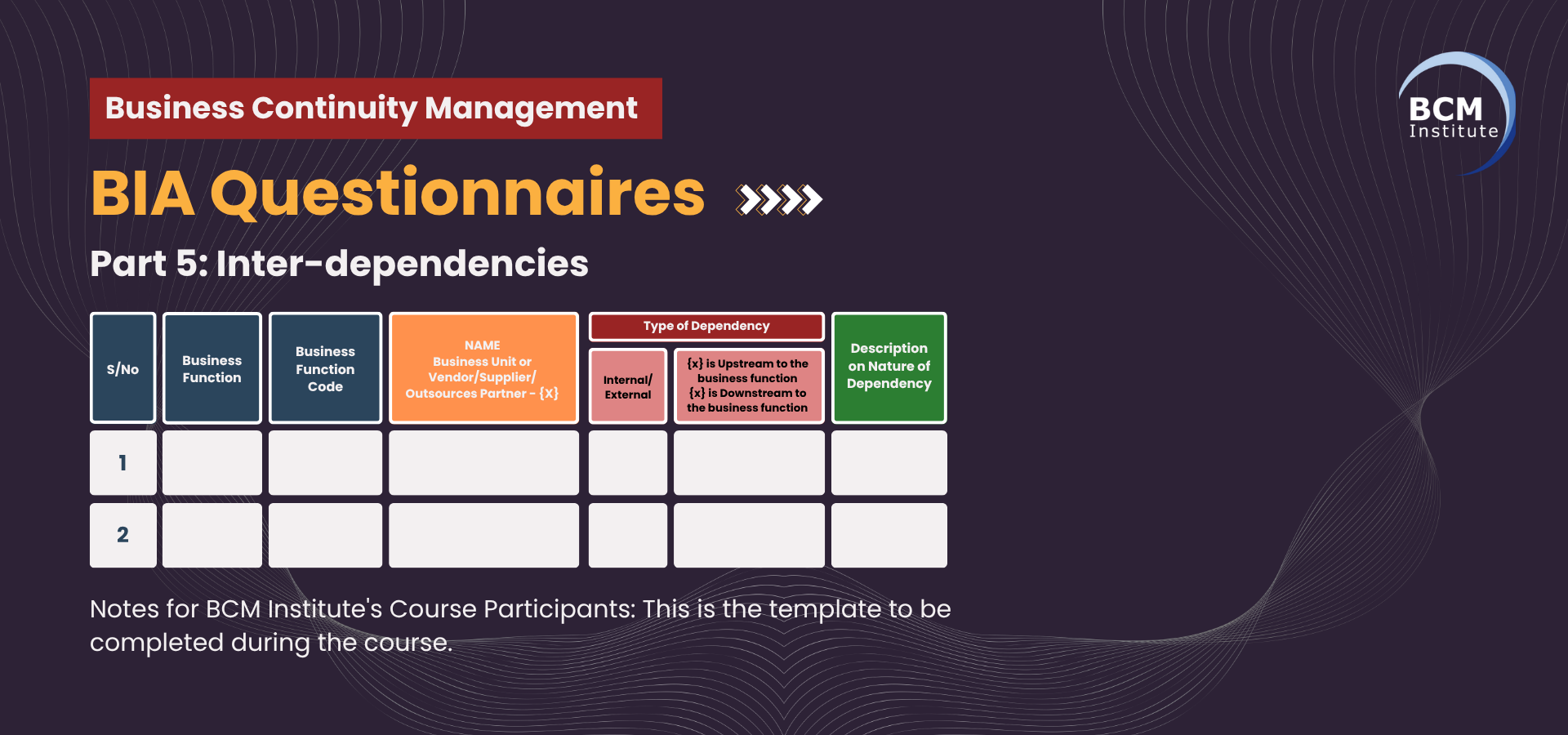
**Table BIA Part 5: Inter-dependencies for CBF-1 Personal Care and 24-Hour Supervision**
| **Sub-CBF Code** | **Sub-Critical Business Function** | **Business Unit / Vendor / Supplier / Outsourcing Partner** | **Internal Dependency** | **External Dependency** | **Dependency Direction (Upstream / Downstream / Mutual)** | **Description of the Nature of Dependency** |
| --- | --- | --- | --- | --- | --- | --- |
| **CBF-1.1** | **Admission and Care Needs Assessment** | **Ministry of Social and Family Development (MSF): referral and placement** | **No** | **Yes** | **Upstream** | **MSF provides the referral, placement approval and case documents for each prospective resident, including the social report and, where available, the referring hospital's medical and discharge summary. The dependency exists because JHA admits destitute persons on MSF's referral and must stay within the conditions of its licence. Pre-admission screening, bed allocation, risk assessment and the initial statement of care needs are all built on these documents. If MSF's case officers or referral systems are unavailable, urgent admissions stall, residents may arrive without a complete history, and the Home risks accepting someone whose needs it cannot safely meet.** |
| **CBF-1.2** | **Individual Care Planning and Review** | **Social Work and Case Management Unit** | **Yes** | **No** | **Mutual** | **Social workers supply each resident's social history, next-of-kin details, preferences, faith needs and case review outcomes; the care team returns the individual care plan, review findings and changes in condition. Care plans cannot be personalised without the social picture, and case reviews with MSF, families and hospitals cannot proceed without a current care plan. Care plan reviews, family conferences, discharge planning and advance care planning all depend on this two-way exchange. If either side is disrupted, plans fall out of date, reviews are postponed, and decisions on placement, hospital discharge or end-of-life care are made on incomplete information.** |
| **CBF-1.3** | **Care Workforce Rostering and Shift Deployment** | **Human Resources (Jamiyah Singapore shared HR service)** | **Yes** | **No** | **Upstream** | **HR provides the approved staffing establishment, staff records, leave and medical certificate data, work pass status for foreign care staff, training and competency records, and approval to engage relief or agency staff. Rostering depends on it because only staff who are employed, eligible to work and trained for the task can be deployed. Every shift's coverage, including the requirement for at least one medication-competent staff member on duty, relies on this information. If HR systems or approvals are unavailable during an outbreak or mass absence, the Home cannot quickly confirm who may work or bring in relief staff, and shifts risk falling below the safe minimum.** |
| **CBF-1.4** | **Activities of Daily Living Assistance** | **Outsourced laundry and linen service provider** | **No** | **Yes** | **Upstream** | **The contractor collects soiled linen and residents' clothing, and returns clean bed linen, towels, clothing and gowns on a fixed schedule. The dependency exists because the Home holds only a limited float of clean stock and cannot launder at volume on site. Bathing, dressing, toileting support and bed-making all draw on that supply every shift. If collections stop, clean stock can run out within one to two days; residents cannot be changed promptly, their dignity suffers, and soiled linen building up on site becomes an infection risk.** |
| **CBF-1.5** | **Continence Care and Skin Integrity Management** | **Medical and care consumables supplier** | **No** | **Yes** | **Upstream** | **The supplier delivers adult diapers and pads, wipes, barrier creams, wound dressings, disposable gloves and pressure-relieving cushions against standing orders. Continence and skin care consume these items at every change and repositioning, several times a day for each dependent resident, and there are few safe substitutes. Scheduled pad changes, two-hourly turning, wound dressing and skin checks all rely on stock being on the shelf. An interruption of more than a few days would force staff to ration changes, quickly leading to moisture-related skin damage, pressure injuries and urinary tract infections in frail residents.** |
| **CBF-1.6** | **Mobility, Transfer and Fall Prevention** | **Assistive and care equipment maintenance contractor** | **No** | **Yes** | **Upstream** | **The contractor inspects, services and repairs hoists, electric beds, bed rails, wheelchairs, shower chairs and bed- and chair-exit alarms, and supplies loan units when equipment is out of service. Safe transfer and fall prevention depend on this equipment being in working order and certified safe to use. Staff rely on it for every transfer of a non-ambulant resident and for overnight fall monitoring. If a hoist fails and is not repaired or replaced promptly, residents may be confined to bed or moved manually, raising the risk of falls and of injury to both residents and staff.** |
| **CBF-1.7** | **Feeding and Hydration Assistance** | **Kitchen and Food Services Unit** | **Yes** | **No** | **Mutual** | **The kitchen provides halal meals, texture-modified diets, thickened fluids and snacks at set times; care staff give the kitchen daily headcounts, diet orders, changes advised by doctors or speech therapists, and feedback on residents' intake. Feeding assistance is safe only if the right texture reaches the right resident, and the kitchen can prepare correctly only with current information from the floor. Mealtime assistance, fluid rounds and intake monitoring all depend on this continuous exchange. A break on either side risks choking, aspiration, dehydration and missed meals, especially for residents with swallowing difficulties or diabetes.** |
| **CBF-1.8** | **Medication Administration Support** | **Contracted pharmacy service provider** | **No** | **Yes** | **Upstream** | **The pharmacy dispenses prescribed medicines, often in resident-specific packs, supplies updated medication administration records, and provides pharmacist review and advice. The dependency exists because staff may give only what has been prescribed and dispensed. Every scheduled medication round, as-needed dose and stock reconciliation relies on accurate, timely supply. If deliveries are delayed or dispensing records are wrong, doses are missed or given in error, and residents with conditions such as diabetes, hypertension or epilepsy can deteriorate within hours.** |
| **CBF-1.9** | **Point-of-Care Infection Prevention and Control** | **Ministry of Health (MOH) and its public health authorities** | **No** | **Yes** | **Mutual** | **JHA, through its attending doctor and nursing staff, reports suspected outbreaks and notifiable diseases and shares case and contact information; MOH issues directives and outbreak guidance, arranges testing and vaccination support, and decides on restrictions to visits and admissions. Isolation, cohorting, PPE use and enhanced cleaning at the bedside are aligned to MOH requirements, while MOH relies on early, accurate reporting from homes to contain spread. If information is delayed in either direction, outbreaks are detected late, controls are applied inconsistently, and infection spreads among residents and staff and into the community.** |
| **CBF-1.10** | **Day and Night Supervision and Safety Rounds** | **Fire Safety Manager and in-house Emergency Response Team** | **Yes** | **No** | **Downstream** | **Supervision and safety rounds produce the live headcount, the location and mobility status of each resident, and reports of hazards such as blocked exits, faulty lighting or wet floors. The Fire Safety Manager and emergency response team rely on this output to plan and run evacuations, account for every resident when an alarm sounds and brief the Singapore Civil Defence Force (SCDF) on arrival. Fire drills, evacuation of bed-bound residents and hazard rectification all draw on it. If rounds are missed or records are not current, especially at night when staffing is lowest, the team may not know who is where or who needs assisted evacuation, with potentially fatal consequences.** |
| **CBF-1.11** | **Dementia and Behavioural Care, including Wandering Prevention** | **Door access control, wander-alert and CCTV system maintenance contractor** | **No** | **Yes** | **Upstream** | **The contractor maintains the magnetic door locks and keypads, which must release safely on a fire alarm, the wander-alert tags and sensors, and the CCTV covering exits and common areas, and responds to faults. Residents with dementia who are at risk of wandering are kept safe largely by these systems working alongside staff observation. Night rounds, exit monitoring and the rapid search for a missing resident all depend on the alerts and camera coverage. If the system fails, staff must be posted at exits, drawing carers away from other duties; if it fails unnoticed, a vulnerable resident may leave the premises undetected and come to serious harm.** |
| **CBF-1.12** | **Health Monitoring and Clinical Escalation** | **Visiting Medical Officer (contracted primary care provider)** | **No** | **Yes** | **Mutual** | **Care and nursing staff provide vital signs, observations and early warning of deterioration; the doctor provides assessment in person or by teleconsultation, medical orders, prescriptions and decisions on hospital transfer. Staff can monitor but cannot diagnose or prescribe, and the doctor can decide safely at a distance only with accurate observations from the floor. Routine monitoring, after-hours escalation and follow-up after hospital discharge all rely on this two-way flow. If the doctor cannot be reached, staff must call 995 for conditions that could have been managed in the Home, avoidable hospital admissions rise, and gradual deterioration may be missed.** |
| **CBF-1.13** | **Incident Reporting and Safeguarding** | **MSF as licensing authority under the Social Residential Homes Act 2025** | **No** | **Yes** | **Downstream** | **JHA submits notifications and reports of serious incidents, such as falls with injury, missing residents, allegations of abuse, outbreaks and unexpected deaths, in the form and within the timeframes MSF requires, followed by investigation reports. MSF depends on these reports to exercise regulatory oversight and protect residents across the sector, and the incident management requirements of the Code of Practice make timely reporting a condition of good standing. Incident logging, safeguarding referrals and family notification feed this output. If reporting channels or the staff who prepare reports are unavailable, notifications may be late or incomplete, exposing JHA to regulatory action and weakening safeguarding.** |
| **CBF-1.14** | **Shift Handover and Care Documentation** | **Superintendent's Office (compliance and quality)** | **Yes** | **No** | **Downstream** | **Handover notes, daily care records, turning and intake charts and incident logs form the evidence the Superintendent's Office uses to monitor quality, answer enquiries from families and agencies, prepare returns to MSF and demonstrate compliance with the Code of Practice. The dependency exists because care that is not recorded cannot be evidenced, audited or safely continued by the next shift. Quality reviews, licensing inspections and investigations all draw on these records. If documentation lapses during a disruption, for example when the electronic records system is down and no paper fallback is used, the audit trail is lost, continuity between shifts weakens, and compliance cannot be shown afterwards.** |
#### Reading the Table: What it Tells the Home
Taken together, the fourteen rows give the Board and the Superintendent six messages.
- **CBF-1 is delivered by JHA staff but resourced by a supply chain.** Nine of the fourteen primary dependencies are external, so supplier and partner continuity must be built into the CBF-1 plan.
- **Upstream supply is concentrated.** Laundry, consumables, pharmacy and equipment maintenance are each likely to rest on a single contract. For every one, the Home should confirm either an alternate source or a reserve stock that lasts beyond the Sub-CBF's MTPD, such as the seven-day medication reserve already set in the MBCO.
- **Mutual relationships need joint arrangements.** The kitchen, social work, the visiting doctor and MOH each rely on JHA as much as JHA relies on them. Contingency procedures for these relationships should be written and exercised together, not separately.
- **Downstream outputs carry regulatory and life-safety weight.** MSF notifications, evacuation information and compliance evidence must continue even when systems fail. Each needs a defined minimum dataset and a paper or offline fallback.
- **Some dependencies sit underneath almost every row.** Staff, electricity, water, telephones and the electronic care records system do not appear as primary dependencies in most rows, yet nearly all of them fail without these. Record them in the register as enabling dependencies and carry them into the resource requirements part of the BIA.
- **Group-level dependencies need agreed priority.** Where JHA relies on Jamiyah Singapore's shared services, the priority JHA will receive in a group-wide disruption should be agreed in advance and recorded in the plan.
#### Using Dependency Information in the BIA and Beyond
##### How dependency mapping supports the BIA
Dependency mapping turns the BIA from a statement of need into a test of capability. The earlier parts set the MBCO, RTO and MTPD for each Sub-CBF; this part shows what must work for those objectives to be met. Each primary dependency can now be checked against a simple rule: its own recovery capability must be at least as fast as the RTO of the Sub-CBF it supports. Where it is not, the BIA has found a gap that the continuity strategy must close. It also explains the shape of the impact curve: a consumables disruption harms no one on the first day, but the impact rises steeply once stock on the shelf is used up.
##### How understanding dependencies improves recovery planning
Recovery plans most often fail when they assume something will be available. A plan that says "continue medication rounds" is incomplete if it does not say where the medicines will come from when the usual delivery fails. Dependency information makes plans specific: it names the contact at each supplier, the reserve held, the alternate source, the manual workaround and the person who may authorise it. Internal dependencies benefit just as much: a paper diet list agreed between the kitchen and care staff, or a printed resident location board updated on every night round, keeps feeding and evacuation safe when the records system is down.
##### Why third-party dependencies belong in the Business Continuity Plan
JHA's accountability to residents and MSF does not change when a contractor performs a task. Therefore, write third-party dependencies into the CBF-1 plan with the same level of detail as internal arrangements. In practice, this means:
- classifying suppliers that support Tier 1 Sub-CBFs as critical, and recording this in the procurement register;
- including continuity obligations in contracts: priority supply during emergencies, notice of the supplier's own disruptions, minimum service levels and named emergency contacts;
- asking critical suppliers for evidence of their own continuity arrangements, and reviewing it at contract renewal;
- involving key partners, such as the pharmacy and the visiting doctor, in exercises; and
- holding pre-qualified alternates for the services where a single contract would otherwise be a single point of failure.
##### How dependency analysis supports supplier resilience, operational resilience and enterprise risk management
For **supplier resilience**, the table provides the basis for tiering suppliers by their effect on resident safety rather than by contract value. A modest consumables contract may matter more to residents than a far larger facilities contract, and procurement effort should follow that order.
For **operational resilience**, the mapping traces the end-to-end chain behind safe care and supervision. It allows the Home to test that chain against severe but plausible scenarios, such as a respiratory outbreak that coincides with staff shortages across the sector and a supplier warehouse closure, and to see where the chain breaks first.
For **enterprise risk management**, each significant dependency becomes a risk that Jamiyah Singapore can enter in its risk register, with an owner, controls, and a rating. This gives the Board oversight of the material risks the Code of Governance for Charities and IPCs (2023) expects, and links business continuity to the wider risk framework rather than treating it as a separate exercise.
##### How dependency information helps management prioritise recovery
During a major disruption, management cannot restore everything at once. Dependency information tells the incident management team what to restore first. A sensible order for CBF-1 is:
1. **Enabling dependencies:** safe minimum staffing, power to critical loads, water, telephones and access to critical resident information. Without these, no Sub-CBF can function.
2. **Upstream dependencies of Tier 1 Sub-CBFs:** medicines, the visiting doctor, consumables, meals and working transfer equipment, in order of their RTOs.
3. **Downstream obligations with fixed deadlines:** MSF notifications, next-of-kin communication and the resident location record for the fire safety team.
4. **Mutual relationships:** re-establish the agreed exchange with the kitchen, social work, and MOH so both sides operate from the same information.
5. **Remaining dependencies** needed to return from the MBCO to normal service.
In an outbreak where a third of care staff are absent and the consumables supplier's warehouse is shut, the map tells management at once: secure HR and agency approvals first, source consumables from the alternate supplier or another Jamiyah home within the MTPD, notify MOH, and meet MSF's reporting deadline. Without it, those decisions are made one at a time, under pressure, and possibly in the wrong order.
#### Implementation checklist
- Primary dependency confirmed with each of the fourteen Sub-CBF owners
- Internal or external classification and dependency direction agreed for each
- Secondary and enabling dependencies recorded in the dependency register
- Recovery capability of each primary dependency checked against the Sub-CBF's RTO
- Gaps recorded, with a reserve stock, alternate source or workaround proposed for each
- Critical suppliers flagged in the procurement register and continuity clauses reviewed
- Joint contingency procedures drafted for each mutual dependency
- Paper or offline fallbacks defined for each downstream output
- Priority for JHA agreed with Jamiyah Singapore's shared services
- Significant dependency risks entered in the risk register and reported to the Board
#### [](https://cta-redirect.hubspot.com/cta/redirect/3893111/117996e6-4a68-4449-880f-d8a48ff3071d)
CBF-1 is where JHA's duty of care is felt most directly by residents, and where the Home depends most heavily on others.
This part of the BIA identifies the primary internal and external dependencies behind each of the fourteen Sub-CBFs, classifies the direction of each relationship, and describes what is exchanged and what fails if the link breaks.
The result is a map the Board and the Superintendent can use to test recovery objectives, strengthen supplier arrangements, and set the recovery order. The next parts of the BIA build on this map to set out the minimum resources each Sub-CBF needs and the continuity strategies that will secure them.
[](https://cta-redirect.hubspot.com/cta/redirect/3893111/3aefb2d2-3110-47c1-ad4f-d3e6e5381066)
[](https://cta-redirect.hubspot.com/cta/redirect/3893111/45126cea-7fe9-4ffe-b72e-5e4451c0e271)
| **eBook 3: Starting Your BCM Implementation** | | | | | | |
| --- | --- | --- | --- | --- | --- | --- |
| **MBCO** | **P&S** | **RAR T1** | **RAR T2** | **RAR T3** | **BCS T1** | **CBF** |
| [](https://cta-redirect.hubspot.com/cta/redirect/3893111/3e0b35d2-08b6-4caf-b7db-144625ec8145) | [](https://cta-redirect.hubspot.com/cta/redirect/3893111/ab611654-bce2-450c-affc-3970de6c8909) | [](https://cta-redirect.hubspot.com/cta/redirect/3893111/806c27e6-1db5-42a2-ac84-e0df3624bc49) | [](https://cta-redirect.hubspot.com/cta/redirect/3893111/bf6da142-014d-4c47-83cf-f31e0c55b75e) | [](https://cta-redirect.hubspot.com/cta/redirect/3893111/4c14572c-2ed4-46aa-82c8-5ead8fd31ced) | [](https://cta-redirect.hubspot.com/cta/redirect/3893111/25548d11-adb7-4e6e-9a5a-054db2ea377d) | [](https://cta-redirect.hubspot.com/cta/redirect/3893111/94f8b16c-55da-4543-a948-448f2241296e) |
| **CBF-1 Strategic Procurement and Sourcing** | | | | | | |
| **DP** | **BIAQ P1** | **BIAQ P2** | **BIAQ P3** | **BIAQ P4** | **BIAQ P5** | **BIAQ P6** |
| **[](https://cta-redirect.hubspot.com/cta/redirect/3893111/b1b7c047-3a39-41d7-b2af-2b00d6f13590)** | **[](https://cta-redirect.hubspot.com/cta/redirect/3893111/ffed8b6e-4d2f-4066-a3ab-24aa0a28728b)** | **[](https://cta-redirect.hubspot.com/cta/redirect/3893111/70981a61-b605-4686-a3e5-de0275050496)** | **[](https://cta-redirect.hubspot.com/cta/redirect/3893111/bf3e01a8-f0da-43cc-abc1-d24397682927)** | **[](https://cta-redirect.hubspot.com/cta/redirect/3893111/98714bc9-8556-479e-894b-b67ccfc0f5b9)** | **[](https://cta-redirect.hubspot.com/cta/redirect/3893111/e1572772-84ee-4091-b436-62fb43179d00)** | **[](https://cta-redirect.hubspot.com/cta/redirect/3893111/4bcf60b1-2551-40ea-a780-6283033126cb)** |
| | | **BCS T2** | **BCS T3** | **PD** | | |
| | | **[](https://cta-redirect.hubspot.com/cta/redirect/3893111/1b2b0da8-76c7-4f9a-b2a6-4d4ae8648810)** | **[](https://cta-redirect.hubspot.com/cta/redirect/3893111/154f46c8-d8e4-4ace-89f4-5a6ff2c5abc9)** | **[](https://cta-redirect.hubspot.com/cta/redirect/3893111/b4e8c236-74a3-4226-9cae-52d2b6bf8868)** | | |
| | | | | | | |
#### More Information About Business Continuity Management Courses
To learn more about the course and schedule, click the buttons below for the BCM-300 Business Continuity Management Implementer \[BCM-3\] and the BCM-5000 Business Continuity Management Expert Implementer \[BCM-5\].
| [](https://cta-redirect.hubspot.com/cta/redirect/3893111/f3922b80-e96a-46d6-8993-dc150a5de2d5) | [](https://cta-redirect.hubspot.com/cta/redirect/3893111/9ff8a3dc-e39a-465b-929f-72e232cdd5fb) | [](https://cta-redirect.hubspot.com/cta/redirect/3893111/ac6cf073-4cdd-4541-91ed-889f731d5076) |
| --- | --- | --- |
| [](https://cta-redirect.hubspot.com/cta/redirect/3893111/21525c10-4003-4934-95fc-fe218174bc5b) | [](https://cta-redirect.hubspot.com/cta/redirect/3893111/46460171-c91a-4936-9bb2-8dc5928a0e02) | [](https://cta-redirect.hubspot.com/cta/redirect/3893111/1cb17ac7-50b2-4f88-bc4b-c7444e4b57b5) |
| [](https://cta-redirect.hubspot.com/cta/redirect/3893111/b3824ba1-7aa1-4eb6-bef8-94f57121c5ae) | Please feel free to send us a note if you have any questions. [](https://cta-redirect.hubspot.com/cta/redirect/3893111/3c53daeb-2836-4843-b0e0-645baee2ab9e) | [](https://cta-redirect.hubspot.com/cta/redirect/3893111/9c199ae8-c470-4bb7-9612-73c7a084e94c) |
| [](https://cta-redirect.hubspot.com/cta/redirect/3893111/8999211a-2c51-4be7-bf49-c393f6c67974) | [](https://cta-redirect.hubspot.com/cta/redirect/3893111/5c1aa95d-f6dd-4067-a95c-5cc0c32d7ed8) | [](https://cta-redirect.hubspot.com/cta/redirect/3893111/086ab3b9-4d66-4a95-b2f7-1148e9803a9c) |
**Comments**
### More Posts
[](https://cta-redirect.hubspot.com/cta/redirect/3893111/839787f4-a4fd-456f-accf-54c947026558)

All rights reserved. Copyright 2026
```json
{
"@context" : "https://schema.org",
"@type" : "BlogPosting",
"author" : {
"@type" : "Person",
"name" : "Dr Goh Moh Heng",
"url" : "https://blog.bcm-institute.org/ebook/author/dr-goh-moh-heng"
},
"dateModified" : "2026-10-21T03:05:53.445Z",
"datePublished" : "2026-10-21T03:05:53.000Z",
"headline" : "[BCM] [JHA] [E3] [BIA] [P5] [CBF] [1] Personal Care and 24-Hour Supervision",
"mainEntityOfPage" : {
"@id" : "https://blog.bcm-institute.org/ebook/bcm-jha-e3-bia-p5-cbf-1-personal-care-and-24-hour-supervision",
"@type" : "WebPage"
},
"publisher" : {
"@type" : "Organization",
"logo" : {
"@type" : "ImageObject",
"url" : "https://blog.bcm-institute.org/hubfs/BCMI%20Logo.png"
},
"name" : "BCMI Pte Ltd"
}
}
```