---
title: [BCM] [JHA] [E3] [BCS] [T1] Mitigation Strategies for the Jamiyah Home for the Aged
description: "How Jamiyah Home for the Aged rates and treats its key business continuity risks: existing controls, risk levels, residual risk and mitigation strategies."
---
.
[](http://www.bcm-institute.org/)
- [Home](https://www.bcm-institute.org/)
- [About Us](https://www.bcm-institute.org/about-us-3/)
- [A President’s Perspective](https://www.bcm-institute.org/about-us/a-presidents-perspective/)
- [Our History](https://www.bcm-institute.org/about-us/our-history/)
- [Our Advisory Council](https://www.bcm-institute.org/about-us/our-advisory-council/)
- [Customers’ Testimonials](https://www.bcm-institute.org/about-us/customers-testimonials/)
- [Credential Verification](https://www.bcm-institute.org/about-us/credential-verification/)
- [Courses](https://blog.bcm-institute.org/blog/course-fees-for-blended-learning-courses-master-catalog)
- [ISO 22301 Business Continuity Management System Audit](https://blog.bcm-institute.org/audit/business-continuity-management-audit-courses)
- [ISO 22301 Business Continuity Management](https://blog.bcm-institute.org/bcm/business-continuity-management-courses)
- [Crisis Communication](https://blog.bcm-institute.org/crisis-communication/crisis-communication-courses)
- [Crisis Management](https://blog.bcm-institute.org/en/crisis-management/courses)
- [IT Disaster Recovery](https://blog.bcm-institute.org/it-disaster-recovery/courses)
- [Operational Resilience](https://blog.bcm-institute.org/operational-resilience/courses)
- [Operational Resilience Audit](https://blog.bcm-institute.org/operational-resilience-audit/courses)
- [Certification](https://blog.bcm-institute.org/certification/types-of-certifications-offered)
- [ISO 22301 BCMS Audit Certification](https://blog.bcm-institute.org/certification/business-continuity-management-audit-certification)
- [ISO22301 Business Continuity Management Certification](https://blog.bcm-institute.org/bcm/business-continuity-management-certification)
- [Crisis Communication Certification](https://blog.bcm-institute.org/crisis-communication/crisis-communication-certification)
- [Crisis Management Certification](https://blog.bcm-institute.org/en/crisis-management/crisis-management-certification)
- [IT Disaster Recovery Planning Certification](https://blog.bcm-institute.org/it-disaster-recovery/it-disaster-recovery-certification)
- [Operational Resilience Certification](https://blog.bcm-institute.org/operational-resilience/operational-resilience-certification)
- [Operational Resilience Audit Certification](https://blog.bcm-institute.org/operational-resilience-audit)
- [Seminars](https://blog.bcm-institute.org/meet-the-expert/mte-webinar-mainpage)
- [Store](https://www.bcm-institute.org/store-2/)
- [Contact Us](http://www.bcm-institute.org/about-us/contact-us/)
-
-
##### Sustaining Community Services: Implementing BCM at Jamiyah Home for the Aged

# \[BCM\] \[JHA\] \[E3\] \[BCS\] \[T1\] Mitigation Strategies for the Jamiyah Home for the Aged
[](https://cta-redirect.hubspot.com/cta/redirect/3893111/1ce18ee1-97ef-4ed4-b16b-5d6ab24cec19)[](https://cta-redirect.hubspot.com/cta/redirect/3893111/2a5cf11e-a5b1-4a7d-aab1-f59bfd58cb5e)This chapter outlines how Jamiyah Home for the Aged (JHA) will address its most significant risks. It is Part 1 of the Business Continuity Strategy (BCS) and turns the Risk Assessment Report (RAR) into a set of practical, owned mitigation measures.
RAR Part 1 listed 70 credible threats to the Home. The risk assessment then asked how likely each threat is and how badly it would hurt residents, staff and the Home's standing.
This chapter takes the next step. For each significant threat, it records what is already in place, how serious the risk remains, how the Board has chosen to treat it, and what more should be done.
[](https://cta-redirect.hubspot.com/cta/redirect/3893111/fdc7087d-c996-4bf1-9dbb-59f7d2ba89c5)
[Dr Goh Moh Heng](https://blog.bcm-institute.org/ebook/author/dr-goh-moh-heng) Oct 21, 2026
###### Business Continuity Management Certified Planner-Specialist-Expert
#### [](https://cta-redirect.hubspot.com/cta/redirect/3893111/5cd5edea-eed4-45ec-99b3-824e5267fb21)[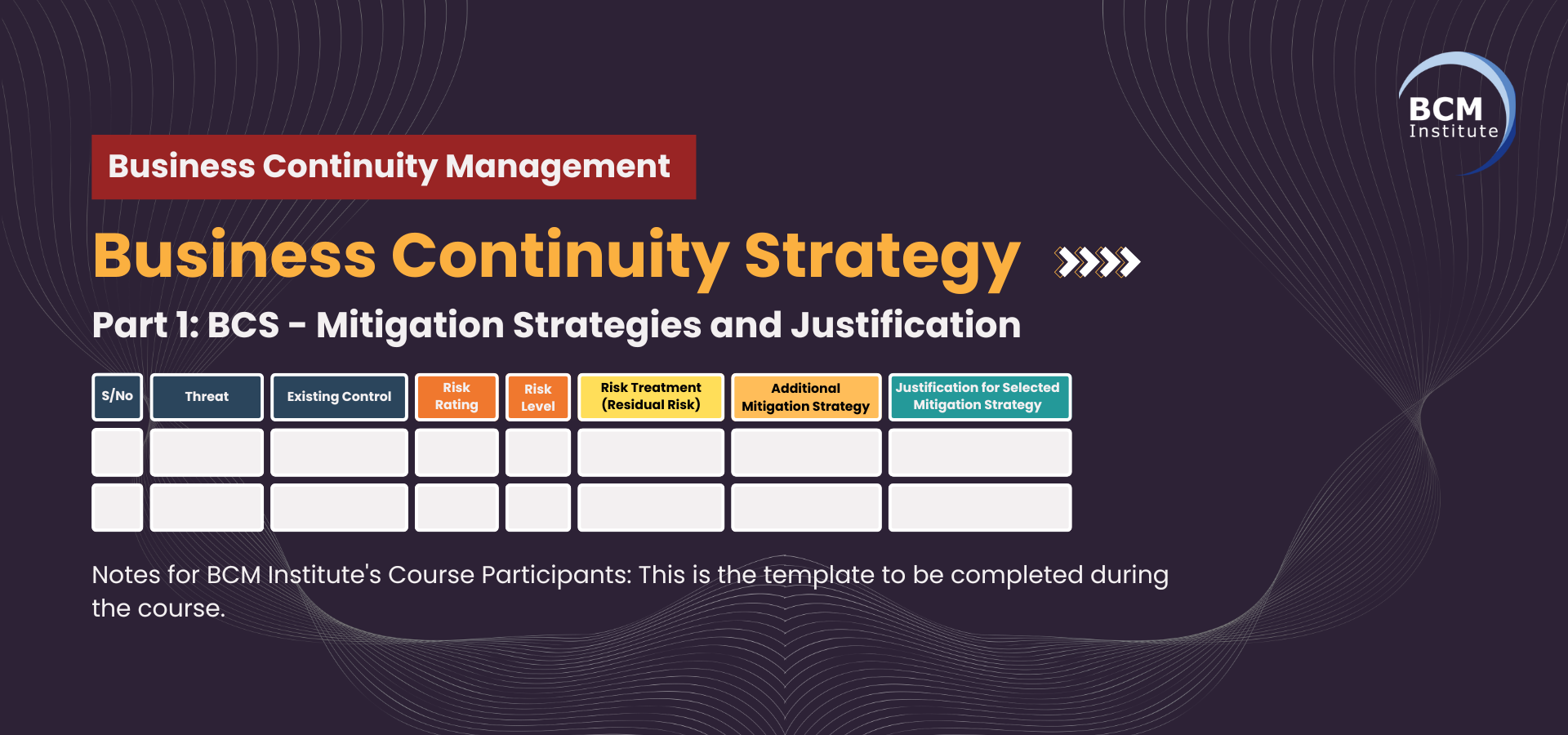](https://cta-redirect.hubspot.com/cta/redirect/3893111/db71ff66-a979-4fcc-8ce7-3866edc2b5ff)[](https://cta-redirect.hubspot.com/cta/redirect/3893111/fdc7087d-c996-4bf1-9dbb-59f7d2ba89c5)[](https://cta-redirect.hubspot.com/cta/redirect/3893111/0d2c5cc8-ed30-4545-b19a-49a3cb32e0e8)
#### Introduction
This chapter outlines how Jamiyah Home for the Aged (JHA) will address its most significant risks. It is Part 1 of the Business Continuity Strategy (BCS) and turns the Risk Assessment Report (RAR) into a set of practical, owned mitigation measures.
RAR Part 1 listed 70 credible threats to the Home. The risk assessment then asked how likely each threat is and how badly it would hurt residents, staff and the Home's standing.
This chapter takes the next step. For each significant threat, it records what is already in place, how serious the risk remains, how the Board has chosen to treat it, and what more should be done.
#### Why Mitigation Matters for JHA
JHA runs 24 hours a day for elderly, frail and largely destitute residents admitted through MSF. Many have limited mobility, chronic illness or cognitive impairment. They cannot leave when something goes wrong, and most have no family to take them in.
This makes prevention and preparation unusually valuable. A fire, an outbreak, or a lost caterer doesn't simply pause a service.
It falls on people who depend on the Home for every meal, every dose of medication, and safety every night. Mitigation reduces the chance of such events and limits the harm when they occur.
#### Where this Chapter Sits in the Standards
ISO 22301:2019 (as amended in 2024) requires JHA to identify and select business continuity strategies based on the outputs of its risk assessment and Business Impact Analysis (clause 8.3).
This includes reducing the likelihood of disruption, shortening its duration, and limiting its impact on prioritised activities. ISO 22313:2020 also provides guidance on choosing measures proportionate to the risk.
The Code of Governance for Charities and IPCs (2023) expects the Board to oversee the charity's key risks.
The Social Residential Homes Act 2025, in force since 1 July 2026, strengthens MSF's oversight of resident safety and wellbeing. A documented, Board-approved mitigation plan directly demonstrates that both duties are being met.
#### How Risk is Rated
Each risk is rated on two five-point scales. **Likelihood** runs from 1 (Rare) to 5 (Almost certain). **Impact** runs from 1 (Insignificant) to 5 (Catastrophic), based on the worst credible effect on resident safety, continuity of care, regulatory standing, finances, and reputation.
The **Risk Rating** is Likelihood multiplied by Impact, giving a score from 1 to 25.
The score sets the **Risk Level**:
| **Risk Level** | **Score** | **What it means for JHA** |
| --- | --- | --- |
| **Very High** | **20–25** | **Not tolerated. Immediate action by the Superintendent; reported to the Board without delay** |
| **High** | **10–16** | **Treatment required. Action plan with an owner and deadline; reviewed by the Board quarterly** |
| **Medium** | **5–9** | **Tolerable with active controls. Monitored by senior staff; reviewed annually** |
| **Low** | **1–4** | **Acceptable. Managed through routine procedures** |
The ratings in this chapter describe current risk, with existing controls taken into account. They are working ratings for discussion. The Superintendent and senior staff should confirm them in a facilitated workshop before the Board approves the chapter.
#### The Four Treatment Options
Every risk is given one treatment, sometimes supported by a second:
- **Reduce** — add controls that lower likelihood, impact or both. This is the main option for JHA's resident-safety risks.
- **Transfer** — share the financial consequence with another party, usually through insurance or contract terms. Accountability for residents stays with JHA.
- **Avoid** — stop or change the activity that creates the risk.
- **Accept** — tolerate the risk at its current level because further action would cost more than it saves. Acceptance must be a recorded Board decision, not a default.
[](https://cta-redirect.hubspot.com/cta/redirect/3893111/6c47a313-5da4-41b7-b904-e204dc433a41)
The treatment column shows the chosen option and the **residual risk**: the level expected once the additional measures are in place. For JHA, the Board's working appetite is that no risk to resident safety should remain above Medium after treatment.
### How to Read the Table
Table BCS-1 covers the 22 threats from RAR Part 1 with the greatest exposure for the Home, plus two low-rated threats to show how acceptance is recorded.
They are ordered by current risk rating, highest first.
The remaining threats in the register are rated Low or Medium and are covered by routine controls; they remain on the register for annual review.
Where JHA-specific information was not available, the existing controls describe what a welfare home of JHA's type would normally have under SCDF fire safety rules, MOH infection control guidance and MSF requirements.
These are assumptions. The Superintendent should confirm each one, since a control that does not exist cannot reduce risk.
#### Mitigation Strategies for Jamiyah Home for the Aged
Sixteen of the 24 threats below are rated High today; after the additional measures, all fall to Medium or Low. Ratings are L (likelihood) × I (impact), as defined in the Introduction.
Table BCS-1: Mitigation Strategies for Jamiyah Home for the Aged
| Threat | Existing Controls | Risk Rating | Risk Level | Risk Treatment (Residual Risk) | Additional Mitigation Strategy | Justification for Selected Mitigation Strategy |
| --- | --- | --- | --- | --- | --- | --- |
| Infectious disease outbreak within the Home | MOH infection prevention and control guidelines; annual influenza and COVID-19 vaccination; hand hygiene and PPE; isolation room; outbreak notification to MOH and MSF | L4 × I4 = 16 | High | Reduce — Residual: Medium (L3 × I3 = 9) | Written outbreak plan with ward cohorting and zoning; four-week PPE and disinfectant stock; trained infection control lead and deputy; surge staffing list with Jamiyah Nursing Home and approved agencies; annual tabletop exercise | Outbreaks are common in shared living, and frail residents face severe outcomes. Cohorting and surge staff limit spread and keep care safe while staff are off sick. Likelihood cannot be cut sharply, so the gain comes mainly from lower impact. |
| High staff turnover and skills shortage | Recruitment through Jamiyah Singapore HR; overtime and agency staff; induction training; foreign worker recruitment channels | L4 × I4 = 16 | High | Reduce — Residual: Medium (L3 × I3 = 9) | Minimum safe staffing level per shift approved by the Board; standing agreements with two care agencies; retention measures (career ladder, recognition, wellbeing support); cross-training of care staff in medication rounds and dementia care; exit interviews to track causes | Care cannot be deferred or automated, so staff shortage is JHA's most direct threat to continuity. A defined safe minimum gives a clear trigger for escalation. Two agency agreements reduce reliance on a single cover source. |
| Fire | Fire alarm and detection system; fire extinguishers and hose reels; fire certificate and SCDF-compliant evacuation plan; fire drills; no-smoking policy; annual electrical inspection | L3 × I5 = 15 | High | Reduce and Transfer — Residual: Medium (L2 × I4 = 8) | Personal emergency evacuation plan for each resident by mobility; progressive horizontal evacuation to protected compartments; evacuation sledges for bedbound residents; night-shift drills twice a year; oxygen and battery-charging rules; relocation agreement with Jamiyah Nursing Home and another MSF home; property and business interruption insurance reviewed | Fire is the most likely threat to cause deaths because residents cannot evacuate themselves. Night shifts have the fewest staff, so drills must test them. Insurance funds rebuilding but cannot protect residents, so it supports rather than replaces reduction. |
| Pandemic and epidemic | National public health orders; MOH guidance for residential care; COVID-19 era experience and procedures; basic PPE stock | L3 × I5 = 15 | High | Reduce — Residual: Medium (L3 × I3 = 9) | Pandemic plan with staged triggers aligned to DORSCON levels; split teams and staggered shifts; on-site lodging option for staff; virtual visiting for families; regular contact with MSF and MOH liaison officers; PPE stockpile rotated to avoid expiry | A pandemic brings long staff absence and high resident risk at the same time. Lessons from 2020 to 2022 show split teams and early triggers keep the Home staffed. Likelihood is outside JHA's control, so planning focuses on impact. |
| Loss of key personnel | Organisation chart; some duties shared with Jamiyah Singapore; informal cover arrangements | L3 × I4 = 12 | High | Reduce — Residual: Medium (L2 × I3 = 6) | Named and trained deputy for the Superintendent, senior nurse, finance and ICT contacts; written delegation of authority approved by the Board; desk procedures for key regulatory returns to MSF; succession plan reviewed annually | Decisions and MSF reporting stall when only one person knows how. Deputies and written procedures are low-cost and remove the single point of failure. |
| Utility and power failure | SP Group supply; standby generator (to be confirmed); emergency lighting; manual handling procedures; water storage tanks | L3 × I4 = 12 | High | Reduce — Residual: Medium (L2 × I3 = 6) | Confirm generator covers lifts, nurse-call, medicine fridges and essential sockets; monthly load test and logged results; diesel supply agreement for 72 hours; battery back-up for oxygen concentrators and spare oxygen cylinders; manual nurse-call (hand bells) and torches per ward | Pressure-relief mattresses, oxygen and medicine fridges fail within hours. A tested generator and on-site oxygen cylinders protect residents most dependent on power at modest cost. |
| Catering and food supplier failure | Contracted halal caterer or in-house kitchen; food hygiene licence; menus for therapeutic diets | L3 × I4 = 12 | High | Reduce — Residual: Medium (L2 × I3 = 6) | Pre-qualified second halal caterer able to supply within 24 hours; three-day emergency food store including texture-modified and diabetic options; contract clauses requiring notice of service failure; quarterly supplier review | Residents need three meals daily, so failure is felt within hours. A standby caterer and short-term stock bridge the gap while a replacement is arranged. |
| Medication and medical supply disruption | Contracted pharmacy service; medication administration records; monthly stock checks | L3 × I4 = 12 | High | Reduce — Residual: Medium (L2 × I3 = 6) | Seven-day buffer of chronic medications and continence and wound-care supplies; secondary pharmacy arrangement; list of critical medicines with substitutes agreed by the visiting doctor; paper medication charts kept current | Missed chronic medication harms residents within days. A one-week buffer and a second pharmacy cover most supplier failures and recalls. |
| Ransomware | Antivirus software; managed ICT support via Jamiyah Singapore; staff passwords | L3 × I4 = 12 | High | Reduce and Transfer — Residual: Medium (L2 × I3 = 6) | Multi-factor authentication on all accounts; prompt patching; offline or immutable backups; paper downtime forms for care and medication; cyber incident response plan with the managing agent; cyber insurance | Ransomware can lock care records and medication charts at once. Downtime forms keep care going, while backups allow recovery. Insurance meets response costs, which a charity would struggle to absorb. |
| Data breach | PDPA policy; Data Protection Officer at Jamiyah Singapore; locked filing cabinets; access controls on systems | L3 × I4 = 12 | High | Reduce — Residual: Medium (L2 × I3 = 6) | Role-based access review every six months; encryption of laptops and portable media; breach response procedure meeting the three-day PDPC notification timeline; annual data protection training; vendor data clauses | Resident health and financial data is sensitive, and breaches damage donor trust. Clear procedures help JHA meet notification duties and limit harm. |
| Backup failure | Backups taken by managing agent (frequency to be confirmed) | L3 × I4 = 12 | High | Reduce — Residual: Medium (L2 × I3 = 6) | Documented backup schedule for each system; one copy offline or off-site; quarterly restore test with results reported to the Superintendent | Untested backups often fail when needed, turning a short outage into permanent loss. Restore tests are cheap and give proof that recovery works. |
| Malware, phishing and business email compromise | Email filtering; antivirus; finance approval limits | L4 × I3 = 12 | High | Reduce — Residual: Medium (L3 × I2 = 6) | Phishing awareness training twice a year; call-back verification before any change to vendor bank details; two-person approval for payments; monitoring for fake appeals using JHA's name | Phishing is the most common route to fraud. Call-back checks stop the most costly attack, false bank detail changes, at almost no cost. |
| Extreme heat | Air-conditioning in parts of the Home; fans; fluid charts for residents | L4 × I3 = 12 | High | Reduce — Residual: Medium (L3 × I2 = 6) | Heat-response protocol triggered by NEA heat stress advisories; extra fluid rounds and heat illness checks; cooled rest area on each floor; air-conditioning servicing before hot months; rest breaks for staff doing physical care | Elderly residents are highly susceptible to heat illness, and hot spells are increasing. A trigger-based protocol is simple, low-cost and acts before harm occurs. |
| Care and safety equipment failure | Maintenance contracts for lifts, fire alarm and nurse-call; equipment register; manual workarounds | L4 × I3 = 12 | High | Reduce — Residual: Medium (L3 × I2 = 6) | Preventive maintenance schedule with response-time terms; spare hoist slings, mattresses and handsets; fault-reporting log reviewed weekly; manual procedures when lifts or nurse-call fail | Equipment failure directly affects resident safety and dignity. Spares and maintenance terms shorten downtime; manual procedures keep care going in the meantime. |
| Regulatory and funding change | MSF funding agreement; Jamiyah Singapore finance oversight; compliance monitoring | L3 × I4 = 12 | High | Reduce — Residual: Medium (L2 × I3 = 6) | SRHA compliance checklist with gaps tracked to closure; named regulatory liaison; reserves policy covering at least three months' operating costs; diversified donor income; Board briefing on regulatory changes each quarter | The new SRHA regime brings fresh obligations, and funding delays would hit staffing. Early compliance work and reserves give the Home time to adapt. |
| Active assailant or intruder | Controlled entry; visitor registration; CCTV; police contact numbers | L2 × I5 = 10 | High | Reduce — Residual: Medium (L1 × I5 = 5) | Lockdown procedure and staff training; panic buttons at reception and nurse stations; visitor policy enforced at all hours; annual review with the Neighbourhood Police Centre | Residents cannot move away from danger, so impact stays high. Prevention at the entrance and a rehearsed lockdown lower likelihood, which is the only practical lever. |
| Transboundary haze | NEA air quality monitoring; indoor activities; N95 masks for staff | L3 × I3 = 9 | Medium | Reduce — Residual: Medium (L3 × I2 = 6) | Haze plan triggered by PSI levels; air purifiers in each ward and common area; window sealing where feasible; review of residents with heart and lung conditions | Haze recurs and harms residents with respiratory illness. Purifiers and a clear trigger are inexpensive and well-tested in Singapore care settings. |
| Flood and flash flood | Building drainage; PUB flood alerts; sandbags (to be confirmed) | L3 × I3 = 9 | Medium | Reduce — Residual: Medium (L2 × I3 = 6) | Flood barriers for ground-floor entrances, kitchen and switch room; relocate critical stores and records above ground level; subscription to PUB flood alerts by the duty manager | Flash floods are frequent and short. Raising critical items and barriers protects the kitchen and power supply at modest one-off cost. |
| Workplace violence | Behaviour care plans; incident reporting; staff training in de-escalation | L3 × I3 = 9 | Medium | Reduce — Residual: Medium (L2 × I3 = 6) | Dementia and de-escalation refresher training; risk assessment for residents with aggressive behaviour; post-incident debrief and staff support; links with psychogeriatric services | Aggression harms staff and residents and adds to turnover. Training and early assessment prevent incidents rather than respond to them. |
| Telecommunications provider failure | Fixed lines and staff mobile phones | L3 × I3 = 9 | Medium | Reduce — Residual: Low (L2 × I2 = 4) | Second carrier for mobile or broadband; printed contact list of families, hospitals, MSF and on-call managers; walkie-talkies for internal coordination | Losing contact with emergency services and families is serious but cheap to avoid. A second carrier and printed lists remove most of the exposure. |
| Outsourcing and shared services failure | Service arrangements with Jamiyah Singapore; outsourced cleaning, laundry and security contracts | L2 × I4 = 8 | Medium | Reduce — Residual: Medium (L2 × I3 = 6) | Service level agreement with Jamiyah Singapore covering payroll, HR, finance and ICT; continuity requirements in vendor contracts; manual payroll fallback; list of alternative vendors | Problems at the managing agent pass straight to JHA. A written agreement sets clear expectations and recovery priorities across Jamiyah's services. |
| Insider threat | Staff screening; resident money handled with receipts; controlled drug register | L2 × I4 = 8 | Medium | Reduce — Residual: Low (L1 × I4 = 4) | Two-person rule for residents' money and controlled drugs; monthly reconciliation by a manager; whistle-blowing channel; prompt removal of system access for leavers | Theft from residents causes direct harm and serious reputational damage. Segregation of duties is a standard, low-cost control expected by the Commissioner of Charities. |
| Public transport disruption | Staff live in varied locations; shift handover procedures | L3 × I2 = 6 | Medium | Accept — Residual: Medium (L3 × I2 = 6) | No new measure. Keep the staff call-out list current and allow the outgoing shift to extend when needed | Disruptions are usually short, and current handover practice already covers them. Further spending would bring little benefit. |
| Earthquake tremors | Building compliant with structural codes; evacuation plan | L1 × I3 = 3 | Low | Accept — Residual: Low (L1 × I3 = 3) | No new measure. Include post-tremor building check in the evacuation plan | Damaging tremors are very rare in Singapore. Existing evacuation arrangements are sufficient; the risk stays on the register for review. |
[](https://cta-redirect.hubspot.com/cta/redirect/3893111/c2542a7f-6d92-4371-93ba-348e87d8c1ce)Table BCS-1 reduces every High risk at JHA to Medium or Low, mainly through low-cost measures the Home can implement within a year. It gives the Board a clear, defensible record of how the Home will manage its most serious risks.
### What the table shows
Three patterns stand out. First, **people are the core exposure**. Staff shortage, outbreaks, pandemics and the loss of key personnel all attack the one resource residential care cannot do without. Safe staffing levels, agency agreements and trained deputies therefore carry the most weight in this plan.
Second, **resident vulnerability keeps impact high**. For fire, intrusion and power failure, JHA cannot make the consequence small, because residents cannot protect themselves. The plan instead lowers likelihood and shortens the time residents are exposed, through drills, evacuation aids, generators and lockdown procedures.
Third, **most measures are modest in cost**. Call-back checks, restore tests, printed contact lists, written deputies and supplier buffers cost little but remove single points of failure. Larger outlays, such as evacuation equipment, air purifiers and insurance, are targeted at the risks where harm to residents would be greatest.
### Priorities for the Board and the Superintendent
1. **Confirm the existing controls.** Several are assumptions. The Superintendent should verify each one, starting with the generator, backups and fire evacuation arrangements.
2. **Validate the ratings.** Hold a short workshop with senior staff to confirm likelihood and impact scores, and reconcile them with RAR Part 2.
3. **Approve the treatment decisions.** The Board should formally approve each treatment, including the two risks accepted, and the appetite that no resident-safety risk remains above Medium.
4. **Assign owners and dates.** Each additional measure needs a named owner, a budget line and a target date, tracked in the risk register.
5. **Act first on the five resident-critical risks.** Address fire, infectious disease outbreaks, staffing, power failure, and medication supply within the next six months.
### Keeping the Strategy Alive
Mitigation is not a one-time exercise. Review residual risks at least once a year, and after any significant incident, change of supplier, change of premises, or new regulatory requirement under the SRHA. Exercises and audits should test whether the measures work in practice, not only on paper.
Mitigation reduces how often disruption occurs and how hard it hits, but it cannot prevent every incident. The next parts of the Business Continuity Strategy will set out how JHA continues and recovers its critical functions when disruption does happen: alternative premises, staff arrangements, manual workarounds and recovery of systems and records. Together with this chapter, they will give the Board confidence that the Home can keep its residents safe and cared for, whatever comes.
#### Sources
- RAR Part 1: List of Threats for Jamiyah Home for the Aged (companion chapter in this series) — threat names and organisation-level relevance
- [Jamiyah Home for the Aged – home page](https://jha.jamiyah.org.sg/) — history, location and 24-hour operation
- Methodology reference: BCMpedia, *Part 1: Mitigation Strategies v2* (column structure)
Risk ratings and existing controls should be reconciled with RAR Part 2 (Treatment and Control) before Board approval.
#### **Comments**
### More Posts
[](https://cta-redirect.hubspot.com/cta/redirect/3893111/839787f4-a4fd-456f-accf-54c947026558)

All rights reserved. Copyright 2026
```json
{
"@context" : "https://schema.org",
"@type" : "BlogPosting",
"author" : {
"@type" : "Person",
"name" : "Dr Goh Moh Heng",
"url" : "https://blog.bcm-institute.org/ebook/author/dr-goh-moh-heng"
},
"dateModified" : "2026-10-21T11:49:34.472Z",
"datePublished" : "2026-10-21T11:49:34.000Z",
"headline" : "[BCM] [JHA] [E3] [BCS] [T1] Mitigation Strategies for the Jamiyah Home for the Aged",
"mainEntityOfPage" : {
"@id" : "https://blog.bcm-institute.org/ebook/bcm-jha-e3-bcs-t1-mitigation-strategies-for-the-jamiyah-home-for-the-aged",
"@type" : "WebPage"
},
"publisher" : {
"@type" : "Organization",
"logo" : {
"@type" : "ImageObject",
"url" : "https://blog.bcm-institute.org/hubfs/BCMI%20Logo.png"
},
"name" : "BCMI Pte Ltd"
}
}
```