---
title: [BCM] [JHA] [E3] [BCS] [P3] [CBF] [1] Personal Care and 24-Hour Supervision
description: Minimum people, workspace, ICT, communications and supplies Jamiyah Home for the Aged needs to hold the MBCO for CBF-1 personal care and 24-hour supervision.
image: https://blog.bcm-institute.org/hubfs/Jamiyah%20Singapore%20Graphic%20Folder/JS%20BCM%20CBF%201%20Morepost/%5BBCM%5D%20%5BJS%5D%20%5BE3%5D%20%5BBCS%5D%20%5BT3%5D%20%5BCBF%5D%20%5B1%5D%20Residential%20Care%20and%20Resident%20Safety.jpg
---
.
[](http://www.bcm-institute.org/)
- [Home](https://www.bcm-institute.org/)
- [About Us](https://www.bcm-institute.org/about-us-3/)
- [A President’s Perspective](https://www.bcm-institute.org/about-us/a-presidents-perspective/)
- [Our History](https://www.bcm-institute.org/about-us/our-history/)
- [Our Advisory Council](https://www.bcm-institute.org/about-us/our-advisory-council/)
- [Customers’ Testimonials](https://www.bcm-institute.org/about-us/customers-testimonials/)
- [Credential Verification](https://www.bcm-institute.org/about-us/credential-verification/)
- [Courses](https://blog.bcm-institute.org/blog/course-fees-for-blended-learning-courses-master-catalog)
- [ISO 22301 Business Continuity Management System Audit](https://blog.bcm-institute.org/audit/business-continuity-management-audit-courses)
- [ISO 22301 Business Continuity Management](https://blog.bcm-institute.org/bcm/business-continuity-management-courses)
- [Crisis Communication](https://blog.bcm-institute.org/crisis-communication/crisis-communication-courses)
- [Crisis Management](https://blog.bcm-institute.org/en/crisis-management/courses)
- [IT Disaster Recovery](https://blog.bcm-institute.org/it-disaster-recovery/courses)
- [Operational Resilience](https://blog.bcm-institute.org/operational-resilience/courses)
- [Operational Resilience Audit](https://blog.bcm-institute.org/operational-resilience-audit/courses)
- [Certification](https://blog.bcm-institute.org/certification/types-of-certifications-offered)
- [ISO 22301 BCMS Audit Certification](https://blog.bcm-institute.org/certification/business-continuity-management-audit-certification)
- [ISO22301 Business Continuity Management Certification](https://blog.bcm-institute.org/bcm/business-continuity-management-certification)
- [Crisis Communication Certification](https://blog.bcm-institute.org/crisis-communication/crisis-communication-certification)
- [Crisis Management Certification](https://blog.bcm-institute.org/en/crisis-management/crisis-management-certification)
- [IT Disaster Recovery Planning Certification](https://blog.bcm-institute.org/it-disaster-recovery/it-disaster-recovery-certification)
- [Operational Resilience Certification](https://blog.bcm-institute.org/operational-resilience/operational-resilience-certification)
- [Operational Resilience Audit Certification](https://blog.bcm-institute.org/operational-resilience-audit)
- [Seminars](https://blog.bcm-institute.org/meet-the-expert/mte-webinar-mainpage)
- [Store](https://www.bcm-institute.org/store-2/)
- [Contact Us](http://www.bcm-institute.org/about-us/contact-us/)
-
-
##### Sustaining Community Services: Implementing BCM at Jamiyah Home for the Aged

# \[BCM\] \[JHA\] \[E3\] \[BCS\] \[P3\] \[CBF\] \[1\] Personal Care and 24-Hour Supervision
[](https://cta-redirect.hubspot.com/cta/redirect/3893111/5cd5edea-eed4-45ec-99b3-824e5267fb21)This chapter answers a practical question every continuity plan must eventually face: when a disruption strikes Jamiyah Home for the Aged (JHA), what is the smallest set of people, places, equipment, and information needed to keep every resident safe, supervised, and cared for?
It applies that question to CBF-1 Personal Care and 24-Hour Supervision, the function closest to residents and the one the Home's Business Impact Analysis (BIA) has placed in Tier 1.
Its Business Unit Minimum Business Continuity Objective (MBCO) is to account for and supervise every resident at all times and deliver essential care as planned. Its Recovery Time Objective (RTO) is continuous, and its Maximum Tolerable Period of Disruption (MTPD) is one hour.
By the end of this chapter, readers will be able to:
- explain why continuity planning is built on minimum, not normal, resources;
- trace the line from the BIA, through the recovery strategy, to a resource list;
- read and maintain the minimum resource table for the fourteen sub-functions of CBF-1; and
- use the table to fund, stock, train and exercise the Home's continuity arrangements.
[](https://cta-redirect.hubspot.com/cta/redirect/3893111/0d2c5cc8-ed30-4545-b19a-49a3cb32e0e8)
[Dr Goh Moh Heng](https://blog.bcm-institute.org/ebook/author/dr-goh-moh-heng) Oct 21, 2026
###### Business Continuity Management Certified Planner-Specialist-Expert
[](https://cta-redirect.hubspot.com/cta/redirect/3893111/5cd5edea-eed4-45ec-99b3-824e5267fb21)
### [](https://cta-redirect.hubspot.com/cta/redirect/3893111/0d2c5cc8-ed30-4545-b19a-49a3cb32e0e8)
### [](https://cta-redirect.hubspot.com/cta/redirect/3893111/2473a6fd-c3f8-42a1-9622-442761ec98fe)
### [](https://cta-redirect.hubspot.com/cta/redirect/3893111/8969ce47-38c2-4b89-88da-727979f12c39)
### Minimum Resources Required During a Disaster for CBF-1 Personal Care and 24-Hour Supervision
#### About This Chapter
This chapter answers a practical question every continuity plan must eventually face: when a disruption strikes Jamiyah Home for the Aged (JHA), what is the smallest set of people, places, equipment, and information that will still keep every resident safe, supervised, and cared for?
It applies that question to CBF-1 Personal Care and 24-Hour Supervision, the function closest to residents and the one the Home's Business Impact Analysis (BIA) has placed in Tier 1.
Its Business Unit Minimum Business Continuity Objective (MBCO) is to account for and supervise every resident at all times and deliver essential care as planned. Its Recovery Time Objective (RTO) is continuous, and its Maximum Tolerable Period of Disruption (MTPD) is one hour.
By the end of this chapter, readers will be able to:
- explain why continuity planning is built on minimum, not normal, resources;
- trace the line from the BIA, through the recovery strategy, to a resource list;
- read and maintain the minimum resource table for the fourteen sub-functions of CBF-1; and
- use the table to fund, stock, train and exercise the Home's continuity arrangements.
#### Why Identify Minimum Recovery Resources
A business continuity strategy is only a promise until it is resourced. The Board can approve an MBCO and an RTO, but on the night of a power failure or the first week of an outbreak, what protects residents is whether the right number of trained staff are on the floor, whether the hoist batteries are charged, and whether there are enough continence products and gloves to last until supplies return.
Identifying minimum recovery resources converts the BIA's conclusions into a list the Home can check, buy, store and test. ISO 22301 requires an organisation to determine the resources its prioritised activities depend on as part of the BIA (clause 8.2.2) and then to determine the resource requirements of the continuity solutions it selects (clause 8.3.4). ISO 22313 adds that resources should be considered across people, information, premises, equipment and consumables, ICT, transport, finance and suppliers.
For JHA the obligation is also regulatory. The Social Residential Homes Act 2025, in operation since 1 July 2026, aims to ensure the continuity of residential accommodation and care for residents of licensed homes.
MSF will expect the Home to show not only that it has a plan, but that it has the resources to back it up.
#### How Resource Planning Supports the Business Continuity Plan
The Business Continuity Plan (BCP) tells responders what to do. The minimum resource table tells them what they will use to do it. In practice, the table serves four purposes:
- **Readiness.** It is the stock list for emergency stores, the specification for equipment purchases and the training matrix for multi-skilled staff.
- **Activation.** During an incident, the nurse-in-charge and the duty manager compare what is available against the minimum and can immediately tell whether the MBCO can be held.
- **Decision-making.** When resources fall below the minimum, the gap triggers escalation: mutual aid from other Jamiyah facilities, agency staff, emergency purchasing or, as a last resort, relocation.
- **Assurance.** It gives the Board, auditors, and MSF reviewers an evidence base to judge whether the Home's continuity commitments are credible.
#### From BIA to Recovery Strategy to Resource Requirements
The three are links in one chain. The BIA establishes what must continue and how quickly: the MBCO, RTO and MTPD for each function.
The recovery strategy decides how to achieve this: for CBF-1, the selected strategy is to shelter in place, consolidate care into fewer zones, prioritise essential care over routine activity, deploy multi-skilled staff flexibly, and fall back to paper when systems fail.
Relocation to an alternate care site is the contingency if the premises become unsafe.
Only once the strategy is chosen can you count resources, because each strategy has its own requirements.
Sheltering in place during a power failure needs battery-operated hoists, torches and static mattress overlays. Consolidating care zones needs radios so that fewer staff can cover a wider area.
Paper fallback needs current printed care summaries and medication records. The resource table below is therefore a direct product of the earlier BIA and strategy chapters, and must be revised whenever either changes.
#### Plan for the Minimum, Not the Normal
The resources recorded here describe what is needed to hold the MBCO, not to run a normal day. This distinction matters for three reasons.
First, it is honest. During a major disruption, JHA will not have its full workforce, its usual suppliers or every system working. A plan built on normal resources will fail when it is needed most.
Second, it is affordable. Every item in the table must be bought, stored, maintained, rotated or trained for. Stockpiling to normal levels would tie up funds that a charity must account for to donors, MSF and the Commissioner of Charities.
Third, it sharpens priorities. Asking "what is the least we need?" forces the Home to decide in advance which tasks continue, which are reduced, and which pause.
Full showers can become bed baths; scheduled care-plan reviews can wait; group activities can stop. Supervision, continence care, safe transfers, feeding assistance and medication cannot.
#### Optimising Scarce Resources in a Disaster
The pressures on a welfare home rise and fall together.
An infectious disease outbreak increases care needs, requires isolation and extra PPE, and removes sick and quarantined staff from the roster at the same time. A prolonged power failure disables powered mattresses, lifts and lighting just as residents need more help.
The table is therefore built on four optimisation principles:
1. **Share before you add.** Share seats, phones, and laptops across sub-functions wherever the work is not simultaneous.
2. **Multi-skill the workforce.** Care staff assigned to activities of daily living also deliver continence care, transfers and feeding assistance. Staff numbers in the table show where each person is primarily deployed, not separate headcounts.
3. **Prefer low-dependency resources.** Paper records, battery equipment and two-way radios keep working when electricity, networks and systems do not.
4. **Size consumables to a defined endurance.** Set stock levels to last 14 days, matching the PPE endurance in the Corporate MBCO and allowing time for supply chains to recover.
##### Planning Assumptions
The quantities that follow are illustrative starting points to be validated in BIA and strategy workshops. They assume:
- a resident census of about 100, with care consolidated into three care zones during a disruption;
- two 12-hour shifts a day;
- a safe minimum on-site complement of 2 nurses and 10 care staff by day, and 1 nurse and 6 care staff by night;
- consumables sized for 14 days at reduced but safe usage; and
- CBF-2 delivers utilities, kitchen, medication supply, records systems, and MSF reporting to CBF-12, with only point-of-care resources recorded here.
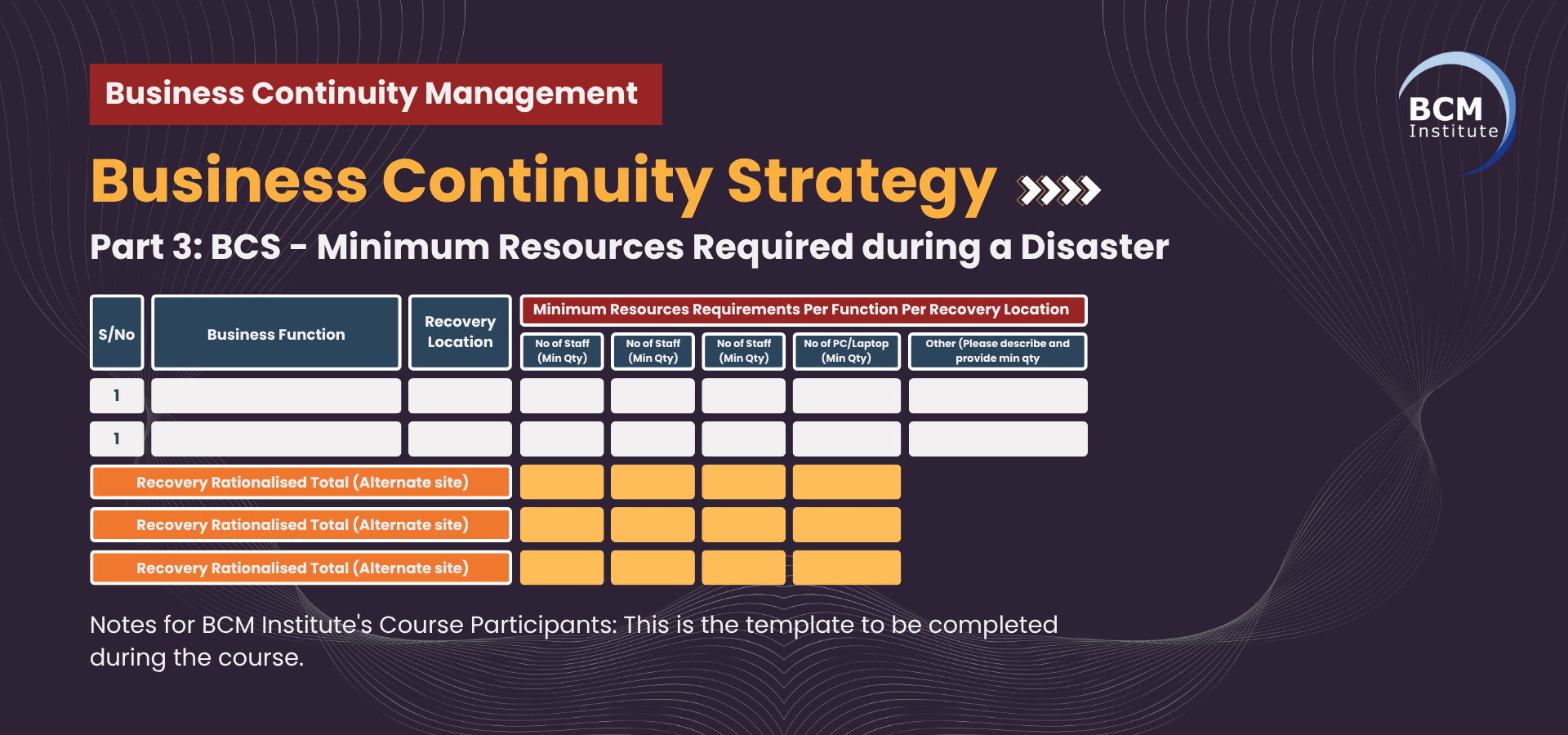
Table BCS P3: Minimum Resources Required during a Disaster for CBF-1 Personal Care and 24-Hour Supervision
| Sub-CBF Code | Sub-Critical Business Function | Recovery Location | Minimum Resource Requirements per Function per Recovery Location | Number of Staff (Minimum) | Number of Seats (Minimum) | Number of Telephones (Minimum) | Number of PCs/Laptops (Minimum) | Other Resources (Description and Minimum Quantity) |
| --- | --- | --- | --- | --- | --- | --- | --- | --- |
| **CBF-1.1** | **Admission and Care Needs Assessment** | **Primary site (the Home): administration office. Referral liaison by Remote Working.** | **MBCO: routine admissions deferred; hospital discharges back to JHA and MSF-directed urgent admissions assessed before arrival. RTO 24 hours. One nurse completes a shortened, safety-focused paper assessment covering falls, swallowing, skin, cognition, medication and infection status. Referral documents received through authorised accounts.** | **1 (day; nurse shared with CBF-1.2)** | **1** | **1 mobile (shared with CBF-1.2)** | **1 laptop (shared with CBF-1.2)** | **Pre-printed rapid admission and risk-assessment packs: 10. Authorised user accounts for MSF and hospital referral systems: 2 (user and back-up). Single room held for new admissions pending infection screening: 1.** |
| **CBF-1.2** | **Individual Care Planning and Review** | **Primary site: nurses' station.** | **MBCO: scheduled reviews deferred; every resident has a current one-page care summary (mobility, diet texture, continence, falls risk, behaviour triggers, allergies, advance care plan status), updated within 24 hours of any change. RTO 24 hours; summaries pre-printed so they are usable immediately if systems fail.** | **1 (day; same nurse as CBF-1.1)** | **0 additional** | **0 additional** | **0 additional** | **Printed care-summary binders with resident photographs, refreshed weekly: 4 (1 per care zone, 1 master at duty office). Colour-coded bed-end risk cards: 100.** |
| **CBF-1.3** | **Care Workforce Rostering and Shift Deployment** | **Primary site: duty office. Roster administration by Remote Working.** | **MBCO: no shift below the safe minimum and a medication-competent person on every shift. RTO: before the next shift. The nurse-in-charge allocates staff to zones each shift and redeploys as absences arise; a roster officer arranges call-outs, agency staff and mutual aid from other Jamiyah facilities.** | **2 (nurse-in-charge per shift; roster officer by day, remote)** | **1** | **2 mobiles (duty phone; roster officer)** | **1 laptop with remote access** | **Printed safe-minimum roster and skills matrix showing hoist, medication and dementia competence: 2. Staff emergency call-out list: 2. Pre-agreed agency and mutual-aid contact list: 1. Staff group messaging channel: 1. Camp beds and bedding for staff held over: 6.** |
| **CBF-1.4** | **Activities of Daily Living Assistance** | **Primary site: consolidated care zones (shelter in place). Alternate care site if residents are relocated.** | **MBCO: every resident's essential hygiene, dressing, oral care and toileting needs are met; full showers may be replaced by bed baths. RTO continuous. Zone-based care teams; water-independent hygiene supplies in case the water supply fails.** | **5 day / 2 night care staff** | **0** | **0 (radios from CBF-1.10)** | **0** | **No-rinse bathing cloths: 1,500 packs. Toiletry and oral-care kits: 100 (14 days). Clean linen: 300 sets (3 per resident). Disposable bed sheets: 500.** |
| **CBF-1.5** | **Continence Care and Skin Integrity Management** | **Primary site: consolidated care zones. Alternate care site if relocated.** | **MBCO: continence care and repositioning delivered at the intervals in each care plan and never longer than 4 hours; no pressure injury caused by missed care. RTO continuous. Powered air mattresses deflate in a power failure, so static overlays are held.** | **2 day / 2 night care staff** | **0** | **0** | **0** | **Adult briefs, assorted sizes: 4,500. Underpads: 2,000. Wet wipes: 300 packs. Barrier cream: 50 tubes. Static pressure-relieving overlays: 15. Paper repositioning and skin-check charts: 14 days' supply.** |
| **CBF-1.6** | **Mobility, Transfer and Fall Prevention** | **Primary site: consolidated care zones. Alternate care site if relocated.** | **MBCO: every transfer made with the assessed equipment and number of staff; no manual lifting of hoist-dependent residents; falls-prevention measures in place. RTO continuous. Equipment must work without mains power and support evacuation.** | **2 per hoist transfer, drawn from CBF-1.4/1.5 (0 additional)** | **0** | **0** | **0** | **Battery mobile hoists: 2, plus 1 stand aid and 2 spare charged batteries. Slings: 1 per hoist-dependent resident plus 6 spares. Wheelchairs: 1 per non-ambulant resident plus 4 spares. Evacuation sledges or chairs: 4. Transfer belts: 6. Fall mats: 10. Battery night lights: 20.** |
| **CBF-1.7** | **Feeding and Hydration Assistance** | **Primary site: care-zone dining points. Alternate care site if relocated.** | **MBCO: every resident who needs help to eat receives it at all three meals; correct texture-modified diets and thickened fluids; fluid intake recorded for at-risk residents. RTO: next meal. Meals supplied by CBF-3; this sub-function covers assistance at the point of care.** | **1 day (dysphagia residents); up to 6 from the pool at mealtimes** | **0** | **0** | **0** | **Food and fluid thickener: 25 tins (14 days). Adapted cutlery, plate guards and spouted cups: 20 spare sets. Drinking water held in care zones: 600 litres (2 litres per resident per day for 3 days). Printed diet and texture list: 3 (1 per zone). Disposable cups and cutlery: 3,000 sets.** |
| **CBF-1.8** | **Medication Administration Support** | **Primary site: medication room and care zones. Alternate care site if relocated.** | **MBCO: give time-critical medication within the prescribed window to the right resident, confirm with a photograph, and record. RTO 2 hours, aligned with CBF-2. Use paper medication administration records (MAR) if electronic records are unavailable.** | **1 medication-competent per shift (nurse by day; nurse-in-charge by night)** | **0** | **0 (uses CBF-1.12 phone)** | **0** | **Lockable medication trolleys: 3. Printed MAR with resident photographs, reprinted after every change: 1 set per zone. Cool box with ice packs and digital thermometer for fridge failure: 1. Bound controlled-drug register: 1. Sharps bins: 4.** |
| **CBF-1.9** | **Point-of-Care Infection Prevention and Control** | **Primary site: care zones, with one zone convertible to an isolation cohort.** | **MBCO: standard precautions at every contact; suspected cases isolated or cohorted within 4 hours with dedicated staff; 14 days of PPE on hand; MOH requirements followed. RTO 4 hours for cohorting. Whole-Home measures sit with CBF-5.** | **1 IPC lead (nurse; 0 additional). Plus 2 care staff per shift ring-fenced to the cohort when active** | **0** | **0** | **0** | **Gloves: 25,000. Surgical masks: 1,500. Fit-tested N95 respirators: 400. Isolation gowns: 400. Plastic aprons: 3,000. Reusable eye protection: 40. Alcohol hand rub (500 ml): 80. Spill kits: 6. Rapid antigen test kits: 200. Isolation trolleys with signage: 2. Clinical waste bags and bins: 14 days' supply.** |
| **CBF-1.10** | **Day and Night Supervision and Safety Rounds** | **Primary site: all occupied areas. Alternate care site if relocated.** | **MBCO: 100% headcount at every shift change and at least every 4 hours; hourly night rounds; communal areas supervised by day. RTO continuous. Communications and lighting must work without mains power, and residents must be protected from heat if cooling fails.** | **1 day / 1 night (rover; all staff support)** | **0** | **0 (radios listed opposite)** | **0** | **Two-way radios with chargers: 8. Head torches or torches with spare batteries: 12. Battery-powered fans: 10. Photo headcount sheets: 2 sets. Evacuation grab bags: 3 (1 per zone). High-visibility vests for zone leads: 6.** |
| **CBF-1.11** | **Dementia and Behavioural Care, including Wandering Prevention** | **Primary site: secured dementia area or zone. Alternate care site if relocated.** | **MBCO: wander-risk residents on enhanced observation; exits secured or watched; behaviour support plans followed; missing-resident procedure started immediately. RTO continuous. Disruption raises distress and wandering, especially during relocation.** | **1 day / 1 night care staff** | **0** | **0 (radios from CBF-1.10)** | **0** | **Bed and chair sensor mats: 15. Resident ID wristbands with the Home's contact number: 130. Photo profiles of wander-risk residents: 3 copies. Comfort and diversional activity kits: 3. Low-stimulus quiet space: 1. Battery back-up for exit alarms (CBF-4): confirmed monthly.** |
| **CBF-1.12** | **Health Monitoring and Clinical Escalation** | **Primary site: nurses' station. Cloud-based virtual consultation with the visiting doctor.** | **MBCO: residents with an acute change observed, recorded and escalated against early-warning criteria; 24-hour route to a doctor, 995 or the 1777 non-emergency ambulance. RTO continuous. One dedicated escalation phone whose number is known to the visiting doctor and hospitals.** | **1 nurse-in-charge per shift** | **1** | **1 dedicated mobile** | **0 (tablet listed opposite)** | **Blood pressure monitors: 3. Pulse oximeters: 5. Thermometers: 5. Glucometers with 14 days of strips: 2. Portable suction units: 2. AED: 1. Oxygen for residents on prescribed oxygen: 72 hours. Tablet with data SIM for virtual consultation: 1. Paper observation charts: 14 days. Printed escalation directory: 3.** |
| **CBF-1.13** | **Incident Reporting and Safeguarding** | **Primary site: duty office.** | **MBCO: every incident and safeguarding concern recorded before the end of the shift; serious cases escalated to the duty manager immediately and evidence preserved, so that CBF-7 can notify MSF and next of kin within the required timeframe. RTO 2 hours. Injuries photographed only on a Home-owned device.** | **0 additional (nurse-in-charge)** | **0 additional** | **0 additional** | **0 (uses CBF-1.14 PC)** | **Paper incident and safeguarding forms: 50. Body-map charts: 50. Lockable file for incident records: 1. Safeguarding and MSF contact card: 3. Home-owned tablet for photographs: shared with CBF-1.12.** |
| **CBF-1.14** | **Shift Handover and Care Documentation** | **Primary site: nurses' station (paper downtime mode if systems fail).** | **MBCO: structured handover at every shift change covering headcount, deteriorating residents, falls, wander risk, isolation, and medication issues; record essential care on paper if electronic records are unavailable, and back-enter within 72 hours of restoration. RTO: next shift change.** | **0 additional (outgoing and incoming nurse-in-charge)** | **2** | **0 additional** | **1 PC on UPS** | **Paper downtime documentation packs: 14 days per zone. Multi-function printer on UPS: 1. UPS for nurses' station: 1. 4G mobile hotspot: 1. Power banks: 6. Handover whiteboards: 3. Printed resident list, updated daily: 1.** |
#### Reading the Table: The Consolidated Shift Complement
Because the same multi-skilled staff deliver several sub-functions, do not add the staff column row by row. The table below shows the consolidated minimum complement.
| Role | Day shift | Night shift | Sub-CBFs covered |
| --- | --- | --- | --- |
| **Nurse-in-charge** | **1** | **1** | **1.3, 1.12, 1.13, 1.14; by night also 1.1, 1.2, 1.8, 1.9** |
| **Nurse (medication and IPC)** | **1** | **0** | **1.1, 1.2, 1.8, 1.9** |
| **Care staff** | **10** | **6** | **1.4, 1.5, 1.6, 1.7, 1.10, 1.11** |
| **Total on site** | **12** | **7** | **Plus 1 remote roster officer by day (1.3)** |
| **Outbreak uplift** | **+2** | **+2** | **Care staff ring-fenced to an isolation cohort (1.9)** |
Two further figures follow from this. Across both devices and workspace, CBF-1 needs only 5 seats, 4 mobile phones, 3 PCs or laptops and 1 tablet at its minimum.
And to sustain 19 staff on site every 24 hours, with rest days, over a two-week disruption, JHA needs a trained pool of at least 30 people who can be called on, including cross-trained staff from other Jamiyah facilities. That pool, not the daily total, truly measures workforce resilience.
##### If Residents Must Be Relocated
The table assumes sheltering in place. If the premises become unsafe and residents move to an alternate care site, such as a partner home or an MSF-arranged facility, the MBCO follows them.
The same staff ratios, care-summary binders, printed MAR, ID wristbands, hoists and slings, and evacuation grab bags travel with residents or must be confirmed at the receiving site before transfer. When the receiving site provides beds and utilities, JHA still supplies the people and information that make care safe.
#### [](https://cta-redirect.hubspot.com/cta/redirect/3893111/6cebfa28-ed8a-49d6-8978-797c3a577f9e)
Identifying minimum recovery resources makes JHA's Business Continuity Plan executable.
The BIA established that CBF-1 must never stop; the recovery strategy chose to shelter in place, consolidate care and rely on multi-skilled staff and low-dependency tools. The table turns those decisions into named quantities: 12 people by day and 7 by night, 8 radios, 2 battery hoists, 15 mattress overlays, 25,000 gloves.
Each line can be bought, stored, checked and exercised, and each can be compared against reality on the day.
#### Why Optimisation Matters
A disruption takes resources away when residents need them most.
Planning to normal levels would be unaffordable for a charity and unrealistic in a crisis. Planning to the minimum puts limited funds into what protects life first, makes sharing and multi-skilling deliberate rather than improvised, and gives managers a clear threshold: above the minimum, the MBCO holds; below it, escalation begins.
#### How Minimum Resource Planning Improves Recovery and Resilience
It shortens the time between disruption and an effective response because the nurse-in-charge doesn't have to figure out what is needed under pressure.
It reveals single points of failure in advance, such as powered mattresses, a lone medication-competent nurse at night, or care records held only electronically.
It also creates a baseline against which exercises, near misses, and real incidents can be measured, and the plan improved, which is the continual improvement cycle ISO 22301 requires.
#### Linking MBCO, Recovery Strategy, Recovery Location and Resources
The four are a single chain and must be kept in step. The MBCO defines the level of care.
The recovery strategy defines how it will be held. The recovery location defines where: in this case, the Home itself, with an alternate care site as the contingency.
The resource allocation defines what is needed at that location to deliver that level by that method within the RTO. Change any link, for example by raising the resident census, adding a dementia wing or changing the relocation partner, and the others must be reviewed.
#### Documentation, Compliance and the Next Step
Documenting the minimum resources in a controlled table, owned by the CBF-1 lead and approved through the Superintendent, gives JHA a single reference for preparing (stocking, training and contracting), responding (checking capability against the minimum at activation) and recovering (restoring from the minimum back to normal in an orderly way).
It provides the evidence that ISO 22301 clauses 8.2.2 and 8.3.4 call for, follows the resource categories set out in ISO 22313, and is consistent with Singapore's national adoption of ISO 22301 as SS ISO 22301 and with the Government's emphasis on organisational preparedness for social service agencies.
It also shows that MSF, under the Social Residential Homes Act 2025 and its Code of Practice, and the Board, under the Code of Governance for Charities and IPCs (2023), resource the Home's commitment to continuous care, not merely state it.
Review the table at least annually, after every exercise or real incident, and whenever the resident profile, staffing model, or recovery strategy changes.
Check stock levels quarterly, and rotate consumables before expiry.
The next chapter turns these requirements into the Business Continuity Plan itself: the procedures, roles and checklists that responders will follow when CBF-1 is disrupted.
[](https://cta-redirect.hubspot.com/cta/redirect/3893111/3aefb2d2-3110-47c1-ad4f-d3e6e5381066)
[](https://cta-redirect.hubspot.com/cta/redirect/3893111/45126cea-7fe9-4ffe-b72e-5e4451c0e271)
| **eBook 3: Starting Your BCM Implementation** | | | | | | |
| --- | --- | --- | --- | --- | --- | --- |
| **MBCO** | **P&S** | **RAR T1** | **RAR T2** | **RAR T3** | **BCS T1** | **CBF** |
| [](https://cta-redirect.hubspot.com/cta/redirect/3893111/3e0b35d2-08b6-4caf-b7db-144625ec8145) | [](https://cta-redirect.hubspot.com/cta/redirect/3893111/ab611654-bce2-450c-affc-3970de6c8909) | [](https://cta-redirect.hubspot.com/cta/redirect/3893111/806c27e6-1db5-42a2-ac84-e0df3624bc49) | [](https://cta-redirect.hubspot.com/cta/redirect/3893111/bf6da142-014d-4c47-83cf-f31e0c55b75e) | [](https://cta-redirect.hubspot.com/cta/redirect/3893111/4c14572c-2ed4-46aa-82c8-5ead8fd31ced) | [](https://cta-redirect.hubspot.com/cta/redirect/3893111/25548d11-adb7-4e6e-9a5a-054db2ea377d) | [](https://cta-redirect.hubspot.com/cta/redirect/3893111/94f8b16c-55da-4543-a948-448f2241296e) |
| **CBF-1 Strategic Procurement and Sourcing** | | | | | | |
| **DP** | **BIAQ P1** | **BIAQ P2** | **BIAQ P3** | **BIAQ P4** | **BIAQ P5** | **BIAQ P6** |
| **[](https://cta-redirect.hubspot.com/cta/redirect/3893111/b1b7c047-3a39-41d7-b2af-2b00d6f13590)** | **[](https://cta-redirect.hubspot.com/cta/redirect/3893111/ffed8b6e-4d2f-4066-a3ab-24aa0a28728b)** | **[](https://cta-redirect.hubspot.com/cta/redirect/3893111/70981a61-b605-4686-a3e5-de0275050496)** | **[](https://cta-redirect.hubspot.com/cta/redirect/3893111/bf3e01a8-f0da-43cc-abc1-d24397682927)** | **[](https://cta-redirect.hubspot.com/cta/redirect/3893111/98714bc9-8556-479e-894b-b67ccfc0f5b9)** | **[](https://cta-redirect.hubspot.com/cta/redirect/3893111/e1572772-84ee-4091-b436-62fb43179d00)** | **[](https://cta-redirect.hubspot.com/cta/redirect/3893111/4bcf60b1-2551-40ea-a780-6283033126cb)** |
| | | **BCS T2** | **BCS T3** | **PD** | | |
| | | **[](https://cta-redirect.hubspot.com/cta/redirect/3893111/1b2b0da8-76c7-4f9a-b2a6-4d4ae8648810)** | **[](https://cta-redirect.hubspot.com/cta/redirect/3893111/154f46c8-d8e4-4ace-89f4-5a6ff2c5abc9)** | **[](https://cta-redirect.hubspot.com/cta/redirect/3893111/b4e8c236-74a3-4226-9cae-52d2b6bf8868)** | | |
| | | | | | | |
**Comments**
### More Posts
[](https://cta-redirect.hubspot.com/cta/redirect/3893111/839787f4-a4fd-456f-accf-54c947026558)

All rights reserved. Copyright 2026
```json
{
"@context" : "https://schema.org",
"@type" : "BlogPosting",
"author" : {
"@type" : "Person",
"name" : "Dr Goh Moh Heng",
"url" : "https://blog.bcm-institute.org/ebook/author/dr-goh-moh-heng"
},
"dateModified" : "2026-10-21T05:06:22.761Z",
"datePublished" : "2026-10-21T04:24:30.000Z",
"headline" : "[BCM] [JHA] [E3] [BCS] [P3] [CBF] [1] Personal Care and 24-Hour Supervision",
"mainEntityOfPage" : {
"@id" : "https://blog.bcm-institute.org/ebook/bcm-jha-e3-bcs-p3-cbf-1-personal-care-and-24-hour-supervision",
"@type" : "WebPage"
},
"publisher" : {
"@type" : "Organization",
"logo" : {
"@type" : "ImageObject",
"url" : "https://blog.bcm-institute.org/hubfs/BCMI%20Logo.png"
},
"name" : "BCMI Pte Ltd"
}
}
```