---
title: [BCM] [JCUS] [E3] [C1] Starting Your BCM Implementation
description: [BCM] [JCUS] [E3] [C1] Starting Your BCM Implementation
image: https://blog.bcm-institute.org/hubfs/JCU%20Graphic%20Folder/JCU%20E3%20Morepost/%5BBCM%5D%20%5BJCU%5D%20%5BE3%5D%20%5BC1%5D%20Starting%20Your%20BCM%20Implementation.jpg
---
. .
[](http://www.bcm-institute.org/)
- [Home](https://www.bcm-institute.org/)
- [About Us](https://www.bcm-institute.org/about-us-3/)
- [A President’s Perspective](https://www.bcm-institute.org/about-us/a-presidents-perspective/)
- [Our History](https://www.bcm-institute.org/about-us/our-history/)
- [Our Advisory Council](https://www.bcm-institute.org/about-us/our-advisory-council/)
- [Customers’ Testimonials](https://www.bcm-institute.org/about-us/customers-testimonials/)
- [Credential Verification](https://www.bcm-institute.org/about-us/credential-verification/)
- [Courses](https://blog.bcm-institute.org/blog/course-fees-for-blended-learning-courses-master-catalog)
- [ISO 22301 Business Continuity Management System Audit](https://blog.bcm-institute.org/audit/business-continuity-management-audit-courses)
- [ISO 22301 Business Continuity Management](https://blog.bcm-institute.org/bcm/business-continuity-management-courses)
- [Crisis Communication](https://blog.bcm-institute.org/crisis-communication/crisis-communication-courses)
- [Crisis Management](https://blog.bcm-institute.org/en/crisis-management/courses)
- [IT Disaster Recovery](https://blog.bcm-institute.org/it-disaster-recovery/courses)
- [Operational Resilience](https://blog.bcm-institute.org/operational-resilience/courses)
- [Operational Resilience Audit](https://blog.bcm-institute.org/operational-resilience-audit/courses)
- [Certification](https://blog.bcm-institute.org/certification/types-of-certifications-offered)
- [ISO 22301 BCMS Audit Certification](https://blog.bcm-institute.org/certification/business-continuity-management-audit-certification)
- [ISO22301 Business Continuity Management Certification](https://blog.bcm-institute.org/bcm/business-continuity-management-certification)
- [Crisis Communication Certification](https://blog.bcm-institute.org/crisis-communication/crisis-communication-certification)
- [Crisis Management Certification](https://blog.bcm-institute.org/en/crisis-management/crisis-management-certification)
- [IT Disaster Recovery Planning Certification](https://blog.bcm-institute.org/it-disaster-recovery/it-disaster-recovery-certification)
- [Operational Resilience Certification](https://blog.bcm-institute.org/operational-resilience/operational-resilience-certification)
- [Operational Resilience Audit Certification](https://blog.bcm-institute.org/operational-resilience-audit)
- [Seminars](https://blog.bcm-institute.org/meet-the-expert/mte-webinar-mainpage)
- [Store](https://www.bcm-institute.org/store-2/)
- [Contact Us](http://www.bcm-institute.org/about-us/contact-us/)
-
-
##### Institutional Resilience in Action: Business Continuity Management Implementation at JCU Singapore

# \[BCM\] \[JCUS\] \[E3\] \[C1\] Starting Your BCM Implementation
[![\[BCM\] \[JCU\] \[Full Banner\] Business Continuity Management Implementation at JCU Singapore](https://no-cache.hubspot.com/cta/default/3893111/c28ce2ee-dfaa-4e23-b28a-6ae8ca285f06.png)](https://cta-redirect.hubspot.com/cta/redirect/3893111/c28ce2ee-dfaa-4e23-b28a-6ae8ca285f06)
[![eBook Cover \[BCM\] \[JCU\] \[E3\] \[2D\]](https://no-cache.hubspot.com/cta/default/3893111/8e52398a-dc6d-44be-bc33-143633de722d.png)](https://cta-redirect.hubspot.com/cta/redirect/3893111/8e52398a-dc6d-44be-bc33-143633de722d)
Business Continuity Management (BCM) provides an organisation with a structured capability to prepare for disruptive incidents, maintain prioritised activities at acceptable predefined levels, and recover affected operations within appropriate timeframes.
For **James Cook University Singapore (JCUS)**, business continuity extends beyond restoring individual systems or facilities.
The continuity of teaching and learning, examinations, student administration, academic records, digital learning platforms, campus operations, student welfare, regulatory obligations, communications, and selected research activities collectively contribute to the University's ability to continue delivering its educational commitments during disruption.
[](https://cta-redirect.hubspot.com/cta/redirect/3893111/dc612b43-f678-4d9a-888e-8dced9d1b72b)
[Moh Heng Goh](https://blog.bcm-institute.org/ebook/author/moh-heng-goh) Oct 2, 2026
###### Business Continuity Management Certified Planner-Specialist-Expert
[![x \[BCM\] \[JCU\] Legal Disclaimer Banner](https://no-cache.hubspot.com/cta/default/3893111/e57030e6-3c63-46cc-988b-1eabb945de75.png)](https://cta-redirect.hubspot.com/cta/redirect/3893111/e57030e6-3c63-46cc-988b-1eabb945de75)
### eBook 3: Chapter 1
[](https://cta-redirect.hubspot.com/cta/redirect/3893111/dc612b43-f678-4d9a-888e-8dced9d1b72b)
#### **Introduction**
[![\[BCM\] \[JCU\] \[E3\] \[C1\] Starting Your BCM Implementation](https://no-cache.hubspot.com/cta/default/3893111/bbb4751f-aa43-4476-a745-a1d42c6602cb.png)](https://cta-redirect.hubspot.com/cta/redirect/3893111/bbb4751f-aa43-4476-a745-a1d42c6602cb)Business Continuity Management (BCM) provides an organisation with a structured capability to prepare for disruptive incidents, maintain prioritised activities at acceptable predefined levels, and recover affected operations within appropriate timeframes.
For **James Cook University Singapore (JCUS)**, business continuity extends beyond restoring individual systems or facilities.
The continuity of teaching and learning, examinations, student administration, academic records, digital learning platforms, campus operations, student welfare, regulatory obligations, communications, and selected research activities collectively contribute to the University's ability to continue delivering its educational commitments during disruption.
This chapter introduces the practical implementation stage of the eBook series:
#### **Institutional Resilience in Action: Business Continuity Management Implementation at JCU Singapore**
The series consists of three complementary eBooks:

##### **eBook 1 — Understanding Your Organisation for James Cook University**
This establishes the organisational context for BCM. It provides the foundation for understanding the organisation, its operating environment, products and services, stakeholders, dependencies, governance considerations, and the business functions that may require continuity arrangements.
##### **eBook 2 — Implementing Business Continuity Management for James Cook University**
This provides the methodology and implementation guidance required to translate BCM concepts into a structured programme. It explains how the organisation can undertake the principal BCM planning activities and develop appropriate continuity capabilities.
##### **eBook 3 — Starting Your BCM Implementation for James Cook University**
This eBook moves from methodology to practical implementation. It drills down into the specific requirements, templates, assessments, decisions, resource requirements, strategies, and procedures required during the BCM planning exercise.
Treat eBooks 1 and 2 as **pre-reading and implementation guidance**, while eBook 3 serves as the practical working guide for preparing, completing, reviewing, and updating the organisation's BCM documentation.
#### **Purpose of This eBook**
This eBook helps JCUS translate its BCM methodology into a structured set of implementation activities and documented outputs.
Rather than treating BCM as a collection of independent plans, the approach establishes a logical progression from understanding threats and business impacts through to determining continuity strategies and developing executable procedures.
The eBook focuses on four principal phases of the BCM planning methodology:

Together, these phases provide a structured path from identifying what could disrupt JCUS, through understanding what must be recovered and when, to determining how continuity will be achieved and documenting what personnel should do when a disruption occurs.
The completed documentation also provides evidence that BCM decisions have been systematically considered, documented, reviewed, and linked to the organisation's operational requirements.
#### **Relationship with ISO 22301**
The implementation approach described in this eBook supports the broader requirements and principles associated with **ISO 22301 Business Continuity Management Systems (BCMS)**.
ISO 22301 establishes a management system framework through which organisations can establish, implement, maintain, and continually improve their business continuity capabilities.
Within that broader framework, this eBook focuses on the practical analysis, strategy, and planning required to establish effective continuity arrangements.
The RAR, BIA, BCS, and PD phases should therefore not be viewed as isolated exercises. Their outputs should support the organisation's wider BCMS, including governance, competence, documentation, exercising, performance evaluation, management review, and continual improvement.
For JCUS, the objective is to ensure BCM documentation reflects the operational realities of an educational institution and supports decision-making during actual disruptions.
### **The BCM Planning Methodology**
The BCM planning methodology used in this eBook consists of four interconnected phases.
#### [](https://cta-redirect.hubspot.com/cta/redirect/3893111/c2dfdab1-7ab0-4a8b-bd31-7876fd39633e)
#### **Risk Analysis and Review Phase**
Risk Analysis and Review identifies disruption threats relevant to the organisation and assesses the controls available to reduce their likelihood or impact.
The RAR phase provides the threat and risk context for continuity planning.
Three principal templates are completed:

##### **List of Threats \[RAR T1\]**
This identifies credible threats that could disrupt JCUS operations. Depending on the organisational context, these may include physical incidents, utility failures, technology disruptions, cyber incidents, workforce disruptions, facility unavailability, supply-chain failures, public-health events, and other operational threats.
##### **Treatment and Control \[RAR T2\]**
This documents existing and proposed preventive, detective, mitigating, and risk-treatment controls associated with identified threats.
The objective is to determine what can reasonably be done to reduce exposure before relying on business continuity arrangements.
##### **Risk Impact and Likelihood Assessment \[RAR T3\]**
This evaluates identified threats using defined impact and likelihood criteria. The assessment helps management understand relative exposure and prioritise appropriate risk treatment and continuity measures.
RAR distinguishes between **reducing the risk of disruption** and **preparing the organisation to continue operating when disruption nevertheless occurs**.
#### [](https://cta-redirect.hubspot.com/cta/redirect/3893111/a1b4b4e2-f0aa-44df-a197-431397a7927c)
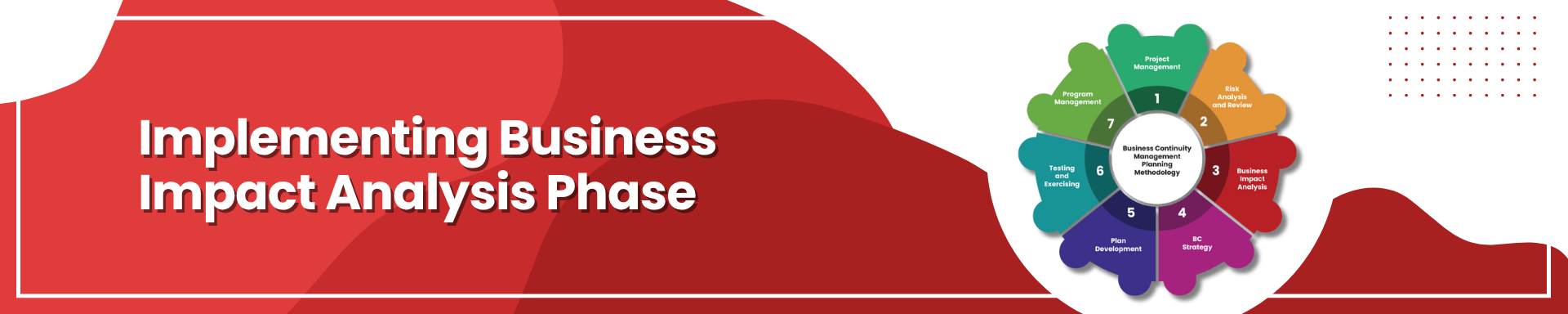
#### **Business Impact Analysis Phase**
The Business Impact Analysis establishes which business activities are important to the organisation's continued delivery of prioritised products and services and determines the consequences of their disruption over time.
For JCUS, the BIA must reflect the University's operational and academic environment.
Different functions may have significantly different time sensitivities.
For example, disruption to a function during a normal administrative period may have different consequences than disruption immediately before examinations, during an assessment period, at the beginning of a teaching term, or during a regulatory reporting deadline.
The BIA therefore provides the analytical basis for establishing continuity and recovery priorities.
##### **Part 0 — Corporate MBCO and Products & Services \[MBCO\] \[P&S\]**
The organisation first sets its overall continuity expectations and identifies the products and services to consider within the BCM programme.
The **Maximum Business Continuity Objective (MBCO)** provides an organisation-level reference for continuity expectations and supports subsequent analysis of individual business functions.
##### **Part 1 — Identification of Business Functions \[BIAQ T1\]**
The organisation identifies and documents the business functions and underlying processes necessary to support its products and services.
This step creates the operational inventory upon which the remaining BIA analysis is performed.
##### **Part 2 — Impact Areas of Business Functions \[BIAQ T1\]**
Assess each business function against relevant impact areas.
For JCUS, these may include:
- student and stakeholder impact;
- academic and teaching impact;
- financial impact;
- regulatory and compliance impact;
- operational impact;
- legal or contractual impact;
- health, safety and welfare impact; and
- reputational impact.
The assessment provides a consistent basis for understanding why a function may become critical following disruption.
##### **Part 3 — Impact Over Time of Business Functions \[BIAQ T2\]**
The assessment evaluates the effect of disruption over defined time intervals.
This is essential because business impact is rarely static. An activity that can tolerate several hours or days of interruption may eventually reach a point where the consequences become unacceptable.
The assessment supports setting appropriate recovery priorities and time objectives.
##### **Part 4 — Supporting IT Systems and Applications \[BIAQ T2\]**
Critical business functions are mapped to the information systems, applications, digital platforms, databases, communication services, and other technology resources needed to operate them.
For JCUS, this is particularly significant because teaching, learning, academic administration, communications, student services, and records management increasingly depend on digital services.
This analysis links business continuity requirements to ICT disaster recovery priorities.
##### **Part 5 — Inter-dependencies \[BIAQ T3\]**
Critical functions rarely operate independently.
The BIA identifies internal and external dependencies necessary for the function to operate, including people, facilities, ICT, suppliers, service providers, other business units, utilities, academic resources, and external stakeholders.
Understanding these dependencies reduces the risk of developing continuity arrangements that restore one component while overlooking another essential dependency.
##### **Part 6 — Vital Records \[BIAQ T3\]**
The organisation identifies information and records that must remain available or recoverable during and following disruption.
These may include academic records, student information, examination information, teaching materials, financial records, regulatory documentation, contracts, operational procedures, contact information, and other records required to support continuity and recovery.
The BIA therefore establishes:

**What is critical → Why it is critical → When it must be recovered → What it depends upon**
These outputs provide the foundation for the Business Continuity Strategy phase.
#### [](https://cta-redirect.hubspot.com/cta/redirect/3893111/fac23b58-f744-480a-b86b-13a824a53308)
#### **Business Continuity Strategy Phase**
Once the organisation understands its risks, critical functions, impacts, recovery priorities, dependencies, systems, and resource requirements, it can develop appropriate continuity strategies.

The Business Continuity Strategy phase addresses three principal requirements.
##### **Mitigation Strategies \[BCS T1\]**
Mitigation strategies identify measures that can reduce vulnerabilities or limit the consequences of disruption.
Examples may include increased redundancy, alternative delivery arrangements, cross-training, alternative facilities, technology resilience, additional supplier arrangements, manual workarounds, and enhanced information protection.
##### **Recovery Strategies and Justifications \[BCS T2\]**
Recovery strategies define how critical business functions will continue or recover following a disruption.
Each strategy should be justified against the BIA requirements and should consider feasibility, recovery timeframe, resource requirements, dependencies, cost, operational constraints, and residual risks.
A strategy should therefore not be selected simply because it is technically possible. It should demonstrate that it can support the required continuity and recovery objectives.
##### **Minimum Resources Required During a Disaster \[BCS T3\]**
The organisation determines the minimum resources necessary to operate the critical business function at an acceptable level during disruption.
These may include:
**People + Workplace + Technology + Information + Equipment + Suppliers + Communications**
The objective is not necessarily to reproduce normal operations immediately. Instead, the organisation determines the minimum capability necessary to sustain prioritised activities until normal operations can be restored.
#### [](https://cta-redirect.hubspot.com/cta/redirect/3893111/8be70e4c-1b23-4b38-bf36-5bd899b28e17)
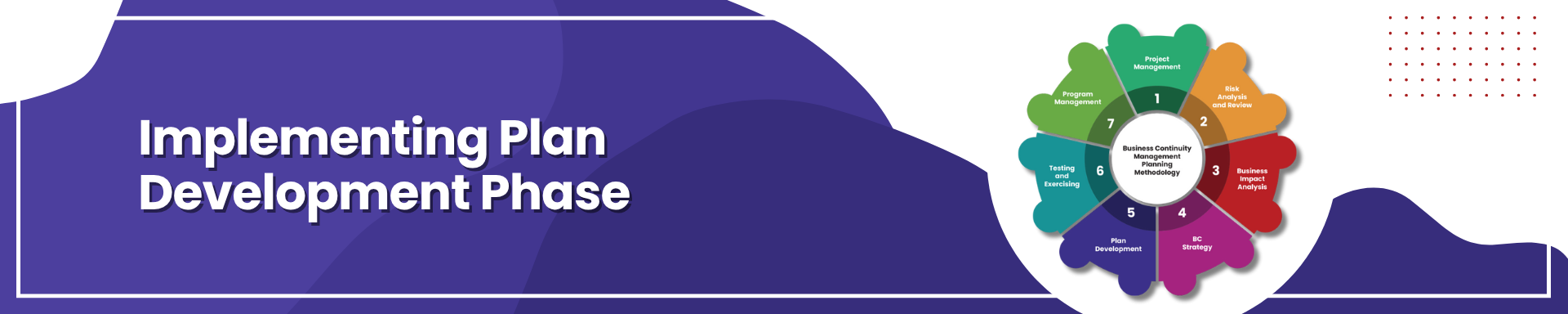
#### **Plan Development Phase**
Plan Development converts the findings and strategic decisions from the previous phases into practical procedures.
For each Critical Business Function, the business continuity plan should explain how responsible personnel will respond to disruption, implement the selected continuity strategy, operate under temporary arrangements, recover prioritised activities, and transition toward normal operations.
Procedures should be detailed enough to be useful during a disruption but flexible enough to accommodate different incident circumstances.
Where appropriate, procedures should address:
- activation and escalation;
- roles and responsibilities;
- initial assessment;
- staff notification;
- continuity arrangements;
- alternative working arrangements;
- manual workarounds;
- minimum resource deployment;
- technology and information requirements;
- dependency coordination;
- internal and external communications;
- recovery actions;
- return to normal operations; and
- documentation of decisions and actions.
The relationship between the four phases can therefore be expressed as:

The quality of the final business continuity plan depends heavily on the quality of the analysis performed in the preceding phases.
#### [![Banner \[Summary\] \[BCM\] \[E1\] \[C10\] Identifying Critical Business Functions](https://no-cache.hubspot.com/cta/default/3893111/0e59113c-d17a-48a8-8c28-bb1bcf487857.png)](https://cta-redirect.hubspot.com/cta/redirect/3893111/0e59113c-d17a-48a8-8c28-bb1bcf487857)
#### **[![\[BCM\] \[JCU\] \[E1\] \[C10\] Identifying Critical Business Functions](https://no-cache.hubspot.com/cta/default/3893111/b7aaf4cf-e4f4-4e31-bb8f-6885a5f2203d.png)](https://cta-redirect.hubspot.com/cta/redirect/3893111/b7aaf4cf-e4f4-4e31-bb8f-6885a5f2203d)Critical Business Functions for JCUS**
Identification of the Critical Business Functions marks the beginning of the detailed Business Impact Analysis.
For this BCM implementation exercise, the following Critical Business Functions have been identified for JCUS.
| Code | Critical Business Function |
| --- | --- |
| CBF-1 | Teaching and Learning Delivery |
| CBF-2 | Examinations and Academic Assessment |
| CBF-3 | Student Enrolment, Registration and Academic Progression |
| CBF-4 | Student Records and Academic Results Management |
| CBF-5 | Critical Digital Learning and Academic Platforms |
| CBF-6 | Critical ICT Infrastructure, Identity and Connectivity |
| CBF-7 | Student Safety, Welfare, and Critical Support |
| CBF-8 | Campus Safety, Security, and Essential Facilities |
| CBF-9 | Admissions and Critical Student Onboarding |
| CBF-10 | Student Fee Administration and Protection |
| CBF-11 | Regulatory Compliance and Education Quality Assurance |
| CBF-12 | Critical University Communications and Crisis Information |
| CBF-13 | Library and Essential Academic Information Resources |
| CBF-14 | Critical Research and Specialist Laboratory Operations |
This list provides the starting structure for the BIA.
Then decompose each CBF into its supporting business functions and processes so you can assess impact, recovery requirements, technology dependencies, interdependencies, vital records, strategies, resources, and recovery procedures at an appropriate operational level.
Designating a function as critical does not mean all activities within that function require the same recovery priority. A detailed BIA is necessary to distinguish highly time-sensitive activities from those that can be deferred during a disruption.
#### **From Critical Business Functions to Implementable BCM Requirements**
The implementation process should progressively drill down from organisation-level requirements to specific recovery procedures.
For each CBF, JCUS should establish a traceable chain:

This traceability matters because it shows why a particular continuity arrangement exists.
For example, a recovery procedure should be traceable to a selected recovery strategy.
The recovery strategy should respond to requirements established through the BIA.
Those requirements should, in turn, relate to the University's prioritised products, services, activities, and organisational obligations.
This prevents the BCM programme from becoming a collection of procedures developed without a documented business rationale.
#### **Using the Templates as a BCM Implementation Tool**
The templates contained in this eBook should not be treated merely as forms to be completed for compliance purposes.
They are intended to facilitate structured discussions between BCM coordinators, business function owners, process owners, academic and administrative representatives, ICT personnel, facilities personnel, risk and compliance stakeholders, and management.
A productive implementation process should involve:
**Analysis → Discussion → Validation → Management Decision → Documentation → Testing → Improvement**
Business owners provide operational knowledge.
BCM practitioners provide methodology and facilitate consistency.
Technology and supporting functions validate dependencies and recovery feasibility.
Management establishes priorities and approves appropriate strategies and resources.
Exercises and actual disruptions subsequently provide evidence about whether the documented arrangements work as intended.
The templates consequently become both **implementation tools and evidence of BCM decision-making**.
#### **Compilation of BCM Submissions**
This eBook is designed to become a structured compilation of submissions generated during JCUS's business continuity planning exercise.
As the project progresses, the eBook can incorporate completed and validated outputs from:
##### **Risk Analysis and Review: RAR**
- List of Threats **\[RAR T1\]**
- Treatment and Control **\[RAR T2\]**
- Risk Impact and Likelihood Assessment **\[RAR T3\]**
##### **Business Impact Analysis: BIA**
- Corporate MBCO and Products & Services
- Identification of Business Functions
- Impact Areas
- Impact Over Time
- Supporting IT Systems and Applications
- Interdependencies
- Vital Records
##### **Business Continuity Strategy: BCS**
- Mitigation Strategies **\[BCS T1\]**
- Recovery Strategies and Justifications **\[BCS T2\]**
- Minimum Resources Required During a Disaster **\[BCS T3\]**
##### **BC Plan Development: PD**
- Business continuity procedures for the relevant processes supporting each Critical Business Function.
As individual submissions are completed, reviewed, challenged, and approved, they collectively form a structured record of the organisation's BCM implementation.
#### **Updating an Existing BCM Programme**
The methodology also applies when JCUS updates an established BCM programme.
Business continuity requirements change as the organisation changes.
New systems may be introduced. Academic delivery models may evolve. New suppliers and external services may create dependencies. Facilities may change.
Organisational structures may be revised. Regulatory requirements may develop. New threats may emerge, while previous assumptions about recovery may no longer remain valid.
An update should therefore involve more than changing dates and contact details in existing plans.
The organisation should reassess whether:
- the identified threats remain relevant;
- existing controls remain effective;
- critical business functions remain correctly identified;
- impact assessments remain valid;
- recovery priorities have changed;
- technology dependencies remain accurate;
- interdependencies are complete;
- vital records remain accessible;
- selected continuity strategies remain feasible;
- minimum resource requirements remain sufficient; and
- continuity procedures remain executable.
This approach helps keep BCM documentation aligned with the organisation's current operating environment rather than a historical record of how the organisation once operated.
#### **Training-Led Implementation**
This eBook also provides value-added, complementary support for organisations implementing or upgrading their BCM programme through BCM Institute's training-led implementation approach, while participating in relevant certification or competency-based training.
The training-led approach connects professional learning with practical organisational implementation.
Participants not only study BCM concepts.
They apply the methodology to their own organisational environment by identifying threats, conducting BIA activities, evaluating strategies, determining resource requirements, and developing continuity procedures.
The relationship can be expressed as:

This gives training outputs an opportunity to contribute directly to the organisation's BCM implementation or programme enhancement.
However, treat templates developed during training as working implementation material until they have undergone the organisation's required review, validation, and approval processes.
#### **Roles in the Implementation Process**
Successful implementation requires participation beyond the designated BCM practitioner.
**Senior Management** provides direction, establishes expectations, approves priorities, and ensures that appropriate resources are available.
**BCM Programme Management** establishes the methodology, coordinates implementation, facilitates assessments, maintains consistency, and monitors completion.
**Critical Business Function Owners** validate operational priorities, impacts, dependencies, minimum resource requirements, strategies, and continuity arrangements.
**Process Owners and Subject-Matter Experts** provide detailed knowledge of how activities are performed and identify practical recovery requirements.
**ICT and Digital Service Owners** validate application, infrastructure, data, identity, connectivity, and technology recovery dependencies.
**Supporting Functions** such as facilities, human resources, procurement, finance, security, communications, and other relevant functions validate cross-organisational dependencies.
**Management and Approving Authorities** review significant assumptions, resource commitments, residual risks, and strategy decisions.
BCM, therefore, remains an organisational capability rather than solely the responsibility of the BCM coordinator.
#### **Implementation Principle: Analysis Before Planning**
A fundamental principle underlying this eBook is:
**Do not start by writing the business continuity plan.**
A useful business continuity plan should come from structured analysis.
The organisation must first understand its threats and vulnerabilities.
It must determine which activities are time-critical, how disruption affects them, what they depend upon, what resources they require, and what recovery arrangements are feasible.
Only then can it develop meaningful continuity procedures.
The complete implementation logic is therefore:

This creates a defensible relationship between business requirements and continuity arrangements.
#### **Expected Outcome**
After implementation, JCUS should have more than a collection of completed templates.
The intended outcome is a coherent BCM capability in which:
- **risks inform preparedness;**
- **business impacts inform recovery priorities;**
- **recovery priorities inform strategy;**
- **strategy determines resource requirements;**
- **resource requirements inform continuity procedures; and**
- **exercises validate whether those procedures can achieve their intended outcomes.**
The documentation generated through RAR, BIA, BCS, and PD should consequently form an interconnected body of evidence supporting the University's wider BCMS.
[](https://cta-redirect.hubspot.com/cta/redirect/3893111/dc612b43-f678-4d9a-888e-8dced9d1b72b)
#### **Moving Forward**
This chapter establishes the implementation framework for the remainder of **Starting Your BCM Implementation for James Cook University**.
The subsequent sections of the eBook move progressively from organisation-level analysis to detailed implementation requirements.
The practical journey begins with Risk Analysis and Review and proceeds through Business Impact Analysis, Business Continuity Strategy, and Plan Development.
Particular attention then turns to the identified Critical Business Functions, beginning with a detailed assessment of the processes supporting those functions.
For JCUS, this means moving systematically from:
**Understanding what may disrupt the University**
to
**understanding what must continue and recover**
to
**determining how continuity will be achieved**
and ultimately to
**documenting practical procedures that personnel can execute when a disruption occurs.**
This progression transforms BCM from a documented requirement into an operational capability that supports the continued delivery of critical educational and university services.
[](https://cta-redirect.hubspot.com/cta/redirect/3893111/3aefb2d2-3110-47c1-ad4f-d3e6e5381066)
[![\[BCM\] \[JCU\] \[3/4 Banner\] Business Continuity Management Implementation at JCU Singapore](https://no-cache.hubspot.com/cta/default/3893111/d81098d9-9f30-4c17-a897-2fc202440adc.png)](https://cta-redirect.hubspot.com/cta/redirect/3893111/d81098d9-9f30-4c17-a897-2fc202440adc)
| **eBook 3: Starting Your BCM Implementation** | | | | | | |
| --- | --- | --- | --- | --- | --- | --- |
| **MBCO** | **P&S** | **RAR T1** | **RAR T2** | **RAR T3** | **BCS T1** | **eBook 1** |
| [![\[BCM\] \[JCU\] \[E3\] \[BIA\] MBCO Corporate MBCO](https://no-cache.hubspot.com/cta/default/3893111/37db16b1-9a61-4815-adbb-527771b7bd35.png)](https://cta-redirect.hubspot.com/cta/redirect/3893111/37db16b1-9a61-4815-adbb-527771b7bd35) | [![\[BCM\] \[JCU\] \[E3\] \[BIA\] \[PS\] Key Product and Services](https://no-cache.hubspot.com/cta/default/3893111/3117a3bf-33fd-4522-a373-4ce343e253a6.png)](https://cta-redirect.hubspot.com/cta/redirect/3893111/3117a3bf-33fd-4522-a373-4ce343e253a6) | [![\[BCM\] \[JCU\] \[E3\] \[RAR\] \[T1\] List of Threats](https://no-cache.hubspot.com/cta/default/3893111/de614923-e16d-4c4b-878e-60b97f56183f.png)](https://cta-redirect.hubspot.com/cta/redirect/3893111/de614923-e16d-4c4b-878e-60b97f56183f) | [![\[BCM\] \[JCU\] \[E3\] \[RAR\] \[T2\] Treatment and Control](https://no-cache.hubspot.com/cta/default/3893111/71606f66-523b-41e0-af99-19f5e4cc2f37.png)](https://cta-redirect.hubspot.com/cta/redirect/3893111/71606f66-523b-41e0-af99-19f5e4cc2f37) | [![\[BCM\] \[JCU\] \[E3\] \[RAR\] \[T3\] Risk Impact and Likelihood Assessment](https://no-cache.hubspot.com/cta/default/3893111/0192071d-0c49-4a20-a2a8-f0894418f873.png)](https://cta-redirect.hubspot.com/cta/redirect/3893111/0192071d-0c49-4a20-a2a8-f0894418f873) | [![\[BCM\] \[JCU\] \[E3\] \[BCS\] \[T1\] Mitigation Strategies and Justification](https://no-cache.hubspot.com/cta/default/3893111/12b9c723-7ba3-4523-a1c2-0e75dc09a4e3.png)](https://cta-redirect.hubspot.com/cta/redirect/3893111/12b9c723-7ba3-4523-a1c2-0e75dc09a4e3) | **[![x eBook Cover \[BCM\] \[JCU\] \[E1\] \[2D\]](https://no-cache.hubspot.com/cta/default/3893111/0f98fc51-8a8d-4b94-8eea-7ced8c678a6a.png)](https://cta-redirect.hubspot.com/cta/redirect/3893111/0f98fc51-8a8d-4b94-8eea-7ced8c678a6a)** |
| **CBF-1 Teaching and Learning Delivery** | | | | | | |
| **DP** | **BIAQ P1** | **BIAQ P2** | **BIAQ P3** | **BIAQ P4** | **BIAQ P5** | **eBook 2** |
| [![\[BCM\] \[JCU\] \[E3\] \[BIA\] \[DP\] \[CBF\] \[1\] Teaching and Learning Delivery](https://no-cache.hubspot.com/cta/default/3893111/87dc20a3-b9ed-454a-90ee-2ca3e2419322.png)](https://cta-redirect.hubspot.com/cta/redirect/3893111/87dc20a3-b9ed-454a-90ee-2ca3e2419322) | **[![\[BCM\] \[JCU\] \[E3\] \[BIA\] \[T1\] \[CBF\] \[1\] Teaching and Learning Delivery](https://no-cache.hubspot.com/cta/default/3893111/c0d85e4b-2df7-44ee-9c25-4112e99a64f3.png)](https://cta-redirect.hubspot.com/cta/redirect/3893111/c0d85e4b-2df7-44ee-9c25-4112e99a64f3)** | **[![\[BCM\] \[JCU\] \[E3\] \[BIA\] \[T2\] \[CBF\] \[1\] Teaching and Learning Delivery](https://no-cache.hubspot.com/cta/default/3893111/3d5d03b2-0465-4e70-8920-efbaf80a835c.png)](https://cta-redirect.hubspot.com/cta/redirect/3893111/3d5d03b2-0465-4e70-8920-efbaf80a835c)** | **[![\[BCM\] \[JCU\] \[E3\] \[BIA\] \[T3\] \[CBF\] \[1\] Teaching and Learning Delivery](https://no-cache.hubspot.com/cta/default/3893111/4107cc4d-b5ca-486c-bca0-d2a049b8c752.png)](https://cta-redirect.hubspot.com/cta/redirect/3893111/4107cc4d-b5ca-486c-bca0-d2a049b8c752)** | **[![\[BCM\] \[JCU\] \[E3\] \[BIA\] \[T4\] \[CBF\] \[1\] Teaching and Learning Delivery](https://no-cache.hubspot.com/cta/default/3893111/e9bd80ac-aa4d-4da0-873e-92bb036ae9c9.png)](https://cta-redirect.hubspot.com/cta/redirect/3893111/e9bd80ac-aa4d-4da0-873e-92bb036ae9c9)** | **[![\[BCM\] \[JCU\] \[E3\] \[BIA\] \[T5\] \[CBF\] \[1\] Teaching and Learning Delivery](https://no-cache.hubspot.com/cta/default/3893111/7c619369-8c50-4876-a478-749b847adee0.png)](https://cta-redirect.hubspot.com/cta/redirect/3893111/7c619369-8c50-4876-a478-749b847adee0)** | **[![eBook Cover \[BCM\] \[JCU\] \[E2\] \[2D\]](https://no-cache.hubspot.com/cta/default/3893111/d22d99cb-1f5b-4f7b-9a08-7fddaa5af6fe.png)](https://cta-redirect.hubspot.com/cta/redirect/3893111/d22d99cb-1f5b-4f7b-9a08-7fddaa5af6fe)** |
| **BIAQ P6** | **BCS T2** | **BCS T3** | **PD** | **CBF** | | **eBook 3** |
| **[![\[BCM\] \[JCU\] \[E3\] \[BIA\] \[T6\] \[CBF\] \[1\] Teaching and Learning Delivery](https://no-cache.hubspot.com/cta/default/3893111/bdb520b6-bc53-40cf-bc72-5e4eb5c2d1ae.png)](https://cta-redirect.hubspot.com/cta/redirect/3893111/bdb520b6-bc53-40cf-bc72-5e4eb5c2d1ae)** | **[![\[BCM\] \[JCU\] \[E3\] \[BCS\] \[T2\] \[CBF\] \[1\] Teaching and Learning Delivery](https://no-cache.hubspot.com/cta/default/3893111/10a04273-213c-4b93-a69a-966039c382bb.png)](https://cta-redirect.hubspot.com/cta/redirect/3893111/10a04273-213c-4b93-a69a-966039c382bb)** | [![\[BCM\] \[JCU\] \[E3\] \[BCS\] \[T3\] \[CBF\] \[1\] Teaching and Learning Delivery](https://no-cache.hubspot.com/cta/default/3893111/d2ec73f8-a65d-473f-9a70-afa20ac0b990.png)](https://cta-redirect.hubspot.com/cta/redirect/3893111/d2ec73f8-a65d-473f-9a70-afa20ac0b990) | [![\[BCM\] \[JCU\] \[E3\] \[PD\] \[CBF\] \[1\] Teaching and Learning Delivery](https://no-cache.hubspot.com/cta/default/3893111/41fe68b0-13dc-4690-bd61-369c6da03192.png)](https://cta-redirect.hubspot.com/cta/redirect/3893111/41fe68b0-13dc-4690-bd61-369c6da03192) | **[![\[BCM\] \[JCU\] \[E1\] \[C10\] Identifying Critical Business Functions](https://no-cache.hubspot.com/cta/default/3893111/b7aaf4cf-e4f4-4e31-bb8f-6885a5f2203d.png)](https://cta-redirect.hubspot.com/cta/redirect/3893111/b7aaf4cf-e4f4-4e31-bb8f-6885a5f2203d)** | | **[![eBook Cover \[BCM\] \[JCU\] \[E3\] \[2D\]](https://no-cache.hubspot.com/cta/default/3893111/8e52398a-dc6d-44be-bc33-143633de722d.png)](https://cta-redirect.hubspot.com/cta/redirect/3893111/8e52398a-dc6d-44be-bc33-143633de722d)** |
| | | | | | | |
#### More Information About Business Continuity Management Courses
[](https://cta-redirect.hubspot.com/cta/redirect/3893111/c010f0fd-7ba6-4f60-b63b-38efafac8ca5)[](https://cta-redirect.hubspot.com/cta/redirect/3893111/354ef907-cf2c-4148-aa47-577a930e76c5)To learn more about the course and schedule, click the buttons below for the BCM-300 Business Continuity Management Implementer \[B-3\] course and the BCM-5000 Business Continuity Management Expert Implementer \[B-5\].
| [![Register \[BL-B-3\]\*](https://no-cache.hubspot.com/cta/default/3893111/ac6cf073-4cdd-4541-91ed-889f731d5076.png)](https://cta-redirect.hubspot.com/cta/redirect/3893111/ac6cf073-4cdd-4541-91ed-889f731d5076) | [](https://cta-redirect.hubspot.com/cta/redirect/3893111/9ff8a3dc-e39a-465b-929f-72e232cdd5fb) | [](https://cta-redirect.hubspot.com/cta/redirect/3893111/f3922b80-e96a-46d6-8993-dc150a5de2d5) |
| --- | --- | --- |
| [](https://cta-redirect.hubspot.com/cta/redirect/3893111/1cb17ac7-50b2-4f88-bc4b-c7444e4b57b5) | [](https://cta-redirect.hubspot.com/cta/redirect/3893111/3ecb1171-819d-45a2-8686-6db917a20156) | [](https://cta-redirect.hubspot.com/cta/redirect/3893111/21525c10-4003-4934-95fc-fe218174bc5b) |
| [![FAQ \[BL-B-3\]](https://no-cache.hubspot.com/cta/default/3893111/b3824ba1-7aa1-4eb6-bef8-94f57121c5ae.png)](https://cta-redirect.hubspot.com/cta/redirect/3893111/b3824ba1-7aa1-4eb6-bef8-94f57121c5ae) | If you have any questions, click to contact us. [![Email to Sales Team \[BCM Institute\]](https://no-cache.hubspot.com/cta/default/3893111/3c53daeb-2836-4843-b0e0-645baee2ab9e.png)](https://cta-redirect.hubspot.com/cta/redirect/3893111/3c53daeb-2836-4843-b0e0-645baee2ab9e) | [](https://cta-redirect.hubspot.com/cta/redirect/3893111/9c199ae8-c470-4bb7-9612-73c7a084e94c) |
| [](https://cta-redirect.hubspot.com/cta/redirect/3893111/8999211a-2c51-4be7-bf49-c393f6c67974) | [](https://cta-redirect.hubspot.com/cta/redirect/3893111/5c1aa95d-f6dd-4067-a95c-5cc0c32d7ed8) | [](https://cta-redirect.hubspot.com/cta/redirect/3893111/086ab3b9-4d66-4a95-b2f7-1148e9803a9c) |
#### **Comments:**
### More Posts
[](https://cta-redirect.hubspot.com/cta/redirect/3893111/839787f4-a4fd-456f-accf-54c947026558)

All rights reserved. Copyright 2026
```json
{
"@context" : "https://schema.org",
"@type" : "BlogPosting",
"author" : {
"@type" : "Person",
"name" : "Moh Heng Goh",
"url" : "https://blog.bcm-institute.org/ebook/author/moh-heng-goh"
},
"dateModified" : "2026-10-03T13:04:42.728Z",
"datePublished" : "2026-10-02T06:21:24.000Z",
"headline" : "[BCM] [JCUS] [E3] [C1] Starting Your BCM Implementation",
"mainEntityOfPage" : {
"@id" : "https://blog.bcm-institute.org/ebook/bcm-jcus-e3-c1-starting-your-bcm-implementation",
"@type" : "WebPage"
},
"publisher" : {
"@type" : "Organization",
"logo" : {
"@type" : "ImageObject",
"url" : "https://blog.bcm-institute.org/hubfs/BCMI%20Logo.png"
},
"name" : "BCMI Pte Ltd"
}
}
```