---
title: [BCM] [JCUS] [E3] [BIA] [P6] [CBF] [1] Teaching and Learning Delivery
description: [BCM] [JCUS] [E3] [BIA] [P6] [CBF] [1] Teaching and Learning Delivery
image: https://blog.bcm-institute.org/hubfs/JCU%20Graphic%20Folder/JCU%20CBF%201%20Morepost/%5BBCM%5D%20%5BJCU%5D%20%5BE3%5D%20%5BBIA%5D%20%5BT6%5D%20%5BCBF%5D%20%5B1%5D%20Teaching%20and%20Learning%20Delivery.jpg
---
. .
[](http://www.bcm-institute.org/)
- [Home](https://www.bcm-institute.org/)
- [About Us](https://www.bcm-institute.org/about-us-3/)
- [A President’s Perspective](https://www.bcm-institute.org/about-us/a-presidents-perspective/)
- [Our History](https://www.bcm-institute.org/about-us/our-history/)
- [Our Advisory Council](https://www.bcm-institute.org/about-us/our-advisory-council/)
- [Customers’ Testimonials](https://www.bcm-institute.org/about-us/customers-testimonials/)
- [Credential Verification](https://www.bcm-institute.org/about-us/credential-verification/)
- [Courses](https://blog.bcm-institute.org/blog/course-fees-for-blended-learning-courses-master-catalog)
- [ISO 22301 Business Continuity Management System Audit](https://blog.bcm-institute.org/audit/business-continuity-management-audit-courses)
- [ISO 22301 Business Continuity Management](https://blog.bcm-institute.org/bcm/business-continuity-management-courses)
- [Crisis Communication](https://blog.bcm-institute.org/crisis-communication/crisis-communication-courses)
- [Crisis Management](https://blog.bcm-institute.org/en/crisis-management/courses)
- [IT Disaster Recovery](https://blog.bcm-institute.org/it-disaster-recovery/courses)
- [Operational Resilience](https://blog.bcm-institute.org/operational-resilience/courses)
- [Operational Resilience Audit](https://blog.bcm-institute.org/operational-resilience-audit/courses)
- [Certification](https://blog.bcm-institute.org/certification/types-of-certifications-offered)
- [ISO 22301 BCMS Audit Certification](https://blog.bcm-institute.org/certification/business-continuity-management-audit-certification)
- [ISO22301 Business Continuity Management Certification](https://blog.bcm-institute.org/bcm/business-continuity-management-certification)
- [Crisis Communication Certification](https://blog.bcm-institute.org/crisis-communication/crisis-communication-certification)
- [Crisis Management Certification](https://blog.bcm-institute.org/en/crisis-management/crisis-management-certification)
- [IT Disaster Recovery Planning Certification](https://blog.bcm-institute.org/it-disaster-recovery/it-disaster-recovery-certification)
- [Operational Resilience Certification](https://blog.bcm-institute.org/operational-resilience/operational-resilience-certification)
- [Operational Resilience Audit Certification](https://blog.bcm-institute.org/operational-resilience-audit)
- [Seminars](https://blog.bcm-institute.org/meet-the-expert/mte-webinar-mainpage)
- [Store](https://www.bcm-institute.org/store-2/)
- [Contact Us](http://www.bcm-institute.org/about-us/contact-us/)
-
-
##### Institutional Resilience in Action: Business Continuity Management Implementation at JCU Singapore

# \[BCM\] \[JCUS\] \[E3\] \[BIA\] \[P6\] \[CBF\] \[1\] Teaching and Learning Delivery
[![\[BCM\] \[JCU\] \[Full Banner\] Business Continuity Management Implementation at JCU Singapore](https://no-cache.hubspot.com/cta/default/3893111/c28ce2ee-dfaa-4e23-b28a-6ae8ca285f06.png)](https://cta-redirect.hubspot.com/cta/redirect/3893111/c28ce2ee-dfaa-4e23-b28a-6ae8ca285f06)
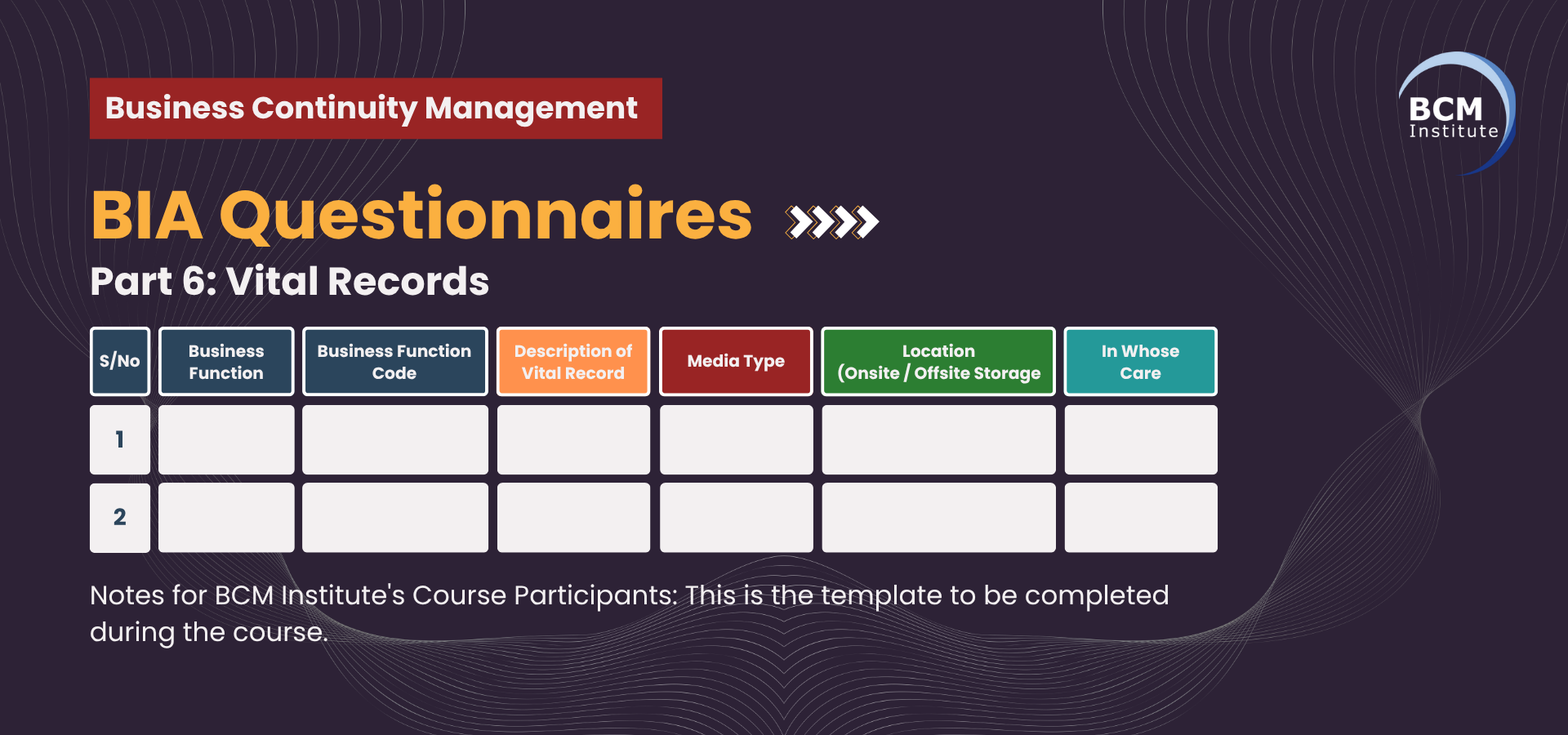
Vital records are the information assets that James Cook University Singapore (JCUS) must be able to access, use, reconstruct, or recover to continue **CBF-1 Teaching and Learning Delivery** during and following a disruption.
Within the Business Impact Analysis (BIA), identifying these records establishes the information requirements associated with each Sub-Critical Business Function and enables those requirements to be incorporated into business continuity, ICT recovery, records management, and information governance arrangements.
The vital-records assessment should focus on records whose loss, corruption, inaccessibility, or prolonged unavailability would materially impede teaching delivery or its recovery.
This is narrower than a general records inventory.
The BCM methodology underpinning BIA Part 6 specifically considers records needed to support individual business functions, their media, storage location, and responsible custodian, with particular attention to unique or difficult-to-replace records and electronic information that may not be adequately backed up.
[![Banner \[BCM\] \[E3\] \[BIA\] \[P6\] Vital Records](https://no-cache.hubspot.com/cta/default/3893111/6d3e4359-14f4-4816-b274-3f61b92be858.png)](https://cta-redirect.hubspot.com/cta/redirect/3893111/6d3e4359-14f4-4816-b274-3f61b92be858)
[Dr Goh Moh Heng](https://blog.bcm-institute.org/ebook/author/dr-goh-moh-heng) Oct 2, 2026
###### Business Continuity Management Certified Planner-Specialist-Expert
[![x \[BCM\] \[JCU\] Legal Disclaimer Banner](https://no-cache.hubspot.com/cta/default/3893111/e57030e6-3c63-46cc-988b-1eabb945de75.png)](https://cta-redirect.hubspot.com/cta/redirect/3893111/e57030e6-3c63-46cc-988b-1eabb945de75)
### [](https://cta-redirect.hubspot.com/cta/redirect/3893111/700da0e2-d784-4d4f-8a4c-4582ba360494)
[![Banner \[BCM\] \[E3\] \[BIA\] \[P6\] Vital Records](https://no-cache.hubspot.com/cta/default/3893111/6d3e4359-14f4-4816-b274-3f61b92be858.png)](https://cta-redirect.hubspot.com/cta/redirect/3893111/6d3e4359-14f4-4816-b274-3f61b92be858)
### CBF-1 Teaching and Learning Delivery
[![\[BCM\] \[JCU\] \[E3\] \[BIA\] \[T6\] \[CBF\] \[1\] Teaching and Learning Delivery](https://no-cache.hubspot.com/cta/default/3893111/bdb520b6-bc53-40cf-bc72-5e4eb5c2d1ae.png)](https://cta-redirect.hubspot.com/cta/redirect/3893111/bdb520b6-bc53-40cf-bc72-5e4eb5c2d1ae)
Vital records are the information assets that James Cook University Singapore (JCUS) must be able to access, use, reconstruct, or recover to continue **CBF-1 Teaching and Learning Delivery** during and following a disruption.
Within the Business Impact Analysis (BIA), identifying these records establishes the information requirements associated with each Sub-Critical Business Function and enables those requirements to be incorporated into business continuity, ICT recovery, records management, and information governance arrangements.
The vital-records assessment should focus on records whose loss, corruption, inaccessibility, or prolonged unavailability would materially impede teaching delivery or its recovery. This is narrower than a general records inventory.
The BCM methodology underpinning BIA Part 6 specifically considers records needed to support individual business functions, their media, storage location, and responsible custodian, with particular attention to unique or difficult-to-replace records and electronic information that may not be adequately backed up.
For JCUS, this requirement is particularly important because teaching delivery combines physical classrooms, academic staff, digital learning environments, timetabling information, teaching materials, attendance information, communications, and technology-enabled delivery.
JCUS identifies **StudentFirst** as the platform where students view their timetables and LearnJCU as an online academic environment that provides teaching materials, lecturer communications, and assessment-related information.
The vital-records assessment, therefore, needs to extend beyond conventional documents.
A teaching timetable stored in an academic planning system, the current version of a subject teaching plan, a class list, attendance records, published learning resources, laboratory safety instructions, records of cancelled or replacement classes, and approved continuity arrangements can all become essential information assets when normal teaching arrangements are disrupted.
#### **Relationship with Records Management and Information Governance**
Records Management, information governance, and Business Continuity Management perform complementary roles.
**Records Management** establishes how records are created, classified, retained, protected, retrieved, disposed of, and preserved throughout their lifecycle.
**Information governance** establishes accountability for the appropriate use, security, quality, confidentiality, integrity, and accessibility of information.
**Business Continuity Management** determines which information must remain available, or be recovered within an acceptable period, for prioritised activities to continue following disruption.
Integrating these disciplines ensures that JCUS not only retains information but can also retrieve the **right information, in an authoritative and usable form, when normal systems, premises, people, or service providers are unavailable**.
The need for reliable teaching records is also connected with JCUS's education-sector governance environment.
JCUS states that legal requirements under Singapore's private-education framework cover areas including courses, teachers, and premises, while EduTrust addresses areas such as academic processes and student support.
Consequently, records supporting teaching delivery may also provide evidence that approved academic activities were appropriately planned, delivered, changed, recovered, and completed.
#### **Protection of Electronic and Physical Records**
Electronic records constitute the primary vital-record medium for many teaching activities.
These records require appropriate access control, backup, replication, version control, cybersecurity protection, recovery arrangements, and alternative access methods.
However, do not disregard physical records.
Signed documents, laboratory documentation, locally maintained operational records, printed emergency teaching packs, specialist instructions, or other original records may still be required.
A fire, flood, security incident, or prolonged denial of access could make such records unavailable even when they remain physically intact.
JCUS should therefore apply protection proportionate to each record's importance and sensitivity, including secure electronic repositories, resilient backup arrangements, controlled physical storage, digitisation where appropriate, and tested recovery procedures.
The following register provides a working vital-records assessment for the 26 Sub-Critical Business Functions supporting **CBF-1 Teaching and Learning Delivery**.
Confirm exact repository names, system configurations, record owners, backup arrangements, and custodians with JCUS Academic, Learning and Teaching, Academic Planning, Learning Technologies, ICT, Facilities, Records/Information Governance, and other relevant functions during implementation.
[![Banner \[Table\] \[BCM\] \[E3\] \[BIA\] \[P6\] Vital Records \[BIAQ\]](https://no-cache.hubspot.com/cta/default/3893111/b44d6d49-dfb5-42a1-bc91-c0c701fc0724.png)](https://cta-redirect.hubspot.com/cta/redirect/3893111/b44d6d49-dfb5-42a1-bc91-c0c701fc0724)
Table BIA Part 6: Vital Records for CBF-1 Teaching and Learning Delivery
| Sub-CBF Code | Sub-Critical Business Function | Description of Vital Records | Media Type | Location | In Whose Care |
| --- | --- | --- | --- | --- | --- |
| 1.1 | Determine Teaching Delivery Requirements | Approved subject and programme requirements; subject outlines; teaching-mode requirements; academic calendars; teaching workload assumptions; delivery standards; current student cohort and subject-demand data | Electronic / Database Record | Academic Management Repository; Student Information System; controlled academic shared repository | Academic Planning; Academic Heads/Programme Leads |
| 1.2 | Confirm Subject and Class Offerings | Approved subject offerings; class-opening decisions; class capacity records; subject availability schedules; approved delivery modes; class cancellation or consolidation approvals | Electronic / Database Record | Student Information System; Academic Planning Repository | Academic Planning; Academic Administration |
| 1.3 | Determine Student Teaching Demand | Current enrolment data; subject registrations; class demand reports; cohort projections; waitlists; student allocation data; approved capacity adjustments | Database Record | Student Information System; Academic Planning reporting repository | Academic Planning; Enrolments/Student Administration |
| 1.4 | Allocate Academic Teaching Staff | Teaching allocation records; academic workload schedules; lecturer-to-subject assignments; availability records; approved replacement-teacher arrangements; relevant staff qualification/authorisation records | Electronic / Database Record | Academic Planning Repository; HR/Academic Staff System | Academic Heads; Academic Planning; Human Resources |
| 1.5 | Develop and Maintain Teaching Timetable | Master teaching timetable; class schedules; lecturer assignments; room allocations; timetable amendments; clash-resolution records; emergency timetable versions | Database Record / Electronic | StudentFirst/timetabling environment; Academic Planning Repository; secured continuity copy | Academic Planning |
| 1.6 | Allocate Teaching Rooms and Facilities | Room-allocation schedules; room capacities; accessibility requirements; specialist-room requirements; approved room changes; facility availability information | Electronic / Database Record | Timetabling/Facilities Systems; Academic Planning Repository | Academic Planning; Facilities Management |
| 1.7 | Prepare Teaching and Learning Materials | Current subject outlines; lesson plans; lecture materials; tutorial instructions; practical/laboratory instructions; teaching guides; essential readings and approved learning resources | Electronic | LearnJCU; controlled academic repository | Subject Coordinators; Academic Staff |
| 1.8 | Publish Digital Learning Materials | Published learning modules; lecture slides; digital readings; learning activities; subject announcements; links to required resources; publication/version records | Electronic / Cloud Storage | LearnJCU and associated approved learning repositories | Subject Coordinators; Academic Staff; Learning Technologies |
| 1.9 | Prepare Teaching Technology and Classroom Resources | Classroom technology requirements; teaching equipment configuration information; software requirements; equipment booking records; technology setup instructions; support procedures | Electronic | ICT/AV Service Repository; Facilities or Equipment Booking System | Learning Technologies; ICT; Facilities/AV Support |
| 1.10 | Deliver Face-to-Face Lectures and Classes | Current timetable; class lists; subject teaching plans; lesson materials; attendance information; classroom instructions; approved delivery changes | Electronic / Database Record | StudentFirst/timetabling environment; LearnJCU; attendance/student systems | Academic Staff; Subject Coordinators |
| 1.11 | Deliver Online or Remote Teaching | Online class schedules; virtual-session information; approved learning content; class lists; remote-teaching instructions; session records where required; alternative access instructions | Electronic / Cloud Storage | LearnJCU; approved online-teaching platforms; controlled academic repository | Academic Staff; Learning Technologies |
| 1.12 | Deliver Hybrid Teaching Activities | Hybrid delivery schedules; student participation arrangements; room and virtual-session information; learning materials; delivery instructions; attendance/participation records | Electronic / Database Record | LearnJCU; timetabling environment; approved collaboration platforms | Academic Staff; Academic Planning; Learning Technologies |
| 1.13 | Deliver Tutorials, Workshops and Interactive Learning | Tutorial/workshop schedules; facilitator allocations; class lists; activity instructions; teaching resources; participation records; room or online-session information | Electronic | LearnJCU; Academic Planning Repository; timetabling environment | Academic Staff; Subject Coordinators |
| 1.14 | Deliver Laboratory and Practical Teaching | Laboratory/practical schedules; class lists; laboratory manuals; experiment/procedure instructions; equipment requirements; safety procedures; risk assessments; required competency or access records | Hybrid (Electronic and Paper) | LearnJCU; Laboratory Controlled Repository; secure laboratory files | Laboratory/Technical Staff; Subject Coordinator; Academic Staff |
| 1.15 | Provide Academic Consultation and Learning Guidance | Academic consultation schedules; relevant student academic information; approved guidance resources; referral information; records of material academic advice where retention is required | Electronic / Database Record | Approved student/academic systems; secure academic repository | Academic Staff; Academic Support/Learning Centre |
| 1.16 | Monitor Student Attendance and Participation | Attendance registers; electronic attendance data; participation records where required; authorised absence information; attendance exception reports; correction/audit records | Database Record / Electronic | Approved attendance/student management system; secure reporting repository | Academic Staff; Student Administration |
| 1.17 | Monitor Teaching Delivery and Class Completion | Teaching completion records; scheduled-versus-delivered class reports; cancelled/postponed class records; lecturer confirmations; outstanding teaching registers; remediation status | Electronic / Database Record | Academic Planning/Quality Repository; controlled shared repository | Academic Heads; Academic Planning; Subject Coordinators |
| 1.18 | Manage Academic Staff Unavailability | Staff teaching assignments; absence notifications relevant to teaching continuity; replacement lecturer lists; approved substitution records; revised teaching schedules; escalation/contact information | Electronic / Database Record | HR System; Academic Planning Repository; secured continuity contact register | Academic Heads; Human Resources; Academic Planning |
| 1.19 | Manage Teaching Facility Disruption | Affected-room schedules; alternative-room inventory; facility status reports; relocation plans; emergency access information; revised timetable; facility incident records | Electronic | Facilities Management System; Academic Planning Repository; BCM Repository | Facilities Management; Academic Planning; BCM Coordinator |
| 1.20 | Manage Digital Learning or ICT Disruption | ICT incident records; affected-service information; system recovery procedures; continuity workarounds; alternate teaching-platform instructions; service restoration status; critical system contact/escalation information | Electronic | ICT Service Management Repository; IT DR/BCM Repository; secured alternate repository | ICT; Learning Technologies; BCM/IT DR Teams |
| 1.21 | Communicate Teaching Changes to Students and Staff | Approved disruption messages; affected-class distribution lists; timetable-change notices; email/portal announcements; communication approvals; communication logs; current stakeholder contact information | Electronic | Official email system; LearnJCU; student communications platforms; communications repository | Academic Planning; Academic Staff; Corporate/Student Communications |
| 1.22 | Provide Accessible and Alternative Teaching Arrangements | Approved accessibility requirements relevant to teaching; alternative-delivery arrangements; adjusted learning-material requirements; approved accommodation records; accessible-format teaching resources | Electronic / Database Record | Secure Student Support Repository; LearnJCU; approved academic systems | Student Support/Accessibility Services; Academic Staff |
| 1.23 | Prioritise Teaching During Major Disruption | Prioritised teaching schedule; critical subject/class register; disruption impact assessment; prioritisation decisions; academic calendar constraints; resource availability information; continuity strategy and decision logs | Electronic | BCM Repository; Academic Planning Repository; secured continuity workspace | Senior Academic Management; Academic Planning; BCM Team |
| 1.24 | Recover Missed or Interrupted Teaching | Register of missed classes; recovery teaching schedule; replacement class approvals; lecturer and room allocations; student notifications; alternative-delivery arrangements; recovery progress records | Electronic / Database Record | Academic Planning Repository; timetabling environment; LearnJCU | Academic Planning; Subject Coordinators; Academic Heads |
| 1.25 | Reconcile and Confirm Teaching Completion | Scheduled-versus-completed teaching reconciliation; outstanding class records; make-up class completion evidence; lecturer confirmations; exception reports; approved closure records | Electronic / Database Record | Academic Quality/Planning Repository; controlled academic records repository | Academic Planning; Academic Heads; Subject Coordinators |
| 1.26 | Return Teaching Operations to Normal | Normalisation plan; restored master timetable; temporary-arrangement closure records; unresolved teaching backlog; recovery completion reports; lessons identified; management approvals; post-disruption action register | Electronic | BCM Repository; Academic Planning Repository; Records Management Repository | Academic Management; Academic Planning; BCM Coordinator |
#### **Applying the Vital-Records Assessment**
Do not treat the table solely as documentation for the BIA.
Evaluate each identified vital record against the disruption scenarios that could make it unavailable.
For example, a timetable may exist electronically but still be unavailable if the primary application is inaccessible.
Teaching materials may be backed up but unusable if academic staff cannot authenticate remotely.
A laboratory procedure may exist only as a printed controlled copy inside an inaccessible laboratory.
Contact information may be stored in a system affected by the same outage that creates the need for emergency communications.
For each material record set, JCUS should therefore confirm:
- **Authoritative source** — which repository contains the official or current version?
- **Accessibility during disruption** — whether authorised personnel can retrieve it if the normal campus, network, application, or device is unavailable.
- **Recovery requirement** — how quickly the information must become available relative to the recovery requirement of the Sub-CBF it supports.
- **Protection and redundancy** — whether appropriate backup, replication, alternate storage, or protected physical copies exist.
- **Integrity and version control** — how JCUS ensures personnel use the current, approved record during recovery.
- **Security and privacy** — whether alternate access arrangements preserve appropriate confidentiality, access controls, and information-governance requirements.
- **Custodianship** — who is accountable for maintaining the record, controlling access, validating its currency, and ensuring that recovery arrangements remain effective.
These controls are particularly important for records that exist only within a primary production environment or at a single physical location.
The underlying BIA vital-record methodology highlights both unique/non-replaceable records and electronic records whose backup arrangements may be insufficient as areas requiring attention.
#### **Records Requiring Heightened Continuity Protection**
Within CBF-1, several record groups deserve heightened continuity attention because they enable multiple teaching activities simultaneously.
The **master teaching timetable and associated class allocations** provide the operational reference for when, where, and by whom teaching should occur.
JCUS publicly identifies StudentFirst as the place where students access timetable information.
A continuity-accessible version of current timetable information would therefore be important when normal timetable services are unavailable.
The **teaching and learning materials held within the learning environment** are similarly important.
JCUS identifies LearnJCU as providing students with access to teaching materials, lecturer communications, and assessment information, while its Learning Technologies function supports the LMS ecosystem.
These materials should consequently be incorporated into application recovery, backup, access-continuity, and cyber-recovery considerations.
**Student attendance and participation information** can also have continuity and governance significance.
JCUS states that students are expected to attend the learning and teaching sessions associated with their programmes.
Therefore, apply appropriate availability and integrity controls to attendance information required during disruption and subsequent reconciliation.
Finally, **recovery records created during the disruption itself** become vital records.
Decisions about cancelled classes, temporary delivery modes, substitute lecturers, revised schedules, student communications, make-up classes, and eventual return to normal operations provide the evidence required to control recovery and demonstrate what occurred.
[![Banner \[BCM\] \[E3\] \[BIA\] \[Summing Up\] \[P6\] Vital Records \[BIAQ\]](https://no-cache.hubspot.com/cta/default/3893111/06d76589-ebcf-4c9f-8e5b-c27f02938eed.png)](https://cta-redirect.hubspot.com/cta/redirect/3893111/06d76589-ebcf-4c9f-8e5b-c27f02938eed)
Identifying vital records is a fundamental component of Business Continuity Planning because a business function cannot be recovered by restoring personnel, premises, technology, and suppliers alone.
Personnel must also have access to the information required to make decisions and perform the activity.
For **CBF-1 Teaching and Learning Delivery**, this means ensuring that teaching schedules, subject information, class lists, teaching resources, attendance information, laboratory instructions, academic staff allocations, disruption communications, recovery schedules, and completion records remain appropriately protected and recoverable.
Effective vital-records management also supports JCUS's wider regulatory and governance obligations.
Reliable records provide evidence of what was planned, what was delivered, what was interrupted, what alternative arrangements were implemented, and whether outstanding teaching obligations were subsequently completed.
This supports accountability and operational recovery.
Records Management provides the lifecycle controls that preserve authenticity, integrity, accessibility, retention, and appropriate disposal.
BCM adds the continuity perspective by asking whether critical records will still be **available when the normal operating environment is not**.
ICT recovery provides the technical capabilities for electronic information, while information governance ensures emergency access does not undermine confidentiality, integrity, privacy, or security.
Clear custodianship is therefore essential.
Every vital record should have an identified business owner or custodian responsible for maintaining its accuracy, controlling its use, and ensuring that appropriate protection and recovery arrangements are in place.
Custodians should periodically verify that alternate copies, backups, repositories, and recovery procedures remain current and usable.
JCUS should incorporate the vital-records register into its ongoing BCM lifecycle and review it whenever there are material changes to subjects, teaching modes, academic systems, learning technologies, facilities, organisational responsibilities, regulatory requirements, or third-party services.
The ultimate objective is not simply to preserve records. It is to ensure that **authorised JCUS personnel can obtain accurate, current, protected, and usable information within the time required to continue or recover Teaching and Learning Delivery**.
When this capability is integrated across Business Continuity Management, Records Management, ICT recovery, and information governance, vital-records management becomes an important contributor to institutional resilience and to the long-term integrity of JCUS's academic information assets.
[](https://cta-redirect.hubspot.com/cta/redirect/3893111/3aefb2d2-3110-47c1-ad4f-d3e6e5381066)
[![\[BCM\] \[JCU\] \[3/4 Banner\] Business Continuity Management Implementation at JCU Singapore](https://no-cache.hubspot.com/cta/default/3893111/d81098d9-9f30-4c17-a897-2fc202440adc.png)](https://cta-redirect.hubspot.com/cta/redirect/3893111/d81098d9-9f30-4c17-a897-2fc202440adc)
| **eBook 3: Starting Your BCM Implementation** | | | | | | |
| --- | --- | --- | --- | --- | --- | --- |
| **MBCO** | **P&S** | **RAR T1** | **RAR T2** | **RAR T3** | **BCS T1** | **CBF** |
| [![\[BCM\] \[JCU\] \[E3\] \[BIA\] MBCO Corporate MBCO](https://no-cache.hubspot.com/cta/default/3893111/37db16b1-9a61-4815-adbb-527771b7bd35.png)](https://cta-redirect.hubspot.com/cta/redirect/3893111/37db16b1-9a61-4815-adbb-527771b7bd35) | [![\[BCM\] \[JCU\] \[E3\] \[BIA\] \[PS\] Key Product and Services](https://no-cache.hubspot.com/cta/default/3893111/3117a3bf-33fd-4522-a373-4ce343e253a6.png)](https://cta-redirect.hubspot.com/cta/redirect/3893111/3117a3bf-33fd-4522-a373-4ce343e253a6) | [![\[BCM\] \[JCU\] \[E3\] \[RAR\] \[T1\] List of Threats](https://no-cache.hubspot.com/cta/default/3893111/de614923-e16d-4c4b-878e-60b97f56183f.png)](https://cta-redirect.hubspot.com/cta/redirect/3893111/de614923-e16d-4c4b-878e-60b97f56183f) | [![\[BCM\] \[JCU\] \[E3\] \[RAR\] \[T2\] Treatment and Control](https://no-cache.hubspot.com/cta/default/3893111/71606f66-523b-41e0-af99-19f5e4cc2f37.png)](https://cta-redirect.hubspot.com/cta/redirect/3893111/71606f66-523b-41e0-af99-19f5e4cc2f37) | [![\[BCM\] \[JCU\] \[E3\] \[RAR\] \[T3\] Risk Impact and Likelihood Assessment](https://no-cache.hubspot.com/cta/default/3893111/0192071d-0c49-4a20-a2a8-f0894418f873.png)](https://cta-redirect.hubspot.com/cta/redirect/3893111/0192071d-0c49-4a20-a2a8-f0894418f873) | [![\[BCM\] \[JCU\] \[E3\] \[BCS\] \[T1\] Mitigation Strategies and Justification](https://no-cache.hubspot.com/cta/default/3893111/12b9c723-7ba3-4523-a1c2-0e75dc09a4e3.png)](https://cta-redirect.hubspot.com/cta/redirect/3893111/12b9c723-7ba3-4523-a1c2-0e75dc09a4e3) | [![\[BCM\] \[JCU\] \[E1\] \[C10\] Identifying Critical Business Functions](https://no-cache.hubspot.com/cta/default/3893111/b7aaf4cf-e4f4-4e31-bb8f-6885a5f2203d.png)](https://cta-redirect.hubspot.com/cta/redirect/3893111/b7aaf4cf-e4f4-4e31-bb8f-6885a5f2203d) |
| **CBF-1 Teaching and Learning Delivery** | | | | | | |
| **DP** | **BIAQ P1** | **BIAQ P2** | **BIAQ P3** | **BIAQ P4** | **BIAQ P5** | **BIAQ P6** |
| [![\[BCM\] \[JCU\] \[E3\] \[BIA\] \[DP\] \[CBF\] \[1\] Teaching and Learning Delivery](https://no-cache.hubspot.com/cta/default/3893111/87dc20a3-b9ed-454a-90ee-2ca3e2419322.png)](https://cta-redirect.hubspot.com/cta/redirect/3893111/87dc20a3-b9ed-454a-90ee-2ca3e2419322) | **[![\[BCM\] \[JCU\] \[E3\] \[BIA\] \[T1\] \[CBF\] \[1\] Teaching and Learning Delivery](https://no-cache.hubspot.com/cta/default/3893111/c0d85e4b-2df7-44ee-9c25-4112e99a64f3.png)](https://cta-redirect.hubspot.com/cta/redirect/3893111/c0d85e4b-2df7-44ee-9c25-4112e99a64f3)** | **[![\[BCM\] \[JCU\] \[E3\] \[BIA\] \[T2\] \[CBF\] \[1\] Teaching and Learning Delivery](https://no-cache.hubspot.com/cta/default/3893111/3d5d03b2-0465-4e70-8920-efbaf80a835c.png)](https://cta-redirect.hubspot.com/cta/redirect/3893111/3d5d03b2-0465-4e70-8920-efbaf80a835c)** | **[![\[BCM\] \[JCU\] \[E3\] \[BIA\] \[T3\] \[CBF\] \[1\] Teaching and Learning Delivery](https://no-cache.hubspot.com/cta/default/3893111/4107cc4d-b5ca-486c-bca0-d2a049b8c752.png)](https://cta-redirect.hubspot.com/cta/redirect/3893111/4107cc4d-b5ca-486c-bca0-d2a049b8c752)** | **[![\[BCM\] \[JCU\] \[E3\] \[BIA\] \[T4\] \[CBF\] \[1\] Teaching and Learning Delivery](https://no-cache.hubspot.com/cta/default/3893111/e9bd80ac-aa4d-4da0-873e-92bb036ae9c9.png)](https://cta-redirect.hubspot.com/cta/redirect/3893111/e9bd80ac-aa4d-4da0-873e-92bb036ae9c9)** | **[![\[BCM\] \[JCU\] \[E3\] \[BIA\] \[T5\] \[CBF\] \[1\] Teaching and Learning Delivery](https://no-cache.hubspot.com/cta/default/3893111/7c619369-8c50-4876-a478-749b847adee0.png)](https://cta-redirect.hubspot.com/cta/redirect/3893111/7c619369-8c50-4876-a478-749b847adee0)** | **[![\[BCM\] \[JCU\] \[E3\] \[BIA\] \[T6\] \[CBF\] \[1\] Teaching and Learning Delivery](https://no-cache.hubspot.com/cta/default/3893111/bdb520b6-bc53-40cf-bc72-5e4eb5c2d1ae.png)](https://cta-redirect.hubspot.com/cta/redirect/3893111/bdb520b6-bc53-40cf-bc72-5e4eb5c2d1ae)** |
| | | **BCS T2** | **BCS T3** | **PD** | | |
| | | [![\[BCM\] \[JCU\] \[E3\] \[BCS\] \[T2\] \[CBF\] \[1\] Teaching and Learning Delivery](https://no-cache.hubspot.com/cta/default/3893111/10a04273-213c-4b93-a69a-966039c382bb.png)](https://cta-redirect.hubspot.com/cta/redirect/3893111/10a04273-213c-4b93-a69a-966039c382bb) | [![\[BCM\] \[JCU\] \[E3\] \[BCS\] \[T3\] \[CBF\] \[1\] Teaching and Learning Delivery](https://no-cache.hubspot.com/cta/default/3893111/d2ec73f8-a65d-473f-9a70-afa20ac0b990.png)](https://cta-redirect.hubspot.com/cta/redirect/3893111/d2ec73f8-a65d-473f-9a70-afa20ac0b990) | [![\[BCM\] \[JCU\] \[E3\] \[PD\] \[CBF\] \[1\] Teaching and Learning Delivery](https://no-cache.hubspot.com/cta/default/3893111/41fe68b0-13dc-4690-bd61-369c6da03192.png)](https://cta-redirect.hubspot.com/cta/redirect/3893111/41fe68b0-13dc-4690-bd61-369c6da03192) | | |
| | | | | | | |
#### More Information About Business Continuity Management Courses
To learn more about the course and schedule, click the buttons below for the BCM-300 Business Continuity Management Implementer \[BCM-3\] and the BCM-5000 Business Continuity Management Expert Implementer \[BCM-5\].
| [](https://cta-redirect.hubspot.com/cta/redirect/3893111/f3922b80-e96a-46d6-8993-dc150a5de2d5) | [](https://cta-redirect.hubspot.com/cta/redirect/3893111/9ff8a3dc-e39a-465b-929f-72e232cdd5fb) | [![Register \[BL-B-3\]\*](https://no-cache.hubspot.com/cta/default/3893111/ac6cf073-4cdd-4541-91ed-889f731d5076.png)](https://cta-redirect.hubspot.com/cta/redirect/3893111/ac6cf073-4cdd-4541-91ed-889f731d5076) |
| --- | --- | --- |
| [](https://cta-redirect.hubspot.com/cta/redirect/3893111/21525c10-4003-4934-95fc-fe218174bc5b) | [](https://cta-redirect.hubspot.com/cta/redirect/3893111/46460171-c91a-4936-9bb2-8dc5928a0e02) | [](https://cta-redirect.hubspot.com/cta/redirect/3893111/1cb17ac7-50b2-4f88-bc4b-c7444e4b57b5) |
| [![FAQ \[BL-B-3\]](https://no-cache.hubspot.com/cta/default/3893111/b3824ba1-7aa1-4eb6-bef8-94f57121c5ae.png)](https://cta-redirect.hubspot.com/cta/redirect/3893111/b3824ba1-7aa1-4eb6-bef8-94f57121c5ae) | Please feel free to send us a note if you have any questions. [![Email to Sales Team \[BCM Institute\]](https://no-cache.hubspot.com/cta/default/3893111/3c53daeb-2836-4843-b0e0-645baee2ab9e.png)](https://cta-redirect.hubspot.com/cta/redirect/3893111/3c53daeb-2836-4843-b0e0-645baee2ab9e) | [](https://cta-redirect.hubspot.com/cta/redirect/3893111/9c199ae8-c470-4bb7-9612-73c7a084e94c) |
| [](https://cta-redirect.hubspot.com/cta/redirect/3893111/8999211a-2c51-4be7-bf49-c393f6c67974) | [](https://cta-redirect.hubspot.com/cta/redirect/3893111/5c1aa95d-f6dd-4067-a95c-5cc0c32d7ed8) | [](https://cta-redirect.hubspot.com/cta/redirect/3893111/086ab3b9-4d66-4a95-b2f7-1148e9803a9c) |
#### **Your Comments Here:**
### More Posts
[](https://cta-redirect.hubspot.com/cta/redirect/3893111/839787f4-a4fd-456f-accf-54c947026558)

All rights reserved. Copyright 2026
```json
{
"@context" : "https://schema.org",
"@type" : "BlogPosting",
"author" : {
"@type" : "Person",
"name" : "Dr Goh Moh Heng",
"url" : "https://blog.bcm-institute.org/ebook/author/dr-goh-moh-heng"
},
"dateModified" : "2026-10-02T12:25:37.544Z",
"datePublished" : "2026-10-02T07:45:58.000Z",
"headline" : "[BCM] [JCUS] [E3] [BIA] [P6] [CBF] [1] Teaching and Learning Delivery",
"mainEntityOfPage" : {
"@id" : "https://blog.bcm-institute.org/ebook/bcm-jcus-e3-bia-p6-cbf-1-teaching-and-learning-delivery",
"@type" : "WebPage"
},
"publisher" : {
"@type" : "Organization",
"logo" : {
"@type" : "ImageObject",
"url" : "https://blog.bcm-institute.org/hubfs/BCMI%20Logo.png"
},
"name" : "BCMI Pte Ltd"
}
}
```