---
title: [BCM] [JCUS] [E3] [BIA] [P5] [CBF] [1] Teaching and Learning Delivery
description: [BCM] [JCUS] [E3] [BIA] [P5] [CBF] [1] Teaching and Learning Delivery
image: https://blog.bcm-institute.org/hubfs/JCU%20Graphic%20Folder/JCU%20CBF%201%20Morepost/%5BBCM%5D%20%5BJCU%5D%20%5BE3%5D%20%5BBIA%5D%20%5BT5%5D%20%5BCBF%5D%20%5B1%5D%20Teaching%20and%20Learning%20Delivery.jpg
---
. .
[](http://www.bcm-institute.org/)
- [Home](https://www.bcm-institute.org/)
- [About Us](https://www.bcm-institute.org/about-us-3/)
- [A President’s Perspective](https://www.bcm-institute.org/about-us/a-presidents-perspective/)
- [Our History](https://www.bcm-institute.org/about-us/our-history/)
- [Our Advisory Council](https://www.bcm-institute.org/about-us/our-advisory-council/)
- [Customers’ Testimonials](https://www.bcm-institute.org/about-us/customers-testimonials/)
- [Credential Verification](https://www.bcm-institute.org/about-us/credential-verification/)
- [Courses](https://blog.bcm-institute.org/blog/course-fees-for-blended-learning-courses-master-catalog)
- [ISO 22301 Business Continuity Management System Audit](https://blog.bcm-institute.org/audit/business-continuity-management-audit-courses)
- [ISO 22301 Business Continuity Management](https://blog.bcm-institute.org/bcm/business-continuity-management-courses)
- [Crisis Communication](https://blog.bcm-institute.org/crisis-communication/crisis-communication-courses)
- [Crisis Management](https://blog.bcm-institute.org/en/crisis-management/courses)
- [IT Disaster Recovery](https://blog.bcm-institute.org/it-disaster-recovery/courses)
- [Operational Resilience](https://blog.bcm-institute.org/operational-resilience/courses)
- [Operational Resilience Audit](https://blog.bcm-institute.org/operational-resilience-audit/courses)
- [Certification](https://blog.bcm-institute.org/certification/types-of-certifications-offered)
- [ISO 22301 BCMS Audit Certification](https://blog.bcm-institute.org/certification/business-continuity-management-audit-certification)
- [ISO22301 Business Continuity Management Certification](https://blog.bcm-institute.org/bcm/business-continuity-management-certification)
- [Crisis Communication Certification](https://blog.bcm-institute.org/crisis-communication/crisis-communication-certification)
- [Crisis Management Certification](https://blog.bcm-institute.org/en/crisis-management/crisis-management-certification)
- [IT Disaster Recovery Planning Certification](https://blog.bcm-institute.org/it-disaster-recovery/it-disaster-recovery-certification)
- [Operational Resilience Certification](https://blog.bcm-institute.org/operational-resilience/operational-resilience-certification)
- [Operational Resilience Audit Certification](https://blog.bcm-institute.org/operational-resilience-audit)
- [Seminars](https://blog.bcm-institute.org/meet-the-expert/mte-webinar-mainpage)
- [Store](https://www.bcm-institute.org/store-2/)
- [Contact Us](http://www.bcm-institute.org/about-us/contact-us/)
-
-
##### Institutional Resilience in Action: Business Continuity Management Implementation at JCU Singapore

# \[BCM\] \[JCUS\] \[E3\] \[BIA\] \[P5\] \[CBF\] \[1\] Teaching and Learning Delivery
[![\[BCM\] \[JCU\] \[Full Banner\] Business Continuity Management Implementation at JCU Singapore](https://no-cache.hubspot.com/cta/default/3893111/c28ce2ee-dfaa-4e23-b28a-6ae8ca285f06.png)](https://cta-redirect.hubspot.com/cta/redirect/3893111/c28ce2ee-dfaa-4e23-b28a-6ae8ca285f06)
A Business Impact Analysis (BIA) should examine not only the activities performed within a Critical Business Function (CBF), but also the people, organisational units, technologies, facilities, suppliers, information, and services on which those activities depend.
A Sub-Critical Business Function may appear recoverable in isolation, but may still be unable to operate if a critical supporting dependency is unavailable.
For James Cook University Singapore (JCUS), **CBF-1 Teaching and Learning Delivery** operates through an interconnected academic service environment.
Teaching depends on academic staff, academic administration, student information, timetabling, teaching facilities, learning technologies, ICT infrastructure, communications, and various externally provided services.
The disruption of any significant dependency can therefore affect the University's ability to maintain scheduled teaching and provide students with appropriate alternative learning arrangements.
[![Banner \[BCM\] \[E3\] \[BIA\] \[P5\] Inter-dependencies](https://no-cache.hubspot.com/cta/default/3893111/c7d00b8b-77c0-43ee-a2cf-76ea43b26fe8.png)](https://cta-redirect.hubspot.com/cta/redirect/3893111/c7d00b8b-77c0-43ee-a2cf-76ea43b26fe8)
[Dr Goh Moh Heng](https://blog.bcm-institute.org/ebook/author/dr-goh-moh-heng) Oct 2, 2026
###### Business Continuity Management Certified Planner-Specialist-Expert
[![x \[BCM\] \[JCU\] Legal Disclaimer Banner](https://no-cache.hubspot.com/cta/default/3893111/e57030e6-3c63-46cc-988b-1eabb945de75.png)](https://cta-redirect.hubspot.com/cta/redirect/3893111/e57030e6-3c63-46cc-988b-1eabb945de75)
[](https://cta-redirect.hubspot.com/cta/redirect/3893111/1ff9c1d3-8fe0-4fff-905c-389cea69b26e)
[![Banner \[BCM\] \[E3\] \[BIA\] \[P5\] Inter-dependencies](https://no-cache.hubspot.com/cta/default/3893111/c7d00b8b-77c0-43ee-a2cf-76ea43b26fe8.png)](https://cta-redirect.hubspot.com/cta/redirect/3893111/c7d00b8b-77c0-43ee-a2cf-76ea43b26fe8)
### CBF-1 Teaching and Learning Delivery
[![\[BCM\] \[JCU\] \[E3\] \[BIA\] \[T5\] \[CBF\] \[1\] Teaching and Learning Delivery](https://no-cache.hubspot.com/cta/default/3893111/7c619369-8c50-4876-a478-749b847adee0.png)](https://cta-redirect.hubspot.com/cta/redirect/3893111/7c619369-8c50-4876-a478-749b847adee0)
A Business Impact Analysis (BIA) should examine not only the activities performed within a Critical Business Function (CBF), but also the people, organisational units, technologies, facilities, suppliers, information, and services on which those activities depend.
A Sub-Critical Business Function may appear recoverable in isolation, but may still be unable to operate if a critical supporting dependency is unavailable.
For James Cook University Singapore (JCUS), **CBF-1 Teaching and Learning Delivery** operates through an interconnected academic service environment.
Teaching depends on academic staff, academic administration, student information, timetabling, teaching facilities, learning technologies, ICT infrastructure, communications, and various externally provided services.
Disruption to any significant dependency can therefore affect the University's ability to maintain scheduled teaching and provide students with appropriate alternative learning arrangements.
Dependency mapping during the BIA provides a structured way to identify these relationships.
It enables JCUS to determine which supporting parties and services must be available before teaching activities can operate, which other activities depend on the outputs of teaching processes, and where reciprocal relationships create shared recovery requirements.
Dependencies can generally be considered from three directions:
**Upstream dependencies** provide resources, information, technology, facilities, approvals or services required before or during the performance of a Sub-CBF.
Examples include ICT services required to operate a digital learning platform or academic staffing information required to prepare the teaching timetable.
**Downstream dependencies** occur where the output of a Sub-CBF is required by another process or stakeholder.
For example, confirmation that scheduled teaching has been completed may provide information required for academic administration, assurance, and subsequent academic activities.
**Mutual dependencies** exist where two parties or functions continuously rely upon each other.
Academic teaching and learning technology support, for example, may have a mutual relationship during hybrid teaching because teaching requires functioning technology while ICT support requires information from teaching staff about incidents, service priorities, and classroom requirements.
Dependencies should also be distinguished between **internal dependencies**, which exist within JCUS, and **external dependencies**, which involve third-party organisations such as telecommunications providers, cloud or software service providers, specialist equipment vendors and other contracted service providers.
Understanding these relationships strengthens Business Continuity Planning by identifying the capabilities that must be recovered together rather than independently.
It also provides useful information for Third-Party Risk Management (TPRM), supplier resilience, ICT continuity and operational resilience by identifying external services whose disruption could prevent JCUS from delivering priority teaching activities within required recovery timeframes.
#### [![Banner \[Table\] \[BCM\] \[E3\] \[BIA\] \[P5\] Inter-dependencies \[BIAQ\]](https://no-cache.hubspot.com/cta/default/3893111/ed6152ff-4926-4fae-bd6b-ba572bcc781b.png)](https://cta-redirect.hubspot.com/cta/redirect/3893111/ed6152ff-4926-4fae-bd6b-ba572bcc781b)
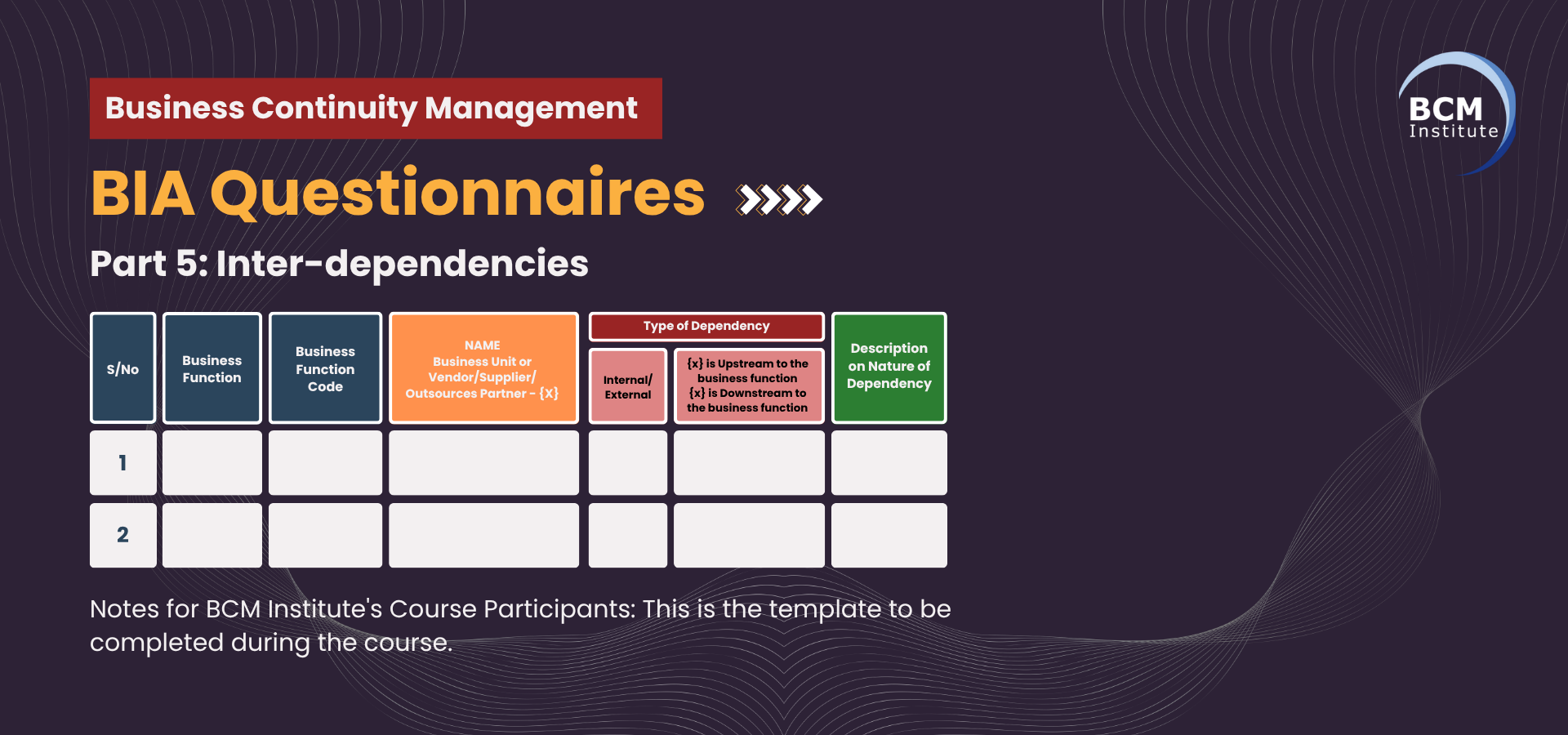
Table BIA Part 5: Inter-dependencies for CBF-1 Teaching and Learning Delivery
| Sub-CBF Code | Sub-Critical Business Function | Business Unit / Vendor / Supplier / Outsourcing Partner | Internal Depend-ency | External Depend-ency | Dependency Direction (Upstream / Downstream / Mutual) | Description of the Nature of Dependency |
| --- | --- | --- | --- | --- | --- | --- |
| 1.1 | Determine Teaching Delivery Requirements | Academic Leadership / Academic Administration | Yes | No | Upstream | Provides curriculum requirements, academic calendars, delivery expectations and programme information required to establish teaching needs. Unavailability may delay identification of classes, delivery modes, staffing and resource requirements. |
| 1.2 | Confirm Subject and Class Offerings | Academic Administration / Programme Management | Yes | No | Mutual | Programme and academic administration coordinate subject availability, class structures and delivery requirements. Delayed confirmation may affect enrolment, timetabling, staffing and communication of available classes. |
| 1.3 | Determine Student Teaching Demand | Student Administration / Student Information Management | Yes | No | Upstream | Provides enrolment, registration and projected student-number information used to determine class demand, teaching capacity and resource requirements. Unavailable or inaccurate data may result in inappropriate class allocations or capacity. |
| 1.4 | Allocate Academic Teaching Staff | Human Resources / Academic Schools | Yes | No | Mutual | Academic units provide teaching requirements while HR and academic management provide staff availability, employment and workload information. Disruption may prevent timely assignment or replacement of teaching personnel. |
| 1.5 | Develop and Maintain Teaching Timetable | Academic Administration / Timetabling Function | Yes | No | Mutual | Exchanges class requirements, staff availability, student demand and room information to create and maintain the teaching timetable. Loss of this capability can create scheduling conflicts and prevent coordinated teaching delivery. |
| 1.6 | Allocate Teaching Rooms and Facilities | Facilities Management | Yes | No | Mutual | Provides information on room availability, capacity, accessibility, safety and facility status. Teaching requirements in turn determine room demand. Disruption can prevent physical classes from proceeding or require relocation. |
| 1.7 | Prepare Teaching and Learning Materials | Academic Staff / Academic Schools | Yes | No | Upstream | Academic staff develop and maintain teaching content, readings, exercises and instructional materials. Staff or information unavailability may delay preparation and reduce the ability to conduct scheduled classes. |
| 1.8 | Publish Digital Learning Materials | Learning Management System / ICT Services | Yes | No | Mutual | Academic staff rely on digital platforms and ICT services to upload and distribute learning materials, while ICT support relies on user information to resolve service issues. Platform disruption may prevent students from accessing required learning content. |
| 1.9 | Prepare Teaching Technology and Classroom Resources | ICT Services / Learning Technology Support | Yes | No | Upstream | Provides classroom computers, audiovisual facilities, connectivity, teaching applications and technical readiness. Failure may prevent technology-dependent classroom, online or hybrid teaching. |
| 1.10 | Deliver Face-to-Face Lectures and Classes | Facilities Management | Yes | No | Upstream | Provides safe and accessible classrooms, utilities and physical teaching facilities. Building closure, utility failure or loss of room access may prevent scheduled face-to-face teaching. |
| 1.11 | Deliver Online or Remote Teaching | Telecommunications / Internet Service Provider | No | Yes | Upstream | Provides external connectivity required by academic staff and students to access virtual teaching and learning services. Major connectivity disruption may prevent or significantly degrade remote teaching. |
| 1.12 | Deliver Hybrid Teaching Activities | ICT Services / Learning Technology Support | Yes | No | Mutual | Hybrid teaching depends on classroom technology, conferencing services, network connectivity and real-time technical support. Technology support also requires teaching schedules and incident information. Failure may affect both on-campus and remote participants. |
| 1.13 | Deliver Tutorials, Workshops and Interactive Learning | Academic Schools / Teaching Staff | Yes | No | Mutual | Requires appropriately assigned academic staff, teaching materials, class information and interaction with students. Staff shortages or unavailable learning resources may result in postponement or reduced learning engagement. |
| 1.14 | Deliver Laboratory and Practical Teaching | Laboratory / Technical Support | Yes | No | Mutual | Provides laboratories, specialist equipment, consumables, technical supervision and safety controls. Teaching requirements determine resource preparation. Loss of laboratory access or technical capability may prevent practical teaching. |
| 1.15 | Provide Academic Consultation and Learning Guidance | Academic Staff / Student Support Services | Yes | No | Mutual | Academic staff and support services exchange student needs, availability and referral information to provide appropriate guidance. Staff or communication disruption may delay time-sensitive academic support. |
| 1.16 | Monitor Student Attendance and Participation | Student Information / Attendance Management Services | Yes | No | Downstream | Teaching activities generate attendance and participation information required for academic administration and student monitoring. Failure to capture or transmit information may affect follow-up, records and compliance processes. |
| 1.17 | Monitor Teaching Delivery and Class Completion | Academic Administration / Academic Leadership | Yes | No | Downstream | Teaching staff provide delivery and completion information for oversight of scheduled classes. Loss of reporting information may prevent management from identifying missed teaching or determining required recovery actions. |
| 1.18 | Manage Academic Staff Unavailability | Human Resources / Academic Leadership | Yes | No | Mutual | HR and academic leadership provide absence, staffing and replacement information while academic units identify teaching priorities and substitute requirements. Delays may lead to cancelled or postponed classes. |
| 1.19 | Manage Teaching Facility Disruption | Facilities Management / Campus Operations | Yes | No | Mutual | Facilities teams provide incident status, building accessibility and alternative-room information, while academic units provide teaching priorities and occupancy requirements. Weak coordination may prolong teaching disruption. |
| 1.20 | Manage Digital Learning or ICT Disruption | ICT Services / External Technology Service Providers | Yes | No | Mutual | ICT teams coordinate incident diagnosis, restoration priorities, workarounds and service status with academic users. Failure to restore critical digital services may prevent online, hybrid or technology-dependent teaching. External technology providers should additionally be recorded in the detailed supplier dependency register. |
| 1.21 | Communicate Teaching Changes to Students and Staff | Corporate Communications / Student Communications | Yes | No | Mutual | Receives verified information on cancellations, relocation, alternative delivery and recovery arrangements and distributes messages through approved channels. Communication failure may cause confusion, missed classes or unsafe attendance at unavailable locations. |
| 1.22 | Provide Accessible and Alternative Teaching Arrangements | Student Support / Accessibility Services | Yes | No | Mutual | Provides information on accessibility requirements and suitable alternative arrangements while academic staff identify teaching options. Loss of coordination may prevent affected students from participating appropriately during disruption. |
| 1.23 | Prioritise Teaching During Major Disruption | Executive Management / Academic Leadership | Yes | No | Upstream | Provides strategic direction, disruption priorities and decisions concerning which teaching activities should continue, relocate, move online, be deferred or recover first. Delayed decisions may lead to inconsistent recovery actions. |
| 1.24 | Recover Missed or Interrupted Teaching | Academic Administration / Timetabling Function | Yes | No | Mutual | Coordinates replacement classes, revised timetables, room availability, teaching staff and student communications. Failure may create accumulated teaching backlogs and affect subsequent academic activities. |
| 1.25 | Reconcile and Confirm Teaching Completion | Academic Administration / Academic Schools | Yes | No | Mutual | Teaching staff and administrators reconcile scheduled versus completed teaching and identify outstanding recovery requirements. Incomplete information may leave missed classes unresolved or incorrectly recorded as completed. |
| 1.26 | Return Teaching Operations to Normal | Academic Leadership / Campus Operations | Yes | No | Mutual | Academic and operational teams coordinate restoration status, facilities, ICT availability, staffing and outstanding teaching activities before returning to normal operations. Poor coordination may result in premature restoration or unresolved teaching gaps. |
##### **Implementation Note**
The table identifies the primary **dependency** for each Sub-CBF. In practice, JCUS should maintain a more detailed dependency register where a Sub-CBF has multiple material dependencies.
For example, online teaching may simultaneously depend on internal ICT support, the learning management environment, identity and access management, telecommunications connectivity, cloud services, and individual academic staff.
Assess each material dependency separately, as its failure could affect the required recovery timeframe.
#### **Applying Dependency Information in the BIA**
Dependency mapping strengthens the BIA by linking the recovery requirements of individual activities to the resources and services needed to meet those recovery objectives.
Establishing a recovery priority for a Sub-CBF without considering its dependencies can create an unrealistic recovery assumption.
A teaching activity targeted for rapid recovery, for example, cannot actually resume if the required academic staff, classroom, digital platform, connectivity, or student communication capability remains unavailable.
JCUS should therefore compare the dependencies identified in this assessment with the recovery requirements established elsewhere in the BIA.
Where a dependency supports a time-critical Sub-CBF, the supporting capability should normally recover early enough to enable the Sub-CBF to meet its recovery objective.
#### **Internal Dependencies and Coordinated Recovery**
Internal dependencies highlight where recovery must be coordinated across organisational boundaries.
Academic units alone cannot recover Teaching and Learning Delivery.
Recovery may require coordinated action involving ICT, facilities, academic administration, human resources, student support, communications, and senior management.
The BIA should therefore identify **dependency conflicts** where several CBFs depend on the same limited resource.
During a major disruption, for example, multiple academic and administrative activities may simultaneously require ICT specialists, alternative rooms, communications capability, or senior-management decisions.
Recognising these competing requirements before an incident enables management to establish appropriate recovery priorities and resource-allocation principles.
#### **External Dependencies and Third-Party Continuity**
External dependencies require particular attention because JCUS may have limited direct control over their recovery.
Telecommunications, cloud services, specialist software, externally supported teaching technology, and other contracted services can become potential points of disruption.
Material third-party dependencies identified through the BIA should therefore be linked to procurement, supplier management, and Third-Party Risk Management processes.
Depending on criticality, appropriate measures may include contractual service requirements, continuity provisions, recovery commitments, escalation arrangements, supplier incident-notification requirements, alternative providers, contingency arrangements, and periodic assurance or testing.
Third-party services necessary to meet the recovery objectives of Teaching and Learning Delivery should also be explicitly reflected in the relevant Business Continuity Plans, rather than assumed to remain available.
#### **From Dependency Mapping to Continuity Strategy**
The completed dependency assessment should inform continuity strategy development.
JCUS should determine whether significant dependencies require additional resilience measures such as alternative teaching locations, remote teaching capability, substitute academic staff, alternative communications channels, redundant connectivity, manual workarounds, alternative suppliers, or pre-agreed recovery arrangements.
Pay particular attention to **concentration dependencies**.
These arise when several Sub-CBFs rely on the same resource, system, facility, supplier, or specialist team.
A single failure may consequently affect numerous teaching activities simultaneously. Such dependencies can pose greater continuity risks than dependencies supporting only one isolated activity.
JCUS should also consider dependency chains, not just direct relationships. For example:
**Teaching Delivery → Digital Learning Platform → ICT Infrastructure → Network Connectivity → Telecommunications Provider**
The teaching activity may therefore be indirectly exposed to an external provider failure even when its immediate dependency appears to be an internal ICT service.
Understanding these extended dependency chains provides a more realistic picture of operational vulnerability.
#### **Supporting Operational Resilience and Enterprise Risk Management**
Dependency analysis extends beyond conventional BIA documentation.
It provides information that can support operational resilience by identifying interconnected resources that collectively enable the continued delivery of important academic services.
The dependency information can also be integrated with enterprise risk management, ICT risk management, supplier risk management, and facilities resilience.
Repeated reliance on a particular system, supplier, location, or specialist resource may indicate a concentration risk that warrants additional treatment even where the individual dependency initially appears manageable.
Where appropriate, incorporate significant dependency chains into exercises and scenario testing.
Scenarios might include simultaneous loss of campus access and increased dependence on online teaching, failure of a major digital learning service during scheduled classes, telecommunications disruption, widespread academic staff unavailability, or failure of critical classroom technology.
#### [![Banner \[BCM\] \[E3\] \[BIA\] \[Summing Up\] \[P5\] Inter-dependencies \[BIAQ\]](https://no-cache.hubspot.com/cta/default/3893111/117996e6-4a68-4449-880f-d8a48ff3071d.png)](https://cta-redirect.hubspot.com/cta/redirect/3893111/117996e6-4a68-4449-880f-d8a48ff3071d)
#### **Management Use During Major Disruption**
During a major disruption, dependency information gives management a practical basis for deciding **what to restore first and what to restore together**.
Rather than considering each teaching process independently, decision-makers can identify the supporting services whose restoration will enable the most priority teaching activities to resume.
For CBF-1 Teaching and Learning Delivery, this means recovery decisions should consider not only the affected class or teaching activity but also the academic staff, facilities, ICT services, digital platforms, connectivity, communications, and third parties required to sustain delivery.
Maintaining an accurate dependency map, therefore, enables JCUS to move from isolated recovery planning toward coordinated institutional resilience.
It strengthens the BIA, improves Business Continuity Plans, supports supplier resilience and Third-Party Risk Management, highlights concentration risks, and gives management better information for prioritising scarce resources during significant disruptions.
Ultimately, dependency analysis ensures that recovery priorities are based on the **complete service-delivery environment** supporting Teaching and Learning Delivery rather than on individual processes viewed in isolation.
[](https://cta-redirect.hubspot.com/cta/redirect/3893111/3aefb2d2-3110-47c1-ad4f-d3e6e5381066)
[![\[BCM\] \[JCU\] \[3/4 Banner\] Business Continuity Management Implementation at JCU Singapore](https://no-cache.hubspot.com/cta/default/3893111/d81098d9-9f30-4c17-a897-2fc202440adc.png)](https://cta-redirect.hubspot.com/cta/redirect/3893111/d81098d9-9f30-4c17-a897-2fc202440adc)
| **eBook 3: Starting Your BCM Implementation** | | | | | | |
| --- | --- | --- | --- | --- | --- | --- |
| **MBCO** | **P&S** | **RAR T1** | **RAR T2** | **RAR T3** | **BCS T1** | **CBF** |
| [![\[BCM\] \[JCU\] \[E3\] \[BIA\] MBCO Corporate MBCO](https://no-cache.hubspot.com/cta/default/3893111/37db16b1-9a61-4815-adbb-527771b7bd35.png)](https://cta-redirect.hubspot.com/cta/redirect/3893111/37db16b1-9a61-4815-adbb-527771b7bd35) | [![\[BCM\] \[JCU\] \[E3\] \[BIA\] \[PS\] Key Product and Services](https://no-cache.hubspot.com/cta/default/3893111/3117a3bf-33fd-4522-a373-4ce343e253a6.png)](https://cta-redirect.hubspot.com/cta/redirect/3893111/3117a3bf-33fd-4522-a373-4ce343e253a6) | [![\[BCM\] \[JCU\] \[E3\] \[RAR\] \[T1\] List of Threats](https://no-cache.hubspot.com/cta/default/3893111/de614923-e16d-4c4b-878e-60b97f56183f.png)](https://cta-redirect.hubspot.com/cta/redirect/3893111/de614923-e16d-4c4b-878e-60b97f56183f) | [![\[BCM\] \[JCU\] \[E3\] \[RAR\] \[T2\] Treatment and Control](https://no-cache.hubspot.com/cta/default/3893111/71606f66-523b-41e0-af99-19f5e4cc2f37.png)](https://cta-redirect.hubspot.com/cta/redirect/3893111/71606f66-523b-41e0-af99-19f5e4cc2f37) | [![\[BCM\] \[JCU\] \[E3\] \[RAR\] \[T3\] Risk Impact and Likelihood Assessment](https://no-cache.hubspot.com/cta/default/3893111/0192071d-0c49-4a20-a2a8-f0894418f873.png)](https://cta-redirect.hubspot.com/cta/redirect/3893111/0192071d-0c49-4a20-a2a8-f0894418f873) | [![\[BCM\] \[JCU\] \[E3\] \[BCS\] \[T1\] Mitigation Strategies and Justification](https://no-cache.hubspot.com/cta/default/3893111/12b9c723-7ba3-4523-a1c2-0e75dc09a4e3.png)](https://cta-redirect.hubspot.com/cta/redirect/3893111/12b9c723-7ba3-4523-a1c2-0e75dc09a4e3) | [![\[BCM\] \[JCU\] \[E1\] \[C10\] Identifying Critical Business Functions](https://no-cache.hubspot.com/cta/default/3893111/b7aaf4cf-e4f4-4e31-bb8f-6885a5f2203d.png)](https://cta-redirect.hubspot.com/cta/redirect/3893111/b7aaf4cf-e4f4-4e31-bb8f-6885a5f2203d) |
| **CBF-1 Teaching and Learning Delivery** | | | | | | |
| **DP** | **BIAQ P1** | **BIAQ P2** | **BIAQ P3** | **BIAQ P4** | **BIAQ P5** | **BIAQ P6** |
| [![\[BCM\] \[JCU\] \[E3\] \[BIA\] \[DP\] \[CBF\] \[1\] Teaching and Learning Delivery](https://no-cache.hubspot.com/cta/default/3893111/87dc20a3-b9ed-454a-90ee-2ca3e2419322.png)](https://cta-redirect.hubspot.com/cta/redirect/3893111/87dc20a3-b9ed-454a-90ee-2ca3e2419322) | **[![\[BCM\] \[JCU\] \[E3\] \[BIA\] \[T1\] \[CBF\] \[1\] Teaching and Learning Delivery](https://no-cache.hubspot.com/cta/default/3893111/c0d85e4b-2df7-44ee-9c25-4112e99a64f3.png)](https://cta-redirect.hubspot.com/cta/redirect/3893111/c0d85e4b-2df7-44ee-9c25-4112e99a64f3)** | **[![\[BCM\] \[JCU\] \[E3\] \[BIA\] \[T2\] \[CBF\] \[1\] Teaching and Learning Delivery](https://no-cache.hubspot.com/cta/default/3893111/3d5d03b2-0465-4e70-8920-efbaf80a835c.png)](https://cta-redirect.hubspot.com/cta/redirect/3893111/3d5d03b2-0465-4e70-8920-efbaf80a835c)** | **[![\[BCM\] \[JCU\] \[E3\] \[BIA\] \[T3\] \[CBF\] \[1\] Teaching and Learning Delivery](https://no-cache.hubspot.com/cta/default/3893111/4107cc4d-b5ca-486c-bca0-d2a049b8c752.png)](https://cta-redirect.hubspot.com/cta/redirect/3893111/4107cc4d-b5ca-486c-bca0-d2a049b8c752)** | **[![\[BCM\] \[JCU\] \[E3\] \[BIA\] \[T4\] \[CBF\] \[1\] Teaching and Learning Delivery](https://no-cache.hubspot.com/cta/default/3893111/e9bd80ac-aa4d-4da0-873e-92bb036ae9c9.png)](https://cta-redirect.hubspot.com/cta/redirect/3893111/e9bd80ac-aa4d-4da0-873e-92bb036ae9c9)** | **[![\[BCM\] \[JCU\] \[E3\] \[BIA\] \[T5\] \[CBF\] \[1\] Teaching and Learning Delivery](https://no-cache.hubspot.com/cta/default/3893111/7c619369-8c50-4876-a478-749b847adee0.png)](https://cta-redirect.hubspot.com/cta/redirect/3893111/7c619369-8c50-4876-a478-749b847adee0)** | **[![\[BCM\] \[JCU\] \[E3\] \[BIA\] \[T6\] \[CBF\] \[1\] Teaching and Learning Delivery](https://no-cache.hubspot.com/cta/default/3893111/bdb520b6-bc53-40cf-bc72-5e4eb5c2d1ae.png)](https://cta-redirect.hubspot.com/cta/redirect/3893111/bdb520b6-bc53-40cf-bc72-5e4eb5c2d1ae)** |
| | | **BCS T2** | **BCS T3** | **PD** | | |
| | | [![\[BCM\] \[JCU\] \[E3\] \[BCS\] \[T2\] \[CBF\] \[1\] Teaching and Learning Delivery](https://no-cache.hubspot.com/cta/default/3893111/10a04273-213c-4b93-a69a-966039c382bb.png)](https://cta-redirect.hubspot.com/cta/redirect/3893111/10a04273-213c-4b93-a69a-966039c382bb) | [![\[BCM\] \[JCU\] \[E3\] \[BCS\] \[T3\] \[CBF\] \[1\] Teaching and Learning Delivery](https://no-cache.hubspot.com/cta/default/3893111/d2ec73f8-a65d-473f-9a70-afa20ac0b990.png)](https://cta-redirect.hubspot.com/cta/redirect/3893111/d2ec73f8-a65d-473f-9a70-afa20ac0b990) | [![\[BCM\] \[JCU\] \[E3\] \[PD\] \[CBF\] \[1\] Teaching and Learning Delivery](https://no-cache.hubspot.com/cta/default/3893111/41fe68b0-13dc-4690-bd61-369c6da03192.png)](https://cta-redirect.hubspot.com/cta/redirect/3893111/41fe68b0-13dc-4690-bd61-369c6da03192) | | |
| | | | | | | |
#### More Information About Business Continuity Management Courses
To learn more about the course and schedule, click the buttons below for the BCM-300 Business Continuity Management Implementer \[BCM-3\] and the BCM-5000 Business Continuity Management Expert Implementer \[BCM-5\].
| [](https://cta-redirect.hubspot.com/cta/redirect/3893111/f3922b80-e96a-46d6-8993-dc150a5de2d5) | [](https://cta-redirect.hubspot.com/cta/redirect/3893111/9ff8a3dc-e39a-465b-929f-72e232cdd5fb) | [![Register \[BL-B-3\]\*](https://no-cache.hubspot.com/cta/default/3893111/ac6cf073-4cdd-4541-91ed-889f731d5076.png)](https://cta-redirect.hubspot.com/cta/redirect/3893111/ac6cf073-4cdd-4541-91ed-889f731d5076) |
| --- | --- | --- |
| [](https://cta-redirect.hubspot.com/cta/redirect/3893111/21525c10-4003-4934-95fc-fe218174bc5b) | [](https://cta-redirect.hubspot.com/cta/redirect/3893111/46460171-c91a-4936-9bb2-8dc5928a0e02) | [](https://cta-redirect.hubspot.com/cta/redirect/3893111/1cb17ac7-50b2-4f88-bc4b-c7444e4b57b5) |
| [![FAQ \[BL-B-3\]](https://no-cache.hubspot.com/cta/default/3893111/b3824ba1-7aa1-4eb6-bef8-94f57121c5ae.png)](https://cta-redirect.hubspot.com/cta/redirect/3893111/b3824ba1-7aa1-4eb6-bef8-94f57121c5ae) | Please feel free to send us a note if you have any questions. [![Email to Sales Team \[BCM Institute\]](https://no-cache.hubspot.com/cta/default/3893111/3c53daeb-2836-4843-b0e0-645baee2ab9e.png)](https://cta-redirect.hubspot.com/cta/redirect/3893111/3c53daeb-2836-4843-b0e0-645baee2ab9e) | [](https://cta-redirect.hubspot.com/cta/redirect/3893111/9c199ae8-c470-4bb7-9612-73c7a084e94c) |
| [](https://cta-redirect.hubspot.com/cta/redirect/3893111/8999211a-2c51-4be7-bf49-c393f6c67974) | [](https://cta-redirect.hubspot.com/cta/redirect/3893111/5c1aa95d-f6dd-4067-a95c-5cc0c32d7ed8) | [](https://cta-redirect.hubspot.com/cta/redirect/3893111/086ab3b9-4d66-4a95-b2f7-1148e9803a9c) |
#### **Your Comments Here:**
### More Posts
[](https://cta-redirect.hubspot.com/cta/redirect/3893111/839787f4-a4fd-456f-accf-54c947026558)

All rights reserved. Copyright 2026
```json
{
"@context" : "https://schema.org",
"@type" : "BlogPosting",
"author" : {
"@type" : "Person",
"name" : "Dr Goh Moh Heng",
"url" : "https://blog.bcm-institute.org/ebook/author/dr-goh-moh-heng"
},
"dateModified" : "2026-10-02T11:52:02.736Z",
"datePublished" : "2026-10-02T07:36:03.000Z",
"headline" : "[BCM] [JCUS] [E3] [BIA] [P5] [CBF] [1] Teaching and Learning Delivery",
"mainEntityOfPage" : {
"@id" : "https://blog.bcm-institute.org/ebook/bcm-jcus-e3-bia-p5-cbf-1-teaching-and-learning-delivery",
"@type" : "WebPage"
},
"publisher" : {
"@type" : "Organization",
"logo" : {
"@type" : "ImageObject",
"url" : "https://blog.bcm-institute.org/hubfs/BCMI%20Logo.png"
},
"name" : "BCMI Pte Ltd"
}
}
```