---
title: [BCM] [JCUS] [E3] [BIA] [P4] [CBF] [1] Teaching and Learning Delivery
description: [BCM] [JCUS] [E3] [BIA] [P4] [CBF] [1] Teaching and Learning Delivery
image: https://blog.bcm-institute.org/hubfs/JCU%20Graphic%20Folder/JCU%20CBF%201%20Morepost/%5BBCM%5D%20%5BJCU%5D%20%5BE3%5D%20%5BBIA%5D%20%5BT4%5D%20%5BCBF%5D%20%5B1%5D%20Teaching%20and%20Learning%20Delivery.jpg
---
. .
[](http://www.bcm-institute.org/)
- [Home](https://www.bcm-institute.org/)
- [About Us](https://www.bcm-institute.org/about-us-3/)
- [A President’s Perspective](https://www.bcm-institute.org/about-us/a-presidents-perspective/)
- [Our History](https://www.bcm-institute.org/about-us/our-history/)
- [Our Advisory Council](https://www.bcm-institute.org/about-us/our-advisory-council/)
- [Customers’ Testimonials](https://www.bcm-institute.org/about-us/customers-testimonials/)
- [Credential Verification](https://www.bcm-institute.org/about-us/credential-verification/)
- [Courses](https://blog.bcm-institute.org/blog/course-fees-for-blended-learning-courses-master-catalog)
- [ISO 22301 Business Continuity Management System Audit](https://blog.bcm-institute.org/audit/business-continuity-management-audit-courses)
- [ISO 22301 Business Continuity Management](https://blog.bcm-institute.org/bcm/business-continuity-management-courses)
- [Crisis Communication](https://blog.bcm-institute.org/crisis-communication/crisis-communication-courses)
- [Crisis Management](https://blog.bcm-institute.org/en/crisis-management/courses)
- [IT Disaster Recovery](https://blog.bcm-institute.org/it-disaster-recovery/courses)
- [Operational Resilience](https://blog.bcm-institute.org/operational-resilience/courses)
- [Operational Resilience Audit](https://blog.bcm-institute.org/operational-resilience-audit/courses)
- [Certification](https://blog.bcm-institute.org/certification/types-of-certifications-offered)
- [ISO 22301 BCMS Audit Certification](https://blog.bcm-institute.org/certification/business-continuity-management-audit-certification)
- [ISO22301 Business Continuity Management Certification](https://blog.bcm-institute.org/bcm/business-continuity-management-certification)
- [Crisis Communication Certification](https://blog.bcm-institute.org/crisis-communication/crisis-communication-certification)
- [Crisis Management Certification](https://blog.bcm-institute.org/en/crisis-management/crisis-management-certification)
- [IT Disaster Recovery Planning Certification](https://blog.bcm-institute.org/it-disaster-recovery/it-disaster-recovery-certification)
- [Operational Resilience Certification](https://blog.bcm-institute.org/operational-resilience/operational-resilience-certification)
- [Operational Resilience Audit Certification](https://blog.bcm-institute.org/operational-resilience-audit)
- [Seminars](https://blog.bcm-institute.org/meet-the-expert/mte-webinar-mainpage)
- [Store](https://www.bcm-institute.org/store-2/)
- [Contact Us](http://www.bcm-institute.org/about-us/contact-us/)
-
-
##### Institutional Resilience in Action: Business Continuity Management Implementation at JCU Singapore

# \[BCM\] \[JCUS\] \[E3\] \[BIA\] \[P4\] \[CBF\] \[1\] Teaching and Learning Delivery
[![\[BCM\] \[JCU\] \[Full Banner\] Business Continuity Management Implementation at JCU Singapore](https://no-cache.hubspot.com/cta/default/3893111/c28ce2ee-dfaa-4e23-b28a-6ae8ca285f06.png)](https://cta-redirect.hubspot.com/cta/redirect/3893111/c28ce2ee-dfaa-4e23-b28a-6ae8ca285f06)
Teaching and Learning Delivery at James Cook University Singapore (JCUS) depends on an interconnected technology environment supporting academic planning, scheduling, learning-content distribution, classroom delivery, online teaching, student participation, communications, and recovery from teaching disruptions.
During a Business Impact Analysis (BIA), it is therefore insufficient to identify only the business activities and their required recovery timeframes.
The organisation must also identify the **IT systems, applications, technology infrastructure, specialised teaching equipment, connectivity, and supporting resources** those activities depend on.
A Sub-Critical Business Function may have an acceptable Business Recovery Time Objective (Business RTO), but it cannot normally be achieved unless the supporting technology is restored early enough.
The recovery requirements established through the BIA should consequently be translated into technical recovery requirements for ICT and IT Disaster Recovery (ITDR) planning.
### [![Banner \[BCM\] \[E3\] \[BIA\] \[P4\] Supporting IT Systems and Applications](https://no-cache.hubspot.com/cta/default/3893111/e60ed308-5615-4727-b6c2-5fb4eed933d7.png)](https://cta-redirect.hubspot.com/cta/redirect/3893111/e60ed308-5615-4727-b6c2-5fb4eed933d7)
[Dr Goh Moh Heng](https://blog.bcm-institute.org/ebook/author/dr-goh-moh-heng) Oct 2, 2026
###### Business Continuity Management Certified Planner-Specialist-Expert
### [![x \[BCM\] \[JCU\] Legal Disclaimer Banner](https://no-cache.hubspot.com/cta/default/3893111/e57030e6-3c63-46cc-988b-1eabb945de75.png)](https://cta-redirect.hubspot.com/cta/redirect/3893111/e57030e6-3c63-46cc-988b-1eabb945de75)
[](https://cta-redirect.hubspot.com/cta/redirect/3893111/58912f86-0de7-4b16-bcf9-99bdedd6b04d)
[![Banner \[BCM\] \[E3\] \[BIA\] \[P4\] Supporting IT Systems and Applications](https://no-cache.hubspot.com/cta/default/3893111/e60ed308-5615-4727-b6c2-5fb4eed933d7.png)](https://cta-redirect.hubspot.com/cta/redirect/3893111/e60ed308-5615-4727-b6c2-5fb4eed933d7)
### CBF-1 Teaching and Learning Delivery
[![\[BCM\] \[JCU\] \[E3\] \[BIA\] \[T4\] \[CBF\] \[1\] Teaching and Learning Delivery](https://no-cache.hubspot.com/cta/default/3893111/e9bd80ac-aa4d-4da0-873e-92bb036ae9c9.png)](https://cta-redirect.hubspot.com/cta/redirect/3893111/e9bd80ac-aa4d-4da0-873e-92bb036ae9c9)Teaching and Learning Delivery at James Cook University Singapore (JCUS) depends on an interconnected technology environment supporting academic planning, scheduling, learning-content distribution, classroom delivery, online teaching, student participation, communications, and recovery from teaching disruptions.
During a Business Impact Analysis (BIA), it is therefore insufficient to identify only the business activities and their required recovery timeframes.
The organisation must also identify the **IT systems, applications, technology infrastructure, specialised teaching equipment, connectivity, and supporting resources** upon which those activities depend.
A Sub-Critical Business Function may have an acceptable Business Recovery Time Objective (Business RTO), but it cannot normally be achieved unless the supporting technology is restored early enough.
The recovery requirements established through the BIA should consequently be translated into technical recovery requirements for ICT and IT Disaster Recovery (ITDR) planning.
#### **Relationship Between Business Continuity and IT Disaster Recovery**
Business Continuity Planning (BCP) focuses on maintaining or restoring priority business activities following disruption. IT Disaster Recovery focuses on restoring the technology capabilities required to support those activities.
For **CBF-1 Teaching and Learning Delivery**, this relationship can be expressed as:
**Teaching and Learning Requirement → Business RTO → Technology Dependency → System RTO → IT Disaster Recovery Capability → Resumption of Teaching**
The Business RTO defines when the teaching activity must resume.
The **System Recovery Time Objective (System RTO)** establishes how quickly the supporting application or technology service should be restored so that the business activity can meet that requirement.
The System RTO should therefore normally be equal to or shorter than the Business RTO, allowing sufficient time for system validation, user access verification, data reconciliation, and operational preparation before teaching resumes.
#### **Recovery Point Objective**
The **Recovery Point Objective (RPO)** represents the maximum acceptable period of data loss following a technology disruption.
For example, an RPO of one hour means that recovery arrangements should enable JCUS to restore information to a point no more than approximately one hour before the disruption.
Systems handling rapidly changing teaching schedules, attendance information, student communications, or learning activities may require shorter RPOs than systems containing relatively static reference information.
RPO should be determined according to factors such as:
- frequency of information changes;
- difficulty of reconstructing lost information;
- academic and student impact;
- integrity and audit requirements;
- dependencies between applications;
- availability of alternative records; and
- consequences of using outdated information.
#### **Supporting Equipment and Technology**
Technology dependency extends beyond software applications.
Teaching may depend upon classroom audiovisual equipment, lecture capture technology, laboratory equipment, secure network connectivity, wireless networks, staff laptops, webcams, microphones, authentication services, cloud infrastructure, backup facilities, and remote-learning technology.
The BIA should identify these dependencies because restoring an application alone does not necessarily restore the full business service.
For example, restoration of an online teaching platform provides limited benefit if academic staff cannot authenticate, network connectivity remains unavailable, or the required classroom or video-conferencing equipment is not operational.
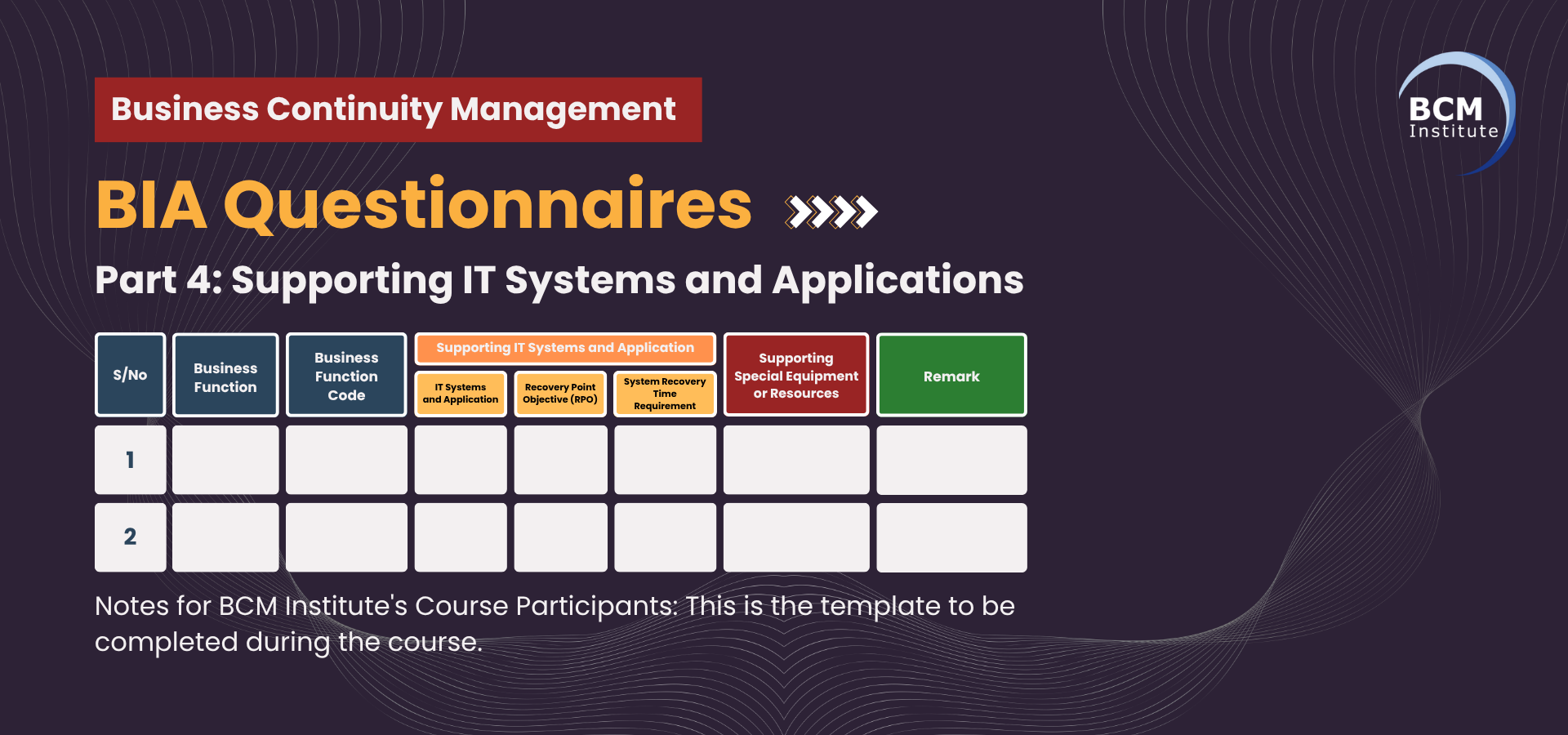
The following table establishes indicative technology dependencies, RPOs, System RTOs, and supporting resources for the 26 Sub-Critical Business Functions associated with **CBF-1 Teaching and Learning Delivery**.
[![Banner \[Table\] \[BCM\] \[E3\] \[BIA\] \[P4\] Supporting IT Systems and Applications \[BIAQ\]](https://no-cache.hubspot.com/cta/default/3893111/b0e47631-f680-46d1-b7a9-040fce25e117.png)](https://cta-redirect.hubspot.com/cta/redirect/3893111/b0e47631-f680-46d1-b7a9-040fce25e117)
Table BIA Part 4: Supporting IT Systems and Applications for CBF-1 Teaching and Learning Delivery
| Sub-CBF Code | Sub-Critical Business Function | Supporting IT Systems and Applications | Recovery Point Objective (RPO) | System Recovery Time Objective (System RTO) | Supporting Special Equipment / Resources | Remarks |
| --- | --- | --- | --- | --- | --- | --- |
| 1.1 | Determine Teaching Delivery Requirements | Student Information/Management System; curriculum and subject management system; academic planning tools; reporting and analytics platform; document repository | 4 hours | 8 hours | Secure staff workstations; network connectivity; reporting access | Teaching requirements depend on accurate enrolment, curriculum and academic planning information. Recovery should prioritise authoritative planning data and integration with student and timetable systems. |
| 1.2 | Confirm Subject and Class Offerings | Student Information System; curriculum management system; class scheduling system; academic workflow/approval platform; document management system | 4 hours | 8 hours | Secure workstations; network connectivity; backup academic records | Incorrect or outdated class-offering information can affect enrolment and timetable preparation. Interfaces between academic, student and scheduling systems should be included in DR testing. |
| 1.3 | Determine Student Teaching Demand | Student Information System; enrolment/registration system; analytics and reporting platform; data warehouse | 1 hour | 8 hours | Secure network; reporting workstations; database infrastructure | Current enrolment and registration information is required to determine class demand. Data reconciliation should be undertaken following recovery before capacity decisions are made. |
| 1.4 | Allocate Academic Teaching Staff | Academic workload/workforce planning system; HR system; timetable system; email and collaboration platform | 4 hours | 8 hours | Staff laptops, secure remote access; collaboration facilities | Staff allocation depends on availability, workload and timetable information. Temporary spreadsheet-based allocation may be used during short disruptions, subject to subsequent reconciliation. |
| 1.5 | Develop and Maintain Teaching Timetable | Timetabling and scheduling system; Student Information System; room-booking system; staff scheduling data; integration services | 1 hour | 4 hours | Scheduling workstations, database services, and network connectivity | Timetabling is a major upstream dependency for teaching delivery. Recovery should preserve the latest approved timetable and interfaces with room, staff and student systems. |
| 1.6 | Allocate Teaching Rooms and Facilities | Room-booking/facilities scheduling system; timetable system; facilities management system; campus information systems | 4 hours | 8 hours | Facilities database; campus network; room availability records | Room allocation must reflect capacity, accessibility and teaching requirements. Current room-status information is particularly important during facility disruptions. |
| 1.7 | Prepare Teaching and Learning Materials | Learning Management System (LMS); document management/cloud storage; productivity applications; content-authoring applications; academic repositories | 4 hours | 8 hours | Academic staff laptops; secure storage; backup facilities; network access | Loss of recently prepared teaching material can delay delivery. Versioning, cloud replication and controlled backup of academic content should support recovery. |
| 1.8 | Publish Digital Learning Materials | LMS; digital content repository; cloud storage; identity and access management; content delivery services | 1 hour | 4 hours | Internet connectivity, cloud infrastructure, and secure authentication | The LMS and content repositories are direct student-facing dependencies. Recovery should prioritise student access, authentication and integrity of published learning materials. |
| 1.9 | Prepare Teaching Technology and Classroom Resources | Classroom audiovisual control systems; IT service management system; asset management system; room-booking system; classroom technology management tools | 4 hours | 8 hours | Projectors/displays; classroom PCs; microphones; cameras; lecture capture equipment; wireless connectivity | Classroom technology should be operational before scheduled teaching. Spare equipment, rapid replacement procedures and alternative teaching rooms should form part of continuity arrangements. |
| 1.10 | Deliver Face-to-Face Lectures and Classes | LMS; timetable system; presentation applications; classroom audiovisual systems; attendance system; campus network | 1 hour | 2 hours | Teaching rooms; classroom PCs; displays/projectors; microphones; Wi-Fi; staff laptops | High operational dependency during scheduled classes. Local copies of essential teaching materials and alternative rooms can provide temporary continuity when central systems are unavailable. |
| 1.11 | Deliver Online or Remote Teaching | LMS; video-conferencing/virtual classroom platform; cloud collaboration services; identity and access management; digital content repository | Less than 15 minutes | 1 hour | Staff laptops; webcams; headsets; broadband/Internet connectivity; secure remote access; cloud infrastructure | Online teaching has a direct and immediate dependency on technology. High availability, resilient Internet access and alternative virtual meeting capability should be considered. |
| 1.12 | Deliver Hybrid Teaching Activities | LMS; video-conferencing platform; classroom AV systems; lecture capture/streaming platform; timetable system; identity services | Less than 15 minutes | 1 hour | Cameras; microphones; AV controllers; classroom displays; staff laptops; high-speed Internet/Wi-Fi | Hybrid delivery requires simultaneous classroom and online capabilities. Recovery planning should address failure of either physical classroom technology or remote-delivery platforms. |
| 1.13 | Deliver Tutorials, Workshops and Interactive Learning | LMS; collaboration platform; digital whiteboard/polling tools; presentation applications; timetable system | 1 hour | 2 hours | Teaching rooms; interactive displays; student/staff devices; Wi-Fi; AV equipment | Interactive activities may continue temporarily using simplified teaching methods. Priority should be given to restoring access to teaching materials and communication channels. |
| 1.14 | Deliver Laboratory and Practical Teaching | Specialist laboratory applications; LMS; laboratory management/scheduling systems; discipline-specific software; authentication services | 1 hour | 4 hours | Laboratory workstations; specialist teaching/laboratory equipment; licensed software; secure network; safety equipment | Recovery may depend on physical specialist equipment as well as ICT. Where equipment cannot be rapidly replaced, alternative laboratories, rescheduling or substitute practical activities should be planned. |
| 1.15 | Provide Academic Consultation and Learning Guidance | LMS; email; collaboration/video-conferencing platform; Student Information System; appointment/calendar system | 4 hours | 4 hours | Staff laptops, headsets, secure remote access; private consultation facilities | Multiple communication channels provide resilience. Sensitive student information should only be accessed through approved secure systems during alternate working arrangements. |
| 1.16 | Monitor Student Attendance and Participation | Attendance management system; LMS activity records; Student Information System; reporting and analytics tools | 1 hour | 4 hours | Attendance devices/readers where applicable; lecturer devices; Wi-Fi/network access | Attendance and participation records may have academic and administrative significance. Temporary manual attendance records should be retained and reconciled after system restoration. |
| 1.17 | Monitor Teaching Delivery and Class Completion | Timetable system; LMS; teaching/activity reporting system; analytics platform; workflow/dashboard tools | 4 hours | 8 hours | Management reporting workstations; network access; dashboard capability | Management requires reliable completion information to identify missed classes and emerging backlog. Recovered data should be reconciled against timetable and faculty records. |
| 1.18 | Manage Academic Staff Unavailability | HR/workforce system; timetable system; staff directory; email/collaboration platform; workflow tools | 1 hour | 4 hours | Secure mobile devices; staff laptops; remote access; contact lists | Rapid identification of replacement academic staff is important for scheduled teaching. Offline escalation and contact lists should be available if central systems are unavailable. |
| 1.19 | Manage Teaching Facility Disruption | Facilities management system; room-booking system; timetable system; mass notification/communications platform; IT service management system | 1 hour | 2 hours | Emergency communication devices; alternative teaching rooms; mobile devices; network connectivity | Facility disruption can require immediate relocation, conversion to online delivery or cancellation. Timetable, room availability and communications systems should receive high recovery priority. |
| 1.20 | Manage Digital Learning or ICT Disruption | IT service management platform; infrastructure/network monitoring; LMS; identity and access management; collaboration platform; DR monitoring and recovery tools | Real-time | 1 hour | Network Operations capability; backup infrastructure; cloud services; DR environment; privileged administration access | This function directly manages technology disruption and therefore requires highly resilient monitoring, authentication and recovery capabilities. ICT incident management and ITDR procedures should be tightly integrated. |
| 1.21 | Communicate Teaching Changes to Students and Staff | Email, LMS announcements, student portal/mobile application, mass notification platform, collaboration tools, SMS services where available | Less than 15 minutes | 1 hour | Secure mobile devices; redundant Internet connectivity; alternative communications channels | Timely communication is critical during disruption. Multiple independent channels should be available so failure of one platform does not prevent urgent teaching notifications. |
| 1.22 | Provide Accessible and Alternative Teaching Arrangements | LMS; video-conferencing platform; accessibility technologies; digital content repository; student information/support systems | 1 hour | 2 hours | Accessible workstations; assistive technologies; captioning tools; webcams/headsets; remote-access facilities | Continuity arrangements should preserve accessibility requirements. Alternative delivery should not unintentionally exclude students dependent on assistive technology or accessible content. |
| 1.23 | Prioritise Teaching During Major Disruption | Business continuity/incident management information; timetable system; Student Information System; LMS; management reporting and analytics; collaboration platform | 1 hour | 2 hours | Crisis/BC coordination facilities; secure laptops; communication devices; current continuity records | Decision-makers require consolidated information on affected classes, students, resources and dependencies. Essential prioritisation data should also be available in controlled offline form. |
| 1.24 | Recover Missed or Interrupted Teaching | Timetable system; LMS; room-booking system; collaboration/video-conferencing platform; Student Information System | 1 hour | 4 hours | Alternative rooms; remote-teaching equipment; staff laptops; AV equipment | Recovery requires identification of missed teaching, available staff, rooms and alternative delivery methods. Systems should support coordinated rescheduling and student notification. |
| 1.25 | Reconcile and Confirm Teaching Completion | LMS; timetable system; attendance system; teaching activity/completion records; reporting and analytics platform | 4 hours | 8 hours | Reporting workstations, secure network; reconciliation records | Following disruption, planned, delivered, cancelled and recovered teaching activities should be reconciled. Audit trails should be retained to demonstrate completeness and identify outstanding teaching. |
| 1.26 | Return Teaching Operations to Normal | LMS; timetable system; Student Information System; facilities management system; IT service management system; reporting platform | 4 hours | 8 hours | Normal teaching facilities; restored ICT infrastructure; operational dashboards; backup and monitoring services | Return to normal operations should be controlled rather than assumed after system restoration. Backlogs, temporary arrangements, data reconciliation and unresolved technology issues should be closed systematically. |
#### **Interpretation of the Recovery Requirements**
The values contained in the table represent **indicative recovery requirements for BIA and ITDR planning**.
They should not automatically be interpreted as confirmation that existing JCUS systems currently provide these recovery capabilities.
Each requirement should be validated against:
- the approved Business RTO for the associated Sub-CBF;
- current system architecture and hosting arrangements;
- application and database recovery capabilities;
- backup frequency and retention arrangements;
- replication architecture;
- cloud and Software-as-a-Service recovery commitments;
- telecommunications dependencies;
- identity and authentication dependencies;
- vendor service-level commitments;
- system integration and interface dependencies; and
- actual results from backup restoration and ITDR exercises.
Where an existing ICT recovery capability does not meet the BIA requirement, record the difference as a recovery capability gap and address it through risk treatment, technology improvement, alternative business continuity arrangements, or formal risk acceptance.
#### **Key Technology Dependencies for Teaching and Learning Delivery**
Analysis of CBF-1 demonstrates that several technology capabilities support multiple Sub-Critical Business Functions.
These common dependencies warrant particular attention because their failure could simultaneously affect a significant proportion of Teaching and Learning Delivery.
##### **Learning Management Environment**
The Learning Management System and associated digital content repositories support preparation, publication, delivery, and recovery of teaching activities. They also provide an important communication and interaction channel between academic staff and students.
Consequently, the learning management environment should have appropriately resilient hosting, backup, authentication, and connectivity arrangements.
##### **Student and Academic Information**
Student information, enrolment, and academic management systems provide authoritative information concerning students, subjects, classes, and academic activities.
Recovery procedures should maintain both **availability and data integrity**. Restoring an application without validating whether its data is complete and synchronised with connected systems may create further operational problems.
##### **Timetabling and Scheduling**
Timetabling supports class delivery, room allocation, staff planning, disruption management, and recovery of missed teaching.
A failure of the scheduling environment during an active teaching period can affect both normal delivery and the organisation's ability to coordinate alternative arrangements.
Current timetable information should therefore be recoverable and, where practical, critical schedules should be accessible through controlled alternative arrangements.
##### **Identity and Access Management**
Identity and Access Management (IAM) is a significant shared dependency.
An LMS, student system, or collaboration platform may technically remain operational but effectively become unavailable if staff and students cannot authenticate.
ITDR planning should therefore consider recovery sequences rather than treating applications independently.
A representative dependency sequence is:
**Network and Cloud Connectivity → Identity and Access Management → Core Databases and Integration Services → LMS / Student / Timetable Systems → Collaboration and Teaching Applications → User Validation → Teaching Resumption**
##### **Communications Technology**
Email, collaboration platforms, LMS announcements, mobile notifications, and other communication channels become particularly important when teaching arrangements change during disruption.
JCUS should avoid overreliance on a single communication mechanism.
Define alternative channels so students and staff can continue receiving authoritative instructions when the primary channel is unavailable.
#### **Connecting Business RTO, System RTO, and RPO**
The BIA and ITDR processes should be integrated through three related recovery requirements.
**Business RTO** determines how quickly the Sub-Critical Business Function must resume.
**System RTO** determines how quickly the supporting technology must be recovered to enable that business recovery.
**RPO** determines the maximum acceptable amount of data loss when the system is recovered.
For example, if an online teaching activity must resume within two hours, recovering its supporting virtual teaching platform only after four hours would not satisfy the business requirement.
The technology recovery requirement must therefore be established early enough to permit authentication, testing, data validation, and preparation before the business activity resumes.
Similarly, meeting the System RTO does not necessarily mean that recovery has succeeded.
A system restored within one hour, but containing data several days out of date, could still prevent effective teaching delivery.
**Time-to-recover and point-of-recovery must therefore be considered together.**
#### **Integration with IT Disaster Recovery Planning**
The technology dependencies identified through this BIA should become direct inputs to JCUS IT Disaster Recovery planning.
For each priority system, ICT and application owners should determine whether the required RPO and System RTO can be achieved through the existing technical architecture.
This should include examination of backup, replication, redundancy, cloud recovery, network resilience, cybersecurity recovery, and third-party service arrangements.
Pay particular attention to **shared technology dependencies**. Restoring the LMS, for example, may require functioning network connectivity, cloud services, identity management, databases, integration services, and external providers. ITDR recovery sequences should reflect these dependencies.
Recovery exercises should consequently test complete business-service recovery rather than simply confirming that individual servers or applications can be restarted.
A suitable validation sequence is:
**BIA Requirement → Business RTO → Identify Technology Dependencies → Define RPO and System RTO → Assess Current Recovery Capability → Identify Recovery Gaps → Implement ITDR Solutions → Exercise and Validate → Improve**
#### **Specialised Equipment and Operational Resources**
Teaching and Learning Delivery illustrates why a BIA should extend beyond conventional IT applications.
A classroom may depend upon functioning displays, projectors, microphones, cameras, teaching workstations and wireless connectivity.
Hybrid teaching may additionally require streaming technology, webcams and video-conferencing services. Laboratory teaching may depend upon specialised hardware, discipline-specific software, licences and physical laboratory resources.
These dependencies should be incorporated into Business Continuity Plans because traditional data-centre or cloud disaster recovery arrangements may not cover them.
Continuity strategies may include:
- maintaining spare teaching equipment;
- identifying alternative teaching rooms;
- maintaining preconfigured replacement devices;
- enabling remote and hybrid teaching;
- retaining essential teaching materials in resilient repositories;
- establishing alternative Internet connectivity;
- maintaining vendor support and replacement arrangements;
- identifying alternative laboratory facilities or practical activities; and
- establishing procedures for switching from technology-intensive teaching to an acceptable temporary delivery method.
[![Banner \[BCM\] \[E3\] \[BIA\] \[Summing Up\] \[P4\] Supporting IT Systems and Applications \[BIAQ\]](https://no-cache.hubspot.com/cta/default/3893111/9bde2d75-0c8e-4d9e-a8ca-e8d1655a082c.png)](https://cta-redirect.hubspot.com/cta/redirect/3893111/9bde2d75-0c8e-4d9e-a8ca-e8d1655a082c)
Supporting IT systems and technology are integral to **CBF-1 Teaching and Learning Delivery**.
Academic planning, scheduling, preparation of learning materials, classroom teaching, online delivery, student participation, communications, and post-disruption recovery all rely, to varying degrees, on information systems and supporting technology.
Identifying these dependencies during the BIA enables JCUS to translate business continuity requirements into specific technical recovery requirements.
The **RPO** sets the acceptable level of data loss, while the System RTO sets how quickly the required technology must be restored to support the Business RTO.
The analysis should not stop at software applications. Network connectivity, identity services, classroom audiovisual systems, teaching devices, specialist laboratory equipment, communications technology, and other resources may be equally important to successful recovery.
The completed BIA, therefore, provides an important connection between **business requirements and technology recovery capability**:
**Critical Business Function → Sub-Critical Business Function → Business RTO → Supporting Technology → RPO and System RTO → ITDR Capability → Business Recovery**
By establishing and validating these dependencies, JCUS can ensure that its Business Continuity and IT Disaster Recovery arrangements are mutually aligned.
This strengthens the University's ability to maintain priority teaching services, implement alternative teaching arrangements when required, recover technology in the appropriate sequence, and restore normal teaching operations in a controlled and resilient manner.
[](https://cta-redirect.hubspot.com/cta/redirect/3893111/3aefb2d2-3110-47c1-ad4f-d3e6e5381066)
[![\[BCM\] \[JCU\] \[3/4 Banner\] Business Continuity Management Implementation at JCU Singapore](https://no-cache.hubspot.com/cta/default/3893111/d81098d9-9f30-4c17-a897-2fc202440adc.png)](https://cta-redirect.hubspot.com/cta/redirect/3893111/d81098d9-9f30-4c17-a897-2fc202440adc)
| **eBook 3: Starting Your BCM Implementation** | | | | | | |
| --- | --- | --- | --- | --- | --- | --- |
| **MBCO** | **P&S** | **RAR T1** | **RAR T2** | **RAR T3** | **BCS T1** | **CBF** |
| [![\[BCM\] \[JCU\] \[E3\] \[BIA\] MBCO Corporate MBCO](https://no-cache.hubspot.com/cta/default/3893111/37db16b1-9a61-4815-adbb-527771b7bd35.png)](https://cta-redirect.hubspot.com/cta/redirect/3893111/37db16b1-9a61-4815-adbb-527771b7bd35) | [![\[BCM\] \[JCU\] \[E3\] \[BIA\] \[PS\] Key Product and Services](https://no-cache.hubspot.com/cta/default/3893111/3117a3bf-33fd-4522-a373-4ce343e253a6.png)](https://cta-redirect.hubspot.com/cta/redirect/3893111/3117a3bf-33fd-4522-a373-4ce343e253a6) | [![\[BCM\] \[JCU\] \[E3\] \[RAR\] \[T1\] List of Threats](https://no-cache.hubspot.com/cta/default/3893111/de614923-e16d-4c4b-878e-60b97f56183f.png)](https://cta-redirect.hubspot.com/cta/redirect/3893111/de614923-e16d-4c4b-878e-60b97f56183f) | [![\[BCM\] \[JCU\] \[E3\] \[RAR\] \[T2\] Treatment and Control](https://no-cache.hubspot.com/cta/default/3893111/71606f66-523b-41e0-af99-19f5e4cc2f37.png)](https://cta-redirect.hubspot.com/cta/redirect/3893111/71606f66-523b-41e0-af99-19f5e4cc2f37) | [![\[BCM\] \[JCU\] \[E3\] \[RAR\] \[T3\] Risk Impact and Likelihood Assessment](https://no-cache.hubspot.com/cta/default/3893111/0192071d-0c49-4a20-a2a8-f0894418f873.png)](https://cta-redirect.hubspot.com/cta/redirect/3893111/0192071d-0c49-4a20-a2a8-f0894418f873) | [![\[BCM\] \[JCU\] \[E3\] \[BCS\] \[T1\] Mitigation Strategies and Justification](https://no-cache.hubspot.com/cta/default/3893111/12b9c723-7ba3-4523-a1c2-0e75dc09a4e3.png)](https://cta-redirect.hubspot.com/cta/redirect/3893111/12b9c723-7ba3-4523-a1c2-0e75dc09a4e3) | [![\[BCM\] \[JCU\] \[E1\] \[C10\] Identifying Critical Business Functions](https://no-cache.hubspot.com/cta/default/3893111/b7aaf4cf-e4f4-4e31-bb8f-6885a5f2203d.png)](https://cta-redirect.hubspot.com/cta/redirect/3893111/b7aaf4cf-e4f4-4e31-bb8f-6885a5f2203d) |
| **CBF-1 Teaching and Learning Delivery** | | | | | | |
| **DP** | **BIAQ P1** | **BIAQ P2** | **BIAQ P3** | **BIAQ P4** | **BIAQ P5** | **BIAQ P6** |
| [![\[BCM\] \[JCU\] \[E3\] \[BIA\] \[DP\] \[CBF\] \[1\] Teaching and Learning Delivery](https://no-cache.hubspot.com/cta/default/3893111/87dc20a3-b9ed-454a-90ee-2ca3e2419322.png)](https://cta-redirect.hubspot.com/cta/redirect/3893111/87dc20a3-b9ed-454a-90ee-2ca3e2419322) | **[![\[BCM\] \[JCU\] \[E3\] \[BIA\] \[T1\] \[CBF\] \[1\] Teaching and Learning Delivery](https://no-cache.hubspot.com/cta/default/3893111/c0d85e4b-2df7-44ee-9c25-4112e99a64f3.png)](https://cta-redirect.hubspot.com/cta/redirect/3893111/c0d85e4b-2df7-44ee-9c25-4112e99a64f3)** | **[![\[BCM\] \[JCU\] \[E3\] \[BIA\] \[T2\] \[CBF\] \[1\] Teaching and Learning Delivery](https://no-cache.hubspot.com/cta/default/3893111/3d5d03b2-0465-4e70-8920-efbaf80a835c.png)](https://cta-redirect.hubspot.com/cta/redirect/3893111/3d5d03b2-0465-4e70-8920-efbaf80a835c)** | **[![\[BCM\] \[JCU\] \[E3\] \[BIA\] \[T3\] \[CBF\] \[1\] Teaching and Learning Delivery](https://no-cache.hubspot.com/cta/default/3893111/4107cc4d-b5ca-486c-bca0-d2a049b8c752.png)](https://cta-redirect.hubspot.com/cta/redirect/3893111/4107cc4d-b5ca-486c-bca0-d2a049b8c752)** | **[![\[BCM\] \[JCU\] \[E3\] \[BIA\] \[T4\] \[CBF\] \[1\] Teaching and Learning Delivery](https://no-cache.hubspot.com/cta/default/3893111/e9bd80ac-aa4d-4da0-873e-92bb036ae9c9.png)](https://cta-redirect.hubspot.com/cta/redirect/3893111/e9bd80ac-aa4d-4da0-873e-92bb036ae9c9)** | **[![\[BCM\] \[JCU\] \[E3\] \[BIA\] \[T5\] \[CBF\] \[1\] Teaching and Learning Delivery](https://no-cache.hubspot.com/cta/default/3893111/7c619369-8c50-4876-a478-749b847adee0.png)](https://cta-redirect.hubspot.com/cta/redirect/3893111/7c619369-8c50-4876-a478-749b847adee0)** | **[![\[BCM\] \[JCU\] \[E3\] \[BIA\] \[T6\] \[CBF\] \[1\] Teaching and Learning Delivery](https://no-cache.hubspot.com/cta/default/3893111/bdb520b6-bc53-40cf-bc72-5e4eb5c2d1ae.png)](https://cta-redirect.hubspot.com/cta/redirect/3893111/bdb520b6-bc53-40cf-bc72-5e4eb5c2d1ae)** |
| | | **BCS T2** | **BCS T3** | **PD** | | |
| | | [![\[BCM\] \[JCU\] \[E3\] \[BCS\] \[T2\] \[CBF\] \[1\] Teaching and Learning Delivery](https://no-cache.hubspot.com/cta/default/3893111/10a04273-213c-4b93-a69a-966039c382bb.png)](https://cta-redirect.hubspot.com/cta/redirect/3893111/10a04273-213c-4b93-a69a-966039c382bb) | [![\[BCM\] \[JCU\] \[E3\] \[BCS\] \[T3\] \[CBF\] \[1\] Teaching and Learning Delivery](https://no-cache.hubspot.com/cta/default/3893111/d2ec73f8-a65d-473f-9a70-afa20ac0b990.png)](https://cta-redirect.hubspot.com/cta/redirect/3893111/d2ec73f8-a65d-473f-9a70-afa20ac0b990) | [![\[BCM\] \[JCU\] \[E3\] \[PD\] \[CBF\] \[1\] Teaching and Learning Delivery](https://no-cache.hubspot.com/cta/default/3893111/41fe68b0-13dc-4690-bd61-369c6da03192.png)](https://cta-redirect.hubspot.com/cta/redirect/3893111/41fe68b0-13dc-4690-bd61-369c6da03192) | | |
| | | | | | | |
#### More Information About Business Continuity Management Courses
To learn more about the course and schedule, click the buttons below for the BCM-300 Business Continuity Management Implementer \[BCM-3\] and the BCM-5000 Business Continuity Management Expert Implementer \[BCM-5\].
| [](https://cta-redirect.hubspot.com/cta/redirect/3893111/f3922b80-e96a-46d6-8993-dc150a5de2d5) | [](https://cta-redirect.hubspot.com/cta/redirect/3893111/9ff8a3dc-e39a-465b-929f-72e232cdd5fb) | [![Register \[BL-B-3\]\*](https://no-cache.hubspot.com/cta/default/3893111/ac6cf073-4cdd-4541-91ed-889f731d5076.png)](https://cta-redirect.hubspot.com/cta/redirect/3893111/ac6cf073-4cdd-4541-91ed-889f731d5076) |
| --- | --- | --- |
| [](https://cta-redirect.hubspot.com/cta/redirect/3893111/21525c10-4003-4934-95fc-fe218174bc5b) | [](https://cta-redirect.hubspot.com/cta/redirect/3893111/46460171-c91a-4936-9bb2-8dc5928a0e02) | [](https://cta-redirect.hubspot.com/cta/redirect/3893111/1cb17ac7-50b2-4f88-bc4b-c7444e4b57b5) |
| [![FAQ \[BL-B-3\]](https://no-cache.hubspot.com/cta/default/3893111/b3824ba1-7aa1-4eb6-bef8-94f57121c5ae.png)](https://cta-redirect.hubspot.com/cta/redirect/3893111/b3824ba1-7aa1-4eb6-bef8-94f57121c5ae) | Please feel free to send us a note if you have any questions. [![Email to Sales Team \[BCM Institute\]](https://no-cache.hubspot.com/cta/default/3893111/3c53daeb-2836-4843-b0e0-645baee2ab9e.png)](https://cta-redirect.hubspot.com/cta/redirect/3893111/3c53daeb-2836-4843-b0e0-645baee2ab9e) | [](https://cta-redirect.hubspot.com/cta/redirect/3893111/9c199ae8-c470-4bb7-9612-73c7a084e94c) |
| [](https://cta-redirect.hubspot.com/cta/redirect/3893111/8999211a-2c51-4be7-bf49-c393f6c67974) | [](https://cta-redirect.hubspot.com/cta/redirect/3893111/5c1aa95d-f6dd-4067-a95c-5cc0c32d7ed8) | [](https://cta-redirect.hubspot.com/cta/redirect/3893111/086ab3b9-4d66-4a95-b2f7-1148e9803a9c) |
#### **Your Comments Here:**
### More Posts
[](https://cta-redirect.hubspot.com/cta/redirect/3893111/839787f4-a4fd-456f-accf-54c947026558)

All rights reserved. Copyright 2026
```json
{
"@context" : "https://schema.org",
"@type" : "BlogPosting",
"author" : {
"@type" : "Person",
"name" : "Dr Goh Moh Heng",
"url" : "https://blog.bcm-institute.org/ebook/author/dr-goh-moh-heng"
},
"dateModified" : "2026-10-02T11:43:44.159Z",
"datePublished" : "2026-10-02T06:42:44.000Z",
"headline" : "[BCM] [JCUS] [E3] [BIA] [P4] [CBF] [1] Teaching and Learning Delivery",
"mainEntityOfPage" : {
"@id" : "https://blog.bcm-institute.org/ebook/bcm-jcus-e3-bia-p4-cbf-1-teaching-and-learning-delivery",
"@type" : "WebPage"
},
"publisher" : {
"@type" : "Organization",
"logo" : {
"@type" : "ImageObject",
"url" : "https://blog.bcm-institute.org/hubfs/BCMI%20Logo.png"
},
"name" : "BCMI Pte Ltd"
}
}
```