---
title: [BCM] [JCUS] [E3] [BIA] [P3] CBF [1] Teaching and Learning Delivery
description: [BCM] [JCUS] [E3] [BIA] [P3] CBF [1] Teaching and Learning Delivery
image: https://blog.bcm-institute.org/hubfs/JCU%20Graphic%20Folder/JCU%20CBF%201%20Morepost/%5BBCM%5D%20%5BJCU%5D%20%5BE3%5D%20%5BBIA%5D%20%5BT3%5D%20%5BCBF%5D%20%5B1%5D%20Teaching%20and%20Learning%20Delivery.jpg
---
. .
[](http://www.bcm-institute.org/)
- [Home](https://www.bcm-institute.org/)
- [About Us](https://www.bcm-institute.org/about-us-3/)
- [A President’s Perspective](https://www.bcm-institute.org/about-us/a-presidents-perspective/)
- [Our History](https://www.bcm-institute.org/about-us/our-history/)
- [Our Advisory Council](https://www.bcm-institute.org/about-us/our-advisory-council/)
- [Customers’ Testimonials](https://www.bcm-institute.org/about-us/customers-testimonials/)
- [Credential Verification](https://www.bcm-institute.org/about-us/credential-verification/)
- [Courses](https://blog.bcm-institute.org/blog/course-fees-for-blended-learning-courses-master-catalog)
- [ISO 22301 Business Continuity Management System Audit](https://blog.bcm-institute.org/audit/business-continuity-management-audit-courses)
- [ISO 22301 Business Continuity Management](https://blog.bcm-institute.org/bcm/business-continuity-management-courses)
- [Crisis Communication](https://blog.bcm-institute.org/crisis-communication/crisis-communication-courses)
- [Crisis Management](https://blog.bcm-institute.org/en/crisis-management/courses)
- [IT Disaster Recovery](https://blog.bcm-institute.org/it-disaster-recovery/courses)
- [Operational Resilience](https://blog.bcm-institute.org/operational-resilience/courses)
- [Operational Resilience Audit](https://blog.bcm-institute.org/operational-resilience-audit/courses)
- [Certification](https://blog.bcm-institute.org/certification/types-of-certifications-offered)
- [ISO 22301 BCMS Audit Certification](https://blog.bcm-institute.org/certification/business-continuity-management-audit-certification)
- [ISO22301 Business Continuity Management Certification](https://blog.bcm-institute.org/bcm/business-continuity-management-certification)
- [Crisis Communication Certification](https://blog.bcm-institute.org/crisis-communication/crisis-communication-certification)
- [Crisis Management Certification](https://blog.bcm-institute.org/en/crisis-management/crisis-management-certification)
- [IT Disaster Recovery Planning Certification](https://blog.bcm-institute.org/it-disaster-recovery/it-disaster-recovery-certification)
- [Operational Resilience Certification](https://blog.bcm-institute.org/operational-resilience/operational-resilience-certification)
- [Operational Resilience Audit Certification](https://blog.bcm-institute.org/operational-resilience-audit)
- [Seminars](https://blog.bcm-institute.org/meet-the-expert/mte-webinar-mainpage)
- [Store](https://www.bcm-institute.org/store-2/)
- [Contact Us](http://www.bcm-institute.org/about-us/contact-us/)
-
-
##### Institutional Resilience in Action: Business Continuity Management Implementation at JCU Singapore

# \[BCM\] \[JCUS\] \[E3\] \[BIA\] \[P3\] CBF \[1\] Teaching and Learning Delivery
[![\[BCM\] \[JCU\] \[Full Banner\] Business Continuity Management Implementation at JCU Singapore](https://no-cache.hubspot.com/cta/default/3893111/c28ce2ee-dfaa-4e23-b28a-6ae8ca285f06.png)](https://cta-redirect.hubspot.com/cta/redirect/3893111/c28ce2ee-dfaa-4e23-b28a-6ae8ca285f06)
This Business Impact Analysis (BIA) assessment determines how the consequences of disruption to the Sub-Critical Business Functions supporting **CBF-1 Teaching and Learning Delivery** increase as the period of unavailability extends.
A disruption that can be accommodated for several hours through timetable adjustments, lecturer communications, temporary workarounds, or alternative delivery arrangements may become significantly more serious when it extends across several teaching days or weeks.
Prolonged disruption can result in accumulated teaching backlogs, missed learning outcomes, reduced student participation, inability to complete scheduled academic activities, pressure on academic staff, disruption to assessment preparation, and increasing stakeholder, compliance, and reputational consequences.
[![Banner \[BCM\] \[E3\] \[BIA\] \[P3\] Impact Over Time of Business Functions](https://no-cache.hubspot.com/cta/default/3893111/bc131ed6-ca92-4253-8940-2f98dad34599.png)](https://cta-redirect.hubspot.com/cta/redirect/3893111/bc131ed6-ca92-4253-8940-2f98dad34599)
[Dr Goh Moh Heng](https://blog.bcm-institute.org/ebook/author/dr-goh-moh-heng) Oct 2, 2026
###### Business Continuity Management Certified Planner-Specialist-Expert
### [![x \[BCM\] \[JCU\] Legal Disclaimer Banner](https://no-cache.hubspot.com/cta/default/3893111/e57030e6-3c63-46cc-988b-1eabb945de75.png)](https://cta-redirect.hubspot.com/cta/redirect/3893111/e57030e6-3c63-46cc-988b-1eabb945de75)
[](https://cta-redirect.hubspot.com/cta/redirect/3893111/326c85d5-f1af-4a99-9f0e-0072cfcad36a)
[![Banner \[BCM\] \[E3\] \[BIA\] \[P3\] Impact Over Time of Business Functions](https://no-cache.hubspot.com/cta/default/3893111/bc131ed6-ca92-4253-8940-2f98dad34599.png)](https://cta-redirect.hubspot.com/cta/redirect/3893111/bc131ed6-ca92-4253-8940-2f98dad34599)
### CBF-1 Teaching and Learning Delivery
#### **Objective**
[![\[BCM\] \[JCU\] \[E3\] \[BIA\] \[T3\] \[CBF\] \[1\] Teaching and Learning Delivery](https://no-cache.hubspot.com/cta/default/3893111/4107cc4d-b5ca-486c-bca0-d2a049b8c752.png)](https://cta-redirect.hubspot.com/cta/redirect/3893111/4107cc4d-b5ca-486c-bca0-d2a049b8c752)This Business Impact Analysis (BIA) assessment determines how the consequences of disruption to the Sub-Critical Business Functions supporting **CBF-1 Teaching and Learning Delivery** increase as the period of unavailability extends.
A disruption that can be accommodated for several hours through timetable adjustments, lecturer communications, temporary workarounds, or alternative delivery arrangements may become significantly more serious when it extends across several teaching days or weeks.
Prolonged disruption can result in accumulated teaching backlogs, missed learning outcomes, reduced student participation, inability to complete scheduled academic activities, pressure on academic staff, disruption to assessment preparation, and increasing stakeholder, compliance, and reputational consequences.
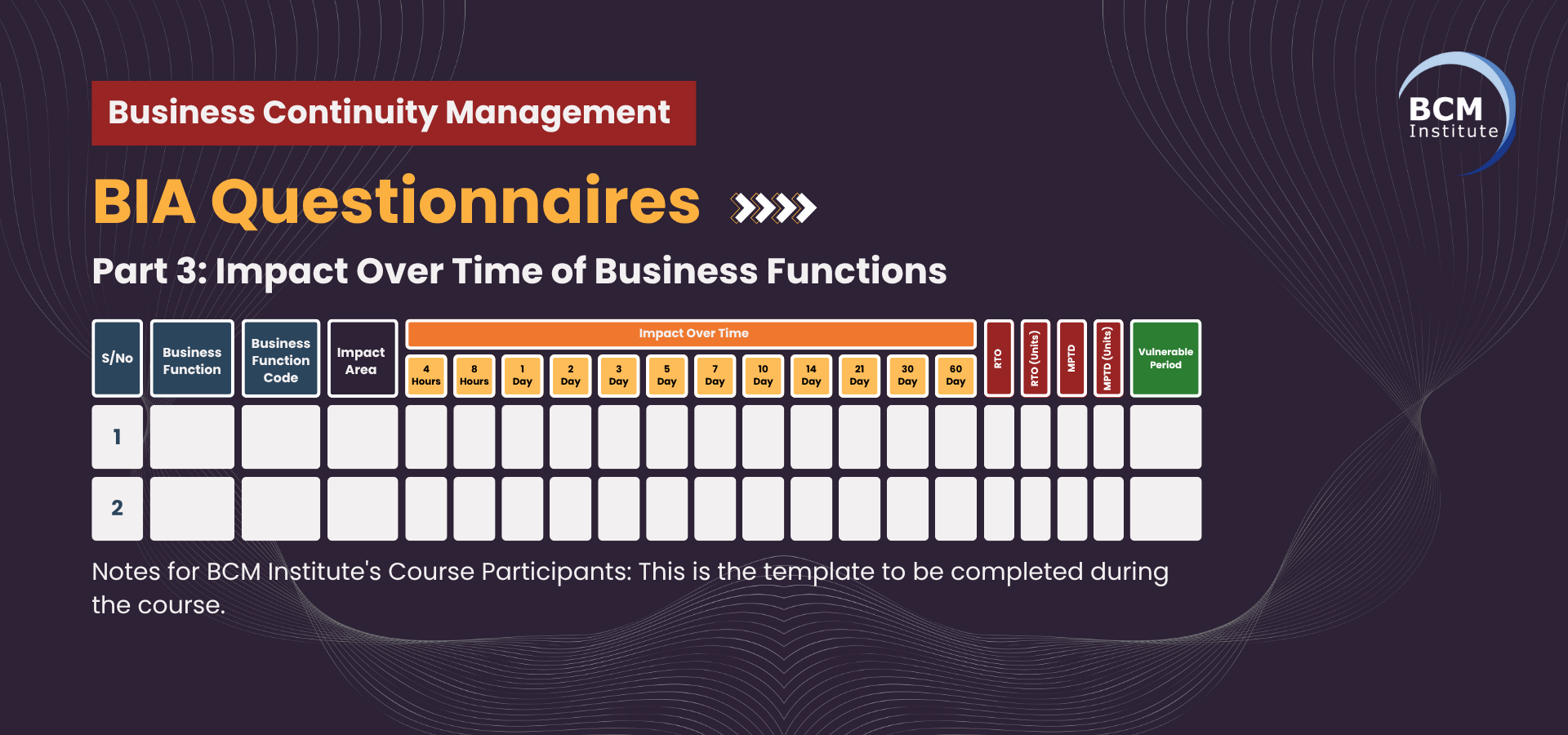
Impact-over-time analysis, therefore, provides a time-based view of criticality rather than treating a business function as having one fixed level of importance. Each Sub-CBF is assessed at twelve disruption intervals from four hours through sixty days using the following scale:
**1 – Very Low | 2 – Low | 3 – Moderate | 4 – High | 5 – Very High**
[](https://cta-redirect.hubspot.com/cta/redirect/3893111/c58454f5-6f12-4820-a580-c4630561bc3a)For this assessment, the **Recovery Time Objective (RTO)** represents the target period within which the Sub-CBF should be restored or brought to an acceptable minimum level of operation.
[](https://cta-redirect.hubspot.com/cta/redirect/3893111/d9f568a1-8059-4161-9d8c-a21d150f7096)**Maximum Tolerable Period of Disruption (MTPD)** represents the outer limit beyond which continued disruption would cause unacceptable consequences to the delivery of the Critical Business Function. The RTO is therefore established sufficiently ahead of the MTPD to provide a practical recovery margin.
The **Vulnerable Period** identifies when disruption would have a disproportionately severe effect.
For Teaching and Learning Delivery, these periods are closely connected with the academic lifecycle, including commencement of teaching periods, intensive teaching weeks, timetable finalisation, laboratory sessions, major assessment preparation periods, and the final weeks of scheduled teaching.
These parameters allow JCUS to distinguish functions requiring restoration within hours from activities that can temporarily operate at reduced capacity or tolerate a longer delay.
They consequently provide an evidence base for determining business continuity priorities, recovery strategies, resource requirements, and contingency arrangements.
#### [![Banner \[Table\] \[BCM\] \[E3\] \[BIA\] \[\[P3\] Impact Over Time of Business Functions \[BIAQ\]](https://no-cache.hubspot.com/cta/default/3893111/b31bbcc9-edc2-4fc8-9cae-5c5797e36f84.png)](https://cta-redirect.hubspot.com/cta/redirect/3893111/b31bbcc9-edc2-4fc8-9cae-5c5797e36f84)
Table BIA Part 3: Impact Over Time of Business Functions for CBF-1 Teaching and Learning Delivery
| Sub-CBF Code | Sub-Critical Business Function | Highest-Impact Area | 4 Hours | 8 Hours | 1 Day | 2 Days | 3 Days | 5 Days | 7 Days | 10 Days | 14 Days | 21 Days | 30 Days | 60 Days | Recovery Time Objective (RTO) | Maximum Tolerable Period of Disruption (MTPD) | Vulnerable Period |
| --- | --- | --- | --- | --- | --- | --- | --- | --- | --- | --- | --- | --- | --- | --- | --- | --- | --- |
| 1.1 | Determine Teaching Delivery Requirements | Operational | 1 | 1 | 1 | 2 | 2 | 3 | 3 | 4 | 4 | 4 | 5 | 5 | 5 days | 30 days | Academic planning period immediately before timetable and subject offerings are finalised |
| 1.2 | Confirm Subject and Class Offerings | Customer / Stakeholder | 1 | 1 | 2 | 2 | 3 | 3 | 4 | 4 | 4 | 5 | 5 | 5 | 3 days | 21 days | Pre-semester subject confirmation and student enrolment period |
| 1.3 | Determine Student Teaching Demand | Operational | 1 | 1 | 1 | 2 | 2 | 3 | 3 | 4 | 4 | 5 | 5 | 5 | 5 days | 21 days | Enrolment period and weeks immediately preceding commencement of teaching |
| 1.4 | Allocate Academic Teaching Staff | Human Resources | 1 | 1 | 2 | 2 | 3 | 3 | 4 | 4 | 5 | 5 | 5 | 5 | 3 days | 14 days | Final teaching allocation period and first two weeks of teaching |
| 1.5 | Develop and Maintain Teaching Timetable | Operational | 1 | 2 | 2 | 3 | 3 | 4 | 4 | 4 | 5 | 5 | 5 | 5 | 2 days | 14 days | Final timetable preparation, semester commencement and periods of major timetable change |
| 1.6 | Allocate Teaching Rooms and Facilities | Operational | 1 | 2 | 2 | 3 | 3 | 4 | 4 | 5 | 5 | 5 | 5 | 5 | 2 days | 10 days | Semester commencement and weeks containing high room utilisation, practical classes or large lectures |
| 1.7 | Prepare Teaching and Learning Materials | Customer / Stakeholder | 1 | 1 | 2 | 2 | 3 | 3 | 4 | 4 | 5 | 5 | 5 | 5 | 3 days | 14 days | Week immediately before commencement of a subject and before major new teaching modules |
| 1.8 | Publish Digital Learning Materials | Technology | 1 | 2 | 2 | 3 | 3 | 4 | 4 | 5 | 5 | 5 | 5 | 5 | 2 days | 10 days | Start of teaching week and periods immediately preceding assignments, tutorials and examinations |
| 1.9 | Prepare Teaching Technology and Classroom Resources | Technology | 1 | 2 | 3 | 3 | 4 | 4 | 4 | 5 | 5 | 5 | 5 | 5 | 1 day | 10 days | Immediately before scheduled technology-dependent classes, hybrid sessions and practical teaching |
| 1.10 | Deliver Face-to-Face Lectures and Classes | Customer / Stakeholder | 2 | 2 | 3 | 3 | 4 | 4 | 5 | 5 | 5 | 5 | 5 | 5 | 1 day | 7 days | Active teaching weeks, particularly compulsory classes and final teaching weeks before examinations |
| 1.11 | Deliver Online or Remote Teaching | Customer / Stakeholder | 2 | 2 | 3 | 3 | 4 | 4 | 5 | 5 | 5 | 5 | 5 | 5 | 1 day | 7 days | Scheduled online teaching days and periods when remote teaching is the primary continuity arrangement |
| 1.12 | Deliver Hybrid Teaching Activities | Operational | 2 | 2 | 3 | 3 | 4 | 4 | 5 | 5 | 5 | 5 | 5 | 5 | 1 day | 7 days | Scheduled hybrid classes and periods when campus access restrictions require mixed delivery |
| 1.13 | Deliver Tutorials, Workshops and Interactive Learning | Customer / Stakeholder | 1 | 2 | 2 | 3 | 3 | 4 | 4 | 5 | 5 | 5 | 5 | 5 | 2 days | 10 days | Weeks containing compulsory tutorials, graded participation, presentations or intensive workshops |
| 1.14 | Deliver Laboratory and Practical Teaching | Operational | 2 | 2 | 3 | 3 | 4 | 4 | 5 | 5 | 5 | 5 | 5 | 5 | 1 day | 7 days | Scheduled laboratory blocks, field/practical sessions and practical competency assessment periods |
| 1.15 | Provide Academic Consultation and Learning Guidance | Customer / Stakeholder | 1 | 1 | 2 | 2 | 3 | 3 | 4 | 4 | 5 | 5 | 5 | 5 | 3 days | 14 days | Immediately before major assessments, examination preparation and academic progression decisions |
| 1.16 | Monitor Student Attendance and Participation | Regulatory | 1 | 2 | 2 | 3 | 3 | 4 | 4 | 5 | 5 | 5 | 5 | 5 | 2 days | 10 days | Active teaching weeks, especially compulsory attendance activities and attendance-monitoring checkpoints |
| 1.17 | Monitor Teaching Delivery and Class Completion | Operational | 1 | 1 | 2 | 2 | 3 | 3 | 4 | 4 | 5 | 5 | 5 | 5 | 3 days | 14 days | Final weeks of each teaching period and immediately before confirmation of curriculum completion |
| 1.18 | Manage Academic Staff Unavailability | Human Resources | 2 | 2 | 3 | 3 | 4 | 4 | 5 | 5 | 5 | 5 | 5 | 5 | 1 day | 7 days | Teaching days involving sole lecturers, specialist faculty, laboratory supervisors or assessment-critical instruction |
| 1.19 | Manage Teaching Facility Disruption | Operational | 2 | 3 | 3 | 4 | 4 | 5 | 5 | 5 | 5 | 5 | 5 | 5 | 8 hours | 5 days | High campus occupancy periods, laboratory sessions, large lectures and examination-related teaching preparation |
| 1.20 | Manage Digital Learning or ICT Disruption | Technology | 3 | 3 | 4 | 4 | 5 | 5 | 5 | 5 | 5 | 5 | 5 | 5 | 4 hours | 3 days | Active online/hybrid teaching, assignment submission periods and periods when digital platforms are required for continuity |
| 1.21 | Communicate Teaching Changes to Students and Staff | Customer / Stakeholder | 2 | 3 | 3 | 4 | 4 | 5 | 5 | 5 | 5 | 5 | 5 | 5 | 8 hours | 5 days | Immediately following campus closure, timetable changes, lecturer unavailability or technology disruption |
| 1.22 | Provide Accessible and Alternative Teaching Arrangements | Customer / Stakeholder | 1 | 2 | 2 | 3 | 3 | 4 | 4 | 5 | 5 | 5 | 5 | 5 | 2 days | 10 days | Periods affecting students requiring accessibility accommodations or when normal delivery modes are unavailable |
| 1.23 | Prioritise Teaching During Major Disruption | Operational | 2 | 3 | 3 | 4 | 4 | 5 | 5 | 5 | 5 | 5 | 5 | 5 | 8 hours | 5 days | Campus-wide or multi-system disruption occurring during active teaching or immediately before examinations |
| 1.24 | Recover Missed or Interrupted Teaching | Customer / Stakeholder | 1 | 1 | 2 | 2 | 3 | 3 | 4 | 4 | 5 | 5 | 5 | 5 | 3 days | 14 days | Following multi-day teaching interruption and during final teaching weeks when make-up opportunities are limited |
| 1.25 | Reconcile and Confirm Teaching Completion | Regulatory | 1 | 1 | 1 | 2 | 2 | 3 | 3 | 4 | 4 | 5 | 5 | 5 | 5 days | 21 days | End of teaching period immediately before study week, examinations and academic completion confirmation |
| 1.26 | Return Teaching Operations to Normal | Operational | 1 | 1 | 1 | 2 | 2 | 3 | 3 | 4 | 4 | 5 | 5 | 5 | 5 days | 21 days | Transition from extended contingency arrangements back to normal campus operations during active teaching |
#### **Interpretation of the Impact-Over-Time Assessment**
The table demonstrates that the 26 Sub-Critical Business Functions do not have identical recovery requirements.
Their criticality depends on both the nature of the activity and the rate at which consequences accumulate when the activity remains unavailable.
#### **Immediate and Rapid-Recovery Functions**
The shortest recovery requirements apply to functions that directly enable JCUS to respond to an active disruption.
**Sub-CBF 1.20 Manage Digital Learning or ICT Disruption** has an RTO of **4 hours**, reflecting contemporary teaching delivery's reliance on digital learning, communications, and supporting ICT services. A prolonged technology disruption can affect physical, online, and hybrid teaching at the same time.
**Sub-CBF 1.19 Manage Teaching Facility Disruption**, **1.21 Communicate Teaching Changes to Students and Staff**, and **1.23 Prioritise Teaching During Major Disruption** have RTOs of **8 hours**.
These functions become especially important once normal teaching arrangements have already been disrupted.
Delayed decisions or communications can amplify the original incident by causing confusion, missed classes, unnecessary travel, inconsistent academic responses, and inefficient use of available recovery resources.
#### **One-Day Recovery Functions**
Several Sub-CBFs should be recovered within **one day**, including:
- **1.9 Prepare Teaching Technology and Classroom Resources**
- **1.10 Deliver Face-to-Face Lectures and Classes**
- **1.11 Deliver Online or Remote Teaching**
- **1.12 Deliver Hybrid Teaching Activities**
- **1.14 Deliver Laboratory and Practical Teaching**
- **1.18 Manage Academic Staff Unavailability**
These functions directly influence the ability to continue scheduled teaching. Although isolated classes can potentially be rescheduled, sustained interruption creates a rapidly accumulating teaching backlog.
The recovery problem becomes increasingly difficult when specialist lecturers, laboratories, teaching facilities, or constrained timetable slots are involved.
#### **Two- to Three-Day Recovery Functions**
Functions such as timetable management, room allocation, publication of learning materials, tutorials, attendance monitoring, academic consultation, and alternative teaching arrangements can generally tolerate a short period of disruption, provided temporary arrangements exist.
Recovery becomes increasingly important after about two to three days because unresolved problems begin to propagate into scheduled teaching activities.
A timetable problem, for example, can affect room allocation, lecturer availability, student communications, and class attendance simultaneously.
#### **Longer-Horizon Planning and Reconciliation Functions**
Planning and reconciliation activities, including determining teaching requirements, student demand, monitoring completion, and returning operations to normal, generally have longer RTOs.
Their longer recovery targets do not mean that these activities are unimportant.
Rather, their immediate interruption is less likely to prevent a class already scheduled for that day from being delivered.
Their impacts accumulate progressively. If disruption continues for several weeks, these activities can eventually affect teaching completeness, academic scheduling, future teaching capacity, student progression, and institutional assurance.
#### **Using RTO and MTPD to Establish Recovery Priorities**
RTOs provide JCUS with a practical restoration sequence.
Functions with RTOs of **4–8 hours** should receive the earliest access to incident-management attention, communications capabilities, ICT support, and decision-making resources.
Functions with **one-day RTOs** should form the next recovery tier because they are closely associated with restoring actual teaching delivery.
Functions with two-, three-, and five-day RTOs can normally follow once immediate continuity of teaching has been stabilised, although their recovery may need to be accelerated when a disruption occurs during their identified vulnerable periods.
The MTPD provides a separate and important boundary. It should not be treated as a planned recovery target.
Reaching the MTPD indicates that disruption has progressed to a level at which the consequences to Teaching and Learning Delivery are becoming unacceptable.
Recovery strategies should therefore be designed with sufficient capability and contingency margin to achieve the RTO substantially before the applicable MTPD.
#### **Influence of Vulnerable Periods**
Time-based impact cannot be evaluated solely by elapsed hours or days. **When the disruption occurs can materially change its consequences.**
For example, disruption to timetable development several months before teaching commences may be manageable through deferred processing.
The same disruption immediately before the commencement of a teaching period could affect large numbers of students and academic staff.
Similarly, temporary loss of laboratory facilities may initially be managed by rescheduling activities.
However, disruption during a tightly scheduled practical teaching or competency assessment period can leave little opportunity for replacement sessions.
The vulnerable periods identified in the BIA should consequently be incorporated into continuity planning.
During these periods, JCUS should consider increased readiness of alternative teaching facilities, academic staff substitutes, remote-learning capability, communications resources, ICT support, and decision-making arrangements.
#### **Relationship to Recovery Strategy Development**
The impact-over-time assessment provides the business requirements that recovery strategies must satisfy.
For the shortest-RTO Sub-CBFs, JCUS may require arrangements that can be activated within hours, such as alternative communications channels, remote teaching platforms, substitute teaching rooms, alternative academic staff, rapid timetable amendments, and prioritisation criteria for essential teaching.
For functions with longer RTOs, strategies may focus on controlled backlog recovery, work redistribution, temporary manual processes, deferred administrative activities, and progressive restoration.
The recovery solution selected for each Sub-CBF should therefore demonstrate that:
1. it can be activated within the required RTO;
2. sufficient people, facilities, technology, information, and third-party resources are available;
3. minimum acceptable teaching capacity can be maintained;
4. accumulated backlogs can be recovered before the MTPD is reached; and
5. the solution remains workable during the identified vulnerable period.
[![Banner \[BCM\] \[E3\] \[BIA\] \[Summing Up\] \[P3\] Impact Over Time of Business Functions \[BIAQ\]](https://no-cache.hubspot.com/cta/default/3893111/987f8ca5-0ba4-4281-be57-5221186733d0.png)](https://cta-redirect.hubspot.com/cta/redirect/3893111/987f8ca5-0ba4-4281-be57-5221186733d0)
Impact-over-time analysis strengthens the Business Impact Analysis by showing **how quickly disruption becomes significant**, rather than simply identifying whether a Sub-Critical Business Function is important.
For **CBF-1 Teaching and Learning Delivery**, the assessment shows that the most urgent recovery requirements involve maintaining digital teaching capability, managing teaching disruptions, communicating changes, and sustaining the delivery of scheduled learning activities.
Planning, monitoring, and reconciliation functions generally allow somewhat longer recovery periods, although their impacts become substantial when disruption extends across multiple teaching weeks.
The RTO establishes the target for restoring each Sub-CBF before serious consequences develop, while the MTPD establishes the outer tolerable disruption boundary.
Together, these parameters enable JCUS to determine appropriate recovery strategies, sequence recovery activities, and allocate continuity resources according to demonstrated business requirements.
Vulnerable periods add an essential operational dimension to this analysis.
They allow JCUS to recognise that a disruption during semester commencement, intensive teaching, laboratory activities, assessment preparation, or the final weeks of teaching may require a faster, more resource-intensive response than the same disruption during a lower-activity period.
When integrated into Business Continuity Plans, incident response arrangements, ICT recovery, alternative teaching arrangements, and exercises, these findings provide a structured basis for protecting the continuity of teaching and learning and strengthening institutional resilience.
[](https://cta-redirect.hubspot.com/cta/redirect/3893111/3aefb2d2-3110-47c1-ad4f-d3e6e5381066)
[![\[BCM\] \[JCU\] \[3/4 Banner\] Business Continuity Management Implementation at JCU Singapore](https://no-cache.hubspot.com/cta/default/3893111/d81098d9-9f30-4c17-a897-2fc202440adc.png)](https://cta-redirect.hubspot.com/cta/redirect/3893111/d81098d9-9f30-4c17-a897-2fc202440adc)
| **eBook 3: Starting Your BCM Implementation** | | | | | | |
| --- | --- | --- | --- | --- | --- | --- |
| **MBCO** | **P&S** | **RAR T1** | **RAR T2** | **RAR T3** | **BCS T1** | **CBF** |
| [![\[BCM\] \[JCU\] \[E3\] \[BIA\] MBCO Corporate MBCO](https://no-cache.hubspot.com/cta/default/3893111/37db16b1-9a61-4815-adbb-527771b7bd35.png)](https://cta-redirect.hubspot.com/cta/redirect/3893111/37db16b1-9a61-4815-adbb-527771b7bd35) | [![\[BCM\] \[JCU\] \[E3\] \[BIA\] \[PS\] Key Product and Services](https://no-cache.hubspot.com/cta/default/3893111/3117a3bf-33fd-4522-a373-4ce343e253a6.png)](https://cta-redirect.hubspot.com/cta/redirect/3893111/3117a3bf-33fd-4522-a373-4ce343e253a6) | [![\[BCM\] \[JCU\] \[E3\] \[RAR\] \[T1\] List of Threats](https://no-cache.hubspot.com/cta/default/3893111/de614923-e16d-4c4b-878e-60b97f56183f.png)](https://cta-redirect.hubspot.com/cta/redirect/3893111/de614923-e16d-4c4b-878e-60b97f56183f) | [![\[BCM\] \[JCU\] \[E3\] \[RAR\] \[T2\] Treatment and Control](https://no-cache.hubspot.com/cta/default/3893111/71606f66-523b-41e0-af99-19f5e4cc2f37.png)](https://cta-redirect.hubspot.com/cta/redirect/3893111/71606f66-523b-41e0-af99-19f5e4cc2f37) | [![\[BCM\] \[JCU\] \[E3\] \[RAR\] \[T3\] Risk Impact and Likelihood Assessment](https://no-cache.hubspot.com/cta/default/3893111/0192071d-0c49-4a20-a2a8-f0894418f873.png)](https://cta-redirect.hubspot.com/cta/redirect/3893111/0192071d-0c49-4a20-a2a8-f0894418f873) | [![\[BCM\] \[JCU\] \[E3\] \[BCS\] \[T1\] Mitigation Strategies and Justification](https://no-cache.hubspot.com/cta/default/3893111/12b9c723-7ba3-4523-a1c2-0e75dc09a4e3.png)](https://cta-redirect.hubspot.com/cta/redirect/3893111/12b9c723-7ba3-4523-a1c2-0e75dc09a4e3) | [![\[BCM\] \[JCU\] \[E1\] \[C10\] Identifying Critical Business Functions](https://no-cache.hubspot.com/cta/default/3893111/b7aaf4cf-e4f4-4e31-bb8f-6885a5f2203d.png)](https://cta-redirect.hubspot.com/cta/redirect/3893111/b7aaf4cf-e4f4-4e31-bb8f-6885a5f2203d) |
| **CBF-1 Teaching and Learning Delivery** | | | | | | |
| **DP** | **BIAQ P1** | **BIAQ P2** | **BIAQ P3** | **BIAQ P4** | **BIAQ P5** | **BIAQ P6** |
| [![\[BCM\] \[JCU\] \[E3\] \[BIA\] \[DP\] \[CBF\] \[1\] Teaching and Learning Delivery](https://no-cache.hubspot.com/cta/default/3893111/87dc20a3-b9ed-454a-90ee-2ca3e2419322.png)](https://cta-redirect.hubspot.com/cta/redirect/3893111/87dc20a3-b9ed-454a-90ee-2ca3e2419322) | **[![\[BCM\] \[JCU\] \[E3\] \[BIA\] \[T1\] \[CBF\] \[1\] Teaching and Learning Delivery](https://no-cache.hubspot.com/cta/default/3893111/c0d85e4b-2df7-44ee-9c25-4112e99a64f3.png)](https://cta-redirect.hubspot.com/cta/redirect/3893111/c0d85e4b-2df7-44ee-9c25-4112e99a64f3)** | **[![\[BCM\] \[JCU\] \[E3\] \[BIA\] \[T2\] \[CBF\] \[1\] Teaching and Learning Delivery](https://no-cache.hubspot.com/cta/default/3893111/3d5d03b2-0465-4e70-8920-efbaf80a835c.png)](https://cta-redirect.hubspot.com/cta/redirect/3893111/3d5d03b2-0465-4e70-8920-efbaf80a835c)** | **[![\[BCM\] \[JCU\] \[E3\] \[BIA\] \[T3\] \[CBF\] \[1\] Teaching and Learning Delivery](https://no-cache.hubspot.com/cta/default/3893111/4107cc4d-b5ca-486c-bca0-d2a049b8c752.png)](https://cta-redirect.hubspot.com/cta/redirect/3893111/4107cc4d-b5ca-486c-bca0-d2a049b8c752)** | **[![\[BCM\] \[JCU\] \[E3\] \[BIA\] \[T4\] \[CBF\] \[1\] Teaching and Learning Delivery](https://no-cache.hubspot.com/cta/default/3893111/e9bd80ac-aa4d-4da0-873e-92bb036ae9c9.png)](https://cta-redirect.hubspot.com/cta/redirect/3893111/e9bd80ac-aa4d-4da0-873e-92bb036ae9c9)** | **[![\[BCM\] \[JCU\] \[E3\] \[BIA\] \[T5\] \[CBF\] \[1\] Teaching and Learning Delivery](https://no-cache.hubspot.com/cta/default/3893111/7c619369-8c50-4876-a478-749b847adee0.png)](https://cta-redirect.hubspot.com/cta/redirect/3893111/7c619369-8c50-4876-a478-749b847adee0)** | **[![\[BCM\] \[JCU\] \[E3\] \[BIA\] \[T6\] \[CBF\] \[1\] Teaching and Learning Delivery](https://no-cache.hubspot.com/cta/default/3893111/bdb520b6-bc53-40cf-bc72-5e4eb5c2d1ae.png)](https://cta-redirect.hubspot.com/cta/redirect/3893111/bdb520b6-bc53-40cf-bc72-5e4eb5c2d1ae)** |
| | | **BCS T2** | **BCS T3** | **PD** | | |
| | | [![\[BCM\] \[JCU\] \[E3\] \[BCS\] \[T2\] \[CBF\] \[1\] Teaching and Learning Delivery](https://no-cache.hubspot.com/cta/default/3893111/10a04273-213c-4b93-a69a-966039c382bb.png)](https://cta-redirect.hubspot.com/cta/redirect/3893111/10a04273-213c-4b93-a69a-966039c382bb) | [![\[BCM\] \[JCU\] \[E3\] \[BCS\] \[T3\] \[CBF\] \[1\] Teaching and Learning Delivery](https://no-cache.hubspot.com/cta/default/3893111/d2ec73f8-a65d-473f-9a70-afa20ac0b990.png)](https://cta-redirect.hubspot.com/cta/redirect/3893111/d2ec73f8-a65d-473f-9a70-afa20ac0b990) | [![\[BCM\] \[JCU\] \[E3\] \[PD\] \[CBF\] \[1\] Teaching and Learning Delivery](https://no-cache.hubspot.com/cta/default/3893111/41fe68b0-13dc-4690-bd61-369c6da03192.png)](https://cta-redirect.hubspot.com/cta/redirect/3893111/41fe68b0-13dc-4690-bd61-369c6da03192) | | |
| | | | | | | |
#### More Information About Business Continuity Management Courses
To learn more about the course and schedule, click the buttons below for the BCM-300 Business Continuity Management Implementer \[BCM-3\] and the BCM-5000 Business Continuity Management Expert Implementer \[BCM-5\].
| [](https://cta-redirect.hubspot.com/cta/redirect/3893111/f3922b80-e96a-46d6-8993-dc150a5de2d5) | [](https://cta-redirect.hubspot.com/cta/redirect/3893111/9ff8a3dc-e39a-465b-929f-72e232cdd5fb) | [![Register \[BL-B-3\]\*](https://no-cache.hubspot.com/cta/default/3893111/ac6cf073-4cdd-4541-91ed-889f731d5076.png)](https://cta-redirect.hubspot.com/cta/redirect/3893111/ac6cf073-4cdd-4541-91ed-889f731d5076) |
| --- | --- | --- |
| [](https://cta-redirect.hubspot.com/cta/redirect/3893111/21525c10-4003-4934-95fc-fe218174bc5b) | [](https://cta-redirect.hubspot.com/cta/redirect/3893111/46460171-c91a-4936-9bb2-8dc5928a0e02) | [](https://cta-redirect.hubspot.com/cta/redirect/3893111/1cb17ac7-50b2-4f88-bc4b-c7444e4b57b5) |
| [![FAQ \[BL-B-3\]](https://no-cache.hubspot.com/cta/default/3893111/b3824ba1-7aa1-4eb6-bef8-94f57121c5ae.png)](https://cta-redirect.hubspot.com/cta/redirect/3893111/b3824ba1-7aa1-4eb6-bef8-94f57121c5ae) | Please feel free to send us a note if you have any questions. [![Email to Sales Team \[BCM Institute\]](https://no-cache.hubspot.com/cta/default/3893111/3c53daeb-2836-4843-b0e0-645baee2ab9e.png)](https://cta-redirect.hubspot.com/cta/redirect/3893111/3c53daeb-2836-4843-b0e0-645baee2ab9e) | [](https://cta-redirect.hubspot.com/cta/redirect/3893111/9c199ae8-c470-4bb7-9612-73c7a084e94c) |
| [](https://cta-redirect.hubspot.com/cta/redirect/3893111/8999211a-2c51-4be7-bf49-c393f6c67974) | [](https://cta-redirect.hubspot.com/cta/redirect/3893111/5c1aa95d-f6dd-4067-a95c-5cc0c32d7ed8) | [](https://cta-redirect.hubspot.com/cta/redirect/3893111/086ab3b9-4d66-4a95-b2f7-1148e9803a9c) |
#### **Your Comments Here:**
### More Posts
[](https://cta-redirect.hubspot.com/cta/redirect/3893111/839787f4-a4fd-456f-accf-54c947026558)

All rights reserved. Copyright 2026
```json
{
"@context" : "https://schema.org",
"@type" : "BlogPosting",
"author" : {
"@type" : "Person",
"name" : "Dr Goh Moh Heng",
"url" : "https://blog.bcm-institute.org/ebook/author/dr-goh-moh-heng"
},
"dateModified" : "2026-10-02T11:37:47.024Z",
"datePublished" : "2026-10-02T03:48:11.000Z",
"headline" : "[BCM] [JCUS] [E3] [BIA] [P3] CBF [1] Teaching and Learning Delivery",
"mainEntityOfPage" : {
"@id" : "https://blog.bcm-institute.org/ebook/bcm-jcus-e3-bia-p3-cbf-1-teaching-and-learning-delivery",
"@type" : "WebPage"
},
"publisher" : {
"@type" : "Organization",
"logo" : {
"@type" : "ImageObject",
"url" : "https://blog.bcm-institute.org/hubfs/BCMI%20Logo.png"
},
"name" : "BCMI Pte Ltd"
}
}
```