---
title: [BCM] [JCUS] [E3] [BIA] [P2] CBF [1] Teaching and Learning Delivery
description: [BCM] [JCUS] [E3] [BIA] [P2] CBF [1] Teaching and Learning Delivery
image: https://blog.bcm-institute.org/hubfs/JCU%20Graphic%20Folder/JCU%20CBF%201%20Morepost/%5BBCM%5D%20%5BJCU%5D%20%5BE3%5D%20%5BBIA%5D%20%5BT2%5D%20%5BCBF%5D%20%5B1%5D%20Examination%2c%20Academic%20Assessment%20and%20Graduation.jpg
---
. .
[](http://www.bcm-institute.org/)
- [Home](https://www.bcm-institute.org/)
- [About Us](https://www.bcm-institute.org/about-us-3/)
- [A President’s Perspective](https://www.bcm-institute.org/about-us/a-presidents-perspective/)
- [Our History](https://www.bcm-institute.org/about-us/our-history/)
- [Our Advisory Council](https://www.bcm-institute.org/about-us/our-advisory-council/)
- [Customers’ Testimonials](https://www.bcm-institute.org/about-us/customers-testimonials/)
- [Credential Verification](https://www.bcm-institute.org/about-us/credential-verification/)
- [Courses](https://blog.bcm-institute.org/blog/course-fees-for-blended-learning-courses-master-catalog)
- [ISO 22301 Business Continuity Management System Audit](https://blog.bcm-institute.org/audit/business-continuity-management-audit-courses)
- [ISO 22301 Business Continuity Management](https://blog.bcm-institute.org/bcm/business-continuity-management-courses)
- [Crisis Communication](https://blog.bcm-institute.org/crisis-communication/crisis-communication-courses)
- [Crisis Management](https://blog.bcm-institute.org/en/crisis-management/courses)
- [IT Disaster Recovery](https://blog.bcm-institute.org/it-disaster-recovery/courses)
- [Operational Resilience](https://blog.bcm-institute.org/operational-resilience/courses)
- [Operational Resilience Audit](https://blog.bcm-institute.org/operational-resilience-audit/courses)
- [Certification](https://blog.bcm-institute.org/certification/types-of-certifications-offered)
- [ISO 22301 BCMS Audit Certification](https://blog.bcm-institute.org/certification/business-continuity-management-audit-certification)
- [ISO22301 Business Continuity Management Certification](https://blog.bcm-institute.org/bcm/business-continuity-management-certification)
- [Crisis Communication Certification](https://blog.bcm-institute.org/crisis-communication/crisis-communication-certification)
- [Crisis Management Certification](https://blog.bcm-institute.org/en/crisis-management/crisis-management-certification)
- [IT Disaster Recovery Planning Certification](https://blog.bcm-institute.org/it-disaster-recovery/it-disaster-recovery-certification)
- [Operational Resilience Certification](https://blog.bcm-institute.org/operational-resilience/operational-resilience-certification)
- [Operational Resilience Audit Certification](https://blog.bcm-institute.org/operational-resilience-audit)
- [Seminars](https://blog.bcm-institute.org/meet-the-expert/mte-webinar-mainpage)
- [Store](https://www.bcm-institute.org/store-2/)
- [Contact Us](http://www.bcm-institute.org/about-us/contact-us/)
-
-
##### Institutional Resilience in Action: Business Continuity Management Implementation at JCU Singapore

# \[BCM\] \[JCUS\] \[E3\] \[BIA\] \[P2\] CBF \[1\] Teaching and Learning Delivery
[![\[BCM\] \[JCU\] \[Full Banner\] Business Continuity Management Implementation at JCU Singapore](https://no-cache.hubspot.com/cta/default/3893111/c28ce2ee-dfaa-4e23-b28a-6ae8ca285f06.png)](https://cta-redirect.hubspot.com/cta/redirect/3893111/c28ce2ee-dfaa-4e23-b28a-6ae8ca285f06)
Business Impact Analysis (BIA) establishes the consequences that may arise when an important business function becomes unavailable or cannot operate at its required level.
For **CBF-1 Teaching and Learning Delivery**, the assessment should extend beyond the immediate cancellation of a lecture or class.
A disruption may affect academic schedules, student progression, access to learning materials, academic staff utilisation, regulatory obligations, institutional reputation, technology services, facilities, and the ability to complete the approved teaching programme.
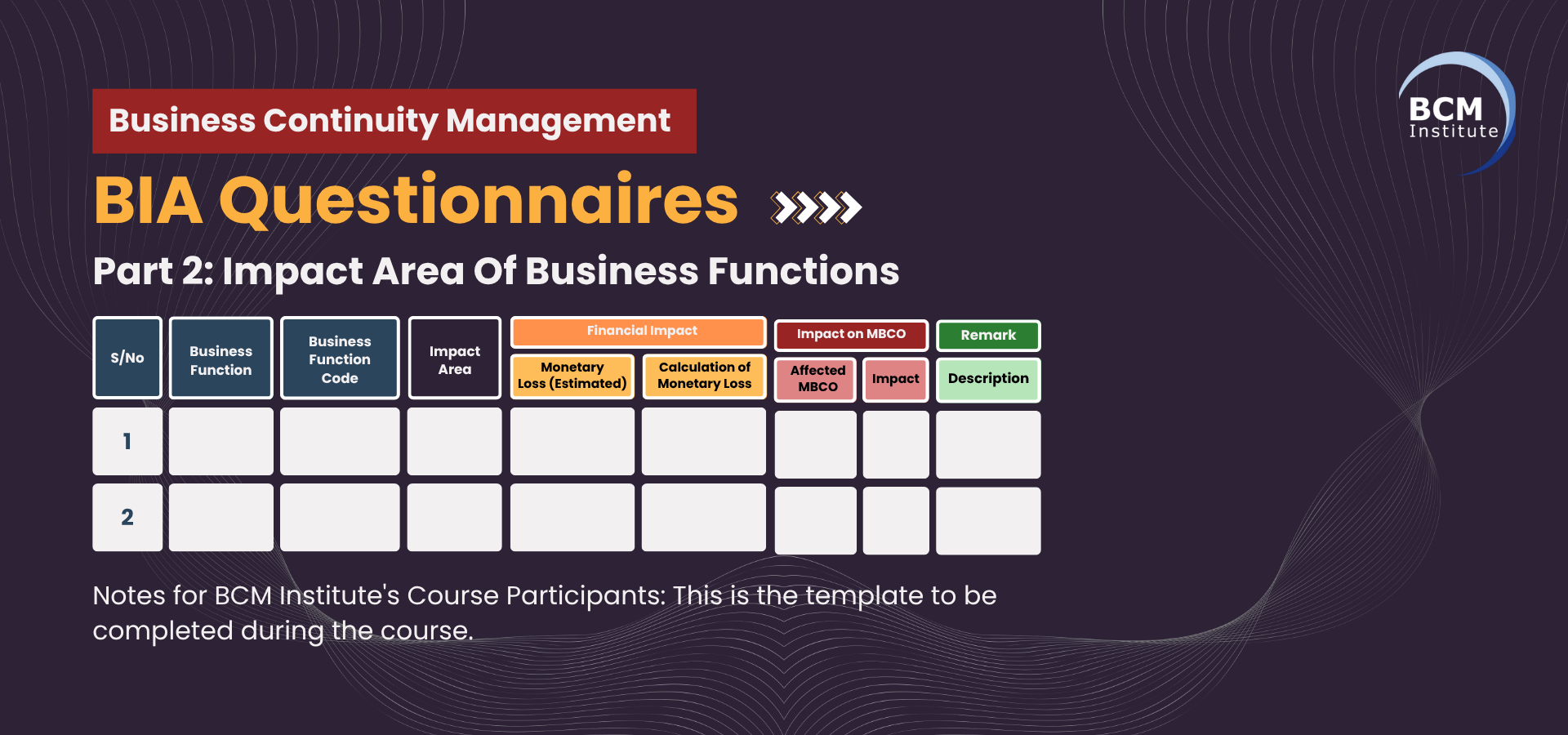
The Part 2 impact assessment, therefore, examines each Sub-Critical Business Function (Sub-CBF) individually and identifies the principal consequence of its disruption.
This approach aligns with BIA methodology, which considers impacts across financial and non-financial dimensions, links them to the applicable MBCO, and uses them to support criticality and recovery analysis.
For JCUS, this assessment is particularly relevant because teaching delivery operates within Singapore's regulatory and quality-assurance environment for private education.
As of 2026, the Skills and Workforce Development Agency (SWDA) exercises functions under the Private Education Act, and JCUS states that its Singapore operations are governed by EduTrust.
The university also operates physical teaching spaces, computer laboratories, and specialised teaching facilities alongside digital and academic resources, making teaching continuity dependent on people, premises, information, and technology.
### [![Banner \[BCM\] \[E3\] \[BIA\] \[P2\] Impact Area of Business Functions](https://no-cache.hubspot.com/cta/default/3893111/182e67c2-aa89-4b0b-b3e9-144293680ea4.png)](https://cta-redirect.hubspot.com/cta/redirect/3893111/182e67c2-aa89-4b0b-b3e9-144293680ea4)
[Dr Goh Moh Heng](https://blog.bcm-institute.org/ebook/author/dr-goh-moh-heng) Oct 2, 2026
###### Business Continuity Management Certified Planner-Specialist-Expert
### [![x \[BCM\] \[JCU\] Legal Disclaimer Banner](https://no-cache.hubspot.com/cta/default/3893111/e57030e6-3c63-46cc-988b-1eabb945de75.png)](https://cta-redirect.hubspot.com/cta/redirect/3893111/e57030e6-3c63-46cc-988b-1eabb945de75)
[](https://cta-redirect.hubspot.com/cta/redirect/3893111/6f3def45-6e82-4ee5-9e44-fc3946ad2398)
### [![Banner \[BCM\] \[E3\] \[BIA\] \[P2\] Impact Area of Business Functions](https://no-cache.hubspot.com/cta/default/3893111/182e67c2-aa89-4b0b-b3e9-144293680ea4.png)](https://cta-redirect.hubspot.com/cta/redirect/3893111/182e67c2-aa89-4b0b-b3e9-144293680ea4)
### CBF-1 Teaching and Learning Delivery
[![\[BCM\] \[JCU\] \[E3\] \[BIA\] \[T2\] \[CBF\] \[1\] Teaching and Learning Delivery](https://no-cache.hubspot.com/cta/default/3893111/3d5d03b2-0465-4e70-8920-efbaf80a835c.png)](https://cta-redirect.hubspot.com/cta/redirect/3893111/3d5d03b2-0465-4e70-8920-efbaf80a835c)
Business Impact Analysis (BIA) establishes the consequences that may arise when an important business function becomes unavailable or cannot operate at its required level.
For **CBF-1 Teaching and Learning Delivery**, the assessment should extend beyond the immediate cancellation of a lecture or class.
A disruption may affect academic schedules, student progression, access to learning materials, academic staff utilisation, regulatory obligations, institutional reputation, technology services, facilities, and the ability to complete the approved teaching programme.
The Part 2 impact assessment, therefore, examines each Sub-Critical Business Function (Sub-CBF) individually and identifies the principal consequence of its disruption.
This approach aligns with BIA methodology, which considers impacts across financial and non-financial dimensions, links them to the applicable MBCO, and uses them to support criticality and recovery analysis.
For JCUS, this assessment is particularly relevant because teaching delivery operates within Singapore's regulatory and quality-assurance environment for private education.
As of 2026, the Skills and Workforce Development Agency (SWDA) exercises functions under the Private Education Act, and JCUS states that its Singapore operations are governed by EduTrust.
The university also operates physical teaching spaces, computer laboratories, and specialised teaching facilities alongside digital and academic resources, making teaching continuity dependent on people, premises, information, and technology.
Assess different impact areas separately because disruption does not affect every Sub-CBF in the same way.
Failure to allocate teaching staff primarily creates an operational and human-resource problem; failure of an online teaching platform is principally a technology dependency; inadequate communication creates a stakeholder impact; and prolonged failure to deliver scheduled teaching can ultimately create regulatory, financial, and reputational consequences.
For this implementation example, the monetary amounts below are **indicative BIA estimates in Singapore dollars (SGD),** not JCUS accounting figures. They represent reasonable planning assumptions for comparing disruption consequences.
Unless otherwise specified, the figures assume a **five-business-day disruption scenario**. Actual implementation should replace these assumptions with validated data from Finance, Academic Administration, Human Resources, ICT, Facilities, and the relevant academic schools.
For BIA purposes, the working **BU MBCO for Teaching and Learning Delivery** is:
**Maintain delivery of priority scheduled teaching and essential student-learning support at a minimum acceptable level, using approved alternative teaching arrangements where necessary, while protecting academic quality, student accessibility, essential records, and regulatory obligations.**
[![Banner \[Table\] \[BCM\] \[E3\] \[BIA\] \[P2\] Impact Areas of Business Functions \[BIAQ\]](https://no-cache.hubspot.com/cta/default/3893111/91582408-03ad-40e1-90e8-43ce62079aa6.png)](https://cta-redirect.hubspot.com/cta/redirect/3893111/91582408-03ad-40e1-90e8-43ce62079aa6)
Table BIA Part 2: Impact Area of Business Functions for CBF-1 Teaching and Learning Delivery
| Sub-CBF Code | Sub-Critical Business Function | Impact Area | Financial Impact – Monetary Loss (Estimated) | Financial Impact – Calculation Formula | Impact on BU MBCO – Affected MBCO | Impact on BU MBCO – Business Impact | Remarks / Description |
| --- | --- | --- | --- | --- | --- | --- | --- |
| 1.1 | Determine Teaching Delivery Requirements | Operational | S$25,000 | Academic planning rework S$15,000 + additional coordination S$10,000 | Maintain an accurate minimum teaching-delivery plan | Required subjects, delivery modes, staffing, and facilities may not be identified correctly or early enough to support minimum teaching operations. | Creates downstream errors in staffing, timetabling, room allocation and teaching-resource planning. |
| 1.2 | Confirm Subject and Class Offerings | Customer / Stakeholder | S$40,000 | Administrative remediation S$15,000 + estimated enrolment/fee exposure S$25,000 | Maintain confirmed priority classes required for student progression | Students may be unable to confirm study plans and required classes may not be available when teaching resumes. | May affect enrolment decisions, progression expectations and confidence in academic administration. |
| 1.3 | Determine Student Teaching Demand | Operational | S$30,000 | Additional planning labour S$10,000 + timetable/resource rework S$20,000 | Maintain sufficient capacity for priority teaching | Minimum teaching capacity cannot be matched reliably to actual student demand. | Underestimation can create overcrowding and access problems; overestimation wastes scarce rooms and academic resources. |
| 1.4 | Allocate Academic Teaching Staff | Human Resources | S$60,000 | Replacement lecturers S$40,000 + overtime/additional workload S$20,000 | Maintain qualified academic coverage for priority classes | Classes cannot proceed at the minimum required capacity where appropriately qualified teaching staff are unavailable. | Prolonged disruption can cause cancellations, workload concentration and academic-quality concerns. |
| 1.5 | Develop and Maintain Teaching Timetable | Operational | S$45,000 | Timetable reconstruction S$20,000 + rescheduling/overtime S$15,000 + room rebooking S$10,000 | Maintain a workable schedule for priority teaching | Students and lecturers cannot reliably determine when and where priority classes will be conducted. | Conflicts may affect multiple programmes, rooms, staff and student cohorts simultaneously. |
| 1.6 | Allocate Teaching Rooms and Facilities | Third-Party Dependency | S$75,000 | Temporary facilities S$50,000 + relocation/logistics S$25,000 | Provide a minimum suitable teaching capacity | Face-to-face classes may have to be reduced, relocated or converted to alternative delivery modes. | Specialised classes may be particularly difficult to relocate where laboratories or purpose-built facilities are required. |
| 1.7 | Prepare Teaching and Learning Materials | Operational | S$30,000 | Academic redevelopment hours S$20,000 + urgent production S$10,000 | Provide essential learning content for priority classes | Teaching may continue only at a reduced standard if essential materials are incomplete or unavailable. | May result in inconsistent delivery and additional academic workload after recovery. |
| 1.8 | Publish Digital Learning Materials | Technology | S$35,000 | ICT recovery S$15,000 + staff remediation S$10,000 + alternative distribution S$10,000 | Maintain student access to essential learning materials | Students cannot access readings, instructions, learning resources or other essential digital content. | Particularly significant during remote or hybrid teaching and may disproportionately affect students unable to attend campus. |
| 1.9 | Prepare Teaching Technology and Classroom Resources | Technology | S$50,000 | Emergency equipment S$25,000 + technical support S$15,000 + replacement/rental S$10,000 | Maintain a minimum functional teaching technology | Technology-dependent classes cannot operate effectively even where staff and rooms remain available. | Failure may affect classroom presentation, conferencing, specialist software and digitally enabled learning. |
| 1.10 | Deliver Face-to-Face Lectures and Classes | Operational | S$150,000 | Estimated affected teaching value S$100,000 + make-up delivery S$50,000 | Deliver priority scheduled teaching to enrolled students | Direct loss of classroom teaching capacity causes immediate failure to meet the minimum teaching service unless alternative delivery is activated. | High-priority continuity function because disruption directly affects students and accumulated teaching obligations. |
| 1.11 | Deliver Online or Remote Teaching | Technology | S$120,000 | Lost/delayed teaching value S$70,000 + platform/ICT recovery S$30,000 + remediation S$20,000 | Maintain remote teaching capability when campus delivery is unavailable | JCUS loses a major alternative delivery channel and cannot readily transfer disrupted campus teaching online. | Simultaneous campus and online constraints could materially reduce overall teaching capacity. |
| 1.12 | Deliver Hybrid Teaching Activities | Technology | S$80,000 | Technical recovery S$30,000 + repeated classes S$30,000 + additional staff support S$20,000 | Maintain flexible teaching across campus and remote cohorts | Students dependent on remote participation may lose access while physical classes continue. | Creates inequitable access and may require duplicated or repeated teaching sessions. |
| 1.13 | Deliver Tutorials, Workshops and Interactive Learning | Operational | S$65,000 | Replacement sessions S$40,000 + facilitator costs S$15,000 + room/technology costs S$10,000 | Maintain essential interactive learning activities | Students lose opportunities for guided application, discussion and feedback required to support learning outcomes. | Impact increases where participation is integral to subject completion or later assessment preparation. |
| 1.14 | Deliver Laboratory and Practical Teaching | Operational | S$125,000 | Replacement laboratory sessions S$60,000 + specialist facility/equipment S$40,000 + consumables S$25,000 | Maintain essential practical and laboratory learning | Practical competencies cannot be delivered solely through normal classroom or remote alternatives. | Potentially severe where laboratory availability, safety controls, specialist equipment or supervised practical experience is required. |
| 1.15 | Provide Academic Consultation and Learning Guidance | Customer / Stakeholder | S$30,000 | Additional consultation backlog S$20,000 + extended support S$10,000 | Maintain essential academic guidance for at-risk and affected students | Students requiring urgent clarification or academic intervention may be unable to obtain timely support. | Prolonged interruption may contribute to poor engagement, incorrect academic decisions and avoidable progression problems. |
| 1.16 | Monitor Student Attendance and Participation | Information | S$25,000 | Attendance reconstruction S$15,000 + administrative verification S$10,000 | Maintain a minimum evidence of student participation | JCUS may be unable to identify disengaged students or demonstrate reliable participation records. | Incomplete records can affect student intervention, academic administration and compliance evidence. |
| 1.17 | Monitor Teaching Delivery and Class Completion | Information | S$30,000 | Academic reconciliation S$15,000 + class verification S$10,000 + remediation S$5,000 | Confirm delivery of priority scheduled teaching | Management cannot reliably determine which teaching obligations have been completed and which require recovery. | Increases risk of unnoticed teaching gaps and inaccurate reporting of programme completion. |
| 1.18 | Manage Academic Staff Unavailability | Human Resources | S$90,000 | Replacement academic staff S$50,000 + overtime S$25,000 + rescheduling S$15,000 | Maintain qualified coverage despite staff loss | Multiple classes may be cancelled or delayed if substitutes cannot be mobilised rapidly. | Especially important during widespread illness, transport disruption or simultaneous loss of specialist lecturers. |
| 1.19 | Manage Teaching Facility Disruption | Operational | S$150,000 | Temporary premises S$80,000 + relocation S$30,000 + technology/logistics S$40,000 | Maintain sufficient alternative teaching capacity | Loss of campus space can affect multiple programmes simultaneously and reduce physical teaching below the minimum acceptable level. | Requires predetermined relocation, remote-teaching and room-prioritisation arrangements. |
| 1.20 | Manage Digital Learning or ICT Disruption | Technology | S$200,000 | ICT recovery S$80,000 + alternative delivery S$50,000 + academic/admin remediation S$40,000 + external technical support S$30,000 | Maintain essential digital teaching and learning services | Online, hybrid, and digitally supported face-to-face teaching may all be impaired simultaneously. | A potentially systemic disruption because teaching delivery, learning resources and communication can depend on common technology platforms. |
| 1.21 | Communicate Teaching Changes to Students and Staff | Customer / Stakeholder | S$35,000 | Emergency communications S$10,000 + helpdesk surge S$15,000 + administrative remediation S$10,000 | Provide timely and authoritative teaching instructions | Even available recovery arrangements may fail if students and staff do not know when, where or how teaching will continue. | Poor communication creates confusion, missed classes, duplicate enquiries and loss of confidence during disruption. |
| 1.22 | Provide Accessible and Alternative Teaching Arrangements | Legal | S$70,000 | Accessibility remediation S$25,000 + alternative delivery S$30,000 + specialist support S$15,000 | Maintain accessible minimum teaching for affected students | Some students may be unable to participate in continuity arrangements even when general teaching remains available. | Continuity solutions should account for accessibility requirements rather than assuming one recovery mode is suitable for all students. |
| 1.23 | Prioritise Teaching During Major Disruption | Operational | S$100,000 | Misallocated recovery resources S$40,000 + avoidable cancellations S$40,000 + management remediation S$20,000 | Protect the highest-priority teaching within constrained capacity | Scarce staff, rooms and technology may be assigned to lower-priority activities while time-sensitive teaching remains unavailable. | This Sub-CBF translates BIA priorities into operational decisions during a major disruption. |
| 1.24 | Recover Missed or Interrupted Teaching | Financial | S$180,000 | Additional lecturer hours S$80,000 + facilities S$40,000 + technology/support S$30,000 + schedule remediation S$30,000 | Restore accumulated teaching obligations within an acceptable period | Backlogs continue to grow and may interfere with subsequent classes, assessments, and academic milestones. | Recovery cost rises materially as disruption duration increases and available timetable capacity decreases. |
| 1.25 | Reconcile and Confirm Teaching Completion | Regulatory | S$45,000 | Verification/reconciliation S$20,000 + academic remediation S$15,000 + compliance evidence preparation S$10,000 | Confirm required teaching has been completed and evidenced | JCUS may be unable to demonstrate that affected subjects have received the required teaching following the disruption. | Important for academic governance, quality assurance, audit trail and management assurance after recovery. |
| 1.26 | Return Teaching Operations to Normal | Reputation | S$100,000 | Extended temporary arrangements S$40,000 + backlog clearance S$30,000 + stakeholder remediation S$20,000 + additional support S$10,000 | Restore normal teaching without losing recovered service capability | Temporary arrangements may persist, backlogs may remain unresolved and service quality may continue below normal levels. | Premature return to normal operations may trigger secondary disruption; transition should therefore be controlled and formally confirmed. |
#### **Interpreting the Impact Assessment**
The table demonstrates that the impact profile of **CBF-1 Teaching and Learning Delivery** is not confined to direct financial loss.
Teaching is an interconnected service supported by academic personnel, physical facilities, ICT platforms, information, communications, and administrative coordination.
Consequently, disruption to a supporting Sub-CBF can propagate into the actual delivery of teaching even where the teaching activity itself has not initially failed.
The financial figures should therefore be interpreted as **BIA planning values**, not forecasts of accounting loss. Their purpose is to translate disruption into a scale that management can use when comparing continuity investments and recovery alternatives.
BCM good practice requires documenting the basis for financial quantification so the estimated amount can be understood and challenged, rather than recorded as an unsupported figure.
For JCUS, some of the most financially significant scenarios are likely to arise from functions that directly maintain teaching capacity or provide recovery capability.
These include face-to-face teaching, laboratory and practical teaching, managing teaching-facility disruption, recovering missed teaching, and managing digital-learning or ICT disruption. Their importance does not arise solely from the estimated monetary values.
They can also create substantial academic, student, regulatory, and reputational consequences.
#### **Relationship to the BU MBCO**
The BU MBCO provides the operational reference point against which JCUS should assess disruption.
Rather than requiring all normal teaching activities to continue unchanged, the MBCO identifies the **minimum acceptable teaching capability that JCUS must sustain during disruption**.
This distinction is important. During a severe disruption, JCUS may not be able to maintain every class, room, teaching method, and supporting activity at normal capacity.
The continuity objective should instead enable management to determine which teaching activities must continue first, which may operate through alternative arrangements, and which may be deferred temporarily without causing unacceptable consequences.
The Sub-CBF analysis, therefore, identifies where failure would prevent the academic business unit from maintaining that minimum level of service. This creates a direct connection between the BIA and practical continuity decisions.
#### **Financial Impact and Management Decision-Making**
Financial quantification gives management a common basis for evaluating otherwise different disruption scenarios.
For example, the cost of restoring an ICT platform can be compared with the cost of prolonged manual workarounds, repeated teaching sessions or delayed recovery. Similarly, investment in alternative teaching facilities can be evaluated against the likely cost of extended campus unavailability.
Management should not, however, determine criticality from monetary loss alone.
A relatively low-cost function may still require rapid recovery where its failure creates significant regulatory, student, safety, accessibility, or academic-quality consequences.
Therefore, evaluate financial and non-financial impacts together.
Actual BIA workshops should validate each estimate using measurable inputs such as academic staff cost, affected teaching hours, number of classes and students, facility costs, ICT recovery charges, external vendor expenses, and the cost of repeating or rescheduling teaching activities.
#### **Influence on RTO and Recovery Priorities**
The results from Part 2 provide an important input into subsequent BIA stages where the **time sensitivity of disruption** is assessed.
Sub-CBFs whose disruption rapidly prevents achievement of the BU MBCO should normally receive stronger consideration for shorter Recovery Time Objectives (RTOs).
For example, the ability to communicate teaching changes, manage major ICT disruption, and establish alternative teaching arrangements may need to be restored earlier than activities associated with final reconciliation and return to normal operations.
The eventual RTO should therefore not be derived solely from the monetary amount in this table. It should reflect:
- how quickly the impact increases;
- when the BU MBCO becomes threatened;
- academic-calendar constraints;
- student and stakeholder consequences;
- regulatory and quality-assurance obligations;
- dependencies between Sub-CBFs; and
- the maximum period for which temporary workarounds remain viable.
This enables the next stage of the BIA to move from **“What happens if this function is unavailable?”** to **“How long can JCUS tolerate the function being unavailable?”**
#### **Influence on Business Continuity Strategies**
Once priority and time sensitivity have been established, the impact assessment informs the selection of appropriate Business Continuity Strategies.
For Teaching and Learning Delivery, possible strategies may include cross-trained or substitute academic staff, remote-teaching capability, alternative classrooms, prioritised access to laboratories, redundant digital-learning infrastructure, emergency communication channels, pre-approved alternative teaching arrangements, recovery timetables, and procedures for clearing accumulated teaching backlogs.
The appropriate strategy should be proportionate to the consequences identified by the BIA. Higher-impact and shorter-tolerance Sub-CBFs generally justify stronger preventive controls, more robust alternate capabilities, and greater recovery investment.
#### **Influence on the Business Continuity Plan**
The BIA ultimately provides the evidence base for translating continuity requirements into executable Business Continuity Plans.
The Teaching and Learning Delivery plan should define activation criteria, responsibilities, priority teaching activities, minimum resource requirements, alternative delivery methods, communication procedures, dependencies, escalation arrangements, and procedures for recovering missed teaching.
It should also distinguish between **continuity**, **recovery,** and **return to normal**. Maintaining priority teaching during disruption does not, by itself, complete recovery.
Missed classes must be restored, completion confirmed, outstanding issues reconciled, and temporary arrangements progressively withdrawn before normal operations can be considered fully re-established.
[![Banner \[BCM\] \[E3\] \[BIA\] \[Summing Up\] \[P2\] Impact Areas of Business Functions \[BIAQ\]](https://no-cache.hubspot.com/cta/default/3893111/76188041-e1c9-43d9-8efa-e550f46ad04d.png)](https://cta-redirect.hubspot.com/cta/redirect/3893111/76188041-e1c9-43d9-8efa-e550f46ad04d)
BIA Part 2 converts the list of Sub-Critical Business Functions developed in Part 1 into a structured understanding of **why those functions matter when disrupted**.
By identifying the principal impact area, estimating monetary consequences, documenting the calculation basis, and connecting each function to the BU MBCO, JCUS can establish a more defensible basis for determining business continuity priorities.
The assessment also demonstrates that the resilience of Teaching and Learning Delivery depends on more than maintaining classroom instruction.
Academic staffing, facilities, digital platforms, information, communication, accessibility, recovery coordination, and completion assurance collectively support the teaching service.
The next stage of the BIA should apply a **time-based impact assessment** to these Sub-CBFs.
This will establish how impacts escalate as disruption continues and provide the basis for determining criticality, Maximum Tolerable Period of Disruption, or equivalent tolerance measures, and appropriate RTOs.
These requirements can then be translated into resource requirements, Business Continuity Strategies, and detailed Business Continuity Plans.
**Implementation Note:** All monetary amounts in this chapter are illustrative assumptions expressed in SGD for BIA development.
Validate and replace them with JCUS-approved financial and operational data during facilitated BIA workshops.
[](https://cta-redirect.hubspot.com/cta/redirect/3893111/3aefb2d2-3110-47c1-ad4f-d3e6e5381066)
[![\[BCM\] \[JCU\] \[3/4 Banner\] Business Continuity Management Implementation at JCU Singapore](https://no-cache.hubspot.com/cta/default/3893111/d81098d9-9f30-4c17-a897-2fc202440adc.png)](https://cta-redirect.hubspot.com/cta/redirect/3893111/d81098d9-9f30-4c17-a897-2fc202440adc)
| **eBook 3: Starting Your BCM Implementation** | | | | | | |
| --- | --- | --- | --- | --- | --- | --- |
| **MBCO** | **P&S** | **RAR T1** | **RAR T2** | **RAR T3** | **BCS T1** | **CBF** |
| [![\[BCM\] \[JCU\] \[E3\] \[BIA\] MBCO Corporate MBCO](https://no-cache.hubspot.com/cta/default/3893111/37db16b1-9a61-4815-adbb-527771b7bd35.png)](https://cta-redirect.hubspot.com/cta/redirect/3893111/37db16b1-9a61-4815-adbb-527771b7bd35) | [![\[BCM\] \[JCU\] \[E3\] \[BIA\] \[PS\] Key Product and Services](https://no-cache.hubspot.com/cta/default/3893111/3117a3bf-33fd-4522-a373-4ce343e253a6.png)](https://cta-redirect.hubspot.com/cta/redirect/3893111/3117a3bf-33fd-4522-a373-4ce343e253a6) | [![\[BCM\] \[JCU\] \[E3\] \[RAR\] \[T1\] List of Threats](https://no-cache.hubspot.com/cta/default/3893111/de614923-e16d-4c4b-878e-60b97f56183f.png)](https://cta-redirect.hubspot.com/cta/redirect/3893111/de614923-e16d-4c4b-878e-60b97f56183f) | [![\[BCM\] \[JCU\] \[E3\] \[RAR\] \[T2\] Treatment and Control](https://no-cache.hubspot.com/cta/default/3893111/71606f66-523b-41e0-af99-19f5e4cc2f37.png)](https://cta-redirect.hubspot.com/cta/redirect/3893111/71606f66-523b-41e0-af99-19f5e4cc2f37) | [![\[BCM\] \[JCU\] \[E3\] \[RAR\] \[T3\] Risk Impact and Likelihood Assessment](https://no-cache.hubspot.com/cta/default/3893111/0192071d-0c49-4a20-a2a8-f0894418f873.png)](https://cta-redirect.hubspot.com/cta/redirect/3893111/0192071d-0c49-4a20-a2a8-f0894418f873) | [![\[BCM\] \[JCU\] \[E3\] \[BCS\] \[T1\] Mitigation Strategies and Justification](https://no-cache.hubspot.com/cta/default/3893111/12b9c723-7ba3-4523-a1c2-0e75dc09a4e3.png)](https://cta-redirect.hubspot.com/cta/redirect/3893111/12b9c723-7ba3-4523-a1c2-0e75dc09a4e3) | [![\[BCM\] \[JCU\] \[E1\] \[C10\] Identifying Critical Business Functions](https://no-cache.hubspot.com/cta/default/3893111/b7aaf4cf-e4f4-4e31-bb8f-6885a5f2203d.png)](https://cta-redirect.hubspot.com/cta/redirect/3893111/b7aaf4cf-e4f4-4e31-bb8f-6885a5f2203d) |
| **CBF-1 Teaching and Learning Delivery** | | | | | | |
| **DP** | **BIAQ P1** | **BIAQ P2** | **BIAQ P3** | **BIAQ P4** | **BIAQ P5** | **BIAQ P6** |
| [![\[BCM\] \[JCU\] \[E3\] \[BIA\] \[DP\] \[CBF\] \[1\] Teaching and Learning Delivery](https://no-cache.hubspot.com/cta/default/3893111/87dc20a3-b9ed-454a-90ee-2ca3e2419322.png)](https://cta-redirect.hubspot.com/cta/redirect/3893111/87dc20a3-b9ed-454a-90ee-2ca3e2419322) | **[![\[BCM\] \[JCU\] \[E3\] \[BIA\] \[T1\] \[CBF\] \[1\] Teaching and Learning Delivery](https://no-cache.hubspot.com/cta/default/3893111/c0d85e4b-2df7-44ee-9c25-4112e99a64f3.png)](https://cta-redirect.hubspot.com/cta/redirect/3893111/c0d85e4b-2df7-44ee-9c25-4112e99a64f3)** | **[![\[BCM\] \[JCU\] \[E3\] \[BIA\] \[T2\] \[CBF\] \[1\] Teaching and Learning Delivery](https://no-cache.hubspot.com/cta/default/3893111/3d5d03b2-0465-4e70-8920-efbaf80a835c.png)](https://cta-redirect.hubspot.com/cta/redirect/3893111/3d5d03b2-0465-4e70-8920-efbaf80a835c)** | **[![\[BCM\] \[JCU\] \[E3\] \[BIA\] \[T3\] \[CBF\] \[1\] Teaching and Learning Delivery](https://no-cache.hubspot.com/cta/default/3893111/4107cc4d-b5ca-486c-bca0-d2a049b8c752.png)](https://cta-redirect.hubspot.com/cta/redirect/3893111/4107cc4d-b5ca-486c-bca0-d2a049b8c752)** | **[![\[BCM\] \[JCU\] \[E3\] \[BIA\] \[T4\] \[CBF\] \[1\] Teaching and Learning Delivery](https://no-cache.hubspot.com/cta/default/3893111/e9bd80ac-aa4d-4da0-873e-92bb036ae9c9.png)](https://cta-redirect.hubspot.com/cta/redirect/3893111/e9bd80ac-aa4d-4da0-873e-92bb036ae9c9)** | **[![\[BCM\] \[JCU\] \[E3\] \[BIA\] \[T5\] \[CBF\] \[1\] Teaching and Learning Delivery](https://no-cache.hubspot.com/cta/default/3893111/7c619369-8c50-4876-a478-749b847adee0.png)](https://cta-redirect.hubspot.com/cta/redirect/3893111/7c619369-8c50-4876-a478-749b847adee0)** | **[![\[BCM\] \[JCU\] \[E3\] \[BIA\] \[T6\] \[CBF\] \[1\] Teaching and Learning Delivery](https://no-cache.hubspot.com/cta/default/3893111/bdb520b6-bc53-40cf-bc72-5e4eb5c2d1ae.png)](https://cta-redirect.hubspot.com/cta/redirect/3893111/bdb520b6-bc53-40cf-bc72-5e4eb5c2d1ae)** |
| | | **BCS T2** | **BCS T3** | **PD** | | |
| | | [![\[BCM\] \[JCU\] \[E3\] \[BCS\] \[T2\] \[CBF\] \[1\] Teaching and Learning Delivery](https://no-cache.hubspot.com/cta/default/3893111/10a04273-213c-4b93-a69a-966039c382bb.png)](https://cta-redirect.hubspot.com/cta/redirect/3893111/10a04273-213c-4b93-a69a-966039c382bb) | [![\[BCM\] \[JCU\] \[E3\] \[BCS\] \[T3\] \[CBF\] \[1\] Teaching and Learning Delivery](https://no-cache.hubspot.com/cta/default/3893111/d2ec73f8-a65d-473f-9a70-afa20ac0b990.png)](https://cta-redirect.hubspot.com/cta/redirect/3893111/d2ec73f8-a65d-473f-9a70-afa20ac0b990) | [![\[BCM\] \[JCU\] \[E3\] \[PD\] \[CBF\] \[1\] Teaching and Learning Delivery](https://no-cache.hubspot.com/cta/default/3893111/41fe68b0-13dc-4690-bd61-369c6da03192.png)](https://cta-redirect.hubspot.com/cta/redirect/3893111/41fe68b0-13dc-4690-bd61-369c6da03192) | | |
| | | | | | | |
#### More Information About Business Continuity Management Courses
To learn more about the course and schedule, click the buttons below for the BCM-300 Business Continuity Management Implementer \[BCM-3\] and the BCM-5000 Business Continuity Management Expert Implementer \[BCM-5\].
| [](https://cta-redirect.hubspot.com/cta/redirect/3893111/f3922b80-e96a-46d6-8993-dc150a5de2d5) | [](https://cta-redirect.hubspot.com/cta/redirect/3893111/9ff8a3dc-e39a-465b-929f-72e232cdd5fb) | [![Register \[BL-B-3\]\*](https://no-cache.hubspot.com/cta/default/3893111/ac6cf073-4cdd-4541-91ed-889f731d5076.png)](https://cta-redirect.hubspot.com/cta/redirect/3893111/ac6cf073-4cdd-4541-91ed-889f731d5076) |
| --- | --- | --- |
| [](https://cta-redirect.hubspot.com/cta/redirect/3893111/21525c10-4003-4934-95fc-fe218174bc5b) | [](https://cta-redirect.hubspot.com/cta/redirect/3893111/46460171-c91a-4936-9bb2-8dc5928a0e02) | [](https://cta-redirect.hubspot.com/cta/redirect/3893111/1cb17ac7-50b2-4f88-bc4b-c7444e4b57b5) |
| [![FAQ \[BL-B-3\]](https://no-cache.hubspot.com/cta/default/3893111/b3824ba1-7aa1-4eb6-bef8-94f57121c5ae.png)](https://cta-redirect.hubspot.com/cta/redirect/3893111/b3824ba1-7aa1-4eb6-bef8-94f57121c5ae) | Please feel free to send us a note if you have any questions. [![Email to Sales Team \[BCM Institute\]](https://no-cache.hubspot.com/cta/default/3893111/3c53daeb-2836-4843-b0e0-645baee2ab9e.png)](https://cta-redirect.hubspot.com/cta/redirect/3893111/3c53daeb-2836-4843-b0e0-645baee2ab9e) | [](https://cta-redirect.hubspot.com/cta/redirect/3893111/9c199ae8-c470-4bb7-9612-73c7a084e94c) |
| [](https://cta-redirect.hubspot.com/cta/redirect/3893111/8999211a-2c51-4be7-bf49-c393f6c67974) | [](https://cta-redirect.hubspot.com/cta/redirect/3893111/5c1aa95d-f6dd-4067-a95c-5cc0c32d7ed8) | [](https://cta-redirect.hubspot.com/cta/redirect/3893111/086ab3b9-4d66-4a95-b2f7-1148e9803a9c) |
#### **Your Comments Here:**
### More Posts
[](https://cta-redirect.hubspot.com/cta/redirect/3893111/839787f4-a4fd-456f-accf-54c947026558)

All rights reserved. Copyright 2026
```json
{
"@context" : "https://schema.org",
"@type" : "BlogPosting",
"author" : {
"@type" : "Person",
"name" : "Dr Goh Moh Heng",
"url" : "https://blog.bcm-institute.org/ebook/author/dr-goh-moh-heng"
},
"dateModified" : "2026-10-02T11:29:18.447Z",
"datePublished" : "2026-10-02T03:26:46.000Z",
"headline" : "[BCM] [JCUS] [E3] [BIA] [P2] CBF [1] Teaching and Learning Delivery",
"mainEntityOfPage" : {
"@id" : "https://blog.bcm-institute.org/ebook/bcm-jcus-e3-bia-p2-cbf-1-teaching-and-learning-delivery",
"@type" : "WebPage"
},
"publisher" : {
"@type" : "Organization",
"logo" : {
"@type" : "ImageObject",
"url" : "https://blog.bcm-institute.org/hubfs/BCMI%20Logo.png"
},
"name" : "BCMI Pte Ltd"
}
}
```