---
title: [BCM] [JCUS] [E3] [BIA] [P1] [CBF] [1] Teaching and Learning Delivery
description: [BCM] [JCUS] [E3] [BIA] [P1] [CBF] [1] Teaching and Learning Delivery
image: https://blog.bcm-institute.org/hubfs/JCU%20Graphic%20Folder/JCU%20CBF%201%20Morepost/%5BBCM%5D%20%5BJCU%5D%20%5BE3%5D%20%5BBIA%5D%20%5BT1%5D%20%5BCBF%5D%20%5B1%5D%20Examination%2c%20Academic%20Assessment%20and%20Graduation.jpg
---
. .
[](http://www.bcm-institute.org/)
- [Home](https://www.bcm-institute.org/)
- [About Us](https://www.bcm-institute.org/about-us-3/)
- [A President’s Perspective](https://www.bcm-institute.org/about-us/a-presidents-perspective/)
- [Our History](https://www.bcm-institute.org/about-us/our-history/)
- [Our Advisory Council](https://www.bcm-institute.org/about-us/our-advisory-council/)
- [Customers’ Testimonials](https://www.bcm-institute.org/about-us/customers-testimonials/)
- [Credential Verification](https://www.bcm-institute.org/about-us/credential-verification/)
- [Courses](https://blog.bcm-institute.org/blog/course-fees-for-blended-learning-courses-master-catalog)
- [ISO 22301 Business Continuity Management System Audit](https://blog.bcm-institute.org/audit/business-continuity-management-audit-courses)
- [ISO 22301 Business Continuity Management](https://blog.bcm-institute.org/bcm/business-continuity-management-courses)
- [Crisis Communication](https://blog.bcm-institute.org/crisis-communication/crisis-communication-courses)
- [Crisis Management](https://blog.bcm-institute.org/en/crisis-management/courses)
- [IT Disaster Recovery](https://blog.bcm-institute.org/it-disaster-recovery/courses)
- [Operational Resilience](https://blog.bcm-institute.org/operational-resilience/courses)
- [Operational Resilience Audit](https://blog.bcm-institute.org/operational-resilience-audit/courses)
- [Certification](https://blog.bcm-institute.org/certification/types-of-certifications-offered)
- [ISO 22301 BCMS Audit Certification](https://blog.bcm-institute.org/certification/business-continuity-management-audit-certification)
- [ISO22301 Business Continuity Management Certification](https://blog.bcm-institute.org/bcm/business-continuity-management-certification)
- [Crisis Communication Certification](https://blog.bcm-institute.org/crisis-communication/crisis-communication-certification)
- [Crisis Management Certification](https://blog.bcm-institute.org/en/crisis-management/crisis-management-certification)
- [IT Disaster Recovery Planning Certification](https://blog.bcm-institute.org/it-disaster-recovery/it-disaster-recovery-certification)
- [Operational Resilience Certification](https://blog.bcm-institute.org/operational-resilience/operational-resilience-certification)
- [Operational Resilience Audit Certification](https://blog.bcm-institute.org/operational-resilience-audit)
- [Seminars](https://blog.bcm-institute.org/meet-the-expert/mte-webinar-mainpage)
- [Store](https://www.bcm-institute.org/store-2/)
- [Contact Us](http://www.bcm-institute.org/about-us/contact-us/)
-
-
##### Institutional Resilience in Action: Business Continuity Management Implementation at JCU Singapore
# \[BCM\] \[JCUS\] \[E3\] \[BIA\] \[P1\] \[CBF\] \[1\] Teaching and Learning Delivery
[![\[BCM\] \[JCU\] \[Full Banner\] Business Continuity Management Implementation at JCU Singapore](https://no-cache.hubspot.com/cta/default/3893111/c28ce2ee-dfaa-4e23-b28a-6ae8ca285f06.png)](https://cta-redirect.hubspot.com/cta/redirect/3893111/c28ce2ee-dfaa-4e23-b28a-6ae8ca285f06)
The Business Impact Analysis (BIA) translates a broad Critical Business Function (CBF) into the operational activities that must be understood, prioritised, and recovered when disruption occurs.
For James Cook University Singapore (JCUS), **CBF-1 Teaching and Learning Delivery** encompasses more than the physical delivery of lectures.
It depends on a connected chain of academic planning, staffing, timetabling, learning materials, teaching facilities, digital platforms, student communications, accessibility arrangements, disruption management, and recovery activities.
Identifying these activities as **Sub-Critical Business Functions (Sub-CBFs)** provides the detail needed to determine where disruption could interrupt teaching delivery and which capabilities must be protected or restored first.
It also makes dependencies visible.
For example, a scheduled class cannot be delivered effectively if the lecturer, timetable, teaching venue, learning materials, or required digital platform are unavailable.
### [![Banner \[BCM\] \[E3\] \[BIA\] \[P1\] Identification of Business Functions](https://no-cache.hubspot.com/cta/default/3893111/206ddd7e-615a-42c8-aa2a-3416a1ad06b3.png)](https://cta-redirect.hubspot.com/cta/redirect/3893111/206ddd7e-615a-42c8-aa2a-3416a1ad06b3)
[Dr Goh Moh Heng](https://blog.bcm-institute.org/ebook/author/dr-goh-moh-heng) Oct 2, 2026
###### Business Continuity Management Certified Planner-Specialist-Expert
### [![x \[BCM\] \[JCU\] Legal Disclaimer Banner](https://no-cache.hubspot.com/cta/default/3893111/e57030e6-3c63-46cc-988b-1eabb945de75.png)](https://cta-redirect.hubspot.com/cta/redirect/3893111/e57030e6-3c63-46cc-988b-1eabb945de75)
[](https://cta-redirect.hubspot.com/cta/redirect/3893111/7ca79bbb-3795-4d02-8291-f7f6c33552b4)
[![Banner \[BCM\] \[E3\] \[BIA\] \[P1\] Identification of Business Functions](https://no-cache.hubspot.com/cta/default/3893111/206ddd7e-615a-42c8-aa2a-3416a1ad06b3.png)](https://cta-redirect.hubspot.com/cta/redirect/3893111/206ddd7e-615a-42c8-aa2a-3416a1ad06b3)
### CBF-1 Teaching and Learning Delivery
[![\[BCM\] \[JCU\] \[E3\] \[BIA\] \[T1\] \[CBF\] \[1\] Teaching and Learning Delivery](https://no-cache.hubspot.com/cta/default/3893111/c0d85e4b-2df7-44ee-9c25-4112e99a64f3.png)](https://cta-redirect.hubspot.com/cta/redirect/3893111/c0d85e4b-2df7-44ee-9c25-4112e99a64f3)The Business Impact Analysis (BIA) translates a broad Critical Business Function (CBF) into the operational activities that must be understood, prioritised, and recovered during disruption.
For James Cook University Singapore (JCUS), **CBF-1 Teaching and Learning Delivery** encompasses more than the physical delivery of lectures.
It depends on a connected chain of academic planning, staffing, timetabling, learning materials, teaching facilities, digital platforms, student communications, accessibility arrangements, disruption management, and recovery activities.
Identifying these activities as **Sub-Critical Business Functions (Sub-CBFs)** provides the detail needed to determine where disruption could interrupt teaching delivery and which capabilities must be protected or restored first. It also makes dependencies visible.
For example, a scheduled class cannot be delivered effectively if the lecturer, timetable, teaching venue, learning materials, or required digital platform are unavailable.
This decomposition is particularly important in the Singapore private education environment. JCUS identifies itself as EduTrust-certified, while Singapore's private education regulatory arrangements emphasise academic processes, student outcomes, and student protection.
Teaching continuity should therefore be considered not merely an internal operational issue but as part of maintaining appropriate academic delivery, student support, and institutional control during disruption.
#### **Business Unit Minimum Business Continuity Objective**
For each Sub-CBF, the BIA establishes a **Business Unit Minimum Business Continuity Objective (BU MBCO)**.
The BU MBCO defines the minimum operational capability or output that should be maintained during disruption so that the overall CBF can continue at an acceptable reduced level.
This differs from requiring normal operations to continue unchanged.
During a significant disruption, JCUS may temporarily reduce teaching capacity, prioritise essential classes, substitute teaching staff, relocate classes, move teaching online, provide alternative learning materials, or defer activities that cannot be delivered safely or effectively.
The BU MBCO specifies the minimum acceptable capability that these arrangements must preserve.
This approach is consistent with the underlying MBCO concept: the objective defines the minimum level of service required during disruption and helps determine the extent of recovery required.
Business-unit MBCOs provide the operational capabilities needed to support the organisation's broader continuity objective.
Importantly, the BU MBCOs below should **not automatically be interpreted as RTOs**.
The MBCO describes *what minimum capability is required*; subsequent BIA analysis determines *how quickly that capability must be recovered*.
RTO can then be set as the target period to restore the function to its required minimum level.
[![Banner \[Table\] \[BCM\] \[E3\] \[BIA\] \[P1\] Identification of Critical Business Functions](https://no-cache.hubspot.com/cta/default/3893111/4fe499c9-0c19-46b4-8b6f-75450dba07d8.png)](https://cta-redirect.hubspot.com/cta/redirect/3893111/4fe499c9-0c19-46b4-8b6f-75450dba07d8)
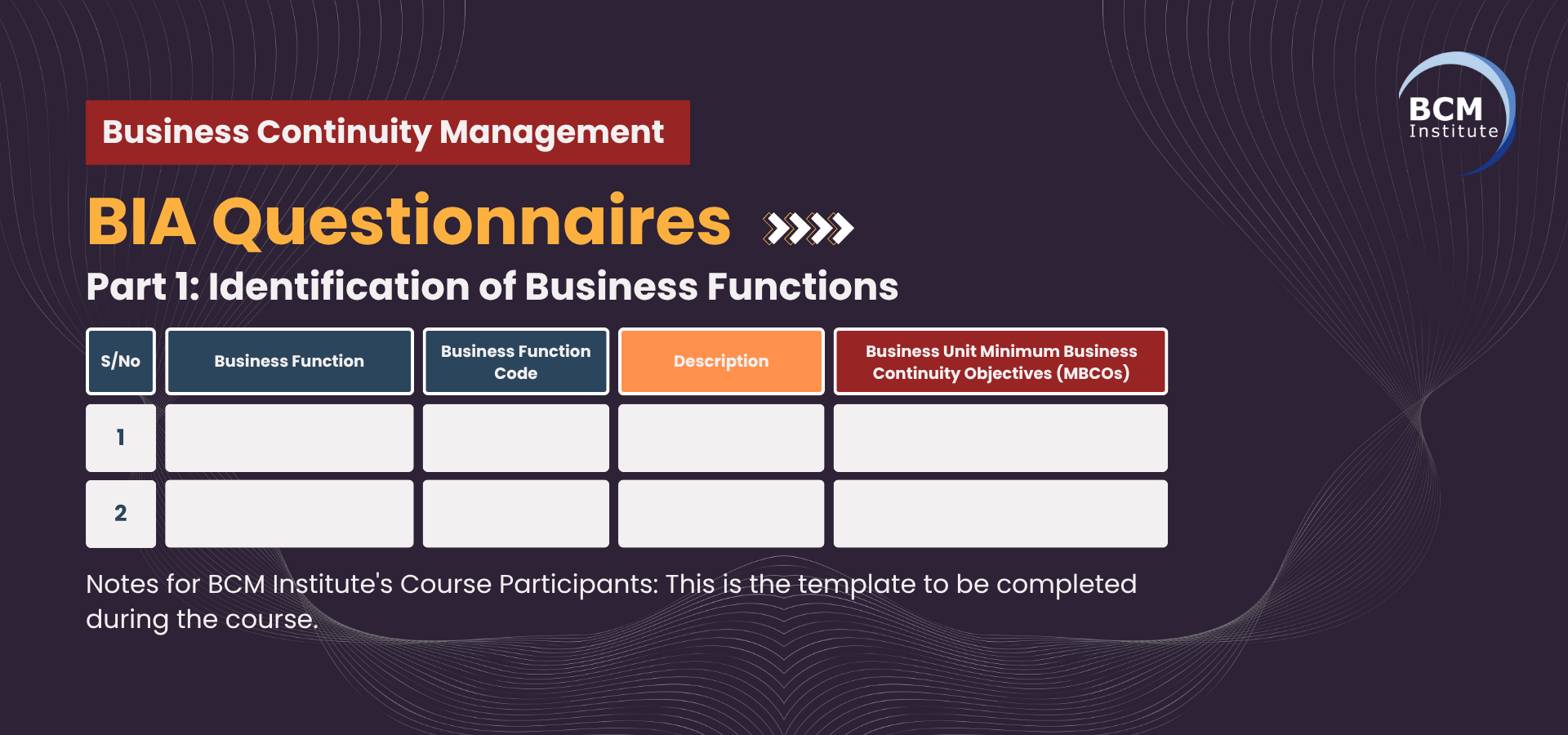
Table BIA Part 1: Identification of Business Functions for Sub-CBF-1 Teaching and Learning Delivery
| Sub-CBF Code | Sub-Critical Business Function | Description of Business Function | Business Unit Minimum Business Continuity Objective (BU MBCO) |
| --- | --- | --- | --- |
| 1.1 | Determine Teaching Delivery Requirements | Establishes the teaching activities required for each academic period based on approved subjects, academic calendars, delivery modes, student cohorts, curriculum requirements, and available academic resources. Provides the planning baseline for CBF-1. | Maintain access to the current approved teaching requirements for all active subjects and identify 100% of classes requiring continuity action during the affected teaching period, prioritising classes due within the next scheduled teaching cycle. |
| 1.2 | Confirm Subject and Class Offerings | Confirms which subjects, class groups, and teaching activities will operate, including delivery mode and scheduled academic period. Ensures students and academic units work from an authorised teaching schedule. | Maintain an authoritative list of all active subject and class offerings affected by the disruption, identifying whether each will proceed, relocate, move online, be rescheduled, or be temporarily suspended. |
| 1.3 | Determine Student Teaching Demand | Establishes the number and distribution of students requiring teaching for each subject and class, supporting capacity, staffing, room, and timetable decisions. | Maintain sufficient enrolment and class-demand information to identify affected cohorts and determine teaching capacity for all priority classes, using the latest validated student data available before the disruption, where live systems are unavailable. |
| 1.4 | Allocate Academic Teaching Staff | Assign suitably qualified academic staff to lectures, tutorials, laboratories, workshops, and other scheduled learning activities. | Maintain a confirmed lecturer/tutor allocation for all priority teaching sessions continuing during the disruption, using approved substitutes or reassigned academic staff when the original staff member is unavailable. |
| 1.5 | Develop and Maintain Teaching Timetable | Develops and maintains teaching schedules covering class time, lecturer, location, delivery mode, and student cohort. Coordinates the teaching sequence across programmes. | Maintain a usable disruption-period timetable covering all teaching activities that will continue, showing current time, delivery mode, lecturer, and physical or virtual location, with material changes controlled and communicated. |
| 1.6 | Allocate Teaching Rooms and Facilities | Assign appropriate classrooms, laboratories, and specialist facilities based on teaching requirements, capacity, accessibility, and equipment needs. | Provide a confirmed physical venue or approved alternative delivery arrangement for all priority classes authorised to proceed, ensuring capacity, safety, and essential teaching requirements can be met. |
| 1.7 | Prepare Teaching and Learning Materials | Develop, update, and make available essential teaching content such as lecture notes, readings, exercises, practical instructions, and supporting academic materials. | Ensure students and teaching staff can access the minimum essential materials required for each priority teaching session, through the normal repository or an approved alternative distribution method. |
| 1.8 | Publish Digital Learning Materials | Uploads and maintains teaching resources on the Learning Management System (LMS) or other authorised digital learning environments. | Maintain digital or approved alternative access to essential learning materials for classes continuing during the disruption, prioritising materials required for the next scheduled teaching activities. |
| 1.9 | Prepare Teaching Technology and Classroom Resources | Ensure audiovisual equipment, teaching applications, connectivity, classroom systems, and other technology required for teaching are operational, or alternatives are available. | Provide the minimum technology configuration required to conduct each priority class, or activate an approved alternative such as another room, device, conferencing platform, or non-digital teaching method. |
| 1.10 | Deliver Face-to-Face Lectures and Classes | Conduct scheduled classroom-based lectures and other in-person teaching activities, which are a primary delivery component of CBF-1. | Continue priority scheduled face-to-face teaching where facilities and staffing remain safe and available; where this cannot be achieved, activate an approved remote, hybrid, relocated, or rescheduled delivery arrangement rather than allowing an unmanaged cancellation. |
| 1.11 | Deliver Online or Remote Teaching | Conducts synchronous or asynchronous teaching through approved digital platforms, enabling teaching without requiring students and staff to be co-located. | Maintain at least one approved remote teaching channel that supports priority classes, including lecturer-to-student communication and access to essential learning content for the session. |
| 1.12 | Deliver Hybrid Teaching Activities | Coordinates teaching involving simultaneous or combined physical and online participation, including the supporting technology and academic arrangements. | Maintain hybrid delivery for priority classes where required, or convert affected classes to one viable approved delivery mode—physical or remote—while preserving essential learning activities and student access. |
| 1.13 | Deliver Tutorials, Workshops, and Interactive Learning | Provides small-group, discussion-based, problem-solving, and interactive activities that reinforce formal teaching and support learning outcomes. | Continue or provide an alternative for priority tutorials and interactive learning activities required to support imminent academic outcomes, allowing lower-priority sessions to be consolidated or rescheduled where necessary. |
| 1.14 | Deliver Laboratory and Practical Teaching | Provides laboratory, technical, experiential, or other practical instruction requiring specialist facilities, equipment, supervision, or controlled conditions. | Maintain delivery of safety-critical and time-sensitive practical activities where suitable facilities, supervision, and equipment remain available; otherwise, secure the activity, preserve required materials/data, and implement an authorised rescheduling or academically acceptable alternative arrangement. |
| 1.15 | Provide Academic Consultation and Learning Guidance | Enables students to obtain academic clarification, learning support, and guidance from teaching staff outside scheduled teaching sessions. | Maintain at least one accessible academic consultation channel for students in active subjects, prioritising urgent academic issues, affected students, and time-critical assessment or progression matters. |
| 1.16 | Monitor Student Attendance and Participation | Records and monitors student attendance or participation where required for academic management, student support, institutional requirements, or applicable conditions. | Continue capturing attendance or participation for all classes delivered during the disruption, using the normal system or a controlled temporary record that can be reconciled later. |
| 1.17 | Monitor Teaching Delivery and Class Completion | Tracks whether scheduled teaching has occurred and identifies cancelled, incomplete, relocated, or otherwise affected classes requiring follow-up. | Maintain a central disruption-period record showing the delivery status of 100% of affected scheduled classes, including completed, modified, cancelled, and outstanding teaching activities. |
| 1.18 | Manage Academic Staff Unavailability | Identify lecturer or tutor absences and coordinate substitutes, workload reassignment, remote delivery, or class rescheduling. | Assess every reported absence affecting an upcoming priority class and provide a confirmed substitute, alternative delivery arrangement, or authorised rescheduling decision before the affected class is due to commence, wherever practicable. |
| 1.19 | Manage Teaching Facility Disruption | Responds to classroom, building, laboratory, or campus-area unavailability and determines how affected teaching will continue. | Identify all classes affected by unavailable teaching facilities and assign a safe alternative venue, remote delivery option, or controlled rescheduling decision for each priority class. |
| 1.20 | Manage Digital Learning or ICT Disruption | Coordinates academic response when LMS, internet connectivity, virtual classroom systems, teaching applications, or other digital services become unavailable. | Maintain an approved alternative means of communicating with affected students and distributing essential teaching instructions/materials, while prioritising restoration or workaround arrangements for systems supporting imminent priority classes. |
| 1.21 | Communicate Teaching Changes to Students and Staff | Provides authoritative information on cancellations, timetable changes, alternative locations, remote-learning arrangements, and recovery actions. | Maintain at least one authoritative communication channel and issue material teaching changes to affected students and staff sufficiently before the changed activity, wherever practicable, including clear instructions on what they must do. |
| 1.22 | Provide Accessible and Alternative Teaching Arrangements | Ensure continuity arrangements consider students requiring accessibility support or alternative participation methods and prevent disruption arrangements from creating avoidable barriers to learning. | Review priority continuity arrangements for known accessibility requirements and provide a reasonable accessible alternative for affected students where the primary disruption arrangement cannot be used. |
| 1.23 | Prioritise Teaching During Major Disruption | Determines which subjects, cohorts, and teaching activities receive scarce staff, facilities, technology, and recovery resources during widespread disruption. | Maintain a documented and authorised priority list covering all materially affected teaching activities, giving precedence to safety-related, time-critical, progression-critical, and difficult-to-reschedule teaching requirements. |
| 1.24 | Recover Missed or Interrupted Teaching | Identifies learning activities lost or materially shortened because of disruption and coordinates replacement classes, alternative learning activities, or other approved recovery measures. | Records 100% of materially missed or interrupted priority teaching activities and assigns each an approved recovery action, responsible owner, and target delivery arrangement. |
| 1.25 | Reconcile and Confirm Teaching Completion | Verifies that teaching scheduled for the affected period has either been delivered, recovered, replaced through an approved alternative, or formally addressed. | Reconcile all classes recorded as affected by the disruption against teaching records and confirm their final status, and formally escalate unresolved teaching gaps to the responsible academic authority. |
| 1.26 | Return Teaching Operations to Normal | Coordinates transition from temporary continuity arrangements to normal teaching operations, including timetable restoration, facility use, system access, temporary records, and outstanding teaching activities. | Restore controlled normal teaching arrangements only after confirming that priority staffing, facilities, timetable information, teaching technology, and student communications are operational, while retaining a tracked action list for residual teaching recovery and reconciliation. |
**Implementation note:** Percentages such as 100% above generally refer to **identification, tracking, decision-making or reconciliation of the affected population**, rather than a requirement to deliver 100% of normal teaching capacity during a major disruption.
The minimum teaching capacity itself should be validated through the subsequent BIA against programme requirements, academic calendars, student impact, available resources and the severity and duration of disruption.
#### **Applying the BU MBCOs in the BIA**
The 26 Sub-CBFs provide a practical decomposition of **CBF-1 Teaching and Learning Delivery**.
They show that continuity of teaching depends on a chain of activities extending from planning and resource allocation through actual teaching delivery to monitoring, disruption response, recovery, and reconciliation.
This decomposition improves the quality of the BIA because impact analysis can now be conducted at the level where disruption actually occurs.
Instead of assessing only the broad question of how long "Teaching and Learning Delivery" can be unavailable, JCUS can assess the consequences of losing academic staff, classrooms, laboratories, timetabling, the LMS, teaching technology, learning materials, or student communications individually and in combination.
#### **BU MBCO as the Minimum Operating Requirement**
The BU MBCOs establish the **minimum operating state** that JCUS should seek to maintain when normal teaching arrangements cannot be sustained.
They therefore bridge impact analysis and continuity strategy.
For example, the normal operating model might require a designated lecturer to deliver a lecture in a particular classroom using classroom technology and LMS-hosted learning resources.
During disruption, the BU MBCO may be achieved through a substitute lecturer, a remote teaching platform, alternative distribution of essential materials, and controlled communication with students. The operating model has changed, but the essential teaching outcome continues.
This is the practical value of the MBCO concept: continuity planning focuses on preserving the required minimum service rather than attempting to recreate every element of business-as-usual immediately.
#### **Relationship to RTO and Recovery Prioritisation**
Once JCUS has agreed on the BU MBCO for each Sub-CBF, the next BIA stages can determine the maximum acceptable disruption and appropriate **Recovery Time Objective (RTO)**. The relationship can be expressed conceptually as:
**Disruption occurs → impact increases over time → minimum teaching capability is required → RTO establishes when that capability must be restored → recovery continues toward normal operations.**
In practical terms, JCUS should determine for each Sub-CBF:
**Normal Capability → Disruption → Minimum Required Capability (BU MBCO) → Recovery within RTO → Progressive Restoration → Normal Capability**
The MBCO and RTO should therefore not be treated as interchangeable.
The **BU MBCO defines the minimum level to be achieved**, while the **RTO establishes the targeted timeframe for achieving it**.
#### **Supporting Recovery Strategy Development**
The BU MBCOs also provide concrete requirements against which continuity strategies can be designed. JCUS can determine the people, premises, technology, information, equipment, suppliers, and academic resources required to achieve each minimum capability.
For example, the requirement to maintain remote teaching for priority classes may translate into minimum requirements for an approved online teaching platform, lecturer connectivity, student communications, essential digital learning materials, and ICT support.
Similarly, continuity of laboratory teaching may require specialist premises, equipment, qualified supervision, and safety controls that cannot readily be substituted by ordinary remote teaching.
This prevents continuity strategies from being selected simply because they are technically available. Instead, the strategy must demonstrate that it can deliver the agreed BU MBCO.
#### **Supporting Business Continuity Plans**
The outputs from BIA Part 1 should ultimately be translated into actionable Business Continuity Plan procedures.
The BCP should identify how the responsible academic and supporting units will activate alternative teaching arrangements, obtain substitute staff, relocate classes, switch delivery modes, distribute essential materials, communicate with students, maintain temporary records, and recover interrupted teaching.
The Sub-CBFs also provide a useful structure for exercising those arrangements.
Scenario exercises can test whether JCUS can actually sustain the defined minimum capability when combinations of resources fail—for example, simultaneous campus inaccessibility and ICT degradation, widespread academic staff unavailability, or prolonged LMS disruption.
[![Banner \[BCM\] \[E3\] \[BIA\] \[Summing Up\] \[P1\] Identification of Critical Business Functions](https://no-cache.hubspot.com/cta/default/3893111/22330ab3-0a0f-4efd-9da7-43032e1e6573.png)](https://cta-redirect.hubspot.com/cta/redirect/3893111/22330ab3-0a0f-4efd-9da7-43032e1e6573)
#### **Contribution to Operational Resilience**
Collectively, these outputs move the BIA beyond a simple list of critical activities. They establish an operational chain connecting:
**Critical Business Function → Sub-Critical Business Functions → BU MBCOs → Impact Analysis → Recovery Priorities → RTOs → Resource Requirements → Recovery Strategies → Business Continuity Procedures → Testing and Exercising**
This gives JCUS a structured basis for demonstrating how Teaching and Learning Delivery can continue at an acceptable minimum level during disruption and then recover in a controlled manner.
The result is a BIA that supports not only recovery planning but broader institutional resilience: protecting continuity of teaching, reducing avoidable student disruption, supporting academic governance, maintaining reliable records and communications, and enabling management to allocate scarce recovery resources to the teaching activities that matter most during a significant disruption.
[](https://cta-redirect.hubspot.com/cta/redirect/3893111/3aefb2d2-3110-47c1-ad4f-d3e6e5381066)
[![\[BCM\] \[JCU\] \[3/4 Banner\] Business Continuity Management Implementation at JCU Singapore](https://no-cache.hubspot.com/cta/default/3893111/d81098d9-9f30-4c17-a897-2fc202440adc.png)](https://cta-redirect.hubspot.com/cta/redirect/3893111/d81098d9-9f30-4c17-a897-2fc202440adc)
| **eBook 3: Starting Your BCM Implementation** | | | | | | |
| --- | --- | --- | --- | --- | --- | --- |
| **MBCO** | **P&S** | **RAR T1** | **RAR T2** | **RAR T3** | **BCS T1** | **CBF** |
| [![\[BCM\] \[JCU\] \[E3\] \[BIA\] MBCO Corporate MBCO](https://no-cache.hubspot.com/cta/default/3893111/37db16b1-9a61-4815-adbb-527771b7bd35.png)](https://cta-redirect.hubspot.com/cta/redirect/3893111/37db16b1-9a61-4815-adbb-527771b7bd35) | [![\[BCM\] \[JCU\] \[E3\] \[BIA\] \[PS\] Key Product and Services](https://no-cache.hubspot.com/cta/default/3893111/3117a3bf-33fd-4522-a373-4ce343e253a6.png)](https://cta-redirect.hubspot.com/cta/redirect/3893111/3117a3bf-33fd-4522-a373-4ce343e253a6) | [![\[BCM\] \[JCU\] \[E3\] \[RAR\] \[T1\] List of Threats](https://no-cache.hubspot.com/cta/default/3893111/de614923-e16d-4c4b-878e-60b97f56183f.png)](https://cta-redirect.hubspot.com/cta/redirect/3893111/de614923-e16d-4c4b-878e-60b97f56183f) | [![\[BCM\] \[JCU\] \[E3\] \[RAR\] \[T2\] Treatment and Control](https://no-cache.hubspot.com/cta/default/3893111/71606f66-523b-41e0-af99-19f5e4cc2f37.png)](https://cta-redirect.hubspot.com/cta/redirect/3893111/71606f66-523b-41e0-af99-19f5e4cc2f37) | [![\[BCM\] \[JCU\] \[E3\] \[RAR\] \[T3\] Risk Impact and Likelihood Assessment](https://no-cache.hubspot.com/cta/default/3893111/0192071d-0c49-4a20-a2a8-f0894418f873.png)](https://cta-redirect.hubspot.com/cta/redirect/3893111/0192071d-0c49-4a20-a2a8-f0894418f873) | [![\[BCM\] \[JCU\] \[E3\] \[BCS\] \[T1\] Mitigation Strategies and Justification](https://no-cache.hubspot.com/cta/default/3893111/12b9c723-7ba3-4523-a1c2-0e75dc09a4e3.png)](https://cta-redirect.hubspot.com/cta/redirect/3893111/12b9c723-7ba3-4523-a1c2-0e75dc09a4e3) | [![\[BCM\] \[JCU\] \[E1\] \[C10\] Identifying Critical Business Functions](https://no-cache.hubspot.com/cta/default/3893111/b7aaf4cf-e4f4-4e31-bb8f-6885a5f2203d.png)](https://cta-redirect.hubspot.com/cta/redirect/3893111/b7aaf4cf-e4f4-4e31-bb8f-6885a5f2203d) |
| **CBF-1 Teaching and Learning Delivery** | | | | | | |
| **DP** | **BIAQ P1** | **BIAQ P2** | **BIAQ P3** | **BIAQ P4** | **BIAQ P5** | **BIAQ P6** |
| [![\[BCM\] \[JCU\] \[E3\] \[BIA\] \[DP\] \[CBF\] \[1\] Teaching and Learning Delivery](https://no-cache.hubspot.com/cta/default/3893111/87dc20a3-b9ed-454a-90ee-2ca3e2419322.png)](https://cta-redirect.hubspot.com/cta/redirect/3893111/87dc20a3-b9ed-454a-90ee-2ca3e2419322) | **[![\[BCM\] \[JCU\] \[E3\] \[BIA\] \[T1\] \[CBF\] \[1\] Teaching and Learning Delivery](https://no-cache.hubspot.com/cta/default/3893111/c0d85e4b-2df7-44ee-9c25-4112e99a64f3.png)](https://cta-redirect.hubspot.com/cta/redirect/3893111/c0d85e4b-2df7-44ee-9c25-4112e99a64f3)** | **[![\[BCM\] \[JCU\] \[E3\] \[BIA\] \[T2\] \[CBF\] \[1\] Teaching and Learning Delivery](https://no-cache.hubspot.com/cta/default/3893111/3d5d03b2-0465-4e70-8920-efbaf80a835c.png)](https://cta-redirect.hubspot.com/cta/redirect/3893111/3d5d03b2-0465-4e70-8920-efbaf80a835c)** | **[![\[BCM\] \[JCU\] \[E3\] \[BIA\] \[T3\] \[CBF\] \[1\] Teaching and Learning Delivery](https://no-cache.hubspot.com/cta/default/3893111/4107cc4d-b5ca-486c-bca0-d2a049b8c752.png)](https://cta-redirect.hubspot.com/cta/redirect/3893111/4107cc4d-b5ca-486c-bca0-d2a049b8c752)** | **[![\[BCM\] \[JCU\] \[E3\] \[BIA\] \[T4\] \[CBF\] \[1\] Teaching and Learning Delivery](https://no-cache.hubspot.com/cta/default/3893111/e9bd80ac-aa4d-4da0-873e-92bb036ae9c9.png)](https://cta-redirect.hubspot.com/cta/redirect/3893111/e9bd80ac-aa4d-4da0-873e-92bb036ae9c9)** | **[![\[BCM\] \[JCU\] \[E3\] \[BIA\] \[T5\] \[CBF\] \[1\] Teaching and Learning Delivery](https://no-cache.hubspot.com/cta/default/3893111/7c619369-8c50-4876-a478-749b847adee0.png)](https://cta-redirect.hubspot.com/cta/redirect/3893111/7c619369-8c50-4876-a478-749b847adee0)** | **[![\[BCM\] \[JCU\] \[E3\] \[BIA\] \[T6\] \[CBF\] \[1\] Teaching and Learning Delivery](https://no-cache.hubspot.com/cta/default/3893111/bdb520b6-bc53-40cf-bc72-5e4eb5c2d1ae.png)](https://cta-redirect.hubspot.com/cta/redirect/3893111/bdb520b6-bc53-40cf-bc72-5e4eb5c2d1ae)** |
| | | **BCS T2** | **BCS T3** | **PD** | | |
| | | [![\[BCM\] \[JCU\] \[E3\] \[BCS\] \[T2\] \[CBF\] \[1\] Teaching and Learning Delivery](https://no-cache.hubspot.com/cta/default/3893111/10a04273-213c-4b93-a69a-966039c382bb.png)](https://cta-redirect.hubspot.com/cta/redirect/3893111/10a04273-213c-4b93-a69a-966039c382bb) | [![\[BCM\] \[JCU\] \[E3\] \[BCS\] \[T3\] \[CBF\] \[1\] Teaching and Learning Delivery](https://no-cache.hubspot.com/cta/default/3893111/d2ec73f8-a65d-473f-9a70-afa20ac0b990.png)](https://cta-redirect.hubspot.com/cta/redirect/3893111/d2ec73f8-a65d-473f-9a70-afa20ac0b990) | [![\[BCM\] \[JCU\] \[E3\] \[PD\] \[CBF\] \[1\] Teaching and Learning Delivery](https://no-cache.hubspot.com/cta/default/3893111/41fe68b0-13dc-4690-bd61-369c6da03192.png)](https://cta-redirect.hubspot.com/cta/redirect/3893111/41fe68b0-13dc-4690-bd61-369c6da03192) | | **[![\[BCM\] \[JCU\] \[E3\] \[C1\] Starting Your BCM Implementation](https://no-cache.hubspot.com/cta/default/3893111/bbb4751f-aa43-4476-a745-a1d42c6602cb.png)](https://cta-redirect.hubspot.com/cta/redirect/3893111/bbb4751f-aa43-4476-a745-a1d42c6602cb)** |
| | | | | | | |
#### More Information About Business Continuity Management Courses
To learn more about the course and schedule, click the buttons below for the BCM-300 Business Continuity Management Implementer \[BCM-3\] and the BCM-5000 Business Continuity Management Expert Implementer \[BCM-5\].
| [](https://cta-redirect.hubspot.com/cta/redirect/3893111/f3922b80-e96a-46d6-8993-dc150a5de2d5) | [](https://cta-redirect.hubspot.com/cta/redirect/3893111/9ff8a3dc-e39a-465b-929f-72e232cdd5fb) | [![Register \[BL-B-3\]\*](https://no-cache.hubspot.com/cta/default/3893111/ac6cf073-4cdd-4541-91ed-889f731d5076.png)](https://cta-redirect.hubspot.com/cta/redirect/3893111/ac6cf073-4cdd-4541-91ed-889f731d5076) |
| --- | --- | --- |
| [](https://cta-redirect.hubspot.com/cta/redirect/3893111/21525c10-4003-4934-95fc-fe218174bc5b) | [](https://cta-redirect.hubspot.com/cta/redirect/3893111/46460171-c91a-4936-9bb2-8dc5928a0e02) | [](https://cta-redirect.hubspot.com/cta/redirect/3893111/1cb17ac7-50b2-4f88-bc4b-c7444e4b57b5) |
| [![FAQ \[BL-B-3\]](https://no-cache.hubspot.com/cta/default/3893111/b3824ba1-7aa1-4eb6-bef8-94f57121c5ae.png)](https://cta-redirect.hubspot.com/cta/redirect/3893111/b3824ba1-7aa1-4eb6-bef8-94f57121c5ae) | Please feel free to send us a note if you have any questions. [![Email to Sales Team \[BCM Institute\]](https://no-cache.hubspot.com/cta/default/3893111/3c53daeb-2836-4843-b0e0-645baee2ab9e.png)](https://cta-redirect.hubspot.com/cta/redirect/3893111/3c53daeb-2836-4843-b0e0-645baee2ab9e) | [](https://cta-redirect.hubspot.com/cta/redirect/3893111/9c199ae8-c470-4bb7-9612-73c7a084e94c) |
| [](https://cta-redirect.hubspot.com/cta/redirect/3893111/8999211a-2c51-4be7-bf49-c393f6c67974) | [](https://cta-redirect.hubspot.com/cta/redirect/3893111/5c1aa95d-f6dd-4067-a95c-5cc0c32d7ed8) | [](https://cta-redirect.hubspot.com/cta/redirect/3893111/086ab3b9-4d66-4a95-b2f7-1148e9803a9c) |
#### **Your Comments Here:**
### More Posts
[](https://cta-redirect.hubspot.com/cta/redirect/3893111/839787f4-a4fd-456f-accf-54c947026558)

All rights reserved. Copyright 2026
```json
{
"@context" : "https://schema.org",
"@type" : "BlogPosting",
"author" : {
"@type" : "Person",
"name" : "Dr Goh Moh Heng",
"url" : "https://blog.bcm-institute.org/ebook/author/dr-goh-moh-heng"
},
"dateModified" : "2026-10-03T13:07:57.660Z",
"datePublished" : "2026-10-02T02:43:02.000Z",
"headline" : "[BCM] [JCUS] [E3] [BIA] [P1] [CBF] [1] Teaching and Learning Delivery",
"mainEntityOfPage" : {
"@id" : "https://blog.bcm-institute.org/ebook/bcm-jcus-e3-bia-p1-cbf-1-teaching-and-learning-delivery",
"@type" : "WebPage"
},
"publisher" : {
"@type" : "Organization",
"logo" : {
"@type" : "ImageObject",
"url" : "https://blog.bcm-institute.org/hubfs/BCMI%20Logo.png"
},
"name" : "BCMI Pte Ltd"
}
}
```